REVIEW 3 major objections 6 minor 92 references
Exploring the evolution of a dwarf spheroidal galaxy with SPH simulations: II. AGN feedback
T0 review · 3 major / 6 minor · reviewed 2026-08-10 · deepseek-v4-flash
Pith's one-line read In an isolated dwarf spheroidal galaxy, an intermediate-mass black hole barely grows but its feedback can still suppress or even boost star formation.
desk verdict Useful parameter-space study with a robust no-growth result for IMBH seeds in an isolated dSph, but the quantitative AGN suppression claims for 10^4 solar-mass seeds rest on shaky subgrid and resolution choices. read the letter →
The pith
A machine-rendered reading of the paper's core claim, the machinery that carries it, and where it could break.
The reading
What carries the argument
The argument is carried by a subgrid black hole accretion and feedback model built on the Bondi-Hoyle-Lyttleton accretion rate, corrected by a factor α (set to 100 in the fiducial runs) to account for the unresolved Bondi radius. The AGN feedback is implemented as thermal heating plus kinetic winds with an energy-driven outflow rate that depends on feedback efficiency εf and wind velocity vw. This machinery determines both how much the black hole grows and how much energy is injected into the surrounding gas, which in turn drives the star formation suppression or enhancement seen in the simulations.
What would settle it
A high-resolution simulation that resolves the Bondi radius (or uses a calibrated subgrid model from such a run) for the same Leo II-like setup, checking whether the black hole grows beyond a factor of 2.4 and whether star formation is still suppressed by tens of percent; alternatively, an observational census finding a $10^{5}$ solar-mass IMBH in a dwarf spheroidal that is still forming stars would conflict with the paper's prediction that such a seed completely quenches the galaxy.
Extended reading notes
Core claim
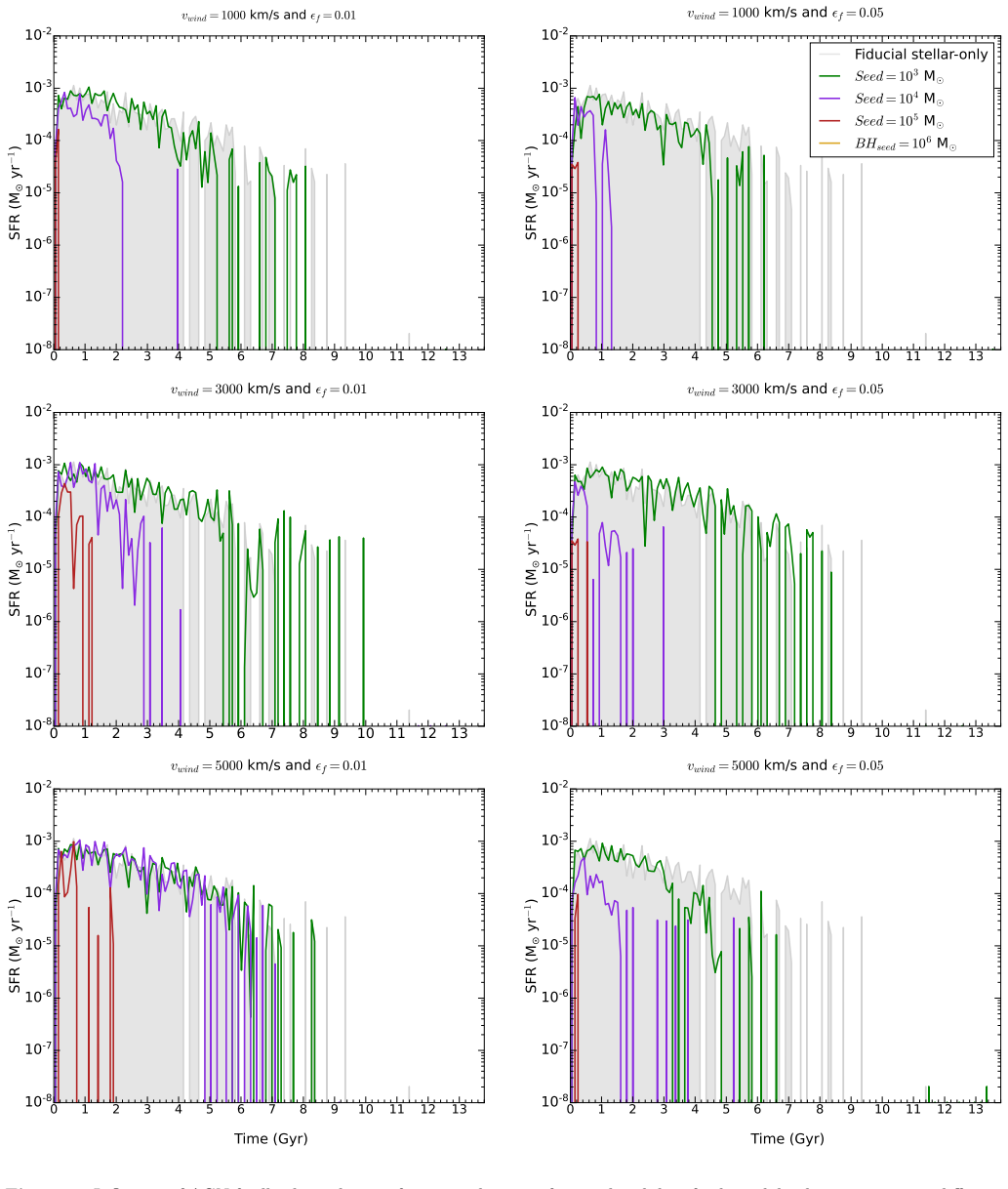
The central discovery is that IMBHs in an isolated dwarf spheroidal accrete so little gas that their final masses remain within the same order of magnitude as their seeds (MBH,final/MBH,seed < 2.4 across all tested models), while still exerting measurable feedback on the host galaxy. For a $10^{4}$ solar-mass seed with a 1% feedback efficiency, the final stellar mass drops by up to ~70% depending on wind velocity; at 5% efficiency the reduction is ~88-91%. Seeds of $10^{5}$ solar masses reduce stellar mass by 90-99%, and $10^{6}$ solar-mass seeds suppress star formation entirely. Conversely, $10^{3}$ solar-mass seeds with an intermediate wind velocity of 3000 km/s increase final stellar mass by ~8-11%, a case of positive AGN feedback attributed to shock compression of gas. The paper concludes that IMBHs probably need mergers or gas-rich interactions to grow, and that feedback efficiencies above 5% are likely too high for dwarf spheroidals like Leo II.
Load-bearing premise
The Bondi accretion rate is multiplied by a factor α = 100 to compensate for the unresolved Bondi radius, and the fiducial AGN feedback parameters are taken from simulations of more massive galaxies; if the true α or coupling efficiency is much smaller, the magnitude of AGN feedback on the host weakens substantially, though the limited black hole growth is robust.
Editorial extensions
If this is right
- If a 10^4 solar-mass IMBH exists in a Leo II-type dwarf, it could be observationally hidden while still having altered the galaxy's star formation history by tens of percent, so the absence of AGN signatures does not rule out a significant feedback role.
- The severe quenching caused by 10^5-10^6 solar-mass seeds implies that such massive IMBHs are unlikely to reside in dSphs that retain gas or show recent star formation.
- The near-zero growth of isolated seeds suggests that observed IMBHs in dwarf galaxies must have grown through mergers or interactions, making occupied dwarfs a probe of past accretion history.
- Feedback efficiencies calibrated on massive galaxies (εf ≥ 0.05) appear too aggressive for dSphs; lower efficiencies near 1% or below are more plausible in the low-mass regime.
- Wandering black holes reduce feedback impact relative to a centrally fixed BH, so the dynamical state of the IMBH must be considered when interpreting feedback effects in real dwarfs.
Reading between the lines
- If isolated dwarfs do not grow their IMBHs, then the current occupation fraction in such galaxies directly reflects the seeding mechanism, turning local dwarf spheroidals into a practical test bed for distinguishing seed formation scenarios.
- The positive feedback at vw = 3000 km/s suggests a non-monotonic relationship between AGN power and star formation; similar effects could appear in other low-mass galaxies if AGN-driven turbulence compresses gas rather than expelling it.
- The strong dependence on the accretion factor α (Table 3) implies that resolving the Bondi radius, or calibrating α with high-resolution simulations, is essential for making quantitative predictions about AGN feedback in dwarfs.
- The simulated ejection of some IMBHs from isolated dwarfs, if physically real, would produce free-floating black holes in the field, a prediction that could be tested with proper-motion surveys or gravitational-wave detections of IMBH mergers.
Editorial analysis
A structured set of objections, weighed in public.
Referee Report
Summary. The paper presents smoothed-particle hydrodynamic simulations of an isolated, Leo II-like dwarf spheroidal galaxy, extending the authors' earlier stellar-feedback-only model by adding AGN feedback from a central intermediate-mass black hole. It explores BH seeds from 10^3 to 10^6 M_sun and varies the Bondi boost factor, feedback efficiency, wind velocity, thermal versus kinetic feedback, BH repositioning, wind geometry, and radiative efficiency. The headline results are that the BH seeds grow very little (final-to-seed mass ratios remain below about 2.4), and that AGN feedback can suppress star formation substantially for 10^4-10^6 M_sun seeds, with some positive feedback for 10^3 M_sun seeds. The authors conclude that IMBHs in isolated dSphs grow inefficiently and that low-efficiency AGN feedback may still have non-negligible effects on the host galaxy.
Significance. If the quantitative feedback magnitudes were robust, the paper would provide a useful constraint on IMBH seeding mechanisms and on the calibration of subgrid AGN models in the low-mass galaxy regime. The paper's strengths include a broad parameter-space exploration, explicit reporting of simulation parameters in Table 2, and a dedicated resolution appendix. The robust part of the work is the limited BH growth, which is consistent across the explored parameter space. The less robust part is the magnitude of the AGN's effect on star formation, which depends strongly on the uncalibrated Bondi boost factor and on numerical resolution; the authors themselves acknowledge both uncertainties in Sections 2.2, 3.8, and the Appendix.
major comments (3)
- [Sec. 3.8, Table 3] The claimed 'tens of percent' star-formation suppression for 10^4 M_sun seeds is not robust to the uncalibrated Bondi boost factor alpha. For runs TK4A100E1V3R, TK4A10E1V3R, and TK4A1E1V3R, the final stellar mass changes are -51%, -1%, and -31%, respectively, and the ordering is non-monotonic in alpha (alpha=1 suppresses more than alpha=10). Because Section 2.2 states that alpha=100 is uncertain for dwarfs and Section 3.8 reports that the Bondi radius is unresolved by factors of 7 to 100, the quantitative AGN-impact claim is conditional on alpha; the paper should either justify alpha for this regime or reframe the suppression magnitudes as upper/lower limits.
- [Appendix, Table 4 and Figs. 19-20] The resolution test shows that doubling the number of gas particles changes the final stellar mass by +60% (reduced to +20% when the stellar mass loading factor is retuned), shifts the BH ejection time to earlier cosmic times, and the text explicitly states that 'strict numerical convergence was not attained.' This directly affects the quantitative SFH comparisons in Section 3.2.1 and the BH ejection claim in Section 3.5; the paper should either demonstrate convergence for the reported magnitudes or present the AGN feedback effect as tentative and resolution-dependent.
- [Sec. 3.2.1 and Fig. 6] All percentage changes in stellar mass are computed relative to a single fiducial stellar-only run from Hazenfratz et al. (2024), with no estimate of run-to-run stochasticity. Since the paper itself attributes one +1.3% case to stochastic fluctuations, the reader cannot distinguish physical sensitivity from numerical scatter in values ranging from -1% to -51%; reporting multiple stellar-only realizations or a stochasticity estimate would clarify which differences are meaningful.
minor comments (6)
- [Sec. 3.2.1] The text 'around 600 Gyr' should read 'around 600 Myr' to be consistent with the time axis of Fig. 5.
- [Secs. 3.2.1 and 3.3] The word 'discrete' is repeatedly used where 'discreet' is meant, for example when describing the reduction in star formation activity and the attenuation of outflows.
- [Sec. 4] There is a typo in the discussion: 'negative feedback thay variably suppresses' should read 'negative feedback that variably suppresses.'
- [Table 2] Rows 3 and 10 both carry the label TK3A100E1V5 with identical parameters; this duplicate entry should be removed or renamed to avoid confusion.
- [Caption of Fig. 5] The caption states 'BHseed = 10^6 M⊙' but the text notes the yellow curve does not appear because star formation is completely suppressed; the caption should explicitly say that this curve is absent for that reason.
- [Sec. 3.8] The sentence describing the Bondi radius resolution, 'the spatial resolution being greater by 7 times up to 2 orders of magnitude than this parameter over time,' is awkward and should be rephrased for clarity.
Circularity Check
No significant circularity: the central simulation results are not fitted to their own conclusions; self-citations provide context and baselines, not load-bearing derivation.
full rationale
The paper's claims are simulation outputs, not derived quantities that reduce to their inputs by construction. Black hole growth is integrated from the Bondi accretion rate (Eq. 1) with an explicitly uncertain boost alpha, and the resulting MBH,final/MBH,seed ratios are measured outcomes (Fig. 4), not fitted targets. The AGN feedback impact on star formation is likewise a simulated comparison against a fiducial stellar-only run; the magnitude depends on adopted subgrid parameters (epsilon_f, vw, alpha), and the paper openly reports this sensitivity and the non-monotonic behavior in Table 3, including that alpha=10 gives -1% while alpha=1 gives -31% for the 10^4 Msun seed. Such parameter dependence is a robustness concern, not circularity. The authors cite their own prior work (Hazenfratz et al. 2024) for initial conditions and the fiducial stellar-feedback baseline, and Barai et al. (2014) / Barai & de Gouveia Dal Pino (2019) for AGN parameter ranges, but these citations supply adopted model components, not the target conclusions; the AGN behavior is simulated rather than read off from those inputs. The appendix's admission that 'strict numerical convergence was not attained' is an acknowledged limitation affecting quantitative strength, not a circular step. No equation in the paper is equivalent to another by definition, and no fitted parameter is renamed as a prediction. Therefore the paper is self-contained for its qualitative central claims, and the appropriate circularity score is 0.
Assumptions & free parameters
free parameters (6)
- alpha (Bondi accretion boost factor) =
varied: 1, 10, 50, 100, 1000; fiducial 100
- epsilon_f (AGN feedback efficiency) =
0.01 and 0.05
- vw (AGN wind injection velocity) =
1000, 3000, 5000 km/s
- epsilon_r (radiative efficiency) =
0.1 and 0.42
- BH seed mass =
10^3 to 10^6 Msun
- Stellar feedback parameters (eta, vwind, chi_star) =
eta=60, vwind=96 km/s, chi_star=0.5
assumptions (5)
- domain assumption Bondi-Hoyle-Lyttleton accretion with an alpha boost approximates gas accretion onto unresolved black holes.
- domain assumption The subgrid star formation and stellar feedback model of Springel & Hernquist (2003) and Tornatore et al. (2007) is valid at the resolved scales of this simulation.
- domain assumption Leo II can be modeled as an isolated system with no reionization, no mergers, and no external tides over 13.7 Gyr.
- domain assumption Dynamical friction of the black hole is not explicitly modeled, but the adaptive gravitational softening indirectly captures some of its effects on scales larger than about 70 pc.
- standard math The gas is optically thin and in ionization equilibrium, with cooling tables from Wiersma et al. (2009) and a Haardt & Madau (2001) UV background.
Cite this review
Pith. "Pith review of Exploring the evolution of a dwarf spheroidal galaxy with SPH simulations: II. AGN feedback." pith.science (2026). https://pith.science/paper/GRFTJFRN
@misc{pith2026250103985,
  author       = {Pith},
  title        = {Pith review of: Exploring the evolution of a dwarf spheroidal galaxy with SPH simulations: II. AGN feedback},
  year         = {2026},
  howpublished = {\url{https://pith.science/paper/GRFTJFRN}},
  note         = {Machine review of arXiv:2501.03985}
}
abstract
We investigate AGN feedback from an intermediate-mass black hole at the center of a dwarf spheroidal galaxy, by performing isolated galaxy simulations using a modified version of the GADGET-3 code. We consider Leo II (PGC 34176) in the Local Group as our simulation reference model. Beginning with black hole seeds ranging from $10^3$ to $10^6$ M$_{\odot}$, our simulations focus on comparing stellar-only feedback with AGN+stellar/SN feedback over 13.7 Gyr of galactic evolution. Our results indicate that a low-mass AGN in a dwarf galaxy influences the star formation history under specific physical conditions. While AGN feedback is generally negative on star formation, instances of positive feedback were also identified. Despite measurable effects on the evolution of the dwarf host galaxy, black hole seeds exhibited only marginal growth. We tested several physical scenarios as modified models in our simulations, primarily concerning the dynamics of the central black holes, which may wander within dwarf galaxies rather than being centrally located. However, none of these adjustments significantly impacted the growth of the black hole seeds. This suggests that intermediate-mass black holes may struggle to achieve higher masses in isolated environments, with mergers and interactions likely playing crucial roles in their growth. Nevertheless, AGN feedback exhibited non-negligible effects in our simulated dwarf spheroidal galaxies, despite the assumed dominant role of stellar feedback in the low-mass regime.
Figures


Figures from the paper (17 more)



Reference graph
Works this paper leans on
-
[1]
2020, Astronomy & Astrophysics, 641, A6
Aghanim, N., Akrami, Y., Ashdown, M., et al. 2020, Astronomy & Astrophysics, 641, A6
2020
-
[2]
F., Reines, A
Baldassare, V. F., Reines, A. E., Gallo, E., & Greene, J. E. 2017, The Astrophysical Journal, 850, 196
2017
-
[3]
Barai, P., & de Gouveia Dal Pino, E. M. 2019, Monthly Notices of the Royal Astronomical Society, 487, 5549
2019
-
[4]
2018, Monthly Notices of the Royal Astronomical Society, 473, 4003
Barai, P., Gallerani, S., Pallottini, A., et al. 2018, Monthly Notices of the Royal Astronomical Society, 473, 4003
2018
-
[5]
2014, Monthly Notices of the Royal Astronomical Society, 437, 1456
Barai, P., Viel, M., Murante, G., Gaspari, M., & Borgani, S. 2014, Monthly Notices of the Royal Astronomical Society, 437, 1456
2014
-
[6]
2023, Monthly Notices of the Royal Astronomical Society, 523, 5610
Beckmann, R., Dubois, Y., Volonteri, M., et al. 2023, Monthly Notices of the Royal Astronomical Society, 523, 5610
2023
-
[7]
M., Cleary, C
Bellovary, J. M., Cleary, C. E., Munshi, F., et al. 2019, Monthly Notices of the Royal Astronomical Society, 482, 2913
2019
-
[8]
M., Hayoune, S., Chafla, K., et al
Bellovary, J. M., Hayoune, S., Chafla, K., et al. 2021, Monthly Notices of the Royal Astronomical Society, 505, 5129
2021
Show all 92 references
-
[9]
2011, Galactic dynamics, Vol
Binney, J., & Tremaine, S. 2011, Galactic dynamics, Vol. 13 (Princeton university press)
2011
-
[10]
1952, Monthly Notices of the Royal Astronomical Society, 112, 195
Bondi, H. 1952, Monthly Notices of the Royal Astronomical Society, 112, 195
1952
-
[11]
1944, Monthly Notices of the Royal Astronomical Society, 104, 273
Bondi, H., & Hoyle, F. 1944, Monthly Notices of the Royal Astronomical Society, 104, 273
1944
-
[12]
2009, Monthly Notices of the Royal Astronomical Society, 398, 53
Booth, C., & Schaye, J. 2009, Monthly Notices of the Royal Astronomical Society, 398, 53
2009
-
[13]
D., Geha, M
Bradford, J. D., Geha, M. C., Greene, J. E., Reines, A. E., & Dickey, C. M. 2018, The Astrophysical Journal, 861, 50
2018
-
[14]
2013, Monthly Notices of the Royal Astronomical Society, 429, 3316
Bryan, S., Kay, S., Duffy, A., et al. 2013, Monthly Notices of the Royal Astronomical Society, 429, 3316
2013
-
[15]
1985, Astrophysical Journal, Part 1 (ISSN 0004-637X), vol
Casertano, S., & Hut, P. 1985, Astrophysical Journal, Part 1 (ISSN 0004-637X), vol. 298, Nov. 1, 1985, p. 80-94., 298, 80
1985
-
[16]
2003, Publications of the Astronomical Society of the Pacific, 115, 763
Chabrier, G. 2003, Publications of the Astronomical Society of the Pacific, 115, 763
2003
-
[17]
2020, Introduction to Galaxy Formation and Evolution (Cambridge, Cambridge Univ
Cimatti, A., Fraternali, F., & Nipoti, C. 2020, Introduction to Galaxy Formation and Evolution (Cambridge, Cambridge Univ. Press
2020
-
[18]
2007, The Astronomical Journal, 134, 1938
Koch, A. 2007, The Astronomical Journal, 134, 1938
2007
-
[19]
2023, arXiv preprint arXiv:2311.08451
Connor, T., Ba˜ nados, E., Cappelluti, N., & Foord, A. 2023, arXiv preprint arXiv:2311.08451
2023 arXiv
-
[20]
A., Wyithe, J
Correa, C. A., Wyithe, J. S. B., Schaye, J., & Duffy, A. R. 2015, Monthly Notices of the Royal Astronomical Society, 452, 1217
2015
-
[21]
2018, Monthly Notices of the Royal Astronomical Society, 473, 5698
Hartwig, T. 2018, Monthly Notices of the Royal Astronomical Society, 473, 5698
2018
-
[22]
1986, Astrophysical Journal, Part 1 (ISSN 0004-637X), vol
Dekel, A., & Silk, J. 1986, Astrophysical Journal, Part 1 (ISSN 0004-637X), vol. 303, April 1, 1986, p. 39-55., 303, 39 Di Matteo, T., Springel, V., & Hernquist, L. 2005, nature, 433, 604
1986
-
[23]
M., Geha, M., Wetzel, A., & El-Badry, K
Dickey, C. M., Geha, M., Wetzel, A., & El-Badry, K. 2019, The Astrophysical Journal, 884, 180
2019
-
[24]
2015, Monthly Notices of the Royal Astronomical Society, 452, 1502 Ferr´ e-Mateu, A., Durr´ e, M., Forbes, D
Dubois, Y., Volonteri, M., Silk, J., et al. 2015, Monthly Notices of the Royal Astronomical Society, 452, 1502 Ferr´ e-Mateu, A., Durr´ e, M., Forbes, D. A., et al. 2021, Monthly Notices of the Royal Astronomical Society, 503, 5455
2015
-
[25]
2000, The Astrophysical Journal, 539, L13
Gebhardt, K., Bender, R., Bower, G., et al. 2000, The Astrophysical Journal, 539, L13
2000
-
[26]
2010, nature, 463, 203
Governato, F., Brook, C., Mayer, L., et al. 2010, nature, 463, 203
2010
-
[27]
Grcevich, J., & Putman, M. E. 2009, The Astrophysical Journal, 696, 385
2009
-
[28]
Greene, J. E. 2012, Nature Communications, 3, 1304
2012
-
[29]
E., Strader, J., & Ho, L
Greene, J. E., Strader, J., & Ho, L. C. 2020, Annual Review of Astronomy and Astrophysics, 58, 257
2020
-
[30]
A., Pakmor, R., Naab, T., & Springel, V
Gutcke, T. A., Pakmor, R., Naab, T., & Springel, V. 2021, Monthly Notices of the Royal Astronomical Society, 501, 5597
2021
-
[31]
2001, arXiv preprint astro-ph/0106018
Haardt, F., & Madau, P. 2001, arXiv preprint astro-ph/0106018
2001 arXiv
-
[32]
2017, Monthly Notices of the Royal Astronomical Society, 468, 3935
Habouzit, M., Volonteri, M., & Dubois, Y. 2017, Monthly Notices of the Royal Astronomical Society, 468, 3935
2017
-
[33]
2022, Monthly Notices of the Royal Astronomical Society, 514, 4912
Haidar, H., Habouzit, M., Volonteri, M., et al. 2022, Monthly Notices of the Royal Astronomical Society, 514, 4912
2022
-
[34]
1950, Publications of the Astronomical Society of the Pacific, 62, 118
Harrington, R., & Wilson, A. 1950, Publications of the Astronomical Society of the Pacific, 62, 118
1950
-
[35]
A., & Caproni, A
Hazenfratz, R., Barai, P., Lanfranchi, G. A., & Caproni, A. 2024, The Astrophysical Journal
2024
-
[36]
F., Kereˇ s, D., O˜ norbe, J., et al
Hopkins, P. F., Kereˇ s, D., O˜ norbe, J., et al. 2014, Monthly Notices of the Royal Astronomical Society, 445, 581
2014
-
[37]
Hoyle, F., & Lyttleton, R. A. 1939, Mathematical Proceedings of the Cambridge Philosophical Society, 35, 405
1939
-
[38]
2011, Monthly Notices of the Royal Astronomical Society, 417, 2846
Iannuzzi, F., & Dolag, K. 2011, Monthly Notices of the Royal Astronomical Society, 417, 2846
2011
-
[39]
Inayoshi, K., Haiman, Z., & Ostriker, J. P. 2016, Monthly Notices of the Royal Astronomical Society, 459, 3738
2016
-
[40]
2020, Annual Review of Astronomy and Astrophysics, 58, 27
Inayoshi, K., Visbal, E., & Haiman, Z. 2020, Annual Review of Astronomy and Astrophysics, 58, 27
2020
-
[41]
R., & Gebhardt, K
Jardel, J. R., & Gebhardt, K. 2012, The Astrophysical Journal, 746, 89 Kennicutt Jr, R. C. 1998a, Annual Review of Astronomy and Astrophysics, 36, 189 —. 1998b, The astrophysical journal, 498, 541
2012
-
[42]
2021, The Astrophysical Journal, 911, 134
Geha, M. 2021, The Astrophysical Journal, 911, 134
2021
-
[43]
A., & Smith, M
Koudmani, S., Sijacki, D., Bourne, M. A., & Smith, M. C. 2019, Monthly Notices of the Royal Astronomical Society, 484, 2047
2019
-
[44]
Koudmani, S., Sijacki, D., & Smith, M. C. 2022, Monthly Notices of the Royal Astronomical Society, 516, 2112
2022
-
[45]
N., Pustilnik, S., & Kamphuis, P
Kurapati, S., Chengalur, J. N., Pustilnik, S., & Kamphuis, P. 2018, Monthly Notices of the Royal Astronomical Society, 479, 228
2018
-
[46]
A., Hazenfratz, R., Caproni, A., & Silk, J
Lanfranchi, G. A., Hazenfratz, R., Caproni, A., & Silk, J. 2021, The Astrophysical Journal, 914, 32
2021
-
[47]
Larson, R. B. 1974, Monthly Notices of the Royal Astronomical Society, 169, 229
1974
-
[48]
2021, arXiv preprint arXiv:2104.03974
Li, H., Hammer, F., Babusiaux, C., et al. 2021, arXiv preprint arXiv:2104.03974
2021 arXiv
-
[49]
2024, The Astrophysical Journal, 965, 152
Liu, W., Veilleux, S., Canalizo, G., et al. 2024, The Astrophysical Journal, 965, 152
2024
-
[50]
2009, The Astrophysical Journal, 699, L113
Lora, V., S´ anchez-Salcedo, F., Raga, A., & Esquivel, A. 2009, The Astrophysical Journal, 699, L113
2009
-
[51]
J., Fender, R
Maccarone, T. J., Fender, R. P., & Tzioumis, A. K. 2005, Monthly Notices of the Royal Astronomical Society: Letters, 356, L17
2005
-
[52]
1998, The Astronomical Journal, 115, 2285
Magorrian, J., Tremaine, S., Richstone, D., et al. 1998, The Astronomical Journal, 115, 2285
1998
-
[53]
2015, Monthly Notices of the Royal Astronomical Society, 451, 2735
Manni, L., Nucita, A., De Paolis, F., Testa, V., & Ingrosso, G. 2015, Monthly Notices of the Royal Astronomical Society, 451, 2735
2015
-
[54]
M., Canalizo, G., & Sales, L
Manzano-King, C. M., Canalizo, G., & Sales, L. V. 2019, The Astrophysical Journal, 884, 54
2019
-
[55]
1998, Annual Review of Astronomy and Astrophysics, 36, 435, doi: 10.1146/annurev.astro.36.1.435
Mateo, M. 1998, Annual Review of Astronomy and Astrophysics, 36, 435, doi: 10.1146/annurev.astro.36.1.435
1998 doi
-
[56]
W., & Walker, M
Mateo, M., Olszewski, E. W., & Walker, M. G. 2008, The Astrophysical Journal, 675, 201
2008
-
[57]
McConnachie, A. W. 2012, The Astronomical Journal, 144, 4
2012
-
[58]
C., & Gammie, C
McKinney, J. C., & Gammie, C. F. 2004, The astrophysical journal, 611, 977
2004
-
[59]
2017, International Journal of Modern Physics D, 26, 1730021
Mezcua, M. 2017, International Journal of Modern Physics D, 26, 1730021
2017
-
[60]
Mezcua, M., & S´ anchez, H. D. 2020, The Astrophysical Journal Letters, 898, L30 Mu˜ noz, R. R., Cˆ ot´ e, P., Santana, F. A., et al. 2018, The Astrophysical Journal, 860, 66
2020
-
[61]
Murray, N., Quataert, E., & Thompson, T. A. 2005, The Astrophysical Journal, 618, 569 —. 2009, The Astrophysical Journal, 709, 191
2005
-
[62]
1995, The Astrophysical Journal, 452, 710
Narayan, R., & Yi, I. 1995, The Astrophysical Journal, 452, 710
1995
-
[63]
2013, Astronomy & Astrophysics, 550, A18
Ingrosso, G. 2013, Astronomy & Astrophysics, 550, A18
2013
-
[64]
A., Nguyen, D
Nyland, K., Davis, T. A., Nguyen, D. D., et al. 2017, The Astrophysical Journal, 845, 50
2017
-
[65]
1972, Astrophysical Journal, Vol
Peebles, P. 1972, Astrophysical Journal, Vol. 178, pp. 371-376 (1972), 178, 371
1972
-
[66]
2018, Monthly Notices of the Royal Astronomical Society, 475, 648
Pillepich, A., Nelson, D., Hernquist, L., et al. 2018, Monthly Notices of the Royal Astronomical Society, 475, 648
2018
-
[67]
E., & Comastri, A
Reines, A. E., & Comastri, A. 2016, Publications of the Astronomical Society of Australia, 33, e054
2016
-
[68]
E., Condon, J
Reines, A. E., Condon, J. J., Darling, J., & Greene, J. E. 2020, The Astrophysical Journal, 888, 36
2020
-
[69]
2021, The Astrophysical Journal Letters, 916, L18
Ricarte, A., Tremmel, M., Natarajan, P., & Quinn, T. 2021, The Astrophysical Journal Letters, 916, L18
2021
-
[70]
J., Johnson, M
Sargent, A. J., Johnson, M. C., Reines, A. E., et al. 2022, The Astrophysical Journal, 933, 160
2022
-
[71]
Schnittman, J. D. 2006, arXiv preprint astro-ph/0601406
2006 arXiv
-
[72]
Schutte, Z., & Reines, A. E. 2022, Nature, 601, 329
2022
-
[73]
I., & Sunyaev, R
Shakura, N. I., & Sunyaev, R. A. 1973, Astronomy and Astrophysics, 24, 337
1973
-
[74]
S., Brooks, A
Sharma, R. S., Brooks, A. M., Somerville, R. S., et al. 2020, The Astrophysical Journal, 897, 103
2020
-
[75]
S., Brooks, A
Sharma, R. S., Brooks, A. M., Tremmel, M., et al. 2022, The Astrophysical Journal, 936, 82
2022
-
[76]
Shi, Y., Kremer, K., & Hopkins, P. F. 2024, arXiv preprint arXiv:2405.17338
2024 arXiv
-
[77]
2019, The Astrophysical Journal, 881, 147
Shin, J., Woo, J.-H., Chung, A., et al. 2019, The Astrophysical Journal, 881, 147
2019
-
[78]
2017, The Astrophysical Journal Letters, 839, L13
Silk, J. 2017, The Astrophysical Journal Letters, 839, L13
2017
-
[79]
Silk, J., & Rees, M. J. 1998, arXiv preprint astro-ph/9801013
1998 arXiv
-
[80]
Smith, M. C. 2021, Monthly Notices of the Royal Astronomical Society, 502, 5417
2021
-
[81]
Somerville, R. S. 2002, The Astrophysical Journal, 572, L23
2002
-
[82]
E., Mateo, M., Walker, M
Spencer, M. E., Mateo, M., Walker, M. G., & Olszewski, E. W. 2017, The Astrophysical Journal, 836, 202
2017
-
[83]
2005, Monthly Notices of the Royal Astronomical Society, 361, 776
Springel, V., Di Matteo, T., & Hernquist, L. 2005, Monthly Notices of the Royal Astronomical Society, 361, 776
2005
-
[84]
2003, Monthly Notices of the Royal Astronomical Society, 339, 289
Springel, V., & Hernquist, L. 2003, Monthly Notices of the Royal Astronomical Society, 339, 289
2003
-
[85]
E., Bullock, J
Strigari, L. E., Bullock, J. S., Kaplinghat, M., et al. 2007, The Astrophysical Journal, 669, 676
2007
-
[86]
Tchekhovskoy, A., Narayan, R., & McKinney, J. C. 2011, Monthly Notices of the Royal Astronomical Society: Letters, 418, L79
2011
-
[87]
2007, Monthly Notices of the Royal Astronomical Society, 382, 945
Tornatore, L., Ferrara, A., & Schneider, R. 2007, Monthly Notices of the Royal Astronomical Society, 382, 945
2007
-
[88]
2010, The Astronomy and Astrophysics Review, 18, 279 Von Hoerner, S
Volonteri, M. 2010, The Astronomy and Astrophysics Review, 18, 279 Von Hoerner, S. 1963, Z. Astrophys. 57, 47-82, 57
2010
-
[89]
G., Mateo, M., Olszewski, E
Walker, M. G., Mateo, M., Olszewski, E. W., et al. 2007, The Astrophysical Journal, 667, L53
2007
-
[90]
D., & Frenk, C
White, S. D., & Frenk, C. S. 1991, Astrophysical Journal, Part 1 (ISSN 0004-637X), vol. 379, Sept. 20, 1991, p. 52-79. Research supported by NASA, NSF, and SERC., 379, 52
1991
-
[91]
P., Schaye, J., & Smith, B
Wiersma, R. P., Schaye, J., & Smith, B. D. 2009, Monthly Notices of the Royal Astronomical Society, 393, 99
2009
-
[92]
2023, Monthly Notices of the Royal Astronomical Society, 520, 5964
Yang, J., Paragi, Z., Frey, S., et al. 2023, Monthly Notices of the Royal Astronomical Society, 520, 5964
2023
Reviewed August 10, 2026 · model on record in the stance chip above.
Discussion (0). Continue with ORCID to comment.