REVIEW 4 major objections 6 minor 2 cited by
A Survey on Federated Learning in Human Sensing
T0 review · 4 major / 6 minor · reviewed 2026-08-10 · deepseek-v4-flash
Pith's one-line read A systematic review of 211 federated-learning studies in human sensing finds that most papers ignore the field's hardest real-world problems, and only a minority demonstrate the reliability needed for practical deployment.
desk verdict A useful, transparent survey of FL in human sensing whose quantitative gap analysis needs a coding reliability check before the specific rankings are cited. read the letter →
The pith
A machine-rendered reading of the paper's core claim, the machinery that carries it, and where it could break.
The reading
What carries the argument
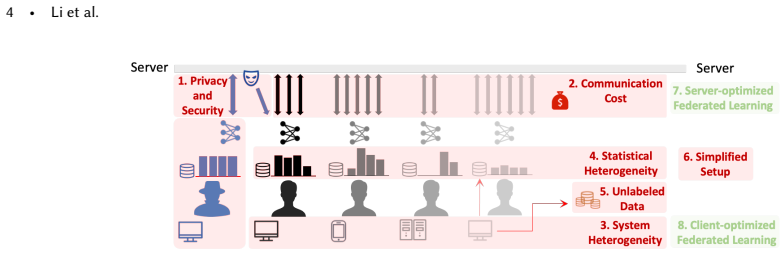
The carrying object is the eight-dimensional assessment: each surveyed paper is coded with a binary checkmark for whether it addresses privacy and security, communication cost, system heterogeneity, statistical heterogeneity, unlabeled data usage, simplified setup, server-optimized FL, or client-optimized FL. The dimension definitions operationalize each challenge (e.g., privacy counts only if the paper adds defenses such as differential privacy or secure aggregation or runs a vulnerability analysis; system heterogeneity counts only if training or deployment involves heterogeneous devices). Layered on top of a taxonomy of six application domains and nine raw-data types, this coding lets the survey turn a heterogeneous literature into comparable percentages and a ranking of research gaps.
What would settle it
Re-code the same 211 papers with an independent coder (or with the authors plus a second coder) using a written coding manual; if the per-dimension consideration rates differ materially for privacy/security or system heterogeneity, the survey's ranking of research gaps is not reproducible. Alternatively, compile all FL-human-sensing papers published before November 2023 that the search missed and check whether they predominantly address system heterogeneity.
Extended reading notes
Core claim
The paper's central claim is that, assessed across eight dimensions, current federated-learning research in human sensing is lopsided: statistical heterogeneity and server-optimized federated learning are the characteristics analyzed most frequently, whereas privacy and security, communication cost, system heterogeneity, and unlabeled-data usage receive far less attention. Across the six application domains—audio and speech processing, well-being, user identification, human mobility and localization, activity recognition, and interface development—activity recognition and well-being dominate the corpus. The survey concludes that only a minority of the reviewed studies achieve the reliability necessary for deployment in practical settings, and it identifies five aspects needing urgent research: privacy and security under active attacks, unlimited participation across heterogeneous devices, exploiting unlabeled data in the wild, clarifying whether the primary target is the server or the clients, and moving beyond simplified experimental setups.
Load-bearing premise
The percentages and gap rankings rest on the assumption that the search and exclusion criteria produced a representative corpus of FL-in-human-sensing papers and that the binary checkmarks in the eight-dimensional assessment were applied consistently, and the paper does not report an inter-rater reliability check or a detailed coding manual.
Editorial extensions
If this is right
- Practitioners selecting an FL approach for a human-sensing product should expect that most published baselines have not hardened privacy against inference or poisoning attacks, so production systems need additional defenses.
- “Unlimited participation” is the paper's label for a concrete open problem: most studies assume homogeneous, well-provisioned clients, so stragglers and low-end devices are implicitly excluded; the survey argues this must change for worldwide deployment.
- Because the corpus is weighted toward activity recognition and well-being, the five urgent research directions apply with different force per domain; interface development, with the fewest studies, is the least explored.
- The simplified-setup dimension is treated as an undesired feature, and its prevalence implies reported accuracies may overstate real-world performance.
- Researchers should treat the paper's priority list as a portfolio recommendation: privacy under attacks, system heterogeneity, unlabeled data, and server/client target clarity.
Reading between the lines
- The survey's own evidence suggests its five priority directions could be re-derived as a coverage gap: the three dimensions with the lowest checkmark rates (system heterogeneity, privacy defenses, unlabeled-data usage) map almost one-to-one onto the first three urgent research aspects; one testable extension is to recompute the dimension-by-dimension percentages after a re-coding with a formal cod
- A second extension: a prospective author could use the eight dimensions as a submission checklist, turning the survey into a de facto evaluation rubric for new FL-human-sensing papers.
- If the claim that only a minority are deployment-ready is taken literally, a natural next study is to define an explicit deployment-readiness threshold (e.g., a minimum number of satisfied dimensions plus a real-device evaluation) and measure what fraction of the 211 papers pass; the survey does not itself formalize that threshold.
Signed reviews
Editorial analysis
A structured set of objections, weighed in public.
Referee Report
Summary. The paper presents a systematic survey of federated learning (FL) in human sensing, following the PRISMA methodology. It constructs a corpus of 211 papers from three digital libraries and thirteen selected conferences, organizes them into a taxonomy of six application domains (audio/speech processing, well-being, user identification, human mobility and localization, activity recognition, and interface development), and evaluates each study against eight dimensions: privacy and security, communication cost, system heterogeneity, statistical heterogeneity, unlabeled data usage, simplified setup, server-optimized FL, and client-optimized FL. Based on the aggregated eight-dimensional assessment, the paper claims that Statistical Heterogeneity and Server-optimized FL are the most frequently analyzed characteristics, that system heterogeneity and privacy are under-addressed, and it proposes five research areas requiring urgent attention.
Significance. If the corpus and the eight-dimensional codings are reliable, this survey is a valuable contribution: it is the first PRISMA-based systematic mapping of FL in human sensing, provides a reusable taxonomy and per-domain tables (Tables 2–9) that are a useful reference resource, and makes concrete, falsifiable claims about research gaps. The search strategy and exclusion rules are described transparently, which is a notable strength for a survey. However, the central quantitative claims about which FL characteristics are most or least analyzed rest entirely on binary checkmarks that are not validated, and the paper provides no inter-rater reliability, no coding manual, and no sensitivity analysis. The ranking of research gaps and the related recommendations are therefore not yet supported by the evidence presented.
major comments (4)
- [Section 2 (dimensions 4 and 7); Tables 2–9; Figure 5] The binary checkmarks for Statistical Heterogeneity and Server-optimized FL are assigned using definitions that do not reliably distinguish explicit consideration from incidental features of the setup. For Statistical Heterogeneity, the text states both that a system 'addresses' the challenge if it 'applies strategies to ensure robustness against non-IID-related attacks' and that the authors 'expect systems using datasets that are inherently heterogeneous to explicitly analyze the impact of such heterogeneity on FL performance.' These criteria can yield different codings for the same paper. For Server-optimized FL, the definition is that 'the server employs methods to enhance model convergence speed and overall performance,' which is satisfied by virtually any FL deployment, including vanilla FedAvg. Without an explicit coding rule (for example, requiring a server-side algorithm beyond default aggregation or an ablation demonstrating the server-side contribution), the checkmarks are easily over-assigned. Since the paper's headline conclusion that these two dimensions are the 'most analyzed' is computed from these checkmarks, the conclusion is not yet supported. I recommend adding a detailed coding manual, reporting inter-rater reliability on a random subset (e.g., Cohen's kappa), and conducting a sensitivity analysis in which the ambiguous dimensions are re-coded under stricter criteria to demonstrate that the ranking in Figure 5 is robust.
- [Section 10, Figure 5] The treatment of N/A entries in the percentage computations is unspecified. The tables contain N/A in many rows (e.g., Table 2, row [293]; Table 3, row [67]; Table 5, row [223]), and the histograms in Figure 5 show three categories: Consideration, Not Applicable, and No Consideration. The paper does not state whether the denominator for each dimension excludes N/A entries or treats them as 'No Consideration.' If N/A entries are excluded, the percentages for different dimensions are not directly comparable because the denominators differ; if they are included as 'No Consideration,' the percentage is distorted. Please specify the exact formula used and justify the treatment; this is essential for interpreting the central claim about which dimensions are most frequently analyzed.
- [Section 3.3, Exclusion for Irrelevance] The exclusion criteria for irrelevance are described only in prose, with no operational definitions or reliability check. The categories 'non-application papers' and 'application papers in other fields' require subjective judgments, particularly the boundary between human sensing and adjacent areas such as IoT and medical research. The manuscript does not report how many papers were excluded under each criterion, nor whether screening was performed independently by multiple reviewers. Because the final corpus of 211 papers is the evidence base for all meta-conclusions, the reproducibility of the screening should be documented—for example, with a PRISMA flow diagram that includes exact counts per exclusion reason and a dual-screening protocol with disagreement resolution, or at least a sensitivity analysis with alternative inclusion rules.
- [Section 11, Conclusion] The statement that 'only a minority achieve the reliability necessary for deployment in practical settings' is not derived from the eight-dimensional assessment in a transparent way. No composite metric or threshold is defined that maps the binary checkmarks onto a reliability judgment, and the paper does not say how the eight dimensions are combined (e.g., whether all eight must be satisfied, or a subset). Please specify how the dimensions are combined to determine deployment readiness, or soften the conclusion to match what the presented data can support.
minor comments (6)
- [Section 3.1, reference list] Reference [38], cited for the ACM Computing Classification System, is listed as 'Generate Code. 1998'; this appears to be an artifact, and it should be corrected to the proper ACM CCS citation.
- [Table 3, row for [36]] The application label 'S,FER' is unclear; it should be written as 'SER/FER' or 'Multi' to match the study's use of both speech and facial inputs.
- [Section 3.1, Figure 3] The PRISMA flow diagram is referenced but the actual numbers at each stage (identification, screening, exclusion, inclusion) are not visible in the manuscript text; the final version should include the full flow diagram with counts per exclusion reason to support the reproducibility claim.
- [Section 10.2] The statement that 'system heterogeneity is the least addressed attribute in the corpus' is presented without an explicit comparison to other under-addressed dimensions such as privacy and unlabeled data usage; please clarify whether this refers to the overall corpus and show the underlying percentages from Figure 5.
- [Section 2, dimension 4] The discussion of statistical heterogeneity would benefit from distinguishing data skewness in features, labels, and temporal distributions, since the coding rule currently conflates these forms of non-IID data.
- [Throughout] There are several minor typographical errors, including 'collaoborative' in Section 7.2 and 'ZHuang' in reference [312]; these should be corrected in a final pass.
Circularity Check
No circular derivation: the survey's corpus-level findings are external judgments over 211 papers, not reductions of its own definitions.
full rationale
This paper is a systematic literature survey, not a derivation with fitted parameters or predicted quantities. Its central claims—the corpus composition, the eight-dimensional assessment of each surveyed study, and the resulting rankings of how often each FL characteristic is addressed—are external judgments about other papers. The eight dimensions are stipulative definitions introduced by the authors, and applying them to each surveyed paper is an empirical coding task; the conclusions do not reduce to the definitions themselves. For example, the claim that Statistical Heterogeneity and Server-optimized FL are the most frequently analyzed characteristics is computed from binary checkmarks in Tables 2–9, which are judgments about external papers rather than consequences of the paper's own assumptions. Similarly, the claim that only a minority of studies achieve reliability for deployment is an aggregate of those external codings. The survey does contain self-citations (e.g., references [60], [70], [71], [81], [120], and [219] include the authors), but these are simply included among the 211 surveyed papers and are not load-bearing: no central conclusion is justified solely by the authors' own prior results, and there is no imported uniqueness theorem or ansatz. Concerns about inter-rater reliability, coding consistency, or subjective exclusion criteria are validity risks rather than circularity: an unreliable measurement is not the same as a conclusion that is true by construction. No equation, fitted parameter, or cited result is shown to be equivalent to the paper's own inputs, so no circular step can be exhibited.
Assumptions & free parameters
assumptions (2)
- domain assumption The three digital libraries plus the selected conferences cover the relevant literature on federated learning in human sensing.
- domain assumption The binary eight-dimensional assessment is a valid way to measure whether a paper addresses a challenge.
Cite this review
Pith. "Pith review of A Survey on Federated Learning in Human Sensing." pith.science (2026). https://pith.science/paper/ZCTZXJBO
@misc{pith2026250104000,
  author       = {Pith},
  title        = {Pith review of: A Survey on Federated Learning in Human Sensing},
  year         = {2026},
  howpublished = {\url{https://pith.science/paper/ZCTZXJBO}},
  note         = {Machine review of arXiv:2501.04000}
}
read the original abstract
Human Sensing, a field that leverages technology to monitor human activities, psycho-physiological states, and interactions with the environment, enhances our understanding of human behavior and drives the development of advanced services that improve overall quality of life. However, its reliance on detailed and often privacy-sensitive data as the basis for its machine learning (ML) models raises significant legal and ethical concerns. The recently proposed ML approach of Federated Learning (FL) promises to alleviate many of these concerns, as it is able to create accurate ML models without sending raw user data to a central server. While FL has demonstrated its usefulness across a variety of areas, such as text prediction and cyber security, its benefits in Human Sensing are under-explored, given the particular challenges in this domain. This survey conducts a comprehensive analysis of the current state-of-the-art studies on FL in Human Sensing, and proposes a taxonomy and an eight-dimensional assessment for FL approaches. Through the eight-dimensional assessment, we then evaluate whether the surveyed studies consider a specific FL-in-Human-Sensing challenge or not. Finally, based on the overall analysis, we discuss open challenges and highlight five research aspects related to FL in Human Sensing that require urgent research attention. Our work provides a comprehensive corpus of FL studies and aims to assist FL practitioners in developing and evaluating solutions that effectively address the real-world complexities of Human Sensing.
Figures


Figures from the paper (2 more)


Forward citations
Cited by 2 Pith papers
-
Label Leakage in Federated Inertial-based Human Activity Recognition
Gradient-based label leakage attacks recover activity class labels from federated HAR updates with high accuracy, especially under sequential sampling, and standard local privacy defenses provide only partial protection.
-
FedAli: Personalized Federated Learning Alignment with Prototype Layers for Generalized Mobile Services
FedAli adds label-free local and global prototype layers, matched by optimal transport, to personalized federated learning, improving cross-client generalization most clearly on the HHAR activity recognition benchmark.
Reference graph
Works this paper leans on
-
[293]
Chong Zhang, Xiao Liu, Jia Xu, Tianxiang Chen, Gang Li, Frank Jiang, and Xuejun Li. 2021. An Edge based Federated Learning Framework for Person Re-identification in UAV Delivery Service. In2021 IEEE International Conference on Web Services (ICWS) . 500–505. https://doi.org/10.1109/ICWS53863.2021.00070
arXiv 2021
-
[67]
Tiantian Feng, Hanieh Hashemi, Rajat Hebbar, Murali Annavaram, and Shrikanth S Narayanan. 2021. Attribute inference attack of speech emotion recognition in federated learning settings. arXiv preprint arXiv:2112.13416 (2021)
arXiv 2021
-
[223]
Rui Shao, Pramuditha Perera, Pong C. Yuen, and Vishal M. Patel. 2022. Federated Generalized Face Presentation Attack Detection. IEEE Transactions on Neural Networks and Learning Systems (2022), 1–14. https://doi.org/10.1109/TNNLS.2022.3172316
arXiv 2022
-
[1]
Sawsan Abdulrahman, Hanine Tout, Hakima Ould-Slimane, Azzam Mourad, Chamseddine Talhi, and Mohsen Guizani. 2021. A Survey on Federated Learning: The Journey From Centralized to Distributed On-Site Learning and Beyond. IEEE Internet of Things Journal 8, 7 (2021), 5476–5497. https://doi.org/10.1109/JIOT.2020.3030072
arXiv 2021
-
[3]
Manan Agrawal, Mohd Ayaan Anwar, and Rajni Jindal. 2023. FedCER - Emotion Recognition Using 2D-CNN in Decentralized Federated Learning Environment. In 2023 6th International Conference on Information Systems and Computer Networks (ISCON) . 1–5. https://doi.org/10.1109/ISCON57294.2023.10112028
arXiv 2023
-
[4]
Usman Ahmed, Jerry Chun-Wei Lin, and Gautam Srivastava. 2023. Hyper-Graph Attention Based Federated Learning Methods for Use in Mental Health Detection. IEEE Journal of Biomedical and Health Informatics 27, 2 (2023), 768–777. https://doi.org/10.1109/JBHI.2022. 3172269
-
[5]
Ahmed A Al-Saedi and Veselka Boeva. 2023. Group-personalized federated learning for human activity recognition through cluster eccentricity analysis. In International Conference on Engineering Applications of Neural Networks . Springer, 505–519
2023
-
[6]
Zareen Alamgir, Farwa K Khan, and Saira Karim. 2022. Federated recommenders: methods, challenges and future. Cluster Computing 25, 6 (2022), 4075–4096
2022
Show all 291 references
-
[7]
Ahmad Almadhor, Gabriel Avelino Sampedro, Mideth Abisado, Sidra Abbas, Ye-Jin Kim, Muhammad Attique Khan, Jamel Baili, and Jae-Hyuk Cha. 2023. Wrist-Based Electrodermal Activity Monitoring for Stress Detection Using Federated Learning. Sensors 23, 8 (2023), 3984
2023
-
[8]
Deepali Aneja, Alex Colburn, Gary Faigin, Linda Shapiro, and Barbara Mones. 2017. Modeling stylized character expressions via deep learning. In Computer Vision–ACCV 2016: 13th Asian Conference on Computer Vision, Taipei, Taiwan, November 20-24, 2016, Revised Selected Papers, P...
2017
-
[9]
Mohd Ayaan Anwar, Manan Agrawal, Neha Gahlan, Divyashikha Sethia, Gaurav Kumar Singh, and Rishabh Chaurasia. 2023. FedEmo: A Privacy-Preserving Framework for Emotion Recognition using EEG Physiological Data. In 2023 15th International Conference on COMmunication Systems & NETw...
2023
-
[10]
Alexei Baevski, Yuhao Zhou, Abdelrahman Mohamed, and Michael Auli. 2020. wav2vec 2.0: A Framework for Self-Supervised Learning of Speech Representations. In Advances in Neural Information Processing Systems , H. Larochelle, M. Ranzato, R. Hadsell, M.F. Balcan, and H. Lin (Eds....
2020
-
[11]
Eugene Bagdasaryan, Andreas Veit, Yiqing Hua, Deborah Estrin, and Vitaly Shmatikov. 2020. How to backdoor federated learning. In International conference on artificial intelligence and statistics . PMLR, 2938–2948. , Vol. 1, No. 1, Article . Publication date: January 2025. A S...
2020
-
[12]
Fan Bai, Jiaxiang Wu, Pengcheng Shen, Shaoxin Li, and Shuigeng Zhou. 2021. Federated face recognition.arXiv preprint arXiv:2105.02501 (2021)
2021 arXiv
-
[13]
Hugo Barbosa, Marc Barthelemy, Gourab Ghoshal, Charlotte R James, Maxime Lenormand, Thomas Louail, Ronaldo Menezes, José J Ramasco, Filippo Simini, and Marcello Tomasini. 2018. Human mobility: Models and applications. Physics Reports 734 (2018), 1–74
2018
-
[14]
Yacine Belal, Sonia Ben Mokhtar, Hamed Haddadi, Jaron Wang, and Afra Mashhadi. 2023. Survey of Federated Learning Models for Spatial-Temporal Mobility Applications. arXiv preprint arXiv:2305.05257 (2023)
2023 arXiv
-
[15]
Claudio Bettini, Gabriele Civitarese, and Riccardo Presotto. 2021. Personalized semi-supervised federated learning for human activity recognition. arXiv preprint arXiv:2104.08094 (2021)
2021
-
[16]
Arjun Nitin Bhagoji, Supriyo Chakraborty, Prateek Mittal, and Seraphin Calo. 2019. Analyzing Federated Learning through an Adversarial Lens. In Proceedings of the 36th International Conference on Machine Learning (Proceedings of Machine Learning Research, Vol. 97), Kamalika Ch...
2019
-
[18]
Keith Bonawitz, Hubert Eichner, Wolfgang Grieskamp, Dzmitry Huba, Alex Ingerman, Vladimir Ivanov, Chloé Kiddon, Jakub Konečný, Stefano Mazzocchi, Brendan McMahan, Timon Van Overveldt, David Petrou, Daniel Ramage, and Jason Roselander. 2019. Towards Federated Learning at Scale:...
2019
-
[19]
Brendan McMahan, Sarvar Patel, Daniel Ramage, Aaron Segal, and Karn Seth
Keith Bonawitz, Vladimir Ivanov, Ben Kreuter, Antonio Marcedone, H. Brendan McMahan, Sarvar Patel, Daniel Ramage, Aaron Segal, and Karn Seth. 2017. Practical Secure Aggregation for Privacy-Preserving Machine Learning. In Proceedings of the 2017 ACM SIGSAC Conference on Compute...
2017
-
[20]
Theodora S Brisimi, Ruidi Chen, Theofanie Mela, Alex Olshevsky, Ioannis Ch Paschalidis, and Wei Shi. 2018. Federated learning of predictive models from federated electronic health records. International journal of medical informatics 112 (2018), 59–67
2018
-
[21]
Tori Andika Bukit, Ericka Pamela Bermudez Pillado, Seok-Lyong Lee, and Bernardo Nugroho Yahya. 2023. Federated Topology Preserving Domain Adaptation for Human Activity Recognition. In 2023 31st Signal Processing and Communications Applications Conference (SIU). 1–4. https://do...
2023
-
[22]
Sebastian Caldas, Jakub Konečny, H Brendan McMahan, and Ameet Talwalkar. 2018. Expanding the reach of federated learning by reducing client resource requirements. arXiv preprint arXiv:1812.07210 (2018)
2018 arXiv
-
[23]
Yekta Said Can and Cem Ersoy. 2021. Privacy-Preserving Federated Deep Learning for Wearable IoT-Based Biomedical Monitoring. ACM Trans. Internet Technol. 21, 1, Article 21 (jan 2021), 17 pages. https://doi.org/10.1145/3428152
2021 doi
-
[24]
Yu, Andrea Piscitello, John Zulueta, Olu Ajilore, Kelly Ryan, and Alex D
Bokai Cao, Lei Zheng, Chenwei Zhang, Philip S. Yu, Andrea Piscitello, John Zulueta, Olu Ajilore, Kelly Ryan, and Alex D. Leow. 2017. DeepMood: Modeling Mobile Phone Typing Dynamics for Mood Detection. In Proceedings of the 23rd ACM SIGKDD International Conference on Knowledge ...
2017
-
[25]
Yi Chang, Sofiane Laridi, Zhao Ren, Gregory Palmer, Björn W Schuller, and Marco Fisichella. 2022. Robust federated learning against adversarial attacks for speech emotion recognition. arXiv preprint arXiv:2203.04696 (2022)
2022 arXiv
-
[26]
Nitesh V Chawla, Kevin W Bowyer, Lawrence O Hall, and W Philip Kegelmeyer. 2002. SMOTE: synthetic minority over-sampling technique. Journal of artificial intelligence research 16 (2002), 321–357
2002
-
[27]
Caiyun Chen. 2023. Research on Online Teaching Emotion Detection Based on Federated Learning. In Proceedings of the 2023 3rd International Conference on Bioinformatics and Intelligent Computing (Sanya, China) (BIC ’23). Association for Computing Machinery, New York, NY, USA, 1...
2023
-
[28]
Kaixuan Chen, Dalin Zhang, Lina Yao, Bin Guo, Zhiwen Yu, and Yunhao Liu. 2021. Deep Learning for Sensor-Based Human Activity Recognition: Overview, Challenges, and Opportunities. ACM Comput. Surv. 54, 4, Article 77 (may 2021), 40 pages. https: //doi.org/10.1145/3447744
2021 doi
-
[29]
Mingqing Chen, Rajiv Mathews, Tom Ouyang, and Françoise Beaufays. 2019. Federated learning of out-of-vocabulary words. arXiv preprint arXiv:1903.10635 (2019)
2019 arXiv
-
[30]
Mingzhe Chen, Omid Semiari, Walid Saad, Xuanlin Liu, and Changchuan Yin. 2019. Federated Deep Learning for Immersive Vir- tual Reality over Wireless Networks. In 2019 IEEE Global Communications Conference (GLOBECOM) . 1–6. https://doi.org/10.1109/ GLOBECOM38437.2019.9013419
2019
-
[31]
Mingzhe Chen, Omid Semiari, Walid Saad, Xuanlin Liu, and Changchuan Yin. 2020. Federated Echo State Learning for Minimizing Breaks in Presence in Wireless Virtual Reality Networks. IEEE Transactions on Wireless Communications 19, 1 (2020), 177–191. https://doi.org/10.1109/TWC....
2020
-
[32]
Xuhui Chen, Jinlong Ji, Changqing Luo, Weixian Liao, and Pan Li. 2018. When Machine Learning Meets Blockchain: A Decentralized, Privacy-preserving and Secure Design. In 2018 IEEE International Conference on Big Data (Big Data) . 1178–1187. https://doi.org/10. , Vol. 1, No. 1, ...
2018
-
[33]
Zhiyong Chen and Shugong Xu. 2023. Learning domain-heterogeneous speaker recognition systems with personalized continual federated learning. EURASIP Journal on Audio, Speech, and Music Processing 2023, 1 (2023), 33
2023
-
[34]
Dongzhou Cheng, Lei Zhang, Can Bu, Xing Wang, Hao Wu, and Aiguo Song. 2023. ProtoHAR: Prototype Guided Personalized Federated Learning for Human Activity Recognition. IEEE Journal of Biomedical and Health Informatics 27, 8 (2023), 3900–3911. https://doi.org/10.1109/JBHI.2023.3275438
2023
-
[35]
Xin Cheng, Chuan Ma, Jun Li, Haiwei Song, Feng Shu, and Jiangzhou Wang. 2022. Federated Learning-Based Localization With Heterogeneous Fingerprint Database. IEEE Wireless Communications Letters 11, 7 (2022), 1364–1368. https://doi.org/10.1109/LWC.2022. 3169215
2022 doi
-
[36]
Prateek Chhikara, Prabhjot Singh, Rajkumar Tekchandani, Neeraj Kumar, and Mohsen Guizani. 2021. Federated Learning Meets Human Emotions: A Decentralized Framework for Human–Computer Interaction for IoT Applications. IEEE Internet of Things Journal 8, 8 (2021), 6949–6962. https...
2021
-
[37]
Bekir Sait Ciftler, Abdullatif Albaseer, Noureddine Lasla, and Mohamed Abdallah. 2020. Federated Learning for RSS Fingerprint-based Localization: A Privacy-Preserving Crowdsourcing Method. In 2020 International Wireless Communications and Mobile Computing (IWCMC). 2112–2117. h...
2020
-
[38]
Generate Code. 1998. Acm computing classification system. (1998)
1998
-
[39]
Federico Concone, Cedric Ferdico, Giuseppe Lo Re, and Marco Morana. 2022. A Federated Learning Approach for Distributed Human Activity Recognition. In 2022 IEEE International Conference on Smart Computing (SMARTCOMP) . 269–274. https://doi.org/10.1109/ SMARTCOMP55677.2022.00066
2022
-
[41]
Yue Cui, Zhuohang Li, Luyang Liu, Jiaxin Zhang, and Jian Liu. 2022. Privacy-preserving Speech-based Depression Diagnosis via Federated Learning. In 2022 44th Annual International Conference of the IEEE Engineering in Medicine & Biology Society (EMBC) . 1371–1374. https://doi.o...
2022
-
[42]
Victor E. de S. Silva, Tiago B. Lacerda, Péricles Miranda, André Câmara, Amerson Riley Cabral Chagas, and Ana Paula C. Furtado
-
[43]
Enmao Diao, Eric W Tramel, Jie Ding, and Tao Zhang. 2023. Semi-supervised federated learning for keyword spotting. arXiv preprint arXiv:2305.05110 (2023)
2023 arXiv
-
[44]
Dimitrios Dimitriadis, Robert Gmyr Ken’ichi Kumatani, Robert Gmyr, Yashesh Gaur, and Sefik Emre Eskimez. 2020. A Federated Approach in Training Acoustic Models.. In Interspeech. 981–985
2020
-
[45]
Kevin Doherty and Gavin Doherty. 2018. Engagement in HCI: Conception, Theory and Measurement. ACM Comput. Surv. 51, 5, Article 99 (nov 2018), 39 pages. https://doi.org/10.1145/3234149
2018 doi
-
[46]
Keval Doshi and Yasin Yilmaz. 2022. Federated Learning-Based Driver Activity Recognition for Edge Devices. In Proceedings of the IEEE/CVF Conference on Computer Vision and Pattern Recognition (CVPR) Workshops . 3338–3346
2022
-
[47]
Fei Dou, Jin Lu, Tan Zhu, and Jinbo Bi. 2023. On-Device Indoor Positioning: A Federated Reinforcement Learning Approach With Heterogeneous Devices. IEEE Internet of Things Journal (2023), 1–1. https://doi.org/10.1109/JIOT.2023.3299262
2023
-
[48]
Runjia Du, Kyungtae Han, Rohit Gupta, Sikai Chen, Samuel Labi, and Ziran Wang. 2023. Driver Monitoring-Based Lane-Change Prediction: A Personalized Federated Learning Framework. In 2023 IEEE Intelligent Vehicles Symposium (IV) . 1–7. https://doi.org/10. 1109/IV55152.2023.10186757
2023
-
[49]
Zhaoyang Du, Celimuge Wu, Tsutomu Yoshinaga, Kok-Lim Alvin Yau, Yusheng Ji, and Jie Li. 2020. Federated Learning for Vehicular Internet of Things: Recent Advances and Open Issues. IEEE Open Journal of the Computer Society 1 (2020), 45–61. https://doi.org/10. 1109/OJCS.2020.2992630
2020
-
[50]
Sannara Ek, François Portet, Philippe Lalanda, and German Vega. 2020. Evaluation of Federated Learning Aggregation Algorithms: Application to Human Activity Recognition. In Adjunct Proceedings of the 2020 ACM International Joint Conference on Pervasive and Ubiquitous Computing...
2020 doi
-
[51]
Sannara EK, François PORTET, Philippe LALANDA, and German VEGA. 2021. A Federated Learning Aggregation Algorithm for Pervasive Computing: Evaluation and Comparison. In 2021 IEEE International Conference on Pervasive Computing and Communications (PerCom). 1–10. https://doi.org/...
2021
-
[52]
Sannara Ek, François Portet, Philippe Lalanda, and German Vega. 2022. Evaluation and comparison of federated learning algorithms for Human Activity Recognition on smartphones. Pervasive and Mobile Computing 87 (2022), 101714. , Vol. 1, No. 1, Article . Publication date: Januar...
2022
-
[54]
Paul Ekman, Wallace V Friesen, and Phoebe Ellsworth. 2013. Emotion in the human face: Guidelines for research and an integration of findings. Vol. 11. Elsevier
2013
-
[55]
Moataz El Ayadi, Mohamed S Kamel, and Fakhri Karray. 2011. Survey on speech emotion recognition: Features, classification schemes, and databases. Pattern recognition 44, 3 (2011), 572–587
2011
-
[56]
Negar Emami, Antonio Di Maio, and Torsten Braun. 2023. FedForce: Network-adaptive Federated Learning for Reinforced Mobility Prediction. In 2023 IEEE 48th Conference on Local Computer Networks (LCN) . 1–9. https://doi.org/10.1109/LCN58197.2023.10223407
2023
-
[57]
Fatima Zahra Errounda and Yan Liu. 2022. A Mobility Forecasting Framework with Vertical Federated Learning. In 2022 IEEE 46th Annual Computers, Software, and Applications Conference (COMPSAC) . IEEE, 301–310
2022
-
[58]
Yaya Etiabi, Marwa Chafii, and El Mehdi Amhoud. 2022. Federated Distillation based Indoor Localization for IoT Networks. arXiv preprint arXiv:2205.11440 (2022)
2022 arXiv
-
[59]
Yaya Etiabi, Wafa Njima, and El Mehdi Amhoud. 2023. Federated Learning based Hierarchical 3D Indoor Localization. In 2023 IEEE Wireless Communications and Networking Conference (WCNC) . 1–6. https://doi.org/10.1109/WCNC55385.2023.10118848
2023
-
[60]
Castro Elizondo Jose Ezequiel, Martin Gjoreski, and Marc Langheinrich. 2022. Federated learning for privacy-aware human mobility modeling. Frontiers in Artificial Intelligence 5 (2022), 867046
2022
-
[61]
Alireza Fallah, Aryan Mokhtari, and Asuman Ozdaglar. 2020. Personalized Federated Learning with Theoretical Guarantees: A Model-Agnostic Meta-Learning Approach. In Advances in Neural Information Processing Systems , H. Larochelle, M. Ranzato, R. Hadsell, M.F. Balcan, and H. Li...
2020
-
[62]
Zipei Fan, Xuan Song, Renhe Jiang, Quanjun Chen, and Ryosuke Shibasaki. 2020. Decentralized Attention-Based Personalized Human Mobility Prediction. Proc. ACM Interact. Mob. Wearable Ubiquitous Technol. 3, 4, Article 133 (sep 2020), 26 pages. https: //doi.org/10.1145/3369830
2020 doi
-
[63]
Lei Fang, Xiaoli Liu, Xiang Su, Juan Ye, Simon Dobson, Pan Hui, and Sasu Tarkoma. 2021. Bayesian inference federated learning for heart rate prediction. In Wireless Mobile Communication and Healthcare: 9th EAI International Conference, MobiHealth 2020, Virtual Event, November ...
2021
-
[64]
Bahar Farahani, Shima Tabibian, and Hamid Ebrahimi. 2023. Toward a Personalized Clustered Federated Learning: A Speech Recognition Case Study. IEEE Internet of Things Journal 10, 21 (2023), 18553–18562. https://doi.org/10.1109/JIOT.2023.3292797
2023
-
[65]
Muhammad Ali Fauzi, Bian Yang, and Bernd Blobel. 2022. Comparative analysis between individual, centralized, and federated learning for smartwatch based stress detection. Journal of Personalized Medicine 12, 10 (2022), 1584
2022
-
[66]
Jie Feng, Can Rong, Funing Sun, Diansheng Guo, and Yong Li. 2020. PMF: A Privacy-Preserving Human Mobility Prediction Framework via Federated Learning. Proc. ACM Interact. Mob. Wearable Ubiquitous Technol. 4, 1, Article 10 (mar 2020), 21 pages. https://doi.org/10. 1145/3381006
2020
-
[68]
Tiantian Feng and Shrikanth Narayanan. 2022. Semi-fedser: Semi-supervised learning for speech emotion recognition on federated learning using multiview pseudo-labeling. arXiv preprint arXiv:2203.08810 (2022)
2022 arXiv
-
[69]
Tiantian Feng, Raghuveer Peri, and Shrikanth Narayanan. 2022. User-level differential privacy against attribute inference attack of speech emotion recognition in federated learning. arXiv preprint arXiv:2204.02500 (2022)
2022 arXiv
-
[70]
Dario Fenoglio, Martin Gjoreski, and Marc Langheinrich. 2023. A Federated Unsupervised Personalisation for Cognitive Workload Estimation. In Proceedings of the 22nd International Conference on Mobile and Ubiquitous Multimedia (<conf-loc>, <city>Vienna</city>, <country>Austria<...
2023
-
[71]
Dario Fenoglio, Daniel Josifovski, Alessandro Gobbetti, Mattias Formo, Hristijan Gjoreski, Martin Gjoreski, and Marc Langheinrich
-
[72]
José Marcelo Fernandes, Jorge Sá Silva, André Rodrigues, and Fernando Boavida. 2022. A Survey of Approaches to Unobtrusive Sensing of Humans. ACM Comput. Surv. 55, 2, Article 41 (jan 2022), 28 pages. https://doi.org/10.1145/3491208
2022 doi
-
[73]
In Proceedings of the 22nd International Conference on Mobile and Ubiquitous Multimedia (<conf-loc>, <city>Vienna</city>, <country>Austria</country>, </conf-loc>)(MUM ’23)
Federated Learning for Privacy-Aware Cognitive Workload Estimation. In Proceedings of the 22nd International Conference on Mobile and Ubiquitous Multimedia (<conf-loc>, <city>Vienna</city>, <country>Austria</country>, </conf-loc>)(MUM ’23). Association for Computing Machinery,...
-
[74]
Neha Gahlan and Divyashikha Sethia. 2023. Federated learning inspired privacy sensitive emotion recognition based on multi-modal physiological sensors. Cluster Computing (2023), 1–23. , Vol. 1, No. 1, Article . Publication date: January 2025. 34 • Li et al
2023
-
[75]
Clement Fung, Chris JM Yoon, and Ivan Beschastnikh. 2018. Mitigating sybils in federated learning poisoning. arXiv preprint arXiv:1808.04866 (2018)
2018 arXiv
-
[76]
Bo Gao, Fan Yang, Nan Cui, Ke Xiong, Yang Lu, and Yuwei Wang. 2023. A Federated Learning Framework for Fingerprinting- Based Indoor Localization in Multibuilding and Multifloor Environments. IEEE Internet of Things Journal 10, 3 (2023), 2615–2629. https://doi.org/10.1109/JIOT....
2023
-
[77]
Gunter, and Nikita Borisov
Karan Ganju, Qi Wang, Wei Yang, Carl A. Gunter, and Nikita Borisov. 2018. Property Inference Attacks on Fully Connected Neural Networks using Permutation Invariant Representations. In Proceedings of the 2018 ACM SIGSAC Conference on Computer and Communications Security (Toront...
2018
-
[78]
Yan Gao, Titouan Parcollet, Salah Zaiem, Javier Fernandez-Marques, Pedro P. B. de Gusmao, Daniel J. Beutel, and Nicholas D. Lane
-
[79]
Lulu Gao and Shin’ichi Konomi. 2023. Personalized Federated Human Activity Recognition through Semi-Supervised Learning and Enhanced Representation. In Adjunct Proceedings of the 2023 ACM International Joint Conference on Pervasive and Ubiquitous Computing & the 2023 ACM Inter...
2023
-
[80]
Khedr, Zaher Al Aghbari, Ashish Jha, Konstantin Sobolev, Salman Ahmadi Asl, and Anh-Huy Phan
Shini Girija, Thar Baker, Naveed Ahmed, Ahmed M. Khedr, Zaher Al Aghbari, Ashish Jha, Konstantin Sobolev, Salman Ahmadi Asl, and Anh-Huy Phan. 2023. Attribute recognition for person re-identification using federated learning at all-in-edge. Internet of Things 22 (2023), 100793...
2023
-
[81]
Martin Gjoreski, Matías Laporte, and Marc Langheinrich. 2022. Toward privacy-aware federated analytics of cohorts for smart mobility. Frontiers in Computer Science 4 (2022), 891206
2022
-
[82]
Avishek Ghosh, Jichan Chung, Dong Yin, and Kannan Ramchandran. 2020. An efficient framework for clustered federated learning. Advances in Neural Information Processing Systems 33 (2020), 19586–19597
2020
-
[83]
Filip Granqvist, Matt Seigel, Rogier Van Dalen, Aine Cahill, Stephen Shum, and Matthias Paulik. 2020. Improving on-device speaker verification using federated learning with privacy. arXiv preprint arXiv:2008.02651 (2020)
2020 arXiv
-
[84]
Gautham Krishna Gudur and Satheesh Kumar Perepu. 2021. Resource-constrained federated learning with heterogeneous labels and models for human activity recognition. In International Workshop on Deep Learning for Human Activity Recognition . Springer, 57–69
2021
-
[85]
Tansel Gönül, Ozlem Durmaz Incel, and Gulfem Isiklar Alptekin. 2022. Human Activity Recognition with Smart Watches Using Federated Learning. In International Conference on Intelligent and Fuzzy Systems . Springer, 77–85
2022
-
[86]
Danish Gufran and Sudeep Pasricha. 2023. FedHIL: Heterogeneity Resilient Federated Learning for Robust Indoor Localization with Mobile Devices. ACM Trans. Embed. Comput. Syst. 22, 5s, Article 125 (sep 2023), 24 pages. https://doi.org/10.1145/3607919
2023 doi
-
[87]
Dhruv Guliani, Françoise Beaufays, and Giovanni Motta. 2021. Training Speech Recognition Models with Federated Learning: A Quality/Cost Framework. In ICASSP 2021 - 2021 IEEE International Conference on Acoustics, Speech and Signal Processing (ICASSP) . 3080–3084. https://doi.o...
2021
-
[88]
Gautham Krishna Gudur and Satheesh K Perepu. 2021. Zero-shot federated learning with new classes for audio classification. arXiv preprint arXiv:2106.10019 (2021)
2021 arXiv
-
[89]
Jingtao Guo, Ivan Wang-Hei Ho, Yun Hou, and Zijian Li. 2023. FedPos: A Federated Transfer Learning Framework for CSI-Based Wi-Fi Indoor Positioning. IEEE Systems Journal 17, 3 (2023), 4579–4590. https://doi.org/10.1109/JSYST.2022.3230425
2023
-
[90]
Yiyu Guo and Zhijin Qin. 2022. Federated Learning for Multi-view Synthesizing in Wireless Virtual Reality Networks. In 2022 IEEE 96th Vehicular Technology Conference (VTC2022-Fall). 1–5. https://doi.org/10.1109/VTC2022-Fall57202.2022.10012859
2022
-
[91]
Dhruv Guliani, Lillian Zhou, Changwan Ryu, Tien-Ju Yang, Harry Zhang, Yonghui Xiao, Françoise Beaufays, and Giovanni Motta
-
[93]
Ehsan Hallaji, Roozbeh Razavi-Far, Mehrdad Saif, Boyu Wang, and Qiang Yang. 2024. Decentralized Federated Learning: A Survey on Security and Privacy. IEEE Transactions on Big Data 10, 2 (2024), 194–213. https://doi.org/10.1109/TBDATA.2024.3362191
2024
-
[94]
Max Hamilton. 1986. The Hamilton rating scale for depression. In Assessment of depression. Springer, 143–152
1986
-
[95]
Zihan Guo, Linlin You, Sheng Liu, Junshu He, and Bingran Zuo. 2023. ICMFed: An Incremental and Cost-Efficient Mechanism of Federated Meta-Learning for Driver Distraction Detection. Mathematics 11, 8 (2023), 1867
2023
-
[96]
Saket Gurukar, Srinivasan Parthasarathy, Rajiv Ramnath, Catherine Calder, and Sobhan Moosavi. 2022. LocationTrails: A Federated Approach to Learning Location Embeddings. In Proceedings of the 2021 IEEE/ACM International Conference on Advances in Social Networks Analysis and Mi...
2022
-
[97]
Andrew Hard, Kurt Partridge, Cameron Nguyen, Niranjan Subrahmanya, Aishanee Shah, Pai Zhu, Ignacio Lopez Moreno, and Rajiv Mathews. 2020. Training keyword spotting models on non-iid data with federated learning. arXiv preprint arXiv:2005.10406 (2020)
2020 arXiv
-
[98]
Andrew Hard, Kanishka Rao, Rajiv Mathews, Swaroop Ramaswamy, Françoise Beaufays, Sean Augenstein, Hubert Eichner, Chloé Kiddon, and Daniel Ramage. 2018. Federated learning for mobile keyboard prediction. arXiv preprint arXiv:1811.03604 (2018)
2018 arXiv
-
[99]
Neska El Haouij, Jean-Michel Poggi, Sylvie Sevestre-Ghalila, Raja Ghozi, and Mériem Jaïdane. 2018. AffectiveROAD System and Database to Assess Driver’s Attention. In Proceedings of the 33rd Annual ACM Symposium on Applied Computing (Pau, France) (SAC ’18). Association for Comp...
2018
-
[100]
Andrew Hard, Kurt Partridge, Neng Chen, Sean Augenstein, Aishanee Shah, Hyun Jin Park, Alex Park, Sara Ng, Jessica Nguyen, Ignacio Lopez Moreno, et al. 2022. Production federated keyword spotting via distillation, filtering, and joint federated-centralized training. arXiv prep...
2022 arXiv
-
[101]
Jajack Heikenfeld, Andrew Jajack, Jim Rogers, Philipp Gutruf, Lei Tian, Tingrui Pan, Ruya Li, Michelle Khine, Jintae Kim, and Juanhong Wang. 2018. Wearable sensors: modalities, challenges, and prospects. Lab on a Chip 18, 2 (2018), 217–248
2018
-
[102]
Kristina Host and Marina Ivašić-Kos. 2022. An overview of Human Action Recognition in sports based on Computer Vision. Heliyon (2022)
2022
-
[103]
Tongyue He, Junxin Chen, Ben-Guo He, Wei Wang, Zhi-Liang Zhu, and Zhihan Lv. 2023. Toward Wearable Sensors: Advances, Trends, and Challenges. ACM Comput. Surv. 55, 14s, Article 333 (jul 2023), 35 pages. https://doi.org/10.1145/3596599
2023 doi
-
[104]
Zecheng He, Tianwei Zhang, and Ruby B. Lee. 2019. Model inversion attacks against collaborative inference. In Proceedings of the 35th Annual Computer Security Applications Conference (San Juan, Puerto Rico, USA) (ACSAC ’19). Association for Computing Machinery, New York, NY, U...
2019
-
[105]
Guang-Bin Huang, Qin-Yu Zhu, and Chee-Kheong Siew. 2006. Extreme learning machine: Theory and applications. Neurocomputing 70, 1 (2006), 489–501. https://doi.org/10.1016/j.neucom.2005.12.126 Neural Networks
2006 doi
-
[106]
Yutao Huang, Lingyang Chu, Zirui Zhou, Lanjun Wang, Jiangchuan Liu, Jian Pei, and Yong Zhang. 2021. Personalized cross-silo federated learning on non-iid data. In Proceedings of the AAAI conference on artificial intelligence , Vol. 35. 7865–7873
2021
-
[107]
Yu, and Xuyun Zhang
Hongsheng Hu, Zoran Salcic, Lichao Sun, Gillian Dobbie, Philip S. Yu, and Xuyun Zhang. 2022. Membership Inference Attacks on Machine Learning: A Survey. ACM Comput. Surv. 54, 11s, Article 235 (sep 2022), 37 pages. https://doi.org/10.1145/3523273
2022 doi
-
[108]
Ziheng Hu, Hongtao Xie, Lingyun Yu, Xingyu Gao, Zhihua Shang, and Yongdong Zhang. 2022. Dynamic-Aware Federated Learning for Face Forgery Video Detection. ACM Trans. Intell. Syst. Technol. 13, 4, Article 57 (jun 2022), 25 pages. https://doi.org/10.1145/3501814
2022 doi
-
[109]
Ahmed Imteaj, Raghad Alabagi, and M Hadi Amini. 2021. Exploiting federated learning technique to recognize human activities in resource-constrained environment. In International Conference on Intelligent Human Computer Interaction . Springer, 659–672
2021
-
[110]
Hadi Amini
Ahmed Imteaj, Urmish Thakker, Shiqiang Wang, Jian Li, and M. Hadi Amini. 2022. A Survey on Federated Learning for Resource- Constrained IoT Devices. IEEE Internet of Things Journal 9, 1 (2022), 1–24. https://doi.org/10.1109/JIOT.2021.3095077
2022
-
[111]
Tae-Ho Hwang, Jingyao Shi, and Kangyoon Lee. 2023. Enhancing Privacy-Preserving Personal Identification Through Federated Learning With Multimodal Vital Signs Data. IEEE Access 11 (2023), 121556–121566. https://doi.org/10.1109/ACCESS.2023.3328641
2023
-
[112]
Alex Iacob, Pedro PB Gusmão, Nicholas D Lane, Armand K Koupai, Mohammud J Bocus, Raúl Santos-Rodríguez, Robert J Piechocki, and Ryan McConville. 2023. Privacy in Multimodal Federated Human Activity Recognition. arXiv preprint arXiv:2305.12134 (2023)
2023 arXiv
-
[113]
Wonyong Jeong, Jaehong Yoon, Eunho Yang, and Sung Ju Hwang. 2020. Federated semi-supervised learning with inter-client consistency & disjoint learning. arXiv preprint arXiv:2006.12097 (2020)
2020 arXiv
-
[114]
Di Jiang, Conghui Tan, Jinhua Peng, Chaotao Chen, Xueyang Wu, Weiwei Zhao, Yuanfeng Song, Yongxin Tong, Chang Liu, Qian Xu, Qiang Yang, and Li Deng. 2021. A GDPR-Compliant Ecosystem for Speech Recognition with Transfer, Federated, and Evolutionary Learning. ACM Trans. Intell. ...
2021 doi
-
[115]
Shoya Ishimaru, Kensuke Hoshika, Kai Kunze, Koichi Kise, and Andreas Dengel. 2017. Towards Reading Trackers in the Wild: Detecting Reading Activities by EOG Glasses and Deep Neural Networks. In Proceedings of the 2017 ACM International Joint Conference on Pervasive and Ubiquit...
2017
-
[116]
Danish Javeed, Muhammad Shahid Saeed, Prabhat Kumar, Alireza Jolfaei, Shareeful Islam, and A. K. M. Najmul Islam. 2023. Federated Learning-based Personalized Recommendation Systems: An Overview on Security and Privacy Challenges. IEEE Transactions on Consumer Electronics (2023...
2023
-
[117]
Xiaopeng Jiang, Shuai Zhao, Guy Jacobson, Rittwik Jana, Wen-Ling Hsu, Manoop Talasila, Syed Anwar Aftab, Yi Chen, and Cristian Borcea. 2021. Federated Meta-Location Learning for Fine-Grained Location Prediction. In 2021 IEEE International Conference on Big Data (Big Data). 446...
2021
-
[118]
Yilun Jin, Yang Liu, Kai Chen, and Qiang Yang. 2023. Federated Learning without Full Labels: A Survey. arXiv preprint arXiv:2303.14453 (2023)
2023 arXiv
-
[119]
Linli Jiang, Chao-Xiong Chen, and Chao Chen. 2023. L2MM: Learning to Map Matching with Deep Models for Low-Quality GPS Trajectory Data. ACM Trans. Knowl. Discov. Data 17, 3, Article 39 (feb 2023), 25 pages. https://doi.org/10.1145/3550486
2023 doi
-
[120]
Shiyi Jiang, Farshad Firouzi, and Krishnendu Chakrabarty. 2023. Low-Overhead Clustered Federated Learning for Personalized Stress Monitoring. IEEE Internet of Things Journal (2023), 1–1. https://doi.org/10.1109/JIOT.2023.3299736
2023
-
[121]
Stamos Katsigiannis and Naeem Ramzan. 2018. DREAMER: A Database for Emotion Recognition Through EEG and ECG Signals From Wireless Low-cost Off-the-Shelf Devices. IEEE Journal of Biomedical and Health Informatics 22, 1 (2018), 98–107. https: //doi.org/10.1109/JBHI.2017.2688239
2018
-
[122]
Ahsan Raza Khan, Syed Mohsin Bokhari, Sarmad Sohaib, Olaoluwa Popoola, Kamran Arshad, Khaled Assaleh, Muhammad Ali Imran, and Ahmed Zoha. [n. d.]. Federated Learning Based Non-Invasive Human Activity Recognition Using Channel State Information. A vailable at SSRN 4395564 ([n. d.])
-
[123]
Peter Kairouz, H Brendan McMahan, Brendan Avent, Aurélien Bellet, Mehdi Bennis, Arjun Nitin Bhagoji, Kallista Bonawitz, Zachary Charles, Graham Cormode, Rachel Cummings, et al. 2021. Advances and open problems in federated learning. Foundations and Trends® , Vol. 1, No. 1, Art...
2021
-
[124]
Stefan Kalabakov, Borche Jovanovski, Daniel Denkovski, Valentin Rakovic, Bjarne Pfitzner, Orhan Konak, Bert Arnrich, and Hristijan Gjoreski. 2023. Federated Learning for Activity Recognition: A System Level Perspective. IEEE Access 11 (2023), 64442–64457. https://doi.org/10.11...
2023
-
[125]
Tran Anh Khoa, Nguyen Dang Trac, Vo Phuc Tinh, Nguyen Hoang Nam, Duc Ngoc Minh Dang, Hoang Hai Son, and Pham Duc Lam
-
[126]
Pearl Brereton, David Budgen, Mark Turner, John Bailey, and Stephen Linkman
Barbara Kitchenham, O. Pearl Brereton, David Budgen, Mark Turner, John Bailey, and Stephen Linkman. 2009. Systematic literature reviews in software engineering – A systematic literature review. Information and Software Technology 51, 1 (2009), 7–15. https: //doi.org/10.1016/j....
2009 doi
-
[127]
Khan, Walid Saad, Zhu Han, Ekram Hossain, and Choong Seon Hong
Latif U. Khan, Walid Saad, Zhu Han, Ekram Hossain, and Choong Seon Hong. 2021. Federated Learning for Internet of Things: Recent Advances, Taxonomy, and Open Challenges. IEEE Communications Surveys & Tutorials 23, 3 (2021), 1759–1799. https: //doi.org/10.1109/COMST.2021.3090430
2021
-
[128]
Tran Anh Khoa, Do-Van Nguyen, Phuoc Van Nguyen Thi, and Koji Zettsu. 2022. FedMCRNN: Federated Learning Using Multiple Convolutional Recurrent Neural Networks for Sleep Quality Prediction. In Proceedings of the 3rd ACM Workshop on Intelligent Cross- Data Analysis and Retrieval...
2022
-
[129]
Alexey Kurakin, Ian Goodfellow, and Samy Bengio. 2016. Adversarial machine learning at scale. arXiv preprint arXiv:1611.01236 (2016)
2016 arXiv
-
[130]
IEEE Transactions on Computational Social Systems (2023), 1–19
Safety Is Our Friend: A Federated Learning Framework Toward Driver’s State and Behavior Detection. IEEE Transactions on Computational Social Systems (2023), 1–19. https://doi.org/10.1109/TCSS.2023.3273727
2023
-
[131]
Marc Langheinrich. 2001. Privacy by design—principles of privacy-aware ubiquitous systems. In International conference on ubiquitous computing. Springer, 273–291
2001
-
[132]
Xiangjie Kong, Wenyi Zhang, Youyang Qu, Xinwei Yao, and Guojiang Shen. 2023. FedAWR : An Interactive Federated Active Learning Framework for Air Writing Recognition.IEEE Transactions on Mobile Computing (2023), 1–15. https://doi.org/10.1109/TMC.2023.3320147
2023
-
[133]
Thomas Kosch, Jakob Karolus, Johannes Zagermann, Harald Reiterer, Albrecht Schmidt, and Paweł W. Woźniak. 2023. A Survey on Measuring Cognitive Workload in Human-Computer Interaction. ACM Comput. Surv. 55, 13s, Article 283 (jul 2023), 39 pages. https://doi.org/10.1145/3582272
2023 doi
-
[134]
Anliang Li, Shuang Wang, Wenzhu Li, Shengnan Liu, and Siyuan Zhang. 2020. Predicting Human Mobility with Federated Learning. In Proceedings of the 28th International Conference on Advances in Geographic Information Systems (Seattle, WA, USA) (SIGSPATIAL ’20). Association for C...
2020
-
[135]
Peter J Lang. 1995. The emotion probe: Studies of motivation and attention. American psychologist 50, 5 (1995), 372
1995
-
[136]
Jinli Li, Ran Zhang, Mingcan Cen, Xunao Wang, and M. Jiang. 2021. Depression Detection Using Asynchronous Federated Optimization. In 2021 IEEE 20th International Conference on Trust, Security and Privacy in Computing and Communications (TrustCom) . 758–765. https://doi.org/10....
2021
-
[137]
Lecun, L
Y. Lecun, L. Bottou, Y. Bengio, and P. Haffner. 1998. Gradient-based learning applied to document recognition. Proc. IEEE 86, 11 (1998), 2278–2324. https://doi.org/10.1109/5.726791
1998 doi
-
[138]
David Leroy, Alice Coucke, Thibaut Lavril, Thibault Gisselbrecht, and Joseph Dureau. 2019. Federated Learning for Keyword Spotting. In ICASSP 2019 - 2019 IEEE International Conference on Acoustics, Speech and Signal Processing (ICASSP) . 6341–6345. https: //doi.org/10.1109/ICA...
2019
-
[139]
Tian Li, Anit Kumar Sahu, Ameet Talwalkar, and Virginia Smith. 2020. Federated Learning: Challenges, Methods, and Future Directions. IEEE Signal Processing Magazine 37, 3 (2020), 50–60. https://doi.org/10.1109/MSP.2020.2975749
2020
-
[140]
Chenglin Li, Di Niu, Bei Jiang, Xiao Zuo, and Jianming Yang. 2021. Meta-HAR: Federated Representation Learning for Human Activity Recognition. In Proceedings of the Web Conference 2021 (Ljubljana, Slovenia) (WWW ’21). Association for Computing Machinery, New York, NY, USA, 912...
2021
-
[141]
Wei Li, Cheng Zhang, and Yoshiaki Tanaka. 2020. Pseudo Label-Driven Federated Learning-Based Decentralized Indoor Localization via Mobile Crowdsourcing. IEEE Sensors Journal 20, 19 (2020), 11556–11565. https://doi.org/10.1109/JSEN.2020.2998116
2020
-
[142]
Lin Li, Mai Li, Fang Qin, and Weijia Zeng. 2021. Evolutionary-based Federated Ensemble Learning on Face Recognition. In 2021 IEEE 4th Advanced Information Management, Communicates, Electronic and Automation Control Conference (IMCEC) , Vol. 4. 815–819. https://doi.org/10.1109/...
2021
-
[143]
Qinbin Li, Yiqun Diao, Quan Chen, and Bingsheng He. 2022. Federated Learning on Non-IID Data Silos: An Experimental Study. In 2022 IEEE 38th International Conference on Data Engineering (ICDE) . 965–978. https://doi.org/10.1109/ICDE53745.2022.00077
2022
-
[144]
Ziqiong Li, Yan-Ran Li, and Shiqi Yu. 2022. FedGait: A Benchmark for Federated Gait Recognition. In 2022 26th International Conference on Pattern Recognition (ICPR) . 1371–1377. https://doi.org/10.1109/ICPR56361.2022.9956474
2022
-
[145]
Wenqi Li, Fausto Milletarì, Daguang Xu, Nicola Rieke, Jonny Hancox, Wentao Zhu, Maximilian Baust, Yan Cheng, Sébastien Ourselin, M Jorge Cardoso, et al. 2019. Privacy-preserving federated brain tumour segmentation. In Machine Learning in Medical Imaging: 10th , Vol. 1, No. 1, ...
2019
-
[146]
Zhentao Lin, Bi Zeng, Huiting Hu, Yuting Huang, Linwen Xu, and Zhuangze Yao. 2023. SASE: Self-Adaptive noise distribution network for Speech Enhancement with Federated Learning using heterogeneous data. Knowledge-Based Systems 266 (2023), 110396. https://doi.org/10.1016/j.knos...
2023
-
[147]
Xin-Chun Li, Jin-Lin Tang, Shaoming Song, Bingshuai Li, Yinchuan Li, Yunfeng Shao, Le Gan, and De-Chuan Zhan. 2022. Avoid overfitting user specific information in federated keyword spotting. arXiv preprint arXiv:2206.08864 (2022)
2022 arXiv
-
[148]
Youpeng Li, Xuyu Wang, and Lingling An. 2023. Hierarchical Clustering-Based Personalized Federated Learning for Robust and Fair Human Activity Recognition. Proc. ACM Interact. Mob. Wearable Ubiquitous Technol. 7, 1, Article 20 (mar 2023), 38 pages. https://doi.org/10.1145/3580795
2023 doi
-
[149]
Jian Liu, Hongbo Liu, Yingying Chen, Yan Wang, and Chen Wang. 2020. Wireless Sensing for Human Activity: A Survey. IEEE Communications Surveys & Tutorials 22, 3 (2020), 1629–1645. https://doi.org/10.1109/COMST.2019.2934489
2020
-
[150]
Eva Lieskovská, Maroš Jakubec, Roman Jarina, and Michal Chmulík. 2021. A review on speech emotion recognition using deep learning and attention mechanism. Electronics 10, 10 (2021), 1163
2021
-
[151]
Songfeng Liu, Jinyan Wang, and Wenliang Zhang. 2022. Federated personalized random forest for human activity recognition. Math. Biosci. Eng 19, 1 (2022), 953–971
2022
-
[152]
Chih-Ting Liu, Chien-Yi Wang, Shao-Yi Chien, and Shang-Hong Lai. 2022. FedFR: Joint optimization federated framework for generic and personalized face recognition. In Proceedings of the AAAI Conference on Artificial Intelligence , Vol. 36. 1656–1664
2022
-
[153]
Decheng Liu, Zhan Dang, Chunlei Peng, Yu Zheng, Shuang Li, Nannan Wang, and Xinbo Gao. 2023. FedForgery: Generalized Face Forgery Detection With Residual Federated Learning. IEEE Transactions on Information Forensics and Security 18 (2023), 4272–4284. https://doi.org/10.1109/T...
2023
-
[154]
Huali Lu, Feng Lyu, Huaqing Wu, Jie Zhang, Ju Ren, Yaoxue Zhang, and Xuemin Shen. 2023. FL-AMM: Federated Learning Augmented Map Matching With Heterogeneous Cellular Moving Trajectories. IEEE Journal on Selected Areas in Communications 41, 12 (2023), 3878–3892. https://doi.org...
2023
-
[155]
Jiabei Liu, Weiming Zhuang, Yonggang Wen, Jun Huang, and Wei Lin. 2022. Optimizing Federated Unsupervised Person Re-identification via Camera-aware Clustering. In 2022 IEEE 24th International Workshop on Multimedia Signal Processing (MMSP) . 1–6. https://doi.org/ 10.1109/MMSP5...
2022
-
[156]
Iván López-Espejo, Zheng-Hua Tan, John H. L. Hansen, and Jesper Jensen. 2022. Deep Spoken Keyword Spotting: An Overview. IEEE Access 10 (2022), 4169–4199. https://doi.org/10.1109/ACCESS.2021.3139508
2022
-
[157]
Xiao Liu, Fanjin Zhang, Zhenyu Hou, Li Mian, Zhaoyu Wang, Jing Zhang, and Jie Tang. 2023. Self-Supervised Learning: Generative or Contrastive. IEEE Transactions on Knowledge and Data Engineering 35, 1 (2023), 857–876. https://doi.org/10.1109/TKDE.2021.3090866
2023
-
[158]
Yuxiang Liu, Huichuwu Li, Jiang Xiao, and Hai Jin. 2019. FLoc: Fingerprint-Based Indoor Localization System under a Federated Learning Updating Framework. In 2019 15th International Conference on Mobile Ad-Hoc and Sensor Networks (MSN) . 113–118. https: //doi.org/10.1109/MSN48...
2019
-
[159]
Aleksander Madry, Aleksandar Makelov, Ludwig Schmidt, Dimitris Tsipras, and Adrian Vladu. 2017. Towards deep learning models resistant to adversarial attacks. arXiv preprint arXiv:1706.06083 (2017)
2017 arXiv
-
[160]
Massimiliano Luca, Gianni Barlacchi, Bruno Lepri, and Luca Pappalardo. 2021. A Survey on Deep Learning for Human Mobility. ACM Comput. Surv. 55, 1, Article 7 (nov 2021), 44 pages. https://doi.org/10.1145/3485125
2021 doi
-
[161]
H Brendan McMahan, Daniel Ramage, Kunal Talwar, and Li Zhang. 2017. Learning differentially private recurrent language models. arXiv preprint arXiv:1710.06963 (2017)
2017 arXiv
-
[162]
Xiaodong Ma, Jia Zhu, Zhihao Lin, Shanxuan Chen, and Yangjie Qin. 2022. A state-of-the-art survey on solving non-IID data in Federated Learning. Future Generation Computer Systems 135 (2022), 244–258
2022
-
[163]
Chetan Madan, Harshita Diddee, Deepika Kumar, and Mamta Mittal. 2022. CodeFed: Federated Speech Recognition for Low-Resource Code-Switching Detection. ACM Trans. Asian Low-Resour. Lang. Inf. Process. (nov 2022). https://doi.org/10.1145/3571732 Just Accepted
2022 doi
-
[164]
Qiang Meng, Feng Zhou, Hainan Ren, Tianshu Feng, Guochao Liu, and Yuanqing Lin. 2022. Improving federated learning face recognition via privacy-agnostic clusters. arXiv preprint arXiv:2201.12467 (2022)
2022 arXiv
-
[165]
Brendan McMahan, Eider Moore, Daniel Ramage, Seth Hampson, and Blaise Aguera y Arcas. 2017. Communication-Efficient Learning of Deep Networks from Decentralized Data. In Proceedings of the 20th International Conference on Artificial Intelligence and Statistics (Proceedings of ...
2017
-
[166]
Durjoy Mistry, M. F. Mridha, Mejdl Safran, Sultan Alfarhood, Aloke Kumar Saha, and Dunren Che. 2023. Privacy-Preserving On- Screen Activity Tracking and Classification in E-Learning Using Federated Learning. IEEE Access 11 (2023), 79315–79329. https: //doi.org/10.1109/ACCESS.2...
2023
-
[167]
Jamie McQuire, Paul Watson, Nick Wright, Hugo Hiden, and Michael Catt. 2021. Uneven and Irregular Surface Condition Prediction from Human Walking Data using both Centralized and Decentralized Machine Learning Approaches. In 2021 IEEE International Conference on Bioinformatics ...
2021
-
[169]
Samaneh Mohammadi, Sima Sinaei, Ali Balador, and Francesco Flammini. 2023. Optimized Paillier Homomorphic Encryption in Federated Learning for Speech Emotion Recognition. In 2023 IEEE 47th Annual Computers, Software, and Applications Conference (COMPSAC). 1021–1022. https://do...
2023
-
[170]
Daniel Opoku Mensah, Godwin Badu-Marfo, Ranwa Al Mallah, and Bilal Farooq. 2022. eFedDNN: Ensemble based Federated Deep Neural Networks for Trajectory Mode Inference. In 2022 IEEE International Smart Cities Conference (ISC2) . 1–7. https://doi.org/10.1109/ ISC255366.2022.9922022
2022
-
[171]
David Moher, Alessandro Liberati, Jennifer Tetzlaff, and Douglas G. Altman. 2010. Preferred reporting items for systematic reviews and meta-analyses: The PRISMA statement. International Journal of Surgery 8, 5 (2010), 336–341. https://doi.org/10.1016/j.ijsu.2010.02.007
2010 doi
-
[172]
Mohammadreza Mohammadi, Roberto Allocca, David Eklund, Rakesh Shrestha, and Sima Sinaei. 2023. Privacy-preserving Federated Learning System for Fatigue Detection. In 2023 IEEE International Conference on Cyber Security and Resilience (CSR) . 624–629. https: //doi.org/10.1109/C...
2023
-
[173]
Samaneh Mohammadi, Mohammadreza Mohammadi, Sima Sinaei, Ali Balador, Ehsan Nowroozi, Francesco Flammini, and Mauro Conti
-
[174]
In 2023 18th Conference on Computer Science and Intelligence Systems (FedCSIS)
Balancing Privacy and Accuracy in Federated Learning for Speech Emotion Recognition. In 2023 18th Conference on Computer Science and Intelligence Systems (FedCSIS) . 191–199. https://doi.org/10.15439/2023F444
2023 doi
-
[175]
Nguyen, Quoc-Viet Pham, Pubudu N
Dinh C. Nguyen, Quoc-Viet Pham, Pubudu N. Pathirana, Ming Ding, Aruna Seneviratne, Zihuai Lin, Octavia Dobre, and Won- Joo Hwang. 2022. Federated Learning for Smart Healthcare: A Survey. ACM Comput. Surv. 55, 3, Article 60 (feb 2022), 37 pages. https://doi.org/10.1145/3501296
2022 doi
-
[176]
Samaneh Mohammadi, Sima Sinaei, Ali Balador, and Francesco Flammini. 2023. Secure and efficient federated learning by combining homomorphic encryption and gradient pruning in speech emotion recognition. In International Conference on Information Security Practice and Experienc...
2023
-
[177]
Isura Nirmal, Abdelwahed Khamis, Mahbub Hassan, Wen Hu, and Xiaoqing Zhu. 2021. Deep Learning for Radio-Based Human Sensing: Recent Advances and Future Directions. IEEE Communications Surveys & Tutorials 23, 2 (2021), 995–1019. https://doi.org/10.1109/ COMST.2021.3058333
2021
-
[178]
Viraaji Mothukuri, Reza M Parizi, Seyedamin Pouriyeh, Yan Huang, Ali Dehghantanha, and Gautam Srivastava. 2021. A survey on security and privacy of federated learning. Future Generation Computer Systems 115 (2021), 619–640
2021
-
[179]
Arijit Nandi and Fatos Xhafa. 2022. A federated learning method for real-time emotion state classification from multi-modal streaming. Methods 204 (2022), 340–347
2022
-
[180]
Nguyen, Ming Ding, Pubudu N
Dinh C. Nguyen, Ming Ding, Pubudu N. Pathirana, Aruna Seneviratne, Jun Li, and H. Vincent Poor. 2021. Federated Learning for Internet of Things: A Comprehensive Survey. IEEE Communications Surveys & Tutorials 23, 3 (2021), 1622–1658. https://doi.org/10. 1109/COMST.2021.3075439
2021
-
[181]
Xiaomin Ouyang, Zhiyuan Xie, Jiayu Zhou, Guoliang Xing, and Jianwei Huang. 2022. ClusterFL: A Clustering-Based Federated Learning System for Human Activity Recognition. ACM Trans. Sen. Netw. 19, 1, Article 17 (dec 2022), 32 pages. https://doi.org/10.1145/3554980
2022 doi
-
[183]
Sinno Jialin Pan and Qiang Yang. 2010. A Survey on Transfer Learning. IEEE Transactions on Knowledge and Data Engineering 22, 10 (2010), 1345–1359. https://doi.org/10.1109/TKDE.2009.191 , Vol. 1, No. 1, Article . Publication date: January 2025. A Survey on Federated Learning i...
2010 doi
-
[184]
Yifan Niu and Weihong Deng. 2022. Federated learning for face recognition with gradient correction. In Proceedings of the AAAI Conference on Artificial Intelligence, Vol. 36. 1999–2007
2022
-
[185]
Evgenia Novikova, Dmitry Fomichov, Ivan Kholod, and Evgeny Filippov. 2022. Analysis of privacy-enhancing technologies in open-source federated learning frameworks for driver activity recognition. Sensors 22, 8 (2022), 2983
2022
-
[186]
Xiaomin Ouyang, Zhiyuan Xie, Jiayu Zhou, Jianwei Huang, and Guoliang Xing. 2021. ClusterFL: A Similarity-Aware Federated Learning System for Human Activity Recognition. In Proceedings of the 19th Annual International Conference on Mobile Systems, Applications, and Services (Vi...
2021
-
[187]
Junha Park, Jiseon Moon, Taekyoon Kim, Peng Wu, Tales Imbiriba, Pau Closas, and Sunwoo Kim. 2022. Federated Learning for Indoor Localization via Model Reliability With Dropout. IEEE Communications Letters 26, 7 (2022), 1553–1557. https://doi.org/10.1109/LCOMM. 2022.3170878
2022
-
[188]
Poojan Oza and Vishal M. Patel. 2021. Federated Learning-based Active Authentication on Mobile Devices. In 2021 IEEE International Joint Conference on Biometrics (IJCB) . 1–8. https://doi.org/10.1109/IJCB52358.2021.9484338
2021
-
[189]
Andreas Pfitzmann and Marit Hansen. 2010. A terminology for talking about privacy by data minimization: Anonymity, unlinkability, undetectability, unobservability, pseudonymity, and identity management
2010
-
[190]
Vassil Panayotov, Guoguo Chen, Daniel Povey, and Sanjeev Khudanpur. 2015. Librispeech: An ASR corpus based on public domain audio books. In 2015 IEEE International Conference on Acoustics, Speech and Signal Processing (ICASSP) . 5206–5210. https://doi.org/10. 1109/ICASSP.2015.7178964
2015
-
[191]
Stuart L Pardau. 2018. The california consumer privacy act: Towards a european-style privacy regime in the united states. J. Tech. L. & Pol’y 23 (2018), 68
2018
-
[192]
German I Parisi, Ronald Kemker, Jose L Part, Christopher Kanan, and Stefan Wermter. 2019. Continual lifelong learning with neural networks: A review. Neural networks 113 (2019), 54–71
2019
-
[193]
Appel Mahmud Pranto and Nafiz Al Asad
Md. Appel Mahmud Pranto and Nafiz Al Asad. 2021. A Comprehensive Model to Monitor Mental Health based on Federated Learning and Deep Learning. In 2021 IEEE International Conference on Signal Processing, Information, Communication & Systems (SPICSCON) . 18–21. https://doi.org/1...
2021
-
[194]
Xingchao Peng, Zijun Huang, Yizhe Zhu, and Kate Saenko. 2019. Federated adversarial domain adaptation. arXiv preprint arXiv:1911.02054 (2019)
2019 arXiv
-
[195]
Riccardo Presotto, Gabriele Civitarese, and Claudio Bettini. 2022. Federated clustering and semi-supervised learning: a new partnership for personalized human activity recognition. Pervasive and Mobile Computing 88 (2022), 101726
2022
-
[196]
Bjarne Pfitzner, Nico Steckhan, and Bert Arnrich. 2021. Federated Learning in a Medical Context: A Systematic Literature Review. ACM Trans. Internet Technol. 21, 2, Article 50 (jun 2021), 31 pages. https://doi.org/10.1145/3412357
2021 doi
-
[197]
Vinh Pham, Yongho Lee, and Tai-Myoung Chung. 2023. Personalized Stress Detection System Using Physiological Data from Wearable Sensors. In International Conference on Future Data and Security Engineering . Springer, 433–441
2023
-
[198]
Daniel Povey, Arnab Ghoshal, Gilles Boulianne, Lukas Burget, Ondrej Glembek, Nagendra Goel, Mirko Hannemann, Petr Motlicek, Yanmin Qian, Petr Schwarz, et al. 2011. The Kaldi speech recognition toolkit. In IEEE 2011 workshop on automatic speech recognition and understanding. IE...
2011
-
[199]
Athanasios Psaltis, Charalampos Z Patrikakis, and Petros Daras. 2022. Deep Multi-Modal Representation Schemes For Federated 3D Human Action Recognition. In European Conference on Computer Vision . Springer, 334–352
2022
-
[200]
Riccardo Presotto, Gabriele Civitarese, and Claudio Bettini. 2022. FedCLAR: Federated Clustering for Personalized Sensor-Based Human Activity Recognition. In 2022 IEEE International Conference on Pervasive Computing and Communications (PerCom) . 227–236. https://doi.org/10.110...
2022
-
[201]
Adnan Qayyum, Junaid Qadir, Muhammad Bilal, and Ala Al-Fuqaha. 2021. Secure and Robust Machine Learning for Healthcare: A Survey. IEEE Reviews in Biomedical Engineering 14 (2021), 156–180. https://doi.org/10.1109/RBME.2020.3013489
2021
-
[203]
Riccardo Presotto, Gabriele Civitarese, and Claudio Bettini. 2022. Semi-supervised and personalized federated activity recognition based on active learning and label propagation. Personal and Ubiquitous Computing 26, 5 (2022), 1281–1298
2022
-
[204]
Vlad-Alexandru Proteasa, Radu-Ioan Ciobanu, Ciprian Dobre, and Radu-Corneliu Marin. 2023. Federated Learning for Human Mobility. In 2023 19th International Conference on Distributed Computing in Smart Systems and the Internet of Things (DCOSS-IoT) . 780–785. https://doi.org/10...
2023
-
[205]
Malik Muhammad Qirtas, Dirk Pesch, Evi Zafeiridi, and Eleanor Bantry White. 2022. Privacy Preserving Loneliness Detection: A Federated Learning Approach. In 2022 IEEE International Conference on Digital Health (ICDH) . 157–162. https://doi.org/10.1109/ ICDH55609.2022.00032
2022
-
[206]
Chetanya Puri, Koustabh Dolui, Gerben Kooijman, Felipe Masculo, Shannon Van Sambeek, Sebastiaan Den Boer, Sam Michiels, Hans Hallez, Stijn Luca, and Bart Vanrumste. 2021. Gestational weight gain prediction using privacy preserving federated learning. In 2021 43rd Annual Intern...
2021
-
[207]
Houda Rafi, Yannick Benezeth, Philippe Reynaud, Emmanuel Arnoux, Fan Yang Song, and Cedric Demonceaux. 2022. Personalization of AI Models Based on Federated Learning for Driver Stress Monitoring. InEuropean Conference on Computer Vision. Springer, 575–585
2022
-
[208]
Fan Qi, Zixin Zhang, Xianshan Yang, Huaiwen Zhang, and Changsheng Xu. 2022. Feeling Without Sharing: A Federated Video Emotion Recognition Framework Via Privacy-Agnostic Hybrid Aggregation. In Proceedings of the 30th ACM International Conference on Multimedia (<conf-loc>, <cit...
2022
-
[209]
Wanbin Qi, Yanxi Xie, Hao Zhang, Jiaen Zhou, Ronghui Zhang, and Xiaojun Jing. 2022. An Efficient Cross-Domain Device-Free Gesture Recognition Method for ISAC with Federated Transfer Learning. InProceedings of the 1st ACM MobiCom Workshop on Integrated Sensing and Communication...
2022
-
[210]
Wanbin Qi, Ronghui Zhang, Jiaen Zhou, Hao Zhang, Yanxi Xie, and Xiaojun Jing. 2023. A Resource-Efficient Cross-Domain Sensing Method for Device-Free Gesture Recognition With Federated Transfer Learning. IEEE Transactions on Green Communications and , Vol. 1, No. 1, Article . P...
2023
-
[211]
Nicola Rieke, Jonny Hancox, Wenqi Li, Fausto Milletari, Holger R Roth, Shadi Albarqouni, Spyridon Bakas, Mathieu N Galtier, Bennett A Landman, Klaus Maier-Hein, et al. 2020. The future of digital health with federated learning. NPJ digital medicine 3, 1 (2020), 119
2020
-
[212]
Sen Qiu, Hongkai Zhao, Nan Jiang, Zhelong Wang, Long Liu, Yi An, Hongyu Zhao, Xin Miao, Ruichen Liu, and Giancarlo Fortino. 2022. Multi-sensor information fusion based on machine learning for real applications in human activity recognition: State-of-the-art and research challe...
2022
-
[213]
Debaditya Roy, Ahmed Lekssays, Sarunas Girdzijauskas, Barbara Carminati, and Elena Ferrari. 2023. Private, Fair and Secure Collaborative Learning Framework for Human Activity Recognition. In Adjunct Proceedings of the 2023 ACM International Joint Conference on Pervasive and Ub...
2023
-
[214]
Swaroop Ramaswamy, Rajiv Mathews, Kanishka Rao, and Françoise Beaufays. 2019. Federated learning for emoji prediction in a mobile keyboard. arXiv preprint arXiv:1906.04329 (2019)
2019 arXiv
-
[215]
Sita Rani, Aman Kataria, Sachin Kumar, and Prayag Tiwari. 2023. Federated learning for secure IoMT-applications in smart healthcare systems: A comprehensive review. Knowledge-Based Systems (2023), 110658
2023
-
[216]
Protection Regulation. 2016. Regulation (EU) 2016/679 of the European Parliament and of the Council. Regulation (eu) 679 (2016), 2016
2016
-
[217]
Sergio Sanchez, Javier Machacuay, and Mario Quinde. 2023. Federated Learning for Human Activity Recognition on the MHealth Dataset. In International Conference on Artificial Intelligence and Soft Computing . Springer, 215–225
2023
-
[218]
Jaechul Roh and Yajun Fang. 2022. Robust Smart Home Face Recognition Under Starving Federated Data. In 2022 6th International Conference on Universal Village (UV) . 1–11. https://doi.org/10.1109/UV56588.2022.10185525
2022
-
[219]
Borjan Sazdov, Bojan Jakimovski, Simon Stankoski, Ivana Kiprijanovska, Bojan Sofronievski, Martin Gjoreski, Charles Nduka, and Hristijan Gjoreski. 2023. Privacy-Aware Human Activity Recognition with Smart Glasses for Digital Therapeutics. InAdjunct Proceedings of the 2023 ACM ...
2023
-
[220]
DN Sachin, B Annappa, and Sateesh Ambesenge. 2022. Federated learning for wearable sensor-based human activity recognition. In International Conference on Intelligent Technologies . Springer, 131–139
2022
-
[221]
Justin Salamon, Christopher Jacoby, and Juan Pablo Bello. 2014. A Dataset and Taxonomy for Urban Sound Research. In Proceedings of the 22nd ACM International Conference on Multimedia (Orlando, Florida, USA) (MM ’14). Association for Computing Machinery, New York, NY, USA, 1041...
2014
-
[222]
Ali Salman and Carlos Busso. 2022. Privacy Preserving Personalization for Video Facial Expression Recognition Using Federated Learning. In Proceedings of the 2022 International Conference on Multimodal Interaction (Bengaluru, India) (ICMI ’22). Association for Computing Machin...
2022
-
[224]
Abhishek Sarkar, Tanmay Sen, and Ashis Kumar Roy. 2021. GraFeHTy: Graph Neural Network using Federated Learning for Human Activity Recognition. In 2021 20th IEEE International Conference on Machine Learning and Applications (ICMLA) . 1124–1129. https://doi.org/10.1109/ICMLA529...
2021
-
[225]
Qiang Shen, Haotian Feng, Rui Song, Stefano Teso, Fausto Giunchiglia, Hao Xu, et al . 2022. Federated Multi-Task Attention for Cross-Individual Human Activity Recognition. In IJCAI. IJCAI, 3423–3429. , Vol. 1, No. 1, Article . Publication date: January 2025. A Survey on Federa...
2022
-
[226]
Philip Schmidt, Attila Reiss, Robert Duerichen, Claus Marberger, and Kristof Van Laerhoven. 2018. Introducing WESAD, a Multimodal Dataset for Wearable Stress and Affect Detection. In Proceedings of the 20th ACM International Conference on Multimodal Interaction (Boulder, CO, U...
2018 doi
-
[227]
Rajendra Acharya
Thanveer Shaik, Xiaohui Tao, Niall Higgins, Raj Gururajan, Yuefeng Li, Xujuan Zhou, and U. Rajendra Acharya. 2022. FedStack: Personalized activity monitoring using stacked federated learning. Knowledge-Based Systems 257 (2022), 109929. https://doi.org/10. 1016/j.knosys.2022.109929
2022
-
[228]
Ertong Shang, Hui Liu, Zhuo Yang, Junzhao Du, and Yiming Ge. 2023. FedBiKD: Federated Bidirectional Knowledge Distillation for Distracted Driving Detection. IEEE Internet of Things Journal 10, 13 (2023), 11643–11654. https://doi.org/10.1109/JIOT.2023.3243622
2023
-
[229]
Ankit Kumar Singh, Ajit Kumar, and Bong Jun Choi. 2022. Privacy-Preserving Digital Intervention for Mental Health Using Federated Learning. In International Conference on Intelligent Human Computer Interaction . Springer, 213–224
2022
-
[230]
Qiang Shen, Haotian Feng, Rui Song, Donglei Song, and Hao Xu. 2023. Federated Meta-Learning with Attention for Diversity-Aware Human Activity Recognition. Sensors 23, 3 (2023), 1083
2023
-
[231]
Konstantin Sozinov, Vladimir Vlassov, and Sarunas Girdzijauskas. 2018. Human Activity Recognition Using Federated Learning. In 2018 IEEE Intl Conf on Parallel & Distributed Processing with Applications, Ubiquitous Computing & Communications, Big Data & Cloud Computing, Social ...
2018
-
[232]
Debaditya Shome and Tejaswini Kar. 2021. FedAffect: Few-Shot Federated Learning for Facial Expression Recognition. In Proceedings of the IEEE/CVF International Conference on Computer Vision (ICCV) Workshops . 4168–4175
2021
-
[233]
Saiful Bari Siddiqui, Sanjida Ali Shusmita, Shareea Sabreen, and Md
Md. Saiful Bari Siddiqui, Sanjida Ali Shusmita, Shareea Sabreen, and Md. Golam Rabiul Alam. 2022. FedNet: Federated Implementation of Neural Networks for Facial Expression Recognition. In2022 International Conference on Decision Aid Sciences and Applications (DASA). 82–87. htt...
2022
-
[234]
Victor E. De S. Silva, Tiago B. Lacerda, Péricles B.C. Miranda, André C.A. Nascimento, and Ana Paula C. Furtado. 2022. Federated Learning for Physical Violence Detection in Videos. In 2022 International Joint Conference on Neural Networks (IJCNN) . 1–8. https: //doi.org/10.110...
2022
-
[235]
Conghui Tan, Di Jiang, Huaxiao Mo, Jinhua Peng, Yongxin Tong, Weiwei Zhao, Chaotao Chen, Rongzhong Lian, Yuanfeng Song, and Qian Xu. 2020. Federated Acoustic Model Optimization for Automatic Speech Recognition. In Database Systems for Advanced Applications, Yunmook Nah, Bin Cu...
2020
-
[236]
Rijul Singhal, Hardik Modi, S Srihari, Advit Gandhi, C O Prakash, and Sivaraman Eswaran. 2023. Body Posture Correction and Hand Gesture Detection Using Federated Learning and Mediapipe. In2023 2nd International Conference for Innovation in Technology (INOCON). 1–6. https://doi...
2023
-
[237]
Thiago Teixeira, Gershon Dublon, and Andreas Savvides. 2010. A survey of human-sensing: Methods for detecting presence, count, location, track, and identity. Comput. Surveys 5, 1 (2010), 59–69
2010
-
[238]
Gan Sun, Yang Cong, Jiahua Dong, Qiang Wang, Lingjuan Lyu, and Ji Liu. 2022. Data Poisoning Attacks on Federated Machine Learning. IEEE Internet of Things Journal 9, 13 (2022), 11365–11375. https://doi.org/10.1109/JIOT.2021.3128646
2022
-
[239]
Banuchitra Suruliraj and Rita Orji. 2022. Federated Learning Framework for Mobile Sensing Apps in Mental Health. In 2022 IEEE 10th International Conference on Serious Games and Applications for Health(SeGAH) . 1–7. https://doi.org/10.1109/SEGAH54908.2022.9978600
2022
-
[240]
Mahan Tabatabaie and Suining He. 2024. Driver Maneuver Interaction Identification with Anomaly-Aware Federated Learning on Heterogeneous Feature Representations. Proc. ACM Interact. Mob. Wearable Ubiquitous Technol. 7, 4, Article 180 (Jan. 2024), 28 pages. https://doi.org/10.1...
2024 doi
-
[241]
Vasileios Tsouvalas, Tanir Ozcelebi, and Nirvana Meratnia. 2022. Privacy-preserving Speech Emotion Recognition through Semi- Supervised Federated Learning. In 2022 IEEE International Conference on Pervasive Computing and Communications Workshops and other Affiliated Events (Pe...
2022
-
[242]
Omid Tasbaz, Vahideh Moghtadaiee, and Bahar Farahani. 2022. Zone-Based Federated Learning in Indoor Positioning. In 2022 12th International Conference on Computer and Knowledge Engineering (ICCKE) . 163–168. https://doi.org/10.1109/ICCKE57176.2022.9960135
2022
-
[243]
Vasileios Tsouvalas, Aaqib Saeed, and Tanir Ozcelebi. 2022. Federated Self-Training for Semi-Supervised Audio Recognition. ACM Trans. Embed. Comput. Syst. 21, 6, Article 74 (oct 2022), 26 pages. https://doi.org/10.1145/3520128
2022 doi
-
[244]
Anja Thieme, Danielle Belgrave, and Gavin Doherty. 2020. Machine Learning in Mental Health: A Systematic Review of the HCI Literature to Support the Development of Effective and Implementable ML Systems. ACM Trans. Comput.-Hum. Interact. 27, 5, Article 34 (aug 2020), 53 pages....
2020 doi
-
[245]
Sreenivas Sremath Tirumala, Seyed Reza Shahamiri, Abhimanyu Singh Garhwal, and Ruili Wang. 2017. Speaker identification features extraction methods: A systematic review.Expert Systems with Applications 90 (2017), 250–271. https://doi.org/10.1016/j.eswa.2017.08.015
2017 doi
-
[246]
Natalia Tomashenko, Salima Mdhaffar, Marc Tommasi, Yannick Estève, and Jean-François Bonastre. 2022. Privacy Attacks for Automatic Speech Recognition Acoustic Models in A Federated Learning Framework. In ICASSP 2022 - 2022 IEEE International Conference on Acoustics, Speech and...
2022
-
[247]
Chunnan Wang, Xiang Chen, Junzhe Wang, and Hongzhi Wang. 2022. ATPFL: Automatic Trajectory Prediction Model Design Under Federated Learning Framework. In Proceedings of the IEEE/CVF Conference on Computer Vision and Pattern Recognition (CVPR) . 6563–6572
2022
-
[248]
Vasileios Tsouvalas, Aaqib Saeed, and Tanir Ozcelebi. 2022. Federated Self-Training for Data-Efficient Audio Recognition. InICASSP 2022 - 2022 IEEE International Conference on Acoustics, Speech and Signal Processing (ICASSP) . 476–480. https://doi.org/10.1109/ICASSP43922. 2022.9746356
2022
-
[249]
Campbell
Rui Wang, Fanglin Chen, Zhenyu Chen, Tianxing Li, Gabriella Harari, Stefanie Tignor, Xia Zhou, Dror Ben-Zeev, and Andrew T. Campbell. 2014. StudentLife: Assessing Mental Health, Academic Performance and Behavioral Trends of College Students Using Smartphones. In Proceedings of...
2014
-
[250]
Linlin Tu, Xiaomin Ouyang, Jiayu Zhou, Yuze He, and Guoliang Xing. 2021. FedDL: Federated Learning via Dynamic Layer Sharing for Human Activity Recognition. In Proceedings of the 19th ACM Conference on Embedded Networked Sensor Systems (Coimbra, Portugal) (SenSys ’21). Associa...
2021
-
[251]
Efthymios Tzinis, Jonah Casebeer, Zhepei Wang, and Paris Smaragdis. 2021. Separate But Together: Unsupervised Federated Learning for Speech Enhancement from Non-IID Data. In 2021 IEEE Workshop on Applications of Signal Processing to Audio and Acoustics (W ASPAA). 46–50. https:...
2021
-
[252]
Jayant Vyas, Debasis Das, Santanu Chaudhury, et al . 2023. Federated learning based driver recommendation for next generation transportation system. Expert Systems with Applications 225 (2023), 119951
2023
-
[253]
Pete Warden. 2018. Speech commands: A dataset for limited-vocabulary speech recognition. arXiv preprint arXiv:1804.03209 (2018)
2018 arXiv
-
[254]
Mei Wang and Weihong Deng. 2021. Deep face recognition: A survey. Neurocomputing 429 (2021), 215–244. https://doi.org/10.1016/j. neucom.2020.10.081
2021 doi
-
[255]
Shinji Watanabe, Takaaki Hori, Shigeki Karita, Tomoki Hayashi, Jiro Nishitoba, Yuya Unno, Nelson Enrique Yalta Soplin, Jahn Heymann, Matthew Wiesner, Nanxin Chen, et al. 2018. Espnet: End-to-end speech processing toolkit. arXiv preprint arXiv:1804.00015 (2018)
2018 arXiv
-
[256]
Yaojie Wang, Xiaolong Cui, Zhiqiang Gao, and Bo Gan. 2020. Fed-SCNN: a federated shallow-cnn recognition framework for distracted driving. Security and Communication Networks 2020 (2020), 1–10
2020
-
[257]
Yangqian Wang, Yuanfeng Song, Di Jiang, Ye Ding, Xuan Wang, Yang Liu, and Qing Liao. 2022. FedSP: Federated Speaker Verification with Personal Privacy Preservation. In Algorithms and Architectures for Parallel Processing , Yongxuan Lai, Tian Wang, Min Jiang, Guangquan Xu, Wei ...
2022
-
[258]
Zexin Wang, Weidong Zhang, Xuangou Wu, and Xiujun Wang. 2021. Matched Averaging Federated Learning Gesture Recognition with WiFi Signals. In 2021 7th International Conference on Big Data Computing and Communications (BigCom) . 38–43. https://doi.org/ 10.1109/BigCom53800.2021.00018
2021
-
[259]
Peng Wu, Tales Imbiriba, Junha Park, Sunwoo Kim, and Pau Closas. 2021. Personalized Federated Learning over non-IID Data for Indoor Localization. In 2021 IEEE 22nd International Workshop on Signal Processing Advances in Wireless Communications (SPA WC). 421–425. https://doi.or...
2021
-
[260]
Dinah Waref and Mohammed Salem. 2022. Split Federated Learning for Emotion Detection. In 2022 4th Novel Intelligent and Leading Emerging Sciences Conference (NILES) . 112–115. https://doi.org/10.1109/NILES56402.2022.9942417
2022
-
[261]
Zheshun Wu, Xiaoping Wu, and Yunliang Long. 2022. Multi-Level Federated Graph Learning and Self-Attention Based Personalized Wi- Fi Indoor Fingerprint Localization. IEEE Communications Letters 26, 8 (2022), 1794–1798. https://doi.org/10.1109/LCOMM.2022.3159504
2022
-
[262]
Jianfeng Weng, Kun Hu, Tingting Yao, Jingya Wang, and Zhiyong Wang. 2023. Federated Unsupervised Cluster-Contrastive learning for person Re-identification: A coarse-to-fine approach. Computer Vision and Image Understanding 237 (2023), 103831. https: //doi.org/10.1016/j.cviu.20...
2023
-
[263]
Abraham Woubie and Tom Bäckström. 2021. Federated Learning for Privacy-Preserving Speaker Recognition. IEEE Access 9 (2021), 149477–149485. https://doi.org/10.1109/ACCESS.2021.3124029
2021
-
[264]
Guile Wu and Shaogang Gong. 2021. Decentralised Learning from Independent Multi-Domain Labels for Person Re-Identification. Proceedings of the AAAI Conference on Artificial Intelligence 35, 4 (May 2021), 2898–2906. https://doi.org/10.1609/aaai.v35i4.16396
2021 doi
-
[265]
Shuzhen Xu, Yanhong Liu, and Xin He. 2022. Studies on Human Recognition Activities Based on Federated Learning. In2022 International Conference on Computer Engineering and Artificial Intelligence (ICCEAI) . 372–377. https://doi.org/10.1109/ICCEAI55464.2022.00084
2022
-
[266]
Zheshun Wu, Xiaoping Wu, Xiaoli Long, and Yunliang Long. 2021. A Privacy-Preserved Online Personalized Federated Learning Framework for Indoor Localization. In 2021 IEEE International Conference on Systems, Man, and Cybernetics (SMC) . 2834–2839. https: //doi.org/10.1109/SMC52...
2021
-
[267]
Xiaohang Xu, Hao Peng, Lichao Sun, Md Zakirul Alam Bhuiyan, Lianzhong Liu, and Lifang He. 2021. Fedmood: Federated learning on mobile health data for mood detection. arXiv preprint arXiv:2102.09342 (2021)
2021 arXiv
-
[268]
Zheshun Wu, Xiaoping Wu, and Yunliang Long. 2022. Prediction Based Semi-Supervised Online Personalized Federated Learning for Indoor Localization. IEEE Sensors Journal 22, 11 (2022), 10640–10654. https://doi.org/10.1109/JSEN.2022.3165042
2022
-
[269]
Zhiwen Xiao, Xin Xu, Huanlai Xing, Fuhong Song, Xinhan Wang, and Bowen Zhao. 2021. A federated learning system with enhanced feature extraction for human activity recognition. Knowledge-Based Systems 229 (2021), 107338. https://doi.org/10.1016/j.knosys.2021. 107338
2021 doi
-
[270]
Jie Xu, Benjamin S Glicksberg, Chang Su, Peter Walker, Jiang Bian, and Fei Wang. 2021. Federated learning for healthcare informatics. Journal of Healthcare Informatics Research 5 (2021), 1–19
2021
-
[271]
Timothy Yang, Galen Andrew, Hubert Eichner, Haicheng Sun, Wei Li, Nicholas Kong, Daniel Ramage, and Françoise Beaufays. 2018. Applied federated learning: Improving google keyboard query suggestions. arXiv preprint arXiv:1812.02903 (2018)
2018 arXiv
-
[272]
Xiaohang Xu, Hao Peng, Md Zakirul Alam Bhuiyan, Zhifeng Hao, Lianzhong Liu, Lichao Sun, and Lifang He. 2022. Privacy-Preserving Federated Depression Detection From Multisource Mobile Health Data. IEEE Transactions on Industrial Informatics 18, 7 (2022), 4788–4797. https://doi....
2022
-
[273]
Feng Yin, Zhidi Lin, Qinglei Kong, Yue Xu, Deshi Li, Sergios Theodoridis, and Shuguang Robert Cui. 2020. FedLoc: Federated Learning Framework for Data-Driven Cooperative Localization and Location Data Processing. IEEE Open Journal of Signal Processing 1 (2020), 187–215. https:...
2020
-
[274]
Chao-Han Huck Yang, Jun Qi, Samuel Yen-Chi Chen, Pin-Yu Chen, Sabato Marco Siniscalchi, Xiaoli Ma, and Chin-Hui Lee. 2021. Decentralizing Feature Extraction with Quantum Convolutional Neural Network for Automatic Speech Recognition. In ICASSP 2021 - , Vol. 1, No. 1, Article . ...
2021
-
[275]
Fengxiang Yang, Zhun Zhong, Zhiming Luo, Shaozi Li, and Nicu Sebe. 2022. Federated and generalized person re-identification through domain and feature hallucinating. arXiv preprint arXiv:2203.02689 (2022)
2022 arXiv
-
[276]
Qiang Yang, Yang Liu, Tianjian Chen, and Yongxin Tong. 2019. Federated Machine Learning: Concept and Applications. ACM Trans. Intell. Syst. Technol. 10, 2, Article 12 (jan 2019), 19 pages. https://doi.org/10.1145/3298981
2019 doi
-
[277]
Zhigang Yu, Jiahui Liu, Mingchuan Yang, Yanmin Cheng, Jie Hu, and Xinchi Li. 2022. An Elderly Fall Detection Method Based on Federated Learning and Extreme Learning Machine (Fed-ELM). IEEE Access 10 (2022), 130816–130824. https://doi.org/10.1109/ACCESS. 2022.3229044
2022
-
[278]
Xiaoshan Yang, Baochen Xiong, Yi Huang, and Changsheng Xu. 2022. Cross-Modal Federated Human Activity Recognition via Modality-Agnostic and Modality-Specific Representation Learning. In Proceedings of the AAAI Conference on Artificial Intelligence , Vol. 36. 3063–3071
2022
-
[279]
Liangqi Yuan, Lu Su, and Ziran Wang. 2023. Federated Transfer–Ordered–Personalized Learning for Driver Monitoring Application. IEEE Internet of Things Journal 10, 20 (2023), 18292–18301. https://doi.org/10.1109/JIOT.2023.3279273
2023
-
[280]
Robert C Young, Jeffery T Biggs, Veronika E Ziegler, and Dolores A Meyer. 1978. A rating scale for mania: reliability, validity and sensitivity. The British journal of psychiatry 133, 5 (1978), 429–435
1978
-
[281]
Hongzheng Yu, Zekai Chen, Xiao Zhang, Xu Chen, Fuzhen Zhuang, Hui Xiong, and Xiuzhen Cheng. 2023. FedHAR: Semi-Supervised Online Learning for Personalized Federated Human Activity Recognition.IEEE Transactions on Mobile Computing 22, 6 (2023), 3318–3332. https://doi.org/10.110...
2023
-
[282]
Wentao Yu, Jan Freiwald, Soeren Tewes, Fabien Huennemeyer, and Dorothea Kolossa. 2021. Federated Learning in ASR: Not as Easy as You Think. In Speech Communication; 14th ITG Conference . 1–5
2021
-
[283]
Sharare Zehtabian, Siavash Khodadadeh, Ladislau Bölöni, and Damla Turgut. 2021. Privacy-Preserving Learning of Human Activity Predictors in Smart Environments. In IEEE INFOCOM 2021 - IEEE Conference on Computer Communications . 1–10. https://doi.org/10. 1109/INFOCOM42981.2021.9488681
2021
-
[284]
Liangqi Yuan, Yunsheng Ma, Lu Su, and Ziran Wang. 2023. Peer-to-Peer Federated Continual Learning for Naturalistic Driving Action Recognition. In Proceedings of the IEEE/CVF Conference on Computer Vision and Pattern Recognition (CVPR) Workshops . 5250–5259
2023
-
[285]
Chunjiong Zhang, Mingyong Li, and Di Wu. 2023. Federated Multidomain Learning With Graph Ensemble Autoencoder GMM for Emotion Recognition. IEEE Transactions on Intelligent Transportation Systems 24, 7 (2023), 7631–7641. https://doi.org/10.1109/TITS. 2022.3203800
2023
-
[286]
Yu, and Christopher G
Liangqi Yuan, Ziran Wang, Lichao Sun, Philip S. Yu, and Christopher G. Brinton. 2024. Decentralized Federated Learning: A Survey and Perspective. IEEE Internet of Things Journal (2024), 1–1. https://doi.org/10.1109/JIOT.2024.3407584
2024
-
[287]
Atiqa Zafar, Christian Prehofer, and Chih-Hong Cheng. 2021. Federated Learning for Driver Status Monitoring. In2021 IEEE International Intelligent Transportation Systems Conference (ITSC) . 1463–1469. https://doi.org/10.1109/ITSC48978.2021.9564936
2021
-
[288]
Faheem Zafari, Athanasios Gkelias, and Kin K. Leung. 2019. A Survey of Indoor Localization Systems and Technologies. IEEE Communications Surveys & Tutorials 21, 3 (2019), 2568–2599. https://doi.org/10.1109/COMST.2019.2911558
2019
-
[289]
Junpeng Zhang, Mengqian Li, Shuiguang Zeng, Bin Xie, and Dongmei Zhao. 2021. A survey on security and privacy threats to federated learning. In 2021 International Conference on Networking and Network Applications (NaNA) . 319–326. https://doi.org/10.1109/ NaNA53684.2021.00062 ...
2021
-
[290]
Bin Zhang, Jingya Wang, Junyi Fu, and Jinxiang Xia. 2022. Driver Action Recognition Using Federated Learning. In Proceedings of the 7th International Conference on Communication and Information Processing (Beijing, China) (ICCIP ’21). Association for Computing Machinery, New Y...
2022
-
[291]
Marvin Zhang, Henrik Marklund, Nikita Dhawan, Abhishek Gupta, Sergey Levine, and Chelsea Finn. 2021. Adaptive risk minimization: Learning to adapt to domain shift. Advances in Neural Information Processing Systems 34 (2021), 23664–23678
2021
-
[292]
Chong Zhang, Xiao Liu, Mingrong Xiang, Aiting Yao, Xiaoliang Fan, and Gang Li. 2023. Fed4ReID: Federated Learning with Data Augmentation for Person Re-identification Service in Edge Computing. In 2023 IEEE International Conference on Web Services (ICWS) . 64–70. https://doi.or...
2023
-
[294]
Chenhan Zhang, Yuanshao Zhu, Christos Markos, Shui Yu, and James J. Q. Yu. 2022. Toward Crowdsourced Transportation Mode Identification: A Semisupervised Federated Learning Approach. IEEE Internet of Things Journal 9, 14 (2022), 11868–11882. https: //doi.org/10.1109/JIOT.2021.3132056
2022
-
[296]
Lei Zhang, Guanyu Gao, and Huaizheng Zhang. 2023. Spatial-Temporal Federated Learning for Lifelong Person Re-identification on Distributed Edges. IEEE Transactions on Circuits and Systems for Video Technology (2023), 1–1. https://doi.org/10.1109/TCSVT.2023. 3281983
2023 doi
-
[298]
Pengling Zhang, Huibin Yan, Wenhui Wu, and Shuoyao Wang. 2023. Improving Federated Person Re-Identification through Feature- Aware Proximity and Aggregation. In Proceedings of the 31st ACM International Conference on Multimedia (Ottawa ON, Canada) (MM ’23). Association for Com...
2023
-
[299]
Narayanan, and Salman Avestimehr
Tuo Zhang, Tiantian Feng, Samiul Alam, Sunwoo Lee, Mi Zhang, Shrikanth S. Narayanan, and Salman Avestimehr. 2023. FedAudio: A Federated Learning Benchmark for Audio Tasks. In ICASSP 2023 - 2023 IEEE International Conference on Acoustics, Speech and Signal Processing (ICASSP). ...
2023
-
[300]
Salman Avestimehr
Tuo Zhang, Lei Gao, Chaoyang He, Mi Zhang, Bhaskar Krishnamachari, and A. Salman Avestimehr. 2022. Federated Learning for the Internet of Things: Applications, Challenges, and Opportunities. IEEE Internet of Things Magazine 5, 1 (2022), 24–29. https: //doi.org/10.1109/IOTM.004.2100182
2022 doi
-
[2023]
In Intelligent Systems, Murilo C
Federated Learning and Mel-Spectrograms for Physical Violence Detection in Audio. In Intelligent Systems, Murilo C. Naldi and Reinaldo A. C. Bianchi (Eds.). Springer Nature Switzerland, Cham, 379–393
Reviewed August 10, 2026 · model on record in the stance chip above.
Discussion (0). Continue with ORCID to comment.