REVIEW 2 major objections 5 minor 42 references
Detecting Exomoons in Free-Floating-Planet Events from Space-based Microlensing Surveys
T0 review · 2 major / 5 minor · reviewed 2026-08-10 · deepseek-v4-flash
Pith's one-line read The paper argues that CSST's planned bulge microlensing survey can detect exomoons around free-floating planets, with sensitivity down to Moon-mass satellites for Neptune-class hosts and Earth-mass satellites across a decade of…
desk verdict A useful forward-simulation feasibility study with a solid Roman correction, but the Hill-radius argument in Section 4 contains a ~90x arithmetic slip that weakens the physical-survival claims for Neptune-class FFPs. read the letter →
The pith
A machine-rendered reading of the paper's core claim, the machinery that carries it, and where it could break.
The reading
What carries the argument
The load-bearing element is the detection-efficiency map in the $(s,q)$ plane. Mock planet-satellite (2L1S) light curves are generated with the VBBinaryLensing code, then fitted to single-lens finite-source models using MCMC and map-making; a satellite counts as detected when the best-fit $\Delta\chi^2$ exceeds 100, and efficiency is the fraction of source-trajectory angles $\alpha$ meeting that threshold. The caustic structures doing the work are the central caustic, which produces the $s\leftrightarrow1/s$ degenerate sensitivity pattern, and the satellite caustics, whose perturbations dominate at wide separations; finite-source effects and event timescales control how much of the signal survives.
What would settle it
Take the first season of actual CSST bulge data and search short FSPL events for caustic anomalies; if the observed number of Neptune-class FFP events matches current rate estimates but no Moon-mass satellite perturbation appears near the Einstein radius, the predicted detection efficiency is too high. The comparison is also directly testable by re-running the Sajadian & Sangtarash (2023) simulations with free single-lens parameters, which should lower their reported efficiencies toward the values reported here.
Extended reading notes
Core claim
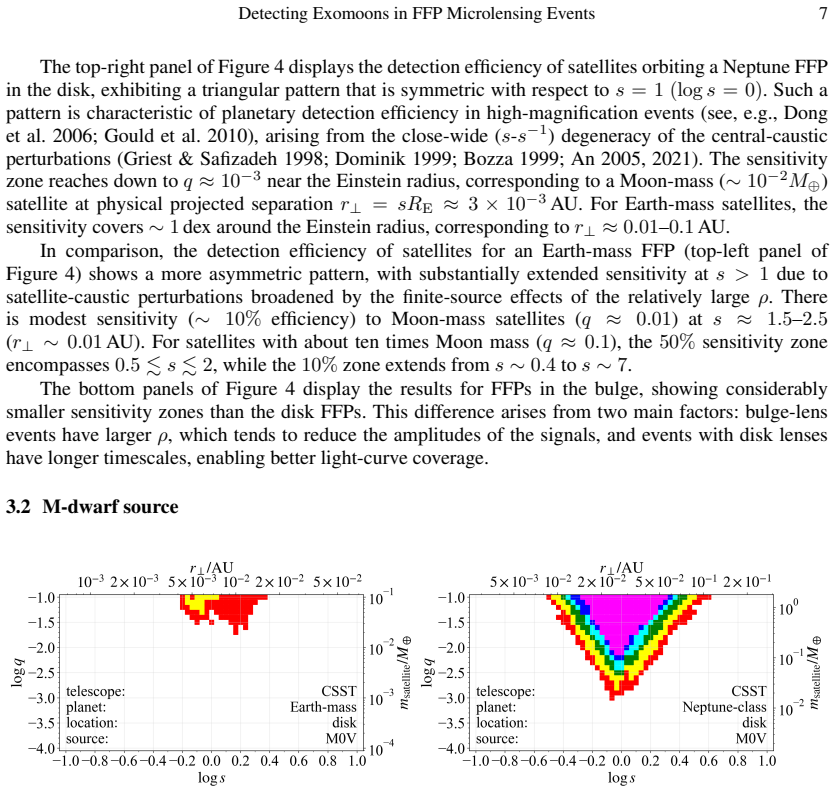
Simulating 2L1S microlensing events with a satellite companion and fitting them with single-lens models, the paper computes detection efficiency as a function of mass ratio $q$ and projected separation $s$ (in Einstein radii) for CSST and Roman. For a G2V source and a disk Neptune-class lens, CSST's 50% efficiency zone reaches $q\sim10^{-3}$ (Moon mass) at $s\approx1$ and spans roughly a decade in separation for $q\sim10^{-2}$ (Earth mass), with the close-wide degeneracy making the efficiency pattern symmetric around $s=1$. Sensitivity degrades substantially for Earth-mass lenses, for bulge lenses, and for M0V sources; Roman retains much of its sensitivity for M-dwarf sources because it observes in the infrared. The paper also finds that previously published Roman sensitivity estimates were inflated because the single-lens model parameters were held fixed to the true values rather than freely fitted.
Load-bearing premise
The sensitivity numbers assume the idealized CSST observing pattern adopted in Section 2: 60-second i-band exposures, a 0.001 magnitude systematic noise floor, 40% duty cycle, and 8 exposures per 1.5-hour orbit, so if the real survey uses a different cadence, filter, or noise floor, the quoted mass-ratio and separation limits will move.
Editorial extensions
If this is right
- CSST should be able to discover Earth-mass exomoons around Neptune-class free-floating planets across projected separations from about 0.01 to 0.1 AU.
- Moon-mass satellites ($q\sim10^{-3}$) become detectable near $s\approx1$, plus a narrower Moon-mass window around $s\approx2$ for Earth-mass hosts.
- M-dwarf sources sharply reduce CSST's reach, but Roman's infrared survey should still detect Moon-mass satellites and even sub-Moon-mass ones at wide separations.
- Detected exomoon populations would directly probe whether satellites survive planetary ejection and at what orbital radii.
- Some detectable Neptune-Earth systems should be tidally heated, making them interesting habitability targets.
Reading between the lines
- If the predicted yields are realized, mass-ratio and separation distributions of FFP exomoons would become a new observable for testing planet-planet scattering models, complementing the FFP mass function itself.
- The same simulation pipeline could be turned on bound planets on wide orbits or on 1L2S events, since the paper explicitly defers the binary-source degeneracy.
- A null detection in the first few years of Roman's survey would bound the exomoon survival fraction and could be published as a meaningful upper limit, not just a failed search.
- The close-wide degeneracy means individual detections will be ambiguous in separation; stacking many events may break the degeneracy statistically.
Editorial analysis
A structured set of objections, weighed in public.
Referee Report
Summary. The manuscript presents forward simulations of space-based microlensing observations of free-floating planets (FFPs) with a bound satellite, computing detection efficiency as a function of satellite-to-planet mass ratio q and projected separation s in units of the Einstein radius. The authors model CSST and Roman photometry for G2V and M0V bulge sources and for Earth-mass and Neptune-class lenses in the disk and bulge, using VBBinaryLensing to generate 2L1S light curves and MCMC fits to 1L1S models with a detection threshold of Delta-chi-squared of at least 100. They report that CSST can detect Earth-mass satellites around disk Neptune-class FFPs over roughly a decade of projected separations, with sensitivity down to Moon-mass satellites near s approximately 1, that M-dwarf sources strongly degrade CSST but not Roman sensitivity, and that a previous Roman study by Sajadian and Sangtarash overestimates efficiency by fixing the 1L1S parameters. A final section discusses Roche, Hill, and ejection-survival constraints and the possibility of tidally heated satellites.
Significance. The detection-efficiency calculation is standard, transparent, and carefully executed: the use of free-parameter 1L1S fits rather than fixed-parameter fits is well justified and supported by illustrative examples, and the explicit acknowledgment that the CSST observing strategy is idealized is appropriate. If the efficiency maps are correct, the paper provides the first quantitative CSST exomoon forecast and a useful Roman comparison, with concrete statements about which q-s configurations are detectable. No step in the pipeline equates an output to an input; the survey parameters are externally chosen, so the detection efficiencies are genuine forward-model outputs. The main weakness is in the physical-consistency section: Eq. (4) contains a numerical error that invalidates the claim that the entire Neptune-class detection zone lies within the Hill radius for typical ejection radii, and this weakens the link from detectable configurations to plausibly surviving ejected systems. The forward-model results themselves do not depend on that error.
major comments (2)
- [Section 4, Eq. (4)] For a Neptune-class lens (m_p = 16 M_Earth), Eq. (4) yields r_H/R_E = 1.4 (a/1 AU) x 16^(-1/6) approximately 0.88 (a/1 AU) in the disk and r_H/R_E approximately 1.26 (a/1 AU) in the bulge. Setting r_H/R_E = 1 therefore gives a_planet approximately 1.13 AU (disk) and approximately 0.79 AU (bulge), not a_planet = 0.013 (0.008) AU as printed. The following sentence, which concludes that the Neptune-class satellite detection zones lie entirely within the Hill radius for typical ejection radii greater than about 1 AU, is consequently incorrect. For example, an Earth-mass satellite at s approximately 1 around a disk Neptune has r_perp approximately 0.03 AU, which exceeds r_H approximately 0.025 AU for a_planet = 1 AU. The detection-efficiency maps in Figures 4-6 are unaffected, but the physical-consistency argument must be recomputed with the corrected threshold.
- [Section 4, last paragraph] The statement that most of our detectable satellites around Neptune-class planets will survive under the less-than-or-equal-to 0.1 r_H survival criterion is not supported once Eq. (4) is corrected. For a Neptune at a_planet = 10 AU, 0.1 r_H is approximately 0.025 AU, while the Earth-mass detection zone extends to r_perp approximately 0.1 AU; only a fraction of the efficiency-weighted parameter space satisfies the survival criterion. The paper should quantify the fraction of detectable (s, q) configurations that lie within 0.1 r_H as a function of a_planet and state which ejection radii are consistent with the headline sensitivity claims.
minor comments (5)
- [Figure 3 caption and text] The caption labels the left panel as Earth and the right panel as Neptune, while the body text says the detected regions are significantly larger for Neptune-class FFPs (left) compared to Earth-mass FFPs (right); one of these is reversed.
- [Section 4, Roche-radius paragraph] The phrase 'minimum separations detectable planets by CSST or Roman' should read 'minimum separations detectable by CSST or Roman'.
- [Abstract and Table 3] The abstract quotes r_perp approximately 0.02 AU for s approximately 2 around an Earth-mass disk FFP, while Table 3 gives R_E = 0.007 AU, so s approximately 2 corresponds to approximately 0.014 AU; the rounding is loose enough to be misleading.
- [General] The manuscript does not state availability of simulation code or mock light-curve data; releasing them would materially aid reproducibility of the efficiency maps.
- [Section 5] The idealized-strategy caveat is clearly stated, but the quantitative contours in Figures 4 and 5 should be explicitly labeled as upper-bound sensitivities for the assumed CSST cadence, filter, and noise floor.
Circularity Check
No significant circularity; the detection-efficiency results are forward products of simulations with externally chosen inputs, and the only apparent numerical issue in Section 4 is an arithmetic error rather than a circular step.
full rationale
The paper's central claims are the CSST and Roman satellite detection efficiencies as functions of mass ratio q and projected separation s. These are computed by forward simulation: 2L1S mock light curves are generated with VBBinaryLensing and then fitted to 1L1S models, with detection defined by delta-chi^2 >= 100. The survey parameters (60-second i-band exposures, 0.001 mag noise floor, 40% duty cycle, 8 observations per orbit for CSST; 15-minute cadence for Roman) are declared inputs adopted from Yan & Zhu (2022), not outputs of the analysis. No parameter is fitted to a subset of the reported efficiency maps and then presented as a prediction of those maps. The comparison with Sajadian & Sangtarash (2023) is an independent methodological point about whether 1L1S parameters should be free, and it does not reduce to a self-citation. The only self-citation is Zhu & Dong (2021), used as a contextual review, and it is not load-bearing for the quantitative results. Section 4's Hill-radius discussion contains an apparent arithmetic error: for a Neptune-class planet (m = 16 M_Earth), Eq. (4) gives r_H/R_E = 1 at a_planet of roughly 1.1 AU in the disk and 0.8 AU in the bulge, not 0.013 and 0.008 AU as stated. That error weakens the physical-interpretation claim that all detectable Neptune-satellite configurations lie within the Hill radius, but it is a numerical correctness issue, not a circular one: the conclusion is not identical to any input by construction. Because the detection efficiencies themselves are neither refit nor defined in terms of the physical constraints, the paper is not circular and receives a score of 0.
Assumptions & free parameters
free parameters (4)
- CSST systematic noise floor =
0.001 mag
- Detection threshold Delta-chi-squared =
100
- CSST duty cycle and cadence =
40% duty cycle; 8 observations per 1.5-hr orbit
- Representative planet masses and distances =
Earth-mass 3e-6 M_sun and Neptune-class 4.8e-5 M_sun; disk pi_rel=0.12 mas, bulge 0.02 mas
assumptions (5)
- standard math VBBinaryLensing and finite-source map-making magnification calculations are correct for 2L1S and 1L1S models.
- domain assumption The representative source and lens choices (G2V and M0V sources, disk and bulge lenses, Earth and Neptune masses) bracket the actual FFP population observed by CSST and Roman.
- domain assumption CSST will execute the idealized observing strategy assumed in the simulations (60-s i-band exposures, 0.001 mag noise floor, 40% duty cycle, 8 exposures per orbit).
- domain assumption A satellite detection is correctly identified by Delta-chi-squared at least 100 between the best-fit 1L1S model and the input 2L1S model, with the 1L1S parameters free.
- domain assumption Planet-satellite systems with the simulated q and s can exist and survive dynamical ejection, as suggested by Hong et al. (2018) and Rabago and Steffen (2019).
Cite this review
Pith. "Pith review of Detecting Exomoons in Free-Floating-Planet Events from Space-based Microlensing Surveys." pith.science (2026). https://pith.science/paper/L3A56JU2
@misc{pith2026250104083,
  author       = {Pith},
  title        = {Pith review of: Detecting Exomoons in Free-Floating-Planet Events from Space-based Microlensing Surveys},
  year         = {2026},
  howpublished = {\url{https://pith.science/paper/L3A56JU2}},
  note         = {Machine review of arXiv:2501.04083}
}
read the original abstract
When a planet is ejected from its star-planet system due to dynamical interactions, its satellite may remain gravitationally bound to the planet. The Chinese Space Station Telescope (CSST) will be capable of detecting a large number of low-mass free-floating planet events (FFPs) from a bulge microlensing survey. We assess the feasibility of detecting satellites (a.k.a., exomoons) orbiting FFPs by simulating CSST light curves and calculating the detection efficiency as a function of satellite-to-planet mass ratios (q) and projected separations (s) in units of the Einstein radius. For a Neptune-class FFP in the Galactic disk with a Sun-like star as the microlensed source, CSST can detect Earth-mass satellites over a decade of separations (from ~0.01 to ~0.1 AU) and has sensitivity down to Moon-mass satellites (q~1e-3) at s~1. CSST also has some sensitivity to detect Moon-mass satellites at s~2 (~0.02 AU) orbiting an Earth-mass FFP in the disk. CSST has substantially reduced sensitivity for detecting satellites when the source star is an M dwarf, compared to a Sun-like source. We also calculate the satellite detection efficiency for the dedicated microlensing survey of the Roman Space Telescope (Roman), which demonstrates greater sensitivity than CSST, particularly for M-dwarf sources. Notably, some of the Neptune-Earth systems detectable by CSST and Roman may exhibit significant tidal heating.
Figures


Figures from the paper (6 more)



Reference graph
Works this paper leans on
-
[1]
On the condition for the central caustic degeneracy of the planetary microlensing
An, J. 2021, arXiv e-prints, arXiv:2102.07950
work page Pith review arXiv 2021
-
[2]
An, J. H. 2005, MNRAS, 356, 1409
work page 2005
-
[3]
P., & Rhie, S
Bennett, D. P., & Rhie, S. H. 2002, ApJ, 574, 985
2002
-
[4]
Bennett, D. P., Batista, V ., Bond, I. A., et al. 2014, ApJ, 785, 155
work page 2014
-
[5]
R., & Roweis, S
Blanton, M. R., & Roweis, S. 2007, AJ, 133, 734
2007
- [6]
-
[7]
Bozza, V ., Bachelet, E., Bartoli´c, F., et al. 2018, MNRAS, 479, 5157
work page 2018
-
[8]
B., Matsumura, S., & Rasio, F
Chatterjee, S., Ford, E. B., Matsumura, S., & Rasio, F. A. 2008, ApJ, 686, 580
2008
Show all 42 references
-
[9]
H., & Sigurdsson, S
Debes, J. H., & Sigurdsson, S. 2007, ApJ, 668, L167
2007
-
[10]
1999, A&A, 349, 108
Dominik, M. 1999, A&A, 349, 108
1999
-
[11]
L., Gaudi, B
Dong, S., DePoy, D. L., Gaudi, B. S., et al. 2006, ApJ, 642, 842
2006
-
[12]
A., Gould, A., et al
Dong, S., Bond, I. A., Gould, A., et al. 2009, ApJ, 698, 1826
2009
-
[13]
Gaudi, B. S. 1998, ApJ, 506, 533
1998
-
[14]
A., Rejkuba, M., Zoccali, M., et al
Gonzalez, O. A., Rejkuba, M., Zoccali, M., et al. 2012, A&A, 543, A13
2012
-
[15]
S., et al
Gould, A., Dong, S., Gaudi, B. S., et al. 2010, ApJ, 720, 1073
2010
-
[16]
K., Hwang, K.-H., et al
Gould, A., Jung, Y . K., Hwang, K.-H., et al. 2022, Journal of Korean Astronomical Society, 55, 173
2022
-
[17]
1998, ApJ, 500, 37
Griest, K., & Safizadeh, N. 1998, ApJ, 500, 37
1998
-
[18]
2002, ApJ, 580, 490
Han, C., & Han, W. 2002, ApJ, 580, 490
2002
-
[19]
N., Nicholson, P
Hong, Y .-C., Raymond, S. N., Nicholson, P. D., & Lunine, J. I. 2018, ApJ, 852, 85
2018
-
[20]
A., Penny, M., Gaudi, B
Johnson, S. A., Penny, M., Gaudi, B. S., et al. 2020, AJ, 160, 123 Juri´c, M., & Tremaine, S. 2008, ApJ, 686, 603
2020
-
[21]
2019, ApJ, 877, L15
Kreidberg, L., Luger, R., & Bedell, M. 2019, ApJ, 877, L15
2019
-
[22]
2010, A&A, 520, A68
Liebig, C., & Wambsganss, J. 2010, A&A, 520, A68
2010
-
[23]
2023, arXiv e-prints, arXiv:2310.07502 Mr´oz, P., Udalski, A., Skowron, J., et al
Mroz, P., & Poleski, R. 2023, arXiv e-prints, arXiv:2310.07502 Mr´oz, P., Udalski, A., Skowron, J., et al. 2017, Nature, 548, 183 Mr´oz, P., Ryu, Y . H., Skowron, J., et al. 2018, AJ, 155, 121
2023 arXiv
-
[24]
M., Gould, A., Fouqu´e, P., et al
Nataf, D. M., Gould, A., Fouqu´e, P., et al. 2013, ApJ, 769, 88
2013
-
[25]
J., & Wickramasinghe, W
Nemiroff, R. J., & Wickramasinghe, W. A. D. T. 1994, ApJ, 424, L21
1994
-
[26]
J., & Mamajek, E
Pecaut, M. J., & Mamajek, E. E. 2013, ApJS, 208, 9
2013
-
[27]
T., Gaudi, B
Penny, M. T., Gaudi, B. S., Kerins, E., et al. 2019, ApJS, 241, 3
2019
-
[28]
Rabago, I., & Steffen, J. H. 2019, MNRAS, 489, 2323
2019
-
[29]
A., & Ford, E
Rasio, F. A., & Ford, E. B. 1996, Science, 274, 954
1996
-
[30]
T., McKay, C
Reynolds, R. T., McKay, C. P., & Kasting, J. F. 1987, Advances in Space Research, 7, 125 Detecting Exomoons in FFP Microlensing Events 13
1987
-
[31]
H., Bennett, D
Rhie, S. H., Bennett, D. P., Becker, A. C., et al. 2000, ApJ, 533, 378
2000
-
[32]
2021, AJ, 161, 126
Ryu, Y .-H., Mr´oz, P., Gould, A., et al. 2021, AJ, 161, 126
2021
-
[33]
2023, MNRAS, 520, 5613
Sajadian, S., & Sangtarash, P. 2023, MNRAS, 520, 5613
2023
-
[34]
Scharf, C. A. 2006, ApJ, 648, 1196
2006
-
[35]
2024, arXiv e-prints, arXiv:2408.16396
Sturm, E., Davies, R., Alves, J., et al. 2024, arXiv e-prints, arXiv:2408.16396
2024 arXiv
-
[36]
P., et al
Sumi, T., Koshimoto, N., Bennett, D. P., et al. 2023, The Astronomical Journal, 166, 108
2023
-
[37]
Teachey, A., & Kipping, D. M. 2018, Science Advances, 4, eaav1784
2018
-
[38]
J., & Marzari, F
Weidenschilling, S. J., & Marzari, F. 1996, Nature, 384, 619
1996
-
[39]
J., & Mao, S
Witt, H. J., & Mao, S. 1994, ApJ, 430, 505
1994
-
[40]
2022, Research in Astronomy and Astrophysics, 22, 025006
Yan, S., & Zhu, W. 2022, Research in Astronomy and Astrophysics, 22, 025006
2022
- [41]
-
[42]
2021, ARA&A, 59, 291
Zhu, W., & Dong, S. 2021, ARA&A, 59, 291
2021
Reviewed August 10, 2026 · model on record in the stance chip above.
Discussion (0). Continue with ORCID to comment.