REVIEW 2 major objections 6 minor 61 references
Modeling Hypergraphs with Diversity and Heterogeneous Popularity
T0 review · 2 major / 6 minor · reviewed 2026-08-10 · deepseek-v4-flash
Pith's one-line read This paper proposes a hypergraph model in which the probability of a group is proportional to the determinant of a kernel submatrix, making diverse sets and popular nodes more likely, and proves its maximum likelihood estimator is…
desk verdict A new DPP-based hypergraph model with a genuine diversity mechanism and a plausible claim of first structured-DPP asymptotics, but the theory and the fitted estimator are not the same object. read the letter →
The pith
A machine-rendered reading of the paper's core claim, the machinery that carries it, and where it could break.
The reading
What carries the argument
The engine is the volume-to-determinant identity: the squared volume of the parallelotope spanned by the lifted vectors $\tilde{v}_i=(v_i,\sqrt{\alpha_i}w_i)$ equals $\det(L_e)$, and summing over all subsets yields $\det(L+I)$. This converts the geometric idea of diversity into an exact probability law, a discrete determinantal point process—a distribution over subsets whose probabilities are determinants of kernel submatrices—with kernel $L=(v_i^\top v_j)+\operatorname{diag}(\alpha)$. The parameter space is the manifold of matrices $\beta W+\operatorname{diag}(\alpha)$ with $W$ positive semidefinite, $\operatorname{rank}(W)\le d$, $\operatorname{diag}(W)=1$, and the theory works by analyzing the Bouligand tangent cone of this manifold at the true $L^*$.
What would settle it
Simulate many hypergraphs from a DiPH model whose parameters are known, with $n_v>2d$ and an irreducible Gram matrix, then compare the empirical distribution of $\sqrt{n_e}(\tilde{L}-L^*)$ to the normal law in Theorem 3. If the empirical covariance systematically deviates from the Hessian/tangent-cone formula, or if a grid or restart search finds better optima than the accelerated projected gradient routine, the theorem's assumptions do not hold as stated.
Extended reading notes
Core claim
On the paper's own terms, the discovery is that a determinantal point process with the structured kernel $L=(v_i^\top v_j)+\operatorname{diag}(\alpha)$ is a principled generative model for non-uniform, non-hereditary hypergraphs with repeated hyperedges. Writing the hyperedge probability as $\det(L_e)/\det(L+I)$ makes within-edge diversity (orthogonality of latent vectors) and node popularity (the $\alpha_i$ terms) the two explicit drivers of hyperedge formation, in contrast to similarity-based latent space and block models. The paper proves the maximum likelihood estimator of these parameters is consistent provided $n_v>2d$ and the true latent vectors span $\mathbb{R}^d$, and it proves asymptotic normality under the additional condition that the Gram matrix is irreducible; this last result is presented as the first asymptotic normality theorem for structured discrete DPPs. The proof handles the non-Euclidean parameter manifold via constrained M-estimation theory and the Bouligand tangent cone of the feasible set.
Load-bearing premise
The asymptotic theorems assume the estimator is the global maximizer of the nonconvex likelihood (11), while the proposed projected gradient algorithm is only shown to reach stationary points, so the computed estimate may differ from the theoretical MLE.
Editorial extensions
If this is right
- Hypergraphs with varying edge sizes and repeated edges can be fitted as a single generative model, without special treatment for $k$-uniformity and without clique expansion.
- The estimated latent positions and popularity parameters are directly interpretable, as shown in the cooking example where ingredient embeddings separate proteins, carbohydrates, and seasonings.
- Because the MLE is asymptotically normal, users can construct confidence sets for popularity parameters and latent directions when the sample of hyperedges is large.
- The model supplies conditional probabilities for completing a partially observed hyperedge and can generate new hyperedges with a desired cardinality.
Reading between the lines
- Inference: the same determinant likelihood gives a ready-made score for team formation or product-bundle selection, ranking candidate groups by diversity and popularity; the paper does not test this decision-theoretic use.
- Inference: because the reported Gaussian limits describe the global MLE rather than the stationary points found by projection, a multi-start or warm-started fitting strategy is a natural safeguard in practice.
- Inference: replacing the Gram matrix by a covariate-dependent kernel $X\Gamma X^\top$ would extend the model to supervised or contextual settings without changing the DPP structure, though such an extension is not explored here.
Editorial analysis
A structured set of objections, weighed in public.
Referee Report
Summary. The paper introduces a latent space model for hypergraphs, named DiPH, in which the probability of observing a hyperedge e is proportional to det(L_e)/det(L+I), where L = (v_i^T v_j) + diag(alpha) and v_i, alpha_i are latent position and popularity parameters for node i. This determinantal point process (DPP) formulation gives higher probability to hyperedges whose latent vectors are diverse (close to orthogonal) and to nodes with large popularity parameters. The model allows hyperedges of arbitrary cardinality and with multiplicity, and its parameter count is n_v d + 1 rather than O(n_v^2). The authors prove identifiability of the parameters up to an orthogonal transformation and sign flips, and establish consistency and asymptotic normality of the global MLE as the number of hyperedges n_e grows while the node set is fixed. They fit the model via an accelerated projected gradient descent algorithm and demonstrate its performance in simulation studies and in an application to a cooking recipe data set, where ingredients are embedded in R^3.
Significance. If the asymptotic results hold, this is a valuable contribution to statistical modeling of hypergraphs and to structured DPPs. The model is original in being explicitly diversity-driven rather than similarity-driven, and the compact parameterization avoids the cardinality restrictions of existing low-rank DPP models. The identifiability theorem is clear, and the simulation study shows that the proposed algorithm can recover parameters in practice. The main weakness is that the theoretical guarantees apply only to the global maximizer of a nonconvex objective, while the optimization algorithm is not shown to reach such a maximizer, so the delivered estimator is not yet connected to the proven asymptotics. In addition, all proofs are relegated to the Supplemental Material, which is unavailable in the present manuscript, leaving essential technical conditions unverifiable from the main text.
major comments (2)
- [Section 2.2 and Theorems 2-3] The estimation algorithm described in Section 2.2 is an accelerated proximal gradient method applied to the nonconvex objective (11). For such objectives, the method is guaranteed only to converge to a stationary point, not to a global optimum. However, Theorem 2 explicitly assumes that 'global optimums of (11) are obtained', and Theorem 3 refers to the MLE obtained by 'the global optimum of (11)'. The paper does not provide any argument that the algorithm attains a global optimum, nor that a stationary point sequence is consistent, nor that every stationary point is a global maximizer. The simulation results in Section 4 and the real-data application in Section 5 are based on the algorithm's output, so the numerical evidence does not directly support the consistency and normality claims for the computed estimator. This creates a load-bearing gap between the theoretical results and the proposed fitting procedure.
- [Section 3 (Theorems 2 and 3)] The proofs of Theorems 2 and 3 are entirely contained in the Supplemental Material. In particular, the compact subset construction needed for the consistency argument (via Theorem 5.14 of van der Vaart, 2000) and the explicit characterization of the Bouligand tangent cone in Definition 5 (referenced as equation (80) in the Supplement) are not presented in the main text. Because these technical components are central to the asymptotic normality claim, I cannot verify from the manuscript alone that the conditions of the cited theorems are satisfied. The authors should make the Supplement available to reviewers or include a proof sketch in an appendix, with the compactness construction and the tangent cone description stated explicitly.
minor comments (6)
- [Section 2.2] The paragraph describing the algorithm should explicitly note that the objective in (11) is nonconvex and that the proposed method yields stationary points, not necessarily global maxima, and should point the reader to the theoretical assumptions in Section 3.
- [Definition 5, Section 3.2] The definition of T_{vec(\bar L)}(vec(L*)) relies on equation (80) in the Supplemental Material; please include the explicit characterization of the tangent cone in the main text or an appendix so that the theorem is self-contained.
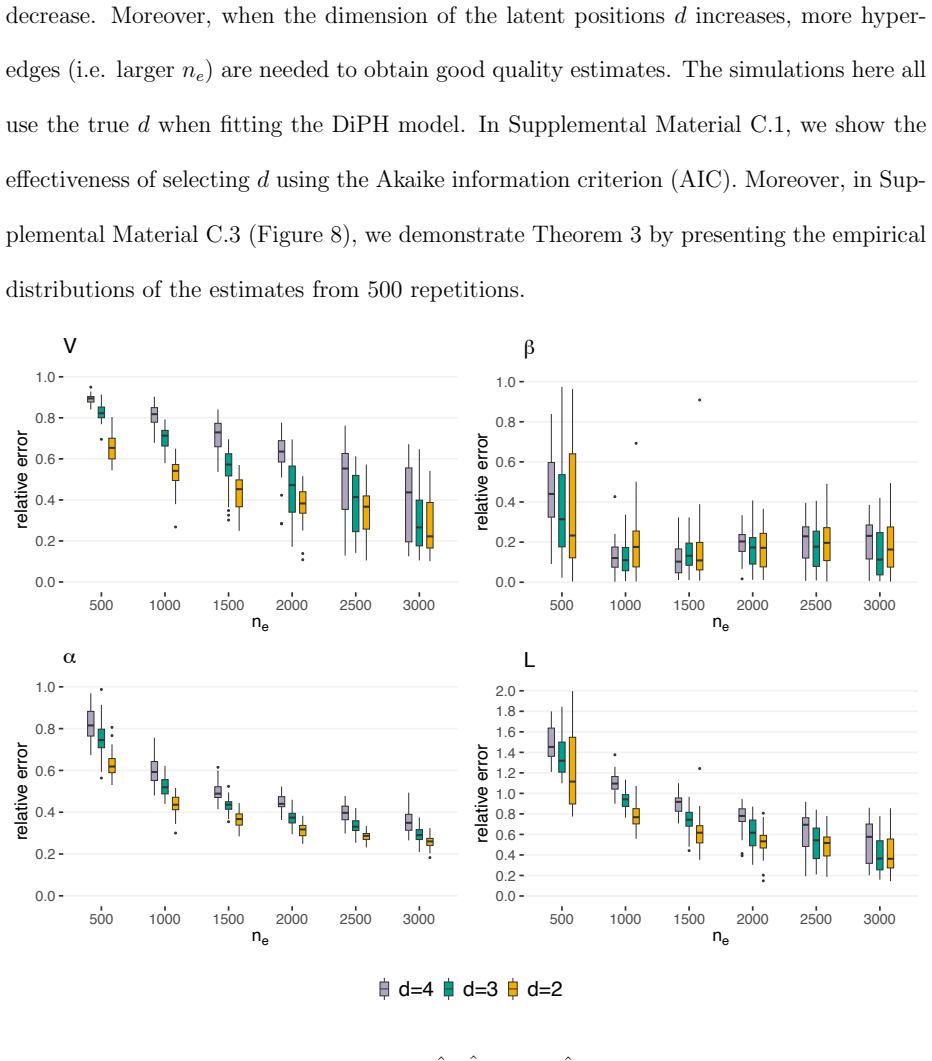
- [Figure 3, Section 4] The legend items 'd=4 d=3 d=2' are not clearly associated with the box plot colors; please add a proper legend.
- [Section 5] 'down stream tasks' should be 'downstream tasks'.
- [Section 1] In the opening sentence, 'relations among individuals make an important part of data' could be rephrased as 'relations among individuals form an important part of data'.
- [Code availability] The paper states that code is available upon request; consider providing a public repository link to facilitate reproducibility.
Circularity Check
No significant circularity: the DiPH likelihood, identifiability theorem, and asymptotic results are self-contained and built on external references.
full rationale
The paper derives its model, likelihood, and theoretical results from first principles and external classical references, not from its own prior conclusions. The DiPH distribution is defined directly as P(E=e)=det(L_e)/det(L+I) with L=(v_i^T v_j)+diag(alpha), and the diversity mechanism is a mathematical consequence of the determinant volume interpretation rather than an output fitted to itself. Identifiability (Theorem 1), consistency (Theorem 2), and asymptotic normality (Theorem 3) are stated with explicit conditions and proofs delegated to the Supplemental Material; the proofs invoke external works such as Van der Vaart (2000), Geyer (1994), and Brunel et al. (2017), none of which are authored by the present authors. The simulations generate hypergraphs from the model and then fit the same model, which is standard Monte Carlo validation rather than circular prediction. The only notable gap is that the asymptotic theorems assume global optima of the nonconvex objective (11), while the proposed projected accelerated gradient descent algorithm is only shown to reach stationary points; this is a correctness or gap concern about matching the computed estimator to the theoretical estimator, not a circularity in which a quantity is defined in terms of its own prediction. No fitted parameter is renamed as a prediction, no load-bearing self-citation appears, and no result reduces to its inputs by construction. Accordingly, the circularity score is 0.
Assumptions & free parameters
free parameters (4)
- latent position vectors v_i (i=1,...,n_v) =
d-dimensional vectors estimated via MLE
- popularity parameters alpha_i =
positive scalars estimated via MLE
- common length parameter beta = ||v_i||^2 =
estimated via MLE (reparameterized from v_i)
- latent dimension d =
selected by AIC in applications
assumptions (6)
- domain assumption Hyperedges are i.i.d. draws from a single distribution P over all subsets of nodes (Eq 1).
- domain assumption P(E=e)=det(L_e)/det(L+I) with L=(v_i^T v_j)+diag(alpha) is a valid DPP; requires L PSD.
- standard math Matrix determinant identity sum_e det(L_e)=det(L+I).
- standard math Classical consistency and constrained M-estimation asymptotics (van der Vaart 2000, Geyer 1994).
- standard math DPP marginal/conditional properties and sampling algorithm from Kulesza and Taskar (2012) and Borodin and Rains (2005).
- domain assumption Conditions n_v>2d, {v_i} spans R^d, and (v_i^T v_j) irreducible hold for the true parameters.
Cite this review
Pith. "Pith review of Modeling Hypergraphs with Diversity and Heterogeneous Popularity." pith.science (2026). https://pith.science/paper/CWKYPJFT
@misc{pith2026250104251,
  author       = {Pith},
  title        = {Pith review of: Modeling Hypergraphs with Diversity and Heterogeneous Popularity},
  year         = {2026},
  howpublished = {\url{https://pith.science/paper/CWKYPJFT}},
  note         = {Machine review of arXiv:2501.04251}
}
read the original abstract
While relations among individuals make an important part of data with scientific and business interests, existing statistical modeling of relational data has mainly been focusing on dyadic relations, i.e., those between two individuals. This article addresses the less studied, though commonly encountered, polyadic relations that can involve more than two individuals. In particular, we propose a new latent space model for hypergraphs using determinantal point processes, which is driven by the diversity within hyperedges and each node's popularity. This model mechanism is in contrast to existing hypergraph models, which are predominantly driven by similarity rather than diversity. Additionally, the proposed model accommodates broad types of hypergraphs, with no restriction on the cardinality and multiplicity of hyperedges, which previous models often have. Consistency and asymptotic normality of the maximum likelihood estimates of the model parameters have been established. The proof is challenging, owing to the special configuration of the parameter space. Further, we apply the projected accelerated gradient descent algorithm to obtain the parameter estimates, and we show its effectiveness in simulation studies. We also demonstrate an application of the proposed model on the What's Cooking data and present the embedding of food ingredients learned from cooking recipes using the model.
Figures


Figures from the paper (2 more)


Reference graph
Works this paper leans on
-
[1]
Ahn, Y.-Y., Ahnert, S. E., Bagrow, J. P., and Barab \'a si, A.-L. (2011). Flavor network and the principles of food pairing. Scientific Reports , 1(1):1--7
work page 2011
-
[2]
A., Chen, A., Bickel, P
Amini, A. A., Chen, A., Bickel, P. J., and Levina, E. (2013). Pseudo-likelihood methods for community detection in large sparse networks
2013
-
[3]
Anderson, T. (2003). An Introduction to Multivariate Statistical Analysis . Wiley Series in Probability and Statistics. Wiley
work page 2003
-
[4]
Bauschke, H. H., Luke, D. R., Phan, H. M., and Wang, X. (2013). Restricted normal cones and the method of alternating projections: theory. Set-Valued and Variational Analysis , 21(3):431--473
work page 2013
-
[5]
Benson, A., Kleinberg, J., and Veldt, N. (2021). Hypergraph cuts with general splitting functions. In 2021 Joint Mathematics Meetings (JMM) . AMS
work page 2021
-
[6]
Benson, A. R., Abebe, R., Schaub, M. T., Jadbabaie, A., and Kleinberg, J. (2018). Simplicial closure and higher-order link prediction. Proceedings of the National Academy of Sciences , 115(48):E11221--E11230
work page 2018
-
[7]
Benson, A. R., Kleinberg, J., and Veldt, N. (2020). Augmented sparsifiers for generalized hypergraph cuts. arXiv preprint arXiv:2007.08075
work page Pith review arXiv 2020
-
[8]
Berge, C. (1970). Graphes et hypergraphes . Dunod, Paris
work page 1970
Show all 61 references
-
[9]
and Rains, E
Borodin, A. and Rains, E. M. (2005). Eynard--mehta theorem, schur process, and their pfaffian analogs. Journal of Statistical Physics , 121(3):291--317
2005
-
[10]
Brunel, V.-E., Moitra, A., Rigollet, P., and Urschel, J. (2017). Rates of estimation for determinantal point processes. In Conference on Learning Theory , pages 343--345. PMLR
2017
-
[11]
Chen, L., Zhang, G., and Zhou, H. (2018). Fast greedy map inference for determinantal point process to improve recommendation diversity. In Proceedings of the 32nd International Conference on Neural Information Processing Systems , pages 5627--5638
2018
-
[12]
Chien, I., Lin, C.-Y., and Wang, I.-H. (2018). Community detection in hypergraphs: Optimal statistical limit and efficient algorithms. In International Conference on Artificial Intelligence and Statistics , pages 871--879. PMLR
2018
-
[13]
Chodrow, P. S. (2020). Configuration models of random hypergraphs. Journal of Complex Networks , 8(3):cnaa018
2020
-
[14]
S., Veldt, N., and Benson, A
Chodrow, P. S., Veldt, N., and Benson, A. R. (2021). Generative hypergraph clustering: from blockmodels to modularity. arXiv preprint arXiv:2101.09611
2021 arXiv
-
[15]
Ducournau, A., Bretto, A., Rital, S., and Laget, B. (2012). A reductive approach to hypergraph clustering: An application to image segmentation. Pattern Recognition , 45(7):2788--2803
2012
-
[16]
Fagin, R. (1983). Degrees of acyclicity for hypergraphs and relational database schemes. Journal of the ACM (JACM) , 30(3):514--550
1983
-
[17]
Gartrell, M., Brunel, V.-E., Dohmatob, E., and Krichene, S. (2019). Learning nonsymmetric determinantal point processes. Advances in Neural Information Processing Systems , 32:6718--6728
2019
-
[18]
Gartrell, M., Paquet, U., and Koenigstein, N. (2017). Low-rank factorization of determinantal point processes. In Thirty-First AAAI Conference on Artificial Intelligence
2017
-
[19]
Geyer, C. J. (1994). On the asymptotics of constrained m-estimation. The Annals of Statistics , pages 1993--2010
1994
-
[20]
and Rigollet, P
Ghosh, S. and Rigollet, P. (2020). Gaussian determinantal processes: A new model for directionality in data. Proceedings of the National Academy of Sciences , 117(24):13207--13213
2020
-
[21]
and Dukkipati, A
Ghoshdastidar, D. and Dukkipati, A. (2014). Consistency of spectral partitioning of uniform hypergraphs under planted partition model. Advances in Neural Information Processing Systems , 27:397--405
2014
-
[22]
and Dukkipati, A
Ghoshdastidar, D. and Dukkipati, A. (2017a). Consistency of spectral hypergraph partitioning under planted partition model. The Annals of Statistics , 45(1):289--315
2017
-
[23]
and Dukkipati, A
Ghoshdastidar, D. and Dukkipati, A. (2017b). Uniform hypergraph partitioning: Provable tensor methods and sampling techniques. The Journal of Machine Learning Research , 18(1):1638--1678
2017
-
[24]
R., Pinter-Wollman, N., and Fefferman, N
Greening Jr, B. R., Pinter-Wollman, N., and Fefferman, N. H. (2015). Higher-order interactions: understanding the knowledge capacity of social groups using simplicial sets. Current Zoology , 61(1):114--127
2015
-
[25]
and Gillenwater, J
Han, I. and Gillenwater, J. (2020). Map inference for customized determinantal point processes via maximum inner product search. In International Conference on Artificial Intelligence and Statistics , pages 2797--2807. PMLR
2020
-
[26]
Jin, J. (2015). Fast community detection by score. The Annals of Statistics , 43(1):57--89
2015
-
[27]
What's cooking? Retrieved September 8, 2020 from https://www.kaggle.com/c/whats-cooking
Kaggle (2015). What's cooking? Retrieved September 8, 2020 from https://www.kaggle.com/c/whats-cooking
2015
-
[28]
and Petrovi \'c , S
Karwa, V. and Petrovi \'c , S. (2016). Discussion of ``coauthorship and citation networks for statisticians". The Annals of Applied Statistics , 10(4):1827--1834
2016
-
[29]
Ke, Z. T. and Jin, J. (2023). Special invited paper: The score normalization, especially for heterogeneous network and text data. Stat , 12(1):e545
2023
-
[30]
T., Shi, F., and Xia, D
Ke, Z. T., Shi, F., and Xia, D. (2019). Community detection for hypergraph networks via regularized tensor power iteration. arXiv preprint arXiv:1909.06503
2019 arXiv
-
[31]
S., and Goemans, M
Kim, C., Bandeira, A. S., and Goemans, M. X. (2018). Stochastic block model for hypergraphs: Statistical limits and a semidefinite programming approach. arXiv preprint arXiv:1807.02884
2018 arXiv
-
[32]
Klamt, S., Haus, U.-U., and Theis, F. (2009). Hypergraphs and cellular networks. PLoS computational biology , 5(5):e1000385
2009
-
[33]
Kolda, T. G. and Bader, B. W. (2009). Tensor decompositions and applications. SIAM review , 51(3):455--500
2009
-
[34]
Konstantinova, E. V. and Skorobogatov, V. A. (2001). Application of hypergraph theory in chemistry. Discrete Mathematics , 235(1):365--383. Chech and Slovak 3
2001
-
[35]
and Taskar, B
Kulesza, A. and Taskar, B. (2011). Learning determinantal point processes. In Proceedings of the Twenty-Seventh Conference on Uncertainty in Artificial Intelligence , pages 419--427
2011
-
[36]
and Taskar, B
Kulesza, A. and Taskar, B. (2012). Determinantal point processes for machine learning. Foundations and Trends in Machine Learning , 5(2--3)
2012
-
[37]
Kumar, T., Vaidyanathan, S., Ananthapadmanabhan, H., Parthasarathy, S., and Ravindran, B. (2020). Hypergraph clustering by iteratively reweighted modularity maximization. Applied Network Science , 5(1):1--22
2020
-
[38]
Lange, K. (2013). Convex minimization algorithms. In Optimization , pages 415--444. Springer
2013
-
[39]
Lavancier, F., M ller, J., and Rubak, E. (2015). Determinantal point process models and statistical inference. Journal of the Royal Statistical Society: Series B (Statistical Methodology) , 77(4):853--877
2015
-
[40]
and Lin, Z
Li, H. and Lin, Z. (2015). Accelerated proximal gradient methods for nonconvex programming. Advances in Neural Information Processing Systems , 28:379--387
2015
-
[41]
and Milenkovic, O
Li, P. and Milenkovic, O. (2017). Inhomogoenous hypergraph clustering with applications. In Advances in Neural Information Processing Systems , pages 2305--2315
2017
-
[42]
Li, X., Li, Y., Shen, C., Dick, A., and Van Den Hengel, A. (2013). Contextual hypergraph modeling for salient object detection. In Proceedings of the IEEE international conference on computer vision , pages 3328--3335
2013
-
[43]
L., and Airoldi, E
Lunag \'o mez, S., Mukherjee, S., Wolpert, R. L., and Airoldi, E. M. (2017). Geometric representations of random hypergraphs. Journal of the American Statistical Association , 112(517):363--383
2017
-
[44]
Lyu, Z., Xia, D., and Zhang, Y. (2021). Latent space model for higher-order networks and generalized tensor decomposition. arXiv preprint arXiv:2106.16042
2021 arXiv
-
[45]
Macchi, O. (1975). The coincidence approach to stochastic point processes. Advances in Applied Probability , 7(1):83--122
1975
-
[46]
P., and Pingali, K
Maleki, S., Wall, D. P., and Pingali, K. (2021). Netvec: A scalable hypergraph embedding system. arXiv preprint arXiv:2103.09660
2021 arXiv
-
[47]
and Gaudin, M
Mehta, M. and Gaudin, M. (1960). On the density of eigenvalues of a random matrix. Nuclear Physics , 18:420--427
1960
-
[48]
Ng, T. L. J. and Murphy, T. B. (2021). Model-based clustering for random hypergraphs. Advances in Data Analysis and Classification , pages 1--33
2021
-
[49]
Rockafellar, R. T. and Wets, R. J.-B. (2009). Variational analysis , volume 317. Springer Science & Business Media
2009
-
[50]
Stasi, D., Sadeghi, K., Rinaldo, A., Petrovi \'c , S., and Fienberg, S. E. (2014). beta models for random hypergraphs with a given degree sequence. arXiv preprint arXiv:1407.1004
2014 arXiv
-
[51]
Tam, M. K. (2017). Regularity properties of non-negative sparsity sets. Journal of Mathematical Analysis and Applications , 447(2):758--777
2017
-
[52]
Tu, K., Cui, P., Wang, X., Wang, F., and Zhu, W. (2018). Structural deep embedding for hyper-networks. In Thirty-Second AAAI Conference on Artificial Intelligence
2018
-
[53]
Turnbull, K., Lunag \'o mez, S., Nemeth, C., and Airoldi, E. (2019). Latent space representations of hypergraphs. arXiv preprint arXiv:1909.00472
2019 arXiv
-
[54]
Van der Vaart, A. W. (2000). Asymptotic statistics , volume 3. Cambridge university press
2000
-
[55]
R., and Kleinberg, J
Veldt, N., Benson, A. R., and Kleinberg, J. (2020). Minimizing localized ratio cut objectives in hypergraphs. In Proceedings of the 26th ACM SIGKDD International Conference on Knowledge Discovery & Data Mining , pages 1708--1718
2020
-
[56]
H., and Gillenwater, J
Wilhelm, M., Ramanathan, A., Bonomo, A., Jain, S., Chi, E. H., and Gillenwater, J. (2018). Practical diversified recommendations on youtube with determinantal point processes. In Proceedings of the 27th ACM International Conference on Information and Knowledge Management , pag...
2018
-
[57]
Yu, J., Tao, D., and Wang, M. (2012). Adaptive hypergraph learning and its application in image classification. IEEE Transactions on Image Processing , 21(7):3262--3272
2012
-
[58]
and Qu, A
Yuan, Y. and Qu, A. (2021). High-order joint embedding for multi-level link prediction. Journal of the American Statistical Association , (just-accepted):1--39
2021
-
[59]
and McCullagh, P
Zhang, D. and McCullagh, P. (2015). Exchangeable random hypergraphs. working paper
2015
-
[60]
and Wang, J
Zhen, Y. and Wang, J. (2021). Community detection in general hypergraph via graph embedding. arXiv preprint arXiv:2103.15035
2021 arXiv
-
[61]
Zhou, D., Huang, J., and Sch \"o lkopf, B. (2006). Learning with hypergraphs: Clustering, classification, and embedding. Advances in neural information processing systems , 19:1601--1608
2006
Reviewed August 10, 2026 · model on record in the stance chip above.
Discussion (0). Continue with ORCID to comment.