REVIEW 4 major objections 6 minor 2 cited by
ContextMRI: Enhancing Compressed Sensing MRI through Metadata Conditioning
T0 review · 4 major / 6 minor · reviewed 2026-08-10 · deepseek-v4-flash
Pith's one-line read Conditioning MRI reconstruction on clinical metadata consistently improves accuracy.
desk verdict Plausible and useful engineering contribution, but the headline claim of consistent gains is not statistically secured by the reported evidence. read the letter →
The pith
A machine-rendered reading of the paper's core claim, the machinery that carries it, and where it could break.
The reading
What carries the argument
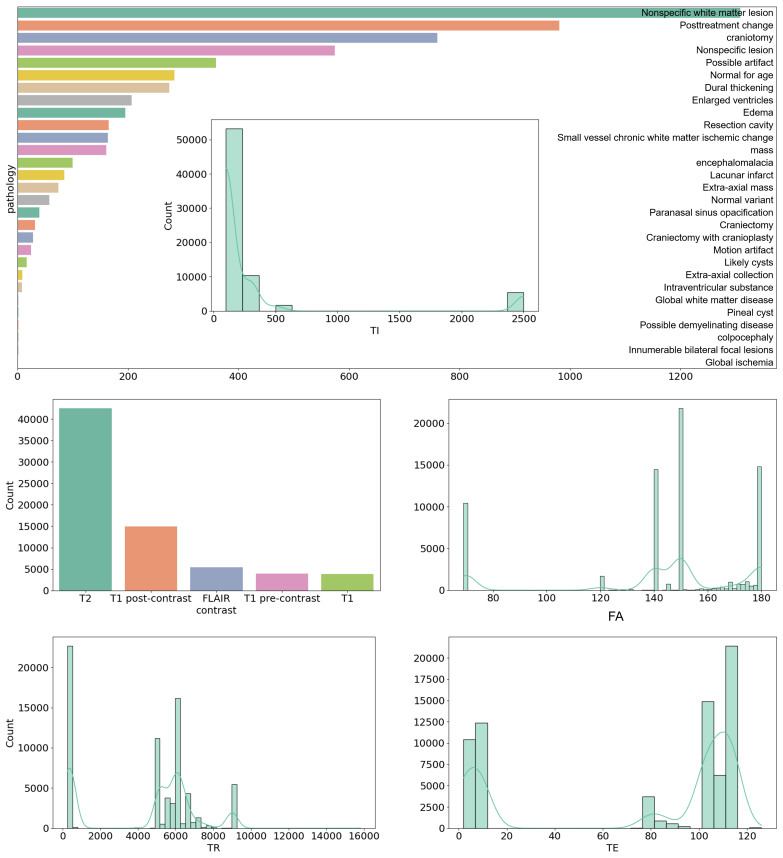
The load-bearing object is a text-conditioned pixel-space diffusion model trained directly on complex-valued MR images represented as two channels, one real and one imaginary. Metadata is flattened into a structured sentence such as “Knee, Slice 19, PDFS, Pathology: ..., TR: 3150, TE: 33, TI: 100, Flip angle: 150”; a frozen contrastive text encoder turns this sentence into an embedding that modulates the diffusion U-Net. At inference, the conditional prior is combined with the measurement model by a decomposed diffusion sampler: each denoising step predicts the clean image, then solves a small data-consistency optimization problem with conjugate-gradient steps, and classifier-free guidance is used to accentuate the metadata signal. This design lets the same pretrained prior be reused zero-shot for different masks and acceleration factors, and it is what makes conditioning on metadata a concrete, testable intervention rather than a vague qualitative advantage.
What would settle it
Reconstruct the same set of slices from the same undersampled measurements many times with different random seeds, once with metadata conditioning and once without, and compute paired per-slice PSNR/SSIM differences. If the 95% confidence interval for the mean difference includes zero in the uniform-1D ×4 setting, the paper's central claim of consistent gains would not be supported; if it excludes zero, the claim survives.
Extended reading notes
Core claim
On the paper's own terms, the discovery is that a diffusion prior conditioned on granular clinical metadata solves compressed-sensing MRI better than the same prior without conditioning. The authors train a pixel-space diffusion model on minimum-variance-unbiased complex-valued images, convert metadata into a structured text prompt, and encode it with a frozen contrastive text encoder; at inference they plug this conditional prior into a decomposed diffusion sampler that alternates denoising steps with conjugate-gradient data-consistency steps, using classifier-free guidance to control how strongly the metadata steers the result. Across uniform one-dimensional and Poisson two-dimensional undersampling masks at ×4, ×8, and ×15 acceleration, conditional reconstruction outperforms the unconditional baseline, and removing metadata fields one at a time—MR parameters, contrast, slice, demographics, pathology—degrades performance in steps. The authors also report that supplying a wrong pathology label still beats no label, because it signals the presence of an abnormality.
Load-bearing premise
The claim that conditional reconstruction consistently beats unconditional reconstruction assumes that the observed mean PSNR/SSIM differences, which are small relative to the reported slice-to-slice standard deviations, are real improvements rather than sampling noise.
Editorial extensions
If this is right
- Metadata already recorded during clinical scans becomes a free source of reconstruction signal: no additional acquisition time or hardware is needed.
- Reconstruction quality improves stepwise as more metadata fields are provided, so hospitals with richer structured records would see larger benefits.
- Even a wrong pathology impression helps relative to no conditioning, as long as it indicates that some abnormality is present, which could make the method robust to preliminary clinical notes.
- Conditional reconstruction tends to reduce slice-to-slice variability, so the same prior could make accelerated scans more consistent for downstream analysis.
Reading between the lines
- A paired significance analysis of per-slice conditional-versus-unconditional differences would directly test whether the reported 0.2–0.5 dB gains are above noise; the reported standard deviations make this the obvious next check.
- The same conditioning recipe could transfer to other medical inverse problems—CT, PET, ultrasound—where acquisition parameters and demographics are already stored in standard image headers.
- If the gains hold up, metadata should be treated as part of the forward model rather than an optional prompt: the reconstruction posterior becomes p(x | y, c) instead of p(x | y), a shift that touches every learned inverse solver, not just MRI.
Editorial analysis
A structured set of objections, weighed in public.
Referee Report
Summary. The paper proposes ContextMRI, a pixel-space text-conditioned diffusion model for complex-valued MRI. The model is trained on MVUE complex images from fastMRI knee and brain, with metadata (anatomy, slice, contrast, MR parameters, pathology) formatted as structured text prompts and encoded with a frozen CLIP text encoder. At inference, the conditional prior is combined with the Decomposed Diffusion Sampler (DDS) for compressed-sensing MRI reconstruction. The central claims are that metadata conditioning yields consistent reconstruction gains across datasets, acceleration factors, and undersampling patterns, and that increasing metadata fidelity systematically improves performance. Additional experiments on SKM-TEA address patient demographics, and fastMRI+ pathology annotations are used to test robustness to incorrect pathology labels.
Significance. If the claims hold, this is a useful and timely direction: clinically available metadata can be exploited at zero acquisition cost to condition MRI reconstruction priors. The paper has several concrete strengths: it handles complex-valued images directly, trains at scale (167,375 slices for fastMRI; 25,731 for SKM-TEA), releases code, and uses a robust inverse-problem solver (DDS). The idea of treating metadata as structured text and using CLIP embeddings is simple and reproducible. However, the significance is currently tempered by the statistical support: the reported effect sizes are small relative to the reported variability, several Table 1 entries contradict the 'consistent gains' claim, and the figures supporting the metadata-fidelity ordering lack error bars. The engineering contribution is solid, but the abstract's strong claims need to be reined in or backed by proper statistical analysis.
major comments (4)
- [Section 2.2, Table 1] The claim of 'consistent gains regardless of the circumstances' is contradicted by the paper's own table. For knee Poisson2D ×8 at CFG=3, PSNR is 33.98±5.85 versus 34.45±4.65 for the unconditional baseline, and LPIPS worsens from 12.46 to 14.22. For brain uniform1D ×8 at CFG=3, LPIPS worsens from 19.77 to 20.97. Several other CFG=3 entries also degrade relative to CFG=1 or CFG=2. These reversals undermine the abstract's 'consistent gains across multiple datasets, acceleration factors, and undersampling patterns' and Section 2.2's 'regardless of anatomy, mask type, or sampling ratio'.
- [Section 2.2, Table 1] No statistical significance testing is reported. The mean PSNR gains are roughly 0.1–0.5 dB, while the reported standard deviations are 2–6 dB, so the effect sizes are small relative to the spread. Moreover, slices from the same volume are highly correlated, so a naive per-slice analysis would overstate significance; the analysis should cluster by volume or by patient. Without paired tests, confidence intervals, or clustered error bars, the statement that ContextMRI 'significantly surpasses' the unconditional DDS baseline is not statistically supported.
- [Section 2.3, Figs. 3–4] The claim that removing MR parameters, contrast, or slice information produces a 'significant gap' and a 'gradual decrease' in performance rests on figures whose y-axes span sub-decibel ranges (e.g., Fig. 3: 30.5–31.3 dB; Fig. 4: 27.78–27.86 dB) and which show no error bars or confidence intervals. The same issue applies to the patient-demographic comparison in Fig. 4. The paper should provide error bars or confidence intervals and a formal test of the monotonic ordering of metadata fidelity, not just visual inspection of zoomed curves.
- [Section 2.5, Fig. 5] The robustness claim that using a wrong pathology label still yields reconstructions 'better than the unconditional case' is based on curves without error bars or quantitative tabulation. Given the small effect sizes and reversals documented in Table 1, the paper should report the actual PSNR/SSIM/LPIPS values and their variability for the correct-pathology, wrong-pathology, and unconditional conditions, and ideally a paired test, before claiming that incorrect pathology provides a 'net boost'.
minor comments (6)
- [Section 2.1] The text refers to 'Figure ??' twice in the discussion of metadata-conditioned synthesis; these placeholders must be resolved before publication.
- [Section 1] There is a typo in the first paragraph: 'appcliations' should be 'applications' (in the sentence about heuristic tuning of algorithms).
- [Section 4.4] The spacing in 'V AE' should be corrected to 'VAE'; also 'T5-XXL' is inconsistently written as 'T5-XXL' in some places and 'T5-XXL' in others.
- [Table 2] The sequence names 'Turbospinecho' and 'QDess' should be standardized to conventional terminology such as 'Turbo Spin Echo' and 'QDESS' for clarity.
- [Section 2.2] The sentence 'This indicates that metadata injection augments the model’s prior beyond information already contained in the undersampled measurement' is a causal interpretation that is not directly tested; alternative explanations, such as CFG acting as a regularizer or changing the effective sampling temperature, are not considered.
- [Section 1] The data processing inequality reference [11] is used rhetorically; the statement that ignoring metadata is 'a suboptimal practice according to the data processing inequality' is not a formal argument, since conditioning on c is not a post-processing operation on y alone. Consider softening or clarifying this point.
Circularity Check
No circularity: the metadata-conditioning claim is an empirical result, not a derivation, and the DDS self-citation is a baseline rather than a load-bearing premise.
full rationale
ContextMRI's central claim is that conditioning a diffusion prior on clinical metadata improves CS-MRI reconstruction. This is established by training a pixel-space diffusion model and comparing measured reconstruction metrics under different CFG scales, metadata ablations, datasets, acceleration factors, and undersampling patterns. No equation in Section 4 derives the reported PSNR/SSIM/LPIPS gains from the definition of the method; the gains are measured outcomes, not consequences of a fitted parameter renamed as a prediction. The data processing inequality is invoked rhetorically in the introduction and in Section 2.3 ('highlighting the advantage of ContextMRI arising from the data processing inequality'), not as a derivation, and the paper does not claim to prove improvement from the inequality. The diffusion sampler DDS [7] is prior work by the same authors and is used as the inference backbone, but it is also the baseline against which the conditional and unconditional versions are compared; the metadata benefit does not reduce to the DDS equations (Eqs. 4-6). There is no uniqueness theorem imported from the authors, no ansatz smuggled in via citation, and no known empirical result renamed as organization. The main weakness is statistical: reported gains are roughly 0.1-0.5 dB with standard deviations of 2-6 dB, several Table 1 entries reverse direction, and no significance tests or volume-clustered error bars are provided. That is a correctness and robustness concern, not circularity. Since no circular step can be quoted and exhibited, the appropriate score under the proportional scale is 0.
Assumptions & free parameters
free parameters (5)
- CFG scale gamma =
0.0 to 3.0, swept per experiment
- DDS hyperparameter eta =
0.8
- DDS data consistency weight xi =
5.0
- Number of conjugate gradient steps in DDS =
5
- Random drop probability for MR imaging parameters =
0.5
assumptions (5)
- domain assumption CLIP text embeddings of structured metadata prompts capture enough semantic information to condition MRI generation and reconstruction.
- domain assumption ESPIRiT sensitivity maps and MVUE estimates provide a valid ground truth for training the diffusion model.
- standard math The forward model y = Ax + n with known coil sensitivity maps accurately represents the MRI acquisition.
- domain assumption fastMRI+ pathology annotations, with bounding box locations ignored, are sufficiently accurate and informative for conditioning.
- domain assumption At inference time, the required metadata (slice, contrast, MR parameters, and where applicable demographics and pathology) is known and can be faithfully encoded.
Cite this review
Pith. "Pith review of ContextMRI: Enhancing Compressed Sensing MRI through Metadata Conditioning." pith.science (2026). https://pith.science/paper/FP3RTX43
@misc{pith2026250104284,
  author       = {Pith},
  title        = {Pith review of: ContextMRI: Enhancing Compressed Sensing MRI through Metadata Conditioning},
  year         = {2026},
  howpublished = {\url{https://pith.science/paper/FP3RTX43}},
  note         = {Machine review of arXiv:2501.04284}
}
read the original abstract
Compressed sensing MRI seeks to accelerate MRI acquisition processes by sampling fewer k-space measurements and then reconstructing the missing data algorithmically. The success of these approaches often relies on strong priors or learned statistical models. While recent diffusion model-based priors have shown great potential, previous methods typically ignore clinically available metadata (e.g. patient demographics, imaging parameters, slice-specific information). In practice, metadata contains meaningful cues about the anatomy and acquisition protocol, suggesting it could further constrain the reconstruction problem. In this work, we propose ContextMRI, a text-conditioned diffusion model for MRI that integrates granular metadata into the reconstruction process. We train a pixel-space diffusion model directly on minimally processed, complex-valued MRI images. During inference, metadata is converted into a structured text prompt and fed to the model via CLIP text embeddings. By conditioning the prior on metadata, we unlock more accurate reconstructions and show consistent gains across multiple datasets, acceleration factors, and undersampling patterns. Our experiments demonstrate that increasing the fidelity of metadata, ranging from slice location and contrast to patient age, sex, and pathology, systematically boosts reconstruction performance. This work highlights the untapped potential of leveraging clinical context for inverse problems and opens a new direction for metadata-driven MRI reconstruction.
Figures


Figures from the paper (5 more)



Forward citations
Cited by 2 Pith papers
-
Inference-Time Search Using Side Information for Diffusion-Based Image Reconstruction
Injecting side information via inference-time particle search (GS/RFJS) improves diffusion-based inverse problem reconstructions across inpainting, super-resolution, deblurring, and MRI tasks in a training-free, plug-...
-
MR-CLIP: Efficient Metadata-Guided Learning of MRI Contrast Representations
MR-CLIP aligns MRI slices with DICOM acquisition metadata through supervised contrastive learning, yielding contrast-aware representations that transfer to an unseen dataset.
Reference graph
Works this paper leans on
-
[1]
A vision–language foundation model for the generation of realistic chest x-ray images
Christian Bluethgen, Pierre Chambon, Jean-Benoit Delbrouck, Rogier van der Sluijs, Mał- gorzata Połacin, Juan Manuel Zambrano Chaves, Tanishq Mathew Abraham, Shivanshu Purohit, Curtis P Langlotz, and Akshay S Chaudhari. “A vision–language foundation model for the generation of realistic chest x-ray images”. In: Nature Biomedical Engineering (2024), pp. 1–...
work page 2024
-
[2]
Classifier-Free Guidance is a Predictor-Corrector
Arwen Bradley and Preetum Nakkiran. “Classifier-Free Guidance is a Predictor-Corrector”. In: arXiv preprint arXiv:2408.09000 (2024) (page 4)
arXiv 2024
-
[3]
Video generation models as world simulators
Tim Brooks, Bill Peebles, Connor Holmes, Will DePue, Yufei Guo, Li Jing, David Schnurr, Joe Taylor, Troy Luhman, Eric Luhman, Clarence Ng, Ricky Wang, and Aditya Ramesh. “Video generation models as world simulators”. In: (2024). URL: https://openai.com/ research/video-generation-models-as-world-simulators (page 1)
work page 2024
-
[4]
MediSyn: Text-Guided Diffusion Models for Broad Medical 2D and 3D Image Synthesis
Joseph Cho, Cyril Zakka, Rohan Shad, Ross Wightman, Akshay Chaudhari, and William Hiesinger. “MediSyn: Text-Guided Diffusion Models for Broad Medical 2D and 3D Image Synthesis”. In: arXiv preprint arXiv:2405.09806 (2024) (page 3)
arXiv 2024
-
[5]
Diffusion Posterior Sampling for General Noisy Inverse Problems
Hyungjin Chung, Jeongsol Kim, Michael Thompson Mccann, Marc Louis Klasky, and Jong Chul Ye. “Diffusion Posterior Sampling for General Noisy Inverse Problems”. In:International Conference on Learning Representations. 2023. URL: https://openreview.net/forum? id=OnD9zGAGT0k (pages 1, 7)
work page 2023
-
[6]
Cfg++: Manifold-constrained classifier free guidance for diffusion models
Hyungjin Chung, Jeongsol Kim, Geon Yeong Park, Hyelin Nam, and Jong Chul Ye. “Cfg++: Manifold-constrained classifier free guidance for diffusion models”. In: arXiv preprint arXiv:2406.08070 (2024) (page 4)
arXiv 2024
-
[7]
Decomposed Diffusion Sampler for Accel- erating Large-Scale Inverse Problems
Hyungjin Chung, Suhyeon Lee, and Jong Chul Ye. “Decomposed Diffusion Sampler for Accel- erating Large-Scale Inverse Problems”. In: The Twelfth International Conference on Learning Representations. 2024. URL: https://openreview.net/forum?id=DsEhqQtfAG (pages 3, 5, 9)
work page 2024
-
[8]
Score-based diffusion models for accelerated MRI
Hyungjin Chung and Jong Chul Ye. “Score-based diffusion models for accelerated MRI”. In: Medical Image Analysis (2022), p. 102479 (page 1)
work page 2022
Show all 49 references
-
[9]
Prompt-tuning Latent Diffusion Models for Inverse Problems
Hyungjin Chung, Jong Chul Ye, Peyman Milanfar, and Mauricio Delbracio. “Prompt-tuning Latent Diffusion Models for Inverse Problems”. In: Forty-first International Conference on Machine Learning. 2024. URL: https : / / openreview . net / forum ? id = hrwIndai8e (pages 1, 2, 9)
2024
-
[10]
Lu- ciddreamer: Domain-free generation of 3d gaussian splatting scenes
Jaeyoung Chung, Suyoung Lee, Hyeongjin Nam, Jaerin Lee, and Kyoung Mu Lee. “Lu- ciddreamer: Domain-free generation of 3d gaussian splatting scenes”. In: arXiv preprint arXiv:2311.13384 (2023) (page 7). 10
2023 arXiv
-
[11]
Elements of information theory
Thomas M Cover. Elements of information theory. John Wiley & Sons, 1999 (page 2)
1999
-
[12]
A survey on diffusion models for inverse problems
Giannis Daras, Hyungjin Chung, Chieh-Hsin Lai, Yuki Mitsufuji, Jong Chul Ye, Peyman Milanfar, Alexandros G Dimakis, and Mauricio Delbracio. “A survey on diffusion models for inverse problems”. In: arXiv preprint arXiv:2410.00083 (2024) (page 9)
2024 arXiv
-
[13]
SKM-TEA: A Dataset for Accelerated MRI Reconstruction with Dense Image Labels for Quantitative Clinical Evaluation
Arjun D Desai, Andrew M Schmidt, Elka B Rubin, Christopher Michael Sandino, Marianne Susan Black, Valentina Mazzoli, Kathryn J Stevens, Robert Boutin, Christopher Re, Garry E Gold, et al. “SKM-TEA: A Dataset for Accelerated MRI Reconstruction with Dense Image Labels for Quanti...
2021
-
[14]
Parallel MR imaging
Anagha Deshmane, Vikas Gulani, Mark A Griswold, and Nicole Seiberlich. “Parallel MR imaging”. In: Journal of Magnetic Resonance Imaging 36.1 (2012), pp. 55–72 (page 9)
2012
-
[15]
Novel View Synthesis with Pixel-Space Diffusion Models
Noam Elata, Bahjat Kawar, Yaron Ostrovsky-Berman, Miriam Farber, and Ron Sokolovsky. “Novel View Synthesis with Pixel-Space Diffusion Models”. In:arXiv preprint arXiv:2411.07765 (2024) (page 9)
2024 arXiv
-
[16]
GenerateCT: Text-Conditional Generation of 3D Chest CT V olumes
Ibrahim Ethem Hamamci, Sezgin Er, Anjany Sekuboyina, Enis Simsar, Alperen Tezcan, Ayse Gulnihan Simsek, Sevval Nil Esirgun, Furkan Almas, Irem Dogan, Muhammed Furkan Dasdelen, et al. “GenerateCT: Text-Conditional Generation of 3D Chest CT V olumes”. In: arXiv preprint arXiv:23...
2023 arXiv
-
[17]
Denoising diffusion probabilistic models
Jonathan Ho, Ajay Jain, and Pieter Abbeel. “Denoising diffusion probabilistic models”. In: Advances in Neural Information Processing Systems 33 (2020), pp. 6840–6851 (pages 1, 8, 9)
2020
-
[18]
Classifier-Free Diffusion Guidance
Jonathan Ho and Tim Salimans. “Classifier-Free Diffusion Guidance”. In: NeurIPS 2021 Workshop on Deep Generative Models and Downstream Applications . 2021. URL: https: //openreview.net/forum?id=qw8AKxfYbI (pages 1, 8)
2021
-
[19]
Estimation of non-normalized statistical models by score matching
Aapo Hyvärinen and Peter Dayan. “Estimation of non-normalized statistical models by score matching.” In: Journal of Machine Learning Research 6.4 (2005) (page 8)
2005
-
[20]
Robust compressed sensing mri with deep generative priors
Ajil Jalal, Marius Arvinte, Giannis Daras, Eric Price, Alexandros G Dimakis, and Jonathan Tamir. “Robust compressed sensing mri with deep generative priors”. In:Advances in Neural Information Processing Systems 34 (2021) (pages 1, 4)
2021
-
[21]
Stochastic Solutions for Linear Inverse Problems using the Prior Implicit in a Denoiser
Zahra Kadkhodaie and Eero P Simoncelli. “Stochastic Solutions for Linear Inverse Problems using the Prior Implicit in a Denoiser”. In: Advances in Neural Information Processing Systems. Ed. by A. Beygelzimer, Y . Dauphin, P. Liang, and J. Wortman Vaughan. 2021.URL: https://ope...
2021
-
[22]
Denoising Diffusion Restora- tion Models
Bahjat Kawar, Michael Elad, Stefano Ermon, and Jiaming Song. “Denoising Diffusion Restora- tion Models”. In: Advances in Neural Information Processing Systems. Ed. by Alice H. Oh, Alekh Agarwal, Danielle Belgrave, and Kyunghyun Cho. 2022. URL: https://openreview. net/forum?id=...
2022
-
[23]
Denoising diffusion probabilistic models for 3D medical image generation
Firas Khader, Gustav Müller-Franzes, Soroosh Tayebi Arasteh, Tianyu Han, Christoph Haar- burger, Maximilian Schulze-Hagen, Philipp Schad, Sandy Engelhardt, Bettina Baeßler, Sebas- tian Foersch, et al. “Denoising diffusion probabilistic models for 3D medical image generation”. ...
2023
-
[24]
Regularization by Texts for Latent Diffusion Inverse Solvers
Jeongsol Kim, Geon Yeong Park, Hyungjin Chung, and Jong Chul Ye. “Regularization by Texts for Latent Diffusion Inverse Solvers”. In: arXiv preprint arXiv:2311.15658 (2023) (pages 1, 2, 9)
2023 arXiv
-
[25]
Dreamsampler: Unifying diffusion sampling and score distillation for image manipulation
Jeongsol Kim, Geon Yeong Park, and Jong Chul Ye. “Dreamsampler: Unifying diffusion sampling and score distillation for image manipulation”. In:European Conference on Computer Vision. Springer. 2025, pp. 398–414 (pages 1, 2, 9)
2025
-
[26]
Controllable text-to-image synthesis for multi-modality MR images
Kyuri Kim, Yoonho Na, Sung-Joon Ye, Jimin Lee, Sung Soo Ahn, Ji Eun Park, and Hwiyoung Kim. “Controllable text-to-image synthesis for multi-modality MR images”. In: Proceedings of the IEEE/CVF Winter Conference on Applications of Computer Vision. 2024, pp. 7936–7945 (page 3)
2024
-
[27]
Auto-encoding variational bayes
Diederik P Kingma and Max Welling. “Auto-encoding variational bayes”. In: arXiv preprint arXiv:1312.6114 (2013) (page 9)
2013 arXiv
-
[28]
The multimodal brain tumor image segmentation benchmark (BRATS)
Bjoern H Menze, Andras Jakab, Stefan Bauer, Jayashree Kalpathy-Cramer, Keyvan Farahani, Justin Kirby, Yuliya Burren, Nicole Porz, Johannes Slotboom, Roland Wiest, et al. “The multimodal brain tumor image segmentation benchmark (BRATS)”. In: IEEE transactions on medical imaging...
2014
-
[29]
SigPy: a python package for high performance iterative reconstruction
Frank Ong and Michael Lustig. “SigPy: a python package for high performance iterative reconstruction”. In: Proceedings of the ISMRM 27th Annual Meeting, Montreal, Quebec, Canada. V ol. 4819. 5. 2019 (page 10)
2019
-
[30]
Scalable diffusion models with transformers
William Peebles and Saining Xie. “Scalable diffusion models with transformers”. In: Proceed- ings of the IEEE/CVF International Conference on Computer Vision. 2023, pp. 4195–4205 (page 1)
2023
-
[31]
Würstchen: An efficient architecture for large-scale text-to-image diffusion models
Pablo Pernias, Dominic Rampas, Mats L Richter, Christopher J Pal, and Marc Aubreville. “Würstchen: An efficient architecture for large-scale text-to-image diffusion models”. In:arXiv preprint arXiv:2306.00637 (2023) (page 3)
2023 arXiv
-
[32]
Brain imaging generation with latent diffusion models
Walter HL Pinaya, Petru-Daniel Tudosiu, Jessica Dafflon, Pedro F Da Costa, Virginia Fernan- dez, Parashkev Nachev, Sebastien Ourselin, and M Jorge Cardoso. “Brain imaging generation with latent diffusion models”. In: MICCAI Workshop on Deep Generative Models. Springer. 2022, p...
2022
-
[33]
DreamFusion: Text-to-3D using 2D Diffusion
Ben Poole, Ajay Jain, Jonathan T. Barron, and Ben Mildenhall. “DreamFusion: Text-to-3D using 2D Diffusion”. In: arXiv (2022) (page 4)
2022
-
[34]
Learning transferable visual models from natural language supervision
Alec Radford, Jong Wook Kim, Chris Hallacy, Aditya Ramesh, Gabriel Goh, Sandhini Agarwal, Girish Sastry, Amanda Askell, Pamela Mishkin, Jack Clark, et al. “Learning transferable visual models from natural language supervision”. In: International conference on machine learning....
2021
-
[35]
High-resolution image synthesis with latent diffusion models
Robin Rombach, Andreas Blattmann, Dominik Lorenz, Patrick Esser, and Björn Ommer. “High-resolution image synthesis with latent diffusion models”. In: Proceedings of the IEEE/CVF Conference on Computer Vision and Pattern Recognition. 2022, pp. 10684–10695 (pages 1, 8, 9)
2022
-
[36]
Solving linear inverse problems provably via posterior sampling with latent diffusion models
Litu Rout, Negin Raoof, Giannis Daras, Constantine Caramanis, Alex Dimakis, and Sanjay Shakkottai. “Solving linear inverse problems provably via posterior sampling with latent diffusion models”. In: Advances in Neural Information Processing Systems 36 (2024) (page 9)
2024
-
[37]
Photorealistic text-to-image diffusion models with deep language understanding
Chitwan Saharia, William Chan, Saurabh Saxena, Lala Li, Jay Whang, Emily L Denton, Kamyar Ghasemipour, Raphael Gontijo Lopes, Burcu Karagol Ayan, Tim Salimans, et al. “Photorealistic text-to-image diffusion models with deep language understanding”. In: Ad- vances in neural inf...
2022
-
[38]
Diffusion Models as Data Mining Tools
Ioannis Siglidis, Aleksander Holynski, Alexei A Efros, Mathieu Aubry, and Shiry Ginosar. “Diffusion Models as Data Mining Tools”. In:arXiv preprint arXiv:2408.02752(2024) (page 7)
2024 arXiv
-
[39]
Denoising Diffusion Implicit Models
Jiaming Song, Chenlin Meng, and Stefano Ermon. “Denoising Diffusion Implicit Models”. In: 9th International Conference on Learning Representations, ICLR. 2021 (page 9)
2021
-
[40]
Solving Inverse Problems in Medical Imaging with Score-Based Generative Models
Yang Song, Liyue Shen, Lei Xing, and Stefano Ermon. “Solving Inverse Problems in Medical Imaging with Score-Based Generative Models”. In:International Conference on Learning Rep- resentations. 2022. URL: https://openreview.net/forum?id=vaRCHVj0uGI (page 1)
2022
-
[41]
Score-Based Generative Modeling through Stochastic Differential Equations
Yang Song, Jascha Sohl-Dickstein, Diederik P. Kingma, Abhishek Kumar, Stefano Ermon, and Ben Poole. “Score-Based Generative Modeling through Stochastic Differential Equations”. In: 9th International Conference on Learning Representations, ICLR. 2021 (pages 1, 8)
2021
-
[42]
UK biobank: an open access resource for identifying the causes of a wide range of complex diseases of middle and old age
Cathie Sudlow, John Gallacher, Naomi Allen, Valerie Beral, Paul Burton, John Danesh, Paul Downey, Paul Elliott, Jane Green, Martin Landray, et al. “UK biobank: an open access resource for identifying the causes of a wide range of complex diseases of middle and old age”. In: PL...
2015
-
[43]
DeepFloyd-IF: High-Quality Text-to-Image Synthesis
DeepFloyd Team. DeepFloyd-IF: High-Quality Text-to-Image Synthesis. https://github. com/deepfloyd/IF. Accessed: 2024-09-12. 2023 (pages 8, 9)
2024
-
[44]
ESPIRiT—an eigenvalue approach to autocalibrating parallel MRI: where SENSE meets GRAPPA
Martin Uecker, Peng Lai, Mark J Murphy, Patrick Virtue, Michael Elad, John M Pauly, Shreyas S Vasanawala, and Michael Lustig. “ESPIRiT—an eigenvalue approach to autocalibrating parallel MRI: where SENSE meets GRAPPA”. In: Magnetic resonance in medicine 71.3 (2014), pp. 990–100...
2014
-
[45]
Towards General Text-guided Image Synthesis for Customized Multimodal Brain MRI Generation
Yulin Wang, Honglin Xiong, Kaicong Sun, Shuwei Bai, Ling Dai, Zhongxiang Ding, Jiameng Liu, Qian Wang, Qian Liu, and Dinggang Shen. “Towards General Text-guided Image Synthesis for Customized Multimodal Brain MRI Generation”. In: arXiv preprint arXiv:2409.16818 (2024) (page 3)
2024 arXiv
-
[46]
Image quality as- sessment: From error visibility to structural similarity
Zhou Wang, Alan C. Bovik, Hamid R. Sheikh, and Eero P. Simoncelli. “Image quality as- sessment: From error visibility to structural similarity”. In: IEEE Transactions on Image Processing 13.4 (2004), pp. 600–612 (page 5). 12
2004
-
[47]
fastMRI: An open dataset and benchmarks for accelerated MRI
Jure Zbontar, Florian Knoll, Anuroop Sriram, Tullie Murrell, Zhengnan Huang, Matthew J Muckley, Aaron Defazio, Ruben Stern, Patricia Johnson, Mary Bruno, et al. “fastMRI: An open dataset and benchmarks for accelerated MRI”. In: arXiv preprint arXiv:1811.08839 (2018) (pages 7, 10)
2018 arXiv
-
[48]
The unrea- sonable effectiveness of deep features as a perceptual metric
Richard Zhang, Phillip Isola, Alexei A Efros, Eli Shechtman, and Oliver Wang. “The unrea- sonable effectiveness of deep features as a perceptual metric”. In: Proceedings of the IEEE conference on computer vision and pattern recognition. 2018, pp. 586–595 (page 5)
2018
-
[49]
fastMRI+: Clinical Pathology Annotations for Knee and Brain Fully Sampled Multi-Coil MRI Data
Ruiyang Zhao, Burhaneddin Yaman, Yuxin Zhang, Russell Stewart, Austin Dixon, Flo- rian Knoll, Zhengnan Huang, Yvonne W Lui, Michael S Hansen, and Matthew P Lungren. “fastMRI+: Clinical Pathology Annotations for Knee and Brain Fully Sampled Multi-Coil MRI Data”. In: arXiv prepr...
2021 arXiv
Reviewed August 10, 2026 · model on record in the stance chip above.
Discussion (0). Continue with ORCID to comment.