REVIEW 5 major objections 6 minor 1 cited by
An Efficient Adaptive Compression Method for Human Perception and Machine Vision Tasks
T0 review · 5 major / 6 minor · reviewed 2026-08-10 · deepseek-v4-flash
Pith's one-line read The paper claims that a lightweight add-on, EAC, can partition a neural codec's latent features into task-specific subsets so that multiple machine vision tasks run at over 33% lower bitrate while human-viewable reconstruction quality is…
desk verdict A plausible incremental extension of the authors' ICMH-Net to multi-task and video settings, but the described architecture doesn't actually enforce the latent partition that the bitrate-savings and human-parity claims rest on. read the letter →
The pith
A machine-rendered reading of the paper's core claim, the machinery that carries it, and where it could break.
The reading
What carries the argument
The adaptive compression module: it multiplies the quantized latent ŷ elementwise by n binary masks (generated from hyperprior μ, σ and, in video, reference-frame features via Gumbel-softmax), losslessly transmits only the selected subsets, then reconstructs and aggregates them, filling unselected elements with the predicted mean μ to form task-specific latents. The task-specific adapter is a small residual-block network inserted before a frozen task network; it projects the reconstructed image or frame (plus, for video, several reconstructed reference frames) into a feature map that nudges the task network toward the correct output. These two pieces together carry the argument: mask selection buys the bitrate savings, and μ-filling plus the adapter preserves task accuracy.
What would settle it
Take a trained EAC (NIC) model and replace its learned binary masks with random binary masks of the same density on a detection benchmark: if mAP@0.5 stays within a small margin of the reported level, then the mask predictor is not the source of the task accuracy. Alternatively, replace the μ-filling of unselected latent entries with zeros: if task accuracy is unchanged, the aggregation step's dependence on the hyperprior mean is not load-bearing.
Extended reading notes
Core claim
EAC claims that the information a downstream vision task needs is a subset of the quantized latent, and that subset can be identified from the hyperprior statistics (μ, σ) — plus, for video, from reference frames — by a small predictor network that outputs binary masks. The selected subset is transmitted and decoded; the unselected positions are filled with the predicted mean μ before reconstruction. For the i-th task, reconstructed subsets are summed and unselected entries filled with μ to yield a task-specific reconstruction. The full latent is transmitted only when a high-quality human-viewable reconstruction is required. With codec weights frozen, only the masks and a tiny adapter are trained, so the scheme is a drop-in extension of Ballé2018, Cheng2020, DVC, and FVC.
Load-bearing premise
The whole scheme rests on the assumption that the information a downstream vision task needs lives in a subset of the codec's latent features that can be predicted from the hyperprior statistics (plus reference frames in video), and that filling the discarded positions with the average value μ leaves reconstructions accurate enough for the task.
Editorial extensions
If this is right
- Any existing neural codec with a hyperprior (e.g., Ballé2018, Cheng2020) can be wrapped by EAC to serve multiple machine tasks without retraining the codec, so the reported savings should transfer to newer codecs that expose latent statistics.
- Machine-vision clients can operate at a fraction of the bitrate by receiving only their task's subset; the same bitstream can still be upgraded to a full human-quality reconstruction when needed, enabling progressive transmission.
- For video, using reference frames as additional mask input improves the selection, so temporal redundancy is exploited for machine tasks the same way it is for human viewing.
- Because only the adapter (about 0.2M parameters) is optimized, adapting a codec to a new task costs orders of magnitude less than full fine-tuning of the task network.
- The two-stage training (predictors first, then adapter) lets the mask and the adapter be optimized separately, so the scheme is compatible with frozen codecs and frozen task networks.
Reading between the lines
- The μ-filling trick suggests a general recipe for any autoencoder with a tractable prior: unselected latent entries can be replaced by their conditional mean at no extra bit cost, and testing it on other modalities (audio, point clouds, medical images) would show whether the recipe is codec-specific.
- The mask predictor learns a task-relevance map over latent channels and positions; equipping it with uncertainty estimates could let a system decide per-image whether to request the full latent, an implicit rate-control policy the paper does not explore.
- A natural stress test is distribution shift: since masks are predicted from hyperprior statistics, images whose statistics differ from training (e.g., night scenes, medical scans) may need more subsets or a fallback to full transmission, a condition the paper does not report.
- The comparison to VTM is at the system level (codec plus frozen task network); a more complete machine-vision benchmark would tune VTM's bitrate allocation for task features, a direction the paper leaves open.
Editorial analysis
A structured set of objections, weighed in public.
Referee Report
Summary. This paper proposes Efficient Adaptive Compression (EAC), a plug-in module for existing learned image and video codecs (Ballé2018, Cheng2020, DVC, FVC) to serve multiple downstream machine vision tasks (classification, segmentation, detection, action recognition, video object segmentation) while preserving human-viewing quality. The core idea is to partition the quantized latent into n subsets via binary masks generated from hyperprior statistics (and, for video, reference frames), transmit only the subsets needed by each task, and fill unselected entries with the predicted mean μ. A second contribution is a lightweight task-specific adapter, trained with the task network frozen, that adapts the reconstructed frame for each task. Training is two-stage: predictors are trained with rate–distortion–task losses, then adapters are trained alone. Experiments on VOC, COCO, ILSVRC2012, UCF101, and DAVIS report bitrate savings over the base codecs plus task-network pipelines and claim parity with the base codecs for human viewing.
Significance. If the results hold, EAC offers a simple and broadly applicable way to redirect established compression architectures toward machine tasks, with a very small parameter overhead (adapter ~0.2% of the task network) and a clean separation of codec and task-network tuning. The adapter-based delta-tuning is a sensible, efficient strategy. However, the central mechanism's correctness depends on an unstated and unenforced partition property of the learned masks, and the experimental evidence is presented entirely through unreadable RD subfigures without tables, error bars, or code release. The claimed 33% bitrate savings and human-vision parity cannot currently be verified. The idea is promising and the architectural modifications are local, so the paper is a candidate for major revision rather than rejection.
major comments (5)
- [Section III-A, Fig. 1, Eqs. (3)–(4)] The paper describes the adaptive compression module as partitioning the quantized latent ŷ into n subsets via binary masks, and claims that for human vision 'we add all reconstructed latent features ... obtaining full latent feature ŷ' (Section III-A). This is only correct if the masks are a partition (disjoint and covering). However, each mask is produced by an independent predictor (with Gumbel-Softmax/Max) and the losses in Eqs. (3)–(4) contain no term enforcing disjointness or full coverage. Nothing prevents two predictors from selecting the same latent elements (inflating total rate) or all predictors from omitting some elements (degrading the human reconstruction). Please add an explicit partition constraint (e.g., a single softmax over n+1 classes, or a regularizer) and, in the experiments, report the overlap/coverage statistics of the learned masks.
- [Section III-A, Section IV-C] The paper does not state how the binary masks are encoded and transmitted. If the masks are regenerated at the decoder, the predictor must be deterministic and the paper should say so; if they are encoded, their bitrate must be added to the reported savings. In addition, because the masks may overlap, the sum R(ŷ1)+...+R(ŷn) is not guaranteed to equal R(ŷ), so the claimed bitrate savings are not well defined. Please clarify the mask transmission scheme and provide a breakdown of bitrate: mask overhead versus latent subvectors.
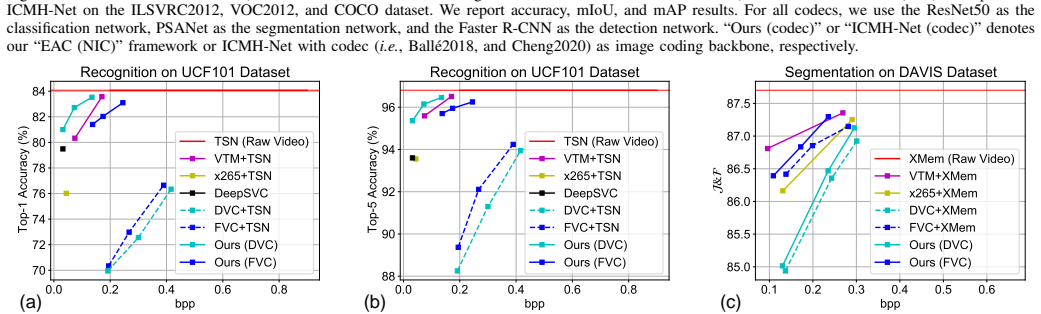
- [Section IV-C, Fig. 5] The central quantitative claims, including 'saves more than 33% bit-rate' at 0.79 mIoU and at 0.67 mAP@0.5, are supported only by RD subfigures with unreadable labels and no numerical tables. No error bars, standard deviations, or number of runs are given, and no code or data are released. The 33% figure cannot be checked from the text. Please add tables with the actual bpp, task-metric, and PSNR values for at least the key operating points, and report variance or standard deviations across at least three runs.
- [Section IV-C, 'Human Vision Results'] The claim that human-vision performance is maintained is circular: it asserts that because the same pre-trained codec and the 'full latent feature' are used, performance is similar to the baseline. This is only true under the partition assumption of Comment 1, and even then, the full-latent reconstruction would be identical to the baseline only if the masks perfectly reconstruct ŷ, which is not guaranteed given that unselected elements are filled with μ for the machine branches. Moreover, no numerical PSNR values are reported; the paper should compare PSNR (or MS-SSIM) of 'Ours' and the baseline at matched bitrates.
- [Section III-E, Eq. (4)] The paper states that a cumulative objective over T frames mitigates error propagation caused by transmitting only subsets of motion and residual latents in video. No ablation is provided: there is no experiment varying T, no comparison with single-frame training, and no measurement of reconstruction drift over time. Please either add evidence for this claim or soften the claim to what the experiments actually support.
minor comments (6)
- [Section IV-C] 'It is worse noting' should be 'It is worth noting' (Section IV-C). Section III-C misspells 'predictor' as 'Preditor'; Section III-D misspells 'reconstructed' as 'reconsturcted'; Section III-C has 'hyperperior' for 'hyperprior'.
- [Figures 5–8] The figure captions contain garbled Unicode tokens (e.g., '/uni00000013/...') that obscure the figure content; these artifacts must be cleaned in the final version.
- [Eq. (4)] Eq. (4) has an unbalanced parenthesis in the displayed formula; please fix the typesetting.
- [Notation] The notation is inconsistent: 'Ballé2018' and 'Cheng2020' are used both as abbreviations and as reference names (e.g., in captions and text). Use 'Ballé et al. [15]' and 'Cheng et al. [16]' consistently.
- [Section IV-B] The paper claims to outperform VTM 'across most bit-rates' but does not specify the bitrate range or whether VTM is used in intra-only mode for image comparison; please state the exact configuration.
- [Table I] Table I gives parameter counts but does not specify what is included in 'Adapter in EAC (NIC)' and 'Adapter in EAC (NVC)'; please clarify the adapter architecture and parameter count.
Circularity Check
Only minor by-construction element is human-vision parity, which the paper itself states; machine-vision claims are empirical and non-circular.
-
self definitional
[Section IV-C, 'Human Vision Results']
"As we adopt the same pre-trained codecs as our baseline method, and use the full latent feature for human vision. So the human vision performance in our methods (e.g., 'Ours (Cheng2020)') is similar to our baseline methods (e.g., 'Cheng2020')."
The paper presents 'maintaining the quality of human vision' as a result, but this result is entailed by the design choice of transmitting the full latent through the same frozen codec as the baseline. No independent prediction or fitted quantity is involved; the human-vision RD curve coincides with the baseline curve by construction. This is a minor self-definitional element and does not bear on the central machine-vision claims, which are empirically measured on held-out splits.
full rationale
The paper's central machine-vision claims are empirical systems results: the predictors and task-specific adapters are trained with rate-distortion and task losses (Eqs. 3-5) on training splits and evaluated on held-out test splits (VOC, COCO, UCF101, DAVIS). No fitted parameter is renamed as a prediction; the reported >33% bitrate savings and task-accuracy gains are measured RD points, not identities. Citations to the authors' conference version [25] provide predictor architecture details and a comparison baseline, but the multi-task improvements are supported by this paper's own ablations and test-set measurements, so the self-citations are not load-bearing. The skeptic's concern that the independently predicted binary masks may not form a true partition of the latent is a correctness or robustness risk, not a circularity, because the paper's rate and reconstruction claims are not defined to be true by the mask equations; they are asserted and then empirically evaluated. The only by-construction element is the human-vision parity, which the paper openly and correctly attributes to using the same pre-trained codec and the full latent for human vision. Overall, no significant circularity.
Assumptions & free parameters
free parameters (3)
- rate-distortion trade-off λ =
unreported
- number of latent subsets n =
unreported
- video context length T for cumulative loss =
unreported
assumptions (5)
- standard math Arithmetic encoding and decoding are lossless.
- domain assumption Pre-trained codec latents contain task-relevant structure separable by learned binary masks.
- domain assumption Replacing unselected latent elements with the predicted mean μ produces reconstructions adequate for downstream task networks.
- ad hoc to paper Frozen codec and task network parameters suffice; only predictors and adapters need training.
- ad hoc to paper Cumulative training over T frames eliminates error propagation in video coding.
Cite this review
Pith. "Pith review of An Efficient Adaptive Compression Method for Human Perception and Machine Vision Tasks." pith.science (2026). https://pith.science/paper/WCCUWXYK
@misc{pith2026250104329,
  author       = {Pith},
  title        = {Pith review of: An Efficient Adaptive Compression Method for Human Perception and Machine Vision Tasks},
  year         = {2026},
  howpublished = {\url{https://pith.science/paper/WCCUWXYK}},
  note         = {Machine review of arXiv:2501.04329}
}
read the original abstract
While most existing neural image compression (NIC) and neural video compression (NVC) methodologies have achieved remarkable success, their optimization is primarily focused on human visual perception. However, with the rapid development of artificial intelligence, many images and videos will be used for various machine vision tasks. Consequently, such existing compression methodologies cannot achieve competitive performance in machine vision. In this work, we introduce an efficient adaptive compression (EAC) method tailored for both human perception and multiple machine vision tasks. Our method involves two key modules: 1), an adaptive compression mechanism, that adaptively selects several subsets from latent features to balance the optimizations for multiple machine vision tasks (e.g., segmentation, and detection) and human vision. 2), a task-specific adapter, that uses the parameter-efficient delta-tuning strategy to stimulate the comprehensive downstream analytical networks for specific machine vision tasks. By using the above two modules, we can optimize the bit-rate costs and improve machine vision performance. In general, our proposed EAC can seamlessly integrate with existing NIC (i.e., Ball\'e2018, and Cheng2020) and NVC (i.e., DVC, and FVC) methods. Extensive evaluation on various benchmark datasets (i.e., VOC2007, ILSVRC2012, VOC2012, COCO, UCF101, and DAVIS) shows that our method enhances performance for multiple machine vision tasks while maintaining the quality of human vision.
Figures


Figures from the paper (5 more)




Forward citations
Cited by 1 Pith paper
-
HEMGS: A Hybrid Entropy Model for 3D Gaussian Splatting Data Compression
HEMGS compresses 3D Gaussian Splatting data with a single variable-rate model and a joint autoregressive/hyperprior entropy model, achieving roughly 40% smaller files than HAC at similar quality.
Reference graph
Works this paper leans on
-
[1]
Semantics-to-signal scal- able image compression with learned revertible representations,
K. Liu, D. Liu, L. Li, N. Yan, and H. Li, “Semantics-to-signal scal- able image compression with learned revertible representations,” Int. J. Comput. Vision, vol. 129, no. 9, pp. 2605–2621, 2021
work page 2021
-
[2]
Towards image understanding from deep compression without decoding,
R. Torfason, F. Mentzer, E. Agustsson, M. Tschannen, R. Timofte, and L. Van Gool, “Towards image understanding from deep compression without decoding,” Proc. Int. Conf. Learn. Representations , 2018
work page 2018
-
[4]
End-to-end compression towards machine vision: Network architecture design and optimization,
S. Wang, Z. Wang, S. Wang, and Y . Ye, “End-to-end compression towards machine vision: Network architecture design and optimization,” IEEE Open J. Circuits Syst. , vol. 2, pp. 675–685, 2021
work page 2021
-
[5]
Learn a compression for objection detection-vae with a bridge,
Y . Mei, F. Li, L. Li, and Z. Li, “Learn a compression for objection detection-vae with a bridge,” in IEEE Int. Conf. Vis. Commun. Image Process. IEEE, 2021, pp. 1–5
work page 2021
-
[6]
Image coding for machines: an end-to-end learned approach,
N. Le, H. Zhang, F. Cricri, R. Ghaznavi-Youvalari, and E. Rahtu, “Image coding for machines: an end-to-end learned approach,” in IEEE Int. Conf. Acoust. Speech Signal Process. , 2021, pp. 1590–1594
work page 2021
-
[7]
Y .-H. Chen, Y .-C. Weng, C.-H. Kao, C. Chien, W.-C. Chiu, and W.- H. Peng, “Transtic: Transferring transformer-based image compression from human perception to machine perception,” in Proc. IEEE Int. Conf. Comp. Vis., 2023, pp. 23 297–23 307
work page 2023
-
[8]
Scalable image coding for humans and machines,
H. Choi and I. V . Baji ´c, “Scalable image coding for humans and machines,” IEEE Trans. Image Process., vol. 31, pp. 2739–2754, 2022
work page 2022
-
[9]
Towards end-to-end image compression and analysis with transformers,
Y . Bai, X. Yang, X. Liu, J. Jiang, Y . Wang, X. Ji, and W. Gao, “Towards end-to-end image compression and analysis with transformers,” in Proc. Conf. AAAI, vol. 36, no. 1, 2022, pp. 104–112
work page 2022
Show all 72 references
-
[10]
Towards coding for human and machine vision: Scalable face image coding,
S. Yang, Y . Hu, W. Yang, L.-Y . Duan, and J. Liu, “Towards coding for human and machine vision: Scalable face image coding,” IEEE Trans. Multimedia, pp. 1–1, 2021
2021
-
[11]
Towards analysis-friendly face representation with scalable feature and texture compression,
S. Wang, S. Wang, W. Yang, X. Zhang, S. Wang, S. Ma, and W. Gao, “Towards analysis-friendly face representation with scalable feature and texture compression,” IEEE Trans. Multimedia , 2021
2021
-
[12]
Deepsvc: Deep scalable video coding for both machine and human vision,
H. Lin, B. Chen, Z. Zhang, J. Lin, X. Wang, and T. Zhao, “Deepsvc: Deep scalable video coding for both machine and human vision,” in Proc. ACM Int. Conf. Multimedia , 2023, pp. 9205–9214
2023
-
[13]
Non-semantics suppressed mask learning for unsupervised video semantic compression,
Y . Tian, G. Lu, G. Zhai, and Z. Gao, “Non-semantics suppressed mask learning for unsupervised video semantic compression,” in Proc. IEEE Int. Conf. Comp. Vis. , 2023, pp. 13 610–13 622
2023
-
[14]
Parameter-efficient fine-tuning of large- scale pre-trained language models,
N. Ding, Y . Qin, G. Yang, F. Wei, Z. Yang, Y . Su, S. Hu, Y . Chen, C.-M. Chan, W. Chen et al. , “Parameter-efficient fine-tuning of large- scale pre-trained language models,” Natu. Mach. Inte., vol. 5, no. 3, pp. 220–235, 2023
2023
-
[15]
Variational image compression with a scale hyperprior,
J. Ball ´e, D. Minnen, S. Singh, S. J. Hwang, and N. Johnston, “Variational image compression with a scale hyperprior,” in Proc. Int. Conf. Learn. Representations, 2018
2018
-
[16]
Learned image com- pression with discretized gaussian mixture likelihoods and attention modules,
Z. Cheng, H. Sun, M. Takeuchi, and J. Katto, “Learned image com- pression with discretized gaussian mixture likelihoods and attention modules,” in Proc. IEEE Conf. Comp. Vis. Patt. Recogn. , 2020, pp. 7939–7948
2020
-
[17]
Dvc: An end-to-end deep video compression framework,
G. Lu, W. Ouyang, D. Xu, X. Zhang, C. Cai, and Z. Gao, “Dvc: An end-to-end deep video compression framework,” in Proc. IEEE Conf. Comp. Vis. Patt. Recogn. , 2019, pp. 11 006–11 015
2019
-
[18]
Fvc: A new framework towards deep video compression in feature space,
Z. Hu, G. Lu, and D. Xu, “Fvc: A new framework towards deep video compression in feature space,” in Proc. IEEE Conf. Comp. Vis. Patt. Recogn., 2021, pp. 1502–1511
2021
-
[19]
Imagenet: A large-scale hierarchical image database,
J. Deng, W. Dong, R. Socher, L.-J. Li, K. Li, and L. Fei-Fei, “Imagenet: A large-scale hierarchical image database,” in Proc. IEEE Conf. Comp. Vis. Patt. Recogn., 2009, pp. 248–255
2009
-
[20]
The pascal visual object classes (voc) challenge,
M. Everingham, L. Van Gool, C. K. Williams, J. Winn, and A. Zisser- man, “The pascal visual object classes (voc) challenge,” Int. J. Comput. Vision, vol. 88, pp. 303–338, 2010
2010
-
[21]
Microsoft coco: Common objects in context,
T.-Y . Lin, M. Maire, S. Belongie, J. Hays, P. Perona, D. Ramanan, P. Doll ´ar, and C. L. Zitnick, “Microsoft coco: Common objects in context,” in Proc. Eur. Conf. Comp. Vis. Springer, 2014, pp. 740–755
2014
-
[22]
Ucf101: A dataset of 101 human actions classes from videos in the wild,
K. Soomro, A. R. Zamir, and M. Shah, “Ucf101: A dataset of 101 human actions classes from videos in the wild,”arXiv preprint arXiv:1212.0402, 2012
2012 arXiv
-
[24]
Vvc test model (vtm),
“Vvc test model (vtm),” 2022, https://jvet.hhi.fraunhofer.de/, ac- cessed:2024. JOURNAL OF LATEX CLASS FILES, VOL. 14, NO. 8, AUGUST 2021 10
2022
-
[25]
Icmh-net: Neural image compres- sion towards both machine vision and human vision,
L. Liu, Z. Hu, Z. Chen, and D. Xu, “Icmh-net: Neural image compres- sion towards both machine vision and human vision,” in Proc. ACM Int. Conf. Multimedia, 2023, pp. 8047–8056
2023
-
[26]
End-to-end optimized image compression,
J. Ball ´e, V . Laparra, and E. P. Simoncelli, “End-to-end optimized image compression,” in Proc. Int. Conf. Learn. Representations , 2017
2017
-
[27]
Joint autoregressive and hierarchical priors for learned image compression,
D. Minnen, J. Ball ´e, and G. D. Toderici, “Joint autoregressive and hierarchical priors for learned image compression,” Advances in Neural Inf. Process. Syst. , vol. 31, 2018
2018
-
[28]
Neural data-dependent transform for learned image compression,
D. Wang, W. Yang, Y . Hu, and J. Liu, “Neural data-dependent transform for learned image compression,” in Proc. IEEE Conf. Comp. Vis. Patt. Recogn., 2022, pp. 17 379–17 388
2022
-
[29]
The devil is in the details: Window- based attention for image compression,
R. Zou, C. Song, and Z. Zhang, “The devil is in the details: Window- based attention for image compression,” in Proc. IEEE Conf. Comp. Vis. Patt. Recogn., 2022, pp. 17 492–17 501
2022
-
[30]
Unified multivariate gaussian mixture for efficient neural image compression,
X. Zhu, J. Song, L. Gao, F. Zheng, and H. T. Shen, “Unified multivariate gaussian mixture for efficient neural image compression,” in Proc. IEEE Conf. Comp. Vis. Patt. Recogn. , 2022, pp. 17 612–17 621
2022
-
[31]
Variable-rate deep image compression through spatially-adaptive feature transform,
M. Song, J. Choi, and B. Han, “Variable-rate deep image compression through spatially-adaptive feature transform,” in Proc. IEEE Int. Conf. Comp. Vis., 2021, pp. 2380–2389
2021
-
[32]
Slimmable compressive autoencoders for practical neural image compression,
F. Yang, L. Herranz, Y . Cheng, and M. G. Mozerov, “Slimmable compressive autoencoders for practical neural image compression,” in Proc. IEEE Conf. Comp. Vis. Patt. Recogn. , 2021, pp. 4998–5007
2021
-
[33]
Learning accurate entropy model with global reference for image compression,
Y . Qian, Z. Tan, X. Sun, M. Lin, D. Li, Z. Sun, L. Hao, and R. Jin, “Learning accurate entropy model with global reference for image compression,” in Proc. Int. Conf. Learn. Representations , 2021
2021
-
[34]
Learned block-based hybrid image compression,
Y . Wu, X. Li, Z. Zhang, X. Jin, and Z. Chen, “Learned block-based hybrid image compression,” IEEE Trans. Circuits Syst. Video Technol. , vol. 32, no. 6, pp. 3978–3990, 2021
2021
-
[35]
Asymmetric gained deep image compression with continuous rate adaptation,
Z. Cui, J. Wang, S. Gao, T. Guo, Y . Feng, and B. Bai, “Asymmetric gained deep image compression with continuous rate adaptation,” in Proc. IEEE Conf. Comp. Vis. Patt. Recogn. , 2021, pp. 10 532–10 541
2021
-
[36]
Content adaptive latents and decoder for neural image compression,
G. Pan, G. Lu, Z. Hu, and D. Xu, “Content adaptive latents and decoder for neural image compression,” in Proc. Eur. Conf. Comp. Vis. Springer, 2022, pp. 556–573
2022
-
[37]
Elic: Efficient learned image compression with unevenly grouped space- channel contextual adaptive coding,
D. He, Z. Yang, W. Peng, R. Ma, H. Qin, and Y . Wang, “Elic: Efficient learned image compression with unevenly grouped space- channel contextual adaptive coding,” in Proc. IEEE Conf. Comp. Vis. Patt. Recogn., 2022, pp. 5718–5727
2022
-
[38]
Cra5: Extreme com- pression of era5 for portable global climate and weather research via an efficient variational transformer,
T. Han, Z. Chen, S. Guo, W. Xu, and L. Bai, “Cra5: Extreme com- pression of era5 for portable global climate and weather research via an efficient variational transformer,” arXiv preprint arXiv:2405.03376 , 2024
2024 arXiv
-
[39]
Pchm-net: A new point cloud compression framework for both human vision and machine vision,
L. Liu, Z. Hu, and J. Zhang, “Pchm-net: A new point cloud compression framework for both human vision and machine vision,” Proc. IEEE Int. Conf. Multimedia Expo , 2023
2023
-
[40]
M-lvc: Multiple frames prediction for learned video compression,
J. Lin, D. Liu, H. Li, and F. Wu, “M-lvc: Multiple frames prediction for learned video compression,” in Proc. IEEE Conf. Comp. Vis. Patt. Recogn., 2020, pp. 3546–3554
2020
-
[41]
Scale-space flow for end-to-end optimized video compres- sion,
E. Agustsson, D. Minnen, N. Johnston, J. Balle, S. J. Hwang, and G. Toderici, “Scale-space flow for end-to-end optimized video compres- sion,” in Proc. IEEE Conf. Comp. Vis. Patt. Recogn. , 2020, pp. 8503– 8512
2020
-
[42]
Neural inter-frame compression for video coding,
A. Djelouah, J. Campos, S. Schaub-Meyer, and C. Schroers, “Neural inter-frame compression for video coding,” in Proc. IEEE Int. Conf. Comp. Vis., 2019, pp. 6421–6429
2019
-
[43]
Video compression with rate-distortion autoencoders,
A. Habibian, T. v. Rozendaal, J. M. Tomczak, and T. S. Cohen, “Video compression with rate-distortion autoencoders,” in Proc. IEEE Int. Conf. Comp. Vis., 2019, pp. 7033–7042
2019
-
[44]
Improving deep video compression by resolution-adaptive flow coding,
Z. Hu, Z. Chen, D. Xu, G. Lu, W. Ouyang, and S. Gu, “Improving deep video compression by resolution-adaptive flow coding,” in Proc. Eur. Conf. Comp. Vis. Springer, 2020, pp. 193–209
2020
-
[45]
Exploiting intra-slice and inter-slice redundancy for learning-based lossless volumetric image compression,
Z. Chen, S. Gu, G. Lu, and D. Xu, “Exploiting intra-slice and inter-slice redundancy for learning-based lossless volumetric image compression,” IEEE Trans. Image Process. , vol. 31, pp. 1697–1707, 2022
2022
-
[46]
Coarse-to-fine deep video coding with hyperprior-guided mode prediction,
Z. Hu, G. Lu, J. Guo, S. Liu, W. Jiang, and D. Xu, “Coarse-to-fine deep video coding with hyperprior-guided mode prediction,” in Proc. IEEE Conf. Comp. Vis. Patt. Recogn. , 2022, pp. 5921–5930
2022
-
[47]
Content adaptive and error propagation aware deep video compression,
G. Lu, C. Cai, X. Zhang, L. Chen, W. Ouyang, D. Xu, and Z. Gao, “Content adaptive and error propagation aware deep video compression,” in Proc. Eur. Conf. Comp. Vis. Springer, 2020, pp. 456–472
2020
-
[48]
An end- to-end learning framework for video compression,
G. Lu, X. Zhang, W. Ouyang, L. Chen, Z. Gao, and D. Xu, “An end- to-end learning framework for video compression,” IEEE Trans. Pattern Anal. Mach. Intell. , vol. 43, no. 10, pp. 3292–3308, 2020
2020
-
[49]
Learning for video compression with hierarchical quality and recurrent enhancement,
R. Yang, F. Mentzer, L. V . Gool, and R. Timofte, “Learning for video compression with hierarchical quality and recurrent enhancement,” in Proc. IEEE Conf. Comp. Vis. Patt. Recogn. , 2020, pp. 6628–6637
2020
-
[50]
Improving facial attribute recognition by group and graph learning,
Z. Chen, S. Gu, F. Zhu, J. Xu, and R. Zhao, “Improving facial attribute recognition by group and graph learning,” in Proc. IEEE Int. Conf. Multimedia Expo. IEEE, 2021, pp. 1–6
2021
-
[51]
Towards point cloud compression for machine perception: A simple and strong baseline by learning the octree depth level predictor,
L. Liu, Z. Hu, and Z. Chen, “Towards point cloud compression for machine perception: A simple and strong baseline by learning the octree depth level predictor,” arXiv preprint arXiv:2406.00791 , 2024
2024 arXiv
-
[52]
Deep contextual video compression,
J. Li, B. Li, and Y . Lu, “Deep contextual video compression,” Advances in Neural Inf. Process. Syst. , vol. 34, pp. 18 114–18 125, 2021
2021
-
[53]
Lsvc: A learning- based stereo video compression framework. in 2022 ieee,
Z. Chen, G. Lu, Z. Hu, S. Liu, W. Jiang, and D. Xu, “Lsvc: A learning- based stereo video compression framework. in 2022 ieee,” in Proc. IEEE Conf. Comp. Vis. Patt. Recogn. , 2022, pp. 6063–6072
2022
-
[54]
Temporal context mining for learned video compression,
X. Sheng, J. Li, B. Li, L. Li, D. Liu, and Y . Lu, “Temporal context mining for learned video compression,” IEEE Trans. Multimedia, 2022
2022
-
[55]
Hybrid spatial-temporal entropy modelling for neural video compression,
J. Li, B. Li, and Y . Lu, “Hybrid spatial-temporal entropy modelling for neural video compression,” in Proc. ACM Int. Conf. Multimedia , 2022, pp. 1503–1511
2022
-
[56]
Neural video compression with spatio-temporal cross- covariance transformers,
Z. Chen, L. Relic, R. Azevedo, Y . Zhang, M. Gross, D. Xu, L. Zhou, and C. Schroers, “Neural video compression with spatio-temporal cross- covariance transformers,” in Proc. ACM Int. Conf. Multimedia, 2023, pp. 8543–8551
2023
-
[57]
Group-aware parameter-efficient updating for content-adaptive neural video compression,
Z. Chen, L. Zhou, Z. Hu, and D. Xu, “Group-aware parameter-efficient updating for content-adaptive neural video compression,” in Proceedings of the 32nd ACM International Conference on Multimedia , 2024, pp. 11 022–11 031
2024
-
[58]
Video coding for machines: A paradigm of collaborative compression and intelligent analytics,
L. Duan, J. Liu, W. Yang, T. Huang, and W. Gao, “Video coding for machines: A paradigm of collaborative compression and intelligent analytics,” IEEE Trans. Image Process. , vol. 29, pp. 8680–8695, 2020
2020
-
[59]
AdapterHub: A framework for adapting transformers,
J. Pfeiffer, A. R ¨uckl´e, C. Poth, A. Kamath, I. Vuli ´c, S. Ruder, K. Cho, and I. Gurevych, “AdapterHub: A framework for adapting transformers,” in Proc. Conf. Empirical Methods in Natural Language Processing, Oct. 2020, pp. 46–54
2020
-
[60]
Towards a unified view of parameter-efficient transfer learning,
J. He, C. Zhou, X. Ma, T. Berg-Kirkpatrick, and G. Neubig, “Towards a unified view of parameter-efficient transfer learning,” in Proc. Int. Conf. Learn. Representations, 2022
2022
-
[61]
Counter-interference adapter for multilingual machine translation,
Y . Zhu, J. Feng, C. Zhao, M. Wang, and L. Li, “Counter-interference adapter for multilingual machine translation,” in Proc. Conf. Empirical Methods in Natural Language Processing , 2021, pp. 2812–2823
2021
-
[62]
SparseAdapter: An easy approach for improving the parameter-efficiency of adapters,
S. He, L. Ding, D. Dong, J. Zhang, and D. Tao, “SparseAdapter: An easy approach for improving the parameter-efficiency of adapters,” in Proc. Conf. Empirical Methods in Natural Language Processing , Dec. 2022, pp. 2184–2190
2022
-
[63]
Compacter: Efficient low-rank hypercomplex adapter layers,
R. Karimi Mahabadi, J. Henderson, and S. Ruder, “Compacter: Efficient low-rank hypercomplex adapter layers,”Advances in Neural Inf. Process. Syst., vol. 34, pp. 1022–1035, 2021
2021
-
[64]
Krona: Parameter efficient tuning with kronecker adapter,
A. Edalati, M. Tahaei, I. Kobyzev, V . P. Nia, J. J. Clark, and M. Reza- gholizadeh, “Krona: Parameter efficient tuning with kronecker adapter,” Advances in Neural Inf. Process. Syst. , 2022
2022
-
[65]
Selective compression learning of latent representations for variable-rate image compression,
J. Lee, S. Jeong, and M. Kim, “Selective compression learning of latent representations for variable-rate image compression,” Advances in Neural Inf. Process. Syst. , vol. 35, pp. 13 146–13 157, 2022
2022
-
[66]
Deep residual learning for image recognition,
K. He, X. Zhang, S. Ren, and J. Sun, “Deep residual learning for image recognition,” in Proc. IEEE Conf. Comp. Vis. Patt. Recogn. , 2016, pp. 770–778
2016
-
[67]
Psanet: Point-wise spatial attention network for scene parsing,
H. Zhao, Y . Zhang, S. Liu, J. Shi, C. C. Loy, D. Lin, and J. Jia, “Psanet: Point-wise spatial attention network for scene parsing,” in Proc. Eur. Conf. Comp. Vis., 2018, pp. 267–283
2018
-
[68]
Faster r-cnn: Towards real-time object detection with region proposal networks,
S. Ren, K. He, R. Girshick, and J. Sun, “Faster r-cnn: Towards real-time object detection with region proposal networks,” Advances in Neural Inf. Process. Syst., vol. 28, 2015
2015
-
[69]
Categorical reparametrization with gumble-softmax,
E. Jang, S. Gu, and B. Poole, “Categorical reparametrization with gumble-softmax,” in Proc. Int. Conf. Learn. Representations , 2017
2017
-
[70]
Temporal segment networks: Towards good practices for deep action recognition,
L. Wang, Y . Xiong, Z. Wang, Y . Qiao, D. Lin, X. Tang, and L. Van Gool, “Temporal segment networks: Towards good practices for deep action recognition,” in Proc. Eur. Conf. Comp. Vis. Springer, 2016, pp. 20–36
2016
-
[71]
Xmem: Long-term video object segmentation with an atkinson-shiffrin memory model,
H. K. Cheng and A. G. Schwing, “Xmem: Long-term video object segmentation with an atkinson-shiffrin memory model,” in Proc. Eur. Conf. Comp. Vis. Springer, 2022, pp. 640–658
2022
-
[72]
A benchmark dataset and evaluation methodology for video object segmentation,
F. Perazzi, J. Pont-Tuset, B. McWilliams, L. Van Gool, M. Gross, and A. Sorkine-Hornung, “A benchmark dataset and evaluation methodology for video object segmentation,” in Proc. IEEE Conf. Comp. Vis. Patt. Recogn., 2016, pp. 724–732
2016
-
[73]
Adam: A method for stochastic optimization,
D. P. Kingma and J. Ba, “Adam: A method for stochastic optimization,” in Proc. Int. Conf. Learn. Representations , 2015
2015
-
[74]
Bpg image format,
B. Fabrice, “Bpg image format,” 2018, http://bellard.org/bpg/, ac- cessed:2022
2018
Reviewed August 10, 2026 · model on record in the stance chip above.
Discussion (0). Continue with ORCID to comment.