REVIEW 4 major objections 5 minor 4 cited by
Periodic orbits and their gravitational wave radiations around the Schwarzschild-MOG black hole
T0 review · 4 major / 5 minor · reviewed 2026-08-10 · deepseek-v4-flash
Pith's one-line read The paper claims that the MOG parameter alpha shifts periodic-orbit energies around a Schwarzschild-MOG black hole relative to Schwarzschild: lower for alpha>0, higher for -1<alpha<0.
desk verdict A routine periodic-orbit extension to a metric that is Reissner-Nordstrom in disguise for α>0; the headline energy ordering is confounded by the Lav convention, and the IBCO formula as printed does not work. read the letter →
The pith
A machine-rendered reading of the paper's core claim, the machinery that carries it, and where it could break.
The reading
What carries the argument
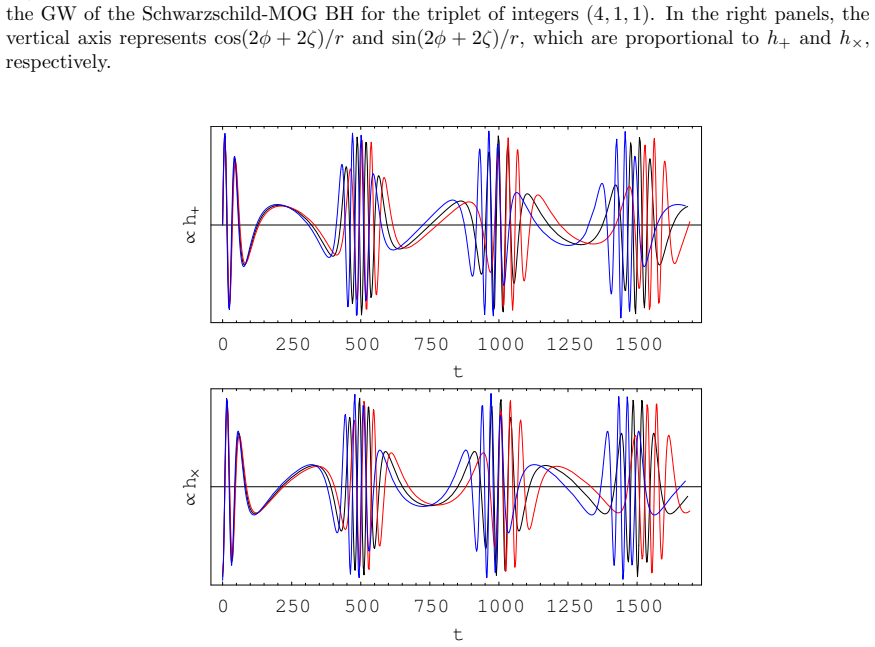
The argument is carried by the rational orbit label $q = w + v/z$, defined from the azimuthal advance $\Delta\phi$ between successive apastra by $q = \Delta\phi/(2\pi) - 1$ and computed by an integral over the radial turning points (Eq. 25), together with the MOG-modified effective potential $V_{\rm eff}(r) = (1 - 2M(1+\alpha)/r + M^2\alpha(1+\alpha)/r^2)(L^2/r^2 + 1)$. The label and the chosen angular momentum $L_{av}$ select a unique periodic orbit, so the energy for each $(z,w,v)$ can be read off; the same potential determines the ISCO, IBCO and photon-sphere radii. For the waveforms the paper adopts the kludge quadrupole formula $h_{ij} = 4\eta M/D_L (V_i V_j - m/r\, n_i n_j)$ and its circular-orbit projection, which yields $h_+ \propto \cos(2\phi+2\zeta)/r$ and $h_\times \propto \sin(2\phi+2\zeta)/r$.
What would settle it
Recompute the (z,w,v) periodic-orbit energies for Schwarzschild-MOG with an independent high-precision integrator and without fixing L = L_av, or compute the emitted radiation with a full black-hole perturbation scheme; if the energy ordering E(alpha>0) < E_Schwarzschild reverses for any orbit label, or if the waveform phases differ by more than a radian over one inspiral timescale, the central claim fails.
Extended reading notes
Core claim
For a test particle moving between the ISCO and IBCO of a Schwarzschild-MOG black hole, the paper finds that the energy E(z,w,v) needed to realize a given periodic orbit, labeled by the integers (z,w,v), depends monotonically on the MOG parameter alpha when angular momentum is fixed to the average L_av = (L_ISCO + L_IBCO)/2. For alpha > 0 the energy is lower than the corresponding Schwarzschild value, while for -1 < alpha < 0 it is higher. The same parameter increases the horizon, photon-sphere, ISCO and IBCO radii, so the whole allowed band of bound orbits moves outward as alpha grows. In the extremal case alpha = -1 the event and Cauchy horizons coincide and the ISCO radius diverges, so the periodic-orbit analysis is restricted to alpha in (-1, infinity).
Load-bearing premise
The gravitational waveforms are computed with a circular-orbit formula (Eqs. 28-29), but the periodic orbits studied here are strongly eccentric zoom-whirl trajectories, and the paper does not test whether that formula remains valid in this regime.
Editorial extensions
If this is right
- If alpha > 0, an extreme-mass-ratio inspiral around a Schwarzschild-MOG black hole will pass through the periodic-orbit sequence with less energy per rational label than in Schwarzschild, shifting the inspiral rate and the emitted frequency evolution.
- The monotonic energy shift lets the rational orbit label serve as a diagnostic for the MOG parameter: identifying the (z,w,v) template in a measured waveform would place bounds on alpha.
- Because the ISCO, IBCO, and horizon radii all grow with alpha, the allowed band of bound orbits moves outward, so an inspiral in MOG will end with a larger final circular orbit before plunge for alpha > 0.
- In the extremal case alpha = -1 the horizon structure degenerates and the ISCO radius diverges, so the paper's periodic-orbit analysis, which requires a finite band between ISCO and IBCO, only applies for alpha in (-1, infinity).
Reading between the lines
- An immediate test of the energy ordering is to repeat the tables with L fixed at a different representative value (not L_av); if the monotonic direction is an artifact of the averaging convention, the central claim would weaken.
- The kludge generator likely underestimates the distinguishability of MOG from Schwarzschild because the circular-orbit projection discards the strong-field multipole structure; a full perturbation calculation could reveal larger phase differences and make alpha easier to constrain with future space-based detectors.
- The same Hamiltonian-plus-taxonomy pipeline could be applied to rotating Kerr-MOG or MOG with a cosmological constant to check whether the energy shift direction persists across the family of modified spacetimes.
- If the shift is monotone and known as a function of alpha, then an observed EMRI waveform's orbit-label sequence could be inverted to estimate alpha while simultaneously fitting the central mass, though systematic waveform-model error would dominate the error budget.
Editorial analysis
A structured set of objections, weighed in public.
Referee Report
Summary. The paper studies timelike geodesics in the Schwarzschild-MOG (STVG) black-hole spacetime, parametrized by the MOG parameter α. It derives the geodesic equations and effective potential via a Hamiltonian formalism, identifies the ISCO, IBCO, and photon-sphere radii, and then applies the Levin-Perez-Giz taxonomy to construct periodic orbits characterized by rational numbers q = w + v/z. The central claim is an energy-ordering statement: for α>0 the periodic-orbit energies are lower than in Schwarzschild, while for -1<α<0 they are higher. The paper also studies precessing orbits near periodic orbits and computes gravitational-wave polarizations using a kludge-type formula for an EMRI configuration. The main quantitative results are presented in Tables 1-2 and in the waveform plots of Sections 6.
Significance. If the central energy-ordering claim is correct, the paper would provide a clean qualitative signature of the MOG parameter in periodic-orbit energies and waveform morphology. The geodesic setup and the use of the rational-orbit taxonomy are standard, and the α=0 limit of the ISCO formula checks out. However, the headline claim is currently read off from tables that vary both α and L, the IBCO formula is problematic as printed for α>0, and the gravitational-wave section applies a circular-orbit projection to highly eccentric zoom-whirl orbits without validation. These are load-bearing issues: until they are resolved, the paper's main conclusions are not established. The paper does not ship code or machine-checked derivations, but the numerical tables are reproducible in principle from Eq. (25).
major comments (4)
- [Eqs. (19)-(20)] The IBCO formula is not usable as printed for the positive-α branch that the paper emphasizes. The expression for Z contains the square root of -32α^3 -69α^4 -42α^5 -5α^6, whose argument is negative for every α>0; hence Z is complex or undefined over the reals for exactly the α values used in Table 2 and in the positive-α figures. In addition, if the prefactor in the second term of Eq. (19) is interpreted as 4/∛2 rather than 4∛2, the α=0 limit does not reduce to rIBCO=4M. The authors should state the unambiguous real algebraic form used to compute LIBCO, verify the α=0 limit, and report values for the α>0 cases explicitly.
- [Section 4, Tables 1-2] The central energy-ordering claim is confounded by the simultaneous variation of L and α. Each row of Tables 1-2 uses a different angular momentum L=Lav(α) defined by Eq. (21), and q in Eq. (25) depends on E, L, and α. Thus the comparison 'for α>0 energies are lower, for -1<α<0 energies are higher' does not isolate the effect of the MOG parameter; it also moves L across the allowed interval. The statement after Tables 1-2 and in the abstract therefore needs either a fixed-L comparison, a physical prescription for choosing L, or a demonstration that the ordering is robust under different choices of representative angular momentum.
- [Table 1] Table 1 contains an internal inconsistency: the rows for α=-0.2 and α=-0.1 have different Lav entries but identical entries in all four energy columns. This indicates that at least one of these rows was not produced by solving Eq. (25) for the stated Lav, and it undermines confidence in the numerical data feeding the energy-ordering comparison. The table should be regenerated and checked.
- [Section 6, Eqs. (27)-(31)] The gravitational-wave results are not supported by the formulas used. Equations (28)-(29) are the leading-order circular-orbit polarization projections, yet they are evaluated on the highly eccentric, zoom-whirl trajectories shown in Figs. 8-13. For a general eccentric geodesic, the radiation contains multiple harmonics and the amplitude and phase structure differ from cos(2ϕ+2ζ)/r and sin(2ϕ+2ζ)/r. No justification, derivation, or numerical cross-check is given for applying this circular-orbit kludge to these orbits. The waveform plots should either be derived from a genuinely general kludge/quadrupole integral, or the section should be explicitly restricted to a regime where the approximation is controlled.
minor comments (5)
- [Eq. (21) and Section 4] The definition of Lav as the arithmetic mean of LISCO and LIBCO is an arbitrary convention. Since the paper uses this convention as the basis for all energy tables, its role should be stated more transparently and, ideally, accompanied by a sensitivity test.
- [Figure 4] The left panel caption says q is plotted versus E for several α, but the right panel's description 'with the energy kept fixed for the (1,1,0) orbit' is not precise enough; please specify which energy value is held fixed for each α.
- [Figure 5] The first panel of Fig. 5 has the energy label E=0.957888 but no (z,w,v) label or α value; the reader cannot identify which periodic orbit it represents.
- [Reference [35]] Reference [35] appears to be an unrelated CMS search paper, not a Taiji gravitational-wave detector reference; the citation should be corrected.
- [Throughout] There are typographical inconsistencies such as 'processing orbits' in the abstract and 'Precession' in the section heading; these should be harmonized.
Circularity Check
No significant circularity: orbit energies are computed from the geodesic integral, not fitted or defined from the target claim.
full rationale
The paper's central result, the alpha-dependent ordering of periodic-orbit energies, is obtained by solving Eq. (25) for E at fixed rational q and fixed L = Lav(alpha). The target ordering is not an input to any equation: E is neither fitted to the Schwarzschild comparison nor defined in terms of it. The Lav convention, while arbitrary and potentially confounding because it changes L with alpha, is an analysis choice rather than a circular derivation, since Lav is computed from LISCO and LIBCO and does not encode the final energy values. The metric, effective potential, ISCO, and IBCO are external theory inputs, and the ISCO/IBCO conditions are standard geodesic conditions, not restatements of the periodic-orbit energies. The gravitational-wave section applies an externally referenced kludge formula (Eqs. 27-29) to the already-computed orbits; the waveform plots are consequences of the orbital kinematics, not independent predictions fitted to those same orbits. There are no load-bearing self-citations, no uniqueness theorem imported from the authors' prior work, and no ansatz smuggled in via a self-citation. The duplicated Table 1 row for alpha = -0.2 and -0.1 and the questionable IBCO expression (Eqs. 19-20) are correctness and internal-consistency concerns, not circularity. Accordingly, the derivation chain is self-contained with respect to circularity.
Assumptions & free parameters
free parameters (2)
- Lav (average angular momentum) =
varies with alpha; e.g., 3.732055 for alpha = 0
- Inclination angle iota and latitudinal angle zeta =
pi/4
assumptions (4)
- domain assumption The Schwarzschild-MOG metric (Eq. 1) is the correct vacuum solution of MOG/STVG and the parameter alpha is a free theory parameter.
- domain assumption The Levin-Perez-Giz rational periodic orbit taxonomy applies to this static, spherically symmetric spacetime.
- ad hoc to paper The kludge gravitational waveform formula (27) and the projection (28)-(29) are valid for computing GWs from test particles on these periodic orbits.
- standard math The Hamiltonian normalization and separation constant setup (Eqs. (6)-(12)) are standard.
Cite this review
Pith. "Pith review of Periodic orbits and their gravitational wave radiations around the Schwarzschild-MOG black hole." pith.science (2026). https://pith.science/paper/ARE4SGXN
@misc{pith2026250104367,
  author       = {Pith},
  title        = {Pith review of: Periodic orbits and their gravitational wave radiations around the Schwarzschild-MOG black hole},
  year         = {2026},
  howpublished = {\url{https://pith.science/paper/ARE4SGXN}},
  note         = {Machine review of arXiv:2501.04367}
}
abstract
This article explores the motion of massive particles in the gravitational field of a modified gravity (MOG) black hole (BH), characterized by the parameter $\alpha$. Using the Hamiltonian formalism, the geodesic equations and the effective potential governing particle trajectories are derived. Key features, including the innermost stable circular orbit (ISCO) and the innermost bound circular orbit (IBCO), are analyzed, revealing their dependence on the particle's energy, angular momentum, and the MOG parameter. In the extremal case, where $\alpha=-1$, the event horizon merges with the Cauchy horizon, forming a distinctive BH configuration. Numerical methods are employed to compute periodic orbits in this spacetime, with a comparison drawn to the Schwarzschild BH. The findings indicate that for $\alpha>0$, periodic orbits around Schwarzschild-MOG BH exhibit lower energy requirements than those in Schwarzschild spacetime, whereas for $-1<\alpha<0$, the energy requirements are higher. Precessing orbits near periodic trajectories are also examined, offering insights into their complex dynamical behavior. Finally, the gravitational wave (GW) radiation from the periodic orbits of a test particle around the Schwarzschild-MOG BH is examined, generating intricate waveforms that provide insights into the gravitational structure of the system.
Figures


Figures from the paper (10 more)


Forward citations
Cited by 4 Pith papers
-
Rational Orbits and Gravitational Waves in Static Spherical Spacetimes: An Open-Source Numerical Framework
Open-source numerical package for rational orbits and gravitational waves in static spherically symmetric spacetimes, validated on Schwarzschild and applied to an IMBH-Sgr A* EMRI.
-
Gravitational wave signatures of magnetized Ernst black hole
Magnetic fields in the Ernst black-hole spacetime alter zoom-whirl EMRI waveforms, spectra, and characteristic strain in ways the authors claim LISA-class detectors could probe.
-
Periodic Timelike Motion and Gravitational Wave Signatures around a Magnetically Charged Black Hole Surrounded by Quintessence
Quintessence shifts orbital radii, turning points, and zoom-whirl parameters for timelike geodesics around a magnetically charged black hole, producing burst-like gravitational waveforms whose phase, timing, and milli...
-
Chaotic imprints of dark matter in extreme mass-ratio inspirals
A toy model shows that adding a hand-made angle-dependent force to dark-matter spacetimes produces visual chaos and irregular numerical-Kludge waveforms, but the force is not a realistic dark-matter perturbation.
Reference graph
Works this paper leans on
-
[30]
Rational orbits around charged black holes,
V. Misra and J. Levin, “Rational orbits around charged black holes,” Physical Review D, vol. 82, no. 8, p. 083001, (2010)
work page 2010
-
[1]
¨Uber das gravitationsfeld eines massenpunktes nach der einsteinschen the- orie,
K. Schwarzschild, “ ¨Uber das gravitationsfeld eines massenpunktes nach der einsteinschen the- orie,” Sitzungsberichte der k¨ oniglich preussischen Akademie der Wissenschaften, pp. 189–196, (1916)
work page 1916
-
[2]
C. Jia, “Gravitational waves through time: Scientific significance, detection techniques, and recent breakthroughs,” arXiv preprint arXiv:2312.16198, (2023)
arXiv 2023
-
[3]
Oscillations of general relativistic superfluid neutron stars,
N. Andersson, G. L. Comer, and D. Langlois, “Oscillations of general relativistic superfluid neutron stars,” Physical Review D, vol. 66, no. 10, p. 104002, (2002)
work page 2002
-
[4]
Deflection of light to second order: A tool for illustrating principles of general relativity,
J. Bodenner and C. M. Will, “Deflection of light to second order: A tool for illustrating principles of general relativity,” American Journal of Physics, vol. 71, no. 8, pp. 770–773, (2003)
work page 2003
-
[5]
Hunting for extra dimensions in the shadow of M87,
S. Vagnozzi and L. Visinelli, “Hunting for extra dimensions in the shadow of M87,” Physical Review D, vol. 100, no. 2, p. 024020, (2019)
work page 2019
-
[6]
G. Bertone and D. Hooper, “History of dark matter,” Reviews of Modern Physics, vol. 90, no. 4, p. 045002, (2018)
work page 2018
-
[7]
A new era in the search for dark matter,
G. Bertone and T. M. P. Tait, “A new era in the search for dark matter,” Nature, vol. 562, no. 7725, pp. 51–56, (2018)
work page 2018
Show all 51 references
-
[8]
Exploring exotica: WIMPs and axions,
K. Freeman and G. McNamara, “Exploring exotica: WIMPs and axions,” In Search of Dark Matter, pp. 123–130, (2006)
2006
-
[9]
Particle dark matter: Evidence, candidates and con- straints,
G. Bertone, D. Hooper, and J. Silk, “Particle dark matter: Evidence, candidates and con- straints,” Physics Reports, vol. 405, no. 5-6, pp. 279–390, (2005)
2005
-
[10]
Scalar–tensor–vector gravity theory,
J. W. Moffat, “Scalar–tensor–vector gravity theory,” Journal of Cosmology and Astroparticle Physics, vol. 2006, no. 03, p. 004, (2006). 20
2006
-
[11]
Time delay predictions in a modified gravity theory,
J. W. Moffat, “Time delay predictions in a modified gravity theory,” Classical and Quantum Gravity, vol. 23, no. 23, p. 6767, (2006)
2006
-
[12]
The MOG weak field approximation and observational test of galaxy rotation curves,
J. W. Moffat and S. Rahvar, “The MOG weak field approximation and observational test of galaxy rotation curves,” Monthly Notices of the Royal Astronomical Society, vol. 436, no. 2, pp. 1439–1451, (2013)
2013
-
[13]
Rotational velocity curves in the Milky Way as a test of modified gravity,
J. W. Moffat and V. Toth, “Rotational velocity curves in the Milky Way as a test of modified gravity,” Physical Review D, vol. 91, no. 4, p. 043004, (2015)
2015
-
[14]
The MOG weak field approximation–ii. observational test of Chandra X-ray clusters,
J. W. Moffat and S. Rahvar, “The MOG weak field approximation–ii. observational test of Chandra X-ray clusters,” Monthly Notices of the Royal Astronomical Society, vol. 441, no. 4, pp. 3724–3732, (2014)
2014
-
[15]
Scalar and vector field constraints, deflection of light and lensing in modified gravity (MOG),
J. W. Moffat, “Scalar and vector field constraints, deflection of light and lensing in modified gravity (MOG),” arXiv preprint arXiv:1410.2464, (2014)
2014 arXiv
-
[16]
Structure growth and the CMB in modified gravity (MOG),
J. W. Moffat, “Structure growth and the CMB in modified gravity (MOG),” arXiv preprint arXiv:1409.0853, (2014)
2014 arXiv
-
[17]
Black holes in modified gravity (MOG),
J. W. Moffat, “Black holes in modified gravity (MOG),” The European Physical Journal C, vol. 75, no. 4, p. 175, (2015)
2015
-
[18]
Modified gravity black holes and their observable shadows,
J. W. Moffat, “Modified gravity black holes and their observable shadows,” The European Physical Journal C, vol. 75, no. 3, p. 130, (2015)
2015
-
[19]
Kerr-MOG-(A) dS black hole and its shadow in scalar-tensor-vector gravity theory,
W. Liu, D. Wu, X. Fang, J. Jing, and J. Wang, “Kerr-MOG-(A) dS black hole and its shadow in scalar-tensor-vector gravity theory,” arXiv preprint arXiv:2406.00579, (2024)
2024 arXiv
-
[20]
Radial and circular motion of photons and test particles in the Schwarzschild black hole with quintessence and string clouds,
G. Mustafa and I. Hussain, “Radial and circular motion of photons and test particles in the Schwarzschild black hole with quintessence and string clouds,” The European Physical Journal C, vol. 81, no. 5, p. 419, (2021)
2021
-
[21]
Epicyclic oscillations around slowly rotating charged black hole in Bumblebee gravity,
G. Mustafa, S. K. Maurya, et al., “Epicyclic oscillations around slowly rotating charged black hole in Bumblebee gravity,” Physics of the Dark Universe, vol. 47, p. 101753, (2025)
2025
-
[22]
Horizon-scale tests of gravity theories and fundamental physics from the Event Horizon Telescope image of Sagittarius A*,
S. Vagnozzi, R. Roy, et al., “Horizon-scale tests of gravity theories and fundamental physics from the Event Horizon Telescope image of Sagittarius A*,” Classical and Quantum Gravity, vol. 40, no. 16, p. 165007, (2023)
2023
-
[23]
Detection of the Schwarzschild precession in the orbit of the star S2 near the Galactic centre massive black hole,
R. Abuter, A. Amorim, et al., “Detection of the Schwarzschild precession in the orbit of the star S2 near the Galactic centre massive black hole,” Astronomy & Astrophysics, vol. 636, p. L5, (2020)
2020
-
[24]
Analytical timelike geodesics in Schwarzschild spacetime,
U. Kosti´ c, “Analytical timelike geodesics in Schwarzschild spacetime,” General Relativity and Gravitation, vol. 44, pp. 1057–1072, (2012). 21
2012
-
[25]
The geodesic structure of the Schwarzschild anti-de Sitter black hole,
N. Cruz, M. Olivares, and J. R. Villanueva, “The geodesic structure of the Schwarzschild anti-de Sitter black hole,” Classical and Quantum Gravity, vol. 22, no. 6, p. 1167, (2005)
2005
-
[26]
Galactic potentials,
K. Lake, “Galactic potentials,” Physical review letters, vol. 92, no. 5, p. 051101, (2004)
2004
-
[27]
A bright electromagnetic counterpart to extreme mass ratio inspirals,
Y. Y. Wang, F. Y. Wang, Y. C. Zou, and Z. G. Dai, “A bright electromagnetic counterpart to extreme mass ratio inspirals,” The Astrophysical Journal Letters, vol. 886, no. 1, p. L22, (2019)
2019
-
[28]
A periodic table for black hole orbits,
J. Levin and G. Perez-Giz, “A periodic table for black hole orbits,” Physical Review D, vol. 77, no. 10, p. 103005, (2008)
2008
-
[29]
Energy level diagrams for black hole orbits,
J. Levin, “Energy level diagrams for black hole orbits,” Classical and Quantum Gravity, vol. 26, no. 23, p. 235010, (2009)
2009
-
[31]
Periodic orbits around Kerr Sen black holes,
C.-Q. Liu, C.-K. Ding, and J.-L. Jing, “Periodic orbits around Kerr Sen black holes,” Commu- nications in Theoretical Physics, vol. 71, no. 12, p. 1461, (2019)
2019
-
[32]
Periodic orbits around a spherically symmetric spacetime,
G. Z. Babar, A. Z. Babar, and Y.-K. Lim, “Periodic orbits around a spherically symmetric spacetime,” Physical Review D, vol. 96, no. 8, p. 084052, (2017)
2017
-
[33]
LISA-an ESA cornerstone mission for a gravitational wave observatory,
K. Danzmann, “LISA-an ESA cornerstone mission for a gravitational wave observatory,” Clas- sical and Quantum Gravity, vol. 14, no. 6, p. 1399, (1997)
1997
-
[34]
Laser interferometer space antenna,
P. Amaro-Seoane, H. Audley, et al., “Laser interferometer space antenna,” arXiv preprint arXiv:1702.00786, (2017)
2017 arXiv
-
[35]
Search for vectorlike light-flavor quark partners in proton- proton collisions at ( s)1/2= 8 TeV,
A. M. Sirunyan, A. Tumasyan, et al., “Search for vectorlike light-flavor quark partners in proton- proton collisions at ( s)1/2= 8 TeV,” Physical Review D, vol. 97, no. 7, p. 072008, (2018)
2018
-
[36]
TianQin: a space-borne gravitational wave detector,
J. Luo, L.-S. Chen, et al., “TianQin: a space-borne gravitational wave detector,” Classical and Quantum Gravity, vol. 33, no. 3, p. 035010, (2016)
2016
-
[37]
Concepts and status of Chinese space gravitational wave detection projects,
Y. Gong, J. Luo, and B. Wang, “Concepts and status of Chinese space gravitational wave detection projects,” Nature Astronomy, vol. 5, no. 9, pp. 881–889, (2021)
2021
-
[38]
New horizons for fundamental physics with LISA,
K. G. Arun, E. Belgacem, et al., “New horizons for fundamental physics with LISA,” Living Reviews in Relativity, vol. 25, no. 1, p. 4, (2022)
2022
-
[39]
Cosmology with the laser interferometer space antenna,
P. Auclair, D. Bacon, et al., “Cosmology with the laser interferometer space antenna,” Living Reviews in Relativity, vol. 26, no. 1, p. 5, (2023)
2023
-
[40]
Zoom and whirl: Eccentric equatorial orbits around spin- ning black holes and their evolution under gravitational radiation reaction,
K. Glampedakis and D. Kennefick, “Zoom and whirl: Eccentric equatorial orbits around spin- ning black holes and their evolution under gravitational radiation reaction,” Physical Review D, vol. 66, no. 4, p. 044002, (2002). 22
2002
-
[41]
Observational signatures of Schwarzschild-MOG black holes in scalar-tensor-vector gravity: shadows and rings with different accretions,
S. Hu, C. Deng, D. Li, X. Wu, and E. Liang, “Observational signatures of Schwarzschild-MOG black holes in scalar-tensor-vector gravity: shadows and rings with different accretions,” The European Physical Journal C, vol. 82, no. 10, p. 885, (2022)
2022
-
[42]
Testing strong-field gravity with quasi-periodic oscillations,
S. DeDeo and D. Psaltis, “Testing strong-field gravity with quasi-periodic oscillations,” arXiv preprint astro-ph/0405067, (2004)
2004 arXiv
-
[43]
Neutral particle motion around a Schwarzschild black hole in modified gravity,
M. Sharif and M. Shahzadi, “Neutral particle motion around a Schwarzschild black hole in modified gravity,” Journal of Experimental and Theoretical Physics, vol. 127, pp. 491–502, (2018)
2018
-
[44]
Bambi, Black Holes: A Laboratory for Testing Strong Gravity
C. Bambi, Black Holes: A Laboratory for Testing Strong Gravity. (Springer, 2017)
2017
-
[45]
Particle motion around Schwarzschild- MOG black hole,
M. Boboqambarova, B. Turimov, and A. Abdujabbarov, “Particle motion around Schwarzschild- MOG black hole,” Modern Physics Letters A, vol. 38, no. 10n11, p. 2350071, (2023)
2023
-
[46]
Periodic orbits and their gravitational wave radiations in a polymer black hole in loop quantum gravity,
Z.-Y. Tu, T. Zhu, and A. Wang, “Periodic orbits and their gravitational wave radiations in a polymer black hole in loop quantum gravity,” Physical Review D, vol. 108, no. 2, p. 024035, (2023)
2023
-
[47]
Zoom-whirl orbits in black hole binaries,
J. Healy, J. Levin, and D. Shoemaker, “Zoom-whirl orbits in black hole binaries,” Physical review letters, vol. 103, no. 13, p. 131101, (2009)
2009
-
[48]
Periodic orbits around a static spherically symmetric black hole surrounded by quintessence,
R. Wang, F. Gao, and H. Chen, “Periodic orbits around a static spherically symmetric black hole surrounded by quintessence,” Annals of Physics, vol. 447, p. 169167, (2022)
2022
-
[49]
“kludge” gravitational waveforms for a test-body orbiting a Kerr black hole,
S. Babak, H. Fang, J. R. Gair, K. Glampedakis, and S. A. Hughes, ““kludge” gravitational waveforms for a test-body orbiting a Kerr black hole,” Physical Review D, vol. 75, no. 2, p. 024005, (2007)
2007
-
[50]
Detecting funda- mental fields with LISA observations of gravitational waves from extreme mass-ratio inspirals,
A. Maselli, N. Franchini, L. Gualtieri, T. P. Sotiriou, S. Barsanti, and P. Pani, “Detecting funda- mental fields with LISA observations of gravitational waves from extreme mass-ratio inspirals,” Nature Astronomy, vol. 6, no. 4, pp. 464–470, (2022)
2022
-
[51]
Probing vector hair of black holes with extreme- mass-ratio inspirals,
D. Liang, R. Xu, Z.-F. Mai, and L. Shao, “Probing vector hair of black holes with extreme- mass-ratio inspirals,” Physical Review D, vol. 107, no. 4, p. 044053, (2023). 23
2023
Reviewed August 10, 2026 · model on record in the stance chip above.
Discussion (0). Continue with ORCID to comment.