REVIEW 4 major objections 8 minor 68 references
Resource Allocation for the Training of Image Semantic Communication Networks
T0 review · 4 major / 8 minor · reviewed 2026-08-10 · deepseek-v4-flash
Pith's one-line read The paper claims that jointly allocating transmit power, bandwidth, CPU frequencies, and semantic compression rate minimizes the weighted time-and-energy cost of distributed image-semantic-communication training while enforcing a PSNR…
desk verdict Genuinely new training-phase resource allocation formulation for image SemCom, but the global optimality proof has a load-bearing gap and the PSNR surrogate needs validation; worth a serious referee but not acceptable as is. read the letter →
The pith
A machine-rendered reading of the paper's core claim, the machinery that carries it, and where it could break.
The reading
What carries the argument
The machinery that carries the argument is the decomposition of the joint problem into two alternately solved subproblems, together with a parametric identity that linearizes the sum-of-ratios cost. For the time/energy subproblem, the PSNR constraint is inverted into a lower bound on the compression rate, which leaves a convex problem solvable by KKT conditions. For the power/bandwidth subproblem, the paper introduces auxiliary variables gamma and delta so that each transmission-energy ratio p_n rho_n d_n D_n / r_n(p_n,B_n) is represented by delta_n, and the objective becomes gamma_n times (p_n rho_n d_n D_n - delta_n r_n(p_n,B_n)); the theorem borrowed from the fractional-programming literature states that solving this converted problem with the correct gamma and delta solves the original sum-of-ratios problem. The fitted PSNR function P(rho, S) = 18.67 ln(3.35(1.52 rho + 0.03 S) + 5.11) is what ties model quality to the resource variables and closes the loop.
What would settle it
Run the same deep JSCC model on held-out or higher-resolution images at a grid of (rho,SNR) values covering the ranges in Table II, measure the true PSNR, and check whether any point lies more than a small tolerance below the fitted surface; a single violation inside the feasible region would mean constraint (16e) is not certified. A sharper test: solve P1 with the true measured PSNR surface and compare the resulting weighted cost and allocation to Algorithm 3's output, since a material gap would refute the optimality claim.
Extended reading notes
Core claim
On the paper's own terms, the central discovery is that the joint problem P1 admits an efficient alternating solution with global optimality of each subproblem. After introducing the auxiliary variable T for the maximum training time, the authors decompose P1 into P3, which optimizes device frequency, BS frequency, compression rate, and T, and P4, which optimizes transmission power and bandwidth. P3 becomes the convex problem P5 once the compression rate is set to the smallest value satisfying the PSNR constraint, so the KKT conditions yield the global f*, h*, and T*. P4 is a sum of pseudoconvex ratios; the paper applies a fractional-programming theorem to convert it into P7, whose solution shares the global optimum with P4 when the auxiliary parameters satisfy gamma_n = omega2 / r_n and delta_n = p_n rho_n d_n D_n / r_n. Algorithm 3 alternates between these two solvers and returns sol* = (p*, B*, f*, h*, rho*), which the paper claims is the optimal solution of P1. The PSNR floor is enforced through the fitted concave surrogate P(x) = 18.67 ln(3.35x + 5.11) with x = 1.52 rho + 0.03S, obtained from CIFAR-10 evaluations of the deep JSCC model.
Load-bearing premise
The load-bearing premise is that the fitted curve P(x)=18.67 ln(3.35x+5.11), with x=1.52 rho+0.03S, accurately represents the true PSNR of the trained deep JSCC model; if the real model's PSNR dips below this curve anywhere in the operating range, the allocations returned by Algorithm 3 will not actually satisfy the quality requirement.
Editorial extensions
If this is right
- If Algorithm 3 behaves as claimed, a fixed pair (p,B) yields globally optimal device frequencies, BS frequencies, compression rates, and makespan from the convex subproblem.
- A fixed set (f,h,rho,T) yields globally optimal power and bandwidth from the sum-of-ratios solver, so neither subproblem leaves resources on the table.
- The alternating procedure converges to an epsilon-accurate solution with complexity O(K(Ij+9I+4)N), making online re-allocation feasible as channels change.
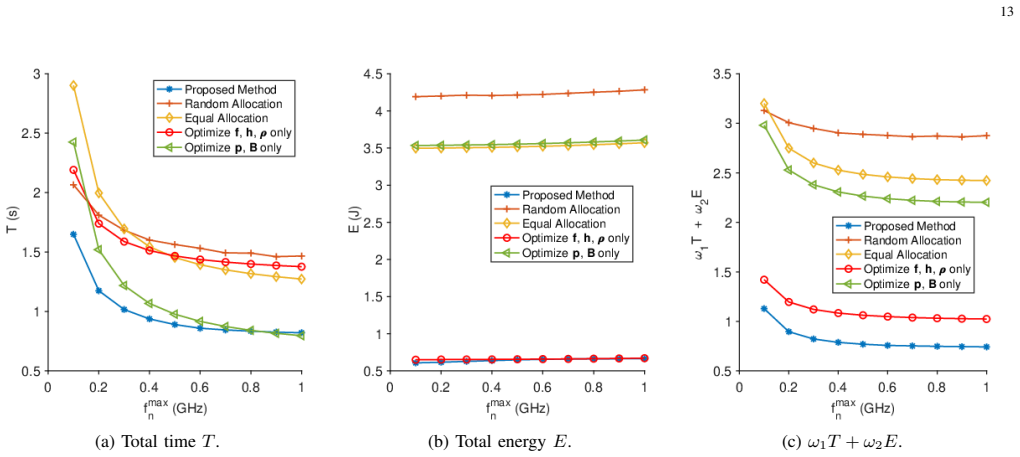
- Raising total bandwidth or maximum device frequency reduces training time, while raising the PSNR floor increases both time and energy and improves the achieved PSNR.
- The trained semantic model reaches 26.95 dB at SNR=13 dB and rho=0.1, exceeding JPEG's 26.13 dB, so the quality constraint is satisfiable while resource costs are being minimized.
Reading between the lines
- Editorial inference: since the PSNR surrogate is fitted once on CIFAR-10, any deployment on different data or channel statistics should re-fit the curve or replace it with a conservative lower bound, otherwise the feasibility guarantee in constraint (16e) is only as accurate as that fit.
- Editorial inference: the same decomposition should carry over to other image quality metrics such as SSIM only if a concave, non-decreasing surrogate in (rho,S) can be validated; without that structure, the KKT step for the compression rate no longer holds directly.
- Editorial inference: the centralized O(N) solver is a natural candidate to be re-run periodically as channel gains drift; a distributed or learning-based policy could trade a small optimality gap for better scalability in very dense networks, a direction the paper flags for future work.
- Editorial inference: a prediction interval around the fitted PSNR curve, rather than a single mean curve, would turn the weakest assumption into a testable certificate that the system truly meets P_min.
Signed reviews
Editorial analysis
A structured set of objections, weighed in public.
Referee Report
Summary. This paper considers a distributed image semantic communication system in which local devices encode and transmit image features to a base station, which decodes, computes the loss, and updates the model. The authors formulate a joint resource allocation problem P1 that minimizes a weighted sum of the maximum per-device training completion time and the total energy consumption, subject to per-device constraints on transmit power, bandwidth, CPU frequencies, compression rate, and a minimum PSNR requirement. P1 is decomposed into P3 over (f,h,rho,T) with (p,B) fixed and P4 over (p,B) with the other variables fixed; P3 is solved by KKT conditions after convexity verification, while P4 is attacked as a sum-of-ratios problem using a parameter-refinement method attributed to Jong [53]. Algorithm 3 alternates between the two subproblems and is claimed to return the optimal solution sol* = (p*,B*,f*,h*,rho*). The experiments use a CIFAR-10 deep JSCC model, compare Algorithm 3 against four baselines under varying bandwidth, power, frequency, weights, and number of users, and also compare reconstructed image quality against JPEG.
Significance. If the results hold, the paper contributes a useful formulation that jointly controls latency, energy, and semantic quality during the training phase of an image semantic communication network, rather than only at inference. The decomposition into P3/P4 is natural, the Hessian calculation for r_n in Lemma 1 is explicit, and the experimental sweep over system parameters is extensive. However, the central claims are not fully established: the proof of Lemma 1 contradicts itself on the convexity of the denominator, Theorem 1 supplies only a necessary condition while Algorithm 2 uses the converse, and the PSNR feasibility constraint is enforced through an in-sample fitted curve with no uncertainty quantification. These are load-bearing gaps, so the significance of the contribution cannot be fully assessed until they are closed.
major comments (4)
- [V-B, Lemma 1] The proof of Lemma 1 first establishes that r_n(p_n,B_n) is jointly concave, but then invokes a pseudoconvexity criterion from [52] that requires the denominator to be positive, convex, and differentiable. A concave denominator does not satisfy that condition. Thus the pseudoconvexity of p_n rho_n d_n / r_n, which underpins the fractional-programming treatment of P4, is not proved as written.
- [V-B, Theorem 1 and Algorithm 2] Theorem 1 states only that a global optimum of P6 implies the existence of (gamma*,delta*) satisfying (35) and solving P7. Algorithm 2 searches for (delta,gamma) with phi = 0 and then declares the resulting P7 solution to be the global optimum of P4. That converse is not proved in the manuscript; it is imported from Lemma 2.1 and Theorem 3.1 of [53] without stating or verifying their hypotheses. In particular, because r_n is concave rather than convex, it has not been shown that the sum-of-ratios framework of [53] applies. Consequently, Algorithm 3's output 'optimal sol*' and the Section VI-B statement that 'global optimality of the subproblems can be secured' are unsupported.
- [III-C and VII-B, Eq. (58)] The PSNR constraint (16e) is enforced through the fitted model P(x) = 18.67 ln(3.35x + 5.11) with x = 1.52 rho + 0.03 S. This curve is fitted to the same CIFAR-10 deep JSCC model used in the subsequent simulations, and only a 5-fold average MAE of 0.4381 dB is reported, with no confidence intervals, no out-of-sample validation, and no sensitivity analysis. If the curve deviates from the true PSNR of the trained model, the allocations returned by Algorithm 3 do not actually guarantee P_min, so the feasibility claim is circular with respect to the model whose training is being optimized.
- [VI-C] The convergence proof for Algorithm 2 states that the function phi(v) is linear and therefore satisfies the hypotheses of Theorem 3.2 in [53]. However, phi in (38) is evaluated at (p^(i+1),B^(i+1)), which are themselves functions of (delta^(i),gamma^(i)) obtained by solving P7. The implicit dependence is not accounted for in the manuscript, so the linearity claim and the resulting invocation of the convergence theorem are not established.
minor comments (8)
- [VII-B, Fig. 2 caption] The word 'Interploted' should be 'Interpolated', and the same typo appears in the caption of Fig. 2.
- [VII-G, Fig. 8 caption] The word 'Comparision' should be 'Comparison'.
- [VI-A] In the complexity analysis, the text says 'step 3 incurs a complexity of O(4N)' when referring to solving P3; this should be step 4, and the subsequent numbering of steps in Algorithm 2 should be aligned with the actual pseudocode.
- [V-B] The definition 'rmin_n = T^* - T^{cmp}_n - T^{S}_n / rho_n d_n' is missing parentheses; it should be rmin_n = (T^* - T^{cmp}_n - T^{S}_n)/(rho_n d_n).
- [III-A] The sentence 'We defer a more detailed introduction of the model to Section III-A' should refer to Section VII-A, since the detailed model introduction appears there.
- [VII-D] The baseline named 'Optimize f, h, rho only' is later referred to as 'Optimize f, rho only' in the discussion of Fig. 5; the names should be made consistent.
- [VI-C and Algorithm 2] The comment inside Algorithm 2 says the proof is given by Theorem 3.1 in [53], while Section VI-C cites Theorem 3.2 for the same convergence claim; this should be reconciled.
- [III-C, Condition 1] Condition 1 writes P''(x) < 0 for a function of two variables; the notation should be clarified as a shorthand for concavity in each argument or expressed via the Hessian.
Circularity Check
No significant circularity: the optimization is model-conditional and the empirical PSNR surrogate is an input, not a predicted output.
full rationale
The paper's derivation chain is a resource-allocation optimization conditional on explicit analytical models (Shannon rate, CPU-cycle energy, FDMA) and on an empirical PSNR surrogate P(rho,S). P1/P2/P3/P4 are optimization problems whose objective (weighted time+energy) and constraints are defined by these models; Algorithm 3 solves them by convex/KKT and sum-of-ratios techniques. The PSNR constraint (16e) uses the fitted curve Eq. (58), which is indeed fitted to the same CIFAR-10 JSCC model used in simulations; however, the paper labels this as curve fitting/interpolation rather than as a first-principles prediction, and the actual measured PSNRs in Figs. 9-10 provide external checks. Thus the performance guarantee is empirical and model-conditional, not a prediction forced by the optimization itself. The only self-citation in this modeling step (Ref. [60] for the logarithmic form) is not load-bearing because the coefficients are fit with 5-fold CV and validated against measured values. A separate correctness risk, not circularity, is that the global-optimality certificate for P4 is deferred to Lemma 2.1/Theorem 3.1 of [53], and Lemma 1 appears to misstate the required convexity of the denominator r_n (it proves r_n concave, then invokes a convex-denominator condition). This is an omitted-proof/hypothesis-checking issue in the claimed optimality proof, not a reduction of the result to its own inputs, so it does not raise the circularity score.
Assumptions & free parameters
free parameters (5)
- PSNR fit coefficient a =
18.67
- PSNR fit multiplicative scale l =
3.35
- PSNR fit offset b =
5.11
- Compression-rate weight in PSNR fit =
1.52
- SNR weight in PSNR fit =
0.03
assumptions (6)
- domain assumption Condition 1: PSNR P(rho_n,S_n) is concave and non-decreasing in both arguments.
- ad hoc to paper The empirical log model P(rho,S) = a ln(c_rho rho + c_s S + b) accurately represents the true PSNR over the operating ranges.
- standard math Shannon capacity formula r_n = B_n log2(1 + p_n g_n / (N0 B_n)) for uplink FDMA transmissions.
- domain assumption Devices and the BS share an aligned training database, and the BS can compute gradients and update all models centrally.
- domain assumption The sum-of-ratios global optimality condition (Lemma 2.1 in [53]) applies to P4/P6/P7.
- standard math KKT conditions and Slater's condition hold for P5.
Cite this review
Pith. "Pith review of Resource Allocation for the Training of Image Semantic Communication Networks." pith.science (2026). https://pith.science/paper/6ECWGAAP
@misc{pith2026250104408,
  author       = {Pith},
  title        = {Pith review of: Resource Allocation for the Training of Image Semantic Communication Networks},
  year         = {2026},
  howpublished = {\url{https://pith.science/paper/6ECWGAAP}},
  note         = {Machine review of arXiv:2501.04408}
}
read the original abstract
Semantic communication is a new paradigm that aims at providing more efficient communication for the next-generation wireless network. It focuses on transmitting extracted, meaningful information instead of the raw data. However, deep learning-enabled image semantic communication models often require a significant amount of time and energy for training, which is unacceptable, especially for mobile devices. To solve this challenge, our paper first introduces a distributed image semantic communication system where the base station and local devices will collaboratively train the models for uplink communication. Furthermore, we formulate a joint optimization problem to balance time and energy consumption on the local devices during training while ensuring effective model performance. An adaptable resource allocation algorithm is proposed to meet requirements under different scenarios, and its time complexity, solution quality, and convergence are thoroughly analyzed. Experimental results demonstrate the superiority of our algorithm in resource allocation optimization against existing benchmarks and discuss its impact on the performance of image semantic communication systems.
Figures


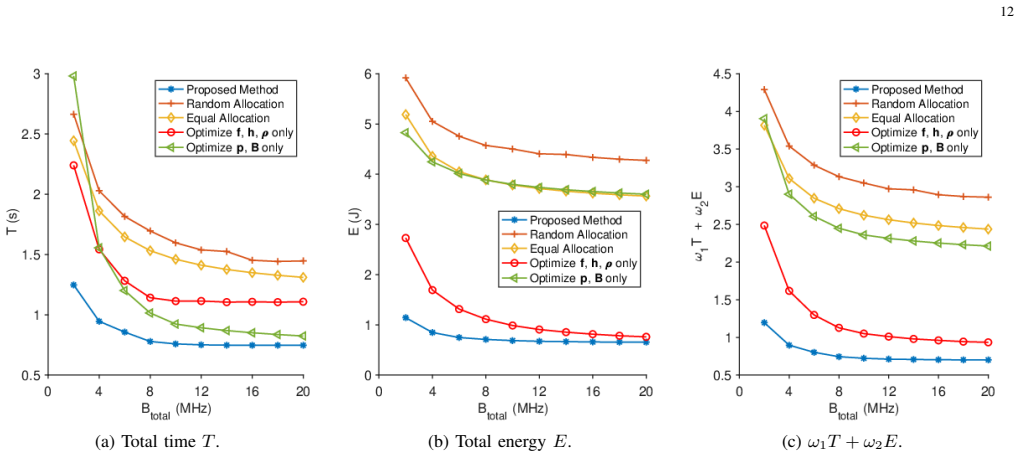
Figures from the paper (7 more)
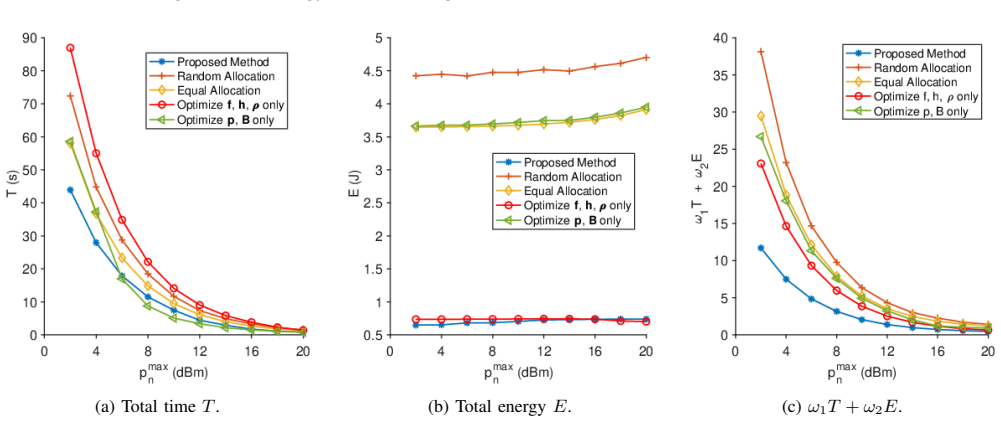


Reference graph
Works this paper leans on
-
[53]
An efficient global optimization algorithm for nonlinear sum- of-ratios problem,
Y . Jong, “An efficient global optimization algorithm for nonlinear sum- of-ratios problem,” Optimization Online, pp. 1–21, 2012
work page 2012
-
[52]
A. Cambini and L. Martein, Generalized convexity and optimization: Theory and applications . Springer Science & Business Media, 2008, vol. 616
work page 2008
-
[1]
Y . Wang, Z. Gao, D. Zheng, S. Chen, D. Gunduz, and H. V . Poor, “Transformer-empowered 6G intelligent networks: From massive MIMO processing to semantic communication,” IEEE Wireless Communica- tions, 2022
work page 2022
-
[2]
Digital-twin- enabled 6G: Vision, architectural trends, and future directions,
L. U. Khan, W. Saad, D. Niyato, Z. Han, and C. S. Hong, “Digital-twin- enabled 6G: Vision, architectural trends, and future directions,” IEEE Communications Magazine, vol. 60, no. 1, pp. 74–80, 2022
work page 2022
-
[3]
Joint optimization of task offloading and resource allocation in tactical edge networks,
Z. Zhang, X. Lin, G. Xue, Y . Zhang, and K. S. Chan, “Joint optimization of task offloading and resource allocation in tactical edge networks,” in MILCOM 2024-2024 IEEE Military Communications Conference (MILCOM). IEEE, 2024, pp. 703–708
work page 2024
-
[4]
Y . Wang, Z. Su, S. Guo, M. Dai, T. H. Luan, and Y . Liu, “A survey on digital twins: architecture, enabling technologies, security and privacy, and future prospects,” IEEE Internet of Things Journal , 2023
work page 2023
-
[5]
Model-assisted learning for adaptive cooperative perception of connected autonomous vehicles,
K. Qu, W. Zhuang, Q. Ye, W. Wu, and X. Shen, “Model-assisted learning for adaptive cooperative perception of connected autonomous vehicles,” IEEE Transactions on Wireless Communications , 2024
work page 2024
-
[6]
Q. Ye, W. Shi, K. Qu, H. He, W. Zhuang, and X. Shen, “Joint RAN slicing and computation offloading for autonomous vehicular networks: A learning-assisted hierarchical approach,” IEEE Open Journal of Ve- hicular Technology, vol. 2, pp. 272–288, 2021
work page 2021
Show all 68 references
-
[7]
Continuous user authentication by contact- less wireless sensing,
F. Wang, Z. Li, and J. Han, “Continuous user authentication by contact- less wireless sensing,” IEEE Internet of Things Journal , vol. 6, no. 5, pp. 8323–8331, 2019
2019
-
[8]
Blockchain-aided secure semantic communication for AI-generated content in metaverse,
Y . Lin, H. Du, D. Niyato, J. Nie, J. Zhang, Y . Cheng, and Z. Yang, “Blockchain-aided secure semantic communication for AI-generated content in metaverse,” IEEE Open Journal of the Computer Society , vol. 4, pp. 72–83, 2023
2023
-
[9]
Enabling the wireless metaverse via semantic multiverse communication,
J. Park, J. Choi, S.-L. Kim, and M. Bennis, “Enabling the wireless metaverse via semantic multiverse communication,” in 2023 20th An- nual IEEE International Conference on Sensing, Communication, and Networking (SECON). IEEE, 2023, pp. 85–90
2023
-
[10]
MIRAS: Model- based reinforcement learning for microservice resource allocation over scientific workflows,
Z. Yang, P. Nguyen, H. Jin, and K. Nahrstedt, “MIRAS: Model- based reinforcement learning for microservice resource allocation over scientific workflows,” in 2019 IEEE 39th International Conference on Distributed Computing Systems (ICDCS) . IEEE, 2019, pp. 122–132
2019
-
[11]
Spectral- efficient RIS-aided RSMA URLLC: Toward mobile broadband reliable low latency communication (mBRLLC),
S. Pala, M. Katwe, K. Singh, B. Clerckx, and C.-P. Li, “Spectral- efficient RIS-aided RSMA URLLC: Toward mobile broadband reliable low latency communication (mBRLLC),”IEEE Transactions on Wireless Communications, 2023
2023
-
[12]
Computation offloading and resource allocation in IoT-based mobile edge computing systems,
B. Hu, Y . Gao, W. Zhang, D. Jia, and H. Liu, “Computation offloading and resource allocation in IoT-based mobile edge computing systems,” in 2023 IEEE International Conference on Smart Internet of Things (SmartIoT). IEEE, 2023, pp. 119–123
2023
-
[13]
C. E. Shannon and W. Weaver, The Mathematical Theory of Communi- cation. University of Illinois Press, 1949
1949
-
[14]
Semantic communications: Principles and challenges,
Z. Qin, X. Tao, J. Lu, W. Tong, and G. Y . Li, “Semantic communications: Principles and challenges,” arXiv preprint arXiv:2201.01389 , 2021
2021 arXiv
-
[15]
Deep learning- enabled semantic communication systems with task-unaware transmitter and dynamic data,
H. Zhang, S. Shao, M. Tao, X. Bi, and K. B. Letaief, “Deep learning- enabled semantic communication systems with task-unaware transmitter and dynamic data,” IEEE Journal on Selected Areas in Communications, vol. 41, no. 1, pp. 170–185, 2022
2022
-
[16]
Deep learning enabled semantic communication systems,
H. Xie, Z. Qin, G. Y . Li, and B.-H. Juang, “Deep learning enabled semantic communication systems,” IEEE Transactions on Signal Pro- cessing, vol. 69, pp. 2663–2675, 2021
2021
-
[17]
Extended context-based semantic communication system for text transmission,
Y . Liu, S. Jiang, Y . Zhang, K. Cao, L. Zhou, B.-C. Seet, H. Zhao, and J. Wei, “Extended context-based semantic communication system for text transmission,” Digital Communications and Networks , 2022
2022
-
[18]
Semantic text compression for classification,
E. Kutay and A. Yener, “Semantic text compression for classification,” in 2023 IEEE International Conference on Communications Workshops (ICC Workshops). IEEE, 2023, pp. 1368–1373
2023
-
[19]
A robust deep learning enabled semantic communication system for text,
X. Peng, Z. Qin, D. Huang, X. Tao, J. Lu, G. Liu, and C. Pan, “A robust deep learning enabled semantic communication system for text,” in IEEE Global Communications Conference (GLOBECOM) . IEEE, 2022, pp. 2704–2709
2022
-
[20]
Deep learning-based image semantic coding for semantic communications,
D. Huang, X. Tao, F. Gao, and J. Lu, “Deep learning-based image semantic coding for semantic communications,” in 2021 IEEE Global Communications Conference (GLOBECOM) . IEEE, 2021, pp. 1–6
2021
-
[21]
Wireless end-to-end image transmission system using semantic communications,
M. U. Lokumarambage, V . S. S. Gowrisetty, H. Rezaei, T. Sivalingam, N. Rajatheva, and A. Fernando, “Wireless end-to-end image transmission system using semantic communications,” IEEE Access, 2023
2023
-
[22]
Dif- fusion models for audio semantic communication,
E. Grassucci, C. Marinoni, A. Rodriguez, and D. Comminiello, “Dif- fusion models for audio semantic communication,” in ICASSP 2024- 2024 IEEE International Conference on Acoustics, Speech and Signal Processing (ICASSP). IEEE, 2024, pp. 13 136–13 140
2024
-
[23]
Wireless semantic commu- nications for video conferencing,
P. Jiang, C.-K. Wen, S. Jin, and G. Y . Li, “Wireless semantic commu- nications for video conferencing,” IEEE Journal on Selected Areas in Communications, vol. 41, no. 1, pp. 230–244, 2022
2022
-
[24]
Attention is all you need,
A. Vaswani, N. Shazeer, N. Parmar, J. Uszkoreit, L. Jones, A. N. Gomez, Ł. Kaiser, and I. Polosukhin, “Attention is all you need,” Advances in neural information processing systems , vol. 30, 2017
2017
-
[25]
A survey of transfer learning,
K. Weiss, T. M. Khoshgoftaar, and D. Wang, “A survey of transfer learning,” Journal of Big Data , vol. 3, no. 1, pp. 1–40, 2016
2016
-
[26]
Transformer-xl: Attentive language models beyond a fixed-length context,
Z. Dai, Z. Yang, Y . Yang, J. Carbonell, Q. V . Le, and R. Salakhutdi- nov, “Transformer-xl: Attentive language models beyond a fixed-length context,” arXiv preprint arXiv:1901.02860 , 2019
1901 arXiv
-
[27]
Sentence-bert: Sentence embeddings using siamese bert- networks,
N. Reimers, “Sentence-bert: Sentence embeddings using siamese bert- networks,” arXiv preprint arXiv:1908.10084 , 2019
1908 arXiv
-
[28]
Semantic communication systems for speech transmission,
Z. Weng and Z. Qin, “Semantic communication systems for speech transmission,” IEEE Journal on Selected Areas in Communications , vol. 39, no. 8, pp. 2434–2444, 2021
2021
-
[29]
Resource allocation for text semantic communications,
L. Yan, Z. Qin, R. Zhang, Y . Li, and G. Y . Li, “Resource allocation for text semantic communications,” IEEE Wireless Communications Letters, vol. 11, no. 7, pp. 1394–1398, 2022
2022
-
[30]
QoE-aware resource allocation for semantic communication networks,
——, “QoE-aware resource allocation for semantic communication networks,” in GLOBECOM 2022-2022 IEEE Global Communications Conference. IEEE, 2022, pp. 3272–3277
2022
-
[31]
Performance optimization for semantic communications: An attention- based reinforcement learning approach,
Y . Wang, M. Chen, T. Luo, W. Saad, D. Niyato, H. V . Poor, and S. Cui, “Performance optimization for semantic communications: An attention- based reinforcement learning approach,”IEEE Journal on Selected Areas in Communications, vol. 40, no. 9, pp. 2598–2613, 2022
2022
-
[32]
Energy efficient semantic communication over wireless networks with rate splitting,
Z. Yang, M. Chen, Z. Zhang, and C. Huang, “Energy efficient semantic communication over wireless networks with rate splitting,”IEEE Journal on Selected Areas in Communications , 2023
2023
-
[33]
Drl-driven dynamic resource allocation for task-oriented semantic communication,
H. Zhang, H. Wang, Y . Li, K. Long, and A. Nallanathan, “Drl-driven dynamic resource allocation for task-oriented semantic communication,” IEEE Transactions on Communications , vol. 71, no. 7, pp. 3992–4004, 2023
2023
-
[34]
Optimization of image transmission in a cooperative semantic communication networks,
W. Zhang, Y . Wang, M. Chen, T. Luo, and D. Niyato, “Optimization of image transmission in a cooperative semantic communication networks,” IEEE Transactions on Wireless Communications , 2023. 16
2023
-
[35]
An efficient federated learning framework for training semantic communication systems,
L. X. Nguyen, H. Q. Le, Y . L. Tun, P. S. Aung, Y . K. Tun, Z. Han, and C. S. Hong, “An efficient federated learning framework for training semantic communication systems,” IEEE Transactions on Vehicular Technology, pp. 1–6, 2024
2024
-
[36]
Federated learning-based co- operative model training for task-oriented semantic communication,
H. Sun, H. Tian, W. Ni, and J. Zheng, “Federated learning-based co- operative model training for task-oriented semantic communication,” in IEEE Conference on Computer Communications Workshops (INFOCOM Workshops), 2024, pp. 1–6
2024
-
[37]
Federated contrastive learning for personalized semantic communication,
Y . Wang, W. Ni, W. Yi, X. Xu, P. Zhang, and A. Nallanathan, “Federated contrastive learning for personalized semantic communication,” IEEE Communications Letters, vol. 28, no. 8, pp. 1875–1879, 2024
2024
-
[38]
Deep joint source- channel coding for wireless image transmission,
E. Bourtsoulatze, D. B. Kurka, and D. G ¨und¨uz, “Deep joint source- channel coding for wireless image transmission,” IEEE Transactions on Cognitive Communications and Networking , vol. 5, no. 3, pp. 567–579, 2019
2019
-
[39]
Image restoration under semantic communications,
T. Van Chien, D. X. Phuc, N. T. Hoa et al. , “Image restoration under semantic communications,” in 2022 International Conference on Advanced Technologies for Communications (ATC) . IEEE, 2022, pp. 332–337
2022
-
[40]
Semantic change driven generative semantic communication framework,
W. Yang, Z. Xiong, H. Du, Y . Yuan, and T. Q. Quek, “Semantic change driven generative semantic communication framework,” in 2024 IEEE Wireless Communications and Networking Conference (WCNC). IEEE, 2024, pp. 01–06
2024
-
[41]
HFEL: Joint edge asso- ciation and resource allocation for cost-efficient hierarchical federated edge learning,
S. Luo, X. Chen, Q. Wu, Z. Zhou, and S. Yu, “HFEL: Joint edge asso- ciation and resource allocation for cost-efficient hierarchical federated edge learning,” IEEE Transactions on Wireless Communications, vol. 19, no. 10, pp. 6535–6548, 2020
2020
-
[42]
Energy efficient federated learning over wireless communication networks,
Z. Yang, M. Chen, W. Saad, C. S. Hong, and M. Shikh-Bahaei, “Energy efficient federated learning over wireless communication networks,” IEEE Transactions on Wireless Communications , vol. 20, no. 3, pp. 1935–1949, 2020
1935
-
[43]
Federated learning over wireless networks: Convergence analysis and resource allocation,
C. T. Dinh, N. H. Tran, M. N. Nguyen, C. S. Hong, W. Bao, A. Y . Zomaya, and V . Gramoli, “Federated learning over wireless networks: Convergence analysis and resource allocation,” IEEE/ACM Transactions on Networking, vol. 29, no. 1, pp. 398–409, 2020
2020
-
[44]
DetFed: Dynamic resource scheduling for deterministic federated learning over time-sensitive networks,
D. Yang, W. Zhang, Q. Ye, C. Zhang, N. Zhang, C. Huang, H. Zhang, and X. Shen, “DetFed: Dynamic resource scheduling for deterministic federated learning over time-sensitive networks,” IEEE Transactions on Mobile Computing, 2023
2023
-
[45]
Joint optimization of en- ergy consumption and completion time in federated learning,
X. Zhou, J. Zhao, H. Han, and C. Guet, “Joint optimization of en- ergy consumption and completion time in federated learning,” in 2022 IEEE 42nd International Conference on Distributed Computing Systems (ICDCS). IEEE, 2022, pp. 1005–1017
2022
-
[46]
To talk or to work: Flexible communication compression for energy efficient federated learning over heterogeneous mobile edge devices,
L. Li, D. Shi, R. Hou, H. Li, M. Pan, and Z. Han, “To talk or to work: Flexible communication compression for energy efficient federated learning over heterogeneous mobile edge devices,” in IEEE Conference on Computer Communications (INFOCOM) , 2021, pp. 1–10
2021
-
[47]
Toward semantic communications: Deep learning-based image semantic coding,
D. Huang, F. Gao, X. Tao, Q. Du, and J. Lu, “Toward semantic communications: Deep learning-based image semantic coding,” IEEE Journal on Selected Areas in Communications , 2022
2022
-
[48]
Se- mantic segmentation-based semantic communication system for image transmission,
J. Wu, C. Wu, Y . Lin, T. Yoshinaga, L. Zhong, X. Chen, and Y . Ji, “Se- mantic segmentation-based semantic communication system for image transmission,” Digital Communications and Networks , 2023
2023
-
[49]
Innovative semantic communication system,
C. Dong, H. Liang, X. Xu, S. Han, B. Wang, and P. Zhang, “Innovative semantic communication system,” arXiv preprint arXiv:2202.09595 , 2022
2022 arXiv
-
[50]
Fair end-to-end window-based congestion control in time-varying data communication networks,
S. Kumari and A. Singh, “Fair end-to-end window-based congestion control in time-varying data communication networks,” International Journal of Communication Systems , vol. 32, no. 11, p. e3986, 2019
2019
-
[51]
Reward optimization for content providers with mobile data subsidization: A hierarchical game approach,
Z. Xiong, J. Zhao, D. Niyato, R. Deng, and J. Zhang, “Reward optimization for content providers with mobile data subsidization: A hierarchical game approach,” IEEE Transactions on Network Science and Engineering, vol. 7, no. 4, pp. 2363–2377, 2020
2020
-
[54]
Fractional programming for communication systems—Part I: Power control and beamforming,
K. Shen and W. Yu, “Fractional programming for communication systems—Part I: Power control and beamforming,” IEEE Transactions on Signal Processing , vol. 66, no. 10, pp. 2616–2630, 2018
2018
-
[55]
Fractional programming for communication systems—Part II: Uplink scheduling via matching,
——, “Fractional programming for communication systems—Part II: Uplink scheduling via matching,” IEEE Transactions on Signal Pro- cessing, vol. 66, no. 10, pp. 2631–2644, 2018
2018
-
[56]
S. P. Boyd and L. Vandenberghe, Convex optimization . Cambridge university press, 2004
2004
-
[57]
Deep joint source-channel coding for semantic communications,
J. Xu, T.-Y . Tung, B. Ai, W. Chen, Y . Sun, and D. D. G ¨und¨uz, “Deep joint source-channel coding for semantic communications,” IEEE Communications Magazine, vol. 61, no. 11, pp. 42–48, 2023
2023
-
[58]
Joint source-channel coding for channel-adaptive digital semantic communications,
J. Park, Y . Oh, S. Kim, and Y .-S. Jeon, “Joint source-channel coding for channel-adaptive digital semantic communications,” IEEE Transactions on Cognitive Communications and Networking , 2024
2024
-
[59]
Cddm: Channel denoising diffusion models for wireless communications,
T. Wu, Z. Chen, D. He, L. Qian, Y . Xu, M. Tao, and W. Zhang, “Cddm: Channel denoising diffusion models for wireless communications,” in GLOBECOM 2023-2023 IEEE Global Communications Conference . IEEE, 2023, pp. 7429–7434
2023
-
[60]
Optimizing utility-energy efficiency for the metaverse over wireless networks under physical layer security,
J. Zhao, X. Zhou, Y . Li, and L. Qian, “Optimizing utility-energy efficiency for the metaverse over wireless networks under physical layer security,” in ACM International Symposium on Theory, Algorithmic Foundations, and Protocol Design for Mobile Networks and Mobile Computing...
2023
-
[61]
Wireless image transmission with semantic and security awareness,
M. Zhang, Y . Li, Z. Zhang, G. Zhu, and C. Zhong, “Wireless image transmission with semantic and security awareness,” IEEE Wireless Communications Letters, vol. 12, no. 8, pp. 1389–1393, 2023
2023
-
[62]
Semantic communications for image recovery and classification via deep joint source and channel coding,
Z. Lyu, G. Zhu, J. Xu, B. Ai, and S. Cui, “Semantic communications for image recovery and classification via deep joint source and channel coding,” IEEE Transactions on Wireless Communications , 2024
2024
-
[63]
Drl-based energy- efficient resource allocation frameworks for uplink noma systems,
X. Wang, Y . Zhang, R. Shen, Y . Xu, and F.-C. Zheng, “Drl-based energy- efficient resource allocation frameworks for uplink noma systems,”IEEE Internet of Things Journal , vol. 7, no. 8, pp. 7279–7294, 2020
2020
-
[64]
A drl-driven intelligent optimization strategy for resource allocation in cloud-edge-end cooperation environments,
C. Fang, T. Zhang, J. Huang, H. Xu, Z. Hu, Y . Yang, Z. Wang, Z. Zhou, and X. Luo, “A drl-driven intelligent optimization strategy for resource allocation in cloud-edge-end cooperation environments,” Symmetry, vol. 14, no. 10, p. 2120, 2022
2022
-
[65]
Deep reinforcement learning- based resource allocation in multi-access edge computing,
M. Khani, M. M. Sadr, and S. Jamali, “Deep reinforcement learning- based resource allocation in multi-access edge computing,” Concurrency and Computation: Practice and Experience , vol. 36, no. 15, p. e7995, 2024
2024
-
[66]
Mobile edge adversarial detection for digital twinning to the metaverse: A deep reinforcement learning approach,
T. J. Chua, W. Yu, and J. Zhao, “Mobile edge adversarial detection for digital twinning to the metaverse: A deep reinforcement learning approach,” IEEE Transactions on Wireless Communications , 2023
2023
-
[67]
Counterfactual reward estimation for credit assignment in multi-agent deep reinforcement learn- ing over wireless video transmission,
Y . Wenhan, L. Qian, T. J. Chua, and J. Zhao, “Counterfactual reward estimation for credit assignment in multi-agent deep reinforcement learn- ing over wireless video transmission,” in 2024 IEEE 44th International Conference on Distributed Computing Systems (ICDCS) . IEEE, 202...
2024
-
[2020]
Her research interests include Optimization, Federated Learning, Wireless Communications
She is currently a PhD student from Nanyang Technological University, Singapore. Her research interests include Optimization, Federated Learning, Wireless Communications. 17 Jun Zhao (S’10-M’15) is currently an Assistant Professor in the College of Computing and Data Science (...
2015
Reviewed August 10, 2026 · model on record in the stance chip above.
Discussion (0). Continue with ORCID to comment.