REVIEW 3 major objections 4 minor 33 references
Gravitational lensing and shadows in the toron solution of Einstein's equations using ray tracing methods
T0 review · 3 major / 4 minor · reviewed 2026-08-10 · deepseek-v4-flash
Pith's one-line read The toron spacetime, with zero ordinary mass but a gravimagnetic parameter, produces NUT-like lensing and shadows, not Kerr-like.
desk verdict First ray tracing of the toron spacetime: the NUT-like shadow and blind-region claims rest on an unjustified absorbing boundary at the ergosphere; deserves a referee but needs a fix. read the letter →
The pith
A machine-rendered reading of the paper's core claim, the machinery that carries it, and where it could break.
The reading
What carries the argument
The central object is the toron Ernst potential, $$E(\xi,\bar\xi)=\frac{\vartheta\left(\int_{\infty_+}^{\xi}\omega+i\$\alpha$,\tau\right)}{\vartheta\left(\int_{\infty_-}^{\xi}\omega+i\$\alpha$,\tau\right)},$$ with $p=0$, $q=i\alpha$, where $\omega$ is the normalized holomorphic differential on the elliptic curve $\mu^2=(\lambda-i\sigma)(\lambda+i\sigma)(\lambda-\xi)(\lambda-\bar\xi)$ and the $\theta$ functions encode the dependence on the Weyl coordinates. This object carries the argument because the single real parameter $\alpha$ controls both the gravimagnetic mass $i\sigma\sinh(2\pi\alpha)$ and the angular momentum of the disk-like source. The metric functions $f$, $A$, and $k$ are obtained from it by quadratures, and the fact that $A$ cannot be made to vanish on the whole symmetry axis produces the twisting of images and the out-of-plane deflection. The ray tracing is driven by backwards integration of the null geodesic equations from a virtual camera, with a termination rule that paints a pixel black once $f=\Re E<\epsilon$ at the approach to the ergosphere.
What would settle it
Integrate backward null geodesics in the toron spacetime using coordinates that do not stop at the surface where $f=0$ and check whether any ray that reaches the observer passes through the first ergosphere to a luminous source; if any do, the black-pixel termination criterion misclassifies them and the shadow and blind region are not physical.
Extended reading notes
Core claim
The paper's claim is that the toron solution of [20], written as a ratio of $\theta$ functions on an elliptic curve, is asymptotically identical to the massless NUT spacetime: on the symmetry axis the Ernst potential is $E(z,0)=(z\pm\sqrt{z^2+\sigma^2}-i\sigma e^{-2\pi\alpha})/(z\pm\sqrt{z^2+\sigma^2}-i\sigma e^{2\pi\alpha})$, which gives the imaginary mass $i\sigma\sinh(2\pi\alpha)$. Ray tracing then shows the geodesic flow is NUT-like near the object: initially equatorial photons leave the plane, light rings lift off the equatorial plane, the Einstein ring disappears, and a quasi-circular blind region appears on the celestial sphere behind the lens. In the toron the blind region is shifted sideways and slightly deformed, and the shadow is non-circular, because the disk also carries angular momentum. The paper further argues that the toron has an infinite family of toroidal ergospheres that accumulate on a ring at $\rho=1$, $z=0$, and that the first ergosphere, approached by any ray with $f<\epsilon$, cannot be crossed since Weyl coordinate time would go to infinity.
Load-bearing premise
The load-bearing premise is that no light ray can cross the surface where the metric function $f$ vanishes, so the simulation stops and colors the pixel black there; if photons can cross that surface, as they do in Kerr, the shadow and blind region would be enlarged or misplaced.
Editorial extensions
If this is right
- A massless vacuum compact object with a gravimagnetic parameter would show a NUT-type blind region on the celestial sphere and no Einstein ring for an equatorial observer, unlike Kerr.
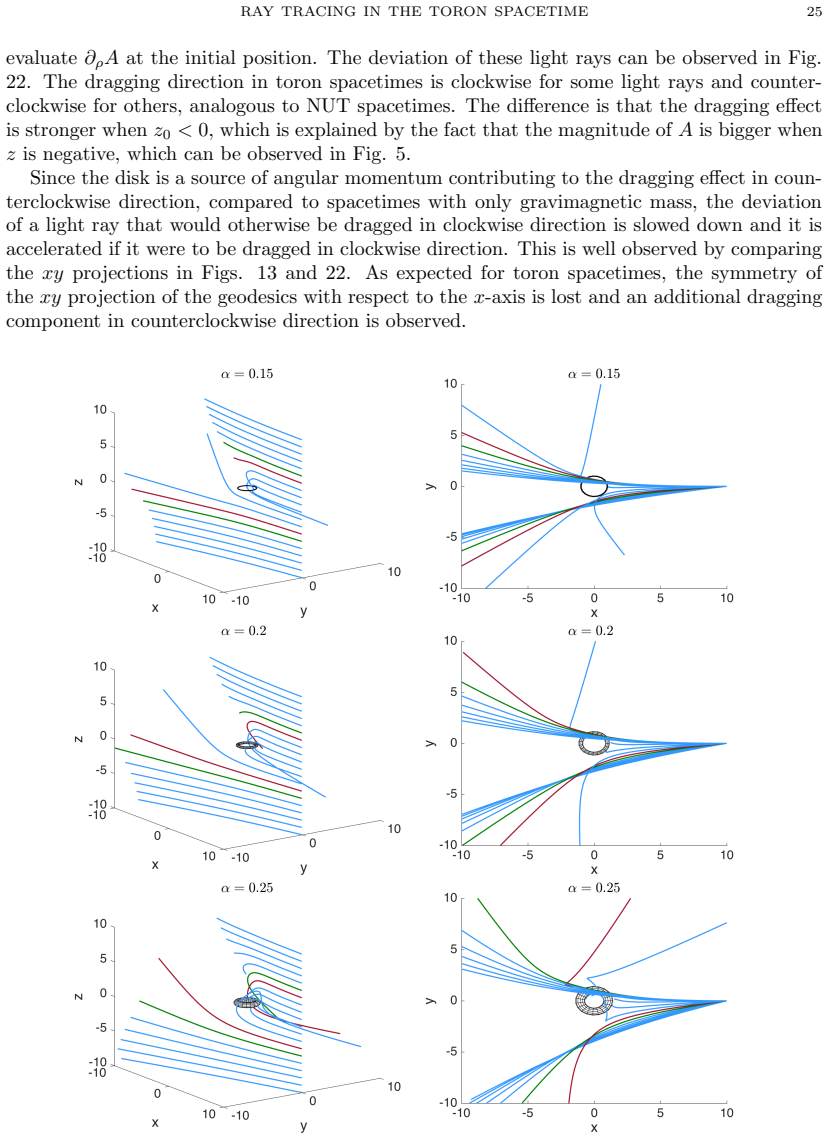
- Larger $\alpha$ means stronger out-of-plane deflection, stronger twisting of the apparent image, and a larger shadow that shifts further sideways.
- The toroidal ergosphere topology leaves a signature: the shadow boundary is set by the outermost ergosphere rather than by a spherical photon sphere.
- Comparing primary and secondary images in the same frame gives a qualitative test: NUT-like images keep the upper and lower celestial hemispheres on the same side, while Kerr-like images flip the secondary copy.
Reading between the lines
- If the ergosphere impenetrability assumption is wrong, the reported shadow and blind region could be artifacts of the $f<\epsilon$ cut-off; integrating rays in coordinates that continue past $f=0$ would test this directly.
- The authors' closing question suggests a testable programme: higher-genus toron-type solutions without a NUT parameter should produce lensing closer to Kerr; if so, the NUT-likeness identified here is tied to the imaginary mass term, not to the elliptic construction itself.
- The shadow offset and blind-region shift could be inverted to estimate $\alpha$ from a single image of an exotic compact object, since these are the only parameters shaping the lensing signature.
- Because the branch disk is treated as totally absorbing, the shadow interior conflates true photon capture with absorption at the disk; a disk with finite emissivity would brighten part of the reported shadow.
Signed reviews
Editorial analysis
A structured set of objections, weighed in public.
Referee Report
Summary. The paper studies the 'toron' solution of the stationary axisymmetric Einstein equations in vacuum, an elliptic-function solution whose asymptotic Ernst potential contains a purely imaginary mass parameter iσ sinh(2πα). The authors derive the axis limit and the ergosphere structure, and then use the ray-tracing code of [8] to compare null geodesics and synthetic images in Schwarzschild, Kerr, NUT, and toron spacetimes. The main observational claim is that toron lensing is qualitatively NUT-like: the primary and secondary images are twisted, there is a quasi-circular blind region on the celestial sphere, and the shadow is non-circular and shifted. The numerical code is benchmarked against known Schwarzschild, Kerr, and NUT images, and the analytical asymptotics are consistent with the earlier toron literature.
Significance. If the main claim holds, the paper provides a nontrivial example of a vacuum spacetime with vanishing real mass and pure NUT-type gravimagnetic mass, whose lensing differs qualitatively from Kerr and resembles NUT despite having no event horizon. The analytical part is valuable: the axis limit and the imaginary-mass asymptotics are derived explicitly, and the paper reproduces several known ray-tracing results as checks. The main fragility is that the shadow and blind-region statements rely on a numerical termination rule whose physical justification is not established; this is a load-bearing issue for the central conclusions.
major comments (3)
- [Sec. 4.3 (termination criterion 2)] The termination rule that stops every backward integration once f < ε and colors the pixel black is load-bearing for the shadow and blind-region claims, but its physical justification is not established. The sentence 'the coordinate time will go to infinity; therefore, the ergosphere cannot be crossed by any light ray in Weyl coordinates' is an assertion, not a derivation. In Kerr spacetimes, the ergosurface is a regular, crossable surface and null geodesics pass through the ergoregion even though f vanishes there in Weyl-Lewis-Papapetrou coordinates; the divergence of f^{-1} is a coordinate effect, not a spacetime boundary. For the toron, E0 is an ergosurface, not an event horizon or the branch disk, and the paper gives no proof that null geodesics cannot cross it. If such crossing is possible, the black pixels in Figs. 27 and 28 can include rays that actually reach the celestial sphere, so the shifted shadow and the hidden region would be at least partly numerical artifacts. The authors should either prove, by a coordinate-independent argument, that E0 is impenetrable to null geodesics in the toron, or change the termination condition and recompute the images.
- [Sec. 7 (conclusion)] The central conclusion that 'the primary images in NUT and toron spacetimes look qualitatively similar' inherits the same assumption, because the comparison uses the same f < ε stopping rule for both spacetimes. For NUT the rule coincides with the event horizon, which is genuinely absorbing, but for toron it does not. The paper should state explicitly which reported features—shadow boundary, blind region, image twist—persist if geodesics are allowed to cross E0, or restrict the claims to the exterior of E0 with a clear caveat.
- [Secs. 3.1 and 7] Equation (3.8) determines the imaginary mass parameter σ sinh(2πα), but the claim that α also controls angular momentum is not derived from an invariant quantity. The numerical deflection of rays in Figs. 21, 22, and 25 is suggestive, but it does not by itself establish the Komar angular momentum or the relevant multipole moments. Either compute an invariant angular-momentum measure or soften the statement that α controls both gravimagnetic mass and angular momentum.
minor comments (4)
- [Sec. 4.3] The threshold ε in termination criterion 2 is never specified; without a value, the effective stopping surface is not well defined and the images could depend on this free numerical parameter.
- [Captions of Figs. 5 and 6] The captions refer to 'Af' without making clear whether the plotted quantity is the product Af or the function A; this should be clarified to avoid confusion.
- [Table 2 and Fig. 25] The apparent disk images for α = 0.2 and α = 0.3 are computed with different focal lengths, so the visual comparison mixes the physical effect of α with the changed camera setting; the text should state this explicitly when discussing apparent sizes.
- [Appendix B] The paper states that the null condition L = 0 is used to control numerical accuracy, but no quantitative error estimate or convergence test is reported; a short statement of the achieved conservation would strengthen confidence in the images.
Circularity Check
No significant circularity: the toron ray-tracing results are computed from the fixed toron metric with independent Schwarzschild/Kerr/NUT benchmarks; self-citations are source attributions rather than load-bearing reductions.
full rationale
The paper's central claims are numerical solutions of the null geodesic equations (B.4)-(B.5) for the toron metric (3.1)-(3.5). The metric parameters, such as alpha and sigma=1, are fixed inputs; no observable is fitted and no target quantity is used to define the model. The comparisons against Schwarzschild, Kerr, and NUT spacetimes are independent external benchmarks run with the same integrator, so the central NUT-toron similarity claim is not manufactured by construction. The toron solution is imported from Korotkin's earlier work [20], and the ray-tracing approach from the authors' prior paper [8], but these are source attributions and numerical tools, not premises that already contain the lensing and shadow conclusions. The interpretation that alpha controls angular momentum (§6.3 and Conclusion) is read off from the same shadow images used to motivate it, so it is an interpretation rather than a derivation; it does not reduce any equation to an input. The paper's termination criterion 2 in §4.3 stops integration at f < epsilon and colors pixels black, asserting that 'the ergosphere cannot be crossed by any light ray in Weyl coordinates'; this is an unproved physical assumption for the toron and is a genuine correctness risk for the shadow and blind-region claims, but it is not circular in the enumerated sense: the stopping rule is not fitted from the output and the claimed result is not equivalent to the rule by definition. Therefore the derivation chain is self-contained apart from this physical-assumption risk, and the appropriate circularity score is low.
Assumptions & free parameters
free parameters (2)
- alpha (toron parameter) =
scanned: 0.2 and 0.3 in simulations; tabulated from 0 to 0.5
- sigma (fixed branch point) =
1 (normalization)
assumptions (4)
- domain assumption The Ernst equation and its elliptic solutions given by theta functions (3.1)-(3.5) correctly describe a vacuum spacetime.
- ad hoc to paper The branch cut z=0, 0<rho<1 is a totally absorbing disk; the spacetime is considered on the first sheet only.
- ad hoc to paper Light rays reaching the first ergosphere (f < epsilon) are absorbed and cannot contribute to the image.
- domain assumption The Runge-Kutta scheme (B.5) with polynomial interpolation on a grid is sufficiently accurate for the qualitative claims.
Cite this review
Pith. "Pith review of Gravitational lensing and shadows in the toron solution of Einstein's equations using ray tracing methods." pith.science (2026). https://pith.science/paper/NWJM5ZEI
@misc{pith2026250104509,
  author       = {Pith},
  title        = {Pith review of: Gravitational lensing and shadows in the toron solution of Einstein's equations using ray tracing methods},
  year         = {2026},
  howpublished = {\url{https://pith.science/paper/NWJM5ZEI}},
  note         = {Machine review of arXiv:2501.04509}
}
read the original abstract
We present a numerical and analytical study of the so-called `toron' solution of the stationary axisymmetric Einstein equations in vacuum expressed in terms of elliptic functions. The asymptotic behavior of this solution coincides with the one of the NUT solution, i.e., it has a `gravimagnetic' mass known as the NUT parameter while the ordinary mass vanishes. The physical properties of this spacetime are studied via ray tracing. The results are compared to known geodesic flows in Schwarzschild, Kerr and NUT spacetimes to discuss similarities and differences, with a particular emphasis on the comparison of NUT and toron spacetimes.
Figures


Figures from the paper (28 more)




Reference graph
Works this paper leans on
-
[20]
D. Korotkin, Solutions of the vacuum Einstein equation having toroidal infinite red-shift surface , Class. Quantum Grav. 8 L219 - L222 (1991)
work page 1991
-
[8]
E.B. de Leon, J. Frauendiener and C. Klein. Visualisation of counter-rotating dust disks using ray tracing methods. Class. Quantum Grav. 41 155005 (2024)
work page 2024
-
[1]
A. Abdujabbarov, F. Atamurotov, Y. Kucukakca, B. Ahmedov and U. Camci. Shadow of Kerr-Taub-NUT black hole . Astrophys. Space Sci. 344, 429 (2012)
work page 2012
-
[2]
J. M. Bardeen, in Black Holes (Les Astres Occlus), edited by C. DeWitt and B. S. DeWitt (Gordon and Breach, New York, 1973) p. 215
work page 1973
-
[3]
V.A. Belinskii, V.E. Zakharov, Integration of the Einstein equations by the methods of inverse scattering theory and construction of explicit multisoliton solutions , Soviet Phys. JETP 48 (1978) 985–994
work page 1978
-
[4]
E.D. Belokolos, A.I. Bobenko, V.Z. Enol’skii, A.R. Its and V.B. Matveev. Algebro-geometric approach to nonlinear integrable equations. Springer, Berlin (1994)
work page 1994
-
[5]
W.B. Bonnor. A new interpretation of the NUT metric in general relativity . Math. Proc. Cambridge Philos. Soc. 66, 145 (1969)
work page 1969
-
[6]
K. Chandrasekharan. Elliptic Functions . Volume 281, Grundlehren der mathematischen Wissenschaften (1985)
work page 1985
Show all 33 references
-
[7]
https://doi.org/10.1007/s10714-018-2361-9
P.V.P.Cunha, C.A.R.Herdeiro, Shadows and strong gravitational lensing: a brief review , Gen Relativ Gravit 50, 42 (2018). https://doi.org/10.1007/s10714-018-2361-9
2018 doi
-
[9]
E.B. de Leon. On a class of algebro-geometric solutions to the Ernst equation , arXiv:2310.19095v1 (2023)
2023 arXiv
-
[10]
Einstein, Lens-Like Action of a Star by the Deviation of Light in the Gravitational Field, Science 84, 506 (1936)
A. Einstein, Lens-Like Action of a Star by the Deviation of Light in the Gravitational Field, Science 84, 506 (1936)
1936
-
[11]
Ernst, New formulation of the axially symmetric gravitational field problem I , Phys
F.J. Ernst, New formulation of the axially symmetric gravitational field problem I , Phys. Rev. D 167, 1175
-
[12]
Ernst, New formulation of the axially symmetric gravitational field problem II , Phys
F.J. Ernst, New formulation of the axially symmetric gravitational field problem II , Phys. Rev. D 168, 1415
-
[13]
Frauendiener and C
J. Frauendiener and C. Klein, Computational approach to hyperelliptic Riemann surfaces , Lett. Math. Phys. 105(3), 379-400
-
[14]
Grenzebach, V
A. Grenzebach, V. Perlick and C. L¨ ammerzahl.Photon regions and shadows of Kerr-Newman-NUT black holes with a cosmological constant . Phys. Rev. D 89, 124004 (2014)
2014
-
[15]
Hackmann and C
E. Hackmann and C. L¨ ammerzahl.Observables for bound orbital motion in axially symmetric space-times . Phys. Rev. D 85, 044049 (2012)
2012
-
[16]
Klein, D
C. Klein, D. Korotkin and V. Shramchenko. Ernst equation, Fay identities and variational formulas on hyperelliptic curves. Mathematical Research Letters (2004) 27–45
2004
-
[17]
Klein, O
C. Klein, O. Richter, Exact relativistic gravitational treatment of a stationary counter- rotating dust disk , Phys. Rev. Lett. 83 (1999) 2884
1999
-
[18]
Klein and O
C. Klein and O. Richter. Ernst Equation and Riemann Surfaces: Analytical and Numerical Methods . Lecture Notes in Physics, Vol. 685. Springer (2005)
2005
-
[19]
Korotkin
D. Korotkin. Finite-gap solutions of the stationary axisymmetric Einstein equation in vacuum . Theor. Math. Phys. 77, 1018 (1988)
1988
-
[21]
Korotkin, Algebraic Geometric Solutions of Einstein ’s Equations: Some Physical Properties , Commun
D. Korotkin, Algebraic Geometric Solutions of Einstein ’s Equations: Some Physical Properties , Commun. Math. Phys. 37, 383-398 (1991)
1991
-
[22]
Maison, Are the stationary axially symmetric Einstein equations completely integrable? Phys
D. Maison, Are the stationary axially symmetric Einstein equations completely integrable? Phys. Rev. Lett. 41 (1978) 521–524
1978
-
[23]
Manko and E
V.S. Manko and E. Ruiz. Physical interpretation of NUT solution. Class. Quantum Grav. 22 3555-60 (2005)
2005
-
[24]
Moreira, C.A
Z.S. Moreira, C.A. Herdeiro and L.C. Crispino. Twisting shadows: Light rings, lensing, and shadows of black holes in swirling universes . Phys. Rev. D 109, 104020 (2024)
2024
-
[25]
Neugebauer, Backlund transformations of axially symmetric stationary gravitational fields J
G. Neugebauer, Backlund transformations of axially symmetric stationary gravitational fields J. Phys. A 12, L67 (1979)
1979
-
[26]
Neugebauer, R.Meinel, General relativistic gravitational field of a rigidly rotating disk of dust: Solution in terms of ultraelliptic functions , Phys
G. Neugebauer, R.Meinel, General relativistic gravitational field of a rigidly rotating disk of dust: Solution in terms of ultraelliptic functions , Phys. Rev. Lett. 75 3046 (1995)
1995
-
[27]
Perlick, O.Y
V. Perlick, O.Y. Tsupko, Calculating black hole shadows: Review of analytical studies , Physics Reports, 2022, arxiv 2105.07101
2022 arXiv
-
[28]
Silverman
J.H. Silverman. The arithmetic of elliptic curves . Graduate texts in mathematics (1986)
1986
-
[29]
Stephani, D
H. Stephani, D. Kramer, M. MacCallum, C. Hoenselaers and E. Herlt. Exact Solutions of Einstein ’s Field Equations. 2nd ed. Cambridge University Press (2003)
2003
-
[30]
J. L. Synge, The Escape of Photons from Gravitationally Intense Stars , Mon. Not. R. Astron. Soc. 131, 463 (1966)
1966
-
[31]
Teo, Spherical Photon Orbits Around a Kerr Black Hole ,General Relativity and Gravitation
E. Teo, Spherical Photon Orbits Around a Kerr Black Hole ,General Relativity and Gravitation. 35 (11): 1909–1926 (2003)
2003
-
[32]
F. H. Vincent, M. Wielgus, M. A. Abramowicz,, E. Gourgoulhon, J.-P. Lasota, T. Paumard and G. Perrin, Geometric modeling of M87* as a Kerr black hole or a non-Kerr compact object, A& A, 646, A37 (2021) 38 E. DE LEON, C. KLEIN, AND D. KOROTKIN
2021
-
[33]
Wilkins, D. C. Bound geodesics in the Kerr metric , Phys. Rev. D 5, 814–822 (1972) Email address : eddybrandon11@hotmail.com Institut de Math ´ematiques de Bourgogne, Universit ´e de Bourgogne-Europe, 9 avenue Alain Savary, 21078 Dijon Cedex, France Institut de Math´ematiques ...
1972
Reviewed August 10, 2026 · model on record in the stance chip above.
Discussion (0). Continue with ORCID to comment.