pith. machine review for the scientific record. sign in

nlin.SI

Exactly Solvable and Integrable Systems

Exactly solvable systems, integrable PDEs, integrable ODEs, Painleve analysis, integrable discrete maps, solvable lattice models, integrable quantum systems

0
nlin.SI 2026-05-11 1 theorem

AKNS reductions create 23 shifted nonlocal NLS equations

Multi-place shifted nonlocal reductions of a multi-component AKNS system

One-soliton solutions from the Hirota method remain nonsingular for admissible parameter values.

Figure from the paper full image
abstract click to expand
Starting from a multi-component AKNS system, we obtain new shifted nonlocal nonlinear Schr\"{o}dinger equations. We find 13 different shifted nonlocal nonlinear Schr\"{o}dinger equations with two-place nonlocalities and 10 shifted nonlocal nonlinear Schr\"{o}dinger equations with four-place nonlocalities. We first obtain one-soliton solutions of the multi-component AKNS system by the Hirota method. Applying the shifted nonlocal reduction formulas to this solution, we obtain one-soliton solutions for the shifted nonlocal nonlinear Schr\"{o}dinger equations. In cases yielding nontrivial solutions, we discuss the singularity structures of the solutions and show that the one-soliton solutions we obtain are nonsingular for certain values of the parameters. We plot representative nonsingular solutions obtained for admissible parameter values.
0
0
nlin.SI 2026-05-11 2 theorems

Toda lattice converges to KdV globally under scaling

The Korteweg-de Vries limit for the global dynamics of the Toda lattice

H^1 initial data yields all-time convergence to KdV via scaling, translation, and conserved quantities from integrability.

abstract click to expand
It has been observed that the dynamics of the Toda lattice can be well described by solutions of the Korteweg-de Vries (KdV) equation in the continuum limit. We show that, under the KdV scaling and a suitable translation, the solution of the Toda lattice with H^1 initial data converges to that of the KdV equation globally in time. Our proof relies on tools from harmonic analysis and also on the construction and the conservation of mass and energy of the Toda lattice, the latter of which are derived from the completely integrable structure of the Toda lattice. As a consequence, we obtain long-wave KdV limits for the Toda lattice.
0
0
nlin.SI 2026-05-08 2 theorems

Ernst equations split into universal trilinear kernel

The General Structure of Trilinear Equations

A tau-ratio form for the potential isolates a cubic trilinear sector that governs all second derivatives, shared across Tomimatsu-Sato cases

abstract click to expand
We investigate trilinear structures as a natural extension of the Hirota bilinear formalism in integrable systems. While bilinear equations are associated with Grassmannian geometry and Pl\"ucker relations, trilinear equations suggest a higher algebraic structure involving three-slot couplings of tau functions. Focusing on the stationary axisymmetric Einstein equations, we show that when the Ernst potential is written in a tau-ratio form, the nonlinear equation decomposes into a cubic sector containing all second-derivative terms and a quartic gradient envelope. The cubic sector is identified with a YTSF-type trilinear kernel. We formulate a general trilinear kernel criterion and apply it to the Tomimatsu--Sato solutions. In particular, we demonstrate that the $\delta=3$ solution possesses the same trilinear kernel structure as the $\delta=2$ case, with a universal normalization up to a constant factor. These results suggest that the trilinear kernel represents a universal structure governing the highest-derivative sector of the Ernst system, providing a new perspective on integrability beyond the bilinear hierarchy.
0
0
nlin.SI 2026-05-08

Tau-ratio form splits Ernst equation into trilinear kernel

The General Structure of Trilinear Equations

The cubic sector matches a YTSF-type structure for both Ξ΄=2 and Ξ΄=3 Tomimatsu-Sato solutions with universal normalization.

abstract click to expand
We investigate trilinear structures as a natural extension of the Hirota bilinear formalism in integrable systems. While bilinear equations are associated with Grassmannian geometry and Pl\"ucker relations, trilinear equations suggest a higher algebraic structure involving three-slot couplings of tau functions. Focusing on the stationary axisymmetric Einstein equations, we show that when the Ernst potential is written in a tau-ratio form, the nonlinear equation decomposes into a cubic sector containing all second-derivative terms and a quartic gradient envelope. The cubic sector is identified with a YTSF-type trilinear kernel. We formulate a general trilinear kernel criterion and apply it to the Tomimatsu--Sato solutions. In particular, we demonstrate that the $\delta=3$ solution possesses the same trilinear kernel structure as the $\delta=2$ case, with a universal normalization up to a constant factor. These results suggest that the trilinear kernel represents a universal structure governing the highest-derivative sector of the Ernst system, providing a new perspective on integrability beyond the bilinear hierarchy.
0
0
nlin.SI 2026-05-05

Infinite conservation laws prove integrability of negative wave hierarchies

Negative Hierarchy of Hydrodynamic Type Equations

Explicit construction for shallow water waves and dispersionless Toda lattice negative hierarchies confirms their integrability.

abstract click to expand
The negative integrable hierarchies of shallow water waves and dispersionless Toda lattice equations are considered. The integrability is shown by explicit construction of an infinite set of conservation laws.
0
0
nlin.SI 2026-05-01

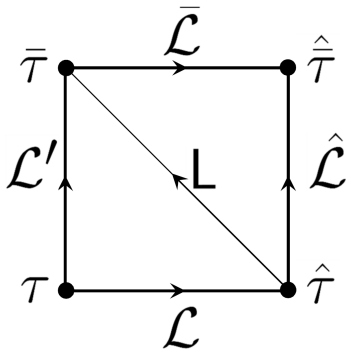
Schwarzian KP recast as bilinear equation on KP tau-function pairs

Bilinear formalism for Schwarzian KP and Harry Dym hierarchies

Linear combinations of the pair stay KP tau-functions, and this yields Harry Dym via Lax-Sato formulation.

Figure from the paper full image
abstract click to expand
We consider the Schwarzian KP and Harry Dym hierarchies in the framework of the bilinear formalism which is well known for such integrable hierarchies as KP, modified KP, BKP, Toda lattice and other. We show that, similarly to the bilinear formulation of the modified KP hierarchy, the Schwarzian KP can be reformulated as an integral bilinear equation for a pair of KP tau-functions with the property that any linear combination of them is again a tau function of the KP hierarchy. The Harry Dym hierarchy is then obtained as the Lax-Sato formulation of the SchKP one. The close connection with Backlund-Darboux transformations for integrable hierarchies is also discussed. Besides, it is shown that the SchKP hierarchy has a natural embedding into the multi-component KP hierarchy.
0
0
nlin.SI 2026-05-01

RH solver computes coupled mKdV solutions directly at any point

Numerical inverse scattering transform for the coupled modified Korteweg-de Vries equation

The 3x3 matrix problem is deformed in three regions using steepest descent to avoid time-stepping errors in long simulations.

abstract click to expand
This paper develops the numerical inverse scattering transform (NIST) framework for the coupled modified Korteweg-de Vries (mKdV) equation based on its associated Riemann-Hilbert problem. The coupled system gives rise to a $3\times3$ matrix-valued Riemann-Hilbert problem, whose jump matrix and scattering data have a more involved structure than in the scalar case. This matrix setting makes the extension of NIST to the coupled system nontrivial, both in the direct scattering computation and in the numerical solution of the inverse problem. Within this framework, the scattering data are first computed by solving the matrix direct scattering problem using a Chebyshev collocation method with suitable mappings. The Deift-Zhou nonlinear steepest descent method is then used to analyze and deform the oscillatory Riemann-Hilbert problem. In particular, the phase function admits two stationary points symmetric about the origin, and the analysis leads to a division of the $(x,t)$-plane into three regions with corresponding contour deformations. Compared with traditional numerical methods, the NIST computes the solution directly at prescribed spatial and temporal points without relying on time-stepping. Numerical experiments illustrate the performance of the proposed NIST in long-time simulations and indicate that it captures the main asymptotic features of the coupled mKdV solutions.
0
0
nlin.SI 2026-04-30

Lax triples of KdV and NLS yield scalene Yang-Baxter maps

Scalene Yang-Baxter maps and Lax triples

The maps solve a generalized set-theoretic Yang-Baxter equation through matrix refactorization problems.

abstract click to expand
We study a generalisation of the set-theoretic Yang-Baxter equation and investigate the connection between its solutions and matrix refactorisation problems. We refer to such solutions as scalene Yang-Baxter maps. Moreover, we construct scalene Yang-Baxter maps associated with integrable equations of KdV and NLS type.
0
0
nlin.SI 2026-04-30

Gauge transforms simplify Lax pairs and build Miura maps for difference equations

On matrix Lax representations for (1+1)-dimensional evolutionary differential-difference equations

General theory for evolutionary differential-difference systems yields new two-component integrable equations linked by explicit discrete Mi

abstract click to expand
Differential-difference matrix Lax representations (Lax pairs), gauge transformations, and discrete Miura-type transformations (MTs) belong to the main tools in the theory of (nonlinear) integrable differential-difference equations. For a given equation, two matrix Lax representations (MLRs) are said to be gauge equivalent if one of them can be obtained from the other by applying a matrix gauge transformation. Generalizing and extending several previous works on MLRs and MTs, we present new results on the following problems: - When and how can one simplify a given MLR by means of gauge transformations? - How can one use MLRs and gauge transformations for constructing MTs? - A MLR is called fake if it is gauge equivalent to a trivial MLR. How to determine whether a given MLR is not fake? We consider the general (1+1)-dimensional evolutionary differential-difference case when a MLR can depend on any shifts of dependent variables and can be non-autonomous. As applications and illustrations of the presented general theory, we construct several new two-component integrable equations (with new MLRs) connected by new MTs to known integrable equations from the papers [S. Konstantinou-Rizos, A.V. Mikhailov, P. Xenitidis, J. Math. Phys. 2015], [E. Mansfield, G. Mari Beffa, Jing Ping Wang, Found. Comput. Math. 2013]), including non-autonomous examples.
0
0
nlin.SI 2026-04-30

Coupled rogue waves split into two distinct coexisting patterns

Coexistence of two distinct rogue wave patterns in the coupled nonlinear Schr\"odinger equation

High-order solutions develop separate regions each with a different fundamental wave type, shiftable by parameter choice

Figure from the paper full image
abstract click to expand
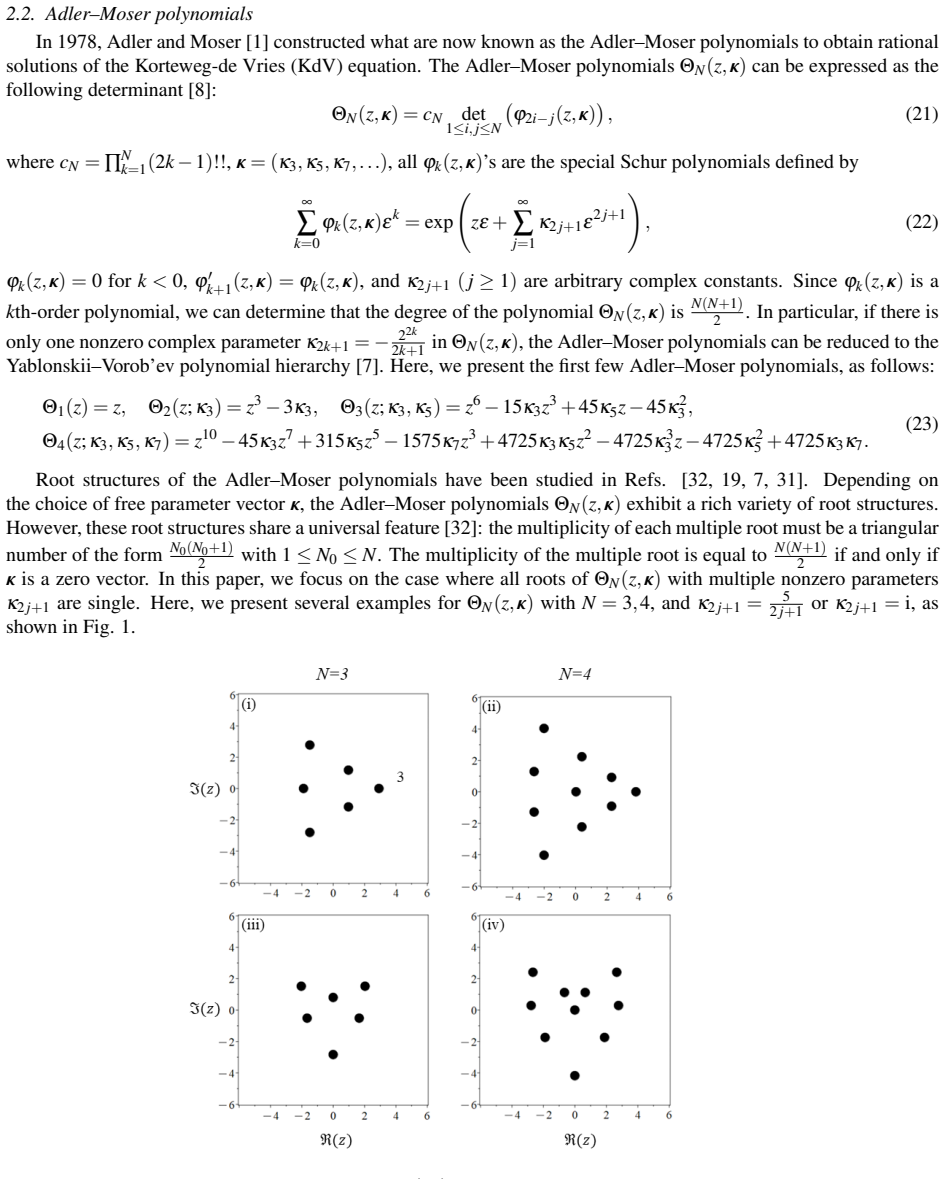
This paper investigates the asymptotic behavior of high-order vector rogue wave (RW) solutions of the coupled nonlinear Schr\"odinger (CNLS) equation in the presence of multiple large internal parameters. We report several new high-order RW patterns in the CNLS system, including double-sector, double-heart, and mixed sector-heart configurations. The main novelty is that each RW pattern contains two distinct regions in which two different fundamental first-order RWs coexist simultaneously, potentially appearing as bright (eye-shaped) versus four-petaled or dark (anti-eye-shaped) forms. These two regions are respectively associated with the simple root structures of two different Adler--Moser polynomials: each region consists of well-separated first-order RWs in one-to-one correspondence with the simple roots of the associated polynomial. In addition, by tuning certain free parameters, the two regions of the RW pattern can be shifted to arbitrary locations in the $ (x,t) $-plane. This flexibility, together with the rich simple-root structures of Adler--Moser polynomials, enables the systematic generation of a much broader family of structured RW patterns in the CNLS equation.
0
0
nlin.SI 2026-04-28

Hirota-Miwa equations collapse to seven distinct models

Discrete integrable equations with three independent variables

Darboux reductions link Toda, semi-discrete and fully discrete classes while preserving integrals, producing Lax pairs for each.

abstract click to expand
In this paper, we study nonlinear integrable equations with three independent variables of the following types: Toda-type lattices, semi-discrete lattices, and fully discrete Hirota-Miwa type models. It is shown that integrable equations of all three types admit reductions in the form of Darboux-integrable hyperbolic systems. It is important that the transition from one class to another is carried out by means of discretization (continualization) of the above-mentioned reductions with preservation of characteristic integrals. In other words, at the level of reductions, one can establish some correspondence between the classes of 3D models under consideration. In the context of this correspondence, the authors managed to conduct a comparative analysis of the well-known list of integrable Hirota-Miwa type equations, containing 13 equations. It was established that some equations from this list are related by point changes of variables. As a result, the final list of known integrable Hirota-Miwa type equations was reduced to seven. One equation was obtained by discretizing the list of semi-discrete Toda-type equations using characteristic integrals in this paper, probably it is new. For all seven models, associated linear systems (Lax pairs) are given.
0
0
nlin.SI 2026-04-27

Umemura roots predict rogue wave patterns

Rogue-wave and lump patterns associated with the third Painlev\'{e} equation

Large parameters in nonlinear SchrΓΆdinger and Boussinesq equations align rogue waves with polynomial roots from the third PainlevΓ© equation,

Figure from the paper full image
abstract click to expand
We report rogue-wave and lump patterns associated with Umemura polynomials, which arise in rational solutions of the third Painlev\'{e} equation. We first show that in many integrable equations such as the nonlinear Schr\"odinger equation and the Boussinesq equation, when internal parameters of their rogue wave solutions are large and of certain form, then their rogue patterns in the spatial-temporal plane can be asymptotically predicted by root distributions of Umemura polynomials (or equivalently, pole distributions of rational solutions to the third Painlev\'{e} equation). Specifically, every simple root of the Umemura polynomial would induce a fundamental rogue wave whose spatial-temporal location is linearly related to that simple root, while a multiple root of the Umemura polynomial would induce a non-fundamental rogue wave in the $O(1)$ neighborhood of the spatial-temporal origin. Next, we show that in a certain class of higher-order lump solutions of the Kadomtsev-Petviashvili-I (KPI) equation, when their internal parameters are large and of certain form, then their lump patterns at $O(1)$ time can also be predicted asymptotically by root distributions of Umemura polynomials, where simple and multiple roots of the polynomial would give rise to fundamental and non-fundamental lumps in the spatial plane, respectively. These results reveal the importance of the third Painlev\'{e} equation in studies of nonlinear wave patterns. We also report a new transformation which turns bilinear rogue-wave solutions of the nonlinear Schr\"odinger equation to higher-order lump solutions of the KPI equation.
0
0
nlin.SI 2026-04-23

Invariants test if spectral parameters in Lax pairs are essential

The gauge action on semi-discrete Lax representations and its invariants

Nontrivial lambda-dependence in any invariant means no gauge transformation can remove the parameter.

abstract click to expand
Semi-discrete (differential-difference) matrix Lax representations (Lax pairs) play an essential role in the theory of integrable differential-difference equations. Fix a (1+1)-dimensional evolutionary differential-difference (semi-discrete) equation and consider matrix Lax representations (MLRs) of this equation. Two MLRs are said to be gauge equivalent if one of them can be obtained from the other by applying a (local) matrix gauge transformation. Gauge transformations (GTs) form an infinite-dimensional group, which acts on the set of MLRs of a given equation. Two MLRs are gauge equivalent iff they belong to the same orbit of this action. When one tries to establish integrability (in the sense of soliton theory) for a given equation, one is interested in MLRs which depend on a parameter (usually called the spectral parameter) such that the parameter cannot be removed by any GT. We introduce and study explicit invariants with respect to the action of GTs on the set of MLRs for a given (1+1)-dimensional evolutionary differential-difference equation with any number of components. Using these invariants, we obtain the following results: - Consider a MLR with a parameter $\lambda$. If at least one of the invariants computed for this MLR depends nontrivially on $\lambda$, then the parameter cannot be removed by any GT. - When we have two different MLRs for a given equation, we present necessary conditions for these two MLRs to be gauge equivalent. Our results on semi-discrete MLRs of differential-difference equations are inspired by results of S$.$Yu. Sakovich and M. Marvan on (continuous) zero-curvature representations of partial differential equations. A comparison with some of the results of S$.$Yu. Sakovich and M. Marvan is presented.
1 0
0
nlin.SI 2026-04-22

New duality maps Hamiltonian to Lagrangian forms for integrable systems

Duality of Hamiltonian and Lagrangian formulations for integrable systems

Hamiltonian potential variables generalize the KdV trick and supply Lagrangian multiforms for gas dynamics and astigmatism equations.

Figure from the paper full image
abstract click to expand
We introduce the concept of Hamiltonian potential variables to map Hamiltonian operators into symplectic operators in a dual space. This generalises the classical trick of switching to a potential variable to obtain a Lagrangian density for the Korteweg-de Vries (KdV) equation. Building on this concept, we present the Lagrangian structure for bi-Hamiltonian systems, discuss the Lenard scheme in the symplectic formalisms, and apply this to construct pairs of Lagrangian multiforms. We discuss the key model of the KdV equation and some dispersionless limits of it. We present a pair of Lagrangian multiforms for these equations, one of which is new. We also consider the examples of polytropic gas dynamics and the constant astigmatism equation, for which no Lagrangian multiforms were previously known.
0
0
nlin.SI 2026-04-22

Orlov-Schulman symmetries extend self-dual conformal hierarchy

Orlov-Schulman symmetries of the self-dual conformal structure equations

They commute with the basic Lax-Sato flows, include Galilean and scaling cases, and arise from Riemann-Hilbert dressing.

abstract click to expand
We construct Orlov-Schulman symmetries for the self-dual conformal structure (SDCS) hierarchy. We provide an explicit proof of compatibility of additional symmetries with the basic Lax-Sato flows of the hierarchy, and consider several simple examples, including Galilean transformations and scalings. We also present a picture of the Orlov-Schulman symmetries in terms of a dressing scheme based on the Riemann-Hilbert problem.
0
0
nlin.SI 2026-04-22

Explicit canonical coordinates separate Kaup-Kupershmidt HΓ©non-Heiles dynamics

Canonical separating coordinates in the generalized cubic H\'enon-Heiles systems

Bi-Hamiltonian geometry supplies both the coordinates and their conjugate momenta, splitting the four-dimensional system into two decoupled

abstract click to expand
We study the three classical integrable generalized cubic H\'enon--Heiles systems -- Kaup--Kupershmidt, KdV$_5$, and Sawada--Kotera -- from the viewpoint of bi-Hamiltonian geometry and separation of variables. On the standard symplectic manifold $T^*\mathbb R^2$, we construct compatible Poisson deformations $P_1=L_XP_0$, compute the associated recursion operators $N=P_1P_0^{-1}$, and analyze the action of $N^*$ on the codistribution generated by the first integrals. This yields the corresponding control matrices, whose eigenvalues provide the separating coordinates. For the generalized Kaup--Kupershmidt case we carry out the construction explicitly: we determine a deformation vector field, the compatible Poisson tensor, the torsionless recursion operator, the control matrix, the separating coordinates, and, crucially, the conjugate momenta. We then derive the separated relations and write the Hamilton equations in canonical separated variables, thus decomposing the original Hamiltonian system into two separated subsystems. To the best of our knowledge, this explicit derivation of the separating variables and, in particular, of the conjugate momenta for the generalized Kaup--Kupershmidt system is new. For the KdV$_5$ and Sawada--Kotera cases we show how the same bi-Hamiltonian scheme applies, emphasizing both the common geometric mechanism and the features peculiar to each system. In this way, the three generalized cubic H\'enon--Heiles systems are treated within a unified framework based on compatible Poisson structures, recursion operators, control matrices, and Darboux--Nijenhuis coordinates.
0
0
nlin.SI 2026-04-16

Same PainlevΓ© surface from different weights but distinct dynamics

On the discrete Painlev\'e equivalence problem, non-conjugate translations and nodal curves

Non-conjugate elements in the Weyl group and nodal curves make some examples inequivalent despite shared D_5^{(1)} type.

Figure from the paper full image
abstract click to expand
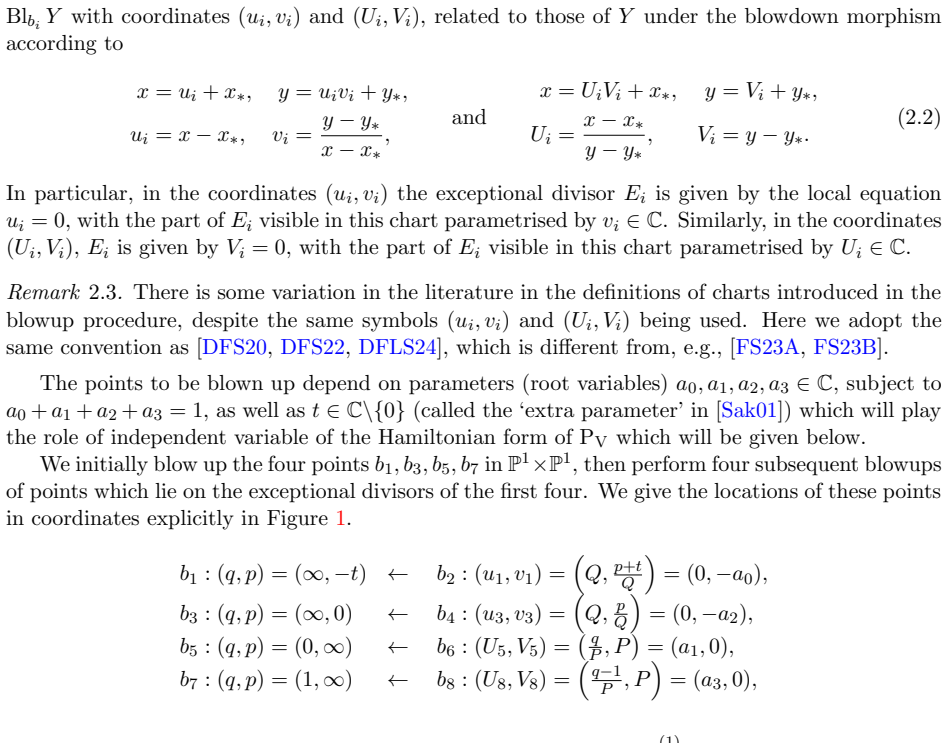
We consider several examples of nonautonomous systems of difference equations coming from semi-classical orthogonal polynomials via recurrence coefficients and ladder operators, with respect to various generalisations of Laguerre and Meixner weights. We identify these as discrete Painlev\'e equations and establish their types in the Sakai classification scheme in terms of the associated rational surfaces. In particular, we find examples which come from different weights and share a common surface type $D_5^{(1)}$ but are inequivalent in two ways. First, their dynamics are generated by non-conjugate elements of $\widehat{W}(A_3^{(1)})$. Second, some of the examples have associated surfaces being non-generic in the sense of having nodal curves. The symmetries of these examples form subgroups of the generic symmetry group, which we compute. In particular, we find $(W(A_1^{(1)})\times W(A_1^{(1)}))\rtimes \mathbb{Z}/2\mathbb{Z}$. These examples give further weight to the argument that any correspondence between different weights and the Sakai classification should make use of the refined version of the discrete Painlev\'e equivalence problem, which takes into account not just surface type, but also the group elements generating the dynamics as well as parameter constraints, e.g. those corresponding to nodal curves.
0
0
nlin.SI 2026-04-14

Infinite family of equations all obey Laurent property

An infinite family of homogeneous discrete equations with the Laurent property

The construction begins with Somos-5 and extends it so every term stays a Laurent polynomial in the initial data.

abstract click to expand
We present and investigate a new infinite family of homogeneous equations which possess the Laurent property. The first representative in this family is the well-known Somos-5 recurrence.
0
0
nlin.SI 2026-04-13

Vector bilinear method yields explicit multi-soliton solutions for coupled mKdV

A Vector Bilinear Framework for Soliton Dynamics in Coupled Modified KdV Systems

It recovers the three-soliton condition at the vector level and supports solitons on nonzero backgrounds for any symmetric coupling.

Figure from the paper full image
abstract click to expand
We investigate the integrable structure and soliton dynamics of a coupled modified Korteweg-de Vries (cmKdV) system with a real symmetric coupling matrix. We introduce a vector reformulation of Hirota's bilinear formalism in which both the bilinear equations and their solutions are expressed directly at the vector level, rather than through a component-wise construction. This formulation preserves the intrinsic structure of the coupled system and provides a compact framework for multi-component nonlinear wave dynamics. Within this approach, we construct explicit one-, two-, and three-soliton solutions in closed vector form and recover the three-soliton condition directly at the vector level, confirming consistency with integrability. The method enables a unified treatment of focusing, defocusing, and mixed-sign regimes. In particular, for indefinite coupling, it reveals the existence of nontrivial vector ground states, leading to soliton solutions on non-zero backgrounds. These results highlight the structural advantages of the vector bilinear approach and open perspectives for the study of more general nonlinear excitations in multi-component integrable systems.
0
0
nlin.SI 2026-04-09 Recognition

Conditions on n-ary magmas turn maps into pentagon maps

Multicomponent pentagon maps

Necessary and sufficient criteria plus a generation procedure yield parametric, multicomponent and entwining families.

Figure from the paper full image
abstract click to expand
We provide necessary and sufficient conditions for maps that satisfy associative-like conditions on families of n-ary magmas to be pentagon maps. We obtain parametric-pentagon maps and we propose a procedure that generates families of multicomponent pentagon and entwining pentagon maps from a given pentagon map.
0
0
nlin.SI 2026-04-03 Recognition

Lotka-Volterra systems made Liouville integrable in high dimensions

Liouville integrable Lotka-Volterra systems

Explicit families supply 3m-2 parameters and enough commuting integrals for exact solvability

Figure from the paper full image
abstract click to expand
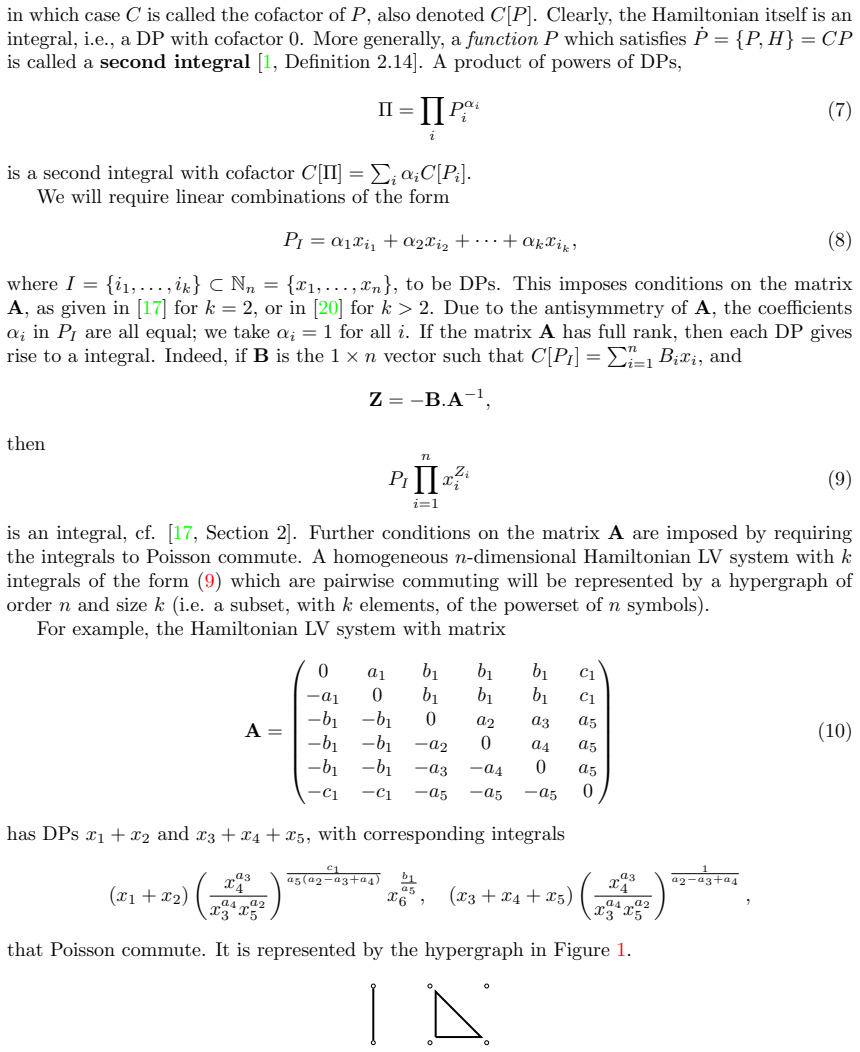
We present $\frac{m^{2}}{4}+\frac{m}{2}+\frac{1-\left(-1\right)^{m}}{8}$ homogeneous $(3m-2)$-parameter families of Liouville integrable $(2m)$- and $(2m-1)$-dimensional Lotka-Volterra systems. We also study inhomogeneous versions of these systems.
0

browse all of nlin.SI β†’ full archive Β· search Β· sub-categories