REVIEW 2 major objections 6 minor 1 cited by
Hot wormholes and chaos dynamics in a two-coupled SYK model
T0 review · 2 major / 6 minor · reviewed 2026-08-10 · deepseek-v4-flash
Pith's one-line read The unstable 'hot wormhole' phase of the two-coupled SYK model has computable chaos exponents, obtained from two non-equilibrium protocols, and they interpolate smoothly between the black hole and wormhole phases.
desk verdict First Lyapunov exponents for the hot wormhole phase, computed by non-equilibrium protocols; the effective-temperature labeling is asserted more than shown, but the claim is plausible and the paper is honest about its limits. read the letter →
The pith
A machine-rendered reading of the paper's core claim, the machinery that carries it, and where it could break.
The reading
What carries the argument
The central object is the retarded out-of-time-order kernel $K_{abcd}(\omega,\omega')$ of Eqs. (3.10)-(3.11), built from the spectral functions $\rho_{ab}(\omega)$ and the effective inverse temperature $\beta_{\rm eff}$; the Lyapunov exponent $\lambda_L$ is the value at which its largest eigenvalue crosses one. The non-equilibrium protocols are the second pillar: the Kadanoff-Baym equations (2.13)-(2.14) produce the real-time propagators, and the Wigner-transformed fluctuation-dissipation fit (2.18) converts each time slice into an effective equilibrium saddle point. The third element is the Schwarzian effective action (4.3) with the matter correction (4.7), whose potential develops a local maximum corresponding to the hot wormhole.
What would settle it
Run the same two-coupled SYK model in the microcanonical ensemble, where the hot wormhole is stable, locate the saddle point, and compute its Lyapunov exponent from the equilibrium kernel at the same $\beta_{\rm eff}$; if the value differs from the one obtained by the cooling and Floquet protocols, the effective-temperature assignment is not reproducing the unstable saddle point.
Extended reading notes
Core claim
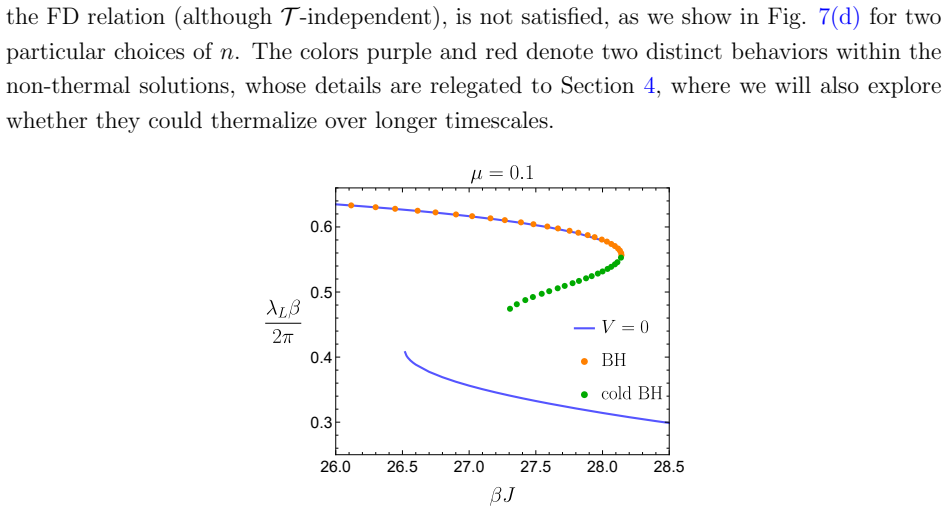
The paper claims that the unstable hot wormhole phase carries computable chaos exponents, even though it is inaccessible in equilibrium. Feeding spectral functions and effective temperatures from non-equilibrium simulations into the retarded out-of-time-order kernel yields Lyapunov exponents along the unstable branch, and those exponents match the smoothly interpolating curve conjectured in earlier work. In the driven protocol, thermal states form only for sufficiently large energy injections ($n\geq 14$ half-cycles); these states lie on the upper half of the hot wormhole branch and their Lyapunov exponents are those of the original model, with no bath. Smaller injections produce two classes of non-thermal states: one is interpreted as excited states of the cold wormhole, and the other shows a slowly varying effective temperature whose extrapolated endpoint would fall on the wrong side of the transition, a puzzle the paper leaves open. The Schwarzian approximation with a matter contribution reproduces the unstable maximum but does not capture all observed behaviors.
Load-bearing premise
The argument assumes that during the slow cooling or after the driving stops, each instant of the non-equilibrium evolution is close enough to a thermal state that a single effective temperature $\beta_{\rm eff}$ from fitting the fluctuation-dissipation ratio labels the same equilibrium (unstable) saddle point whose spectral functions feed the chaos kernel; if that mapping fails, the extracted exponents are not hot-wormhole exponents.
Editorial extensions
If this is right
- The Lyapunov exponent of the hot wormhole phase is numerically accessible and interpolates smoothly between the black hole and wormhole values along the unstable branch, confirming the interpolation conjectured in [16].
- Periodic driving of the inter-side coupling $\mu$ reaches only the upper segment of the hot wormhole branch; energy injections below a threshold ($n<14$ half-cycles) yield non-thermal excited states of the cold wormhole rather than hot wormhole states.
- The cooling-with-bath protocol extracts chaos exponents for a modified system, namely the model coupled to the bath, so only the driven and combined protocols give exponents of the original model.
- The Schwarzian potential with the matter contribution develops a local maximum corresponding to the hot wormhole, explaining qualitatively why energy injections above a threshold thermalize while smaller ones remain trapped.
- The combined cooling-then-decoupling protocol reproduces the same picture: only the upper segment of the hot wormhole branch thermalizes, and larger energy extractions produce non-thermal states.
Reading between the lines
- A direct check of the effective-temperature map would be to compute the kernel eigenvalue at $\beta_{\rm eff}$ from the true equilibrium unstable saddle point and compare it with the non-equilibrium value; agreement would make the smooth Lyapunov interpolation a statement about the phase diagram itself.
- The red non-thermal states, whose extrapolated inverse temperatures fall above $\beta_c$, hint at a slow thermalization connected to the power-law revival envelope noted in [22]; extending the simulations beyond $t_{\rm max}=1500$ could decide whether the fluctuation-dissipation fits eventually become exact.
- A microcanonical simulation, where the negative-heat-capacity phase is stable, is the natural place to populate the lower segment of the hot wormhole branch that the driving protocol cannot reach, and to benchmark the non-equilibrium exponents.
- The effective-temperature labeling and kernel machinery could be carried over to other holographic quench or Floquet systems, and to the tighter chaos bounds cited in [38,39] that the paper leaves for future work.
Editorial analysis
A structured set of objections, weighed in public.
Referee Report
Summary. The paper studies chaotic dynamics in the two-coupled SYK model, focusing on the thermodynamically unstable "hot wormhole" phase, which is not accessible in equilibrium canonical simulations. The authors use two non-equilibrium Schwinger-Keldysh protocols: coupling the system to a cold bath, and periodically driving the inter-copy coupling mu. From the real-time Green functions they extract a time-dependent effective inverse temperature beta_eff(T) via a fluctuation-dissipation fit, Eq. (2.18), together with the associated spectral functions. These are fed into the retarded ladder kernel, Eqs. (3.10)-(3.11), and the Lyapunov exponent lambda_L is obtained from the eigenvalue crossing condition. For the bath protocol lambda_L interpolates smoothly between the black-hole and wormhole values; for the Floquet protocol only sufficiently large energy injections (n >= 14) thermalize, and these land on the upper segment of the hot wormhole branch. Non-thermal states at smaller n are classified and interpreted using a Schwarzian effective potential, Eq. (4.5), supplemented by a matter contribution, Eq. (4.7). The paper concludes that the hot wormhole phase has computable chaos exponents and a richer structure than the equilibrium phase diagram alone suggests.
Significance. If the identification of the simulated states with the unstable hot-wormhole saddle is correct, the paper provides the first numerical Lyapunov exponents for this phase and a direct test of the conjecture in Ref. [16] that lambda_L interpolates smoothly across the stable/unstable branches. The frequency-space kernel in Eq. (3.11) is a standard and explicit tool, and the use of the NESSi library for long-time simulations is appropriate. The paper is also transparent about the bath protocol modifying the model and about which Floquet states satisfy the fluctuation-dissipation relation. A notable strength is that the Floquet protocol, when it works, returns to the original Hamiltonian and produces thermal final states without any bath, giving a physically clean route to the hot branch. However, the central attribution of the extracted exponents to the hot wormhole phase relies on an equivalence between non-equilibrium states and equilibrium unstable saddles that is asserted but not demonstrated in detail, and the numerical lambda_L values are reported without error estimates or convergence tests.
major comments (2)
- [Section 2.1, Eq. (2.18); Section 3, Eq. (3.11)] The load-bearing assumption is that each non-equilibrium state used in the calculation coincides with the (possibly bath-modified) equilibrium unstable saddle at the fitted beta_eff(T). For the cooling protocol this is asserted in Section 2.1 with the sentence 'We have checked numerically that this is the case,' but no comparison is shown: the non-equilibrium spectral functions rho(T,omega) are never directly compared with the spectral functions of the equilibrium hot-wormhole solution at the same beta. Since Eq. (3.11) uses equilibrium thermal Wightman functions with a single beta, the lambda_L values in Figs. 5 and 8 are only interpretable as hot-wormhole exponents if this equivalence holds. For the Floquet thermal states, the FD relation and the energy location in Fig. 7(c) are suggestive, but FD alone does not select among the three equilibrium saddle solutions in the coexistence region. A direct comparison of the final spectral functions (or of G^R and G^W) with those of the hot-wormhole saddle would close this gap and should be added.
- [Section 3, Figs. 5 and 8] No error bars, convergence estimates, or numerical parameters are reported for the Lyapunov exponents. Solving the eigenvalue problem in Eqs. (3.10)-(3.11) requires discretizing omega, truncating the spectral functions, and fitting beta_eff(T); the sensitivity of the eigenvalue crossing to these choices is not discussed. Since the main quantitative claim is the smooth interpolation and the specific values of lambda_L on the hot branch, the authors should provide convergence checks (e.g., grid spacing, time-window length, fitting range for beta_eff) or at least representative error bars.
minor comments (6)
- [Section 4, paragraph after Fig. 10] The phrase 'the thermalized purple solutions should be rather called cold black holes' is confusing because the purple solutions were previously defined as states for which the fluctuation-dissipation relation is not satisfied; the intended wording is likely 'non-thermal purple solutions.'
- [Fig. 6 caption] The caption 'initially in a black hole solution (T = 0)' is ambiguous: T here appears to denote the average time, not temperature, but the same symbol is used for temperature throughout the paper; please disambiguate (e.g., T_avg or t_avg).
- [Eq. (2.18) and Fig. 7] The paper does not state the frequency range over which the tanh(beta omega/2) fit is performed, nor the goodness of fit for the thermal states. Adding this information would make the beta_eff extraction reproducible and would strengthen the distinction between thermal and non-thermal states.
- [Section 3.1] The simulation parameters state J = J_B = 1, mu = 0.1 and V = 0.2, but the number of bath fermions M and any convergence checks with respect to M or the time step are not reported; a brief statement would help reproducibility.
- [Section 4, Eq. (4.1)] For the red non-thermal solutions, the exponential fit beta_eff(T) = A e^{-gamma T} + beta_infty is used to place points in Fig. 7(c), but no fit quality or fitted values of A and gamma are reported; without these, the claim beta_infty > beta_c is difficult to assess.
- [Section 4.1.1, Eq. (4.7)] The proposed attractor mechanism for explaining why a range of energy injections leads to long-time residence at the local maximum of the modified Schwarzian potential is presented as a speculation ('may give rise to an attractor mechanism'); this is acceptable, but the sentence 'it is ultimately dictated by the Schwinger-Dyson equations, which admit a single solution for a given energy' needs a brief justification or a reference, because the coexistence region by definition contains multiple stationary solutions at a given temperature.
Circularity Check
The reported Lyapunov exponents come from a standard kernel eigenvalue calculation, not from fitting the target result; the paper is essentially non-circular, with only a minor unverified mapping between non-equilibrium states and equilibrium saddle points.
full rationale
The central quantity, the hot-wormhole Lyapunov exponent, is obtained by solving the retarded-kernel eigenvalue condition (3.10)-(3.11) for the value of lambda_L at which the largest eigenvalue crosses 1. The inputs are the spectral functions rho_ab(omega,T) and the effective inverse temperature beta_eff(T) extracted from the non-equilibrium simulation via the fluctuation-dissipation fit (2.18), but lambda_L is not a fitted parameter and no equation defines beta_eff in terms of lambda_L or vice versa. The Floquet protocol is cited from the authors' prior work [19], yet that citation supplies a driving setup rather than the theoretical conclusion, and the protocol is explicitly described in Section 3.2, making the numerical output an independent result. The paper also honestly discards the n<14 Floquet states because the FD relation is not satisfied, so those non-thermal solutions are not mislabeled as hot-wormhole states for the purpose of the exponent calculation. The main weakness is that Section 2.1 asserts 'We have checked numerically that this is the case' when claiming that the non-equilibrium configurations correspond to the unstable equilibrium saddle-point solutions, but no direct comparison of non-equilibrium and equilibrium spectral functions is shown; this is an evidence gap affecting whether lambda_L is exactly the hot-wormhole exponent, not a circularity in the derivation. No uniqueness theorem is imported from the authors' prior work, and no known empirical pattern is merely renamed as the central claim. Overall, the Lyapunov computation is self-contained and non-circular.
Assumptions & free parameters
free parameters (2)
- beta_eff(T) effective inverse temperature =
time-dependent fits at each average time T
- beta_infinity from exponential fits of red solutions =
values above beta_c ~ 27.3, shown as red dots in Fig. 7(c)
assumptions (6)
- domain assumption Large-N saddle point and factorization of correlators in the two-coupled SYK model.
- domain assumption Kadanoff-Baym equations (2.13)-(2.14) integrated with the NESSi package give accurate real-time Green's functions.
- domain assumption The retarded chaos kernel (3.5) remains valid in the presence of the bath.
- domain assumption The Schwarzian action (4.2) and effective potential (4.5) capture the low-energy dynamics.
- domain assumption Matter contribution to the Schwarzian potential (4.7) from the lightest fermion with Delta = 1/4.
- domain assumption Driving at the resonant frequency Omega = 1.0 of the wormhole phase injects energy exponentially.
Cite this review
Pith. "Pith review of Hot wormholes and chaos dynamics in a two-coupled SYK model." pith.science (2026). https://pith.science/paper/C3EUJERD
@misc{pith2026250104660,
  author       = {Pith},
  title        = {Pith review of: Hot wormholes and chaos dynamics in a two-coupled SYK model},
  year         = {2026},
  howpublished = {\url{https://pith.science/paper/C3EUJERD}},
  note         = {Machine review of arXiv:2501.04660}
}
read the original abstract
We study the dynamics of chaos across the phase transition in a 2-coupled Sachdev-Ye-Kitaev (SYK) model, with a focus on the unstable "hot wormhole" phase. Using the Schwinger-Keldysh formalism, we employ two non-equilibrium protocols that allow access to this phase, which is inaccessible through equilibrium simulations: one involves cooling the system via a coupling to a thermal bath, while in the other we periodically drive the coupling parameter between the two sides. We numerically compute the Lyapunov exponents of the hot wormhole for the two cases. Our results uncover a rich structure within this phase, including both thermal and non-thermal solutions. These behaviors are analyzed in detail, with partial insights provided by the Schwarzian approximation, which captures certain but not all aspects of the observed dynamics.
Figures


Figures from the paper (11 more)




Forward citations
Cited by 1 Pith paper
-
Size Operator and Spectral Clustering in the Two Coupled SYK Model
The finite-N spectrum of the two coupled SYK model organizes into operator-size clusters that underlie the conformal towers, revival dynamics, and wormhole-black hole transition.
Reference graph
Works this paper leans on
-
[16]
Chaos exponents of SYK traversable wormholes
T. Nosaka and T. Numasawa, Chaos exponents of SYK traversable wormholes , JHEP 02 (2021) 150 [ 2009.10759]
work page Pith review arXiv 2021
-
[1]
P. Hayden and J. Preskill, Black holes as mirrors: Quantum information in random subsystems, JHEP 09 (2007) 120 [ 0708.4025]. 26
arXiv 2007
- [2]
-
[3]
S.H. Shenker and D. Stanford, Black holes and the butterfly effect , JHEP 03 (2014) 067 [1306.0622]
arXiv 2014
-
[4]
S. Sachdev and J. Ye, Gapless spin-fluid ground state in a random quantum Heisenberg magnet, Physical Review Letters 70 (1993) 3339 [ cond-mat/9212030]
arXiv 1993
-
[5]
A. Kitaev, A simple model of quantum holography (part 1) , Talk at KITP, April 7, 2015, https: // online. kitp. ucsb. edu/ online/ entangled15/ kitaev/(2015)
work page 2015
-
[6]
Kitaev, A simple model of quantum holography (part 2) , Talk at KITP, May 27, 2015, https: // online
A. Kitaev, A simple model of quantum holography (part 2) , Talk at KITP, May 27, 2015, https: // online. kitp. ucsb. edu/ online/ entangled15/ kitaev2/(2015)
work page 2015
-
[7]
J. Maldacena and D. Stanford, Remarks on the Sachdev-Ye-Kitaev model , Phys. Rev. D 94 (2016) 106002 [ 1604.07818]
arXiv 2016
Show all 41 references
-
[8]
Maldacena, S.H
J. Maldacena, S.H. Shenker and D. Stanford, A bound on chaos , JHEP 08 (2016) 106 [1503.01409]
2016 arXiv
-
[9]
Maldacena, D
J. Maldacena, D. Stanford and Z. Yang, Conformal symmetry and its breaking in two dimensional Nearly Anti-de-Sitter space , PTEP 2016 (2016) 12C104 [ 1606.01857]
2016 arXiv
- [10]
-
[11]
Gao, D.L
P. Gao, D.L. Jafferis and A.C. Wall, Traversable wormholes via a double trace deformation, Journal of High Energy Physics 2017 (2017) [ 1608.05687]
2017 arXiv
-
[12]
Maldacena, D
J. Maldacena, D. Stanford and Z. Yang, Diving into traversable wormholes , Fortschritte der Physik 65 (2017) [ 1704.05333]
2017 arXiv
-
[13]
Gao and D.L
P. Gao and D.L. Jafferis, A traversable wormhole teleportation protocol in the SYK model, JHEP 07 (2021) 097 [ 1911.07416]
2021 arXiv
-
[14]
Brown, H
A.R. Brown, H. Gharibyan, S. Leichenauer, H.W. Lin, S. Nezami, G. Salton et al., Quantum Gravity in the Lab. I. Teleportation by Size and Traversable Wormholes , PRX Quantum 4 (2023) [ 1911.06314]
2023 arXiv
-
[15]
Nezami, H.W
S. Nezami, H.W. Lin, A.R. Brown, H. Gharibyan, S. Leichenauer, G. Salton et al., Quantum gravity in the lab. ii. teleportation by size and traversable wormholes , PRX Quantum 4 (2023) [ 2102.01064]. 27
2023 arXiv
-
[17]
Kamenev, Field Theory of Non-Equilibrium Systems , Cambridge University Press (2011)
A. Kamenev, Field Theory of Non-Equilibrium Systems , Cambridge University Press (2011)
2011
-
[18]
Maldacena and A
J. Maldacena and A. Milekhin, SYK wormhole formation in real time , JHEP 04 (2021) 258 [ 1912.03276]
2021 arXiv
-
[19]
Berenguer, A
M. Berenguer, A. Dey, J. Mas, J. Santos-Su´ arez and A.V. Ramallo, Floquet SYK wormholes, JHEP 06 (2024) 106 [ 2404.08394]
2024 arXiv
-
[20]
T.-G. Zhou, L. Pan, Y. Chen, P. Zhang and H. Zhai, Disconnecting a Traversable Wormhole: Universal Quench Dynamics in Random Spin Models , Phys. Rev. Res. 3 (2021) 022024 [ 2009.00277]
2021 arXiv
-
[21]
Zhang, More on Complex Sachdev-Ye-Kitaev Eternal Wormholes , JHEP 03 (2021) 087 [2011.10360]
P. Zhang, More on Complex Sachdev-Ye-Kitaev Eternal Wormholes , JHEP 03 (2021) 087 [2011.10360]
2021 arXiv
-
[22]
Plugge, E
S. Plugge, E. Lantagne-Hurtubise and M. Franz, Revival dynamics in a traversable wormhole, Physical Review Letters 124 (2020) [ 2003.03914]
2020 arXiv
-
[23]
Haenel, S
R. Haenel, S. Sahoo, T.H. Hsieh and M. Franz, Traversable wormhole in coupled Sachdev-Ye-Kitaev models with imbalanced interactions, Physical Review B 104 (2021) [2102.05687]
2021 arXiv
-
[24]
Almheiri, A
A. Almheiri, A. Milekhin and B. Swingle, Universal constraints on energy flow and SYK thermalization , JHEP 08 (2024) 034 [ 1912.04912]
2024 arXiv
-
[25]
Haehl and M
F.M. Haehl and M. Rangamani, Records from the S-Matrix Marathon: Schwinger-Keldysh Formalism, 10, 2024 [ 2410.10602]
2024 arXiv
-
[26]
Eberlein, V
A. Eberlein, V. Kasper, S. Sachdev and J. Steinberg, Quantum quench of the Sachdev-Ye-Kitaev model, Physical Review B 96 (2017) [ 1706.07803]
2017 arXiv
-
[27]
Bhattacharya, D.P
R. Bhattacharya, D.P. Jatkar and N. Sorokhaibam, Quantum quenches and thermalization in SYK models , Journal of High Energy Physics 2019 (2019) [1811.06006]
2019 arXiv
-
[28]
Haldar, P
A. Haldar, P. Haldar, S. Bera, I. Mandal and S. Banerjee, Quench, thermalization, and residual entropy across a non-Fermi liquid to Fermi liquid transition , Physical Review Research 2 (2020) [ 1903.09652]. 28
2020 arXiv
-
[29]
Kuhlenkamp and M
C. Kuhlenkamp and M. Knap, Periodically Driven Sachdev-Ye-Kitaev Models , Physical Review Letters 124 (2020) [ 1906.06341]
2020 arXiv
-
[30]
Larzul and M
A. Larzul and M. Schir´ o,Quenches and (pre)thermalization in a mixed Sachdev-Ye-Kitaev model, Physical Review B 105 (2022) [ 2107.07781]
2022 arXiv
-
[31]
Hosseinabadi, S.P
H. Hosseinabadi, S.P. Kelly, J. Schmalian and J. Marino, Thermalization of non-Fermi-liquid electron-phonon systems: Hydrodynamic relaxation of the Yukawa-Sachdev-Ye-Kitaev model, Phys. Rev. B 108 (2023) 104319 [ 2306.03898]
2023 arXiv
-
[32]
H. Guo, R. Mukherjee and D. Chowdhury, Dynamical Freezing in Exactly Solvable Models of Driven Chaotic Quantum Dots , 2405.01627
-
[33]
Jaramillo, R
S.S. Jaramillo, R. Jha and S. Kehrein, Thermalization of a Closed Sachdev-Ye-Kitaev System in the Thermodynamic Limit , 2411.12421
-
[34]
Sch¨ uler, D
M. Sch¨ uler, D. Gole˘ z, Y. Murakami, N. Bittner, A. Herrmann, H.U. Strand et al., NESSi: The Non-Equilibrium Systems Simulation package , Computer Physics Communications 257 (2020) 107484 [ 1911.01211]
2020 arXiv
-
[35]
Garc ´ ıa-Garc ´ ıa, J.J.M
A.M. Garc ´ ıa-Garc ´ ıa, J.J.M. Verbaarschot and J.-p. Zheng,The Lyapunov exponent as a signature of dissipative many-body quantum chaos , 2403.12359
-
[36]
Lantagne-Hurtubise, S
E. Lantagne-Hurtubise, S. Plugge, O. Can and M. Franz, Diagnosing quantum chaos in many-body systems using entanglement as a resource , Phys. Rev. Res. 2 (2020) 013254 [1907.01628]
2020 arXiv
-
[37]
A. Dhar, A. Gaikwad, L.K. Joshi, G. Mandal and S.R. Wadia, Gravitational collapse in SYK models and Choptuik-like phenomenon , JHEP 11 (2019) 067 [ 1812.03979]
2019 arXiv
-
[38]
Avdoshkin and A
A. Avdoshkin and A. Dymarsky, Euclidean operator growth and quantum chaos , Phys. Rev. Res. 2 (2020) 043234 [ 1911.09672]
2020 arXiv
-
[39]
Y. Gu, A. Kitaev and P. Zhang, A two-way approach to out-of-time-order correlators , JHEP 03 (2022) 133 [ 2111.12007]
2022 arXiv
-
[40]
Garc ´ ıa-Garc ´ ıa and V
A.M. Garc ´ ıa-Garc ´ ıa and V. Godet,Euclidean wormhole in the Sachdev-Ye-Kitaev model, Phys. Rev. D 103 (2021) 046014 [ 2010.11633]
2021 arXiv
-
[41]
Garc ´ ıa-Garc ´ ıa, V
A.M. Garc ´ ıa-Garc ´ ıa, V. Godet, C. Yin and J.P. Zheng,Euclidean-to-Lorentzian wormhole transition and gravitational symmetry breaking in the Sachdev-Ye-Kitaev model, Phys. Rev. D 106 (2022) 046008 [ 2204.08558]. 29
2022 arXiv
Reviewed August 10, 2026 · model on record in the stance chip above.
Discussion (0). Continue with ORCID to comment.