REVIEW 4 major objections 5 minor 1 cited by
An original classification of obscuration-free telescopes designs unfolded in two dimensions
T0 review · 4 major / 5 minor · reviewed 2026-08-10 · deepseek-v4-flash
Pith's one-line read For two-dimensional unfolded telescopes, the paper's GOFF A nomenclature is exhaustive: every unobscured design with up to four mirrors falls into one of 6, 32, or 288 connected families.
desk verdict Solid math-meets-optics classification with a real reproducibility gap: the necessary invariants are proven, but the sufficiency of the nomenclature and the exact counts 32 and 288 lean on undocumented CAD enumeration and a path-heuristic that needs code, data, or certificates before the claims can be trusted. read the letter →
The pith
A machine-rendered reading of the paper's core claim, the machinery that carries it, and where it could break.
The reading
What carries the argument
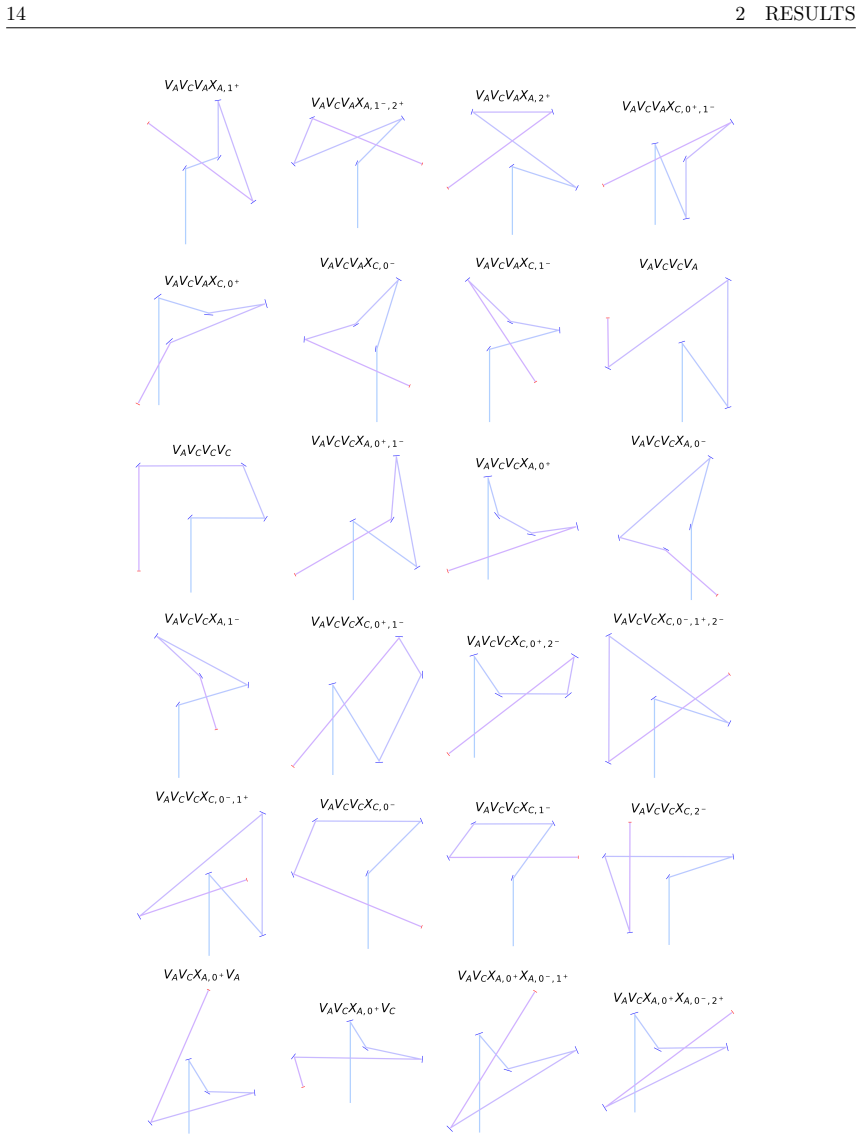
The load-bearing object is a semialgebraic model of an unfolded telescope: a configuration is a list of points $(a_0,\dots,a_{n+1})\in(\mathbb{R}^2)^{n+2}$, and the cost function $J(a)$ counts forbidden incidences such as a mirror lying on a ray segment or an aligned grazing triplet. The unobscured set $\widetilde A_n=\{J=0\}$ is open and semialgebraic, so its path-connected components are exactly the design families. Four invariants--rotation sense of consecutive triplets, intersection or non-intersection of non-adjacent ray segments, the sign of their crossing orientation, and a winding number around non-adjacent mirrors--are constant on each component and are recorded in the GOFF A name. Cylindrical algebraic decomposition on the product polynomial $Q_n$ defining $\widetilde B_n$ supplies sample points, and the linear path heuristic tests whether two samples lie in the same component.
What would settle it
Run the enumeration with a different certified implementation of cylindrical algebraic decomposition on $Q_4$, attempt to join every same-name sample pair by a numerically certified path inside $\widetilde A_4$, and compare the invariant signatures of all returned points; a single new signature or unconnectable same-name pair would break the counts.
Extended reading notes
Core claim
On the paper's own terms, the discovery is Theorem 1: for three-mirror systems in $\widetilde A_3$ and four-mirror systems in $\widetilde A_4$, two unobscured telescopes lie in the same path-connected component if and only if their GOFF A names coincide. The proof bounds the number of components from above by enumerating sample points in the Zariski-open superset $\widetilde B_n$ with cylindrical algebraic decomposition and then joining same-name points by straight-line paths (plus a listed set of intermediate points for four mirrors); it bounds from below by the four invariants encoded in the name. The two bounds are asserted to meet, giving the exhaustive counts 6, 32, and 288, with each class represented by an explicit starting design.
Load-bearing premise
The exhaustive counts 32 and 288 hold only if the computer-algebra routine really returns at least one point per connected component of $\widetilde B_4$, and only if the straight-line and listed intermediate paths between same-name sample points stay inside the unobscured set.
Editorial extensions
If this is right
- Optimizing one representative from every GOFF A class in parallel yields a comprehensive search: no qualitatively different unobscured layout is left unexplored.
- For three mirrors, only the $VAVAX_{A,0}$ family and its mirror-symmetric partner can approach zero total tilt, so near-planar three-mirror searches can be restricted to that family.
- Reading a GOFF A name reveals crossings, rotation directions, and whether a surface sits in a bounded region, so a designer can judge a layout without tracing rays.
- The method stops at four mirrors because cylindrical algebraic decomposition is doubly exponential in dimension; extending the exhaustive classification to five mirrors requires new algorithmic ideas.
- If planar symmetry is dropped and systems unfold in three dimensions, a dimension argument leaves a single connected component, so the 6, 32, and 288 counts are specific to two-dimensional unfolding.
Reading between the lines
- A clean next step is to replace the straight-line path heuristic with a certified connectivity algorithm on the CAD adjacency graph, which would promote the counts 32 and 288 from computational-plus-invariant evidence to a fully machine-checked theorem.
- The same four invariants may classify other planar line-segment arrangement problems beyond optics, such as obstacle-free linkages or multi-joint routing.
- Since three-dimensional unfolding admits only one connected component, the 2D classes are best understood as manufacturability-motivated subdivisions of a single optical layout space, not as fundamental optical distinctions.
- One could test the nomenclature's practical promise by counting how often the best optimized performance across 288 four-mirror seeds improves on the best three-mirror seed for a fixed specification.
Signed reviews
Editorial analysis
A structured set of objections, weighed in public.
Referee Report
Summary. The paper proposes an exhaustive classification of two-dimensional unfolded unobscured reflective telescope systems with up to four mirrors. The authors model a telescope by the positions of its mirrors and image plane, define a semialgebraic set fAn of admissible (non-obscured, non-grazing) configurations, and introduce four topological invariants (sense of rotation of consecutive triplets, intersection/non-intersection of flux segments, relative orientation of crossing fluxes, and winding numbers around mirror points). These invariants are assembled into the GOFF A nomenclature. Theorem 1 claims that for three- and four-mirror systems two configurations lie in the same path-connected component of fAn if and only if they have the same GOFF A name, and the paper reports the counts |CC(fA2)|=6, |CC(fA3)|=32, and |CC(fA4)|=288. The counts are obtained by combining Mathematica's SemialgebraicComponentInstances on the Zariski-open set fBn with a linear-path joining heuristic and a list of explicitly chosen intermediate points. The paper also provides one representative configuration per class and argues that these can serve as starting points for parallel optical optimization.
Significance. If the classification is correct, this is a genuinely useful contribution: it replaces brute-force searches of unobscured telescope configurations with a finite, topologically certified list of classes, and each GOFF A name would carry intrinsic geometric and manufacturability information. The necessity direction of the classification is well structured: Propositions 3-6 give clean topological invariants, and the semialgebraic formulation in Proposition 7 is appropriate. The nomenclature being defined directly in terms of the invariants means that matching GOFF A names is equivalent to matching invariants by construction, so the necessity half does not involve circular reasoning. The principal weakness is that the sufficiency half of Theorem 1—the direction that makes the classification exhaustive—rests entirely on undocumented computational steps: the correctness of the CAD component enumeration, the completeness of the linear-path and intermediate-point joining, and the reduction from the CAD upper bound to the invariant count.
major comments (4)
- [Theorem 1 and Section 2.3] The sufficiency half of Theorem 1 is not established in the manuscript. The equality |CC(fA4)|=288 depends on the assertions that SemialgebraicComponentInstances returns at least one point in every connected component of fB4, that the linear-path heuristic of Section 3.2 successfully connects all pairs of sample points within each GOFF A class, and that the intermediate points of Section 3.3 close the remaining gaps. None of these steps is accompanied by code, data files, a list of successfully joined pairs, or certificates verifying that the proposed paths stay inside fAn. As written, the claim that the upper bound of 320 is reduced to the invariant count of 144 is an unverifiable assertion. Please provide a reproducible script and machine-checkable verification for the component enumeration and path joining, or state precisely which of these steps are being asserted as computational lemmas rather than proven facts.
- [Section 2.3 and Proposition 7] The displayed polynomials Q3 and Q4 do not match the definition of fBn. For fB3, the correct product should include the factor P(1,3,4) in addition to x2x3x4, P(1,2,3), P(1,2,4), and P(2,3,4); the displayed Q3 omits P(1,3,4). For fB4, the correct product should include P(1,3,4) and P(1,4,5) in addition to the factors listed; the displayed Q4 omits both. This is confirmed by the stated degrees deg Q3=11 and deg Q4=22, which are only obtained when the missing factors are included, and by the Mathematica command in Section 3.1, which does include the missing factors. As printed, the polynomials do not define fB3 and fB4, so a reader implementing the CAD step from Section 2.3 would compute on a different set. Please correct the displayed factors and verify that the counts in the text were obtained with the complete product.
- [Sections 3.2 and 3.3] The linear-path heuristic is described only in principle. The manuscript does not state how many pairs of the 25,920 CAD sample points were tested, how many straight-line connections failed, which failures were repaired with the intermediate points listed in Section 3.3, or how the intermediate-point paths themselves were verified to remain in fA4. The sentence in Section 2.3 saying 'The proof of the previous results being constructive' is not supported: no construction algorithm is given that would allow a reader to recover the grouping into 144 classes. This is not a minor omission, because the reduction from the CAD upper bound to the claimed count is exactly where the sufficiency of the GOFF A nomenclature is established.
- [Section 2.1 and Theorem 1] The statement 'In hindsight, it will be seen that the four invariants ... are sufficient' and the phrase 'From the foregoing' in Theorem 1 suggest that the sufficiency direction is a mathematical consequence of the preceding propositions, but the paper only proves necessity for Propositions 3-6. The sufficiency is supplied by the computational enumeration and path joining, not by an analytic argument. The theorem should be stated as a computational theorem whose validity depends on the reliability of the CAD and path-joining computations, or an analytic proof of sufficiency should be supplied. As it stands, the wording overstates what has been demonstrated.
minor comments (5)
- [General] There are numerous typographical errors, including 'componants' (Section 2.1), 'coresponding' (Section 2.3), 'miurrors' (Introduction), 'litterature' (Introduction), 'univoque' (Introduction), 'propostion' (Appendix), 'pratical' (Conclusion), and 'sucessfully' (Introduction). A careful proofreading pass is needed.
- [Definitions 1 and 4] The notation '(a0; a1]' is used without a formal definition. Earlier '(a; b)' denotes the entire line through a and b, while '[a; b]' denotes the segment, so the half-open notation is ambiguous, especially because the text describes the incoming ray as an 'infinite half straight line'. Please define this ray explicitly, for example as {a1 + t(a1-a0), t ≥ 0} or an equivalent parameterization.
- [Figure 5] The names in Figure 5, such as 'VAXA,0XA,01', are difficult to parse without a legend explaining the subscripts and superscripts. Consider adding a small legend or a table that decodes the notation for the three-mirror case before presenting the four-mirror atlas.
- [Section 2.3] The sentence 'The proof of the previous results being constructive, we not only obtain the number of families but also a representative for each connected component' is grammatically incomplete and, as noted above, the constructive nature is not demonstrated. Please rephrase and support it with the promised data or an explicit algorithm.
- [Conclusion] The conclusion states that the nomenclature is 'mathematically proved' and describes the classification as exhaustive. Given that the sufficiency direction depends on computational steps that are not documented, the wording should be softened to reflect the actual status of the proof unless the computational evidence is supplied.
Circularity Check
No circularity: GOFF A names encode independently proven invariants, and counts are obtained by comparing CAD upper bounds with invariant-based lower bounds, not by fitting or self-citation.
full rationale
The classification chain is self-contained. The topological invariants in Propositions 3-6 are proven directly from the definition of fAn using continuity and the intermediate value theorem, with detailed proofs in the appendices. The GOFF A nomenclature is explicitly constructed from those invariants (Section 2.2), so matching names is equivalent to matching the invariant tuple by construction. Theorem 1 has two parts: necessity is supplied by the invariants; sufficiency is established computationally via CAD sample points, straight-line path tests, and listed intermediate points that reduce the CAD upper bound to the invariant lower bound. This is a genuine upper/lower bound comparison, not a circular reduction: the path tests independently check that sample points sharing a GOFF A name are actually path-connected in fAn. No parameter is fitted to a subset of data and then renamed a prediction, and no load-bearing claim rests on a self-citation — the only author self-citation, [21], is a complementary classification, not used to prove Theorem 1 or the counts 6, 32, and 288. The paper's real weakness is that the sufficiency half and the counts 32 and 288 depend on unverified, unreleased CAD and path-joining computations; that is a reproducibility and verification gap, not circularity. A self-contained derivation with a computational verification gap therefore receives a circularity score of 0.
Assumptions & free parameters
assumptions (3)
- domain assumption The zero-pupil-diameter point-ray model captures the topological classification of obscuration-free systems relevant for real telescopes.
- domain assumption Mathematica's SemialgebraicComponentInstances returns at least one point per connected component of the semialgebraic set {Q_n > 0} and is correct.
- domain assumption The 'linear path heuristic' checks path membership exactly (i.e., that P∘T does not vanish on [0,1]) using exact arithmetic, and the listed intermediate points suffice to connect all relevant components.
Cite this review
Pith. "Pith review of An original classification of obscuration-free telescopes designs unfolded in two dimensions." pith.science (2026). https://pith.science/paper/4TR2VIQX
@misc{pith2026250104748,
  author       = {Pith},
  title        = {Pith review of: An original classification of obscuration-free telescopes designs unfolded in two dimensions},
  year         = {2026},
  howpublished = {\url{https://pith.science/paper/4TR2VIQX}},
  note         = {Machine review of arXiv:2501.04748}
}
read the original abstract
In this article we propose an original classification method for unobscured imaging systems unfolded in two dimensions. This classification is based on a study of off-axis properties, and relies on topology and algorithm of real algebraic geometry to find at least one instance by connected component of a semialgebraic set. Our corresponding nomenclature provides intrinsic information about the system, in terms of geometry and manufacturability. The proposed systems for each name of the nomenclature, can be used as starting points for parallel optimizations, allowing for a much more comprehensive search of an unobscured solution, given a set of specifications. We exemplify our method on three and four mirrors imaging systems.
Figures


Figures from the paper (8 more)




Forward citations
Cited by 1 Pith paper
-
A certified classification of first-order controlled coaxial telescopes
For three-mirror coaxial telescopes, the first-order admissible solution set splits into finitely many connected components, each named uniquely by a signature of magnification and curvature signs.
Reference graph
Works this paper leans on
-
[1]
Moebius, A. F. Theorie der elementaren verwandtschaften, Ber. Verh. Sachs. , 15, (1863)
-
[2]
Real and Complex Analysis , Mc-Graw-Hill, Inc
Rudin, W. Real and Complex Analysis , Mc-Graw-Hill, Inc. , (1987)
work page 1987
-
[3]
Collins, G.E. Quantifier elimination for the elementary theory of real closed fields by cylindrical algebraic decomposition, Springer LNCS , 33, (1975)
work page 1975
-
[4]
& Thistlethwaite, M.B., Classification of knot projections, Topology Appl., 16, 19-31 (1983)
Dowker, C.H. & Thistlethwaite, M.B., Classification of knot projections, Topology Appl., 16, 19-31 (1983)
work page 1983
-
[5]
Reflective Optics, Academic Press, (1991)
Korsch, D. Reflective Optics, Academic Press, (1991)
work page 1991
-
[6]
J. M. Howard, B. D. Stone, Three-mirrors freeform imagers, Applied Optics, 153, (2000)
work page 2000
- [7]
-
[8]
Cannon, J.W. & Conner, G.R. On the fondamental groups of one-dimensional spaces, Topology Appl., 153, 2648-2672 (2006)
work page 2006
Show all 21 references
-
[9]
Algorithms in Real Algebraic Geometry, Algorithms and Computations in Mathematics , 10, (2006)
Basu, S., Pollack, R., Roy, M-F. Algorithms in Real Algebraic Geometry, Algorithms and Computations in Mathematics , 10, (2006)
2006
-
[10]
Ideals, Varieties, and Algorithms, Springer, (2015)
Cox, D.A., Little, J., & O’Shea, D. Ideals, Varieties, and Algorithms, Springer, (2015)
2015
-
[11]
Chrisp, M., Primeau, B. & M. Echter, Imaging freeform optical systems designed with NURBS, Optical Engineering, 55, (2016). Property .This document is not to be reproduced, modified, adapted, published translated in any material form in whole or in part nor disclosed to any th...
2016
-
[12]
& Rolland, J
Bauer, A., Schiesser, E. & Rolland, J. Starting geometry creation and design method for freeform optics, Nature Communications, 9, (2018)
2018
-
[13]
Papa, J.C., Howard, J. M. & Rolland, J. Imaging with three spherical mirrors, Optical Design and Engineering (2018)
2018
-
[14]
& Gross, H
Cai, D. & Gross, H. Obscuration elimination in three-dimensional nonsymmetrical optical systems , J. Phys. Photonics , 1, (2019)
2019
-
[15]
& Saefy El Din, M
Lairez, P., Mezzarobba, M. & Saefy El Din, M. Computing the volume of compact semi-algebraic sets, International Symposium on Symbolic and Algebraic Computation , (2019)
2019
-
[16]
& Schicho, J
Capco, J., Safey Eld Din, M. & Schicho, J. Robots, computer algebra and eight connected components Proceedings of the 45th International Symposium on Symbolic and Algebraic Computation, 62–69, (2020)
2020
-
[17]
& Zhu, J
Zhang, B., Jin, G. & Zhu, J. Towards automatic freeform optics design: coarse and fine search of the three-mirror solution space , Light:Science and Applications , 56, (2021)
2021
-
[18]
& Rolland, J
Papa, J., Howard, J. & Rolland, J. Survey of the four-mirror freeform imager solution space, Optics Express, 29, (2021)
2021
-
[19]
Optical imaging systems with freeform surfaces : optimization algorithms study and freeform surfaces metrology, PhD thesis, Universit´ e de Lyon, (2021)
2021
-
[20]
Wolfram Research, Inc., Mathematica, Version 13.2, (2022)
2022
-
[21]
org/ abs/ 2412
Drogoul, A., A certified classification of coaxial first-order controlled telescopes, https: // arxiv. org/ abs/ 2412. 11546, (2024) Property .This document is not to be reproduced, modified, adapted, published translated in any material form in whole or in part nor disclosed ...
2024
Reviewed August 10, 2026 · model on record in the stance chip above.
Discussion (0). Continue with ORCID to comment.