REVIEW 2 major objections 3 minor 2 cited by
Phase Transitions in Quasi-Periodically Driven Quantum Critical Systems: Analytical Results
T0 review · 2 major / 3 minor · reviewed 2026-08-10 · deepseek-v4-flash
Pith's one-line read In a quasiperiodically driven quantum critical system, the boundary between heating and non-heating phases is fixed by one analytic condition, and the Lyapunov exponent controlling entanglement growth is obtained in closed form.
desk verdict Genuinely new type-II quasiperiodic-driven CFT setup with a clean Avila-based analysis; the exact phase diagram claim needs a caveat where uniform hyperbolicity occurs. read the letter →
The pith
A machine-rendered reading of the paper's core claim, the machinery that carries it, and where it could break.
The reading
What carries the argument
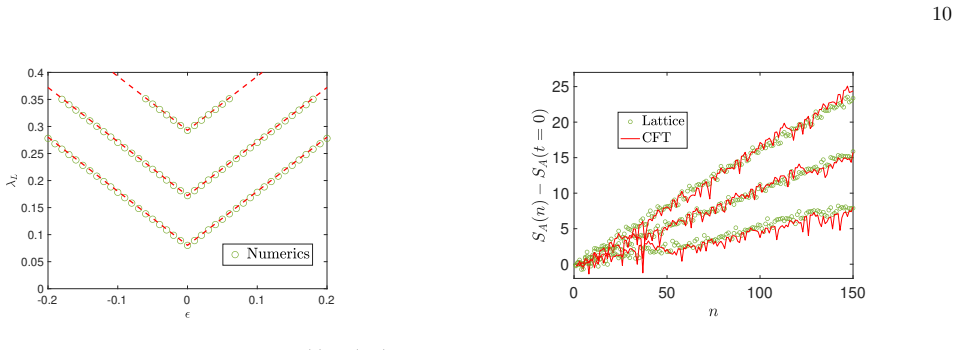
The central object is a one-frequency analytic quasiperiodic cocycle---a sequence of $\mathrm{SL}(2,\mathbb{R})$ matrices indexed by a phase that advances by the irrational frequency each step---built as $A(x)=M_0(x)M_1$, where $M_0,M_1\in\mathrm{SU}(1,1)$ are the fractional-linear transformations describing how local operators evolve during one driving step. The argument complexifies the phase, $x\to x+i\epsilon$; the global theory of such cocycles guarantees that $\lambda_L(\epsilon)$ is convex and piecewise linear with integer slope (the acceleration), and the large-$\epsilon$ asymptotic is dominated by a constant matrix whose Lyapunov exponent is $\log|\beta_1\sinh\alpha|$ (or $\log|\alpha_1|$ for type-I). Combining the asymptotic value with the integer-slope constraint yields the max-formula for $\lambda_L$, and the vanishing of its argument locates the critical line. The same cocycle determines the physical diagnostic through $S_A(n)-S_A(0)=\frac{c}{3}(\log|\alpha_n+\beta_n|+\log|\alpha'_n+\beta'_n|)$.
What would settle it
Numerically compute $\lambda_L(0)$ from the matrix product (2.19) on a fine grid straddling the line $|a|/\sqrt{1-a^2}\cdot\sinh\alpha=1$; if any point on the predicted non-heating side has a positive Lyapunov exponent, or the entanglement entropy grows linearly there instead of oscillating, the phase boundary as stated is not exact. The paper's Fig. 9 already provides a parameter set where the max-formula misses a uniformly hyperbolic heating case, so the grid test would locate the true boundary.
Extended reading notes
Core claim
The paper's central claim is that in type-II quasiperiodic driving the phase diagram is controlled by the cocycle $A(x)=M_0(x)M_1$ and, for cocycles that are not uniformly hyperbolic, its complexified Lyapunov exponent has the form $\lambda_L(\epsilon)=\max\{\log|\beta_1\sinh\alpha|+\epsilon,0\}$. This makes the phase transition occur exactly when $|\beta_1\sinh\alpha|=1$, and gives the heating rate $\lambda_L(0)=\max\{\log|\beta_1\sinh\alpha|,0\}$; for the representative choice $a_0=1,a_+=a,a_-=0$ the condition becomes $|a|/\sqrt{1-a^2}\cdot\sinh\alpha=1$. In the heating phase the entanglement entropy grows as $S_A(n)\simeq (2c/3)\lambda_L n$, it grows logarithmically at the critical point, and it oscillates in the non-heating phase; the authors verify this behavior in lattice free-fermion calculations. For type-I driving, they prove $\lambda_L(0)=\log|\alpha_1|>0$ always, so no phase transition can appear. The paper thus asserts that type-II quasiperiodicity produces genuine, analytically determined heating transitions, while the earlier type-I quasiperiodicity cannot.
Load-bearing premise
The analytic phase boundary and Lyapunov exponent assume the type-II cocycle is not uniformly hyperbolic, a condition that the paper checks numerically at many parameter values but does not prove globally; where it fails, the formula can predict no heating when the actual Lyapunov exponent is positive, and the paper shows one such case.
Editorial extensions
If this is right
- In the type-II protocol, the entire heating/non-heating phase diagram follows from one analytic formula, so no exhaustive parameter scan is needed to know where linear entanglement growth starts.
- The linear growth rate of entanglement entropy in the heating phase is quantitatively fixed by the Lyapunov exponent, and the paper's lattice simulations confirm that prediction.
- The previously studied type-I quasiperiodic protocol provably cannot host a heating-to-non-heating transition, so any non-heating behavior seen there would have to come from a different mechanism.
- Phase transitions appear in all nine elliptic/parabolic/hyperbolic combinations of the two driving Hamiltonians, indicating that the transition is a generic feature of type-II driving rather than a special-case effect.
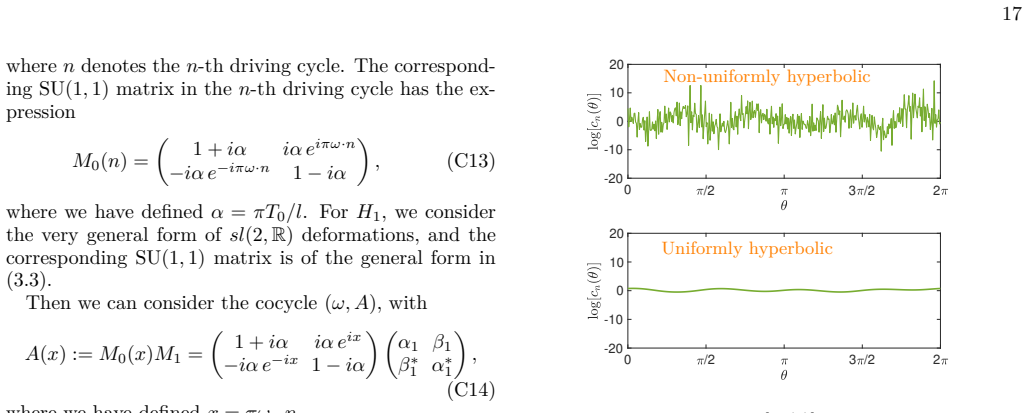
- The uniform-versus-non-uniform hyperbolicity distinction is visible through subleading fluctuations of the entanglement entropy, giving a separate observable signature beyond the leading growth rate.
Reading between the lines
- Because formula (4.9) is only derived for non-uniformly hyperbolic cocycles, an exact global phase diagram would require locating uniformly hyperbolic islands; the paper's own Fig. 9 suggests these islands can sit near the predicted line, so the true boundary may differ there.
- The same cocycle-plus-acceleration technique may transfer to other finite-dimensional symmetry groups or multi-band drives whenever the one-step evolution is an analytic matrix function of the quasi-periodic phase, though the integer-acceleration theorem used here is special to SL(2,R)-type cocycles.
- A natural next step would be to look for the quantized acceleration $\omega_\lambda$ as a directly measurable quantity in the lattice model---for example, as a winding number or a quantized energy absorption rate---since the paper raises this as an open question without establishing it.
Editorial analysis
A structured set of objections, weighed in public.
Referee Report
Summary. The paper studies quasi-periodically driven (1+1)-dimensional CFTs with sl(2,R) deformations, building on earlier work on periodically, quasi-periodically, and randomly driven CFTs. Two driving protocols are considered: type-I, where the timing of a fixed Hamiltonian is quasiperiodic, and type-II, where the Hamiltonian itself depends quasiperiodically on the step index. Using Avila's global theory of one-frequency analytic SL(2,R) cocycles, the authors derive exact-looking formulas for the Lyapunov exponent λ_L and the acceleration ω_λ, and from them the heating/non-heating phase diagram. For type-I driving they show that λ_L>0 always, proving the absence of a phase transition. For type-II driving they obtain λ_L = max{log|β_1 sinh α|, 0} and a phase boundary |β_1 sinh α| = 1, which for their explicit choice becomes |a/√(1−a²) sinh α| = 1 (Eq. 4.10). The analytical predictions are compared with numerical Lyapunov exponents and with CFT/lattice entanglement-entropy evolution, with good agreement away from special parameter regions.
Significance. The paper makes a useful methodological contribution by bringing Avila's global theory into the study of driven CFTs, where it gives parameter-free formulas for the Lyapunov exponents without any fitting. The type-I result is a clean, correct explanation of the previously observed absence of phase transitions, and the type-II setup is a new and interesting way to obtain heating/non-heating transitions in quasiperiodic driving. The numerical checks, including lattice simulations of entanglement entropy, support the analysis in the regimes where the authors' assumptions hold. The main limitation is that the type-II phase diagram is not fully exact as claimed, because the analytic expression for λ_L is derived under the assumption that the cocycle is not uniformly hyperbolic, and the paper itself identifies uniformly hyperbolic regions where the formula fails and the phase boundary is shifted.
major comments (2)
- [Sec. IV.B–IV.C, Eqs. (4.9)–(4.10)] The central claim that the type-II phase boundary is exactly |a/√(1−a²) sinh α| = 1 is not supported, because Eq. (4.9) is derived under the assumption that the cocycle is not uniformly hyperbolic, and the manuscript itself reports a counterexample. In Fig. 9 (bottom) the parameters (a, α) = (0.25, 2) give |a/√(1−a²) sinh α| ≈ 0.936 < 1, so Eq. (4.10) places the system in the non-heating phase; however, the complexified Lyapunov exponent shown there is uniformly hyperbolic with λ_L(0) > 0, i.e., the system heats. The authors acknowledge 'subtle deviations' near the phase transitions but do not characterize the uniform-hyperbolic regions analytically, so the phase diagram in Fig. 7 and the abstract's statement that the phase diagram 'can be analytically obtained' are overstated. To make the claim exact, the authors need to either prove that uniformly hyperbolic heating does not occur on the non-heating side of (4.10), or provide an analytic description of the actual transition including those regions.
- [Appendix C and Abstract] The same non-uniform-hyperbolicity caveat applies to all the general type-II results in Appendix C: Eqs. (C6), (C9), and (C11) are stated conditional on the cocycle being non-uniformly hyperbolic, and no proof is given that the phase boundaries in Fig. 13 are valid in uniformly hyperbolic patches. Since the abstract and the conclusions of Sec. V make the unqualified claim that the phase diagrams and Lyapunov exponents are analytically obtained, the paper's central claim goes beyond what the derivation supports. The authors should either extend the analysis to cover uniformly hyperbolic cocycles or explicitly restrict the claim to the non-uniformly hyperbolic case and state the extent to which the plotted phase boundaries are proven.
minor comments (3)
- [Eq. (2.19)] The definition of the Lyapunov exponent in Eq. (2.19) appears to be missing the logarithm: as written it is the growth rate of the norm itself, but the subsequent formulas use λ_L as the exponential rate, i.e., λ_L = lim (1/n) log ||M_1⋯M_n||. Please correct the displayed equation.
- [Sec. IV.C, text near Fig. 9] The cross-references in the paragraph discussing non-uniform versus uniform hyperbolicity are inconsistent: the text says 'as shown in Fig. 10' and 'as seen in Fig. 10 (top)' / 'Fig. 10 (bottom)', but the relevant panels are in Fig. 9, which displays the complexified Lyapunov exponents; Fig. 10 shows entanglement entropy evolutions. Please fix the figure references.
- [Sec. IV.C, footnote 7] The footnote says that near the phase transition there could be uniformly hyperbolic cases with very small Lyapunov exponents, but the example shown in Fig. 9 for (a, α) = (0.25, 2) is not a case of a small Lyapunov exponent; it is a uniformly hyperbolic heating case where Eq. (4.9) gives subcritical behavior. Clarify the intended meaning, or adjust the footnote to match the actual counterexample.
Circularity Check
No significant circularity: the Lyapunov exponents and phase boundaries are parameter-free analytic functions derived from Avila's external theory, not fitted inputs.
full rationale
No significant circularity. The paper's central results, the type-I Lyapunov exponent λL = log|α1*| and the type-II formula λL(ε) = max{log|β1 sinh α| + ε, 0}, are derived by applying Avila's global theory for one-frequency quasiperiodic SL(2,R) cocycles to the explicit SU(1,1) transfer matrices of the driven CFT. These are parameter-free functions of the driving parameters, not quantities fitted to the numerical data; the lattice and CFT numerics are used as verification, not as inputs. The type-II phase boundary |β1 sinh α| = 1 follows algebraically from setting the argument of the max to zero, and the paper openly states the condition under which this formula applies: if the cocycle is uniformly hyperbolic, (4.9) no longer holds, and the paper itself displays such a case in Fig. 9. That caveat is a correctness limitation on the claimed exactness of the analytic phase diagram, not a circular dependence. Self-citations to the authors' earlier work [1,25] supply the CFT framework and previously observed numerical facts, but the present derivation does not reduce to those citations; the load-bearing classification and Lyapunov-exponent formulas come from Avila's independently established theory. No fitted parameter is renamed as a prediction, and no result is defined in terms of the quantity it purports to explain.
Assumptions & free parameters
assumptions (5)
- standard math Avila's global theory: for one-frequency analytic SL(2,R) cocycles, the complexified Lyapunov exponent lambda_L(epsilon) is convex and piecewise linear with integer slopes, and uniform hyperbolicity is equivalent to positive lambda_L with zero acceleration.
- domain assumption Operator evolution under sl(2,R) deformed CFT Hamiltonians is a Mobius transformation generated by SU(1,1) matrices, and the entanglement entropy is given by log|alpha_n + beta_n| in Eq. (2.20).
- domain assumption The quasiperiodically driven evolution is equivalent to multiplying SU(1,1) matrices along a rotation of phase x = pi*omega*n on S1, so Avila's theory applies.
- ad hoc to paper The cocycles in the type-II phase diagram are not uniformly hyperbolic in the regions where Eqs. (4.9) and (4.10) are used.
- domain assumption A positive Lyapunov exponent implies linear growth of entanglement entropy, and lambda_L = 0 at the transition implies logarithmic growth.
Cite this review
Pith. "Pith review of Phase Transitions in Quasi-Periodically Driven Quantum Critical Systems: Analytical Results." pith.science (2026). https://pith.science/paper/PQ7TETGC
@misc{pith2026250104795,
  author       = {Pith},
  title        = {Pith review of: Phase Transitions in Quasi-Periodically Driven Quantum Critical Systems: Analytical Results},
  year         = {2026},
  howpublished = {\url{https://pith.science/paper/PQ7TETGC}},
  note         = {Machine review of arXiv:2501.04795}
}
read the original abstract
In this work, we study analytically the phase transitions in quasi-periodically driven one dimensional quantum critical systems that are described by conformal field theories (CFTs). The phase diagrams and phase transitions can be analytically obtained by using Avila's global theory in one-frequency quasiperiodic cocycles. Compared to the previous works where the quasiperiodicity was introduced in the driving time and no phase transitions were observed [1], here we propose a setup where the quasiperiodicity is introduced in the driving Hamiltonians. In our setup, one can observe the heating phases, non-heating phases, and the phase transitions. The phase diagram as well as the Lyapunov exponents that determine the entanglement entropy evolution can be analytically obtained. In addition, based on Avila's theory, we prove there is no phase transition in the previously proposed setup of quasi-periodically driven CFTs [1]. We verify our field theory results by studying the time evolution of entanglement entropy on lattice models.
Figures


Figures from the paper (9 more)


Forward citations
Cited by 2 Pith papers
-
Gapless higher-order topology and corner states in Floquet systems
Corner modes at zero and π quasienergy survive topological transitions in a driven Creutz ladder plus SSH chain, with a generalized winding number that counts them even when the bulk is gapless.
-
Non-relativistic Floquet Conformal Field Theory
Periodically driven non-relativistic conformal field theories show three Floquet phases — oscillatory, heating, and power-law transition — fixed exactly by the SO(2,1) representation parameter ρ.
Reference graph
Works this paper leans on
-
[1]
Can one have a setupofquasi-periodicallydrivenCFTswherethere are both heating phases and non-heating phases with phase transitions?
For the setups of quasi-periodically driven CFTs thatarealreadystudiedintheliterature[1,12], only the heating phases were observed. Can one have a setupofquasi-periodicallydrivenCFTswherethere are both heating phases and non-heating phases with phase transitions?
-
[2]
For a general setup of quasi-periodically driven CFT, e.g., the Aubry-Andre-like driving in Ref.[1], can one find an analytical way to determine the phase diagram? Furthermore, in the heating phase, can one obtain analytically the Lyapunov expo- nents which determine the entanglement entropy evolution? In this work, we will give affirmative answers to the...
-
[3]
We generalize the setup of quasi-periodically driven CFTs in [1, 12] to the case where the driving Hamiltonians themselves depend on parameters in a quasi-periodical way, which is illustrated in the type-II driving in Fig.1.2 In this new setup, we find the phase transition between heating and non- heating phases is a generic feature
-
[4]
Both types of quasiperiodic drivings in Fig.1 can be studiedbasedonAvila’sglobaltheoryforquasiperi- odic cocycles. By applying Avilia’s global theory, one can evaluate the Lyapunov exponents as well as the acceleration analytically, based on which one can obtain the phase diagrams of quasi-periodically driven CFTs. For the type-I driving in Fig.1, we can ...
-
[5]
The subcritical regime:λL = 0 and ωλ = 0
-
[6]
The critical regime:λL = 0 and ωλ∈ Z+
-
[7]
Here Z+ denotepositiveintegers
The supercritical regime:λL > 0 and ωλ∈ Z+. Here Z+ denotepositiveintegers. Pictorially, thefeatures of the complexified Lyapunov exponentsλL(ϵ) for these threedifferentcasesareshowninFig.2. Onecanfindthat althoughλL = 0 in both subcritical and critical regimes, it is stable in the subcritical regime and unstable in the critical regime under complexificat...
-
[8]
λ< 1: λL(E) = 0, andωλ(E) = 0
Show all 88 references
-
[9]
λ = 1: λL(E) = 0, andωλ(E) = 1
-
[10]
order param- eter
λ> 1: λL(E) = log|λ|, andωλ(E) = 1. These three cases correspond to the subcritical, crit- ical, and supercritical regimes in Fig.2, and physically they correspond to the metallic phase, phase transition, and the insulating phase, respectively. The rest of this work is organiz...
-
[11]
More explicitly, the heating phase is determined by λL(ϵ = 0) > 0, i.e.,|β1· sinh(α)| > 1, and the phase transitions to the non-heating phases are determined by |β1· sinh(α)| = 1
may be zero, indicating the possible phase transi- tions. More explicitly, the heating phase is determined by λL(ϵ = 0) > 0, i.e.,|β1· sinh(α)| > 1, and the phase transitions to the non-heating phases are determined by |β1· sinh(α)| = 1. (4.6) In the next subsection, we will g...
-
[12]
Here n denotes then-th time driving cycle
Quasiperiodic Hamiltonians that are elliptic The driving Hamiltonians H0 are elliptic, which are deformed quasi-periodically in time as a0 = 1, a + =α cos(πω·n), a − =α sin(πω·n), (C1) where α∈ (0, 1), ω is an irrational number, andn∈ Z. Here n denotes then-th time driving cyc...
-
[13]
non-uniform
Quasiperiodic Hamiltonians that are parabolic NowweconsidertheparabolicHamiltonians H0, which are deformed quasi-periodically in time as a0 = 1, a + = cos(πω·n), a − = sin(πω·n), (C12) 17 wheren denotes then-th driving cycle. The correspond- ing SU(1, 1) matrix in then-th driv...
-
[15]
Sachdev, Quantum Phase Transitions, 2nd ed
S. Sachdev, Quantum Phase Transitions, 2nd ed. (Cam- bridge University Press, 2011)
2011
-
[16]
P. T. Dumitrescu, R. Vasseur, and A. C. Potter, Log- arithmically slow relaxation in quasiperiodically driven random spin chains, Phys. Rev. Lett.120, 070602 (2018)
2018
-
[17]
Giergiel, A
K. Giergiel, A. Kuroś, and K. Sacha, Discrete time qua- sicrystals, Phys. Rev. B99, 220303 (2019)
2019
-
[18]
H. Zhao, F. Mintert, and J. Knolle, Floquet time spi- rals and stable discrete-time quasicrystals in quasiperiod- ically driven quantum many-body systems, Phys. Rev. B 100, 134302 (2019), arXiv:1906.06989 [cond-mat.dis-nn]
2019 arXiv
-
[19]
D. R. Grempel, R. E. Prange, and S. Fishman, Quantum dynamics of a nonintegrable system, Phys. Rev. A29, 1639 (1984)
1984
-
[20]
F. L. Moore, J. C. Robinson, C. Bharucha, P. E. Williams, and M. G. Raizen, Observation of dynamical localization in atomic momentum transfer: A new test- ing ground for quantum chaos, Phys. Rev. Lett.73, 2974 (1994)
1994
-
[21]
Martin, G
I. Martin, G. Refael, and B. Halperin, Topological fre- quency conversion in strongly driven quantum systems, Phys. Rev. X7, 041008 (2017)
2017
-
[22]
Peng and G
Y. Peng and G. Refael, Topological energy conversion through the bulk or the boundary of driven systems, Phys. Rev. B97, 134303 (2018)
2018
-
[23]
D. V. Else, W. W. Ho, and P. T. Dumitrescu, Long- lived interacting phases of matter protected by multiple time-translation symmetries in quasiperiodically driven systems, Phys. Rev. X10, 021032 (2020)
2020
-
[24]
A. J. Friedman, B. Ware, R. Vasseur, and A. C. Potter, Topological edge modes without symmetry in quasiperi- odically driven spin chains, Phys. Rev. B105, 115117 (2022), arXiv:2009.03314 [cond-mat.str-el]
2022 arXiv
-
[25]
Lapierre, K
B. Lapierre, K. Choo, A. Tiwari, C. Tauber, T. Neu- pert, and R. Chitra, The fine structure of heating in a quasiperiodically driven critical quantum system, arXiv e-prints , arXiv:2006.10054 (2020), arXiv:2006.10054 [cond-mat.str-el]
2020 arXiv
-
[26]
Schmid, Y
H. Schmid, Y. Peng, G. Refael, and F. von Oppen, Self- similar phase diagram of the Fibonacci-driven quantum Ising model, arXiv e-prints , arXiv:2410.18219 (2024), arXiv:2410.18219 [cond-mat.dis-nn]
2024
-
[27]
Avila, Global theory of one-frequency Schrödinger op- erators, Acta Mathematica215, 1 (2015)
A. Avila, Global theory of one-frequency Schrödinger op- erators, Acta Mathematica215, 1 (2015)
2015
-
[28]
Wen and J.-Q
X. Wen and J.-Q. Wu, Floquet conformal field theory, (2018), arXiv:1805.00031 [cond-mat.str-el]
2018 arXiv
-
[29]
Wen and J.-Q
X. Wen and J.-Q. Wu, Quantum dynamics in sine-square deformed conformal field theory: Quench from uniform to nonuniform conformal field theory, Physical Review B 97, 184309 (2018), arXiv:1802.07765 [cond-mat.str-el]
2018 arXiv
-
[30]
R. Fan, Y. Gu, A. Vishwanath, and X. Wen, Emergent Spatial Structure and Entanglement Localization in Flo- quet Conformal Field Theory, Phys. Rev. X10, 031036 (2020), arXiv:1908.05289 [cond-mat.str-el]
2020 arXiv
-
[31]
Lapierre, K
B. Lapierre, K. Choo, C. Tauber, A. Tiwari, T. Neupert, and R. Chitra, Emergent black hole dynamics in criti- cal Floquet systems, Phys. Rev. Res.2, 023085 (2020), arXiv:1909.08618 [cond-mat.str-el]
2020 arXiv
-
[32]
Lapierre and P
B. Lapierre and P. Moosavi, Geometric approach to in- homogeneous Floquet systems, Physical Review B103, 224303 (2021), arXiv:2010.11268 [cond-mat.stat-mech]
2021 arXiv
-
[33]
R. Fan, Y. Gu, A. Vishwanath, and X. Wen, Floquet conformal field theories with generally deformed Hamil- tonians, SciPost Phys.10, 049 (2021), arXiv:2011.09491 [hep-th]
2021 arXiv
-
[34]
Han and X
B. Han and X. Wen, Classification of S L2 deformed Flo- quet conformal field theories, Physical Review B 102, 205125 (2020), arXiv:2008.01123 [cond-mat.stat-mech]
2020 arXiv
-
[35]
D. S. Ageev, A. A. Bagrov, and A. A. Iliasov, Determinis- tic chaos and fractal entropy scaling in Floquet conformal field theories, Physical Review B103, L100302 (2021), arXiv:2006.11198 [cond-mat.stat-mech]
2021 arXiv
-
[36]
Andersen, F
M. Andersen, F. Norfjand, and N. T. Zinner, Real-time correlation function of floquet conformal fields, Phys. Rev. D103, 056005 (2021)
2021
-
[37]
D. Das, R. Ghosh, and K. Sengupta, Conformal Floquet dynamics with a continuous drive protocol, Journal of High Energy Physics2021, 172 (2021), arXiv:2101.04140 [hep-th]
2021 arXiv
-
[39]
Sengupta, Out-of-Time-Order correlators in driven conformal field theories, Journal of High Energy Physics 2022, 221 (2022), arXiv:2202.12815 [hep-th]
S.Das, B.Ezhuthachan, A.Kundu, S.Porey, B.Roy,and K. Sengupta, Out-of-Time-Order correlators in driven conformal field theories, Journal of High Energy Physics 2022, 221 (2022), arXiv:2202.12815 [hep-th]
2022 arXiv
-
[40]
Bermond, M
B. Bermond, M. Chernodub, A. G. Grushin, and D. Carpentier, Anomalous Luttinger equivalence be- tween temperature and curved spacetime: From black hole’s atmosphere to thermal quenches, arXiv e-prints , arXiv:2206.08784 (2022), arXiv:2206.08784 [cond- mat.stat-mech]
2022 arXiv
-
[41]
K. Choo, B. Lapierre, C. Kuhlenkamp, A. Tiwari, T. Ne- upert, and R. Chitra, Thermal and dissipative effects on the heating transition in a driven critical system, arXiv e-prints , arXiv:2205.02869 (2022), arXiv:2205.02869 [cond-mat.str-el]
2022 arXiv
-
[42]
X. Wen, R. Fan, and A. Vishwanath, Floquet’s Refrig- erator: Conformal Cooling in Driven Quantum Criti- cal Systems, arXiv e-prints , arXiv:2211.00040 (2022), arXiv:2211.00040 [cond-mat.str-el]
2022 arXiv
-
[44]
Nozaki, K
M. Nozaki, K. Tamaoka, and M. Tian Tan, In- homogeneous quenches as state preparation in two- dimensional conformal field theories, arXiv e-prints , arXiv:2310.19376 (2023), arXiv:2310.19376 [hep-th]
2023 arXiv
-
[47]
K. Goto, M. Nozaki, S. Ryu, K. Tamaoka, and M. T. Tan, Scrambling and recovery of quantum information in inhomogeneous quenches in two-dimensional confor- mal field theories, Physical Review Research6, 023001 (2024), arXiv:2302.08009 [hep-th]
2024 arXiv
-
[49]
K. Goto, T. Guo, T. Nosaka, M. Nozaki, S. Ryu, and K.Tamaoka,Spatialdeformationofmany-bodyquantum chaotic systems and quantum information scrambling, Phys. Rev. B 109, 054301 (2024), arXiv:2305.01019 [quant-ph]
2024 arXiv
-
[50]
X. Wen, Y. Gu, A. Vishwanath, and R. Fan, Period- ically, Quasi-periodically, and Randomly Driven Con- formal Field Theories (II): Furstenberg’s Theorem and Exceptions to Heating Phases, SciPost Physics13, 082 (2022), arXiv:2109.10923 [cond-mat.stat-mech]
2022 arXiv
-
[51]
Furstenberg, Noncommuting random products, Trans- actions of the American Mathematical Society108, 377 (1963)
H. Furstenberg, Noncommuting random products, Trans- actions of the American Mathematical Society108, 377 (1963)
1963
-
[52]
K. Goto, M. Nozaki, K. Tamaoka, M. Tian Tan, and S. Ryu, Non-Equilibrating a Black Hole with Inhomogeneous Quantum Quench, arXiv e-prints , arXiv:2112.14388 (2021), arXiv:2112.14388 [hep-th]
2021 arXiv
-
[53]
Caputa and D
P. Caputa and D. Ge, Entanglement and geometry from subalgebras of the Virasoro algebra, Journal of High En- ergy Physics 2023, 159 (2023), arXiv:2211.03630 [hep- th]
2023 arXiv
-
[54]
de Boer, V
J. de Boer, V. Godet, J. Kastikainen, and E. Keski- Vakkuri,QuantuminformationgeometryofdrivenCFTs, Journal of High Energy Physics 2023, 87 (2023), arXiv:2306.00099 [hep-th]
2023 arXiv
-
[55]
Kudler-Flam, M
J. Kudler-Flam, M. Nozaki, T. Numasawa, S. Ryu, and M. Tian Tan, Bridging two quantum quench problems – local joining quantum quench and Möbius quench – and their holographic dual descriptions, arXiv e-prints , arXiv:2309.04665 (2023), arXiv:2309.04665 [hep-th]
2023 arXiv
-
[56]
Bernamonti, F
A. Bernamonti, F. Galli, and D. Ge, Boundary- induced transitions in Möbius quenches of holo- graphic BCFT, arXiv e-prints , arXiv:2402.16555 (2024), arXiv:2402.16555 [hep-th]
2024 arXiv
-
[57]
Miyata, M
A. Miyata, M. Nozaki, K. Tamaoka, and M. Watan- abe, Hawking-Page and entanglement phase transition in 2d CFT on curved backgrounds, arXiv e-prints , arXiv:2406.06121 (2024), arXiv:2406.06121 [hep-th]
2024 arXiv
-
[58]
Jiang and M
H. Jiang and M. Mezei, New horizons for inhomo- geneous quenches and Floquet CFT, arXiv e-prints , arXiv:2404.07884 (2024), arXiv:2404.07884 [hep-th]
2024 arXiv
-
[59]
Sengupta, Brane detectors of a dynamical phase transition in a driven CFT, SciPost Physics 15, 202 (2023), arXiv:2212.04201 [hep-th]
S.Das, B.Ezhuthachan, A.Kundu, S.Porey, R.Baishali, and K. Sengupta, Brane detectors of a dynamical phase transition in a driven CFT, SciPost Physics 15, 202 (2023), arXiv:2212.04201 [hep-th]
2023 arXiv
-
[60]
S. Das, B. Ezhuthachan, S. Porey, and B. Roy, Notes on heating phase dynamics in Floquet CFTs and Modular quantization, arXiv e-prints , arXiv:2406.10899 (2024), arXiv:2406.10899 [hep-th]
2024 arXiv
-
[61]
C. Bai, A. Miyata, and M. Nozaki, Entanglement dynam- ics in 2d HCFTs on the curved background: the case of q-Möbius Hamiltonian, arXiv e-prints , arXiv:2408.06594 (2024), arXiv:2408.06594 [hep-th]
2024 arXiv
-
[62]
Das and A
J. Das and A. Kundu, Flowery Horizons & Bulk Ob- servers: sl(q)(2, R)Drivein 2dHolographicCFT,arXive- prints , arXiv:2412.18536 (2024), arXiv:2412.18536 [hep- th]
2024 arXiv
-
[63]
D. Das, S. R. Das, A. Kundu, and K. Sengupta, Exactly Solvable Floquet Dynamics for Conformal Field Theo- ries in Dimensions Greater than Two, arXiv e-prints , arXiv:2311.13468 (2023), arXiv:2311.13468 [hep-th]
2023 arXiv
-
[64]
Malvimat, S
V. Malvimat, S. Porey, and B. Roy, Krylov Complexity in 2d CFTs with SL(2, R) deformed Hamiltonians, arXiv e-prints , arXiv:2402.15835 (2024), arXiv:2402.15835 [hep-th]
2024 arXiv
-
[65]
Lapierre, T
B. Lapierre, T. Numasawa, T. Neupert, and S. Ryu, Flo- quet engineered inhomogeneous quantum chaos in crit- ical systems, arXiv e-prints , arXiv:2405.01642 (2024), arXiv:2405.01642 [cond-mat.str-el]
2024
-
[66]
W. Mao, M. Nozaki, K. Tamaoka, and M. Tian Tan, Lo- cal operator quench induced by two-dimensional inhomo- geneous and homogeneous CFT Hamiltonians, arXiv e- prints , arXiv:2403.15851 (2024), arXiv:2403.15851 [hep- th]
2024 arXiv
-
[67]
X. Wen, Exactly solvable non-unitary time evolution in quantum critical systems I: effect of complex space- time metrics, Journal of Statistical Mechanics: Theory and Experiment2024, 103103 (2024), arXiv:2406.17059 [cond-mat.stat-mech]
2024 arXiv
-
[68]
X. Liu, A. McDonald, T. Numasawa, B. Lian, and S. Ryu, Quantum Quenches of Conformal Field Theory with Open Boundary, arXiv e-prints , arXiv:2309.04540 (2023), arXiv:2309.04540 [cond-mat.stat-mech]
2023 arXiv
-
[69]
Moosavi, M
P. Moosavi, M. Christandl, G. M. Graf, and S. Sotiri- adis, Perfect Wave Transfer in Continuous Quan- tum Systems, arXiv e-prints , arXiv:2408.00723 (2024), arXiv:2408.00723 [quant-ph]
2024
-
[70]
Banerjee, S
T. Banerjee, S. Das, and K. Sengupta, Entan- glement asymmetry in periodically driven quantum systems, arXiv e-prints , arXiv:2412.03654 (2024), arXiv:2412.03654 [quant-ph]
2024 arXiv
-
[71]
Caputa, J
P. Caputa, J. M. Magan, and D. Patramanis, Geome- try of Krylov complexity, Physical Review Research4, 013041 (2022), arXiv:2109.03824 [hep-th]
2022 arXiv
-
[72]
Allegra, J
N. Allegra, J. Dubail, J.-M. Stéphan, and J. Viti, Inho- mogeneous field theory inside the arctic circle, Journal of Statistical Mechanics: Theory and Experiment5, 053108 (2016), arXiv:1512.02872 [cond-mat.stat-mech]
2016 arXiv
-
[73]
Dubail, J.-M
J. Dubail, J.-M. Stéphan, J. Viti, and P. Calabrese, Con- formal field theory for inhomogeneous one-dimensional quantum systems: the example of non-interacting Fermi gases, SciPost Physics 2, 002 (2017), arXiv:1606.04401 [cond-mat.str-el]
2017 arXiv
-
[74]
J. Dubail, J.-M.Stéphan, andP.Calabrese,Emergence of curved light-cones in a class of inhomogeneous Luttinger 20 liquids, SciPost Physics3, 019 (2017), arXiv:1705.00679 [cond-mat.str-el]
2017 arXiv
-
[75]
K.Gawędzki, E.Langmann,andP.Moosavi,Finite-Time Universality in Nonequilibrium CFT, Journal of Statis- tical Physics 172, 353 (2018), arXiv:1712.00141 [cond- mat.stat-mech]
2018 arXiv
-
[76]
Langmann and P
E. Langmann and P. Moosavi, Diffusive Heat Waves in Random Conformal Field Theory, Phys. Rev. Lett.122, 020201 (2019), arXiv:1807.10239 [cond-mat.stat-mech]
2019 arXiv
-
[77]
X. Wen, R. Fan, A. Vishwanath, and Y. Gu, Periodi- cally, quasi-periodically, and randomly driven conformal field theories: Part i, (2020), arXiv:2006.10072 [cond- mat.stat-mech]
2020 arXiv
-
[78]
A.Avila, J.You,andQ.Zhou,Sharpphasetransitionsfor the almost Mathieu operator, Duke Mathematical Jour- nal 166, 2697 (2017)
2017
-
[79]
M. R. Herman, Une méthode pour minorer les exposants de lyapounov et quelques exemples montrant le caractere local dun théoreme d’arnold et de moser sur le tore de di- mension 2., Commentarii mathematici Helvetici58, 453 (1983)
1983
-
[80]
Yoccoz, Some questions and remarks about sl (2, r) cocycles, Modern dynamical systems and applications , 447 (2004)
J.-C. Yoccoz, Some questions and remarks about sl (2, r) cocycles, Modern dynamical systems and applications , 447 (2004)
2004
-
[81]
Damanik, Schrödinger Operators with Dynami- cally Defined Potentials: A Survey, arXiv e-prints , arXiv:1410.2445 (2014), arXiv:1410.2445 [math.SP]
D. Damanik, Schrödinger Operators with Dynami- cally Defined Potentials: A Survey, arXiv e-prints , arXiv:1410.2445 (2014), arXiv:1410.2445 [math.SP]
2014 arXiv
-
[82]
C. M. Soukoulis and E. N. Economou, Localization in one-dimensional lattices in the presence of incommensu- rate potentials, Phys. Rev. Lett.48, 1043 (1982)
1982
-
[83]
Simon, Almost periodic schrödinger operators: A re- view, Advances in Applied Mathematics3, 463 (1982)
B. Simon, Almost periodic schrödinger operators: A re- view, Advances in Applied Mathematics3, 463 (1982)
1982
-
[84]
Bourgain and S
J. Bourgain and S. Jitomirskaya, Continuity of the Lya- punov Exponent for Quasiperiodic Operators with Ana- lytic Potential, Journal of Statistical Physics108, 1203 (2002), arXiv:math-ph/0110040 [math-ph]
2002 arXiv
-
[85]
E.Witten,Coadjointorbitsofthevirasorogroup,Comm. Math. Phys.114, 1 (1988)
1988
-
[86]
Ishibashi and T
N. Ishibashi and T. Tada, Infinite circumference limit of conformal field theory, Journal of Physics A: Mathemat- ical and Theoretical48, 315402 (2015)
2015
-
[87]
Ishibashi and T
N. Ishibashi and T. Tada, Dipolar quantization and the infinite circumference limit of two-dimensional conformal field theories, International Journal of Modern Physics A 31, 1650170 (2016)
2016
-
[88]
Tada, Time development of conformal field the- ories associated with l1 and l−1 operators, (2019), arXiv:1904.12414 [hep-th]
T. Tada, Time development of conformal field the- ories associated with l1 and l−1 operators, (2019), arXiv:1904.12414 [hep-th]
2019 arXiv
-
[89]
I. Peschel, LETTER TO THE EDITOR: Calculation of reduced density matrices from correlation functions, Journal of Physics A Mathematical General 36, L205 (2003), arXiv:cond-mat/0212631 [cond-mat]
2003 arXiv
-
[90]
Y. Liu, Q. Zhou, and S. Chen, Localization transi- tion, spectrum structure, and winding numbers for one- dimensional non-hermitian quasicrystals, Phys. Rev. B 104, 024201 (2021)
2021
-
[91]
X. Wang, Z. Wang, J. You, and Q. Zhou, Winding number, density of states and acceleration, International Mathematics Research Notices2024, 7972 (2024)
2024
-
[92]
J. Fang, Q. Zhou, and X. Wen, In preparation
-
[93]
Viana, Lectures on Lyapunov exponents , Vol
M. Viana, Lectures on Lyapunov exponents , Vol. 145 (Cambridge University Press, 2014)
2014
-
[94]
Mañé, Quasi-anosov diffeomorphisms and hyperbolic manifolds, Transactions of the American Mathematical Society 229, 351 (1977)
R. Mañé, Quasi-anosov diffeomorphisms and hyperbolic manifolds, Transactions of the American Mathematical Society 229, 351 (1977)
1977
Reviewed August 10, 2026 · model on record in the stance chip above.
Discussion (0). Continue with ORCID to comment.