REVIEW 4 major objections 6 minor 1 cited by
TimeDP: Learning to Generate Multi-Domain Time Series with Domain Prompts
T0 review · 4 major / 6 minor · reviewed 2026-08-10 · deepseek-v4-flash
Pith's one-line read A single diffusion model, conditioned on few-shot 'domain prompts' built from a frozen random dictionary of time-series prototypes, generates high-quality data for trained domains and adapts to unseen domains without fine-tuning.
desk verdict A useful multi-domain time series diffusion method with credible in-domain results, but the unseen-domain generalization claim runs ahead of the evidence. read the letter →
The pith
A machine-rendered reading of the paper's core claim, the machinery that carries it, and where it could break.
The reading
What carries the argument
The load-bearing objects are the time-series semantic prototypes and the prototype assignment module (PAM). Prototypes are $N_p=16$ vectors $P \in \mathbb{R}^{N_p \times d}$, initialized as random orthogonal vectors and frozen; each vector is meant to encode an elementary time-series feature such as trend or seasonality, acting like a 'word' in a shared dictionary. PAM is a small network $\varphi$ that maps an input sequence $x$ to a weight vector $m = \varphi(x)$, with negative entries set to zero for sparsity. The weights $m$ are added to the scaled dot-product attention scores in each cross-attention layer of the denoising U-Net, so the predicted noise $\hat{\epsilon} = \epsilon_{\theta,P}(x_n, n, m)$ is conditioned on the assigned prototypes. At sampling time, the same PAM is applied to $K$ few-shot samples of the target domain to form the domain prompt $m_{D_i}=\{m^i_1,\dots,m^i_K\}$, and the model generates by repeated denoising conditioned on these prompts.
What would settle it
Hold out a domain whose time series contain frequency components absent from the twelve training datasets—for example, a synthetic chirp with a time-varying frequency, or a series of aperiodic spikes. Give TimeDP 10 or 100 samples from that domain and compute the MMD and K-L divergence between its generated samples and the true test set, alongside the same metrics for the model's own unconditional output. If the prompted generation is not closer to the target distribution than the unconditional output, or if increasing the sample count from 3 to 100 does not improve fidelity, the claim that frozen random prototypes can express unseen domains is falsified.
Extended reading notes
Core claim
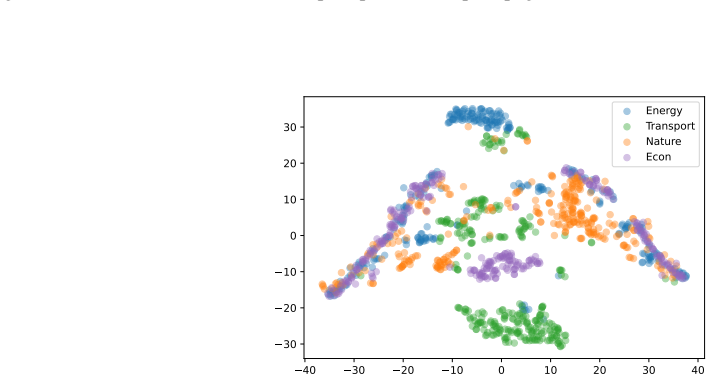
TimeDP's central claim is that a small set of frozen random orthogonal vectors can act as a universal time-series 'dictionary,' and that a learned prototype assignment module can express any domain—trained or unseen—as a weighted combination of these vectors. These weights, called domain prompts, are fed into a U-Net diffusion model by biasing the cross-attention logits between the noisy latent and the prototype keys and values. During sampling, K few-shot samples from the target domain are mapped through the assignment network to obtain a prompt population, and the diffusion model generates new sequences conditioned on it. On 12 datasets across energy, transport, nature, and economic domains, TimeDP reports the best Maximum Mean Discrepancy and K-L divergence on most datasets, beating a class-conditioned vector-quantized baseline without using labels; on the unseen Stock and Web datasets it reports the best MMD, K-L, and marginal-distribution scores with 3, 10, or 100 prompt samples, improving as the few-shot count grows, while fine-tuned baselines do not consistently improve.
Load-bearing premise
The method assumes that 16 fixed, randomly chosen and frozen vectors can represent the temporal structure of any domain, including domains never seen in training, and that the assignment network trained only on source domains will map a few samples from any new domain to a meaningful prompt; if a new domain's patterns cannot be expressed by those vectors, the prompt carries no useful information and generation falls back to unconditional output.
Editorial extensions
If this is right
- One trained TimeDP model can replace per-dataset generators: the same weights serve every domain, and the only per-domain input is a few dozen sample sequences.
- Unseen-domain generation needs no fine-tuning: a handful of samples defines the prompt, and quality improves as the number of samples grows from 3 to 100.
- Domain labels and natural-language descriptions become unnecessary for conditional time-series generation, removing a bottleneck for new or evolving domains whose patterns are hard to describe.
- The prototype dictionary provides an interpretable control axis: prompting with one-hot weights yields distinct seasonal or trend patterns, so a user can steer generation in a human-readable way.
- Because the prompt is a distribution over a shared basis, domains are explicitly related rather than treated as independent, which the paper argues helps the model capture inter-domain similarity.
Reading between the lines
- Not explored in the paper: learning the prototype vectors during training instead of freezing them; if random orthogonal vectors already work, a learned, updated basis might cover a wider range of temporal patterns and improve unseen-domain transfer further.
- The prompting mechanism is modality-agnostic in principle: any signal that can be decomposed into a small set of elementary patterns (images, audio, spatiotemporal data) could reuse the same few-shot prompt-extraction idea.
- The ablation shows that removing PAM or the prompt barely changes K-L divergence but sharply worsens MMD, suggesting the prompt mainly preserves sequential dependence rather than marginals; a direct check of autocorrelation or spectral fidelity of generated sequences would test this interpretation.
- The paper's unseen-domain experiments use only two target datasets; a stronger probe would be to hold out entire categories (for instance, all economic domains) and test whether prompts still separate them, which would clarify whether the frozen basis is truly universal or merely sufficient for these data.
Signed reviews
Editorial analysis
A structured set of objections, weighed in public.
Referee Report
Summary. TimeDP is a multi-domain time series diffusion model that conditions generation on a "domain prompt" derived from a set of randomly initialized and then frozen prototype vectors. The Prototype Assignment Module (PAM) maps each input sequence to a sparse weight vector over the prototypes; the weights are added to the cross-attention logits of a U-Net denoiser. The model is trained jointly on 12 datasets with balanced sampling; at inference, prompts are extracted from a few-shot sample of the target domain, including domains unseen in training. The paper reports in-domain generation results on 12 datasets using MMD, K-L, and MDD metrics, plus few-shot unseen-domain results on Stock and Web, and ablations on prototype count and component removal.
Significance. TimeDP addresses a real gap: multi-domain time series generation without explicit class labels or text descriptions. The core idea of using a small set of basis vectors and sparse assignments as a conditioning interface is simple and potentially useful. The in-domain benchmark is reasonably strong: the proposed model achieves the best MMD and K-L scores on most of the 12 datasets against established baselines, and the ablation shows that the conditioning mechanism gives a large improvement in MMD over the same model without prompts. The release of code and the use of five seeds are commendable. However, the paper's broader claims—that the prototypes "learn" time-series semantics and that the method generalizes to "any unseen dataset"—are not supported as stated, because the prototype vectors are frozen and the unseen-domain evidence is limited to two near-source datasets.
major comments (4)
- [Semantic Prototype Module; Abstract; Conclusion]
- [Algorithm 1 (Training algorithm), line 5]
- [Unseen Domain Generation; Table 2]
- [Table 3 (Ablation Study)]
minor comments (6)
- [Algorithm 2 (Sampling with domain prompts)]
- [Equation (6)]
- [Contributions and Related Work]
- [Experiment Settings]
- [Table 2 and Appendix Figures 6/7]
- [Abstract and Background]
Circularity Check
No circular derivation: few-shot domain prompts condition generation without being defined as the predicted outputs, and unseen-domain results are evaluated on non-overlapping test samples; the main weaknesses are an unsupported generalization assumption and an undefined unconditional identifier, not circularity.
full rationale
The derivation chain is self-contained. TimeDP trains a conditional DDPM with condition m = phi(x0) (Eq. 6, Eq. 10), so the training condition is computed from the target sample x0; this is self-conditioning, but it is not circular inference because at sampling the condition is extracted from K few-shot samples of the target domain (Algorithm 2 and the 'Generation with Domain Prompt' section), and the evaluation compares generated samples with a held-out test set that 'does not overlap with these samples' (Unseen Domain Generation experiments). No quantity that the paper calls a prediction is defined as a fitted parameter: the prototype matrix P is initialized with random orthogonal vectors and frozen, and the assignment network phi is trained on source domains but applied to few-shot inputs that are not the generated outputs. The 'unseen domain' capability is asserted from the premise that prototypes' 'representation ability is not restricted to the domains in training sets,' but this is an unvalidated generalization assumption supported only by Stock and Web experiments; under-support is a correctness risk, not circularity. The self-citations (Huang et al. 2024; Fan et al. 2024; Yang et al. 2024) are used for application motivation and background, not to justify the central reduction, so they are not load-bearing. One reproducibility gap, not a circular step, is Algorithm 1's 'Randomly set P as unconditional identifier pu' where pu is never defined. Overall the claimed generation quality is an empirical result against external baselines and held-out real data, not a restatement of the model's inputs.
Assumptions & free parameters
free parameters (4)
- Number of prototypes Np =
16
- Few-shot prompt count K =
3, 10, 100
- Unconditional identifier injection probability =
not specified
- Negative-weight masking rule =
-inf in attention
assumptions (6)
- standard math DDPM forward noising and reverse denoising with epsilon-parameterization
- domain assumption Channel-independent univariate formulation
- ad hoc to paper A fixed set of 16 random orthogonal prototype vectors can serve as a time series basis across all domains
- domain assumption Each time series sample corresponds to a distinct weighted allocation over prototypes, and a few samples characterize the domain
- domain assumption The assignment network phi trained on source domains transfers to unseen domains
- domain assumption Mixing multiple datasets during training improves per-domain generation
invented entities (3)
-
Time series semantic prototypes P
-
Domain prompts m_Di
-
Unconditional identifier pu
Cite this review
Pith. "Pith review of TimeDP: Learning to Generate Multi-Domain Time Series with Domain Prompts." pith.science (2026). https://pith.science/paper/IJZWOMP2
@misc{pith2026250105403,
  author       = {Pith},
  title        = {Pith review of: TimeDP: Learning to Generate Multi-Domain Time Series with Domain Prompts},
  year         = {2026},
  howpublished = {\url{https://pith.science/paper/IJZWOMP2}},
  note         = {Machine review of arXiv:2501.05403}
}
read the original abstract
Time series generation models are crucial for applications like data augmentation and privacy preservation. Most existing time series generation models are typically designed to generate data from one specified domain. While leveraging data from other domain for better generalization is proved to work in other application areas, this approach remains challenging for time series modeling due to the large divergence in patterns among different real world time series categories. In this paper, we propose a multi-domain time series diffusion model with domain prompts, named TimeDP. In TimeDP, we utilize a time series semantic prototype module which defines time series prototypes to represent time series basis, each prototype vector serving as "word" representing some elementary time series feature. A prototype assignment module is applied to extract the extract domain specific prototype weights, for learning domain prompts as generation condition. During sampling, we extract "domain prompt" with few-shot samples from the target domain and use the domain prompts as condition to generate time series samples. Experiments demonstrate that our method outperforms baselines to provide the state-of-the-art in-domain generation quality and strong unseen domain generation capability.
Figures


Figures from the paper (4 more)



Forward citations
Cited by 1 Pith paper
-
TarDiff: Target-Oriented Diffusion Guidance for Synthetic Electronic Health Record Time Series Generation
TarDiff guides diffusion-based synthetic EHR generation with a gradient-alignment signal computed from a guidance set, reporting improved downstream mortality and ICU-stay classification versus prior generative models.
Reference graph
Works this paper leans on
-
[1]
, " * write output.state after.block = add.period write newline
ENTRY address archivePrefix author booktitle chapter edition editor eid eprint howpublished institution isbn journal key month note number organization pages publisher school series title type volume year label extra.label sort.label short.list INTEGERS output.state before.all mid.sentence after.sentence after.block FUNCTION init.state.consts #0 'before.a...
-
[2]
write newline
" write newline "" before.all 'output.state := FUNCTION n.dashify 't := "" t empty not t #1 #1 substring "-" = t #1 #2 substring "--" = not "--" * t #2 global.max substring 't := t #1 #1 substring "-" = "-" * t #2 global.max substring 't := while if t #1 #1 substring * t #2 global.max substring 't := if while FUNCTION word.in bbl.in capitalize " " * FUNCT...
-
[3]
Coletta, A.; Gopalakrishnan, S.; Borrajo, D.; and Vyetrenko, S. 2023. On the Constrained Time-Series Generation Problem. In Advances in Neural Information Processing Systems, 61048--61059
work page 2023
-
[4]
Coletta, A.; Prata, M.; Conti, M.; Mercanti, E.; Bartolini, N.; Moulin, A.; Vyetrenko, S.; and Balch, T. 2021. Towards realistic market simulations: a generative adversarial networks approach. In Proceedings of the ACM International Conference on AI in Finance, 1--9
work page 2021
-
[5]
Das, A.; Kong, W.; Sen, R.; and Zhou, Y. 2024. A decoder-only foundation model for time-series forecasting. In Proceedings of the International Conference on Machine Learning, 10148--10167
work page 2024
-
[6]
Desai, A.; Freeman, C.; Wang, Z.; and Beaver, I. 2021. TimeVAE: A Variational Auto-Encoder for Multivariate Time Series Generation. arXiv preprint, arXiv:2111.08095
arXiv 2021
-
[7]
Fan, X.; Wu, Y.; Xu, C.; Huang, Y.; Liu, W.; and Bian, J. 2024. MG-TSD: Multi-Granularity Time Series Diffusion Models with Guided Learning Process. In International Conference on Learning Representations
work page 2024
-
[8]
Gao, S.; Koker, T.; Queen, O.; Hartvigsen, T.; Tsiligkaridis, T.; and Zitnik, M. 2024. UniTS: Building a Unified Time Series Model. arXiv preprint, arXiv:2403.00131
arXiv 2024
Show all 28 references
-
[9]
Ho, J.; Jain, A.; and Abbeel, P. 2020. Denoising Diffusion Probabilistic Models. In Advances in Neural Information Processing Systems, 6840--6851
2020
-
[10]
Ho, J.; and Salimans, T. 2021. Classifier-Free Diffusion Guidance. In NeurIPS 2021 Workshop on Deep Generative Models and Downstream Applications
2021
-
[11]
Huang, Y.-H.; Xu, C.; Liu, Y.; Liu, W.; Li, W.-J.; and Bian, J. 2024. Controllable Financial Market Generation with Diffusion Guided Meta Agent. arXiv preprint, arXiv:2408.12991
2024
-
[12]
Jeon, J.; KIM, J.; Song, H.; Cho, S.; and Park, N. 2022. Time-series Generative Adversarial Networks. In Advances in Neural Information Processing Systems, 36999--37010
2022
-
[13]
Jiang, Y.; Pan, Z.; Zhang, X.; Garg, S.; Schneider, A.; Nevmyvaka, Y.; and Song, D. 2024. Empowering Time Series Analysis with Large Language Models: A Survey. In Proceedings of the International Joint Conference on Artificial Intelligence, 8095--8103
2024
-
[14]
Y.; Shi, X.; Chen, P.-Y.; Liang, Y.; Li, Y.-F.; Pan, S.; et al
Jin, M.; Wang, S.; Ma, L.; Chu, Z.; Zhang, J. Y.; Shi, X.; Chen, P.-Y.; Liang, Y.; Li, Y.-F.; Pan, S.; et al. 2024. Time-LLM: Time Series Forecasting by Reprogramming Large Language Models. In International Conference on Learning Representations
2024
-
[15]
F.; Bohlke-Schneider, M.; Zschiegner, J.; Wang, H.; and Wang, Y
Kollovieh, M.; Ansari, A. F.; Bohlke-Schneider, M.; Zschiegner, J.; Wang, H.; and Wang, Y. 2023 a . Predict, refine, synthesize: self-guiding diffusion models for probabilistic time series forecasting. In Advances in Neural Information Processing Systems, 28341--28364
2023
-
[16]
F.; Bohlke-Schneider, M.; Zschiegner, J.; Wang, H.; and Wang, Y
Kollovieh, M.; Ansari, A. F.; Bohlke-Schneider, M.; Zschiegner, J.; Wang, H.; and Wang, Y. B. 2023 b . Predict, Refine, Synthesize: Self-Guiding Diffusion Models for Probabilistic Time Series Forecasting. In Advances in Neural Information Processing Systems, 28341--28364
2023
-
[17]
S.; and Kersting, K
Kraus, M.; Divo, F.; Steinmann, D.; Dhami, D. S.; and Kersting, K. 2024. United We Pretrain, Divided We Fail! Representation Learning for Time Series by Pretraining on 75 Datasets at Once. arXiv preprint, arXiv:2402.15404
2024 arXiv
-
[18]
Lee, D.; Malacarne, S.; and Aune, E. 2023. Vector Quantized Time Series Generation with a Bidirectional Prior Model. In Proceedings of the International Conference on Artificial Intelligence and Statistics, 7665--7693
2023
-
[19]
Li, H.; Yu, S.; and Pr \' ncipe, J. C. 2023. Causal Recurrent Variational Autoencoder for Medical Time Series Generation. In Williams, B.; Chen, Y.; and Neville, J., eds., Proceedings of the AAAI Conference on Artificial Intelligence , 8562--8570
2023
-
[20]
Ni, Z.; Yu, H.; Liu, S.; Li, J.; and Lin, W. 2023. Basisformer: Attention-based time series forecasting with learnable and interpretable basis. Advances in Neural Information Processing Systems, 71222--71241
2023
-
[21]
H.; Sinthong, P.; and Kalagnanam, J
Nie, Y.; Nguyen, N. H.; Sinthong, P.; and Kalagnanam, J. 2023. A Time Series is Worth 64 Words: Long-term Forecasting with Transformers. In International Conference on Learning Representations
2023
-
[22]
Rasul, K.; Seward, C.; Schuster, I.; and Vollgraf, R. 2021. Autoregressive denoising diffusion models for multivariate probabilistic time series forecasting. In Proceedings of the International Conference on Machine Learning, 8857--8868
2021
-
[23]
Shen, L.; and Kwok, J. T. 2023. Non-autoregressive conditional diffusion models for time series prediction. In Proceedings of the International Conference on Machine Learning, 31016--31029
2023
-
[24]
A.; Maheswaranathan, N.; and Ganguli, S
Sohl - Dickstein, J.; Weiss, E. A.; Maheswaranathan, N.; and Ganguli, S. 2015. Deep Unsupervised Learning using Nonequilibrium Thermodynamics. In Proceedings of the International Conference on Machine Learning, 2256--2265
2015
-
[25]
Woo, G.; Liu, C.; Kumar, A.; Xiong, C.; Savarese, S.; and Sahoo, D. 2024. Unified Training of Universal Time Series Forecasting Transformers. In Proceedings of the International Conference on Machine Learning, 53140--53164
2024
-
[26]
Yang, Y.; Jin, M.; Wen, H.; Zhang, C.; Liang, Y.; Ma, L.; Wang, Y.; Liu, C.; Yang, B.; Xu, Z.; Bian, J.; Pan, S.; and Wen, Q. 2024. A Survey on Diffusion Models for Time Series and Spatio-Temporal Data. arXiv preprint, arXiv:2404.18886
2024
-
[27]
Yoon, J.; Jarrett, D.; and van der Schaar, M. 2019. Time-series Generative Adversarial Networks. In Advances in Neural Information Processing Systems, 5509--5519
2019
-
[28]
Yuan, X.; and Qiao, Y. 2024. Diffusion-TS: Interpretable Diffusion for General Time Series Generation. In International Conference on Learning Representations
2024
Reviewed August 10, 2026 · model on record in the stance chip above.
Discussion (0). Continue with ORCID to comment.