REVIEW 4 major objections 3 minor 3 cited by
Tuning-Free Long Video Generation via Global-Local Collaborative Diffusion
T0 review · 4 major / 3 minor · reviewed 2026-08-10 · deepseek-v4-flash
Pith's one-line read This paper claims that a tuning-free plugin can make a 49-frame video diffusion model generate coherent videos of over 1,000 frames by fusing global and local denoising paths.
desk verdict A sensible, well-ablated plug-and-play method for long video generation; the superiority claim is not yet proven because the margins over FreeNoise are small and the hyperparameters were tuned on the same VBench prompts used for evaluation. read the letter →
The pith
A machine-rendered reading of the paper's core claim, the machinery that carries it, and where it could break.
The reading
What carries the argument
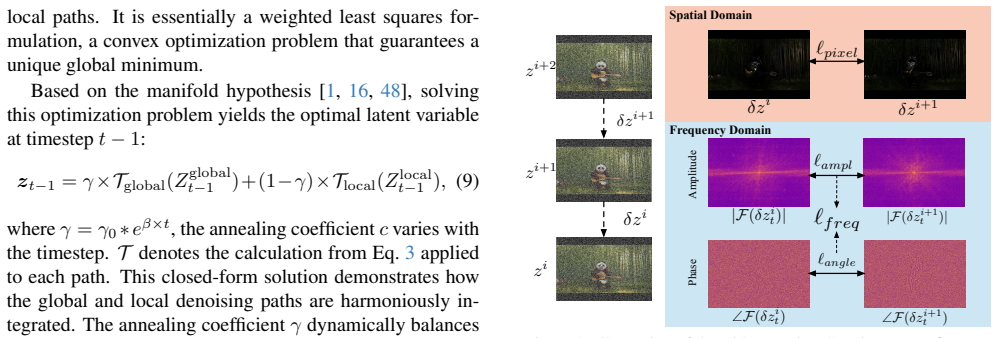
The load-bearing object is Global-Local Collaborative Denoising (GLCD), framed as a single weighted least-squares problem over all global and local clips (Eq. 8). Global Dilated Sampling builds clips by taking frames $d$ apart, so the model sees long-range structure; Local Random Shifting Sampling builds overlapping clips with start indices shifted randomly at each timestep, so seams and flicker get corrected from multiple temporal viewpoints. The two paths are merged by the annealing blend $z_{t-1} = \gamma\,T_{\mathrm{global}}(Z^{\mathrm{global}}_{t-1}) + (1-\gamma)\,T_{\mathrm{local}}(Z^{\mathrm{local}}_{t-1})$, where $T$ is the clip-merge operation of Eq. 3 and $\gamma$ grows with timestep. Around this core sit Noise Reinitialization (local noise shuffle plus frequency fusion of the initial latents), the Anchor-Based Attention Mechanism (ABAM) that injects the first clip's keys and values into other clips' attention, and Video Motion Consistency Refinement (VMCR), a gradient step on a pixel-plus-frequency motion loss.
What would settle it
Compute the argmin of Eq. 8 directly on a real denoising step, keeping the global and local clips fixed, and compare it with the Eq. 9 weighted average; if the two differ, the paper's stated optimization is not actually being solved by the implemented fusion. A complementary external check is to replace the closed-form blend with the numerically solved least-squares reconstruction and rerun the same evaluation protocol; equal or worse scores would indicate that the blend, not the optimization, is the working ingredient.
Extended reading notes
Core claim
In the paper's own telling, GLC-Diffusion is a tuning-free recipe that turns a short-clip video diffusion model into a long-video generator. The denoising trajectory is split into a global path and a local path; global dilated sampling holds the overall scene and narrative steady, while local clips with random temporal shifts smooth frame-to-frame motion. The two paths are fused at every timestep by a weighted blend with an annealing coefficient, the initial noise is reinitialized by shuffling local noise and recombining low frequencies with fresh high-frequency noise, and a gradient-based motion refinement aligns adjacent frames in both pixel and Fourier domains. On 200 prompts from the VBench benchmark, the paper reports the highest scores among Direct Sampling, Gen-L-Video, FreeNoise, and FreeLong on all five reported consistency and fidelity metrics at both $3\times$ and $6\times$ lengths, and demonstrates a video of more than 1,000 frames from a model trained on 49 frames.
Load-bearing premise
The method's theoretical story depends on the claim that the weighted least-squares problem in Eq. 8 has the convex blend in Eq. 9 as its exact solution, asserted via the manifold hypothesis without a derivation or numerical check.
Editorial extensions
If this is right
- A pretrained 49-frame text-to-video model can generate 294-frame and longer videos without additional training, with higher reported scores than four tuning-free baselines.
- Long-range content consistency and local frame-to-frame coherence are both improved by combining dilated global sampling with randomly shifted overlapping local clips.
- Noise reinitialization through local shuffling plus frequency fusion increases visual diversity while keeping overall content stable.
- The VMCR gradient step improves motion smoothness and flicker metrics across the whole generated video.
- The same recipe scales a 49-frame model to more than 1,000 frames, roughly 25 times the trained clip length.
Reading between the lines
- Going beyond the paper, the two-path fusion only needs clip projections and denoising calls, so it could likely be dropped into other temporal-attention video models.
- A direct numerical solution of Eq. 8 would test whether the claimed optimum matters or whether the weighted average alone is the working ingredient.
- The VMCR frequency-domain motion alignment could be used as a post-hoc smoothing regularizer on any video sampling pipeline.
- The noise-reinitialization idea offers a low-cost way to add output diversity to existing short-video models.
Editorial analysis
A structured set of objections, weighed in public.
Referee Report
Summary. The paper proposes GLC-Diffusion, a tuning-free, plug-and-play method for extending short video diffusion models to generate longer videos. The method combines two denoising paths: a global path using dilated sampling to capture long-range dependencies and a local path using randomly shifted overlapping clips for local temporal coherence, fused through an annealing coefficient. It also introduces an anchor-based attention modulation (ABAM), a noise reinitialization strategy that shuffles local noise and fuses low/high frequency components, and a video motion consistency refinement (VMCR) module that aligns motion vectors through pixel-wise and frequency-wise losses. Experiments on CogVideoX generate videos at 3x and 6x the original length and report VBench scores over 200 prompts, claiming superiority over Direct Sampling, Gen-L-Video, FreeNoise, and FreeLong. Ablations and hyperparameter studies are given in the appendix.
Significance. If the results are robust, the contribution is practically useful: a training-free extension that scales a 49-frame model to hundreds or thousands of frames while preserving content consistency and temporal coherence is of clear interest to the video generation community. The modular design and the inclusion of ablations for each component are strengths, and the method's compatibility with an existing model such as CogVideoX lends credibility to the plug-and-play claim. However, the central claim of superiority over prior work is currently supported only by small margins on a single evaluation run, with hyperparameters selected on the same 200 prompts used for evaluation. This is a selection-on-the-test-set protocol that, combined with the absence of error bars, makes the reported advantage potentially attributable to fitting evaluation noise rather than a robust method advantage.
major comments (4)
- [Section 4.2, Table 1; Appendix Tables 3-6] The headline claim that GLC-Diffusion is superior to prior methods rests on very small margins over FreeNoise. In Table 1, the largest advantage at 3x is +1.22 in Imaging, while Motion, Flicker, and Background gains are only +0.12, +0.23, and +0.66, respectively; at 6x the Motion and Flicker gains are +0.26 and +0.46. No seeds, per-video distributions, confidence intervals, or significance tests are reported. More importantly, the appendix shows that all four central hyperparameters—gamma0 in GLCD (Table 3), lambda in ABAM (Table 4), lambda_f in VMCR (Table 5), and omega_motion (Table 6)—were selected by sweeping VBench metrics on the same 200 prompts used to produce Table 1. No held-out split is described. Under this protocol, the reported margins are consistent with selection on evaluation noise. The authors should provide multiple seeded runs with confidence intervals, use a held-out split for any hyperparameter selection, or perform significance tests before claiming superiority.
- [Algorithm 1, line 17] Algorithm 1 in the supplementary material is inconsistent with Eq. (9) and with the described method. Eq. (9) defines z_{t-1} = gamma * T_global(Z_global) + (1-gamma) * T_local(Z_local), and the text states that the global and local paths are fused with the annealing coefficient. However, Algorithm 1 line 17 writes only z_{t-1} = gamma * T_global(Z_global), with a comment saying "Combine global and local paths," and the local term is absent. If the implementation matches Algorithm 1, the local path is not used at all, which contradicts the ablation study showing that removing the local path substantially degrades results. This must be corrected or clarified, as it is load-bearing for reproducibility.
- [Section 3.2, Eqs. (8)-(9)] The derivation from the weighted least-squares objective in Eq. (8) to the closed-form blend in Eq. (9) is asserted rather than proven. In general, the solution of Eq. (8) depends on the overlap structure and the weight matrices W_k; it is not generically equal to a simple convex combination of independent global and local reconstructions, gamma * T_global + (1-gamma) * T_local. Invoking the "manifold hypothesis" does not by itself establish this equality. If the optimization framing cannot be substantiated, the method should be presented as a heuristic weighted fusion of two denoising paths. The empirical results may still stand, but the current statement overclaims the theoretical grounding of Eq. (9).
- [Section 4.4, Table 2] The ablation study also lacks error bars or repeated runs, which matters for the interpretation of the results. In particular, removing Noise Reinitialization changes Imaging from 69.86 to 69.71, a 0.15-point difference that is almost certainly within run-to-run noise, yet the text describes the noise reinitialization module as having a significant impact. The same issue applies to the hyperparameter sweeps in Tables 3-6, where the selected values are often separated by differences comparable to the margins over baselines in Table 1. The authors should temper the language or provide statistical support for the claimed improvements.
minor comments (3)
- [Introduction, Section 4.1, Figure 1] The paper inconsistently states that CogVideoX produces 48 frames (Introduction) and 49 frames (Section 4.1 and Figure 1). Please reconcile these numbers.
- [Section 3.2, Eq. (4)] In Eq. (4), the variable j is described as "the j-th video clip" but it is used as a frame offset within a clip (j = 0, ..., L-1). This is confusing; j should be described as the frame index inside the clip, and the mapping between clip index i and sampled frames should be stated more precisely.
- [Supplementary, Section 7] The hyperparameter section states that gamma0 = 0.005 and beta = 0.0005, but it does not give the total number of timesteps T used for DDIM sampling. Since gamma = gamma0 * exp(beta * t) depends on t, the effective range of gamma cannot be assessed without T. Please state the schedule and the resulting gamma at the final timestep.
Circularity Check
Quantitative superiority is partially circular: the VBench metrics used to select all four hyperparameters are the same VBench metrics used to declare superiority; the derivation itself is otherwise self-contained.
-
fitted input called prediction
[Sec. 4.2 (Table 1) and Supplementary Sec. 7 (Tables 3-6)]
"As shown in Table 1, we selected 200 prompts from VBench [13] to evaluate the effectiveness of our proposed method. ... These hyperparameters are fine-tuned to provide optimal video quality and temporal consistency, as demonstrated by the experimental results."
The reported 'Ours' row in Table 1 is the argmax of the same VBench protocol over the swept grid of gamma0, lambda, lambda_f, and omega_motion: each appendix table (3-6) selects the best value by comparing VBench scores, and Table 1 then uses those same VBench scores on the same 200 prompts as evidence of superiority over FreeNoise et al. The quantitative advantage is therefore a fitted value, not an independent prediction; the selection metric and the evaluation metric are identical, so the comparison is statistically forced by the tuning procedure rather than by the method's content.
full rationale
The core GLCD derivation is not self-referential: Eq. 8 is a weighted least-squares formulation and Eq. 9 is an asserted closed-form convex blend based on the cited manifold hypothesis; whether Eq. 9 truly solves Eq. 8 is an unproven mathematical step but not a circular one. The only self-citations ([25], [42]) are incidental background references, not load-bearing. Noise Reinitialization and VMCR are defined by their own equations and evaluated against external baselines. The substantive circularity is confined to the quantitative evaluation protocol: all four method hyperparameters are tuned on VBench metrics/prompts and the superiority claim is then read from the same VBench metrics/prompts, so Table 1's margins are partly a selection artifact. This justifies a moderate score rather than 0, but the central architectural claims retain independent empirical content outside the fitted comparison.
Assumptions & free parameters
free parameters (8)
- gamma_0 =
0.005
- beta =
0.0005
- lambda =
0.1
- lambda_f =
0.2
- lambda_mse =
0.001
- lambda_phase =
1
- omega_motion =
2e-5
- global dilation rate d and local clip length L =
not specified
assumptions (4)
- domain assumption The manifold hypothesis: the least-squares denoising fusion in Eq. 8 has a unique closed-form solution given by Eq. 9.
- domain assumption The pretrained video diffusion model produces valid denoised latents for temporally dilated and randomly shifted frame sequences.
- domain assumption VBench metrics are a faithful proxy for human-judged coherence and fidelity.
- standard math DDIM sampling and Fourier transforms behave as standard in the latent space.
Cite this review
Pith. "Pith review of Tuning-Free Long Video Generation via Global-Local Collaborative Diffusion." pith.science (2026). https://pith.science/paper/DXZB365I
@misc{pith2026250105484,
  author       = {Pith},
  title        = {Pith review of: Tuning-Free Long Video Generation via Global-Local Collaborative Diffusion},
  year         = {2026},
  howpublished = {\url{https://pith.science/paper/DXZB365I}},
  note         = {Machine review of arXiv:2501.05484}
}
read the original abstract
Creating high-fidelity, coherent long videos is a sought-after aspiration. While recent video diffusion models have shown promising potential, they still grapple with spatiotemporal inconsistencies and high computational resource demands. We propose GLC-Diffusion, a tuning-free method for long video generation. It models the long video denoising process by establishing denoising trajectories through Global-Local Collaborative Denoising to ensure overall content consistency and temporal coherence between frames. Additionally, we introduce a Noise Reinitialization strategy which combines local noise shuffling with frequency fusion to improve global content consistency and visual diversity. Further, we propose a Video Motion Consistency Refinement (VMCR) module that computes the gradient of pixel-wise and frequency-wise losses to enhance visual consistency and temporal smoothness. Extensive experiments, including quantitative and qualitative evaluations on videos of varying lengths (\textit{e.g.}, 3\times and 6\times longer), demonstrate that our method effectively integrates with existing video diffusion models, producing coherent, high-fidelity long videos superior to previous approaches.
Figures


Figures from the paper (10 more)


Forward citations
Cited by 3 Pith papers
-
LatSearch: Latent Reward-Guided Search for Faster Inference-Time Scaling in Video Diffusion
LatSearch improves video diffusion quality and efficiency by scoring intermediate latents with a trained reward model and performing reward-guided resampling plus final pruning.
-
TokensGen: Harnessing Condensed Tokens for Long Video Generation
TokensGen generates consistent long videos by representing each clip as condensed semantic tokens, generating all tokens jointly from text, and stitching clips with adaptive FIFO denoising.
-
iARCS: Iterative Agentic RL for Controllable 3D Scene Generation
A two-stage agentic RL framework with LLM-generated, iteratively refined reward programs improves functional constraint fidelity in 3D scene generation and enables self-augmentation of the base generator.
Reference graph
Works this paper leans on
-
[1]
MultiDiffusion: Fusing diffusion paths for controlled image generation
Omer Bar-Tal, Lior Yariv, Yaron Lipman, and Tali Dekel. MultiDiffusion: Fusing diffusion paths for controlled image generation. In Proceedings of the 40th International Confer- ence on Machine Learning, pages 1737–1752. PMLR, 2023. 2, 4, 5
work page 2023
-
[2]
Stable video diffusion: Scaling latent video diffusion models to large datasets
Andreas Blattmann, Tim Dockhorn, Sumith Kulal, Daniel Mendelevitch, Maciej Kilian, Dominik Lorenz, Yam Levi, Zion English, Vikram V oleti, Adam Letts, et al. Stable video diffusion: Scaling latent video diffusion models to large datasets. arXiv preprint arXiv:2311.15127, 2023. 3
arXiv 2023
-
[3]
Video generation models as world simulators, 2024
Tim Brooks, Bill Peebles, Connor Holmes, Will DePue, Yufei Guo, Li Jing, David Schnurr, Joe Taylor, Troy Luh- man, Eric Luhman, et al. Video generation models as world simulators, 2024. 3
work page 2024
-
[4]
Video- dreamer: Customized multi-subject text-to-video generation with disen-mix finetuning
Hong Chen, Xin Wang, Guanning Zeng, Yipeng Zhang, Yuwei Zhou, Feilin Han, and Wenwu Zhu. Video- dreamer: Customized multi-subject text-to-video generation with disen-mix finetuning. arXiv preprint arXiv:2311.00990,
-
[5]
Exvideo: Extending video diffusion models via parameter-efficient post-tuning
Zhongjie Duan, Wenmeng Zhou, Cen Chen, Yaliang Li, and Weining Qian. Exvideo: Extending video diffusion models via parameter-efficient post-tuning. arXiv preprint arXiv:2406.14130, 2024. 2
arXiv 2024
-
[6]
Structure and content-guided video synthesis with diffusion models
Patrick Esser, Johnathan Chiu, Parmida Atighehchian, Jonathan Granskog, and Anastasis Germanidis. Structure and content-guided video synthesis with diffusion models. In Proceedings of the IEEE/CVF International Conference on Computer Vision, pages 7346–7356, 2023. 2
work page 2023
-
[7]
Scaling recti- fied flow transformers for high-resolution image synthesis
Patrick Esser, Sumith Kulal, Andreas Blattmann, Rahim Entezari, Jonas M ¨uller, Harry Saini, Yam Levi, Dominik Lorenz, Axel Sauer, Frederic Boesel, et al. Scaling recti- fied flow transformers for high-resolution image synthesis. In Forty-first International Conference on Machine Learn- ing, 2024. 2
2024
-
[8]
Animatediff: Animate your personalized text- to-image diffusion models without specific tuning
Yuwei Guo, Ceyuan Yang, Anyi Rao, Zhengyang Liang, Yaohui Wang, Yu Qiao, Maneesh Agrawala, Dahua Lin, and Bo Dai. Animatediff: Animate your personalized text- to-image diffusion models without specific tuning. In The Twelfth International Conference on Learning Representa- tions, 2024. 3
work page 2024
Show all 52 references
-
[9]
Latent video diffusion models for high-fidelity long video generation
Yingqing He, Tianyu Yang, Yong Zhang, Ying Shan, and Qifeng Chen. Latent video diffusion models for high-fidelity long video generation. arXiv preprint arXiv:2211.13221 ,
-
[10]
Streamingt2v: Con- sistent, dynamic, and extendable long video generation from text
Roberto Henschel, Levon Khachatryan, Daniil Hayrapetyan, Hayk Poghosyan, Vahram Tadevosyan, Zhangyang Wang, Shant Navasardyan, and Humphrey Shi. Streamingt2v: Con- sistent, dynamic, and extendable long video generation from text. arXiv preprint arXiv:2403.14773, 2024. 2, 3
2024 arXiv
-
[11]
Denoising dif- fusion probabilistic models
Jonathan Ho, Ajay Jain, and Pieter Abbeel. Denoising dif- fusion probabilistic models. Advances in neural information processing systems, 33:6840–6851, 2020. 2
2020
-
[12]
Video dif- fusion models
Jonathan Ho, Tim Salimans, Alexey Gritsenko, William Chan, Mohammad Norouzi, and David J Fleet. Video dif- fusion models. Advances in Neural Information Processing Systems, 35:8633–8646, 2022. 2
2022
-
[13]
Vbench: Comprehensive bench- mark suite for video generative models
Ziqi Huang, Yinan He, Jiashuo Yu, Fan Zhang, Chenyang Si, Yuming Jiang, Yuanhan Zhang, Tianxing Wu, Qingyang Jin, Nattapol Chanpaisit, et al. Vbench: Comprehensive bench- mark suite for video generative models. In Proceedings of the IEEE/CVF Conference on Computer Vision and P...
2024
-
[14]
Fifo-diffusion: Generating infinite videos from text without training
Jihwan Kim, Junoh Kang, Jinyoung Choi, and Bohyung Han. Fifo-diffusion: Generating infinite videos from text without training. arXiv preprint arXiv:2405.11473, 2024. 3
2024 arXiv
-
[15]
Open-sora-plan, 2024
PKU-Yuan Lab and Tuzhan AI etc. Open-sora-plan, 2024. 3
2024
-
[16]
Syncdiffusion: Coherent montage via synchronized joint diffusions
Yuseung Lee, Kunho Kim, Hyunjin Kim, and Minhyuk Sung. Syncdiffusion: Coherent montage via synchronized joint diffusions. Advances in Neural Information Processing Systems, 36:50648–50660, 2023. 5
2023
-
[17]
A survey on long video generation: Challenges, methods, and prospects
Chengxuan Li, Di Huang, Zeyu Lu, Yang Xiao, Qingqi Pei, and Lei Bai. A survey on long video generation: Challenges, methods, and prospects. arXiv preprint arXiv:2403.16407 ,
-
[18]
Training-free long video generation with chain of diffusion model experts
Wenhao Li, Yichao Cao, Xiu Su, Xi Lin, Shan You, Mingkai Zheng, Yi Chen, and Chang Xu. Training-free long video generation with chain of diffusion model experts. arXiv preprint arXiv:2408.13423, 2024. 2, 3
2024 arXiv
-
[19]
Videogen: A reference-guided latent diffusion ap- proach for high definition text-to-video generation
Xin Li, Wenqing Chu, Ye Wu, Weihang Yuan, Fanglong Liu, Qi Zhang, Fu Li, Haocheng Feng, Errui Ding, and Jingdong Wang. Videogen: A reference-guided latent diffusion ap- proach for high definition text-to-video generation. arXiv preprint arXiv:2309.00398, 2023. 2
2023 arXiv
-
[20]
Sora: A review on background, technology, limitations, and opportunities of large vision models
Yixin Liu, Kai Zhang, Yuan Li, Zhiling Yan, Chujie Gao, Ruoxi Chen, Zhengqing Yuan, Yue Huang, Hanchi Sun, Jian- feng Gao, et al. Sora: A review on background, technology, limitations, and opportunities of large vision models. arXiv preprint arXiv:2402.17177, 2024. 2
2024 arXiv
-
[21]
Video- drafter: Content-consistent multi-scene video generation with llm
Fuchen Long, Zhaofan Qiu, Ting Yao, and Tao Mei. Video- drafter: Content-consistent multi-scene video generation with llm. arXiv preprint arXiv:2401.01256, 2024. 2
2024 arXiv
-
[22]
Freelong: Training-free long video generation with spectralblend tem- 9 poral attention
Yu Lu, Yuanzhi Liang, Linchao Zhu, and Yi Yang. Freelong: Training-free long video generation with spectralblend tem- 9 poral attention. arXiv preprint arXiv:2407.19918, 2024. 2, 3, 6, 7
2024 arXiv
-
[23]
Fastercache: Training-free video diffusion model acceleration with high quality
Zhengyao Lv, Chenyang Si, Junhao Song, Zhenyu Yang, Yu Qiao, Ziwei Liu, and Kwan-Yee K Wong. Fastercache: Training-free video diffusion model acceleration with high quality. arXiv preprint arXiv:2410.19355, 2024. 2
2024 arXiv
-
[24]
Latte: Latent diffusion transformer for video generation
Xin Ma, Yaohui Wang, Gengyun Jia, Xinyuan Chen, Zi- wei Liu, Yuan-Fang Li, Cunjian Chen, and Yu Qiao. Latte: Latent diffusion transformer for video generation. arXiv preprint arXiv:2401.03048, 2024. 2, 3
2024 arXiv
-
[25]
Rd- nerf: Neural robust distilled feature fields for sparse-view scene segmentation
Yongjia Ma, Bin Dou, Tianyu Zhang, and Zejian Yuan. Rd- nerf: Neural robust distilled feature fields for sparse-view scene segmentation. In ICASSP 2024 - 2024 IEEE Interna- tional Conference on Acoustics, Speech and Signal Process- ing (ICASSP), pages 3470–3474, 2024. 2
2024
-
[26]
Snap video: Scaled spatiotemporal transformers for text-to-video synthesis
Willi Menapace, Aliaksandr Siarohin, Ivan Skorokhodov, Ekaterina Deyneka, Tsai-Shien Chen, Anil Kag, Yuwei Fang, Aleksei Stoliar, Elisa Ricci, Jian Ren, et al. Snap video: Scaled spatiotemporal transformers for text-to-video synthesis. In Proceedings of the IEEE/CVF Conference...
2024
-
[27]
Mevg: Multi-event video generation with text-to-video models
Gyeongrok Oh, Jaehwan Jeong, Sieun Kim, Wonmin Byeon, Jinkyu Kim, Sungwoong Kim, and Sangpil Kim. Mevg: Multi-event video generation with text-to-video models. In European Conference on Computer Vision, pages 401–418. Springer, 2025. 2, 3
2025
-
[28]
Scalable diffusion mod- els with transformers
William Peebles and Saining Xie. Scalable diffusion mod- els with transformers. In Proceedings of the IEEE/CVF In- ternational Conference on Computer Vision (ICCV) , pages 4195–4205, 2023. 3
2023
-
[29]
SDXL: Improving latent diffusion models for high-resolution image synthesis
Dustin Podell, Zion English, Kyle Lacey, Andreas Blattmann, Tim Dockhorn, Jonas M ¨uller, Joe Penna, and Robin Rombach. SDXL: Improving latent diffusion models for high-resolution image synthesis. In The Twelfth Interna- tional Conference on Learning Representations, 2024. 2
2024
-
[30]
Freetraj: Tuning-free tra- jectory control in video diffusion models
Haonan Qiu, Zhaoxi Chen, Zhouxia Wang, Yingqing He, Menghan Xia, and Ziwei Liu. Freetraj: Tuning-free tra- jectory control in video diffusion models. arXiv preprint arXiv:2406.16863, 2024. 3
2024 arXiv
-
[31]
Freenoise: Tuning- free longer video diffusion via noise rescheduling
Haonan Qiu, Menghan Xia, Yong Zhang, Yingqing He, Xin- tao Wang, Ying Shan, and Ziwei Liu. Freenoise: Tuning- free longer video diffusion via noise rescheduling. In The Twelfth International Conference on Learning Representa- tions, 2024. 2, 3, 5, 6, 7
2024
-
[32]
High-resolution image synthesis with latent diffusion models
Robin Rombach, Andreas Blattmann, Dominik Lorenz, Patrick Esser, and Bj ¨orn Ommer. High-resolution image synthesis with latent diffusion models. In Proceedings of the IEEE/CVF conference on computer vision and pattern recognition, pages 10684–10695, 2022. 2
2022
-
[33]
Make-a-video: Text-to-video generation without text-video data
Uriel Singer, Adam Polyak, Thomas Hayes, Xi Yin, Jie An, Songyang Zhang, Qiyuan Hu, Harry Yang, Oron Ashual, Oran Gafni, Devi Parikh, Sonal Gupta, and Yaniv Taigman. Make-a-video: Text-to-video generation without text-video data. In The Eleventh International Conference on Lea...
2023
-
[34]
Denois- ing diffusion implicit models
Jiaming Song, Chenlin Meng, and Stefano Ermon. Denois- ing diffusion implicit models. In International Conference on Learning Representations, 2021. 3
2021
-
[35]
Gen-l-video: Multi-text to long video generation via temporal co-denoising
Fu-Yun Wang, Wenshuo Chen, Guanglu Song, Han-Jia Ye, Yu Liu, and Hongsheng Li. Gen-l-video: Multi-text to long video generation via temporal co-denoising. arXiv preprint arXiv:2305.18264, 2023. 2, 3, 6, 7
2023 arXiv
-
[36]
Lavie: High-quality video gener- ation with cascaded latent diffusion models
Yaohui Wang, Xinyuan Chen, Xin Ma, Shangchen Zhou, Ziqi Huang, Yi Wang, Ceyuan Yang, Yinan He, Jiashuo Yu, Peiqing Yang, et al. Lavie: High-quality video gener- ation with cascaded latent diffusion models. arXiv preprint arXiv:2309.15103, 2023. 2
2023 arXiv
-
[37]
Internvid: A large-scale video-text dataset for multimodal understanding and generation
Yi Wang, Yinan He, Yizhuo Li, Kunchang Li, Jiashuo Yu, Xin Ma, Xinhao Li, Guo Chen, Xinyuan Chen, Yaohui Wang, et al. Internvid: A large-scale video-text dataset for multimodal understanding and generation. arXiv preprint arXiv:2307.06942, 2023. 2
2023 arXiv
-
[38]
Loong: Generating minute-level long videos with autoregressive lan- guage models
Yuqing Wang, Tianwei Xiong, Daquan Zhou, Zhijie Lin, Yang Zhao, Bingyi Kang, Jiashi Feng, and Xihui Liu. Loong: Generating minute-level long videos with autoregressive lan- guage models. arXiv preprint arXiv:2410.02757, 2024. 2
2024 arXiv
-
[39]
Lamp: Learn a motion pat- tern for few-shot-based video generation
Ruiqi Wu, Liangyu Chen, Tong Yang, Chunle Guo, Chongyi Li, and Xiangyu Zhang. Lamp: Learn a motion pat- tern for few-shot-based video generation. arXiv preprint arXiv:2310.10769, 2023. 2
2023 arXiv
-
[40]
Freeinit: Bridging initialization gap in video dif- fusion models
Tianxing Wu, Chenyang Si, Yuming Jiang, Ziqi Huang, and Ziwei Liu. Freeinit: Bridging initialization gap in video dif- fusion models. In European Conference on Computer Vision, pages 378–394. Springer, 2025. 2, 5
2025
-
[41]
A survey on video diffusion models
Zhen Xing, Qijun Feng, Haoran Chen, Qi Dai, Han Hu, Hang Xu, Zuxuan Wu, and Yu-Gang Jiang. A survey on video diffusion models. ACM Computing Surveys, 2023. 2
2023
-
[42]
Tv-3dg: Mastering text-to-3d customized gener- ation with visual prompt
Jiahui Yang, Donglin Di, Baorui Ma, Xun Yang, Yongjia Ma, Wenzhang Sun, Wei Chen, Jianxun Cui, Zhou Xue, Meng Wang, et al. Tv-3dg: Mastering text-to-3d customized gener- ation with visual prompt. arXiv preprint arXiv:2410.21299,
-
[43]
Cogvideox: Text-to-video diffusion models with an expert transformer
Zhuoyi Yang, Jiayan Teng, Wendi Zheng, Ming Ding, Shiyu Huang, Jiazheng Xu, Yuanming Yang, Wenyi Hong, Xiao- han Zhang, Guanyu Feng, et al. Cogvideox: Text-to-video diffusion models with an expert transformer. arXiv preprint arXiv:2408.06072, 2024. 1, 2, 3, 6
2024 arXiv
-
[44]
Safree: Training-free and adaptive guard for safe text-to-image and video generation
Jaehong Yoon, Shoubin Yu, Vaidehi Patil, Huaxiu Yao, and Mohit Bansal. Safree: Training-free and adaptive guard for safe text-to-image and video generation. arXiv preprint arXiv:2410.12761, 2024. 2
2024 arXiv
-
[45]
Efficient video diffusion mod- els via content-frame motion-latent decomposition
Sihyun Yu, Weili Nie, De-An Huang, Boyi Li, Jinwoo Shin, and Anima Anandkumar. Efficient video diffusion mod- els via content-frame motion-latent decomposition. arXiv preprint arXiv:2403.14148, 2024. 2
2024 arXiv
-
[46]
Tvg: A training-free transi- tion video generation method with diffusion models
Rui Zhang, Yaosen Chen, Yuegen Liu, Wei Wang, Xum- ing Wen, and Hongxia Wang. Tvg: A training-free transi- tion video generation method with diffusion models. arXiv preprint arXiv:2408.13413, 2024. 3
2024 arXiv
-
[47]
Open-sora: Democratizing efficient video production for all, 2024
Zangwei Zheng, Xiangyu Peng, Tianji Yang, Chenhui Shen, Shenggui Li, Hongxin Liu, Yukun Zhou, Tianyi Li, and Yang You. Open-sora: Democratizing efficient video production for all, 2024. 3 10
2024
-
[48]
Twindiffusion: Enhanc- ing coherence and efficiency in panoramic image generation with diffusion models
Teng Zhou and Yongchuan Tang. Twindiffusion: Enhanc- ing coherence and efficiency in panoramic image generation with diffusion models. arXiv preprint arXiv:2404.19475 ,
-
[50]
First, we initialize the latent variable z′ T us- ing the Noise Reinitialization strategy, which combines lo- cal noise shuffling and frequency fusion to enhance motion diversity
Algorithm We further illustrate the synthesis process of long videos in Algorithm 1. First, we initialize the latent variable z′ T us- ing the Noise Reinitialization strategy, which combines lo- cal noise shuffling and frequency fusion to enhance motion diversity. For the deno...
-
[51]
Below, we outline the key hyperparameters and their roles, the chosen ranges for the experiments, and the correspond- ing results
Hyperparameter In this section, we provide an extensive analysis of the hy- perparameter settings used in our proposed method, along with detailed experimental results to validate their impact. Below, we outline the key hyperparameters and their roles, the chosen ranges for th...
-
[52]
More Qualitative Results In this chapter, we report more qualitative experiment re- sults. Hyperparameter Ablation Qualitative Results The qualitative results for different initial annealing coefficients γ0 are illustrated in Figure 6, highlighting their impact on the outcome....
-
[2024]
5 11 Tuning-Free Long Video Generation via Global-Local Collaborative Diffusion Supplementary Material In this appendix, we provide the following materials: Sec. 6 Algorithm: The denoising process in GLC Diffu- sion is thoroughly outlined, detailing the steps involved in globa...
Reviewed August 10, 2026 · model on record in the stance chip above.
Discussion (0). Continue with ORCID to comment.