REVIEW 3 major objections 6 minor 19 references
The more polypersonal the better -- a short look on space geometry of fine-tuned layers
T0 review · 3 major / 6 minor · reviewed 2026-08-10 · deepseek-v4-flash
Pith's one-line read Adding a single fine-tuned layer to a frozen BERT separates a newly introduced grammatical system from the original language inside the model's latent space.
desk verdict An original but methodologically tangled interpretability study; the headline causal claim is undercut by a contradiction in the training pipeline. read the letter →
The pith
A machine-rendered reading of the paper's core claim, the machinery that carries it, and where it could break.
The reading
What carries the argument
The load-bearing object is the pair of persistence diagrams built from a sentence's token embeddings via Vietoris-Rips filtration, compared with the bottleneck distance. A persistence diagram records which clusters or holes in the point cloud of embeddings survive across scales, and the bottleneck distance is the largest shift needed to match one diagram to another. Comparing these distances between standard and polypersonal sentences, across BERT outputs and grammar-module outputs, is what grounds the claim that fine-tuning changes representation topology rather than merely shifting average vectors.
What would settle it
Replace the person-number affix with a matched nonsense suffix that triggers the same tokenization changes but encodes no agreement, and compare the bottleneck distances to the genuine polypersonal case; if the distances are comparable, the effect is an artifact of surface tokenization rather than grammatical separation.
Extended reading notes
Core claim
The paper's central discovery is that fine-tuning a single layer before the prediction head creates a topology change in BERT's latent space: representations of sentences containing the new polypersonal affix are moved away from representations of standard Russian, while the old geometry is left largely intact. The authors measure this as a bottleneck distance between Vietoris-Rips persistence diagrams built from token embeddings, and they find that the separation appears in the grammar module rather than in the frozen BERT body. Prefix marking produces slightly more separation than suffix marking, and the LSTM variant shows the same separation with smaller distances, which they read as the recurrent layer keeping representations more clustered. On the strength of these observations they conclude that fine-tuning layers creates disentangled and linearly separable representations by changing the representation topology, and that this is why the fine-tuned model reduces perplexity on both text types compared with the unadapted checkpoint.
Load-bearing premise
The geometric conclusion assumes that the bottleneck distances between persistence diagrams of standard and polypersonal sentences reflect the model's grammatical differentiation, not surface tokenization or positional-encoding artifacts of the added affix.
Editorial extensions
If this is right
- A frozen pretrained encoder can gain a brand-new inflectional category by learning a small layer, while leaving the geometry of the original language mostly unchanged.
- Because the new system appears in its own region of latent space, grammatical knowledge can be inspected and potentially extracted without full-model fine-tuning.
- Fine-tuning a single layer narrows the perplexity gap between standard and polypersonal text, so adaptation is real on the model's own metric.
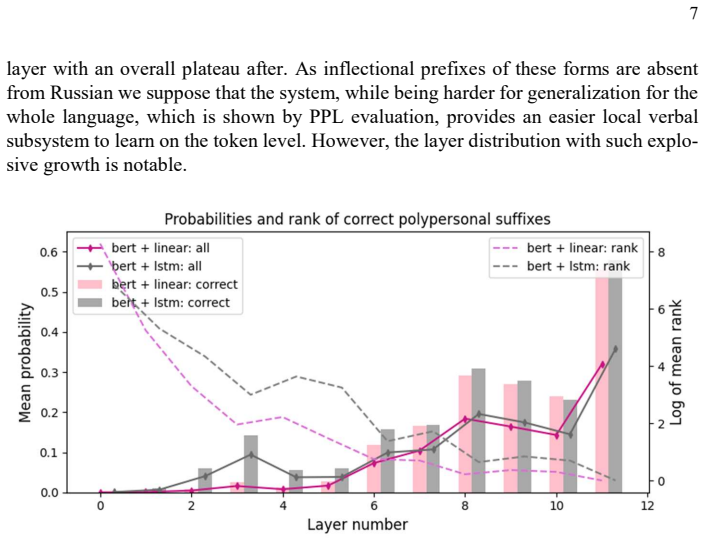
- Layer-wise probing shows the new affix is predicted with rising confidence in later layers, matching the general pattern that higher layers carry syntax.
- The same architecture works with either suffix or prefix marking, but prefix marking is harder for overall perplexity while easier for token-level prediction.
Reading between the lines
- The conclusion's phrase "linearly separable" is stronger than the reported bottleneck-distance measurements, which compare topology but never train a linear classifier; a linear probe on BERT versus grammar-module outputs is the direct test of that wording.
- Since the paper reports no variance across the 1,000 sampled sentences and says the distance source could lie in tokenization or positional encoding, part of the observed separation may be a surface-form artifact; replacing the genuine affix with a matched nonce suffix would isolate the grammatical contribution.
- The same minimal-pair protocol should transfer to other absent inflectional categories, such as evidentiality or noun incorporation, to check whether topological disentangling is a general mechanism for adding grammar rather than a peculiarity of polypersonality.
Signed reviews
Editorial analysis
A structured set of objections, weighed in public.
Referee Report
Summary. The paper studies how a BERT model adapted to an artificial grammatical feature (polypersonal agreement in Russian) changes its internal representations. The authors fine-tune RuBERT with an added MLM head and, in one variant, an additional LSTM layer, on data containing polypersonal suffix or prefix verb forms. They report pseudo-perplexity, layerwise MLM probing results, and bottleneck distances between Vietoris-Rips persistence diagrams built from token representations. The central claim is that adding even one grammatical layer causes the model to separate old and new grammatical systems in latent space and improves perplexity adaptation, with the conclusion asserting that fine-tuned layers create 'disentangled and linearly separable representations.'
Significance. If the causal claim were established, the paper would offer a striking and practically relevant result: a small trainable module attached to a frozen language model can acquire a novel grammatical category and localize it in a distinct region of the latent space, with geometric changes visible through topological data analysis. The study's strengths include the use of minimal pairs, the choice of pseudo-perplexity scoring appropriate for multi-token words, and the explicit acknowledgment of tokenization as a possible confound. The bottleneck-distance methodology is a nonstandard and potentially informative lens on fine-tuning. However, the central causal conclusion is currently not supported by the evidence as presented, because of a direct contradiction in the training pipeline and the absence of any variance or significance assessment in the geometric comparisons.
major comments (3)
- [§3.1 and §3.3] Section 3.1 states that RuBERT is frozen during training 'as we do not want RuBERT to acquire information about polypersonality,' but Section 3.3 states that 'RuBERT was pretrained for 10 epochs with all the layers unfrozen on MLM task using regular Russian sentences and modified polypersonal Russian sentences mixed in equal amounts.' These statements cannot both describe the pipeline that produced the models analyzed in Section 4.3. If the unfrozen pretraining stage was used, then the baseline 'BERT layer outputs' in Figure 3 are not from vanilla RuBERT, and the observed bottleneck-distance shift cannot be attributed to the added grammar layer; the statement in Section 4.3 that 'BERT never actually encountered polypersonal sentences during pretraining' is then false. The authors must clarify whether the frozen-pipeline models produced all reported results, or rerun the analysis with a strictly frozen base BERT, before the causal claim in the abstract can be evaluated.
- [§4.3 and Conclusion] The geometric evidence is underpowered. Bottleneck distances are reported as averages over 1,000 sampled sentences without any variance, confidence interval, or significance test, so the visual differences in Figure 3 could plausibly be driven by outliers or noise. Furthermore, the Conclusion's assertion that fine-tuning 'creates disentangled and linearly separable representations' is not supported by any direct measurement of linear separability (e.g., linear probe accuracy, margin, or a separation index); no such analysis appears in Section 4.3. Without these quantitative supports, the paper overstates what the bottleneck-distance comparisons demonstrate.
- [§4.3] The paper itself concedes that 'the clear identification of the sources is difficult. We suggest that it may be explained both by tokenization (hence positional encoding effects) and linguistic improbability.' This concession directly weakens the abstract's causal claim that adding a grammatical layer 'causes the model to separate the new and old grammatical systems.' The observed bottleneck-distance shifts could reflect surface tokenization of the nonce affixes rather than a newly acquired grammatical representation. A concrete control would be to compare persistence diagrams for sentences in which the same affix shape is used without the polypersonal agreement (or after removing affix tokens), and to show that the geometric separation is specific to the grammatical function rather than to the token string.
minor comments (6)
- [References] Reference [19] is cited for the Vietoris-Rips filtration, but [19] is the VisBERT paper; a standard source for Vietoris-Rips filtrations and persistence diagrams should be cited instead.
- [Introduction] The sentence 'ChatGPT is sometimes capable of outperforming full-shot models in such tasks.' appears twice in consecutive paragraphs and should be removed.
- [Throughout] There are several typographical issues: 'modeles’' in §3.3, 'сonstructed' with a Cyrillic 'с' in §3.3, 'an noticable' and 'significantlymore' in the Conclusion, and 'Fig, 2' in §4.2.
- [§3.2] The text refers to the 'BERT-Small tokenizer' when selecting the affix paradigm, but the experimental model is RuBERT; please clarify which tokenizer was used and whether it matches the final model.
- [§3.3] Experimental details needed for reproducibility are missing, including the LSTM hidden dimension, optimizer, learning rate, batch size, number of training examples, and the exact split of the fiction-text corpus into train and test sets.
- [Figures 1–3] The figures would benefit from axis labels, units, and error bars; in particular, Figure 3 does not define the scale or meaning of the bottleneck-distance axis in the caption.
Circularity Check
No circularity: the paper's conclusions are empirical measurements, not reductions of predicted quantities to fitted inputs.
full rationale
The paper contains no derivation that reduces a predicted quantity to a fitted input. The central measurements—pseudo-perplexity of held-out sentences and bottleneck distances between Vietoris–Rips persistence diagrams—are computed after training and are not used as training objectives or fitted parameters. There are no load-bearing self-citations: all cited works are external and none carries the paper's conclusion. The causal claim that the added grammar layer causes the separation would be undermined if the 10-epoch unfrozen pretraining stage in §3.3 was actually applied to the models analyzed in §4.3, because then BERT itself would have seen polypersonal text; the paper's own statement in §4.3 that 'BERT never actually encountered polypersonal sentences during pretraining' conflicts with that procedure. That is an internal-validity ambiguity, not a circular reduction, and the paper likewise acknowledges in §4.3 that 'the clear identification of the sources is difficult' (tokenization vs linguistic factors). Since no claim is equivalent to its inputs by construction, the appropriate circularity finding is none.
Assumptions & free parameters
free parameters (4)
- Pretraining epochs =
10
- Fine-tuning data mix =
equal amounts regular and polypersonal Russian
- Affix paradigm =
first-conjugation suffix -jet and prefix variant
- LSTM hidden dimension =
not reported
assumptions (5)
- standard math Vietoris-Rips persistence diagrams and bottleneck distance are valid summaries of representation geometry
- domain assumption Pseudo-perplexity via PLL-word-l2r is a valid estimate of language-model quality on multi-token low-frequency words
- domain assumption The synthetic polypersonal affix introduces a genuine new grammatical category without confounding tokenization
- domain assumption Frozen RuBERT has no prior knowledge of polypersonal text
- domain assumption The test set is drawn from the same distribution and does not leak training examples
Cite this review
Pith. "Pith review of The more polypersonal the better -- a short look on space geometry of fine-tuned layers." pith.science (2026). https://pith.science/paper/5WLYUY3D
@misc{pith2026250105503,
  author       = {Pith},
  title        = {Pith review of: The more polypersonal the better -- a short look on space geometry of fine-tuned layers},
  year         = {2026},
  howpublished = {\url{https://pith.science/paper/5WLYUY3D}},
  note         = {Machine review of arXiv:2501.05503}
}
read the original abstract
The interpretation of deep learning models is a rapidly growing field, with particular interest in language models. There are various approaches to this task, including training simpler models to replicate neural network predictions and analyzing the latent space of the model. The latter method allows us to not only identify patterns in the model's decision-making process, but also understand the features of its internal structure. In this paper, we analyze the changes in the internal representation of the BERT model when it is trained with additional grammatical modules and data containing new grammatical structures (polypersonality). We find that adding a single grammatical layer causes the model to separate the new and old grammatical systems within itself, improving the overall performance on perplexity metrics.
Figures


Reference graph
Works this paper leans on
-
[1]
Vaswani, A., Shazeer, N., Parmar, N., Uszkoreit, J., Jones, L., Gomez, A. N., ... & Polosu- khin, I. (2017). Attention is all you need. Advances in neural information processing sys- tems, 30
work page 2017
- [2]
-
[3]
Anelli, V. W., Biancofiore, G. M., De Bellis, A., Di Noia, T., & Di Sciascio, E. (2022, Oc- tober). Interpretability of BERT latent space through knowledge graphs. In Proceedings of the 31st ACM International Conference on Information & Knowledge Management (pp. 3806-3810)
work page 2022
-
[4]
Chistyakova, K. E., & Kazakova, T. B. (2023). Grammar In Language Models: Bert Study (No. WP BRP 115/LNG/2023). National Research University Higher School of Economics
work page 2023
-
[5]
J., Singh, C., Kumbier, K., Abbasi-Asl, R., & Yu, B
Murdoch, W. J., Singh, C., Kumbier, K., Abbasi-Asl, R., & Yu, B. (2019). Definitions, methods, and applications in interpretable machine learning. Proceedings of the National Academy of Sciences, 116(44), 22071-22080. 10
work page 2019
-
[6]
Doshi-Velez, F., & Kim, B. (2017). Towards a rigorous science of interpretable machine learning. arXiv preprint arXiv:1702.08608
arXiv 2017
-
[7]
D., DerSimonian, R., & Freedman, D
Flanders, W. D., DerSimonian, R., & Freedman, D. S. (1992). Interpretation of linear re- gression models that include transformations or interaction terms. Annals of Epidemiology, 2(5), 735-744
work page 1992
-
[8]
Clark, K., Khandelwal, U., Levy, O., & Manning, C. D. (2019). What does bert look at? An analysis of bert's attention. arXiv preprint arXiv:1906.04341
arXiv 2019
Show all 19 references
-
[9]
Hewitt, J., & Manning, C. D. (2019, June). A structural probe for finding syntax in word representations. In Proceedings of the 2019 Conference of the North American Chapter of the Association for Computational Linguistics: Human Language Technologies, Volume 1 (Long and Short...
2019
-
[10]
Isotropy in the Contex- tual Embedding Space: Clusters and Manifolds
Xingyu Cai, Jiaji Huang, Yuchen Bian, & Kenneth Church (2021). Isotropy in the Contex- tual Embedding Space: Clusters and Manifolds. In International Conference on Learning Representations
2021
-
[11]
Representation De- generation Problem in Training Natural Language Generation Models
Jun Gao, Di He, Xu Tan, Tao Qin, Liwei Wang, & Tieyan Liu (2019). Representation De- generation Problem in Training Natural Language Generation Models. In International Con- ference on Learning Representations
2019
-
[12]
WhiteningBERT: An Easy Unsupervised Sentence Embedding Ap- proach
Junjie Huang, Duyu Tang, Wanjun Zhong, Shuai Lu, Linjun Shou, Ming Gong, Daxin Jiang, & Nan Duan (2021). WhiteningBERT: An Easy Unsupervised Sentence Embedding Ap- proach. arXiv preprint arXiv: 2104.01767
2021 arXiv
-
[13]
Visualizing and Measuring the Geometry of BERT
Andy Coenen, Emily Reif, Ann Yuan, Been Kim, Adam Pearce, Fernanda Viégas, & Martin Wattenberg (2019). Visualizing and Measuring the Geometry of BERT. arXiv preprint arXiv: 1906.02715
2019 arXiv
-
[14]
TopoBERT: Exploring the topology of fine-tuned word representations
Archit Rathore, Yichu Zhou, Vivek Srikumar, & Bei Wang (2023). TopoBERT: Exploring the topology of fine-tuned word representations. Inf. Vis., 22(3), 186–208
2023
-
[15]
Haim Meirom, S., & Bobrowski, O. (2022). Unsupervised Geometric and Topological Ap- proaches for Cross-Lingual Sentence Representation and Comparison. In Proceedings of the 7th Workshop on Representation Learning for NLP (pp. 173–183). Association for Compu- tational Linguistics
2022
-
[16]
Socher (2016)
Hakan Inan, Khashayar Khosravi, & R. Socher (2016). Tying Word Vectors and Word Clas- sifiers: A Loss Framework for Language Modeling. International Conference on Learning Representations
2016
-
[17]
Kauf, C., & Ivanova, A. (2023). A Better Way to Do Masked Language Model Scoring. In Proceedings of the 61st Annual Meeting of the Association for Computational Linguistics (Volume 2: Short Papers) (pp. 925–935). Association for Computational Linguistics
2023
-
[18]
Stability of Persistence Diagrams
David Cohen-Steiner, Herbert Edelsbrunner, & John Harer (2005). Stability of Persistence Diagrams. Discrete & Computational Geometry, 37, 103-120
2005
-
[19]
V., Winter, B., Löser, A., & Gers, F
Aken, B. V., Winter, B., Löser, A., & Gers, F. A. (2020, April). Visbert: Hidden-state visu- alizations for transformers. In Companion Proceedings of the Web Conference 2020 (pp. 207-211)
2020
Reviewed August 10, 2026 · model on record in the stance chip above.
Discussion (0). Continue with ORCID to comment.