REVIEW 3 major objections 5 minor 144 references
Environment Modeling for Service Robots From a Task Execution Perspective
T0 review · 3 major / 5 minor · reviewed 2026-08-10 · deepseek-v4-flash
Pith's one-line read This survey claims to be the first to organize robot environment modeling by the tasks it serves—localization, navigation, manipulation, and long-term autonomy—and identifies long-term home modeling as the open problem.
desk verdict A coherent survey with a useful task-oriented taxonomy, but the unverifiable 'first survey' claim and the missing literature protocol keep it from being definitive. read the letter →
The pith
A machine-rendered reading of the paper's core claim, the machinery that carries it, and where it could break.
The reading
What carries the argument
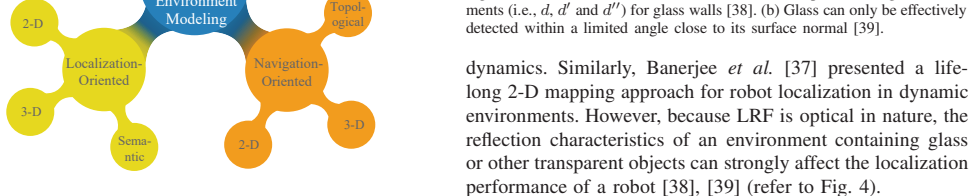
The central object is the four-part taxonomy of task-execution-oriented environment modeling (Figure 2), with subcategories by information type: localization (2-D, 3-D, semantic), navigation (2-D, 3-D, topological), manipulation (3-D, integrated 3-D, semantic), and LTA (combined, consistent, probabilistic). Here 'integrated 3-D' means a full 3-D model enriched with object-level semantic information, 'combined' means a mixture of 2-D, 3-D, and object models, 'consistent' means maintaining one-to-one mappings between modeled and real entities, and 'probabilistic' means using object-room relationships to infer where task objects are likely to be. The taxonomy does the organizing work of the survey: every reviewed method is placed in one cell, and the four comparative tables turn the literature into a matrix of model type versus merit/demerit. This matrix exposes the recurring trade-off between representational richness and computational cost, and it isolates the missing cell—an adaptable, task-driven model that stays consistent in an open, dynamic home over long periods.
What would settle it
A systematic review with explicit inclusion criteria that finds a substantial share of recent home-robot environment modeling papers outside the four categories—for instance, models built for human-robot interaction, task planning, or learning—would show the taxonomy is incomplete; the deferred supplementary methodology could be checked first.
Extended reading notes
Core claim
Guided by the requirements of a domestic service robot, the paper claims that task-execution-oriented environment modeling decomposes into four parts: localization-oriented modeling (2-D, 3-D, and semantic models), navigation-oriented modeling (2-D, 3-D, and topological models), manipulation-oriented modeling (3-D, integrated 3-D, and semantic models), and LTA-oriented modeling (combined, consistent, and probabilistic models). It reviews representative work in each category and compares approaches in four merit/demerit tables. The through-line is a trade-off: 2-D maps are efficient and widely used but cannot describe 3-D spatial structure; 3-D maps are rich but computationally heavy and often require an a priori full model; semantic and topological maps improve efficiency but ignore task relevance and environmental dynamics. For long-term autonomy, successful demonstrations rely on known objects, markers, static scenes, or specific task controllers, and the paper concludes that constructing and maintaining an environment model consistent with a dynamic home over long periods—especially updating object-room relationships after task execution—is the main unsolved problem.
Load-bearing premise
The load-bearing premise is that task-execution-oriented environment modeling divides cleanly into localization, navigation, manipulation, and long-term autonomy, and that the example works in Tables I to IV fairly represent each category; the paper asserts this division and defers its methodology and evaluation to a supplementary file that is not present in the preprint version.
Editorial extensions
If this is right
- A single universal map is not the goal: because localization, navigation, manipulation, and LTA impose different requirements, the survey implies that hybrid representations—such as 2-D maps enriched with 3-D or semantic information—will be the practical route for home robots.
- For localization, LRF-based 2-D modeling will remain a backbone, and fusing LRF with vision to build 2-D models that carry 3-D spatial information is identified as a promising direction.
- For navigation, topological models improve efficiency but ignore task relevance and dynamics, so future models should combine 2-D, semantic, and topological information under task and environment constraints.
- For manipulation, full 3-D modeling remains necessary, but the computational cost of a priori full 3-D models plus real-time re-modeling motivates task-driven modeling using representations such as NeRF, 3-D Gaussian Splatting, and learned geometric fields.
- For LTA, the survey predicts that progress will come from integrating vision foundation models, embodied AI, and lifelong learning into environment modeling, so the model itself is updated autonomously as the home changes.
Reading between the lines
- An unstated consequence of the taxonomy is that it can double as a requirements checklist: a home-robot architecture should allocate modeling capacity to each of the four dimensions, and a system that skips LTA-oriented modeling is, by this framing, incomplete.
- The taxonomy's completeness is testable: a systematic review with explicit inclusion criteria could reveal whether task-relevant categories such as human-robot interaction, task planning, or learning-based world models deserve their own branches; the paper defers its methodology to a supplementary file that is absent from the preprint version.
- If the open problem is correctly identified, benchmark design for home robots should emphasize long-horizon consistency—for example, how well a model's object-room relationships survive days of residents moving objects and the robot performing tasks—rather than one-shot task success.
- A practical extension of the survey's comparison tables would be a decision procedure that maps a concrete domestic task, such as finding the milk or grasping a cup, to a recommended model type, since the tables summarize trade-offs but stop short of prescribing a selection rule.
Editorial analysis
A structured set of objections, weighed in public.
Referee Report
Summary. This survey reviews environment modeling for home service robots from a task-execution-oriented perspective. It organizes the field into four categories—localization, navigation, manipulation, and long-term autonomy (LTA)—and, within each category, discusses representative 2-D, 3-D, semantic, topological, combined, consistent, and probabilistic modeling methods. The paper claims to be the first to summarize robot task-execution-oriented environment modeling and to provide a comprehensive survey guided by the requirements of domestic service tasks. It concludes by identifying open challenges, with the main unsolved problem stated as the modeling of the home environment for efficient long-term autonomous task execution.
Significance. If the four-part taxonomy and the claimed comprehensiveness are accepted, the survey provides a useful organizing frame for a fragmented literature, and its qualitative comparative tables are a convenient entry point for researchers. The paper's qualitative characterizations—for example, that LRF-based 2-D maps are efficient but blind to 3-D obstacles, that 3-D models are computationally expensive, and that current LTA modeling relies on hand-crafted or environment-specific assumptions—are consistent with the general knowledge of the field. The future directions, including sensor fusion for 2-D maps, task-aware topological navigation, and integration of vision foundation models, are reasonable. However, the central novelty and comprehensiveness claims are not currently auditable, because the paper does not state a search protocol and the supplementary material that is said to contain the methodology is not present in the arXiv version. These issues, rather than the individual technical comparisons, are what prevent the survey from being fully usable as a reference work.
major comments (3)
- [Section VII and Section I, Contribution 1] The load-bearing claims that the survey is 'comprehensive' and 'the first to summarize robot task-execution-oriented environment modeling' are not verifiable. Section VII states that 'a summary of the methodology and evaluation can be found in the supplementary material,' but the arXiv version contains no supplementary file, and Sections I–VII with Tables I–IV state no search strategy, inclusion criteria, screening rules, or quality filters. Without an explicit protocol and either a complete corpus or a clear statement of corpus size, both the 'first' and 'comprehensive' claims cannot be checked. Please add a methodology section (or a usable supplementary file) and, if a systematic review was not performed, soften the claims accordingly.
- [Section II and Fig. 2] The four-part taxonomy is asserted rather than derived. The statement that robot task-execution-oriented environment modeling 'mainly includes: localization, navigation, manipulation, and LTA' is presented as a definitional claim without a supporting citation or derivation from task requirements. Because this taxonomy is the organizing contribution of the paper, the authors should justify its exhaustiveness and discuss why other task-critical dimensions—such as human-robot interaction, task planning, symbolic world models, or learning-based adaptation—are excluded or subsumed under the four chosen headings. As written, the taxonomy risks being an artifact of the authors' own prior work rather than a derived classification.
- [Tables I–IV] The representativeness of the works selected for the comparative tables cannot be assessed because no inclusion criteria are stated. Many entries are the authors' own publications (e.g., [11], [13], [41], [55], [62], [101], [112], [115], [122], [123]); this is not improper in itself, but it makes the absence of an external protocol more consequential. Please state the selection criteria, and either validate the tables against a systematic search or explicitly frame them as illustrative representative works rather than a comprehensive enumeration.
minor comments (5)
- [Section III.B] The sentence describing Yu et al. [48] contains a stray phrase: 'used a 3-D laser sensor to conduct 3-D model of the ceiling for robot localization of the.' This should be corrected to 'for robot localization.'
- [Reference [55]] The author string 'Y . Bi, Wenfu amd Zhang, M. Zhang' is garbled and should be corrected to a consistent author list (apparently 'W. Bi, M. Zhang, ...').
- [Section III.A] The name 'A wais [40]' should be 'Awais [40]'.
- [Section V.C] The citation 'G¨ untheret al. [111]' should be typeset as 'Günther et al. [111].'
- [Fig. 2] The lower-level taxonomy labels are printed as a long unbroken string ('Probabilistic Consistent Combined 3-D Integrated 3-D Semantic Topological 3-D 2-D Semantic 2-D 3-D'), which makes the hierarchy difficult to read. A clearer tree layout or a legend would improve readability.
Circularity Check
No circular derivation: the survey's taxonomy is a scoping definition and its comparisons rest on external literature, not on fitted inputs or self-citation chains.
full rationale
This is a survey paper with no equations, fitted parameters, or quantitative predictions, so there is no derivation chain in which an output is equivalent to an input by construction. Section II's four-part decomposition (localization, navigation, manipulation, and LTA) is explicitly presented as a scoping definition ('robot task-execution-oriented environment modeling mainly includes: localization, navigation, manipulation, and LTA'), not as a result derived from those categories. The claim to be 'the first to summarize robot task-execution-oriented environment modeling' is a historical assertion about the literature, not a conclusion forced by the paper's own definitions; its auditability is weakened by the absence of the promised supplementary methodology (Section VII), but an absent search protocol is a verifiability limitation, not a circular reduction. The comparative tables draw on a large body of external work, and although several representative entries are the authors' own prior papers (e.g., [13], [41], [62], [101], [123]), those citations are used as examples of existing methods rather than as authority for the central taxonomy or for any claimed result. No step in the paper reduces, by the paper's own equations or by self-citation, to its own inputs. Therefore the appropriate finding is no significant circularity.
Assumptions & free parameters
assumptions (3)
- domain assumption Task-execution-oriented environment modeling decomposes completely into localization, navigation, manipulation, and long-term autonomy.
- domain assumption The selected representative works fairly represent the state of the art in each category.
- domain assumption The home environment is open, unstructured, and dynamic, which is the motivating context for all modeling requirements.
Cite this review
Pith. "Pith review of Environment Modeling for Service Robots From a Task Execution Perspective." pith.science (2026). https://pith.science/paper/LMSVCM7Q
@misc{pith2026250105931,
  author       = {Pith},
  title        = {Pith review of: Environment Modeling for Service Robots From a Task Execution Perspective},
  year         = {2026},
  howpublished = {\url{https://pith.science/paper/LMSVCM7Q}},
  note         = {Machine review of arXiv:2501.05931}
}
read the original abstract
Service robots are increasingly entering the home to provide domestic tasks for residents. However, when working in an open, dynamic, and unstructured home environment, service robots still face challenges such as low intelligence for task execution and poor long-term autonomy (LTA), which has limited their deployment. As the basis of robotic task execution, environment modeling has attracted significant attention. This integrates core technologies such as environment perception, understanding, and representation to accurately recognize environmental information. This paper presents a comprehensive survey of environmental modeling from a new task-executionoriented perspective. In particular, guided by the requirements of robots in performing domestic service tasks in the home environment, we systematically review the progress that has been made in task-execution-oriented environmental modeling in four respects: 1) localization, 2) navigation, 3) manipulation, and 4) LTA. Current challenges are discussed, and potential research opportunities are also highlighted.
Figures


Figures from the paper (5 more)


Reference graph
Works this paper leans on
-
[11]
Building metric-topological map to efficient object search for mobil e robot,
Y . Zhang, G. Tian, X. Shao, S. Liu, M. Zhang, and P . Duan, “ Building metric-topological map to efficient object search for mobil e robot,” IEEE Trans. Ind. Electron. , vol. 69, no. 7, pp. 7076–7087, 2022
2022
-
[13]
Safe and efficient robot m anipulation: Task-oriented environment modeling and object pose estima tion,
Y . Zhang, G. Tian, and X. Shao, “Safe and efficient robot m anipulation: Task-oriented environment modeling and object pose estima tion,” IEEE Trans. Instrum. Meas. , vol. 70, pp. 1–12, 2021
2021
-
[41]
Effective safe ty strategy for mobile robots based on laser-visual fusion in home envir onments,
Y . Zhang, G. Tian, X. Shao, and J. Cheng, “Effective safe ty strategy for mobile robots based on laser-visual fusion in home envir onments,” IEEE Trans. Syst., Man, Cybern., Syst. , vol. 52, no. 7, pp. 4138–4150, 2022
2022
-
[55]
Robot localization based on semantic information i n dynamic indoor environments with similar layouts,
R. Song, J. Liu, Y . Bi, Wenfu amd Zhang, M. Zhang, C.-H. Zh ang, and C. Hua, “Robot localization based on semantic information i n dynamic indoor environments with similar layouts,” in Proc. IEEE Int. Conf. Robot. Biomimetics , 2024, pp. 1–6
2024
-
[62]
User preference-aw are naviga- tion for mobile robot in domestic via defined virtual area,
Y . Zhang, C.-H. Zhang, and X. Shao, “User preference-aw are naviga- tion for mobile robot in domestic via defined virtual area,” J. Netw. Comput. Appl. , vol. 173, pp. 1–11, 2021
2021
-
[101]
Y . Zhang, G. Tian, J. Lu, M. Zhang, and S. Zhang, “Efficie nt dy- namic object search in home environment by mobile robot: A pr iori knowledge-based approach,” IEEE Trans. V eh. Technol., vol. 68, no. 10, pp. 9466–9477, 2019
work page 2019
-
[112]
Hierarc hical semantic knowledge-based object search method for househo ld robots,
M. Zhang, G. Tian, Y . Cui, Y . Zhang, and Z. Xia, “Hierarc hical semantic knowledge-based object search method for househo ld robots,” IEEE Trans. Emerg. Topics Comput. Intell. , vol. 8, no. 1, pp. 930–941, 2024
work page 2024
-
[115]
W. Bi, M. Yin, W. Ren, G. Zhao, Y . Zhang, and C. Hua, “Ob- ject fingerprinting-based environment model for service ro bots: Task- oriented modeling approach,” in Proc. IEEE Int. Conf. Cyber Technol. Autom., Control, Intell. Syst. , 2023, pp. 504–509
work page 2023
-
[122]
Y . Cui, G. Tian, Z. Jiang, M. Zhang, Y . Gu, and Y . Wang, “A n active task cognition method for home service robot using mu lti-graph attention fusion mechanism,” IEEE Trans. Circuits Syst. Video Technol., vol. 34, no. 6, pp. 4957–4972, 2024
work page 2024
-
[123]
Y . Zhang, G. Tian, X. Shao, M. Zhang, and S. Liu, “Semant ic grounding for long-term autonomy of mobile robots toward dy namic object search in home environments,” IEEE Trans. Ind. Electron. , vol. 70, no. 2, pp. 1655–1665, 2023
work page 2023
Show all 144 references
-
[1]
Advancements in humanoid r obots: A comprehensive review and future prospects,
Y . Tong, H. Liu, and Z. Zhang, “Advancements in humanoid r obots: A comprehensive review and future prospects,” IEEE/CAA J. Autom. Sinica, vol. 11, no. 2, pp. 301–328, 2024
2024
-
[2]
Artificial intelligence for long-term robot autonomy: A su rvey,
L. Kunze, N. Hawes, T. Duckett, M. Hanheide, and T. Krajn´ ık, “Artificial intelligence for long-term robot autonomy: A su rvey,” IEEE Robot. Autom. Lett. , vol. 3, no. 4, pp. 4023–4030, Oct. 2018
2018
-
[3]
The journey/dao/tao of embodied intelligence: From large models to foundation intelligence and parallel intelligence,
T. Shen, J. Sun, S. Kong, Y . Wang, J. Li, X. Li, and F.-Y . Wan g, “The journey/dao/tao of embodied intelligence: From large models to foundation intelligence and parallel intelligence,” IEEE/CAA J. Autom. Sinica, vol. 11, no. 6, pp. 1313–1316, 2024. THIS ARTICLE HAS BEEN ACC...
2024
-
[4]
An object deformation-agnostic framework for human–robot collabor ative trans- portation,
D. Sirintuna, A. Giammarino, and A. Ajoudani, “An object deformation-agnostic framework for human–robot collabor ative trans- portation,” IEEE Trans. Autom. Sci. Eng., vol. 21, no. 2, pp. 1986–1999, 2024
1986
-
[5]
Exploring the cognitive p rocess for service task in smart home: A robot service mechanism,
Y . Zhang, G. Tian, and H. Chen, “Exploring the cognitive p rocess for service task in smart home: A robot service mechanism,” Future Gener . Comput. Syst. , vol. 102, pp. 588–602, Jan. 2020
2020
-
[6]
Boundary gap based re active navigation in unknown environments,
Z. Gao, J. Qin, S. Wang, and Y . Wang, “Boundary gap based re active navigation in unknown environments,” IEEE/CAA J. Autom. Sinica , vol. 8, no. 2, pp. 468–477, 2021
2021
-
[7]
Cognitive navigation for intelligent mobile robots: A learning-based approach with topological memory configuration,
Q. Liu, X. Cui, Z. Liu, and H. Wang, “Cognitive navigation for intelligent mobile robots: A learning-based approach with topological memory configuration,” IEEE/CAA J. Autom. Sinica , vol. 11, no. 9, pp. 1933–1943, 2024
1933
-
[8]
Service pl anning oriented efficient object search: A knowledge-based framew ork for home service robot,
S. Liu, G. Tian, Y . Zhang, M. Zhang, and S. Liu, “Service pl anning oriented efficient object search: A knowledge-based framew ork for home service robot,” Expert Syst. Appl. , vol. 187, pp. 1–22, 2022
2022
-
[9]
Autonomous mobile robot navigation in uneven and unstructured indoor environments ,
C. Wang, L. Meng, S. She, I. M. Mitchell, T. Li, F. Tung, W. W an, M. Q.-H. Meng, and C. W. de Silva, “Autonomous mobile robot navigation in uneven and unstructured indoor environments ,” in Proc. IEEE/RSJ Int. Conf. Intell. Robot. Syst. , 2017, pp. 109–116
2017
-
[10]
Meaningful maps with object-oriented semantic mapping,
N. S¨ underhauf, T. T. Pham, Y . Latif, M. Milford, and I. R eid, “Meaningful maps with object-oriented semantic mapping,” in Proc. IEEE/RSJ Int. Conf. Intell. Robot. Syst. , 2017, pp. 5079–5085
2017
-
[12]
Cognition-enabled r obot manip- ulation in human environments: requirements, recent work, and open problems,
M. Ersen, E. Oztop, and S. Sariel, “Cognition-enabled r obot manip- ulation in human environments: requirements, recent work, and open problems,” IEEE Robot. Autom. Mag. , vol. 24, no. 3, pp. 108–122, Sep. 2017
2017
-
[14]
Simultaneous localiz ation and map- ping: Part I,
H. Durrant-Whyte and T. Bailey, “Simultaneous localiz ation and map- ping: Part I,” IEEE Robot. Autom. Mag. , vol. 13, no. 2, pp. 99–110, 2006
2006
-
[15]
Simultaneous localiz ation and map- ping: Part II,
T. Bailey and H. Durrant-Whyte, “Simultaneous localiz ation and map- ping: Part II,” IEEE Robot. Autom. Mag. , vol. 13, no. 3, pp. 108–117, 2006
2006
-
[16]
An evaluatio n of 2D SLAM techniques available in robot operating system,
J. M. Santos, D. Portugal, and R. P . Rocha, “An evaluatio n of 2D SLAM techniques available in robot operating system,” in Proc. IEEE Int. Symp. Safety Secur . Rescue Robot. , 2013, pp. 1–6
2013
-
[17]
A critique of current deve lopments in simultaneous localization and mapping,
S. Huang and G. Dissanayake, “A critique of current deve lopments in simultaneous localization and mapping,” Int. J. Adv. Robot. Syst. , vol. 13, no. 5, pp. 1–13, 2016
2016
-
[18]
Past, present, and future of simu ltaneous localization and mapping: Toward the robust-perception ag e,
C. Cadena, L. Carlone, H. Carrillo, Y . Latif, D. Scaramu zza, J. Neira, I. Reid, and J. J. Leonard, “Past, present, and future of simu ltaneous localization and mapping: Toward the robust-perception ag e,” IEEE Trans. Robot., vol. 32, no. 6, pp. 1309–1332, 2016
2016
-
[19]
A survey of state-of-the-art on visual slam,
I. A. Kazerouni, L. Fitzgerald, G. Dooly, and D. Toal, “A survey of state-of-the-art on visual slam,” Expert Syst. Appl. , vol. 205, pp. 1–17, 2022
2022
-
[20]
Keyframe -based monocular SLAM: Design, survey, and future directions,
G. Y ounes, D. Asmar, E. Shammas, and J. Zelek, “Keyframe -based monocular SLAM: Design, survey, and future directions,” Robot. Auton. Syst. , vol. 98, pp. 67–88, 2017
2017
-
[21]
Visual SLA M and structure from motion in dynamic environments: A survey,
M. R. U. Saputra, A. Markham, and N. Trigoni, “Visual SLA M and structure from motion in dynamic environments: A survey,” ACM Comput. Surv., vol. 51, no. 2, pp. 1–36, 2018
2018
-
[22]
Visual slam i ntegration with semantic segmentation and deep learning: A review,
H. Pu, J. Luo, G. Wang, T. Huang, and H. Liu, “Visual slam i ntegration with semantic segmentation and deep learning: A review,” IEEE Sensors J. , vol. 23, no. 19, pp. 22 119–22 138, 2023
2023
-
[23]
A survey on active simult aneous localization and mapping: State of the art and new frontiers ,
J. A. Placed, J. Strader, H. Carrillo, N. Atanasov, V . In delman, L. Carlone, and J. A. Castellanos, “A survey on active simult aneous localization and mapping: State of the art and new frontiers ,” IEEE Trans. Robot., vol. 39, no. 3, pp. 1686–1705, 2023
2023
-
[24]
A survey o f image semantics-based visual simultaneous localization a nd mapping: Application-oriented solutions to autonomous navigation of mobile robots,
L. Xia, J. Cui, R. Shen, X. Xu, Y . Gao, and X. Li, “A survey o f image semantics-based visual simultaneous localization a nd mapping: Application-oriented solutions to autonomous navigation of mobile robots,” Int. J. Adv. Robot. Syst. , vol. 17, no. 3, pp. 1–17, 2020
2020
-
[25]
Se mantic information for robot navigation: A survey,
J. Crespo, J. C. Castillo, O. M. Mozos, and R. Barber, “Se mantic information for robot navigation: A survey,” Appl. Sci. , vol. 10, no. 2, pp. 1–28, 2020
2020
-
[26]
Semantic mapping for mobile robots in indoor scenes: A survey,
X. Han, S. Li, X. Wang, and W. Zhou, “Semantic mapping for mobile robots in indoor scenes: A survey,” Information, vol. 12, no. 2, pp. 1–14, 2021
2021
-
[27]
A survey of v isual slam in dynamic environment: the evolution from geometric t o semantic approaches,
Y . Wang, Y . Tian, J. Chen, K. Xu, and X. Ding, “A survey of v isual slam in dynamic environment: the evolution from geometric t o semantic approaches,” IEEE Trans. Instrum. Meas. , vol. 73, pp. 1–21, 2024
2024
-
[28]
Hardware im plementa- tion of slam algorithms: a survey on implementation approac hes and platforms,
R. Eyvazpour, M. Shoaran, and G. Karimian, “Hardware im plementa- tion of slam algorithms: a survey on implementation approac hes and platforms,” Artif. Intell. Rev. , vol. 56, no. 7, pp. 6187–6239, 2023
2023
-
[29]
A review of visual slam for robotics: evolution, properties, and future applications,
B. Al-Tawil, T. Hempel, A. Abdelrahman, and A. Al-Hamad i, “A review of visual slam for robotics: evolution, properties, and future applications,” Frontiers Robot. AI , vol. 11, pp. 1–18, 2024
2024
-
[30]
Air-ground collaborative robots for fire and rescue missions: Towards mapping and navigation perspe ctive,
Y . Zhang, H. Y an, D. Zhu, J. Wang, C.-H. Zhang, W. Ding, X. Luo, C. Hua, and M. Q.-H. Meng, “Air-ground collaborative robots for fire and rescue missions: Towards mapping and navigation perspe ctive,” arXiv preprint arXiv:2412.20699 , 2024
2024 arXiv
-
[31]
Estimating uncert ain spatial relationships in robotics,
R. Smith, M. Self, and P . Cheeseman, “Estimating uncert ain spatial relationships in robotics,” in Auton. Robot V eh., 1990, pp. 167–193
1990
-
[32]
Efficient sparse pose adjustment for 2D mapp ing,
K. Konolige, G. Grisetti, R. K¨ ummerle, W. Burgard, B. L imketkai, and R. Vincent, “Efficient sparse pose adjustment for 2D mapp ing,” in Proc. IEEE/RSJ Int. Conf. Intell. Robot. Syst. , 2010, pp. 22–29
2010
-
[33]
Improved te chniques for grid mapping with rao-blackwellized particle filters,
G. Grisetti, C. Stachniss, and W. Burgard, “Improved te chniques for grid mapping with rao-blackwellized particle filters,” IEEE Trans. Robot., vol. 23, no. 1, pp. 34–46, 2007
2007
-
[34]
Self-adaptive monte carlo m ethod for indoor localization of smart AGVs using LIDAR data,
A. Yilmaz and H. Temeltas, “Self-adaptive monte carlo m ethod for indoor localization of smart AGVs using LIDAR data,” Robot. Auton. Syst., vol. 122, pp. 1–19, 2019
2019
-
[35]
An exploration-enha nced search algorithm for robot indoor source searching,
M. Wang, B. Xin, M. Jing, and Y . Qu, “An exploration-enha nced search algorithm for robot indoor source searching,” IEEE Trans. Robot. , vol. 40, pp. 4160–4178, 2024
2024
-
[36]
Persistent localization and life-long mapping in changing environmen ts using the frequency map enhancement,
T. Krajn´ ık, J. P . Fentanes, M. Hanheide, and T. Duckett , “Persistent localization and life-long mapping in changing environmen ts using the frequency map enhancement,” in Proc. IEEE/RSJ Int. Conf. Intell. Robot. Syst. , 2016, pp. 4558–4563
2016
-
[37]
Lifelong mapping in the wild: Novel strategies for ensurin g map stability and accuracy over time evaluated on thousands of r obots,
N. Banerjee, D. Lisin, S. R. Lenser, J. Briggs, R. Barava lle, V . Al- banese, Y . Chen, A. Karimian, T. Ramaswamy, P . Pilotti et al. , “Lifelong mapping in the wild: Novel strategies for ensurin g map stability and accuracy over time evaluated on thousands of r obots,” Robot...
2023
-
[38]
Localization of a mobile robot usin g a laser range finder in a glass-walled environment,
J. Kim and W. Chung, “Localization of a mobile robot usin g a laser range finder in a glass-walled environment,” IEEE Trans. Ind. Electron., vol. 63, no. 6, pp. 3616–3627, 2016
2016
-
[39]
On line glass confidence map building using laser rangefinder for mobile ro bots,
J. Jiang, R. Miyagusuku, A. Y amashita, and H. Asama, “On line glass confidence map building using laser rangefinder for mobile ro bots,” Adv. Robot., vol. 34, no. 23, pp. 1506–1521, 2020
2020
-
[40]
Improved laser-based navigation for mobile robots,
M. Awais, “Improved laser-based navigation for mobile robots,” in Proc. Int. Conf. Adv. Robot. , 2009, pp. 1–6
2009
-
[42]
A monocular visi on sensor- based efficient slam method for indoor service robots,
T.-j. Lee, C.-h. Kim, and D.-i. D. Cho, “A monocular visi on sensor- based efficient slam method for indoor service robots,” IEEE Trans. Ind. Electron., vol. 66, no. 1, pp. 318–328, 2019
2019
-
[43]
Monocular vision aided depth map from rgb images to estimate of localization and sup port to navigation of mobile robots,
S. P . P . da Silva, J. S. Almeida, E. F. Ohata, J. J. Rodrigu es, V . H. C. de Albuquerque, and P . P . Reboucas Filho, “Monocular vision aided depth map from rgb images to estimate of localization and sup port to navigation of mobile robots,” IEEE Sensors J. , vol. 20, no. 2...
2020
-
[44]
A robust RGB-D SLAM system with points and lines for low texture indoo r environments,
Q. Fu, H. Y u, L. Lai, J. Wang, X. Peng, W. Sun, and M. Sun, “A robust RGB-D SLAM system with points and lines for low texture indoo r environments,” IEEE Sensors J. , vol. 19, no. 21, pp. 9908–9920, 2019
2019
-
[45]
ORB-SL AM: a versatile and accurate monocular SLAM system,
R. Mur-Artal, J. M. M. Montiel, and J. D. Tardos, “ORB-SL AM: a versatile and accurate monocular SLAM system,” IEEE Trans. Robot. , vol. 31, no. 5, pp. 1147–1163, 2015
2015
-
[46]
Robust mob ile robot self- localization by soft sensor paradigm,
U. Maniscalco, I. Infantino, and A. Manfre, “Robust mob ile robot self- localization by soft sensor paradigm,” in Proc. IEEE Int. Symp. Robot. Intell. Sensors , 2017, pp. 19–24
2017
-
[47]
Open source robot local ization for nonplanar environments,
F. M. Rico, J. M. G. Hern´ andez, R. P´ erez-Rodr´ ıguez, J . D. Pe˜ na- Narvaez, and A. G. G´ omez-Jacinto, “Open source robot local ization for nonplanar environments,” J. Field Robot. , vol. 41, no. 6, pp. 1922– 1939, 2024
1922
-
[48]
Complex environ- ment localization system using complementary ceiling and g round map information,
C.-A. Y u, H.-Y . Chen, C.-C. Wang, and L.-C. Fu, “Complex environ- ment localization system using complementary ceiling and g round map information,” Auton. Robot. , vol. 47, no. 6, pp. 669–683, 2023
2023
-
[49]
The office marathon: Robust navigation in an indoor office en viron- ment,
E. Marder-Eppstein, E. Berger, T. Foote, B. Gerkey, and K. Konolige, “The office marathon: Robust navigation in an indoor office en viron- ment,” in Proc. IEEE Int. Conf. Robot. Automat. , 2010, pp. 300–307. THIS ARTICLE HAS BEEN ACCEPTED FOR PUBLICA TION IN A FUTURE IS SUE OF T...
2010
-
[50]
Robust localization a nd localizabil- ity estimation with a rotating laser scanner,
W. Zhen, S. Zeng, and S. Soberer, “Robust localization a nd localizabil- ity estimation with a rotating laser scanner,” in Proc. IEEE Int. Conf. Robot. Automat. , 2017, pp. 6240–6245
2017
-
[51]
Dynamic bayesi an network for semantic place classification in mobile robotics,
C. Premebida, D. R. Faria, and U. Nunes, “Dynamic bayesi an network for semantic place classification in mobile robotics,” Auton. Robot. , vol. 41, no. 5, pp. 1161–1172, 2017
2017
-
[52]
Semantic pl ace under- standing for human–robot coexistence—toward intelligent workplaces,
S. Rosa, A. Patane, C. X. Lu, and N. Trigoni, “Semantic pl ace under- standing for human–robot coexistence—toward intelligent workplaces,” IEEE Trans. Human-Mach. Syst. , vol. 49, no. 2, pp. 160–170, 2019
2019
-
[53]
Semantic place classification of indoor environments with mobile rob ots using boosting,
A. Rottmann, O. M. Mozos, C. Stachniss, and W. Burgard, “ Semantic place classification of indoor environments with mobile rob ots using boosting,” in Proc. Nat. Conf. Artif. Intell., vol. 5, 2005, pp. 1306–1311
2005
-
[54]
Unsuper- vised semantic clustering and localization for mobile robo tics tasks,
V . Balaska, L. Bampis, M. Boudourides, and A. Gasterato s, “Unsuper- vised semantic clustering and localization for mobile robo tics tasks,” Robot. Auton. Syst. , vol. 131, pp. 1–10, 2020
2020
-
[56]
Life long update of semantic maps in dynamic environments,
M. Narayana, A. Kolling, L. Nardelli, and P . Fong, “Life long update of semantic maps in dynamic environments,” in Proc. IEEE/RSJ Int. Conf. Intell. Robot. Syst. , 2020, pp. 6164–6171
2020
-
[57]
Localiza- tion exploiting semantic and metric information in non-sta tic indoor environments,
C. Gomez, A. C. Hernandez, R. Barber, and C. Stachniss, “ Localiza- tion exploiting semantic and metric information in non-sta tic indoor environments,” J. Intell. Robot. Syst. , vol. 109, no. 4, p. 86, 2023
2023
-
[58]
RiSH: a ro bot- integrated smart home for elderly care,
H. M. Do, M. Pham, W. Sheng, D. Y ang, and M. Liu, “RiSH: a ro bot- integrated smart home for elderly care,” Robot. Auton. Syst. , vol. 101, pp. 74–92, 2018
2018
-
[59]
Is this the right place? geometric-semantic p ose verifica- tion for indoor visual localization,
H. Taira, I. Rocco, J. Sedlar, M. Okutomi, J. Sivic, T. Pa jdla, T. Sattler, and A. Torii, “Is this the right place? geometric-semantic p ose verifica- tion for indoor visual localization,” in Proc. IEEE Int. Conf. Comput. Vis., 2019, pp. 4373–4383
2019
-
[60]
Localization and navigatio n of the cobots over long-term deployments,
J. Biswas and M. M. V eloso, “Localization and navigatio n of the cobots over long-term deployments,” Int. J. Robot. Res. , vol. 32, no. 14, pp. 1679–1694, 2013
2013
-
[61]
Efficient dense frontier detection for 2-d graph slam based on occupancy grid submaps,
J. Orˇ suli´ c, D. Mikli´ c, and Z. Kovaˇ ci´ c, “Efficient dense frontier detection for 2-d graph slam based on occupancy grid submaps,” IEEE Robot. Autom. Lett. , vol. 4, no. 4, pp. 3569–3576, 2019
2019
-
[63]
Safe guidance fo r a walking-assistant robot using gait estimation and obstacl e avoidance,
K.-T. Song, S.-Y . Jiang, and S.-Y . Wu, “Safe guidance fo r a walking-assistant robot using gait estimation and obstacl e avoidance,” IEEE/ASME Trans. Mechatronics, vol. 22, no. 5, pp. 2070–2078, 2017
2017
-
[64]
Invest igation of obstacle prediction network for improving home-care robot navigation performance,
M. Y ani, A. A. Saputra, W. H. Chin, and N. Kubota, “Invest igation of obstacle prediction network for improving home-care robot navigation performance,” J. Robot. Mechatronics , vol. 35, no. 2, pp. 510–520, 2023
2023
-
[65]
Cross-level multi -modal features learning with transformer for rgb-d object recogn ition,
Y . Zhang, M. Yin, H. Wang, and C. Hua, “Cross-level multi -modal features learning with transformer for rgb-d object recogn ition,” IEEE Trans. Circuits Syst. Video Technol. , vol. 33, no. 12, pp. 7121–7130, 2023
2023
-
[66]
Monocular vision aided autonomous uav navigation in indoo r corridor environments,
R. P . Padhy, F. Xia, S. K. Choudhury, P . K. Sa, and S. Baksh i, “Monocular vision aided autonomous uav navigation in indoo r corridor environments,” IEEE Trans. Sustain. Comput. , vol. 4, no. 1, pp. 96– 108, 2019
2019
-
[67]
Leveraging 3d data fo r whole object shape and reflection aware 2d map building,
A. Mora, R. Barber, and L. Moreno, “Leveraging 3d data fo r whole object shape and reflection aware 2d map building,” IEEE Sensors J. , vol. 24, no. 14, pp. 21 941–21 948, 2024
2024
-
[68]
Stereo vision based mapping and navi- gation for mobile robots,
D. Murray and C. Jennings, “Stereo vision based mapping and navi- gation for mobile robots,” in Proc. IEEE Int. Conf. Robot. Automat. , vol. 2, 1997, pp. 1694–1699
1997
-
[69]
Are laser scanners replaceable by kinect sensors in robotic app lications?
S. Zug, F. Penzlin, A. Dietrich, T. T. Nguyen, and S. Albe rt, “Are laser scanners replaceable by kinect sensors in robotic app lications?” in Proc. IEEE Int. Symp. Robot. Sens. Environ. , 2012, pp. 144–149
2012
-
[70]
Obj ect semantic grid mapping with 2d lidar and rgb-d camera for dome stic robot navigation,
X. Qi, W. Wang, Z. Liao, X. Zhang, D. Y ang, and R. Wei, “Obj ect semantic grid mapping with 2d lidar and rgb-d camera for dome stic robot navigation,” Appl. Sci. , vol. 10, no. 17, p. 5782, 2020
2020
-
[71]
Multisensor fusion-based concu rrent envi- ronment mapping and moving object detection for intelligen t service robotics,
R. C. Luo and C. C. Lai, “Multisensor fusion-based concu rrent envi- ronment mapping and moving object detection for intelligen t service robotics,” IEEE Trans. Ind. Electron. , vol. 61, no. 8, pp. 4043–4051, 2014
2014
-
[72]
Fusion of l aser and visual data for robot motion planning and collision avoidance,
H. Baltzakis, A. Argyros, and P . Trahanias, “Fusion of l aser and visual data for robot motion planning and collision avoidance,” Mach. Vis. Appl., vol. 15, no. 2, pp. 92–100, 2003
2003
-
[73]
Efficient grid-based spatial representations for robot navigation in dynamic environme nts,
B. Lau, C. Sprunk, and W. Burgard, “Efficient grid-based spatial representations for robot navigation in dynamic environme nts,” Robot. Auton. Syst. , vol. 61, no. 10, pp. 1116–1130, 2013
2013
-
[74]
Skimap: An efficient ma pping framework for robot navigation,
D. De Gregorio and L. Di Stefano, “Skimap: An efficient ma pping framework for robot navigation,” in Proc. IEEE Int. Conf. Robot. Automat., 2017, pp. 2569–2576
2017
-
[75]
Mim: Indoor and outdoor navigation in compl ex environments using multi-layer intensity maps,
A. J. Sathyamoorthy, K. Weerakoon, M. Elnoor, M. Russel l, J. Pusey, and D. Manocha, “Mim: Indoor and outdoor navigation in compl ex environments using multi-layer intensity maps,” in Proc. IEEE Int. Conf. Robot. Automat. , 2024, pp. 10 917–10 924
2024
-
[76]
Online social robot navigation in indoor, lar ge and crowded environments,
S. Silva, N. V erdezoto, D. Paillacho, S. Millan-Norman , and J. D. Hern´ andez, “Online social robot navigation in indoor, lar ge and crowded environments,” in Proc. IEEE Int. Conf. Robot. Automat. , 2023, pp. 9749–9756
2023
-
[77]
How nerfs and 3d gaussian splatting are reshap ing slam: a survey,
F. Tosi, Y . Zhang, Z. Gong, E. Sandstr¨ om, S. Mattoccia, M. R. Oswald, and M. Poggi, “How nerfs and 3d gaussian splatting are reshap ing slam: a survey,” arXiv preprint arXiv:2402.13255 , vol. 4, 2024
2024 arXiv
-
[78]
Rnr-nav: A real-world visual navigation system using renderable neural radiance maps,
M. Kim, O. Kwon, H. Jun, and S. Oh, “Rnr-nav: A real-world visual navigation system using renderable neural radiance maps,” arXiv preprint arXiv:2410.05621, 2024
2024 arXiv
-
[79]
Nerf-vins: A real-time neural radiance field m ap-based visual-inertial navigation system,
S. Katragadda, W. Lee, Y . Peng, P . Geneva, C. Chen, C. Guo , M. Li, and G. Huang, “Nerf-vins: A real-time neural radiance field m ap-based visual-inertial navigation system,” in Proc. IEEE Int. Conf. Robot. Automat., 2024, pp. 10 230–10 237
2024
-
[80]
Real-time navi gation in 3D environments based on depth camera data,
D. Maier, A. Hornung, and M. Bennewitz, “Real-time navi gation in 3D environments based on depth camera data,” in Proc. IEEE-RAS Int. Conf. Humanoid Robots , 2012, pp. 692–697
2012
-
[81]
Toward learning-ba sed visuomotor navigation with neural radiance fields,
Q. Liu, N. Chen, Z. Liu, and H. Wang, “Toward learning-ba sed visuomotor navigation with neural radiance fields,” IEEE Transactions on Industrial Informatics , vol. 20, no. 6, pp. 8907–8916, 2024
2024
-
[82]
Evaluation of topologica l mapping methods in indoor environments,
K. Muravyev and K. Y akovlev, “Evaluation of topologica l mapping methods in indoor environments,” IEEE Access , vol. 11, pp. 132 683– 132 698, 2023
2023
-
[83]
Topomap: Topological mapping and navigation based on visu al slam maps,
F. Blochliger, M. Fehr, M. Dymczyk, T. Schneider, and R. Siegwart, “Topomap: Topological mapping and navigation based on visu al slam maps,” in Proc. IEEE Int. Conf. Robot. Automat. , 2018, pp. 3818–3825
2018
-
[84]
Hybrid topological and 3d dense mapping th rough autonomous exploration for large indoor environments,
C. Gomez, M. Fehr, A. Millane, A. C. Hernandez, J. Nieto, R. Barber, and R. Siegwart, “Hybrid topological and 3d dense mapping th rough autonomous exploration for large indoor environments,” in Proc. IEEE Int. Conf. Robot. Automat. , 2020, pp. 9673–9679
2020
-
[85]
Situational graphs for robot navigation in structured ind oor environ- ments,
H. Bavle, J. L. Sanchez-Lopez, M. Shaheer, J. Civera, an d H. V oos, “Situational graphs for robot navigation in structured ind oor environ- ments,” IEEE Robot. Autom. Lett. , vol. 7, no. 4, pp. 9107–9114, 2022
2022
-
[86]
From pixels to buildings: End -to-end probabilistic deep networks for large-scale semantic mapp ing,
K. Zheng and A. Pronobis, “From pixels to buildings: End -to-end probabilistic deep networks for large-scale semantic mapp ing,” in Proc. IEEE/RSJ Int. Conf. Intell. Robot. Syst. , 2019, pp. 3511–3518
2019
-
[87]
Fht-map: Fe ature- based hybrid topological map for relocalization and path pl anning,
K. Song, W. Liu, G. Chen, X. Xu, and Z. Xiong, “Fht-map: Fe ature- based hybrid topological map for relocalization and path pl anning,” IEEE Robot. Autom. Lett. , vol. 9, no. 6, pp. 5401–5408, 2024
2024
-
[88]
Topologica l mapping, localization and navigation using image collections,
F. Fraundorfer, C. Engels, and D. Nist´ er, “Topologica l mapping, localization and navigation using image collections,” in Proc. IEEE/RSJ Int. Conf. Intell. Robot. Syst. , 2007, pp. 3872–3877
2007
-
[89]
Topol ogical semantic graph memory for image-goal navigation,
N. Kim, O. Kwon, H. Y oo, Y . Choi, J. Park, and S. Oh, “Topol ogical semantic graph memory for image-goal navigation,” in Proc. Conf. Robot Learn. , 2023, pp. 393–402
2023
-
[90]
Humanoid navigation using a visual memory with obstacle avoidance,
J. Delfin, H. M. Becerra, and G. Arechavaleta, “Humanoid navigation using a visual memory with obstacle avoidance,” Robot. Auton. Syst. , vol. 109, pp. 109–124, 2018
2018
-
[91]
OctoMap: An efficient probabilistic 3d mapping frame work based on octrees,
A. Hornung, K. M. Wurm, M. Bennewitz, C. Stachniss, and W . Bur- gard, “OctoMap: An efficient probabilistic 3d mapping frame work based on octrees,” Auton. Robot. , vol. 34, no. 3, pp. 189–206, 2013
2013
-
[92]
Act3d: 3d feature field transformers for multi-task robotic manipula tion,
T. Gervet, Z. Xian, N. Gkanatsios, and K. Fragkiadaki, “ Act3d: 3d feature field transformers for multi-task robotic manipula tion,” in Proc. Conf. Robot Learn. , 2023, pp. 1–11
2023
-
[93]
Force-based si multaneous mapping and object reconstruction for robotic manipulatio n,
J. Bimbo, A. S. Morgan, and A. M. Dollar, “Force-based si multaneous mapping and object reconstruction for robotic manipulatio n,” IEEE Robot. Autom. Lett. , vol. 7, no. 2, pp. 4749–4756, 2022
2022
-
[94]
Planning and execution of groping behavior for co ntact sensor based manipulation in an unknown environment,
M. Murooka, R. Ueda, S. Nozawa, Y . Kakiuchi, K. Okada, an d M. Inaba, “Planning and execution of groping behavior for co ntact sensor based manipulation in an unknown environment,” in Proc. IEEE Int. Conf. Robot. Automat. , 2016, pp. 3955–3962
2016
-
[95]
Moving object removal and surfac e mesh mapping for path planning on 3D terrain,
Y . Hara and M. Tomono, “Moving object removal and surfac e mesh mapping for path planning on 3D terrain,” Adv. Robot., vol. 34, no. 6, pp. 375–387, 2020
2020
-
[96]
Object-orien ted semantic slam based on geometric constraints of points and lines,
T. Ran, L. Y uan, J. Zhang, Z. Wu, and L. He, “Object-orien ted semantic slam based on geometric constraints of points and lines,” IEEE Trans. Cogn. Develop. Syst. , vol. 15, no. 2, pp. 751–760, 2023. THIS ARTICLE HAS BEEN ACCEPTED FOR PUBLICA TION IN A FUTURE IS SUE OF THE IE...
2023
-
[97]
Learning generalizable feature fields for mobile manipulation,
R.-Z. Qiu, Y . Hu, G. Y ang, Y . Song, Y . Fu, J. Y e, J. Mu, R. Y a ng, N. Atanasov, S. Scherer et al. , “Learning generalizable feature fields for mobile manipulation,” arXiv preprint arXiv:2403.07563 , 2024
2024 arXiv
-
[98]
Point cloud projective analy sis for part- based grasp planning,
R. Monica and J. Aleotti, “Point cloud projective analy sis for part- based grasp planning,” IEEE Robot. Autom. Lett. , vol. 5, no. 3, pp. 4695–4702, 2020
2020
-
[99]
3D-CNN based heuristic guided task-space planner for fast er motion planning,
R. Terasawa, Y . Ariki, T. Narihira, T. Tsuboi, and K. Nag asaka, “3D-CNN based heuristic guided task-space planner for fast er motion planning,” in Proc. IEEE Int. Conf. Robot. Automat. , 2020, pp. 9548– 9554
2020
-
[100]
L earning environment-aware affordance for 3d articulated object ma nipulation under occlusions,
R. Wu, K. Cheng, Y . Zhao, C. Ning, G. Zhan, and H. Dong, “L earning environment-aware affordance for 3d articulated object ma nipulation under occlusions,” in Proc. Adv. Neural Inf. Process. Syst. , 2023, pp. 1–18
2023
-
[102]
An object slam framework for association, mapping, and hig h-level tasks,
Y . Wu, Y . Zhang, D. Zhu, Z. Deng, W. Sun, X. Chen, and J. Zh ang, “An object slam framework for association, mapping, and hig h-level tasks,” IEEE Trans. Robot. , vol. 39, no. 4, pp. 2912–2932, 2023
2023
-
[103]
Ovir-3d: Open-vocabulary 3d instance retrieval without training on 3d data,
S. Lu, H. Chang, E. P . Jing, A. Boularias, and K. Bekris, “Ovir-3d: Open-vocabulary 3d instance retrieval without training on 3d data,” in Proc. Conf. Robot Learn. , 2023, pp. 1610–1620
2023
-
[104]
2d-3d hybrid mapping for path planning in autonomou s robots,
R. K. Megalingam, S. Tantravahi, H. S. S. K. Tammana, an d H. S. R. Puram, “2d-3d hybrid mapping for path planning in autonomou s robots,” Int. J. Intell. Robot. Appl. , vol. 7, no. 2, pp. 291–303, 2023
2023
-
[105]
Extend- ing maps with semantic and contextual object information fo r robot navigation: a learning-based framework using visual and de pth cues,
R. Martins, D. Bersan, M. F. Campos, and E. R. Nasciment o, “Extend- ing maps with semantic and contextual object information fo r robot navigation: a learning-based framework using visual and de pth cues,” Pattern Recognit., vol. 99, no. 3, pp. 555–569, 2020
2020
-
[106]
Building multiversal semantic maps for mobile robot operation,
J.-R. Ruiz-Sarmiento, C. Galindo, and J. Gonzalez-Ji menez, “Building multiversal semantic maps for mobile robot operation,” Knowl.-Based Syst., vol. 119, pp. 257–272, Mar. 2017
2017
-
[107]
Stable autonomous r obotic wheelchair navigation in the environment with slope way,
C. Wang, M. Xia, and M. Q.-H. Meng, “Stable autonomous r obotic wheelchair navigation in the environment with slope way,” IEEE Trans. V eh. Technol., vol. 69, no. 10, pp. 10 759–10 771, 2020
2020
-
[108]
Depth camera based indoor mob ile robot localization and navigation,
J. Biswas and M. V eloso, “Depth camera based indoor mob ile robot localization and navigation,” in Proc. IEEE Int. Conf. Robot. Automat. , 2012, pp. 1697–1702
2012
-
[109]
Navigation in three-dimensional cluttered environments for mobile manipulation,
A. Hornung, M. Phillips, E. G. Jones, M. Bennewitz, M. L ikhachev, and S. Chitta, “Navigation in three-dimensional cluttered environments for mobile manipulation,” in Proc. IEEE Int. Conf. Robot. Automat. , 2012, pp. 423–429
2012
-
[110]
Learn- ing hierarchical interactive multi-object search for mobi le manipula- tion,
F. Schmalstieg, D. Honerkamp, T. Welschehold, and A. V alada, “Learn- ing hierarchical interactive multi-object search for mobi le manipula- tion,” IEEE Robot. Autom. Lett. , vol. 8, no. 12, pp. 8549–8556, 2023
2023
-
[111]
Model-based furniture recognition for building semantic object maps,
M. G¨ unther, T. Wiemann, S. Albrecht, and J. Hertzberg , “Model-based furniture recognition for building semantic object maps,” Artif. Intell. , vol. 247, pp. 336–351, 2017
2017
-
[113]
RoboEarth semantic mapping: A cloud enabled knowledge- based approach,
L. Riazuelo, M. Tenorth, D. Di Marco, M. Salas, D. G´ alv ez-L ´ opez, L. M¨ osenlechner, L. Kunze, M. Beetz, J. D. Tard´ os, L. Monta no et al. , “RoboEarth semantic mapping: A cloud enabled knowledge- based approach,” IEEE Trans. Autom. Sci. Eng. , vol. 12, no. 2, pp. 432–443, 2015
2015
-
[114]
Semantic gras ping via a knowledge graph of robotic manipulation: A graph represen tation learning approach,
J. H. Kwak, J. Lee, J. J. Whang, and S. Jo, “Semantic gras ping via a knowledge graph of robotic manipulation: A graph represen tation learning approach,” IEEE Robot. Autom. Lett. , vol. 7, no. 4, pp. 9397– 9404, 2022
2022
-
[116]
A conditional rand om field model for place and object classification,
J. G. Rogers and H. I. Christensen, “A conditional rand om field model for place and object classification,” in Proc. IEEE Int. Conf. Robot. Automat., 2012, pp. 1766–1772
2012
-
[117]
Envisioning the qualitative ef fects of robot manipulation actions using simulation-based projections ,
L. Kunze and M. Beetz, “Envisioning the qualitative ef fects of robot manipulation actions using simulation-based projections ,” Artif. Intell., vol. 247, pp. 352–380, 2017
2017
-
[118]
Perceiving and reasoning about liquids using fully convolutional networks,
C. Schenck and D. Fox, “Perceiving and reasoning about liquids using fully convolutional networks,” Int. J. Robot. Res. , vol. 37, no. 4-5, pp. 452–471, 2018
2018
-
[119]
Learning haptic represent ation for manipulating deformable food objects,
M. C. Gemici and A. Saxena, “Learning haptic represent ation for manipulating deformable food objects,” in Proc. IEEE/RSJ Int. Conf. Intell. Robot. Syst. , 2014, pp. 638–645
2014
-
[120]
Randomized multi-mod al motion planning for a humanoid robot manipulation task,
K. Hauser and V . Ng-Thow-Hing, “Randomized multi-mod al motion planning for a humanoid robot manipulation task,” Int. J. Robot. Res. , vol. 30, no. 6, pp. 678–698, 2011
2011
-
[121]
Continuous visual world modeling for autonomous robot manipulation,
A. Inceoglu, C. Koc, B. O. Kanat, M. Ersen, and S. Sariel , “Continuous visual world modeling for autonomous robot manipulation,” IEEE Trans. Syst., Man, Cybern., Syst. , vol. 49, no. 1, pp. 192–205, 2019
2019
-
[124]
From multi-modal property dataset to robot-centri c conceptual knowledge about household objects,
M. Thosar, C. A. Mueller, G. J¨ ager, J. Schleiss, N. Pul ugu, R. Mallikar- jun Chennaboina, S. V . Rao Jeevangekar, A. Birk, M. Pfingstho rn, and S. Zug, “From multi-modal property dataset to robot-centri c conceptual knowledge about household objects,” Frontiers in Robotics a...
2021
-
[125]
Learning to ground fact symbols in behavior-based robots,
J. Hertzberg, H. Jaeger, and F. Sch¨ onherr, “Learning to ground fact symbols in behavior-based robots,” in Proc. Eur . Conf. Artif. Intell. , vol. 2, 2002, pp. 708–712
2002
-
[126]
A semantic knowledge-bas ed method for home service robot to grasp an object,
C. Li, G. Tian, and M. Zhang, “A semantic knowledge-bas ed method for home service robot to grasp an object,” Knowl.-Based Syst. , vol. 297, p. 111947, 2024
2024
-
[127]
An introduction to the anchoring problem,
S. Coradeschi and A. Saffiotti, “An introduction to the anchoring problem,” Robot. Auton. Syst. , vol. 43, no. 2-3, pp. 85–96, 2003
2003
-
[128]
Semantic relational object tracking,
A. Persson, P . Z. Dos Martires, L. De Raedt, and A. Loutfi , “Semantic relational object tracking,” IEEE Trans. Cogn. Develop. Syst. , vol. 12, no. 1, pp. 84–97, 2020
2020
-
[129]
Semantic world modeling using probabilistic multiple hyp othesis anchoring,
J. Elfring, S. van den Dries, M. V an De Molengraft, and M . Steinbuch, “Semantic world modeling using probabilistic multiple hyp othesis anchoring,” Robot. Auton. Syst. , vol. 61, no. 2, pp. 95–105, 2013
2013
-
[130]
Exploiting perceptual anch oring for color image enhancement,
K.-T. Shih and H. H. Chen, “Exploiting perceptual anch oring for color image enhancement,” IEEE Trans. Multimedia, vol. 18, no. 2, pp. 300– 310, 2016
2016
-
[131]
Vision-and-langua ge navigation: Interpreting visually-grounded navigation i nstructions in real environments,
P . Anderson, Q. Wu, D. Teney, J. Bruce, M. Johnson, N. S¨ underhauf, I. Reid, S. Gould, and A. V an Den Hengel, “Vision-and-langua ge navigation: Interpreting visually-grounded navigation i nstructions in real environments,” in Proc. IEEE Conf. Comput. Vis. Pattern Recog. , 2...
2018
-
[132]
Semantic-based multi-object search optimization in serv ice robots using probabilistic and contextual priors,
A. Chikhalikar, A. A. Ravankar, J. V . S. Luces, and Y . Hi rata, “Semantic-based multi-object search optimization in serv ice robots using probabilistic and contextual priors,” IEEE Access , vol. 12, pp. 113 151–113 164, 2024
2024
-
[133]
Semantic temporal object search system based o n heat maps,
M. Mantelli, F. M. Noori, D. Pittol, R. Maffei, J. Torre sen, and M. Kolberg, “Semantic temporal object search system based o n heat maps,” J. Intell. Robot. Syst. , vol. 106, no. 4, p. 69, 2022
2022
-
[134]
Plan-based object search and exploration using sema ntic spatial knowledge in the real world
A. Aydemir, M. G¨ obelbecker, A. Pronobis, K. Sj¨ o¨ o, a nd P . Jens- felt, “Plan-based object search and exploration using sema ntic spatial knowledge in the real world.” in Proc. Eur . Conf. Mobile Robots, 2011, pp. 13–18
2011
-
[135]
6-dof grasping for target-driven object manipulation in clutter ,
A. Murali, A. Mousavian, C. Eppner, C. Paxton, and D. Fo x, “6-dof grasping for target-driven object manipulation in clutter ,” in Proc. IEEE Int. Conf. Robot. Automat. , 2020, pp. 6232–6238
2020
-
[136]
Effi cient object search with belief road map using mobile robot,
C. Wang, J. Cheng, J. Wang, X. Li, and M. Q.-H. Meng, “Effi cient object search with belief road map using mobile robot,” IEEE Robot. Autom. Lett. , vol. 3, no. 4, pp. 3081–3088, 2018
2018
-
[137]
Zer o-shot active visual search (zavis): Intelligent object search for robot ic assistants,
J. Park, T. Y oon, J. Hong, Y . Y u, M. Pan, and S. Choi, “Zer o-shot active visual search (zavis): Intelligent object search for robot ic assistants,” in Proc. IEEE Int. Conf. Robot. Automat. , 2023, pp. 2004–2010
2023
-
[138]
Semantic linkin g maps for active visual object search,
Z. Zeng, A. R¨ ofer, and O. C. Jenkins, “Semantic linkin g maps for active visual object search,” in Proc. IEEE Int. Conf. Robot. Automat. , 2020, pp. 1984–1990
2020
-
[139]
Language-grounded dynamic scene graphs for interact ive object search with mobile manipulation,
D. Honerkamp, M. B¨ uchner, F. Despinoy, T. Welschehol d, and A. V al- ada, “Language-grounded dynamic scene graphs for interact ive object search with mobile manipulation,” IEEE Robot. Autom. Lett. , vol. 9, no. 10, pp. 8298–8305, 2024
2024
-
[140]
Semantic maps from m ultiple visual cues,
I. Kostavelis and A. Gasteratos, “Semantic maps from m ultiple visual cues,” Expert Syst. Appl. , vol. 68, pp. 45–57, 2017
2017
-
[141]
Keroglou, I
C. Keroglou, I. Kansizoglou, P . Michailidis, K. M. Oik onomou, I. T. Papapetros, P . Dragkola, I. T. Michailidis, A. Gasteratos, E. B. Kos- matopoulos, and G. C. Sirakoulis, “A survey on technical cha llenges of assistive robotics for elder people in domestic environmen ts: t...
2023
-
[142]
Learning robotic navigation fr om experience: principles, methods and recent results,
S. Levine and D. Shah, “Learning robotic navigation fr om experience: principles, methods and recent results,” Philos. Trans. Roy. Soc. B , vol. 378, no. 1869, p. 20210447, 2023
2023
-
[143]
A survey on approximate edge ai for energy efficient autonom ous driving services,
D. Katare, D. Perino, J. Nurmi, M. Warnier, M. Janssen, and A. Y . Ding, “A survey on approximate edge ai for energy efficient autonom ous driving services,” IEEE Commun. Surveys Tuts. , vol. 25, no. 4, pp. 2714–2754, 2023
2023
-
[144]
Foundation models in robotics: Applications, challenges, and the future,
R. Firoozi, J. Tucker, S. Tian, A. Majumdar, J. Sun, W. L iu, Y . Zhu, S. Song, A. Kapoor, K. Hausman et al. , “Foundation models in robotics: Applications, challenges, and the future,” Int. J. Robot. Res. , 2024, to be published. doi:10.1177/02783649241281508. Ying Zhang (Sen...
2024 doi
Reviewed August 10, 2026 · model on record in the stance chip above.
Discussion (0). Continue with ORCID to comment.