A graph-based approach to entanglement entropy of quantum error correcting codes
Pith reviewed 2026-05-23 05:40 UTC · model grok-4.3
The pith
A graph mapping interprets entanglement entropy of CSS quantum codes as cut sizes or connectivity measures.
A machine-rendered reading of the paper's core claim, the machinery that carries it, and where it could break.
Core claim
The entanglement entropy of CSS codes admits a direct correspondence with graph cuts in a graph constructed from the code's stabilizer or parity-check structure; this correspondence supplies both an intuitive picture of local versus long-range entanglement and a computationally efficient evaluation scheme, as verified by explicit calculations on toric codes and quantum LDPC codes.
What carries the argument
The mapping from a CSS code's stabilizer generators to an undirected graph whose cut size equals the von Neumann entropy of a chosen subsystem.
If this is right
- Entanglement entropy for any CSS code subsystem reduces to a standard graph-cut computation.
- Scaling of entropy with subsystem size follows directly from the geometry of the derived graph.
- Local entanglement arises from short graph edges while long-range entanglement arises from global connectivity.
- The same graph construction yields numerical values for toric codes and quantum LDPC codes that match known area-law behavior.
Where Pith is reading between the lines
- The method could be adapted to study entanglement in non-CSS stabilizer codes by relaxing the bipartition of X and Z checks.
- Similar graph reductions might apply to other information-theoretic quantities such as mutual information or conditional entropy in the same codes.
- If the mapping holds for larger system sizes, it would allow rapid screening of candidate quantum LDPC codes for desired entanglement scaling.
Load-bearing premise
The entanglement entropy of CSS codes can be exactly recovered from graph cuts or connectivity measures without hidden approximations or extra assumptions.
What would settle it
For a small toric code on a 4-by-4 lattice, compute the von Neumann entropy of a contiguous subsystem of size 4 qubits by exact diagonalization and check whether it equals the cut size given by the graph constructed from the code's X and Z stabilizers.
Figures


read the original abstract
We develop a graph-based method to study the entanglement entropy of Calderbank-Shor-Steane quantum codes. This method offers a straightforward interpretation for the entanglement entropy of quantum error correcting codes through graph-theoretical concepts, shedding light on the origins of both the local and long-range entanglement. Furthermore, it inspires an efficient computational scheme for evaluating the entanglement entropy. We illustrate the method by calculating the von Neumann entropy of subsystems in toric codes and two types of quantum low-density-parity check codes, and by comparing the scaling behavior of the entanglement entropy with respect to the subsystem size. Our method provides a new perspective for understanding the entanglement structure in quantum many-body systems.
Editorial analysis
A structured set of objections, weighed in public.
Referee Report
Summary. The paper develops a graph-based method for computing the von Neumann entanglement entropy of Calderbank-Shor-Steane (CSS) quantum error-correcting codes. Stabilizer generators are mapped to a Tanner-like graph whose cut sizes and connectivity measures directly determine the rank deficiency that sets S = (rank restrictions) log 2. The approach is applied exactly (no approximations) to the toric code and two families of quantum LDPC codes in Sections 3–4, with the long-range contribution arising from homology cycles captured by graph connectivity; scaling of entropy with subsystem size is compared across these examples.
Significance. If the claimed direct mapping holds, the work supplies both an interpretive link between entanglement structure and graph-theoretic quantities and an efficient computational route that avoids direct density-matrix diagonalization. The exact, approximation-free derivations for standard topological and QLDPC codes constitute a concrete strength that could be useful for larger instances where conventional methods scale poorly.
minor comments (3)
- [Section 3] Section 3: the precise definition of the Tanner-like graph (vertex bipartition and edge weights) is introduced without an accompanying small worked example for the [[4,1,2]] toric code; adding one would improve readability.
- [Figure 2] Figure 2 caption: the plotted subsystem sizes are not numerically labeled on the x-axis, making direct comparison of the reported scaling exponents difficult.
- [Abstract] The abstract states the method applies to 'quantum error correcting codes' but the derivation is restricted to CSS codes; a clarifying clause would prevent over-generalization.
Simulated Author's Rebuttal
We thank the referee for their positive summary of our work and their recommendation to accept the manuscript. No major comments were raised in the report.
Circularity Check
No significant circularity; derivation is self-contained
full rationale
The paper maps CSS stabilizer generators to a Tanner-like graph whose cut sizes yield the exact rank deficiency determining von Neumann entropy S = (rank restrictions) log 2. Sections 3–4 derive this directly from the CSS structure for toric codes and QLDPC families, with long-range terms arising from homology cycles in graph connectivity. No fitted parameters, self-definitional loops, or load-bearing self-citations reduce the central claim to its inputs; the mapping is lossless and independent of the target entropy values.
Axiom & Free-Parameter Ledger
Lean theorems connected to this paper
-
IndisputableMonolith/Foundation/AlexanderDuality.leanalexander_duality_circle_linking echoes?
echoesECHOES: this paper passage has the same mathematical shape or conceptual pattern as the Recognition theorem, but is not a direct formal dependency.
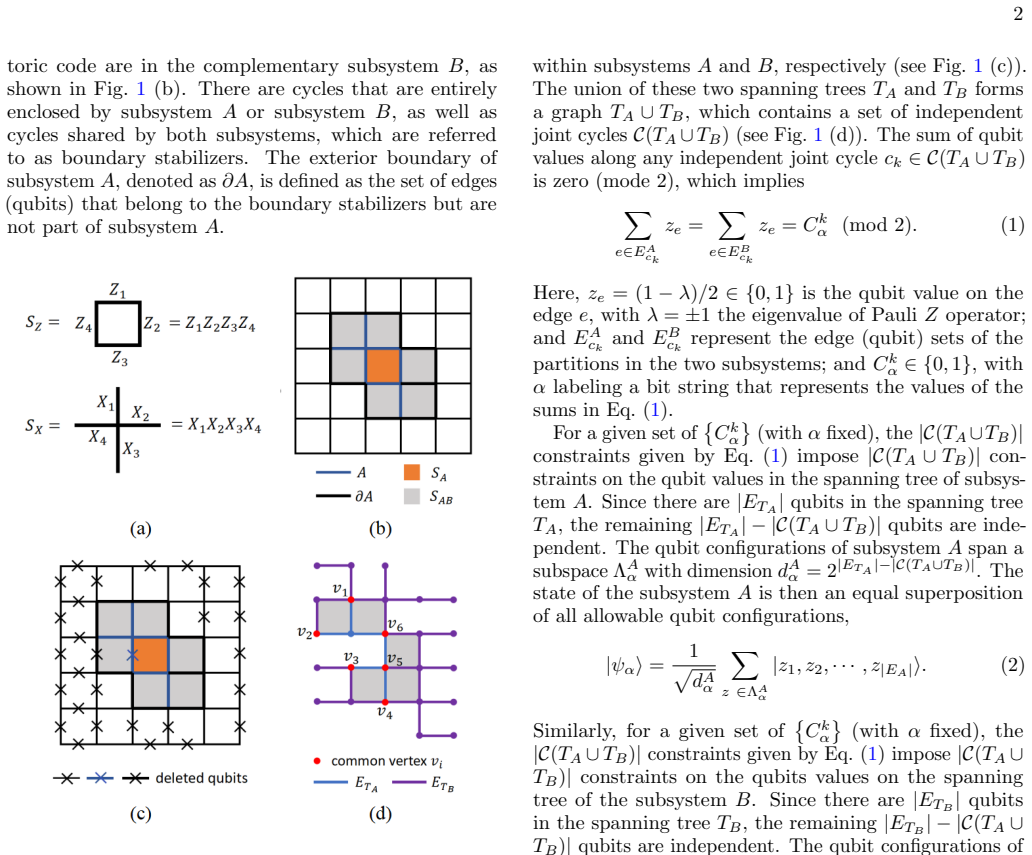
The entanglement entropy equals 5, which is the number of independent joint cycles, as determined by |CTA∪TB| or computed via Eq. (5). ... SA = |C(TA ∪ TB)| = |VA∩B| − K1 − K2 + 1
What do these tags mean?
- matches
- The paper's claim is directly supported by a theorem in the formal canon.
- supports
- The theorem supports part of the paper's argument, but the paper may add assumptions or extra steps.
- extends
- The paper goes beyond the formal theorem; the theorem is a base layer rather than the whole result.
- uses
- The paper appears to rely on the theorem as machinery.
- contradicts
- The paper's claim conflicts with a theorem or certificate in the canon.
- unclear
- Pith found a possible connection, but the passage is too broad, indirect, or ambiguous to say the theorem truly supports the claim.
Forward citations
Cited by 1 Pith paper
-
Hyper-optimized Quantum Lego Contraction Schedules
A new Sparse Stabilizer Tensor cost function enables hyper-optimized contraction schedules for Quantum LEGO WEP calculations, delivering orders-of-magnitude improvements over dense tensor baselines for stabilizer codes.
Reference graph
Works this paper leans on
-
[1]
A. Kitaev and J. Preskill, Phys. Rev. Lett.96, 110404 (2006), URL https://link.aps.org/doi/10. 1103/PhysRevLett.96.110404
work page 2006
-
[2]
M. Levin and X.-G. Wen, Phys. Rev. Lett.96, 110405 (2006), URL https://link.aps.org/doi/10. 1103/PhysRevLett.96.110405
work page 2006
-
[3]
J. Eisert, M. Cramer, and M. B. Plenio, Rev. Mod. Phys.82, 277 (2010), URL https://link.aps.org/doi/ 10.1103/RevModPhys.82.277
-
[4]
S. W. Hawking, Phys. Rev. D14, 2460 (1976), URL 6 https://link.aps.org/doi/10.1103/PhysRevD.14. 2460
-
[5]
D. N. Page, Phys. Rev. Lett.71, 3743 (1993), URL https: //link.aps.org/doi/10.1103/PhysRevLett.71.3743
-
[6]
P. Hayden and J. Preskill, Journal of High Energy Physics 2007, 120 (2007), URL https://dx.doi.org/10.1088/ 1126-6708/2007/09/120
work page 2007
-
[7]
A. Almheiri, X. Dong, and D. Harlow, Journal of High Energy Physics2015, 1 (2015)
work page 2015
-
[8]
F. Pastawski, B. Yoshida, D. Harlow, and J. Preskill, Journal of High Energy Physics2015, 1 (2015)
work page 2015
-
[9]
F. Ares, S. Murciano, and P. Calabrese, Nature Commu- nications14, 2036 (2023)
work page 2036
-
[10]
F. Ares, S. Murciano, L. Piroli, and P. Calabrese, Phys. Rev. D110, L061901 (2024), URL https://link.aps. org/doi/10.1103/PhysRevD.110.L061901
-
[11]
S. Liu, H.-K. Zhang, S. Yin, and S.-X. Zhang, Phys. Rev. Lett.133, 140405 (2024), URL https://link.aps.org/ doi/10.1103/PhysRevLett.133.140405
-
[12]
G. Vidal, J. I. Latorre, E. Rico, and A. Kitaev, Phys. Rev. Lett.90, 227902 (2003), URL https://link.aps.org/ doi/10.1103/PhysRevLett.90.227902
- [13]
-
[14]
P. W. Shor, Phys. Rev. A52, R2493 (1995), URL https: //link.aps.org/doi/10.1103/PhysRevA.52.R2493
-
[15]
E. Knill and R. Laflamme, Phys. Rev. A55, 900 (1997), URL https://link.aps.org/doi/10.1103/ PhysRevA.55.900
work page 1997
-
[16]
C. H. Bennett, D. P. DiVincenzo, J. A. Smolin, and W. K. Wootters, Phys. Rev. A54, 3824 (1996), URL https: //link.aps.org/doi/10.1103/PhysRevA.54.3824
-
[17]
S. Bravyi, D. Lee, Z. Li, and B. Yoshida, Phys. Rev. Lett. 134, 210602 (2025), URL https://link.aps.org/doi/ 10.1103/PhysRevLett.134.210602
-
[18]
Z. Li, D. Lee, and B. Yoshida, Phys. Rev. X15, 021090 (2025), URL https://link.aps.org/doi/10. 1103/pw12-kdjx
work page 2025
-
[19]
Entanglement in the stabilizer formalism
D. Fattal, T. S. Cubitt, Y. Yamamoto, S. Bravyi, and I. L. Chuang, arXiv preprint quant-ph/0406168 (2004)
work page internal anchor Pith review Pith/arXiv arXiv 2004
- [20]
- [21]
-
[22]
S. T. Flammia, A. Hamma, T. L. Hughes, and X.-G. Wen, Phys. Rev. Lett.103, 261601 (2009), URL https://link. aps.org/doi/10.1103/PhysRevLett.103.261601
-
[23]
M. Kargarian, Phys. Rev. A78, 062312 (2008), URL https://link.aps.org/doi/10.1103/PhysRevA.78. 062312
-
[24]
A. Nahum, J. Ruhman, S. Vijay, and J. Haah, Phys. Rev. X7, 031016 (2017), URL https://link.aps.org/doi/ 10.1103/PhysRevX.7.031016
-
[25]
Y. Li, X. Chen, and M. P. A. Fisher, Phys. Rev. B 100, 134306 (2019), URL https://link.aps.org/doi/ 10.1103/PhysRevB.100.134306
-
[26]
Ebisu, arXiv preprint arXiv:2302.11468 (2023)
H. Ebisu, arXiv preprint arXiv:2302.11468 (2023)
-
[27]
J.-P. Tillich and G. Z´ emor, IEEE Transactions on Infor- mation Theory60, 1193 (2013)
work page 2013
-
[28]
A. A. Kovalev and L. P. Pryadko, Phys. Rev. A 88, 012311 (2013), URL https://link.aps.org/doi/10. 1103/PhysRevA.88.012311
work page 2013
-
[29]
N. P. Breuckmann and B. M. Terhal, IEEE Transactions on Information Theory62, 3731 (2016)
work page 2016
- [30]
-
[31]
N. P. Breuckmann and J. N. Eberhardt, IEEE Transac- tions on Information Theory67, 6653 (2021)
work page 2021
-
[32]
P. Panteleev and G. Kalachev, inProceedings of the 54th Annual ACM SIGACT Symposium on Theory of Comput- ing(2022), pp. 375–388
work page 2022
-
[33]
A. Leverrier and G. Z´ emor, in2022 IEEE 63rd Annual Symposium on Foundations of Computer Science (FOCS) (IEEE, 2022), pp. 872–883
work page 2022
-
[34]
O. Higgott and N. P. Breuckmann, arXiv preprint arXiv:2308.03750 (2023)
-
[35]
R. Wang, H.-K. Lin, and L. P. Pryadko, in2023 12th International Symposium on Topics in Coding (ISTC) (IEEE, 2023), pp. 1–5
work page 2023
- [36]
-
[37]
N. P. Breuckmann and J. N. Eberhardt, PRX Quantum 2, 040101 (2021), URL https://link.aps.org/doi/10. 1103/PRXQuantum.2.040101
work page 2021
- [38]
-
[39]
M. Hagiwara and H. Imai, in2007 IEEE international symposium on information theory(IEEE, 2007), pp. 806– 810
work page 2007
-
[40]
Diestel,Graph theory(Springer (print edition); Rein- hard Diestel (eBooks), 2024)
R. Diestel,Graph theory(Springer (print edition); Rein- hard Diestel (eBooks), 2024)
work page 2024
-
[41]
see Supplementary Materials (2025)
work page 2025
-
[42]
A. Y. Kitaev, Annals of physics303, 2 (2003)
work page 2003
-
[43]
A. R. Calderbank and P. W. Shor, Phys. Rev. A54, 1098 (1996), URL https://link.aps.org/doi/10.1103/ PhysRevA.54.1098
work page 1996
-
[44]
Steane, Proceedings of the Royal Society of London
A. Steane, Proceedings of the Royal Society of London. Se- ries A: Mathematical, Physical and Engineering Sciences 452, 2551 (1996)
work page 1996
-
[45]
M. M. Wilde, Phys. Rev. A79, 062322 (2009), URL https://link.aps.org/doi/10.1103/PhysRevA.79. 062322
-
[46]
M. A. Nielsen and I. L. Chuang,Quantum computation and quantum information(Cambridge university press, 2010). Appendix A: Edge space, cycle space and symmetric difference One can extract a vector space from a graph. The process involves extracting the edge set from a graph, which subsequently allows for the construction of a corresponding vector space bas...
work page 2010
-
[47]
of two binary vectors of its row space. All the stabilizers are generated by multiplying several stabilizer generators in the parity check matrix. Therefore, we can regard all independent generators as a basis of a cycle space. Each stabilizer corresponds to a cycle in the cycle space and the qubits associated with the stabilizers can be regarded as the e...
-
[48]
The boundary of subsystem A contains only one cycle
One qubit Suppose that subsystem A contains a single qubit, which participates in two Z-type stabilizer generators. The boundary of subsystem A contains only one cycle. After deleting a qubit from the boundary to remove the cycle, the qubit in subsystem A and the spanning tree of subsystem B form one joint cycle. Therefore, the entanglement entropy is 1
-
[49]
Two qubits Suppose that subsystem A contains two qubits. These two qubits belong to either a single Z-type stabilizer generator, or two distinct Z-type stabilizer generators. In the former case, subsystem A and its boundary form 3 stabilizer generators, and the boundary contains one cycle. Therefore, the entanglement entropy is 2. In the latter case, subs...
-
[50]
The qubit chain Consider a d×d square lattice and a non-contractible qubit chain in the torus, as shown by the red edges in Fig. 5 (a). The spanning tree of subsystem A and that of subsystem B form a joint cycle space with dimension d− 1. Therefore, 10 the entanglement entropy for the non-contractible qubit chain isd−1
-
[51]
The vertical qubit ladder Suppose that the qubits in subsystem A form a vertical ladder, as shown by the red edges in Fig. 5 (b). The qubits in the vertical ladder are disconnected, forming multiple spanning trees, which is known as the spanning forest. The spanning forest of subsystem A and the spanning tree of subsystem B form d parallel non-contractibl...
-
[52]
The cross The qubits in subsystem A form a cross, as shown by the red edges in Fig. 5 (c). The spanning forest of subsystem A and the spanning tree of subsystem B form a joint cycle space. A basis of the joint cycle space consists of d− 1 contractible cycles, represented by a pink face and orange faces, along with d non-contractible cycles.The cyclomatic ...
-
[53]
All vertical qubits The subsystem A contains all vertical qubits in the torus, as shown by the red edges in Fig. 5 (d). By removing all the vertical edges in the first row, one can obtain the spanning forest of A. Similarly, the spanning forest of B can be obtained by removing all horizontal edges from the first column. The spanning forest of A and that o...
-
[54]
If the generatorg 1 commutes with all other generators, set it aside in a “set of processed operators”
-
[55]
If the generatorg 1 anti-commutes with another generatorg j, modify the remaining generators as follows: ∀i∈ {2,· · ·, m}, i̸=j gi → gi,[g i, g1 ] = 0,[g i, gj ] = 0; gi,{g i, g1}= 0,{g i, gj}= 0; gig1,[g i, g1 ] = 0,{g i, gj}= 0; gigj,{g i, g1}= 0,[g i, gj ] = 0. After the modification, all other generators commute with both g1 and gj. Then set g...
-
[56]
Execute the above procedure recursively to the remaining generators. For an arbitrary CSS code, we should first compute the generator matrix GZ from the parity check matrix HZ. The procedure can be found in Ref. [ 46]. By applying the algorithm to the generator matrix GZ, where each row represents an independent generator of the code, the output is a new ...
-
[57]
Begin by randomly selecting a stabilizer generator and adding it to a “waiting set”. Initially, subsystem A contains no qubits. 14
-
[58]
For each stabilizer in the “waiting set”, append all qubits that are acted on non-trivially by the stabilizer to subsystem A, then apply the graph-based method to compute the von Neumann entropy of the updated subsystem A. Note that subsystem A progressively expands as the procedure iterates through each stabilizer in the ”waiting set,” gradually incorpor...
-
[59]
If subsystemAis smaller than half of the entire system, expand subsystemAvia step 4
-
[60]
For each qubit in subsystem A, add all stabilizers that acts non-trivially on it to a new set S. If a stabilizer is already present in the old “waiting set”, do not add it again. Finally, set S to the “waiting set”, then repeat steps 2 and 3. By following this procedure, the subsystem expands by adding the qubits that are acted on non-trivially by the adj...
-
[61]
+K=|V A∩B| − X i (K i 1 +K i
-
[62]
+K.(J9) Recognizing that P i K i 1 =K 1 andK i 2 =K 2, we obtain the general expression for the entanglement entropy, SA =|V A∩B| −K 1 −K 2 +K.(J10) This result suggests that the entanglement entropy depends on both the connection strength between subsystems, quantified by |VA∩B|, and the fragmentation within each subsystem, characterized by their respect...
discussion (0)
Sign in with ORCID, Apple, or X to comment. Anyone can read and Pith papers without signing in.