REVIEW 4 major objections 5 minor 2 cited by
AI Drawing Partner: Co-Creative Drawing Agent and Research Platform to Model Co-Creation
T0 review · 4 major / 5 minor · reviewed 2026-08-10 · deepseek-v4-flash
Pith's one-line read This paper claims a drawing agent can collaborate with a user and automatically quantify, model, and visualize the co-creative process, with case-study data validating the measurement framework.
desk verdict A genuinely useful system paper wrapped around a measurement framework whose validation is undercut by its own coding choices. read the letter →
The pith
A machine-rendered reading of the paper's core claim, the machinery that carries it, and where it could break.
The reading
What carries the argument
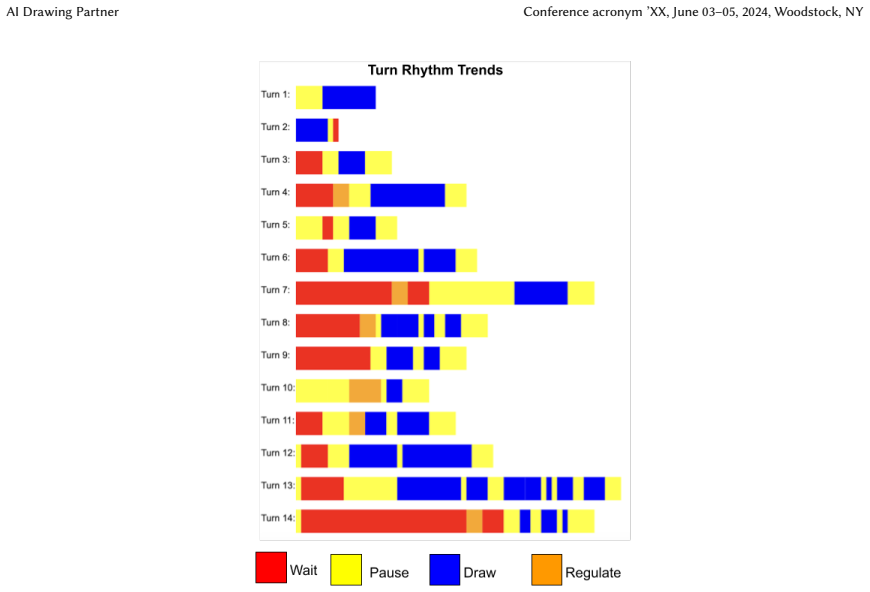
The load-bearing mechanism is the creative sense-making coding convention: four interaction modes mapped to numeric values on a clamped-to-unclamped cognition continuum — communicate to the AI $= 1$, manipulate the interface $= 0.5$, wait $= 0$, execute a drawing action $= -1$. Continuously applied to the interaction log, these codes form a time series whose cumulative sum is the 'creative sense-making curve': rising segments mean the partner is regulating the interaction, falling segments mean fluid execution, and flat segments mean waiting. Linear regression on the curve yields its slope, and a moving-average convergence-divergence (MACD) analysis with exponential moving averages classifies each time step as regulate (buy), execute (sell), or wait (hold), producing the visualized trend sequences. This machinery converts an enactive theory of sense-making into a dataset the system records automatically — no human video coding, no inter-rater reliability — and every reported statistic, curve, and trend visualization is computed from it.
What would settle it
Record a set of co-creative sessions in which the user's moment-by-moment intentions are captured (e.g., by retrospective protocol analysis or think-aloud) and compare them against the automatically coded curve: if reported 'reflecting on the artwork' moments produce the same curve pattern as moments of merely waiting for the agent to finish, the cognitive interpretation of the wait category is falsified; if the coded phases instead align with reported intentions across many users, the framework's validity is supported.
Extended reading notes
Core claim
The paper's central discovery is that a co-creative system can be both the collaborator and the measurement instrument: the AI Drawing Partner draws with the user and, in the same run, emits a complete quantitative record of the co-creative process. The record is generated by the co-creative sense-making framework, which draws on enactive cognitive science to define four data categories — cognitive dynamics, interaction dynamics, collaboration dynamics, and domain behaviors — and continuously codes user actions onto a continuum from clamped cognition (fluently executing, $-1$) to unclamped cognition (communicating, $1$). From this coded time series the system builds the creative sense-making curve, applies a linear regression for its slope, and uses stock-market-style moving-average analysis to label each time step as regulate, execute, or wait. In the demonstrative case study, the user's execute codes ($p=.039$), communication ($p=.003$), interface manipulation ($p=.009$), average coded value ($p=.0003$), CSM-curve slope ($p=.002$), lines drawn ($p=.005$), and turns ($p=.0001$) all differed significantly between five abstract and five representational sessions. The authors take these differences as validating CCSM: a quantitative method that coincides with the qualitative difference between the two creative strategies.
Load-bearing premise
Everything measured rests on the coding assumption that drawing equals clamped cognition ($-1$), waiting equals $0$, interface manipulation equals $0.5$, and communication equals unclamped cognition ($1$) — a mapping the paper itself admits has arbitrary polar values, so if these numbers do not track genuine sense-making, the curves, slopes, trend classifications, and all the significant differences in Section 7 are artifacts of the coding choice rather than measurements of co-creation.
Editorial extensions
If this is right
- If CCSM is valid, any co-creative system that adopts the coding schema produces interaction data comparable to any other, enabling within-domain and cross-domain comparison of co-creative experiences.
- Automatic coding removes human coders from the loop, eliminating inter-rater reliability checks and reducing bias and error in the analysis of co-creative interaction.
- The trend-sequence visualization splits a session into regulate, execute, and wait phases, allowing researchers to study co-creation in segments rather than as a single aggregate score.
- Because the platform is public and the analysis pipeline is automated, the AI Drawing Partner can serve as an off-the-shelf experimental platform for studying human-AI drawing without building a new system.
- Future work (per the paper) suggests the CSM curve can become a real-time model of user intent, letting the agent adapt its contributions to detected phases of ideation or refinement.
Reading between the lines
- The coding scale's numerical spacing — $1$, $0.5$, $0$, $-1$ — is treated as interval data, yet the paper concedes the poles are arbitrary; a different monotone encoding would preserve the sign of slopes but could change which group comparisons reach significance, so cross-study comparability rests on the whole community adopting the identical convention.
- The 'wait' code conflates at least three distinct experiences — user reflection, user waiting for the agent, and user watching the agent draw — and the paper itself flags the first two; separating them in the coding scheme would plausibly change flat segments of the CSM curve and therefore some trend classifications.
- The case study's single user was the system's designer and thus already fluent with the interface, so the large effect sizes may overstate what naive users would show; a larger study with naive participants would test whether the significant differences replicate.
- The framework invites a direct validity check the paper does not perform: pair each automatically detected trend phase with a retrospective protocol label of the user's intention, and test whether the curve's 'regulate' phases coincide with reported moments of reflection or evaluation.
Signed reviews
Editorial analysis
A structured set of objections, weighed in public.
Referee Report
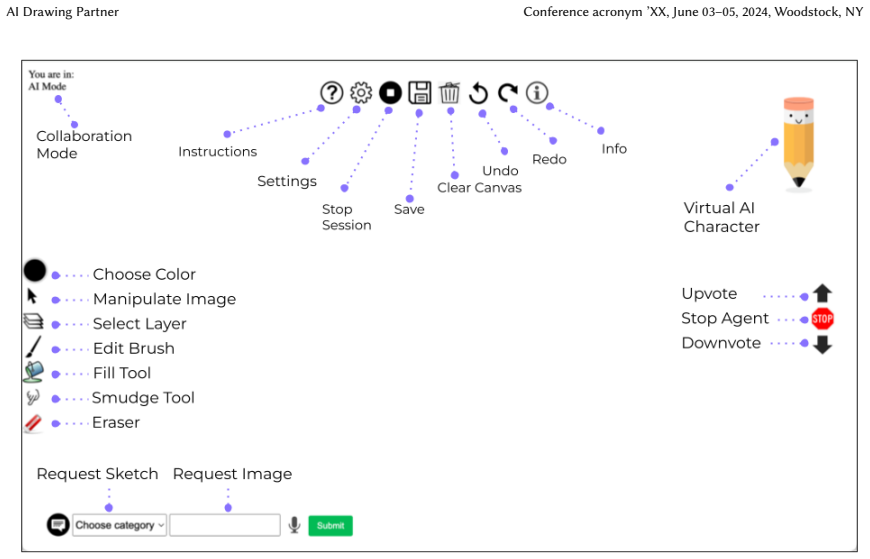
Summary. The paper presents the AI Drawing Partner, a web-based co-creative drawing agent that also logs user and agent interactions according to the Co-Creative Sense-Making (CCSM) framework. The CCSM maps interaction modes to cognitive states (clamped/unclamped cognition) and assigns numeric codes (communicate=1, manipulate interface=0.5, wait=0, execute=-1). The system records raw interaction counts and computes cumulative sums to form creative sense-making (CSM) curves; slopes and stock-market-style MACD trend classifications are derived from these curves. A case study reports ten five-minute co-creative drawing sessions, five abstract and five representational, all conducted by the first author, who also designed the system. The paper finds significant between-group differences in average coded value, CSM slope, interaction counts, and other metrics, and interprets these as helping to validate CCSM. The primary claimed contribution is the AI Drawing Partner as a unique quantified co-creative AI system and research platform.
Significance. If the validation claims were supported, the paper would provide a useful open platform for studying co-creation and a domain-independent framework for quantifying interaction dynamics. The system is publicly accessible, automatically logs interaction data, and the companion analysis pipeline is a concrete step toward reproducible process-level analysis of human-AI co-creation. The adoption of the COFI framework to situate the system and the detailed system architecture are informative. However, the central evidential claim—that the case study validates CCSM by showing significant differences between abstract and representational sessions—is not supported by the data as analyzed. The numerical coding convention that drives every reported statistic is acknowledged in the paper to be arbitrary, and all sessions come from a single participant who is also the system designer. The paper is better characterized as a systems and demonstration contribution than as a validation of the CCSM framework.
major comments (4)
- The coding values in Table 2 are the foundation of every quantitative result in Section 7. The paper states that 'the polar values of the continuum are arbitrary' and offers no theoretical or empirical justification for the spacing among communicate=1, manipulate=0.5, wait=0, and execute=-1. The average coded value, CSM slope, and MACD trend classifications are all monotone functions of these weights. The significant differences reported in Section 7 (e.g., p=.0003 for average coded value, p=.002 for slope) therefore largely reflect the fact that abstract sessions contain more drawing (coded -1) and representational sessions contain more communication (coded +1), which is a property of the chosen coding scheme rather than an independent measurement of cognitive dynamics. I request a robustness analysis using alternative monotone codings (e.g., execute=-2, wait=-0.5, manipulate=0.5, communicate=1) or a non-parametric analysis based on raw interaction-mode counts, or a substantial weakening of the validation claim in the abstract and conclusions.
- All ten sessions were conducted by the first author, who designed the AI Drawing Partner. The paper acknowledges in Section 10 that 'the user was also the designer of the AI Drawing Partner, and he was thoroughly familiar with the interface,' yet Section 7 treats the ten sessions as independent observations for statistical testing. With a single participant, these sessions are not independent replicates, and the reported p-values (e.g., p=.002 for slope, p=.0001 for turns) cannot support population-level claims about co-creation or about the validity of CCSM. At most, the case study demonstrates that the pipeline can detect differences in the designer's own behavior across two self-selected conditions. I recommend reframing the reported statistics as descriptive, and moving the validation claim to future work with external participants.
- The claim that 'the results help validate the CCSM by showing significant differences' is not justified by the presented evidence. Because the abstract and representational sessions were deliberately chosen by the same individual who designed the system, the observed differences are expected from the experimental setup; the analysis then interprets those differences through the same coding convention that produced them. This creates a circularity concern that is not addressed by the paper. I suggest that the paper either (a) present the case study strictly as an illustrative demonstration of the analytics pipeline, with the validation claim removed, or (b) add a validation study with independent participants, pre-registered hypotheses, and robustness checks on the coding scheme.
- The MACD trend analysis uses parameters (12-period EMA, 26-period EMA, 9-period signal) that are standard for financial data but are not justified for the interaction data sampled at 0.5-second intervals. Since the entire trend-classification visualization in Figure 9 depends on these periods, the paper should include a sensitivity analysis or at least a justification for why these specific windows are appropriate for co-creative interaction data. Without this, the trend sequences are one arbitrary choice among many, particularly given that the underlying coding values are already arbitrary.
minor comments (5)
- The word 'Maping' in the section title appears to be a typo; it should read 'Mapping.'
- Reference [25] contains the typo 'Co-Creativve AI' in the title; please correct it.
- The statement that 'Waiting is coded as 0 so waiting and non-action do not influence the direction of the trend' is unclear, since waiting can influence the slope when it appears between other coded events; please clarify whether the coding is applied per time step or per interaction event.
- The sentence 'A line is calculated as the content between a pen down event and when the user raises their pen' defines a line as a stroke, but elsewhere the paper also refers to 'lines' as discrete algorithmic outputs; please make the terminology consistent.
- The phrase 'the agent is actively engaged in sense-making' in the context of wait time seems to describe the user's cognitive state rather than the agent's; please revise for clarity.
Circularity Check
CCSM 'validation' reduces to the Table 2 coding convention: the CSM curve, slope, and average coded value are all weighted sums of the same interaction codes, so the abstract-vs-representational differences are built in by definition.
-
self definitional
[Section 3.2, Table 2; Section 7.1]
"These interaction modes are given a value (communicate = 1; manipulate interface = .5; wait = 0; execute = -1) and continuously coded through time. ... The coded values produce two kinds of data: the raw interaction mode count, and the cumulative sum of the raw interaction mode count, which forms the creative sense-making curve. ... When the curve is trending downward, that means the user is drawing."
The creative sense-making curve is defined as the cumulative sum of the Table 2 codes, so its slope is by construction a weighted count of execute (-1) versus communicate (+1) events. The paper reads a downward slope as 'the user is drawing' and an upward slope as 'regulating,' but these semantics are assigned in the coding table, not measured. Any session that is mostly drawing mechanically produces a negative slope, and any session that is mostly communicating produces a positive slope. The paper concedes that 'the polar values of the continuum are arbitrary,' which means the curve's direction and magnitude are conventions rather than independent measurements of sense-making.
-
fitted input called prediction
[Section 6 (Hypothesis 2) and Section 7 (Results)]
"Hypothesis 2: There will be more drawing actions and a greater quantity of lines produced in the abstract group due to lack of communication ... leading to a decreased slope in the CSM curve and a lower average coded value. ... The average coded value ... is significantly different between the two groups (p=.0003). The abstract group had a mean of -.18, and the representational group had a mean of .22, demonstrating more fluid execution of drawing in the abstract versus more regulating the interaction in the representational sessions."
The hypothesis is directly implied by the coding convention: since drawing is coded -1 and communication is coded +1, any group that draws more and communicates less will have a lower average coded value and a more negative cumulative slope. The reported p-values therefore do not test a theory of creative sense-making; they restate the known behavioral difference that the abstract sessions were mostly sketching while the representational sessions were dominated by image and sketch requests. The 'prediction' is forced by the Table 2 weights, so confirming it cannot independently validate CCSM.
1 more flagged steps
-
renaming known result
[Abstract and Section 8 Discussion]
"The results help validate the CCSM by showing significant differences in the interaction dynamics and collaboration dynamics between abstract and representational sessions that match the qualitative difference of the user's interactions with the system."
The qualitative difference to be matched is the same behavior that was coded: more drawing in the abstract sessions and more communication and interface manipulation in the representational sessions. Reporting that the coded values differ between the groups is a rename of the raw interaction counts into 'interaction dynamics and collaboration dynamics.' Because the categories are defined by the very codes that produce the significant results, the match is guaranteed by construction; no independent ground truth about sense-making is used to validate the framework.
full rationale
The engineering contribution of the paper is not circular: the AI Drawing Partner is a real system that automatically logs raw interaction counts, and those logs are genuinely new functionality. However, the paper's derived scientific output, the quantification and case-study validation of CCSM, reduces to the coding convention in Table 2. The CSM curve is defined as the cumulative sum of the Table 2 codes; the average coded value is a weighted average of the same codes; and the MACD trend classifications operate on that same curve. Since the paper explicitly states that 'the polar values of the continuum are arbitrary' and provides no external construct validation, the significant differences reported in Section 7 are consequences of the chosen weights and the known task instructions, not evidence that the framework measures sense-making. The case study also uses the first author as the participant, which is not itself circularity but reinforces that the 'validation' is self-referential. The result that abstract sessions have negative slopes and representational sessions have positive slopes is forced by defining execute as -1 and communicate as +1. I therefore assign a score of 8: the central validation claim reduces by definition, even though the system's logging architecture and software design remain non-circular contributions.
Assumptions & free parameters
free parameters (3)
- Interaction mode coding values =
communicate = 1, manipulate = 0.5, wait = 0, execute = -1
- MACD trend analysis periods =
12, 26, and 9 periods; 0.5 second steps
- Sketch recognition confidence threshold =
30%
assumptions (3)
- domain assumption Enaction and participatory sense-making provide a valid theoretical foundation for describing human-AI co-creation.
- ad hoc to paper The four interaction modes (execute, manipulate interface, communicate, wait) exhaustively describe user behavior in co-creative drawing and map linearly to clamped/unclamped cognition.
- ad hoc to paper The CCSM's four categories (cognitive, interaction, collaboration, domain) are sufficient to model co-creation.
Cite this review
Pith. "Pith review of AI Drawing Partner: Co-Creative Drawing Agent and Research Platform to Model Co-Creation." pith.science (2026). https://pith.science/paper/ONXDQVWJ
@misc{pith2026250106607,
  author       = {Pith},
  title        = {Pith review of: AI Drawing Partner: Co-Creative Drawing Agent and Research Platform to Model Co-Creation},
  year         = {2026},
  howpublished = {\url{https://pith.science/paper/ONXDQVWJ}},
  note         = {Machine review of arXiv:2501.06607}
}
read the original abstract
This paper describes the AI Drawing Partner, which is a co-creative drawing agent that also serves as a research platform to model co-creation. The AI Drawing Partner is an early example of a quantified co-creative AI system that automatically models the co-creation that happens on the system. The method the system uses to capture this data is based on a new cognitive science framework called co-creative sense-making (CCSM). The CCSM is based on the cognitive theory of enaction, which describes how meaning emerges through interaction with the environment and other people in that environment in a process of sense-making. The CCSM quantifies elements of interaction dynamics to identify sense-making patterns and interaction trends. This paper describes a new technique for modeling the interaction and collaboration dynamics of co-creative AI systems with the co-creative sense-making (CCSM) framework. A case study is conducted of ten co-creative drawing sessions between a human user and the co-creative agent. The analysis includes showing the artworks produced, the quantified data from the AI Drawing Partner, the curves describing interaction dynamics, and a visualization of interaction trend sequences. The primary contribution of this paper is presenting the AI Drawing Partner, which is a unique co-creative AI system and research platform that collaborates with the user in addition to quantifying, modeling, and visualizing the co-creative process using the CCSM framework.
Figures


Figures from the paper (9 more)




Forward citations
Cited by 2 Pith papers
-
Who Decides How Knowing Becomes Doing? Redistributing Authority in Human-AI Music Co-Creation
Editing an AI's reasoning steps instead of only typing prompts made 180 musicians report more contestability, agency, and protection of non-mainstream styles, though the survey evidence lacks statistical analysis.
-
SakugaFlow: A Stagewise Illustration Framework Emulating the Human Drawing Process and Providing Interactive Tutoring for Novice Drawing Skills
A four-stage AI illustration pipeline with a large-language-model tutor aims to scaffold novice drawing skill acquisition by exposing intermediate diffusion outputs.
Reference graph
Works this paper leans on
-
[1]
2024. chatGPT. https://chat.openai.com Accessed on March 20, 2024
2024
-
[2]
Friendly Machine Learning for the Web
2024. Friendly Machine Learning for the Web. https://ml5js.org Accessed on April 28, 2024
2024
-
[3]
Github Copilot
2024. Github Copilot. https://github.com/features/copilot Accessed on March 20, 2024
2024
-
[4]
Google Gemini
2024. Google Gemini. https://gemini.google.com/app Accessed on March 20, 2024
2024
-
[5]
Imagine with Meta AI
2024. Imagine with Meta AI. https://imagine.meta.com Accessed on March 20, 2024
2024
-
[6]
2024. OpenAI. https://openai.com Accessed on March 20, 2024
2024
-
[7]
Quick, Draw! The Data
2024. Quick, Draw! The Data. https://quickdraw.withgoogle.com/data Accessed on April 27, 2024
2024
-
[8]
Sarah Abdellahi, Mary Lou Maher, and Safat Siddiqui. 2020. Arny: A Co-Creative System Design based on Emotional Feedback.. In ICCC. 81–84
2020
Show all 109 references
-
[9]
Helmut Alt and Michael Godau. 1995. Computing the Fréchet distance between two polygonal curves. International Journal of Computational Geometry & Applications 5, 01n02 (1995), 75–91
1995
-
[10]
Bonnie B Armbruster. 1989. Metacognition in creativity. In Handbook of creativity. Springer, 177–182. 29 Conference acronym ’XX, June 03–05, 2024, Woodstock, NY Short authors
1989
-
[11]
Malika Auvray and Marieke Rohde. 2012. Perceptual crossing: the simplest online paradigm. Frontiers in human neuroscience 6 (2012), 181
2012
-
[12]
Donna J Betts. 2006. Art therapy assessments and rating instruments: Do they measure up? The Arts in psychotherapy 33, 5 (2006), 422–434
2006
-
[13]
John A Biles. 2002. GenJam: Evolution of a jazz improviser. In Creative evolutionary systems. Elsevier, 165–187
2002
-
[14]
Volker Bilgram and Felix Laarmann. 2023. Accelerating innovation with generative AI: AI-augmented digital prototyping and innovation methods. IEEE Engineering Management Review (2023)
2023
-
[15]
John M Carroll. 1997. Human-computer interaction: psychology as a science of design. Annual review of psychology 48, 1 (1997), 61–83
1997
-
[16]
Xiang’Anthony’ Chen, Jeff Burke, Ruofei Du, Matthew K Hong, Jennifer Jacobs, Philippe Laban, Dingzeyu Li, Nanyun Peng, Karl DD Willis, Chien-Sheng Wu, et al. 2023. Next steps for human-centered generative AI: A technical perspective. arXiv preprint arXiv:2306.15774 (2023)
2023 arXiv
-
[17]
Andy Clark. 1999. An embodied cognitive science? Trends in cognitive sciences 3, 9 (1999), 345–351
1999
-
[18]
Simon Colton. 2008. Creativity Versus the Perception of Creativity in Computational Systems.. In AAAI spring symposium: creative intelligent systems, Vol. 8. Palo Alto, CA, 7
2008
-
[19]
Simon Colton, John William Charnley, and Alison Pease. 2011. Computational Creativity Theory: The FACE and IDEA Descriptive Models.. In ICCC. Mexico City, 90–95
2011
-
[20]
Simon Colton, Geraint A Wiggins, et al. 2012. Computational creativity: The final frontier?. In Ecai, Vol. 12. Montpelier, 21–26
2012
-
[21]
Mihaly Csikszentmihalyi and Mihaly Csikzentmihaly. 1990. Flow: The psychology of optimal experience . Vol. 1990. Harper & Row New York
1990
-
[22]
Elena Clare Cuffari, Ezequiel Di Paolo, and Hanne De Jaegher. 2015. From participatory sense-making to language: there and back again. Phenomenology and the Cognitive Sciences 14 (2015), 1089–1125
2015
-
[23]
Nicholas Davis. 2013. Human-computer co-creativity: Blending human and computational creativity. In Proceedings of the AAAI Conference on Artificial Intelligence and Interactive Digital Entertainment , Vol. 9. 9–12
2013
-
[24]
Nicholas Davis. 2023. AI Drawing Partner: Co-Creative Drawing Agent and Research Platform. https://drawing-partner.vercel.app Accessed on March 19, 2024
2023
-
[25]
Nicholas Davis. 2024. Creative Sense-Making: Quantifying the Interaction Dynamics of Co-Creativve AI. To appear in eds. Tigre-Moura, F., AI, Co-Creativity, and Creativity (2024)
2024
-
[26]
Nicholas Davis, Ellen Yi-Luen Do, Pramod Gupta, and Shruti Gupta. 2011. Computing harmony with PerLogicArt: perceptual logic inspired collaborative art. In Proceedings of the 8th ACM conference on Creativity and cognition . 185–194
2011
-
[27]
N Davis, C Hsiao, Kunwar Yashraj Singh, Brenda Lin, and Brian Magerko. 2017. Quantifying collaboration with a co-creative drawing agent. ACM Transactions on Interactive Intelligent Systems (TiiS) 7, 4 (2017), 1–25
2017
-
[28]
Nicholas Davis, Chih-Pin Hsiao, Yanna Popova, and Brian Magerko. 2015. An enactive model of creativity for computational collaboration and co-creation. Creativity in the digital age (2015), 109–133
2015
-
[29]
Nicholas Davis, Chih-PIn Hsiao, Kunwar Yashraj Singh, Lisa Li, Sanat Moningi, and Brian Magerko. 2015. Drawing apprentice: An enactive co-creative agent for artistic collaboration. In Proceedings of the 2015 ACM SIGCHI Conference on Creativity and Cognition . 185–186
2015
-
[30]
Nicholas Davis, Chih-Pin Hsiao, Kunwar Yashraj Singh, Brenda Lin, and Brian Magerko. 2017. Creative sense-making: Quantifying interaction dynamics in co-creation. In Proceedings of the 2017 ACM SIGCHI Conference on Creativity and Cognition . 356–366
2017
-
[31]
Nicholas Davis, Chih-Pin Hsiao, Kunwar Yashraj Singh, and Brian Magerko. 2016. Co-creative drawing agent with object recognition. InProceedings of the AAAI Conference on Artificial Intelligence and Interactive Digital Entertainment , Vol. 12. 9–15
2016
-
[32]
Nicholas Davis, Chih-PIn Hsiao, Kunwar Yashraj Singh, Lisa Li, and Brian Magerko. 2016. Empirically studying participatory sense-making in abstract drawing with a co-creative cognitive agent. In Proceedings of the 21st International Conference on Intelligent User Interfaces . 196–207
2016
-
[33]
Hanne De Jaegher and Ezequiel Di Paolo. 2007. Participatory sense-making: An enactive approach to social cognition. Phenomenology and the cognitive sciences 6 (2007), 485–507
2007
-
[34]
Jan Degenaar and J Kevin O’regan. 2017. Sensorimotor theory and enactivism. Topoi 36 (2017), 393–407
2017
-
[35]
Manoj Deshpande and Brian Magerko. 2021. Drawcto: A Multi-Agent Co-Creative AI for Collaborative Non-Representational Art.. In AIIDE Workshops
2021
-
[36]
Manoj Deshpande, Milka Trajkova, Andrea Knowlton, and Brian Magerko. 2023. Observable Creative Sense-Making (OCSM): A Method For Quantifying Improvisational Co-Creative Interaction. In Proceedings of the 15th Conference on Creativity and Cognition . 103–115
2023
-
[37]
Sebastian Deterding, Jonathan Hook, Rebecca Fiebrink, Marco Gillies, Jeremy Gow, Memo Akten, Gillian Smith, Antonios Liapis, and Kate Compton
-
[38]
Ezequiel Di Paolo, Thomas Buhrmann, and Xabier Barandiaran. 2017. Sensorimotor life: An enactive proposal . Oxford University Press
2017
-
[39]
Ezequiel A Di Paolo, Marieke Rohde, and Hanne De Jaegher. 2010. Horizons for the enactive mind: Values, social interaction, and play. (2010)
2010
-
[40]
John J Dudley and Per Ola Kristensson. 2018. A review of user interface design for interactive machine learning. ACM Transactions on Interactive Intelligent Systems (TiiS) 8, 2 (2018), 1–37
2018
-
[41]
Upol Ehsan, Philipp Wintersberger, Q Vera Liao, Elizabeth Anne Watkins, Carina Manger, Hal Daumé III, Andreas Riener, and Mark O Riedl. 2022. Human-Centered Explainable AI (HCXAI): beyond opening the black-box of AI. In CHI conference on human factors in computing systems exte...
2022
-
[42]
Jerry Alan Fails and Dan R Olsen Jr. 2003. Interactive machine learning. InProceedings of the 8th international conference on Intelligent user interfaces . 39–45. 30 AI Drawing Partner Conference acronym ’XX, June 03–05, 2024, Woodstock, NY
2003
-
[43]
Judith E Fan, Monica Dinculescu, and David Ha. 2019. Collabdraw: an environment for collaborative sketching with an artificial agent. InProceedings of the 2019 Conference on Creativity and Cognition . 556–561
2019
-
[44]
Thomas Fuchs and Hanne De Jaegher. 2009. Enactive intersubjectivity: Participatory sense-making and mutual incorporation. Phenomenology and the cognitive sciences 8 (2009), 465–486
2009
-
[45]
Daniel Fuller and Brian Magerko. 2011. Shared mental models in improvisational theatre. In Proceedings of the 8th ACM conference on Creativity and cognition. 269–278
2011
-
[46]
Linda Gantt and Carmello Tabone. 1998. The formal elements art therapy scale: The rating manual . Gargoyle Press Morgantown, WV
1998
-
[47]
Matthew Guzdial, Nicholas Liao, and Mark Riedl. 2018. Co-creative level design via machine learning. arXiv preprint arXiv:1809.09420 (2018)
2018 arXiv
-
[48]
Matthew Guzdial and Mark Riedl. 2019. An interaction framework for studying co-creative ai. arXiv preprint arXiv:1903.09709 (2019)
2019 arXiv
-
[49]
David Ha and Douglas Eck. 2017. A neural representation of sketch drawings. arXiv preprint arXiv:1704.03477 (2017)
2017 arXiv
-
[50]
Mika Hämäläinen. 2018. Poem machine-a co-creative nlg web application for poem writing. In Proceedings of the 11th International Conference on Natural Language Generation. 195–196
2018
-
[51]
James Hollan, Edwin Hutchins, and David Kirsh. 2000. Distributed cognition: toward a new foundation for human-computer interaction research. ACM Transactions on Computer-Human Interaction (TOCHI) 7, 2 (2000), 174–196
2000
-
[52]
Cheng-Zhi Anna Huang, Hendrik Vincent Koops, Ed Newton-Rex, Monica Dinculescu, and Carrie J Cai. 2020. AI song contest: Human-AI co-creation in songwriting. arXiv preprint arXiv:2010.05388 (2020)
2020 arXiv
-
[53]
Edwin Hutchins. 2000. Distributed cognition. International encyclopedia of the social and behavioral sciences 138, 1 (2000), 1–10
2000
-
[54]
Francisco Ibarrola, Tomas Lawton, and Kazjon Grace. 2023. A collaborative, interactive and context-aware drawing agent for co-creative design. IEEE Transactions on Visualization and Computer Graphics (2023)
2023
-
[55]
Takashi Ikegami and Hiroyuki Iizuka. 2007. Turn-taking interaction as a cooperative and co-creative process. Infant Behavior and Development 30, 2 (2007), 278–288
2007
-
[56]
Nanna Inie, Jeanette Falk, and Steve Tanimoto. 2023. Designing Participatory AI: Creative Professionals’ Worries and Expectations about Generative AI. In Extended Abstracts of the 2023 CHI Conference on Human Factors in Computing Systems (, Hamburg, Germany,) (CHI EA ’23). Ass...
2023
-
[57]
Chipp Jansen and Elizabeth Sklar. 2021. Predicting Artist Drawing Activity via Multi-camera Inputs for Co-creative Drawing. In Annual Conference Towards Autonomous Robotic Systems. Springer, 217–227
2021
-
[58]
Anna Jordanous. 2016. Four PPPPerspectives on computational creativity in theory and in practice. Connection Science 28, 2 (2016), 194–216
2016
-
[59]
Anna Kantosalo, Prashanth Thattai Ravikumar, Kazjon Grace, and Tapio Takala. 2020. Modalities, Styles and Strategies: An Interaction Framework for Human-Computer Co-Creativity.. In ICCC. 57–64
2020
-
[60]
Anna Kantosalo and Sirpa Riihiaho. 2019. Usability testing and feedback collection in a school context: Case poetry machine. Ergonomics in Design 27, 3 (2019), 17–23
2019
-
[61]
Anna Kantosalo, Jukka M Toivanen, Hannu Toivonen, et al. 2015. Interaction Evaluation for Human-Computer Co-creativity: A Case Study.. In ICCC. 276–283
2015
-
[62]
Pegah Karimi, Kazjon Grace, Mary Lou Maher, and Nicholas Davis. 2018. Evaluating creativity in computational co-creative systems. arXiv preprint arXiv:1807.09886 (2018)
2018 arXiv
-
[63]
Pegah Karimi, Mary Lou Maher, Nicholas Davis, and Kazjon Grace. 2019. Deep learning in a computational model for conceptual shifts in a co-creative design system. arXiv preprint arXiv:1906.10188 (2019)
2019 arXiv
-
[64]
Pegah Karimi, Jeba Rezwana, Safat Siddiqui, Mary Lou Maher, and Nasrin Dehbozorgi. 2020. Creative sketching partner: an analysis of human-AI co-creativity. In Proceedings of the 25th international conference on intelligent user interfaces . 221–230
2020
-
[65]
James C Kaufman and Ronald A Beghetto. 2009. Beyond big and little: The four c model of creativity. Review of general psychology 13, 1 (2009), 1–12
2009
-
[66]
Jody Koenig Kellas and April R Trees. 2014. Rating interactional sense-making in the process of joint storytelling. In The Sourcebook of Nonverbal Measures. Psychology Press, 281–294
2014
-
[67]
Jingoog Kim and Mary Lou Maher. 2021. Evaluating the Effect of Co-Creative Systems on Design Ideation.. In ICCC. 440–443
2021
-
[68]
Tomas Lawton, Kazjon Grace, and Francisco J Ibarrola. 2023. When is a tool a tool? user perceptions of system agency in human–ai co-creative drawing. In Proceedings of the 2023 ACM Designing Interactive Systems Conference . 1978–1996
2023
-
[69]
Tomas Lawton, Francisco J Ibarrola, Dan Ventura, and Kazjon Grace. 2023. Drawing with reframer: Emergence and control in co-creative ai. In Proceedings of the 28th International Conference on Intelligent User Interfaces . 264–277
2023
-
[70]
Izabela Lebuda and Mathias Benedek. 2023. A systematic framework of creative metacognition. Physics of Life Reviews (2023)
2023
-
[71]
Lei Li, Changqing Zou, Youyi Zheng, Qingkun Su, Hongbo Fu, and Chiew-Lan Tai. 2020. Sketch-R2CNN: an RNN-rasterization-CNN architecture for vector sketch recognition. IEEE transactions on visualization and computer graphics 27, 9 (2020), 3745–3754
2020
-
[72]
Yuyu Lin, Jiahao Guo, Yang Chen, Cheng Yao, and Fangtian Ying. 2020. It is your turn: Collaborative ideation with a co-creative robot through sketch. In Proceedings of the 2020 CHI conference on human factors in computing systems . 1–14
2020
-
[73]
Ryan Louie, Andy Coenen, Cheng Zhi Huang, Michael Terry, and Carrie J Cai. 2020. Novice-AI music co-creation via AI-steering tools for deep generative models. In Proceedings of the 2020 CHI conference on human factors in computing systems . 1–13. 31 Conference acronym ’XX, Jun...
2020
-
[74]
Brian Magerko, Christopher DeLeon, and Peter Dohogne. 2011. Digital improvisational theatre: party quirks. In Intelligent Virtual Agents: 10th International Conference, IV A 2011, Reykjavik, Iceland, September 15-17, 2011. Proceedings 11 . Springer, 42–47
2011
-
[75]
Yaoli Mao, Janet Rafner, Yi Wang, and Jacob Sherson. 2023. A hybrid intelligence approach to training generative design assistants: partnership between human experts and AI enhanced co-creative tools. In HHAI 2023: Augmenting Human Intellect . IOS Press, 108–123
2023
-
[76]
Solange Margarido, Penousal Machado, Licínio Roque, and Pedro Martins. 2022. Let’s Make Games Together: Explainability in Mixed-initiative Co-creative Game Design. In 2022 IEEE Conference on Games (CoG) . IEEE, 638–645
2022
-
[77]
Michael Muller and Justin Weisz. 2022. Extending a human-ai collaboration framework with dynamism and sociality. In Proceedings of the 1st Annual Meeting of the Symposium on Human-Computer Interaction for Work . 1–12
2022
-
[78]
Don Norman. 2013. The design of everyday things: Revised and expanded edition . Basic books
2013
-
[79]
Elisabeth Norman, Gerit Pfuhl, Rannveig Grøm Sæle, Frode Svartdal, Torstein Låg, and Tove Irene Dahl. 2019. Metacognition in psychology.Review of General Psychology 23, 4 (2019), 403–424
2019
-
[80]
Alva Noë. 2004. Action in perception. MIT press
2004
-
[81]
Changhoon Oh, Jungwoo Song, Jinhan Choi, Seonghyeon Kim, Sungwoo Lee, and Bongwon Suh. 2018. I lead, you help but only with enough details: Understanding user experience of co-creation with artificial intelligence. In Proceedings of the 2018 CHI Conference on Human Factors in ...
2018
-
[82]
Hugo Gonçalo Oliveira, Tiago Mendes, Ana Boavida, Ai Nakamura, and Margareta Ackerman. 2019. Co-PoeTryMe: interactive poetry generation. Cognitive Systems Research 54 (2019), 199–216
2019
-
[83]
J Kevin O’regan and Alva Noë. 2001. A sensorimotor account of vision and visual consciousness.Behavioral and brain sciences 24, 5 (2001), 939–973
2001
-
[84]
Daniel J Pesut. 1990. Creative Thinking as a Self-Regulatory Metacognitive Process-A Model for Education, Training and Further Research. The Journal of Creative Behavior 24, 2 (1990), 105–110
1990
-
[85]
Janet Rafner, Roger E Beaty, James C Kaufman, Todd Lubart, and Jacob Sherson. 2023. Creativity in the age of generative AI. Nature Human Behaviour 7, 11 (2023), 1836–1838
2023
-
[86]
Janet Rafner, Dominik Dellermann, Arthur Hjorth, Dora Veraszto, Constance Kampf, Wendy MacKay, and Jacob Sherson. 2022. Deskilling, upskilling, and reskilling: a case for hybrid intelligence. Morals & Machines 1, 2 (2022), 24–39
2022
-
[87]
Jeba Rezwana and Mary Lou Maher. 2022. Designing creative AI partners with COFI: A framework for modeling interaction in human-AI co-creative systems. ACM Transactions on Computer-Human Interaction (2022)
2022
-
[88]
Jeba Rezwana and Mary Lou Maher. 2023. Designing creative AI partners with COFI: A framework for modeling interaction in human-AI co-creative systems. ACM Transactions on Computer-Human Interaction 30, 5 (2023), 1–28
2023
-
[89]
Jeba Rezwana, Mary Lou Maher, and Nicholas Davis. 2021. Creative PenPal: A Virtual Embodied Conversational AI Agent to Improve User Engagement and Collaborative Experience in Human-AI Co-Creative Design Ideation.. In IUI Workshops
2021
-
[90]
Robbins and M
P. Robbins and M. Aydede (Eds.). 2008. The Cambridge handbook of situated cognition . Cambridge University Press
2008
-
[91]
Robin Rombach, Andreas Blattmann, Dominik Lorenz, Patrick Esser, and Björn Ommer. 2022. High-resolution image synthesis with latent diffusion models. In Proceedings of the IEEE/CVF conference on computer vision and pattern recognition . 10684–10695
2022
-
[92]
Maor Rosenberg, Goren Gordon, Lior Noy, and Kristian Tylén. 2022. Social interaction dynamics modulates collective creativity. In Proceedings of the Annual Meeting of the Cognitive Science Society , Vol. 44
2022
-
[93]
Ravi Kiran Sarvadevabhatla and Jogendra Kundu. 2016. Enabling my robot to play pictionary: Recurrent neural networks for sketch recognition. In Proceedings of the 24th ACM international conference on Multimedia . 247–251
2016
-
[94]
Donald A Schön. 1992. Designing as reflective conversation with the materials of a design situation. Knowledge-based systems 5, 1 (1992), 3–14
1992
-
[95]
Ben Shneiderman. 2020. Human-centered artificial intelligence: Three fresh ideas. AIS Transactions on Human-Computer Interaction 12, 3 (2020), 109–124
2020
-
[96]
Sarah C Slayton, Jeanne D’Archer, and Frances Kaplan. 2010. Outcome studies on the efficacy of art therapy: A review of findings. Art therapy 27, 3 (2010), 108–118
2010
-
[97]
Lucille Alice Suchman. 2007. Human-machine reconfigurations: Plans and situated actions . Cambridge university press
2007
-
[98]
Lingyun Sun, Pei Chen, Wei Xiang, Peng Chen, Wei-yue Gao, and Ke-jun Zhang. 2019. SmartPaint: a co-creative drawing system based on generative adversarial networks. Frontiers of Information Technology & Electronic Engineering 20, 12 (2019), 1644–1656
2019
-
[99]
Evan Thompson and Mog Stapleton. 2009. Making sense of sense-making: Reflections on enactive and extended mind theories. Topoi 28 (2009), 23–30
2009
-
[100]
E Paul Torrance. 1971. Stimulation, enjoyment, and originality in dyadic creativity. Journal of Educational Psychology 62, 1 (1971), 45
1971
-
[101]
Steve Torrance and Tom Froese. 2011. An inter-enactive approach to agency: participatory sense-making, dynamics, and sociality. Humana. Mente 15, 2011 (2011), 21–53
2011
-
[102]
Francisco J Varela, Evan Thompson, and Eleanor Rosch. 2017. The embodied mind, revised edition: Cognitive science and human experience . MIT press
2017
-
[103]
Geraint A Wiggins. 2006. Searching for computational creativity. New Generation Computing 24, 3 (2006), 209–222
2006
-
[104]
Lauren Winston and Brian Magerko. 2017. Turn-taking with improvisational co-creative agents. In Proceedings of the AAAI Conference on Artificial Intelligence and Interactive Digital Entertainment , Vol. 13. 129–135. 32 AI Drawing Partner Conference acronym ’XX, June 03–05, 202...
2017
-
[105]
Xingyuan Wu, Yonggang Qi, Jun Liu, and Jie Yang. 2018. Sketchsegnet: A rnn model for labeling sketch strokes. In 2018 IEEE 28th International Workshop on Machine Learning for Signal Processing (MLSP) . IEEE, 1–6
2018
-
[106]
Georgios N Yannakakis, Antonios Liapis, and Constantine Alexopoulos. 2014. Mixed-initiative co-creativity. (2014)
2014
-
[107]
Chao Zhang, Cheng Yao, Jianhui Liu, Zili Zhou, Weilin Zhang, Lijuan Liu, Fangtian Ying, Yijun Zhao, and Guanyun Wang. 2021. StoryDrawer: A Co-Creative Agent Supporting Children’s Storytelling through Collaborative Drawing. In Extended Abstracts of the 2021 CHI Conference on Hu...
2021
-
[108]
Jichen Zhu, Antonios Liapis, Sebastian Risi, Rafael Bidarra, and G Michael Youngblood. 2018. Explainable AI for designers: A human-centered perspective on mixed-initiative co-creation. In 2018 IEEE conference on computational intelligence and games (CIG) . IEEE, 1–8. Fig. 11. ...
2018
-
[2017]
In Proceedings of the 2017 CHI Conference Extended Abstracts on Human Factors in Computing Systems
Mixed-initiative creative interfaces. In Proceedings of the 2017 CHI Conference Extended Abstracts on Human Factors in Computing Systems . 628–635
2017
Reviewed August 10, 2026 · model on record in the stance chip above.
Discussion (0). Continue with ORCID to comment.