REVIEW 4 major objections 5 minor 34 references
Soft Vision-Based Tactile-Enabled SixthFinger: Advancing Daily Objects Manipulation for Stroke Survivors
T0 review · 4 major / 5 minor · reviewed 2026-08-10 · deepseek-v4-flash
Pith's one-line read This paper claims that a wearable soft sixth finger with vision-based tactile sensing can autonomously tighten its grip when it detects slip, allowing stroke survivors to grasp everyday objects.
desk verdict A well-integrated assistive-finger demo whose central closed-loop force-adjustment claim is not yet isolated by the experiments. read the letter →
The pith
A machine-rendered reading of the paper's core claim, the machinery that carries it, and where it could break.
The reading
What carries the argument
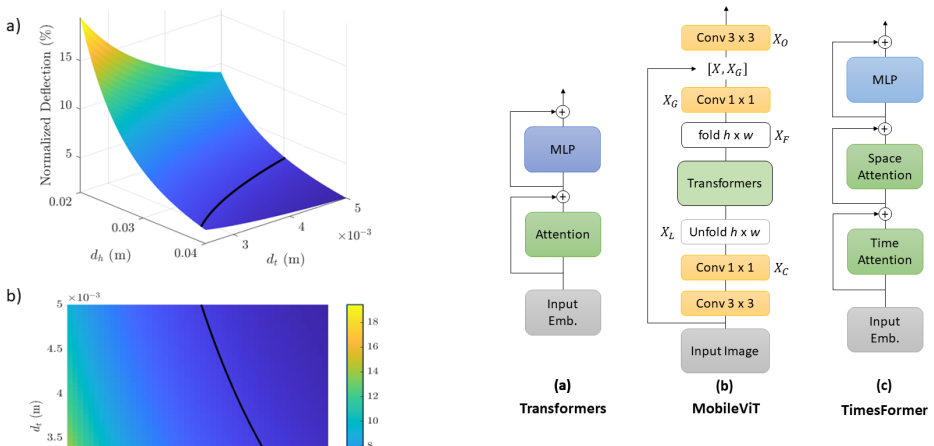
The load-bearing mechanism is the closed control loop that runs from tactile images to actuator command: touch detection, then slip detection, then automatic force increase. Touch uses MobileViT, a lightweight vision transformer, on single GelSight images; slip uses TimeSformer, a video transformer that separates temporal and spatial attention, on eight-frame sequences at 224 by 224 resolution. The models were fine-tuned on the public slip dataset of [18] plus a new dataset collected with nine everyday objects, after ablations over hidden size, attention heads, and encoder blocks. The device itself is a single-tendon soft finger whose flexible-joint geometry was chosen with a parametric simulation study so that the added sensor weight does not deflect the tip more than 3 percent of the finger's total length.
What would settle it
Run the production VTE-SF through the same sliding-grasp protocol used in the paper but record every tactile image; if the TimeSformer's real-time slip-detection accuracy falls well below the reported 89.23 percent, or if the tendon actuator cannot deliver enough added tension to stop slip across repeated trials on unseen objects, the central claim fails. A simpler check: repeat the 30-trial fluid-weight test with objects outside the nine-item training set; a success rate close to 90 percent would support the claim, while a large drop would refute the transfer assumption.
Extended reading notes
Core claim
On the paper's own terms, the central discovery is that a slip-detection loop built from vision-based tactile images can replace manual or EMG control of the supernumerary finger. The VTE-SF prototype uses a GelSight mini sensor mounted in the fingertip; a MobileViT touch model triggers grip initiation, and a TimeSformer slip model classifies eight-frame tactile image sequences. Ablation studies identify a configuration with eight encoder blocks and sixteen attention heads that reaches 89.23 percent slip-detection accuracy, above the 80.6 percent of the CNN+LSTM baseline and other video-transformers tested. The experiments then show the closed loop working on the hardware: the finger slides over an object, secures it, holds it while fluid is poured in, and re-tightens after slip. The paper presents this as a step toward reducing the cognitive load of the device's earlier manual and EMG interfaces.
Load-bearing premise
The slip and touch models are trained on offline images from a vision-based tactile sensor in controlled setups and on nine everyday objects; the system assumes those images look enough like the real-time tactile images during dynamic grasps that the 100 and 90 percent success rates still hold.
Editorial extensions
If this is right
- Stroke survivors can use their paretic limb as the static side of a grip while the VTE-SF supplies the moving side, so bimanual tasks such as pouring can be done with one functional hand.
- Users no longer need to adjust grip force manually or via EMG gestures, reducing the cognitive load that limited earlier SixthFinger interfaces.
- The slip-detection model reaches 89.23 percent accuracy after ablations, outperforming the CNN+LSTM baseline and other video-transformers on the same data.
- In hardware demonstrations the system held both seen and unseen objects in 100 percent of 30-trial attempts and recovered from slip in 90 percent of trials when object weight was increased by adding fluid.
- The touch-detection model approached 100 percent accuracy on the collected dataset after fine-tuning, which the system relies on to time the switch from approaching to monitoring for slip.
Reading between the lines
- The same slip-detection loop could be transferred to other wearable grippers or prosthetic hands that have an optical tactile sensor, since the model consumes only image sequences and a single tension command.
- The reported 100 and 90 percent success rates come from a limited object set and a laboratory protocol; a patient study would be needed to see whether the transfer assumption holds under real-world hand tremor, variable lighting, and long-duration use.
- Combining the touch and slip models into one temporal model, or adding haptic feedback to the user when slip is detected, could further reduce cognitive load, but the paper does not test either option.
- The ablation result that eight encoder blocks beat twelve suggests the slip-detection task is not very deep, which may mean a much lighter model could run on embedded hardware for a fully untethered device.
Editorial analysis
A structured set of objections, weighed in public.
Referee Report
Summary. The paper presents a soft, vision-based tactile-enabled supernumerary robotic finger (VTE-SF) intended to help stroke survivors grasp daily objects. The device uses a GelSight Mini tactile sensor, a MobileViT touch-detection model, and a TimeSformer slip-detection model; when slip is detected, the system is claimed to autonomously increase tendon-driven grip force. The authors report ablation studies for the slip model, a comparison with prior models, and demonstrations in which the system achieved 100% grasping success on seen and unseen daily objects and 90% success when object weight was increased by adding fluid (Section V-B, Fig. 9). Clinical testing with stroke survivors is stated as future work.
Significance. If the central claim of autonomous slip-triggered force modulation were fully evidenced, the VTE-SF would be a meaningful step toward low-cognitive-load assistive grasping for stroke survivors. The paper has clear strengths: the parametric design study with SoRoSim guides the soft-joint geometry in a reproducible way (Section IV-A), the transformer-based touch and slip detection pipeline is compared against several baselines (Table II), and the end-to-end demonstrations cover a realistic range of everyday objects. However, the evidence presented does not currently establish that the slip-detection model caused the reported force adjustments or grasping successes. The demonstration trials are small, self-conducted, and lack statistical analysis, direct force/tension measurements, a feedback-disabled baseline, and a quantification of the domain shift between the training data and the deployed sensor. The clinical framing in the title and abstract is stronger than the evidence, which is currently limited to able-bodied demonstrations.
major comments (4)
- [Section V-B, Fig. 9] The paper's central claim that the VTE-SF 'autonomously adjusts grip force in response to slippage detection' is not directly evidenced by the reported experiments. The demonstrations report only end-to-end grasping success rates (100% for seen and unseen objects, 90% for the fluid-addition test) without logging whether the TimeSformer actually detected a slip, whether the motor command or tendon tension increased in response, or whether that increase was necessary for the successful outcome. There is no baseline condition with the slip-feedback loop disabled and no direct measurement of grip force, motor current, or tendon tension. Consequently, the 90% result could be explained by an initially conservative grip, by re-grasping, or by the experimenter's motion, rather than by the transformer-based closed-loop response. Please add per-trial logs of slip-detection events, actuator commands or tension, and a feedback-disabled control condition.
- [Section IV-C, Dataset and Data Collection] The slip and touch models are trained on the public dataset of [18] plus self-collected data from nine YCB objects, but the manuscript does not report the dataset size, class balance, train/validation/test split, or per-object accuracy. More importantly, the transfer of models trained on [18]'s sensor-gripper setup to the VTE-SF's GelSight Mini configuration is asserted rather than quantified. No calibration, domain-shift analysis, or on-device evaluation of detection latency, false-positive rate, or false-negative rate is provided. Please report these details and add an explicit evaluation of the deployed models on the VTE-SF, including the touch model's claimed near-100% accuracy with a concrete number and test set description.
- [Section V-B, Demonstration results] The success rates of 100% and 90% are each based on 30 self-conducted grasp attempts with no confidence intervals, no statistical tests, and no independent subjects or repeated sessions. With 30 trials, a 90% success rate has a wide binomial confidence interval, and the 100% rate is compatible with a true success rate well below 100%. The paper should report exact binomial confidence intervals, define failure criteria explicitly (e.g., whether object fall or re-grasping counts as failure), and, ideally, include multiple experimenters or independent trial sessions to reduce bias.
- [Section III and Section IV-A] The force-control mechanism is described only qualitatively: 'the system independently calibrates the exerted force, increasing it until secure grip is established' (Section III) and the single-tendon actuator 'guarantees grip stability' (Section IV-A). No control law, force increment size, actuator current limit, update rate, or detection-to-actuation latency is specified. Without these details, the claimed closed-loop behavior is not reproducible, and the reader cannot assess whether the actuator can deliver enough additional tension to arrest slip for the tested objects. Please specify the control policy and report the relevant actuator and timing measurements.
minor comments (5)
- [Throughout] The manuscript contains several typographical errors and formatting inconsistencies, including 'Subsequen/tly' in Section IV-B, 'Y .' in the author list and references, 'T able' in Section IV, and 'I NTRODUCTION' in the section heading. These should be corrected during revision.
- [Fig. 4] The subplots (a) and (b) of Fig. 4 are referenced in the text, but the figure caption does not label them clearly. Please add explicit panel labels.
- [Section IV-E, Table II] The comparison table reports accuracy values for the baseline and proposed models, but it is not stated whether these are per-frame, per-sequence, or per-clip accuracies, nor how the validation set was constructed. Clarifying the evaluation protocol would make the comparison meaningful.
- [Section IV-A] The parametric study reports a chosen soft-joint thickness of 3.8 mm for a height of 3.4 cm, but the paper does not state the material properties of the thermoplastic polyurethane used in the SoRoSim simulation. Reporting these properties would improve reproducibility.
- [References] Several references are cited as arXiv preprints (e.g., [16], [22], [29], [32]) although later published versions exist. Updating these citations to their published venues would improve the bibliography.
Circularity Check
No meaningful circularity: the central grasping behavior is an empirical closed-loop system tested end-to-end; model fits are not renamed as predictions.
full rationale
The paper makes no first-principles derivation that reduces to its own inputs. The touch and slip detection models are trained on labeled tactile datasets (the public dataset of [18] plus a self-collected set of nine YCB objects) and then embedded in a closed-loop controller; the headline results are end-to-end grasping success rates (100% for seen and unseen objects, 90% under added weight), not the fitted accuracy values being reported as predictions. The slip-detection model's validation accuracy (0.8923) is presented as a model metric, separate from the physical grasping outcome. The design lineage builds on the authors' own prior SixthFinger work, but that lineage is background and does not itself justify the slip-response claim. The main weakness is experimental rather than circular: no feedback-disabled baseline, no recorded motor current or tendon tension, and no per-trial slip-detection logs are reported, so the causal role of the transformer-based slip signal in the 90% outcome is not directly evidenced. That is a correctness or evidence gap, not a circularity. The ambiguous sentence 'For both seen and unseen objects (Shown in Fig.6)' is too underspecified to establish that the 'unseen' successes were on training-set objects; absent a specific reduction, it is not a circularity finding. Self-citations appear in related work and device lineage but are not load-bearing for the central claim. No step satisfies the requirement of exhibiting Eq. X = Eq. Y by construction or a fitted parameter renamed as a prediction.
Assumptions & free parameters
free parameters (3)
- Slip and touch model weights =
Not released; fine-tuned on [18] and custom 9-object dataset
- Soft joint thickness dt =
3.8 mm
- Grip force increment on slip =
Not reported
assumptions (3)
- domain assumption GelSight tactile images carry sufficient information to detect incipient and full slip in real time.
- ad hoc to paper The slip dataset of [18] is transferable to the VTE-SF sensor setup despite differences in sensor and gripper.
- domain assumption The single-tendon soft finger can supply sufficient force to stop slip on all tested objects.
Cite this review
Pith. "Pith review of Soft Vision-Based Tactile-Enabled SixthFinger: Advancing Daily Objects Manipulation for Stroke Survivors." pith.science (2026). https://pith.science/paper/WTBHK2BH
@misc{pith2026250106806,
  author       = {Pith},
  title        = {Pith review of: Soft Vision-Based Tactile-Enabled SixthFinger: Advancing Daily Objects Manipulation for Stroke Survivors},
  year         = {2026},
  howpublished = {\url{https://pith.science/paper/WTBHK2BH}},
  note         = {Machine review of arXiv:2501.06806}
}
read the original abstract
The presence of post-stroke grasping deficiencies highlights the critical need for the development and implementation of advanced compensatory strategies. This paper introduces a novel system to aid chronic stroke survivors through the development of a soft, vision-based, tactile-enabled extra robotic finger. By incorporating vision-based tactile sensing, the system autonomously adjusts grip force in response to slippage detection. This synergy not only ensures mechanical stability but also enriches tactile feedback, mimicking the dynamics of human-object interactions. At the core of our approach is a transformer-based framework trained on a comprehensive tactile dataset encompassing objects with a wide range of morphological properties, including variations in shape, size, weight, texture, and hardness. Furthermore, we validated the system's robustness in real-world applications, where it successfully manipulated various everyday objects. The promising results highlight the potential of this approach to improve the quality of life for stroke survivors.
Figures


Figures from the paper (5 more)


Reference graph
Works this paper leans on
-
[18]
Slip detection with combined tactile and visual information,
J. Li, S. Dong, and E. Adelson, “Slip detection with combined tactile and visual information,” in 2018 IEEE International Conference on Robotics and Automation (ICRA) . IEEE, 2018, pp. 7772–7777
work page 2018
-
[1]
Compensation in recovery of upper extremity function after stroke: the copenhagen stroke study,
H. Nakayma, H. S. Jørgensen, H. O. Raaschou, and T. S. Olsen, “Compensation in recovery of upper extremity function after stroke: the copenhagen stroke study,” Archives of physical medicine and rehabilitation, vol. 75, no. 8, pp. 852–857, 1994
work page 1994
-
[2]
I. Hussain, G. Spagnoletti, G. Salvietti, and D. Prattichizzo, “Toward wearable supernumerary robotic fingers to compensate missing grasp- ing abilities in hemiparetic upper limb,” The International Journal of Robotics Research, vol. 36, no. 13-14, pp. 1414–1436, 2017
work page 2017
-
[3]
I. Hussain, G. Salvietti, G. Spagnoletti, M. Malvezzi, D. Cioncoloni, S. Rossi, and D. Prattichizzo, “A soft supernumerary robotic finger and mobile arm support for grasping compensation and hemiparetic upper limb rehabilitation,” Robotics and Autonomous Systems , vol. 93, pp. 1–12, 2017
work page 2017
-
[4]
Compensating hand function in chronic stroke patients through the supernumerary robotic finger,
I. Hussain and D. Prattichizzo, “Compensating hand function in chronic stroke patients through the supernumerary robotic finger,”Aug- menting Human Manipulation Abilities with Supernumerary Robotic Limbs, pp. 25–38, 2020
work page 2020
-
[5]
B. B. Hasanen, M. I. Awad, M. N. Boushaki, Z. Niu, M. A. Ra- madan, and I. Hussain, “Novel supernumerary robotic limb based on variable stiffness actuators for hemiplegic patients assistance,” in 2022 IEEE/RSJ International Conference on Intelligent Robots and Systems (IROS). IEEE, 2022, pp. 1892–1899
work page 2022
-
[6]
S. Hendriks, B. Hasanen, N. Afzal, I. Hussain, and M. Obaid, “Enhancing functional and extra motor abilities: A focus group study on the re-design of an extra-robotic finger,” in 2024 33rd IEEE Inter- national Conference on Robot and Human Interactive Communication (ROMAN). IEEE, 2024, pp. 667–673
work page 2024
-
[7]
I. Hussain, G. Salvietti, G. Spagnoletti, and D. Prattichizzo, “The soft-sixthfinger: a wearable emg controlled robotic extra-finger for grasp compensation in chronic stroke patients,” IEEE Robotics and Automation Letters, vol. 1, no. 2, pp. 1000–1006, 2016
work page 2016
Show all 34 references
-
[8]
Psychopathologie des accidents vasculaires c ´er´ebraux,
A. Carota, S. Dieguez, and J. Bogousslavsky, “Psychopathologie des accidents vasculaires c ´er´ebraux,” Psychologie & NeuroPsychiatrie du vieillissement, vol. 3, no. 4, pp. 235–249, 2005
2005
-
[9]
Using the robotic sixth finger and vi- brotactile feedback for grasp compensation in chronic stroke patients,
I. Hussain, G. Salvietti, L. Meli, C. Pacchierotti, D. Cioncoloni, S. Rossi, and D. Prattichizzo, “Using the robotic sixth finger and vi- brotactile feedback for grasp compensation in chronic stroke patients,” in 2015 IEEE International Conference on Rehabilitation Robotics (I...
2015
-
[10]
An emg interface for the control of motion and compliance of a supernumerary robotic finger,
I. Hussain, G. Spagnoletti, G. Salvietti, and D. Prattichizzo, “An emg interface for the control of motion and compliance of a supernumerary robotic finger,” Frontiers in neurorobotics, vol. 10, p. 18, 2016
2016
-
[11]
Factors influencing the force control during precision grip,
G. Westling and R. S. Johansson, “Factors influencing the force control during precision grip,” Experimental brain research, vol. 53, pp. 277– 284, 1984
1984
-
[12]
Gelsight: High-resolution robot tactile sensors for estimating geometry and force,
W. Yuan, S. Dong, and E. H. Adelson, “Gelsight: High-resolution robot tactile sensors for estimating geometry and force,” Sensors, vol. 17, no. 12, p. 2762, 2017
2017
-
[13]
Lump detection with a gelsight sensor,
X. Jia, R. Li, M. A. Srinivasan, and E. H. Adelson, “Lump detection with a gelsight sensor,” in 2013 World Haptics Conference (WHC) . IEEE, 2013, pp. 175–179
2013
-
[14]
Tactile sensors for friction estimation and incipient slip detection—toward dexterous robotic manipulation: A review,
W. Chen, H. Khamis, I. Birznieks, N. F. Lepora, and S. J. Red- mond, “Tactile sensors for friction estimation and incipient slip detection—toward dexterous robotic manipulation: A review,” IEEE Sensors Journal, vol. 18, no. 22, pp. 9049–9064, 2018
2018
-
[15]
Artificial sense of slip—a review,
M. T. Francomano, D. Accoto, and E. Guglielmelli, “Artificial sense of slip—a review,” IEEE Sensors Journal , vol. 13, no. 7, pp. 2489–2498, 2013
2013
-
[16]
The feeling of success: Does touch sensing help predict grasp outcomes?
R. Calandra, A. Owens, M. Upadhyaya, W. Yuan, J. Lin, E. H. Adelson, and S. Levine, “The feeling of success: Does touch sensing help predict grasp outcomes?” arXiv preprint arXiv:1710.05512, 2017
2017 arXiv
-
[17]
More than a feeling: Learning to grasp and regrasp using vision and touch,
R. Calandra, A. Owens, D. Jayaraman, J. Lin, W. Yuan, J. Malik, E. H. Adelson, and S. Levine, “More than a feeling: Learning to grasp and regrasp using vision and touch,” IEEE Robotics and Automation Letters, vol. 3, no. 4, pp. 3300–3307, 2018
2018
-
[19]
Measurement of shear and slip with a gelsight tactile sensor,
W. Yuan, R. Li, M. A. Srinivasan, and E. H. Adelson, “Measurement of shear and slip with a gelsight tactile sensor,” in 2015 IEEE International Conference on Robotics and Automation (ICRA) . IEEE, 2015, pp. 304–311
2015
-
[20]
Detection of slip from vision and touch,
G. Yan, A. Schmitz, T. P. Tomo, S. Somlor, S. Funabashi, and S. Sug- ano, “Detection of slip from vision and touch,” in 2022 International Conference on Robotics and Automation (ICRA) . IEEE, 2022, pp. 3537–3543
2022
-
[21]
Rotational direction detection using tactile sensor and external camera,
J. Li, “Rotational direction detection using tactile sensor and external camera,” in 2019 IEEE/ASME International Conference on Advanced Intelligent Mechatronics (AIM) . IEEE, 2019, pp. 1456–1461
2019
-
[22]
Learning generalizable vision-tactile robotic grasp- ing strategy for deformable objects via transformer,
Y . Han, R. Batra, N. Boyd, T. Zhao, Y . She, S. Hutchinson, and Y . Zhao, “Learning generalizable vision-tactile robotic grasp- ing strategy for deformable objects via transformer,” arXiv preprint arXiv:2112.06374, 2021
2021 arXiv
-
[23]
Transfer of learning from vision to touch: A hybrid deep convolutional neural network for visuo- tactile 3d object recognition,
G. Rouhafzay, A.-M. Cretu, and P. Payeur, “Transfer of learning from vision to touch: A hybrid deep convolutional neural network for visuo- tactile 3d object recognition,” Sensors, vol. 21, no. 1, p. 113, 2020
2020
-
[24]
Learning to identify object instances by touch: Tactile recognition via multimodal matching,
J. Lin, R. Calandra, and S. Levine, “Learning to identify object instances by touch: Tactile recognition via multimodal matching,” in 2019 International Conference on Robotics and Automation (ICRA) . IEEE, 2019, pp. 3644–3650
2019
-
[25]
“touching to see
J.-T. Lee, D. Bollegala, and S. Luo, ““touching to see” and “seeing to feel”: Robotic cross-modal sensory data generation for visual- tactile perception,” in 2019 International Conference on Robotics and Automation (ICRA) . IEEE, 2019, pp. 4276–4282
2019
-
[26]
Sorosim: A matlab toolbox for hybrid rigid–soft robots based on the geometric variable-strain approach,
A. T. Mathew, I. B. Hmida, C. Armanini, F. Boyer, and F. Renda, “Sorosim: A matlab toolbox for hybrid rigid–soft robots based on the geometric variable-strain approach,” IEEE Robotics & Automation Magazine, vol. 30, no. 3, pp. 106–122, 2022
2022
-
[27]
Reduced order modeling of hybrid soft-rigid robots us- ing global, local, and state-dependent strain parameterization,
A. T. Mathew, D. Feliu-Talegon, A. Y . Alkayas, F. Boyer, and F. Renda, “Reduced order modeling of hybrid soft-rigid robots us- ing global, local, and state-dependent strain parameterization,” The International Journal of Robotics Research , p. 02783649241262333, 2024
2024
-
[28]
A survey on vision transformer,
K. Han, Y . Wang, H. Chen, X. Chen, J. Guo, Z. Liu, Y . Tang, A. Xiao, C. Xu, Y . Xu, et al., “A survey on vision transformer,” IEEE transactions on pattern analysis and machine intelligence , vol. 45, no. 1, pp. 87–110, 2022
2022
-
[29]
Mobilevit: light-weight, general- purpose, and mobile-friendly vision transformer,
S. Mehta and M. Rastegari, “Mobilevit: light-weight, general- purpose, and mobile-friendly vision transformer,” arXiv preprint arXiv:2110.02178, 2021
2021 arXiv
-
[30]
An image is worth 16x16 words: Transformers for image recognition at scale,
A. Dosovitskiy, L. Beyer, A. Kolesnikov, D. Weissenborn, X. Zhai, T. Unterthiner, M. Dehghani, M. Minderer, G. Heigold, S. Gelly, J. Uszkoreit, and N. Houlsby, “An image is worth 16x16 words: Transformers for image recognition at scale,” ICLR, 2021
2021
-
[31]
Is space-time attention all you need for video understanding?
G. Bertasius, H. Wang, and L. Torresani, “Is space-time attention all you need for video understanding?” in ICML, vol. 2, no. 3, 2021, p. 4
2021
-
[32]
Benchmarking in manipulation research: The ycb object and model set and benchmarking protocols,
B. Calli, A. Walsman, A. Singh, S. Srinivasa, P. Abbeel, and A. M. Dollar, “Benchmarking in manipulation research: The ycb object and model set and benchmarking protocols,” arXiv preprint arXiv:1502.03143, 2015
2015 arXiv
-
[33]
Vivit: A video vision transformer,
A. Arnab, M. Dehghani, G. Heigold, C. Sun, M. Lu ˇci´c, and C. Schmid, “Vivit: A video vision transformer,” in Proceedings of the IEEE/CVF international conference on computer vision , 2021, pp. 6836–6846
2021
-
[34]
X-clip: End- to-end multi-grained contrastive learning for video-text retrieval,
Y . Ma, G. Xu, X. Sun, M. Yan, J. Zhang, and R. Ji, “X-clip: End- to-end multi-grained contrastive learning for video-text retrieval,” in Proceedings of the 30th ACM International Conference on Multimedia , 2022, pp. 638–647
2022
Reviewed August 10, 2026 · model on record in the stance chip above.
Discussion (0). Continue with ORCID to comment.