REVIEW 5 major objections 4 minor 52 references
SAM-DA: Decoder Adapter for Efficient Medical Domain Adaptation
T0 review · 5 major / 4 minor · reviewed 2026-08-10 · deepseek-v4-flash
Pith's one-line read A zero-initialized attention adapter placed in SAM's mask decoder achieves comparable performance to full fine-tuning while training less than 1% of SAM's parameters, and improves generalization to unseen medical domains.
desk verdict Useful practical adapter with solid experiments, but the decoder-placement story is partly a MedSAM initialization effect and the abstract overclaims. read the letter →
The pith
A machine-rendered reading of the paper's core claim, the machinery that carries it, and where it could break.
The reading
What carries the argument
The central object is the SAM Decoder Adapter (SAM-DA): at each of the two layers of SAM's mask-decoder transformer, a learnable prompt $A_\ell$ is fed as keys and values into a zero-initialized cross-attention block whose queries are the decoder's own dense embeddings $T_\ell$. A learnable gating scalar $g_\ell$, initialized to zero, scales the attention output before it is added to the embeddings, so training starts from the unmodified pretrained model. This is the LLaMA-Adapter mechanism transplanted from NLP into SAM. Its job is to let the decoder recombine the frozen encoder's features for a new domain while leaving the encoder untouched; the gating acts as a warm start that grows the correction gradually.
What would settle it
Take a medical dataset where the domain shift is primarily in the image encoder, such as training on retinal OCT and testing on a different modality like ultrasound or CT, and compare SAM-DA against an encoder adapter with matched parameters. If the encoder adapter equals or beats the decoder adapter on the unseen domain, the paper's central claim that decoder-only adaptation is preferable fails.
Extended reading notes
Core claim
The central claim is that the mask decoder of SAM is the right place to adapt the model for medical segmentation, and that a parameter-efficient adapter there can perform comparably to full fine-tuning while training 0.66M parameters out of roughly 90.6M (less than 1%). The paper shows that on domain generalization (training on one device or site, testing on another), the decoder adapter outperforms encoder-adaptation methods, with gains up to 8.5 and 13.8 IoU points on Retouch and WMH, respectively. The paper also reports a limitation: on the large HQSeg-44K dataset, encoder adapters exceed it (LoRA 83.1, Med-SA 83.8 vs. 79.6), indicating that decoder-only adaptation loses when abundant training data is available.
Load-bearing premise
The frozen image encoder already extracts features that are good enough for medical images, so only the decoder needs adapting; the paper's own ablations show this holds for small medical datasets but not for the large HQSeg-44K set, where encoder adaptation wins.
Editorial extensions
If this is right
- If the claim holds, any SAM-based segmentation model can be adapted to a new medical imaging protocol using only a few hundred thousand trainable parameters, making deployment on a single GPU or even at the edge feasible.
- Test-time domain adaptation becomes practical: the adapter can be fit per image in a handful of iterations, and the paper reports the best IoU on all three medical datasets under this setting.
- The generalization results imply that encoder freezing is not just a cost-saving measure but also a form of regularization, since updating the encoder hurts zero-shot transfer to unseen devices and sites.
- On large natural-image datasets the advantage disappears, so the method's benefits are specific to the small-data medical regime.
Reading between the lines
- A natural extension the paper does not run is combining the decoder adapter with a light encoder adapter; the paper's own ablations show the two placements capture complementary strengths, so a hybrid might recover the HQSeg-44K gap while preserving generalization.
- The zero-init gating suggests that the adapter learns a residual correction on the decoder's feature re-weighting; measuring the rank of the learned correction across datasets would test whether it behaves as a low-rank perturbation of the attention maps.
- Because the paper uses only SAM's ViT-B/16 backbone with MedSAM weights, the claim should be re-checked on larger SAM variants (ViT-L/H) and on 3D medical data, which the authors note require architectural changes.
Editorial analysis
A structured set of objections, weighed in public.
Referee Report
Summary. The paper proposes SAM-DA, a parameter-efficient fine-tuning method for the Segment Anything Model (SAM) that inserts a zero-initialized, prompt-based attention adapter into the mask decoder. The adapter uses a small set of learnable prompt tokens as keys and values, with decoder embeddings as queries, and a gating factor that starts at zero. The method is evaluated on four datasets (Retouch, MRI, WMH, HQSeg-44K) under fully supervised training, domain generalization, and test-time domain adaptation, and is compared against full fine-tuning, decoder-only fine-tuning, LoRA, Med-SA, and HQ-SAM. The core claims are that the decoder placement yields strong generalization and that the method matches or exceeds state-of-the-art while training less than 1% of SAM's parameters.
Significance. If the central claims were fully supported, SAM-DA would be a practically valuable contribution: it is simple, parameter-efficient, and the experimental setup is more careful than is typical (four seeds, validation-set hyperparameter tuning, per-dataset splits, and an honest statistical appendix). The method is clearly described and the ablations are informative. However, the paper's headline claims are not fully backed by its own tables, and the decoder-placement advantage is confounded by the use of MedSAM initialization in all medical experiments. The core architectural insight is plausible and worth publishing after appropriate scoping and additional analysis.
major comments (5)
- [Abstract and Table 2] The abstract and introduction claim that SAM-DA 'outperform[s] existing methods' and achieves 'comparable performances to full fine-tuning,' but Table 2 shows otherwise on two of the four datasets: on WMH, Med-SA achieves 44.7 IoU while SAM-DA achieves 44.2, and on HQSeg-44K, LoRA (83.1) and Med-SA (83.8) both exceed SAM-DA (79.6). The claims should be scoped to reflect the actual rankings, or the presentation should emphasize the settings where the method is genuinely superior.
- [Section 4.2 and Section 5.3 (Tables 4 and 9)] The claim that decoder placement is broadly superior for SAM is confounded by initialization. All medical experiments initialize SAM ViT-B with MedSAM weights, and the only experiment with official SAM weights, HQSeg-44K, shows the opposite ranking: the encoder adapter reaches 80.8 IoU versus 79.6 for the decoder adapter, and both LoRA and Med-SA outperform SAM-DA by roughly 4 points. The domain-generalization results in Table 3 therefore do not establish a general decoder advantage for SAM; they may hold only for MedSAM-initialized models. The paper should either scope its claims to MedSAM-initialized models or demonstrate the decoder advantage from official SAM weights on a medical task.
- [Section 5.2 and Appendix C] Section 5.2 asserts 'statistically significant superiority' of SAM-DA on zero-shot generalization compared to Med-SA and LoRA, but no significance tests are reported for the results in Table 3. The only significance test in the appendix is a paired t-test for the fully supervised Retouch case, and the authors themselves state that this test is 'not completely justified' because image-wise mIoU scores are not directly comparable across images. The paper should either report an appropriate statistical analysis for the generalization claims or soften the language accordingly.
- [Section 4.4 and Table 8] The test-time domain adaptation results in Table 8 are reported without any error bars or indication of the number of runs. The paper states that experiments are repeated four times for the fully supervised setting, but it is unclear whether this applies to TTDA. Given that the differences between methods are small (e.g., 67.5 for SAM-DA vs. 67.0 for LoRA on Retouch), the lack of variance information makes it difficult to assess whether the reported improvements are meaningful.
- [Equation (5) and Section 3.2] The claim that initializing the gating factor to zero 'ensure[s] no disruption during the early stages of adaptation' is only valid if the linear projection Lineart in Eq. (5) is initialized as an identity map. As written, T'_ℓ = Lineart(Tℓ + gℓ·S'_ℓ) with gℓ=0 still transforms Tℓ through Lineart, which would alter the embedding unless that layer is specially initialized. The paper should specify the initialization of Lineart and, if needed, use a residual connection so that the zero-init guarantee actually holds.
minor comments (4)
- [Table 1] The note that HQSeg-44K 'uses the same set for validation and testing' is confusing and potentially problematic if hyperparameters are tuned on the test set. Please clarify whether any hyperparameter selection was performed on that split and how the reported IoU values were obtained.
- [Section 5.1] The phrase 'this dataset can be considered quite distinct' is vague. It would be clearer to say that HQSeg-44K is much larger than the others and contains natural images, which explains the different behavior of PEFT methods.
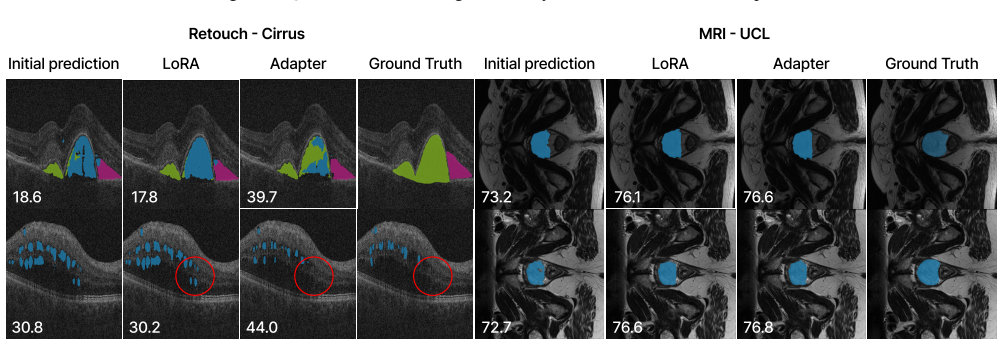
- [Figure 4] The quantitative values in the Figure 4 caption are not fully explained; please add a sentence describing how the IoU scores are computed and which methods the numbers refer to.
- [Section 2.1] The related work section mentions only a few recent SAM-based PEFT works; citing additional recent methods such as SAM-Adapter and other prompt-based adaptations would help position the contribution.
Circularity Check
No circularity: SAM-DA is an empirical adapter paper whose claims rest on external benchmarks and ablations, not on self-referential derivation or fitted inputs renamed as predictions.
full rationale
The paper proposes an adapter architecture and validates it against external baselines (LoRA, Med-SA, HQ-SAM, and full fine-tuning) on fixed datasets with separate training, validation, and test splits. The decoder placement is presented as a design choice and is justified empirically by the ablations in Tables 4 and 5, not derived from the method's definition. The zero-initialized gating is inherited from LLaMA-Adapter as an architectural mechanism, not as a proof step. The adapter parameters are trained on source-domain supervision and evaluated on held-out test sets; no target result is used to define the method, and no fitted parameter is renamed as a prediction. The only self-citation, reference [8], is a related domain-adaptation method by overlapping authors, and it appears only in a related-work citation group, not as load-bearing support for the central claim. The statistical appendix's admission that the paired t-test is 'not completely justified' is a statistical validity concern, not circularity. The reviewer's observation that medical experiments start from MedSAM weights while the HQSeg-44K experiment using official SAM weights reverses the decoder/encoder ranking is a substantive scoping concern about the generality of the decoder-placement claim, but it does not make the derivation circular. No equation or fitted value reduces to the paper's own conclusions.
Assumptions & free parameters
free parameters (7)
- Adapter prompt length N =
2
- Adapter dimension D =
512
- Attention key/value dimension Dk=Dv =
256
- Gating factor initialization g_l =
0
- Mask loss Dice:CrossEntropy ratio =
0.8:0.2
- TTDA loss term weights =
not reported
- TTDA number of iterations =
5
assumptions (3)
- domain assumption Frozen SAM encoder features are sufficiently transferable that decoder-only adaptation is preferable to encoder adaptation for medical domain shift.
- domain assumption The only difference between source and target domains is the acquisition device; class semantics and the number of classes are unchanged.
- domain assumption Pretrained SAM and MedSAM weights provide a good initialization, so no training from scratch is needed.
Cite this review
Pith. "Pith review of SAM-DA: Decoder Adapter for Efficient Medical Domain Adaptation." pith.science (2026). https://pith.science/paper/OOVZK2B5
@misc{pith2026250106836,
  author       = {Pith},
  title        = {Pith review of: SAM-DA: Decoder Adapter for Efficient Medical Domain Adaptation},
  year         = {2026},
  howpublished = {\url{https://pith.science/paper/OOVZK2B5}},
  note         = {Machine review of arXiv:2501.06836}
}
read the original abstract
This paper addresses the domain adaptation challenge for semantic segmentation in medical imaging. Despite the impressive performance of recent foundational segmentation models like SAM on natural images, they struggle with medical domain images. Beyond this, recent approaches that perform end-to-end fine-tuning of models are simply not computationally tractable. To address this, we propose a novel SAM adapter approach that minimizes the number of trainable parameters while achieving comparable performances to full fine-tuning. The proposed SAM adapter is strategically placed in the mask decoder, offering excellent and broad generalization capabilities and improved segmentation across both fully supervised and test-time domain adaptation tasks. Extensive validation on four datasets showcases the adapter's efficacy, outperforming existing methods while training less than 1% of SAM's total parameters.
Figures


Figures from the paper (3 more)


Reference graph
Works this paper leans on
-
[1]
Vincent Abbott. Neural circuit diagrams: Robust dia- grams for the communication, implementation, and anal- ysis of deep learning architectures. arXiv preprint arXiv:2402.05424, 2024. 4, 11
arXiv 2024
-
[2]
Retouch: The retinal oct fluid detection and segmenta- tion benchmark and challenge
Hrvoje Bogunovic, Freerk Venhuizen, Sophie Klimscha, et al. Retouch: The retinal oct fluid detection and segmenta- tion benchmark and challenge. IEEE Transactions on Medi- cal Imaging, 38:1858–1874, 8 2019. 1, 4, 11
work page 2019
-
[3]
Pipa: Pixel-and patch-wise self-supervised learning for do- main adaptative semantic segmentation
Mu Chen, Zhedong Zheng, Yi Yang, and Tat-Seng Chua. Pipa: Pixel-and patch-wise self-supervised learning for do- main adaptative semantic segmentation. In Proceedings of the 31st ACM International Conference on Multimedia , pages 1905–1914, 2023. 3
work page 1905
-
[4]
Sam-adapter: Adapting segment anything in underperformed scenes
Tianrun Chen, Lanyun Zhu, et al. Sam-adapter: Adapting segment anything in underperformed scenes. In Proceedings of the IEEE/CVF International Conference on Computer Vi- sion, pages 3367–3375, 2023. 2
work page 2023
-
[5]
Vision transformer adapter for dense predictions
Zhe Chen, Yuchen Duan, Wenhai Wang, Junjun He, Tong Lu, Jifeng Dai, and Yu Qiao. Vision transformer adapter for dense predictions. arXiv preprint arXiv:2205.08534, 2022. 2
arXiv 2022
-
[6]
Global contrast based salient region detection
Ming-Ming Cheng, Niloy J Mitra, Xiaolei Huang, et al. Global contrast based salient region detection. IEEE transactions on pattern analysis and machine intelligence , 37(3):569–582, 2014. 4
work page 2014
-
[7]
An image is worth 16x16 words: Transformers for image recognition at scale
Alexey Dosovitskiy, Lucas Beyer, Alexander Kolesnikov, Dirk Weissenborn, et al. An image is worth 16x16 words: Transformers for image recognition at scale. InInternational Conference on Learning Representations, 2021. 3, 4
work page 2021
-
[8]
Domain adaptation for med- ical image segmentation using transformation-invariant self- training
Negin Ghamsarian, Javier Gamazo Tejero, Pablo M ´arquez- Neila, Sebastian Wolf, Martin Zinkernagel, Klaus Schoeff- mann, and Raphael Sznitman. Domain adaptation for med- ical image segmentation using transformation-invariant self- training. In International Conference on Medical Image Computing and Computer-Assisted Intervention, pages 331–
Show all 52 references
-
[9]
Towards a unified view of parameter-efficient transfer learning
Junxian He, Chunting Zhou, Xuezhe Ma, Taylor Berg- Kirkpatrick, and Graham Neubig. Towards a unified view of parameter-efficient transfer learning. arXiv preprint arXiv:2110.04366, 2021. 2
2021 arXiv
-
[10]
Parameter-efficient transfer learning for nlp
Neil Houlsby, Andrei Giurgiu, Stanislaw Jastrzebski, Bruna Morrone, Quentin De Laroussilhe, Andrea Gesmundo, Mona Attariyan, and Sylvain Gelly. Parameter-efficient transfer learning for nlp. In International Conference on Machine Learning, pages 2790–2799. PMLR, 2019. 2
2019
-
[11]
Mic: Masked image consistency for context- enhanced domain adaptation
Lukas Hoyer, Dengxin Dai, Haoran Wang, and Luc Van Gool. Mic: Masked image consistency for context- enhanced domain adaptation. In Proceedings of the IEEE/CVF Conference on Computer Vision and Pattern Recognition, pages 11721–11732, 2023. 3
2023
-
[12]
LoRA: Low- rank adaptation of large language models
Edward J Hu, Yelong Shen, Phillip Wallis, et al. LoRA: Low- rank adaptation of large language models. In International Conference on Learning Representations, 2022. 2, 4, 6, 7
2022
-
[13]
Single image test-time adaptation for segmentation
Klara Janouskova, Tamir Shor, Chaim Baskin, and Jiri Matas. Single image test-time adaptation for segmentation. arXiv preprint arXiv:2309.14052, 2023. 2, 3
2023 arXiv
-
[14]
Segment anything in high quality
Lei Ke, Mingqiao Ye, Martin Danelljan, Yu-Wing Tai, Chi- Keung Tang, , et al. Segment anything in high quality. Ad- vances in Neural Information Processing Systems, 36, 2024. 1, 2, 3, 4, 5, 6, 11
2024
-
[15]
Berg, Wan-Yen Lo, Piotr Doll ´ar, and Ross Girshick
Alexander Kirillov, Eric Mintun, Nikhila Ravi, Hanzi Mao, Chloe Rolland, Laura Gustafson, Tete Xiao, Spencer White- head, Alexander C. Berg, Wan-Yen Lo, Piotr Doll ´ar, and Ross Girshick. Segment anything. 4 2023. 1, 3, 5
2023
-
[16]
Kuijf, Adria Casamitjana, D
Hugo J. Kuijf, Adria Casamitjana, D. Louis Collins, Mahsa Dadar, Achilleas Georgiou, et al. Standardized assessment of automatic segmentation of white matter hyperintensities and results of the wmh segmentation challenge.IEEE Trans- actions on Medical Imaging, 38:2556–2568, 11...
2019
-
[17]
Universal source-free domain adaptation
Jogendra Nath Kundu, Naveen Venkat, R Venkatesh Babu, et al. Universal source-free domain adaptation. In Proceed- ings of the IEEE/CVF Conference on Computer Vision and Pattern Recognition, pages 4544–4553, 2020. 3
2020
-
[18]
The power of scale for parameter-efficient prompt tuning.arXiv preprint arXiv:2104.08691, 2021
Brian Lester, Rami Al-Rfou, and Noah Constant. The power of scale for parameter-efficient prompt tuning.arXiv preprint arXiv:2104.08691, 2021. 3
2021 arXiv
-
[19]
Fss-1000: A 1000-class dataset for few- shot segmentation
Xiang Li, Tianhan Wei, Yau Pun Chen, Yu-Wing Tai, and Chi-Keung Tang. Fss-1000: A 1000-class dataset for few- shot segmentation. In Proceedings of the IEEE/CVF con- ference on computer vision and pattern recognition , pages 2869–2878, 2020. 4
2020
-
[20]
Prefix-tuning: Optimiz- ing continuous prompts for generation
Xiang Lisa Li and Percy Liang. Prefix-tuning: Optimiz- ing continuous prompts for generation. arXiv preprint arXiv:2101.00190, 2021. 2
2021 arXiv
-
[21]
Deep interactive thin object selection
Jun Hao Liew, Scott Cohen, Brian Price, Long Mai, and Ji- ashi Feng. Deep interactive thin object selection. InProceed- ings of the IEEE/CVF Winter Conference on Applications of Computer Vision, pages 305–314, 2021. 4
2021
-
[22]
Focal loss for dense object detection
Tsung-Yi Lin, Priya Goyal, Ross Girshick, Kaiming He, and Piotr Doll´ar. Focal loss for dense object detection. In Pro- ceedings of the IEEE international conference on computer vision, pages 2980–2988, 2017. 5
2017
-
[23]
Ex- ploring versatile generative language model via parameter- efficient transfer learning
Zhaojiang Lin, Andrea Madotto, and Pascale Fung. Ex- ploring versatile generative language model via parameter- efficient transfer learning. arXiv preprint arXiv:2004.03829,
2004 arXiv
-
[24]
Shape-aware meta-learning for generalizing prostate mri segmentation to unseen domains
Quande Liu, Qi Dou, and Pheng-Ann Heng. Shape-aware meta-learning for generalizing prostate mri segmentation to unseen domains. In Medical Image Computing and Com- puter Assisted Intervention–MICCAI 2020: 23rd Interna- tional Conference, Lima, Peru, October 4–8, 2020, Proceed-...
2020
-
[25]
Ms- net: Multi-site network for improving prostate segmentation with heterogeneous mri data
Quande Liu, Qi Dou, Lequan Yu, and Pheng Ann Heng. Ms- net: Multi-site network for improving prostate segmentation with heterogeneous mri data. IEEE Transactions on Medical Imaging, 39:2713–2724, 9 2020. 1, 4, 11
2020
-
[26]
Gpt understands, too
Xiao Liu, Yanan Zheng, Zhengxiao Du, Ming Ding, Yujie Qian, Zhilin Yang, and Jie Tang. Gpt understands, too. AI Open, 2023. 2
2023
-
[27]
Decoupled weight decay regularization
Ilya Loshchilov and Frank Hutter. Decoupled weight decay regularization. arXiv preprint arXiv:1711.05101, 2017. 5
2017 arXiv
-
[28]
Segment anything in medical images
Jun Ma, Yuting He, Feifei Li, Lin Han, Chenyu You, and Bo Wang. Segment anything in medical images. Nature Communications, 15:1–9, 2024. 2, 4
2024
-
[29]
Parameter- efficient multi-task fine-tuning for transformers via shared hypernetworks
Rabeeh Karimi Mahabadi, Sebastian Ruder, et al. Parameter- efficient multi-task fine-tuning for transformers via shared hypernetworks. arXiv preprint arXiv:2106.04489, 2021. 2
2021 arXiv
-
[30]
Milletari, N
F. Milletari, N. Navab, and S. Ahmadi. V-net: Fully convo- lutional neural networks for volumetric medical image seg- mentation. In 2016 Fourth International Conference on 3D Vision (3DV), pages 565–571, Los Alamitos, CA, USA, oct
2016
-
[31]
Dinov2: Learning robust visual features without supervision
Maxime Oquab, Timoth ´ee Darcet, Th ´eo Moutakanni, Huy V o, Marc Szafraniec, Vasil Khalidov, Pierre Fernandez, Daniel Haziza, Francisco Massa, Alaaeldin El-Nouby, et al. Dinov2: Learning robust visual features without supervision. arXiv preprint arXiv:2304.07193, 2023. 3
2023 arXiv
-
[32]
Adapterfusion: Non-destructive task composition for transfer learning
Jonas Pfeiffer, Aishwarya Kamath, Andreas R ¨uckl´e, Kyunghyun Cho, et al. Adapterfusion: Non-destructive task composition for transfer learning. arXiv preprint arXiv:2005.00247, 2020. 2
2005 arXiv
-
[33]
Highly accurate dichotomous image segmentation
Xuebin Qin, Hang Dai, Xiaobin Hu, et al. Highly accurate dichotomous image segmentation. In European Conference on Computer Vision, pages 38–56. Springer, 2022. 4
2022
-
[34]
Transfusion: Understanding transfer learning for medical imaging
Maithra Raghu, Chiyuan Zhang, Jon Kleinberg, and Samy Bengio. Transfusion: Understanding transfer learning for medical imaging. Advances in neural information processing systems, 32, 2019. 2
2019
-
[35]
Hierar- chical image saliency detection on extended cssd
Jianping Shi, Qiong Yan, Li Xu, and Jiaya Jia. Hierar- chical image saliency detection on extended cssd. IEEE transactions on pattern analysis and machine intelligence , 38(4):717–729, 2015. 4
2015
-
[36]
Llama: Open and efficient foundation language models
Hugo Touvron, Thibaut Lavril, Gautier Izacard, Xavier Martinet, Marie-Anne Lachaux, Timoth´ee Lacroix, Baptiste Rozi`ere, Naman Goyal, Eric Hambro, Faisal Azhar, et al. Llama: Open and efficient foundation language models. arXiv preprint arXiv:2302.13971, 2023. 3
2023 arXiv
-
[37]
Tent: Fully test-time adaptation by entropy minimization
Dequan Wang, Evan Shelhamer, Shaoteng Liu, et al. Tent: Fully test-time adaptation by entropy minimization. In In- ternational Conference on Learning Representations , 2021. 5
2021
-
[38]
Dynamically instance- guided adaptation: A backward-free approach for test-time domain adaptive semantic segmentation
Wei Wang, Zhun Zhong, Weijie Wang, Xi Chen, Charles Ling, Boyu Wang, and Nicu Sebe. Dynamically instance- guided adaptation: A backward-free approach for test-time domain adaptive semantic segmentation. In Proceedings of the IEEE/CVF Conference on Computer Vision and Pattern R...
2023
-
[39]
Medical sam adapter: Adapting segment anything model for medical image seg- mentation
Junde Wu, Rao Fu, Huihui Fang, et al. Medical sam adapter: Adapting segment anything model for medical image seg- mentation. arXiv preprint arXiv:2304.12620, 2023. 2, 4, 6, 7, 12
2023 arXiv
-
[40]
Adap- tive adversarial network for source-free domain adaptation
Haifeng Xia, Handong Zhao, and Zhengming Ding. Adap- tive adversarial network for source-free domain adaptation. In Proceedings of the IEEE/CVF International Conference on Computer Vision, pages 9010–9019, 2021. 3
2021
-
[41]
Dual modality prompt tuning for vision-language pre-trained model
Yinghui Xing, Qirui Wu, De Cheng, Shizhou Zhang, Guo- qiang Liang, Peng Wang, and Yanning Zhang. Dual modality prompt tuning for vision-language pre-trained model. IEEE Transactions on Multimedia, 2023. 3
2023
-
[42]
Parameter-efficient fine-tuning methods for pretrained language models: A critical review and assess- ment
Lingling Xu, Haoran Xie, Si-Zhao Joe Qin, Xiaohui Tao, and Fu Lee Wang. Parameter-efficient fine-tuning methods for pretrained language models: A critical review and assess- ment. arXiv preprint arXiv:2312.12148, 2023. 2
2023 arXiv
-
[43]
Saliency detection via graph-based man- ifold ranking
Chuan Yang, Lihe Zhang, Huchuan Lu, Xiang Ruan, and Ming-Hsuan Yang. Saliency detection via graph-based man- ifold ranking. In Proceedings of the IEEE conference on computer vision and pattern recognition, pages 3166–3173,
-
[44]
Taskonomy: Disentangling task transfer learning
Amir R Zamir, Alexander Sax, William Shen, Leonidas J Guibas, Jitendra Malik, and Silvio Savarese. Taskonomy: Disentangling task transfer learning. In Proceedings of the IEEE conference on computer vision and pattern recogni- tion, pages 3712–3722, 2018. 2
2018
-
[45]
Towards high-resolution salient object detec- tion
Yi Zeng, Pingping Zhang, Jianming Zhang, Zhe Lin, and Huchuan Lu. Towards high-resolution salient object detec- tion. In Proceedings of the IEEE/CVF international confer- ence on computer vision, pages 7234–7243, 2019. 1, 4
2019
-
[46]
A comprehensive survey on segment anything model for vision and beyond
Chunhui Zhang, Li Liu, Yawen Cui, Guanjie Huang, Weilin Lin, Yiqian Yang, and Yuehong Hu. A comprehensive survey on segment anything model for vision and beyond. arXiv preprint arXiv:2305.08196, 2023. 1
2023 arXiv
-
[47]
Improving the generalization of segmentation foundation model under distribution shift via weakly supervised adaptation
Haojie Zhang, Yongyi Su, Xun Xu, and Kui Jia. Improving the generalization of segmentation foundation model under distribution shift via weakly supervised adaptation. arXiv preprint arXiv:2312.03502, 2023. 3, 5
2023 arXiv
-
[48]
Customized segment any- thing model for medical image segmentation
Kaidong Zhang and Dong Liu. Customized segment any- thing model for medical image segmentation. arXiv preprint arXiv:2304.13785, 2023. 2
2023 arXiv
-
[49]
Llama-adapter: Efficient fine-tuning of language models with zero-init attention
Renrui Zhang, Jiaming Han, Aojun Zhou, Xiangfei Hu, Shilin Yan, Pan Lu, Hongsheng Li, Peng Gao, and Yu Qiao. Llama-adapter: Efficient fine-tuning of language models with zero-init attention. arXiv preprint arXiv:2303.16199 ,
-
[50]
Learning to prompt for vision-language models
Kaiyang Zhou, Jingkang Yang, Chen Change Loy, and Ziwei Liu. Learning to prompt for vision-language models. In- ternational Journal of Computer Vision, 130(9):2337–2348,
-
[51]
Segment everything every- where all at once
Xueyan Zou, Jianwei Yang, et al. Segment everything every- where all at once. Advances in Neural Information Process- ing Systems, 36, 2024. 1 A. Implementation details Figure 5 shows the architecture of our adapter ( Aℓ) as a neural diagram (introduced in [1]). It is combined...
2024
-
[2016]
IEEE Computer Society. 5
Reviewed August 10, 2026 · model on record in the stance chip above.
Discussion (0). Continue with ORCID to comment.