REVIEW 3 major objections 6 minor 4 cited by
Systematic uncertainties from higher-twist corrections in DIS at large x
T0 review · 3 major / 6 minor · reviewed 2026-08-10 · deepseek-v4-flash
Pith's one-line read This paper shows that in global QCD fits the choice of how higher-twist corrections enter proton and neutron structure functions — additive versus multiplicative, and isospin-independent versus isospin-dependent — shifts the extracted…
desk verdict A careful systematic study showing that isospin-independent higher-twist corrections bias the large-x n/p ratio and off-shell function in global fits; the recommendation to allow isospin-dependent HT is sound, though reproducibility and a mock-data test would firm it up. read the letter →
The pith
A machine-rendered reading of the paper's core claim, the machinery that carries it, and where it could break.
The reading
What carries the argument
The argument runs on three pieces. First, the $x \to 1$ asymptotics of the $n/p$ ratio: an isospin-independent multiplicative higher-twist term $C(x)$ cancels in the ratio, while an isospin-independent additive term $H(x)$ leaves a $1/Q^2$ tail proportional to $H/(u Q^2)$, which is what inflates the ratio. Second, the equivalence formula $\tilde H(x,Q^2) = F_2(x,Q^2)\,C(x)$: an isospin-independent multiplicative correction becomes isospin-dependent when recast additively, and vice versa, so the common "isospin-independent" implementation is not self-consistent. Third, the off-shell expansion $\delta_f(x)$ of nucleons bound in the deuteron, fitted to data through the weak-binding-approximation smearing formula: because the off-shell function is constrained in practice only for $x \lesssim 0.7$, it has the freedom to compensate the higher-twist implementation bias in the deuteron and hide the discrepancy from the data.
What would settle it
Re-run the isospin-independent additive and multiplicative fits on deuteron data with substantially wider $Q^2$ coverage at large $x$ — the paper identifies such data as the experimental route forward. Since the higher-twist terms fall as $1/Q^2$ while the off-shell deformation is assumed constant, a dataset in which $1/Q^2$ changes by a factor of two or more within the same $x$ bins should either make the fitted off-shell function visibly $Q^2$-dependent, or force the additive and multiplicative fits to disagree with the data; either outcome would refute the compensation mechanism as described.
Extended reading notes
Core claim
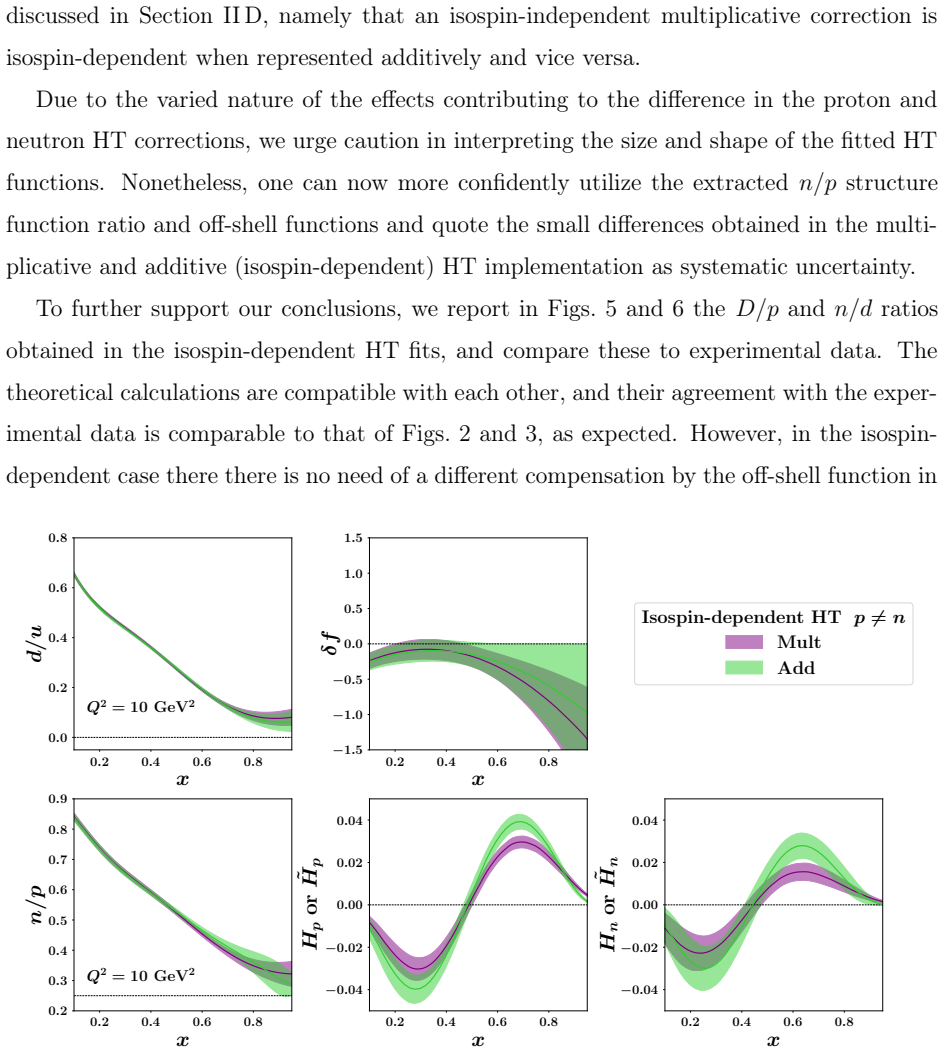
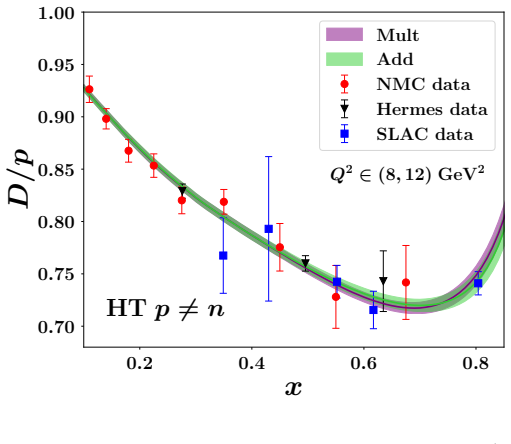
Stated as the authors would state it: the large-$x$ behavior of the neutron-to-proton structure function ratio is partly an artefact of how higher-twist corrections are implemented, not a pure measurement. For an isospin-independent multiplicative correction, the factor $(1 + C/Q^2)$ cancels in the ratio and $n/p$ approaches the leading-twist value $1/4$ as $x \to 1$. For an isospin-independent additive correction, the ratio picks up a term proportional to $H/(u Q^2)$, and the fitted $n/p$ rises noticeably — about 25% higher at $x = 0.8$. Because the neutron structure function reaches global fits almost entirely through deuteron data, the fit compensates for this artificial rise by shifting the fitted off-shell deformation $\delta_f$: positive in the additive case, negative in the multiplicative case, with both fits describing the deuteron-to-proton ratio equally well. Relaxing the isospin-independence constraint lets the proton and neutron higher-twist functions absorb the isospin-dependent $1/Q^2$ effects; the additive and multiplicative fits then yield compatible $n/p$ ratios and compatible off-shell functions, and the difference between them becomes a bounded, quantifiable systematic uncertainty.
Load-bearing premise
The load-bearing assumption is that the off-shell deformation $\delta_f$ of nucleons bound in the deuteron is independent of $Q^2$, even though the higher-twist corrections it is found to compensate fall as $1/Q^2$; the paper states this in Section II.B.2 and flags it as "somewhat peculiar" in Section III.C, so if $\delta_f$ actually varies with $Q^2$, the compensation pattern and the inferred bias magnitude could change.
Editorial extensions
If this is right
- Extracting the neutron-to-proton ratio without reporting the higher-twist implementation is incomplete: isospin-independent fits can shift the ratio by about 25% at $x = 0.8$ depending on the additive or multiplicative form.
- Fitting proton and neutron higher-twist functions separately removes the compensation mechanism, and the residual additive-versus-multiplicative spread becomes the systematic uncertainty to quote.
- The fitted off-shell deformation of deuteron-bound nucleons is currently correlated with the higher-twist implementation, so its large-$x$ values should not be read as a physical nucleon deformation until the isospin-dependent treatment is standard.
- The $d/u$ PDF ratio stays protected from the bias only when free-proton data such as the $W$-boson rapidity asymmetry from proton-antiproton collisions pin it down; without them the bias migrates into $d/u$.
- Deuteron data with wider $Q^2$ reach or higher statistical power at large $x$ are required to separate the $Q^2$-independent off-shell effect from the $1/Q^2$ higher-twist terms.
Reading between the lines
- The bias mechanism is generic rather than framework-specific: any fit that forces proton and neutron $1/Q^2$ corrections to be identical and chooses the additive form inherits the same artificial $n/p$ tail, because the argument turns only on the structure-function ratio.
- If the off-shell deformation carries intrinsic $Q^2$ dependence — which the paper itself notes is peculiar to exclude — then both the extracted $\delta_f$ and the higher-twist functions would need revisiting; a joint fit with $Q^2$-dependent off-shell terms is a direct testable extension.
- The paper's effective off-shell function for the deuteron structure function, defined in its Appendix C, is a portable quantity that other fitting groups could compute, making it a natural cross-framework benchmark for nuclear corrections.
- The same isospin-blind treatment could bias flavor-dependent off-shell extractions from tritium and helium-3 data, so future analyses of those targets should adopt isospin-dependent higher-twist terms from the outset.
Editorial analysis
A structured set of objections, weighed in public.
Referee Report
Summary. This paper investigates how the phenomenological implementation of higher-twist (HT) corrections in global QCD analyses of deep-inelastic scattering affects extracted large-x quantities. Working in the CTEQ-JLab (CJ22) framework, the authors compare multiplicative (F2[1+C(x)/Q2]) and additive (F2+H(x)/Q2) HT forms, each with the HT function either constrained to be identical for proton and neutron (isospin-independent) or fitted separately (isospin-dependent). They find that the isospin-independent additive and multiplicative implementations describe the deuteron data with comparable quality but imply substantially different n/p structure function ratios at large x (about 25% at x=0.8, Fig. 1) and oppositely signed off-shell deformation functions δf; the near-identical D/p predictions (Fig. 2) are interpreted as the fitted off-shell function compensating for the HT implementation choice. When isospin dependence is allowed (Fig. 4), the additive and multiplicative fits agree in n/p, d/u and δf, the n/p tail is closer to the multiplicative result as anticipated by the analytic argument of Sec. IID (Eqs. 13-15), and the neutron HT function is found to be roughly half the proton one. The paper further shows (Sec. IV) that without Tevatron W-asymmetry data the compensation can partly shift into the d/u ratio, but the isospin-dependent conclusion persists.
Significance. If the claims hold, the paper has immediate practical consequences for large-x PDF analyses: global fits that silently assume isospin-independent higher-twist corrections carry a large, previously underestimated systematic uncertainty in the n/p ratio and in the extracted deuteron off-shell deformation. The paper's strengths are substantial: a transparent analytic demonstration of the implementation ambiguity (Eqs. 13-15), a controlled comparison in which only the HT implementation is varied within the same framework, explicit treatment of the WBA smearing and off-shell formalism, a concrete recommendation (isospin-dependent HT with the additive/multiplicative spread quoted as uncertainty), and unusually candid statements of the model limitations (Q2-independence of δf, the catch-all nature of the fitted HT term, and the WBA validity range). Inclusion of the full CJ22 data set and the BONuS cross-checks (Figs. 3 and 6) lends weight to the numerical results.
major comments (3)
- [Secs. II.D, III, and V] The central claim — that isospin-independent HT implementations are biased and that separate proton and neutron HT functions remove the bias — is inferred from refitting the same experimental data with different ansatze, not from recovery of a known input. The analytic argument in Sec. IID (Eqs. 13-15) fixes the asymptotic n/p behavior for fixed coefficients H and C, and Eqs. (11)-(12) correctly show that an isospin-independent multiplicative term is isospin-dependent when rewritten additively. In the fits, however, C(x) and H(x) are free parameters, so the roughly 25% difference at x=0.8 (Sec. IIIA, Fig. 1) is a property of the fitted ansatze under the data constraints; it does not by itself establish which scenario is closer to the truth. A mock-data closure test — generating pseudodata from a known model with specified input HT functions and δf, then refitting under all four scenarios — would directly establish whether the isospin-dependent fits recover the input n/p, d/u, and δf, and whether the isospin-independent additive and multiplicative fits deviate in the claimed direction. I recommend adding such a test, or explicitly reframing the conclusions as demonstrating a systematic ambiguity with a well-motivated preferred resolution rather than a demonstrated bias.
- [Sec. II.B.2 and Sec. III.C] The compensation mechanism underlying the paper assumes δf is independent of Q2 while the HT terms fall as 1/Q2. The assumption is stated in Sec. II.B.2, and Sec. III.C correctly flags it as 'somewhat peculiar' given that a Q2-independent term is used to absorb a power-suppressed bias. Over the limited Q2 range of the SLAC deuteron data, a constant shift is partially degenerate with a 1/Q2 term, so the partition of the correction between δf and the HT functions is ansatz-dependent. If δf were allowed a mild Q2 dependence (e.g., a logarithmic or 1/Q2 term), the additive and multiplicative isospin-independent fits might be reconciled differently, which could weaken the conclusion that isospin-dependent HT is required. The concluding paragraph of Sec. V anticipates this caveat qualitatively, but the central message depends on the point; I would like to see a robustness test in which a Q2-dependent parameter is added to δf and the four scenarios of Secs. IIIA-IIIB are rerun, to determine whether the main conclusions survive.
- [Sec. IV, Figs. 7-9] Section IV demonstrates that the compensation channel is not unique. With W-asymmetry data excluded and b fixed to 0.06 (Fig. 8), the multiplicative fit agrees with the additive fit in n/p and δf, but the implementation difference reappears in d/u, at a cost of Δχ2=10 and χ2_W/npt=6; the text further states that a similar reconciliation can be obtained by increasing the multiplicative off-shell function, again pushing the difference into d/u. This shows that the allocation of the HT implementation difference among n/p, δf, and d/u depends on the data set and on the parametrization rather than being determined uniquely by the physics. The paper draws the right conclusion regarding the value of the W-asymmetry data, but the non-uniqueness should be acknowledged when the 'artificial compensation by the off-shell function' is stated in Secs. IIIA and V, and ideally the effect should be quantified as a range over the allowed compensation channels.
minor comments (6)
- [Fig. 2 caption] 'in teh global fit' is a typo for 'in the global fit'.
- [Acknowledgments] 'aknowledge' is a typo for 'acknowledge'.
- [Appendix C] The clause defining δF2D is garbled ('dwefined as i.e.'); it should read 'is defined as'.
- [Sec. III.B] 'there there is no need' contains a duplicated word.
- [Secs. III.A-III.B] For the four main scenarios, the paper quotes no total or per-dataset χ2 values; reporting them (as it does for the Δχ2=10 and χ2_W/npt values in Sec. IV) would let the reader see whether the isospin-dependent fits are preferred by the data or merely equally acceptable.
- [Eq. (14)] The appearance of the factor 9 in the numerator and denominator would be clearer if the text noted that the charge factors (4/9, 1/9) have been cleared by a common factor 9; without this remark, the reader may wonder about the normalization convention for H(x).
Circularity Check
No circular reduction: the additive-vs-multiplicative difference is analytic, and the numerical comparison is a model-uncertainty study rather than a disguised prediction.
full rationale
The paper's central claim is not circular. Equations (13)-(15) explicitly derive the different x->1 limits of the n/p ratio from the definitions of isospin-independent multiplicative and additive higher-twist terms, so the difference is a mathematical consequence of the ansatze rather than a hidden reuse of the conclusion. The numerical fits in Secs. III-IV then test whether the expected difference survives in a full global fit; the observation that the off-shell function compensates in one case and not the other is read off from the fitted functions, which is a model-dependence or validation concern (the skeptic's mock-data closure test would strengthen the inference), but it is not a circular reduction: no fitted parameter is renamed as a prediction, and no self-citation is used as the load-bearing argument. The reliance on the CJ22 framework [20] is a normal use of the authors' own established fitting setup and is not what drives the additive/multiplicative comparison. The paper also explicitly flags the fragility of its interpretation in Sec. III.C, calling it 'somewhat peculiar' that a Q2-independent off-shell term compensates a 1/Q2 higher-twist term, and in Sec. IV it shows the compensation can shift to the d/u ratio when W-asymmetry data are excluded. These admissions indicate the authors are exposing assumptions rather than smuggling in the conclusion. The result is thus a legitimate systematic-uncertainty study with an independent analytic anchor; the main weakness is the absence of a closure test, which belongs to validation risk, not circularity.
Assumptions & free parameters
free parameters (4)
- d-quark PDF mixing parameter b =
not quoted (varied; fixed to 0.06 in one illustrative fit)
- off-shell function polynomial coefficients a_off^(0), a_off^(1), a_off^(2) =
not quoted
- proton higher-twist function C_p(x) or H_p(x) =
not quoted; shown only as bands in Figs. 1 and 4
- neutron higher-twist function C_n(x) or H_n(x) =
not quoted; shown as bands
assumptions (7)
- domain assumption Non-relativistic Weak Binding Approximation with AV18 deuteron wave function is valid for deuteron DIS at x up to about 0.8.
- ad hoc to paper Off-shell nucleon deformation delta_f(x) is independent of Q2.
- domain assumption The fitted higher-twist term collects all residual 1/Q2 power corrections and can be cleanly separated from leading-twist PDF dynamics.
- domain assumption Final-state interactions in deuteron DIS are negligible and the spectator nucleon is on-shell.
- domain assumption Tevatron decay-lepton and reconstructed W-boson asymmetry data from the same events can be included together without harmful double counting.
- domain assumption First-order expansion in the bound-nucleon virtuality v = (p^2 - M^2)/M^2 is sufficient for off-shell corrections.
- ad hoc to paper Proton and neutron higher-twist functions can be fitted independently without a theoretical prior relating their x-dependence.
Cite this review
Pith. "Pith review of Systematic uncertainties from higher-twist corrections in DIS at large x." pith.science (2026). https://pith.science/paper/BDID7VOP
@misc{pith2026250106849,
  author       = {Pith},
  title        = {Pith review of: Systematic uncertainties from higher-twist corrections in DIS at large x},
  year         = {2026},
  howpublished = {\url{https://pith.science/paper/BDID7VOP}},
  note         = {Machine review of arXiv:2501.06849}
}
abstract
We investigate the systematic uncertainties and potential biases arising from the inclusion of large-$x$ corrections to proton and deuteron deep inelastic scattering (DIS) data in global quantum chromodynamics (QCD) analyses. Using the CTEQ-JLab framework, we examine various approaches to implementing higher-twist corrections in nucleon structure functions and off-shell PDF modifications in deuteron targets. We analyze how these components interact and influence the determination of the $d$-quark PDF and the neutron structure function at large $x$. We find that it is very important to consider isospin-dependent higher-twist corrections in order to minimize implementation biases in the extracted quantities.
Figures


Figures from the paper (10 more)


Forward citations
Cited by 4 Pith papers
-
Isospin dependence of nuclear EMC effect from global QCD analysis
Nucleon parton distributions must include off-shell (binding) corrections to describe A=2,3 DIS data, with evidence for an isovector component that changes the extracted nuclear EMC ratios.
-
Pionic gluons from global QCD analysis of experimental and lattice data
A global fit of pion parton distributions including lattice gluon data reduces uncertainties on the high-x gluon PDF and indicates a gluon enhancement in the pion over the proton.
-
Decoding the proton's gluonic density with lattice QCD-informed machine learning
A variational autoencoder inverse mapper extracts the proton's gluon PDF from lattice QCD pseudo-Ioffe-time distributions, yielding results consistent with global fits.
-
NNLO Determination of Polarized Parton Distribution Functions with Higher-Twist and Target-Mass Corrections
KLS26 is an NNLO polarized PDF set from inclusive DIS that includes TMC, additive and multiplicative higher-twist terms, and positivity, with the largest NNLO shifts in the strange-quark helicity distribution.
Reference graph
Works this paper leans on
-
[1]
Its full expression is reported in Appendix A
Deuteron Smearing The smearing function fN/D can be calculated in the Weak Binding Approximation (WBA) [44–48] as a product of the non-relativistic wave function of a nucleon inside the nucleus and kinematic factors that depend on the structure function under consideration. Its full expression is reported in Appendix A. For our analysis we use a wave func...
-
[2]
residual
Off-shell corrections 7 C. 1/Q2 power corrections 9 D. Systematic bias in the implementation of higher-twist corrections 11 III. Interplay of higher-twist and off-shell corrections 13 A. Isospin-independent HT implementation 14 B. Isospin-dependent HT implementation 18 C. Results from other studies 21 IV. Fits excludingW-boson asymmetry data 22 V. Conclus...
-
[3]
= adv 0 dv(x, Q2 0) adv 0 + bxcuv(x, Q2 0) . (1) The normalization adv 0 is determined by the valence sum rule,b is a free parameter, and c = 2 is fixed due to the lack of strong constraints from the currently available experimental data. The theoretical setup is also the same as in the CJ22 fit. More specifically, we calculate observables at next-to-lead...
-
[4]
off-shell functions
Off-shell corrections Deformations of the bound nucleon structure that can affect DIS at largex are assumed to depend on the nucleon’s (off-shell) four-momentum squared. In the deuteron,p2 does not differ much from the free-nucleon massM 2 and one can Taylor-expand the off-shell nucleon structure around its on-shell limitp2 ≃ M 2 using the nucleon’s virtu...
-
[5]
S. J. Brodsky, M. Burkardt, and I. Schmidt, Nucl. Phys. B441, 197 (1995)
1995
-
[6]
Melnitchouk and A
W. Melnitchouk and A. W. Thomas, Phys. Lett. B377, 11 (1996)
1996
-
[7]
Isgur, Phys
N. Isgur, Phys. Rev. D59, 034013 (1999)
1999
-
[8]
R. J. Holt and C. D. Roberts, Rev. Mod. Phys.82, 2991 (2010)
2010
Show all 92 references
-
[9]
C. D. Roberts, R. J. Holt, and S. M. Schmidt, Phys. Lett. B727, 249 (2013)
2013
-
[10]
Accardi, PoSDIS2015, 001 (2015)
A. Accardi, PoSDIS2015, 001 (2015)
2015
-
[11]
Accardi et al., Eur
A. Accardi et al., Eur. Phys. J. C76, 471 (2016)
2016
-
[12]
Accardi, T
A. Accardi, T. J. Hobbs, X. Jing, and P. M. Nadolsky, Eur. Phys. J. C81, 603 (2021)
2021
-
[13]
R. D. Ball, A. Candido, S. Forte, F. Hekhorn, E. R. Nocera, J. Rojo, and C. Schwan, Eur. Phys. J. C82, 1160 (2022)
2022
-
[14]
Hammou, Z
E. Hammou, Z. Kassabov, M. Madigan, M. L. Mangano, L. Mantani, J. Moore, M. M. Al- varado, and M. Ubiali, JHEP11, 090 (2023)
2023
- [15]
- [16]
-
[17]
Wang et al
D. Wang et al. (PVDIS), Nature506, 67 (2014)
2014
-
[18]
Arrington et al
J. Arrington et al. (Jefferson Lab SoLID), J. Phys. G50, 110501 (2023). 27
2023
-
[19]
Boughezal, F
R. Boughezal, F. Petriello, and D. Wiegand, Phys. Rev. D104, 016005 (2021)
2021
-
[20]
Bacchetta, M
A. Bacchetta, M. Cerutti, L. Manna, M. Radici, and X. Zheng, Phys. Lett. B849, 138455 (2024)
2024
-
[21]
Accardi, M
A. Accardi, M. E. Christy, C. E. Keppel, W. Melnitchouk, P. Monaghan, J. G. Morfín, and J. F. Owens, Phys. Rev. D81, 034016 (2010)
2010
-
[22]
J. F. Owens, A. Accardi, and W. Melnitchouk, Phys. Rev. D87, 094012 (2013)
2013
-
[23]
Accardi, L
A. Accardi, L. T. Brady, W. Melnitchouk, J. F. Owens, and N. Sato, Phys. Rev. D93, 114017 (2016)
2016
-
[24]
Accardi, X
A. Accardi, X. Jing, J. F. Owens, and S. Park, Phys. Rev. D107, 113005 (2023)
2023
-
[25]
Jimenez-Delgado, W
P. Jimenez-Delgado, W. Melnitchouk, and J. F. Owens, J. Phys. G40, 093102 (2013)
2013
-
[26]
Kovařík, P
K. Kovařík, P. M. Nadolsky, and D. E. Soper, Rev. Mod. Phys.92, 045003 (2020)
2020
-
[27]
Blumlein, H
J. Blumlein, H. Bottcher, and A. Guffanti, Nucl. Phys. B774, 182 (2007)
2007
-
[28]
Blumlein and H
J. Blumlein and H. Bottcher, Phys. Lett. B662, 336 (2008)
2008
-
[29]
Blumlein and H
J. Blumlein and H. Bottcher, in 20th International Workshop on Deep-Inelastic Scattering and Related Subjects (2012), pp. 237–241, arXiv:1207.3170 [hep-ph]
2012 arXiv
-
[30]
Georgi and H
H. Georgi and H. D. Politzer, Phys. Rev. D14, 1829 (1976)
1976
-
[31]
De Rujula, H
A. De Rujula, H. Georgi, and H. D. Politzer, Annals Phys.103, 315 (1977)
1977
-
[32]
M. A. G. Aivazis, F. I. Olness, and W.-K. Tung, Phys. Rev. D50, 3085 (1994)
1994
-
[33]
Kretzer and M
S. Kretzer and M. H. Reno, Phys. Rev. D66, 113007 (2002)
2002
-
[34]
Accardi and J.-W
A. Accardi and J.-W. Qiu, JHEP07, 090 (2008)
2008
-
[35]
F. M. Steffens, M. D. Brown, W. Melnitchouk, and S. Sanches, Phys. Rev. C86, 065208 (2012)
2012
-
[36]
Schienbein et al., J
I. Schienbein et al., J. Phys. G35, 053101 (2008)
2008
-
[37]
L. T. Brady, A. Accardi, T. J. Hobbs, and W. Melnitchouk, Phys. Rev. D84, 074008 (2011), [Erratum: Phys.Rev.D 85, 039902 (2012)]
2011
-
[38]
Ruiz et al., Prog
R. Ruiz et al., Prog. Part. Nucl. Phys.136, 104096 (2024)
2024
-
[39]
Virchaux and A
M. Virchaux and A. Milsztajn, Phys. Lett. B274, 221 (1992)
1992
-
[40]
S. I. Alekhin, S. A. Kulagin, and S. Liuti, Phys. Rev. D69, 114009 (2004)
2004
-
[41]
Alekhin, S
S. Alekhin, S. A. Kulagin, and R. Petti, in 16th International Workshop on Deep Inelastic Scattering and Related Subjects (2008), p. 43, arXiv:0810.4893 [hep-ph]
2008 arXiv
-
[42]
Alekhin, J
S. Alekhin, J. Blumlein, and S. Moch, Phys. Rev. D86, 054009 (2012). 28
2012
-
[43]
Cocuzza, C
C. Cocuzza, C. E. Keppel, H. Liu, W. Melnitchouk, A. Metz, N. Sato, and A. W. Thomas (Jefferson Lab Angular Momentum (JAM)), Phys. Rev. Lett.127, 242001 (2021)
2021
-
[44]
Alekhin, J
S. Alekhin, J. Blümlein, S. Moch, and R. Placakyte, Phys. Rev. D96, 014011 (2017)
2017
-
[45]
Alekhin, S
S. Alekhin, S. Kulagin, and R. Petti, Phys. Rev. D96, 054005 (2017)
2017
-
[46]
S. I. Alekhin, S. A. Kulagin, and R. Petti, Phys. Rev. D105, 114037 (2022)
2022
-
[47]
S. I. Alekhin, S. A. Kulagin, and R. Petti, Phys. Rev. D107, L051506 (2023)
2023
-
[48]
S. A. Kulagin, Nucl. Phys. A500, 653 (1989)
1989
-
[49]
S. A. Kulagin, G. Piller, and W. Weise, Phys. Rev. C50, 1154 (1994)
1994
-
[50]
S. A. Kulagin and R. Petti, Nucl. Phys. A765, 126 (2006)
2006
-
[51]
S. A. Kulagin and W. Melnitchouk, Phys. Rev. C77, 015210 (2008)
2008
-
[52]
Y. Kahn, W. Melnitchouk, and S. A. Kulagin, Phys. Rev. C79, 035205 (2009)
2009
-
[53]
Del Dotto, E
A. Del Dotto, E. Pace, G. Salmè, and S. Scopetta, Phys. Rev. C95, 014001 (2017)
2017
-
[54]
Fornetti, E
F. Fornetti, E. Pace, M. Rinaldi, G. Salmè, S. Scopetta, and M. Viviani, Phys. Lett. B851, 138587 (2024)
2024
-
[55]
Accardi et al., Eur
A. Accardi et al., Eur. Phys. J. A60, 173 (2024)
2024
-
[56]
Krämer, F
M. Krämer, F. I. Olness, and D. E. Soper, Phys. Rev. D62, 096007 (2000)
2000
-
[57]
Carli, D
T. Carli, D. Clements, A. Cooper-Sarkar, C. Gwenlan, G. P. Salam, F. Siegert, P. Starovoitov, and M. Sutton, Eur. Phys. J. C66, 503 (2010)
2010
-
[58]
R. B. Wiringa, V. G. J. Stoks, and R. Schiavilla, Phys. Rev. C51, 38 (1995)
1995
-
[59]
Gross and A
F. Gross and A. Stadler, Phys. Rev. C82, 034004 (2010)
2010
-
[60]
Machleidt, Phys
R. Machleidt, Phys. Rev. C63, 024001 (2001)
2001
-
[61]
S. Li, A. Accardi, M. Cerutti, I. P. Fernando, C. E. Keppel, W. Melnitchouk, P. Monaghan, G. Niculescu, M. I. Niculescu, and J. F. Owens, Phys. Rev. D109, 074036 (2024)
2024
-
[62]
P. J. Ehlers, A. Accardi, L. T. Brady, and W. Melnitchouk, Phys. Rev. D90, 014010 (2014)
2014
-
[63]
S. A. Kulagin and R. Petti, Phys. Rev. C90, 045204 (2014)
2014
-
[64]
Melnitchouk, A
W. Melnitchouk, A. W. Schreiber, and A. W. Thomas, Phys. Lett. B335, 11 (1994)
1994
-
[65]
Melnitchouk, A
W. Melnitchouk, A. W. Schreiber, and A. W. Thomas, Phys. Rev. D49, 1183 (1994)
1994
-
[66]
S. A. Kulagin, W. Melnitchouk, G. Piller, and W. Weise, Phys. Rev. C52, 932 (1995)
1995
-
[67]
Corcella and L
G. Corcella and L. Magnea, Phys. Rev. D72, 074017 (2005)
2005
-
[68]
Accardi, D
A. Accardi, D. P. Anderle, and F. Ringer, Phys. Rev. D91, 034008 (2015)
2015
-
[69]
Bonvini, S
M. Bonvini, S. Marzani, J. Rojo, L. Rottoli, M. Ubiali, R. D. Ball, V. Bertone, S. Carrazza, 29 and N. P. Hartland, JHEP09, 191 (2015)
2015
-
[70]
Simonelli, A
A. Simonelli, A. Accardi, M. Cerutti, C. S. R. Costa, and A. Signori (2025), arXiv:2502.15033 [hep-ph]
2025 arXiv
-
[71]
A. D. Martin, R. G. Roberts, W. J. Stirling, and R. S. Thorne, Eur. Phys. J. C35, 325 (2004)
2004
-
[72]
Krause, Validation of hadron mass correction schemes in deep inelastic scattering at low energy transfer (2023), M.Sc
A. Krause, Validation of hadron mass correction schemes in deep inelastic scattering at low energy transfer (2023), M.Sc. thesis, URLhttps://www.proquest.com/docview/2899570295
2023
-
[73]
Cerutti, A
M. Cerutti, A. Accardi, I. P. Fernando, and S. Li, PoSDIS2024, 031 (2024)
2024
-
[74]
V. M. Abazov et al. (D0), Phys. Rev. Lett.112, 151803 (2014), [Erratum: Phys.Rev.Lett. 114, 049901 (2015)]
2014
-
[75]
Acosta et al
D. Acosta et al. (CDF), Phys. Rev. D71, 051104 (2005)
2005
-
[76]
Baillie et al
N. Baillie et al. (CLAS), Phys. Rev. Lett.108, 142001 (2012), [Erratum: Phys.Rev.Lett. 108, 199902 (2012)]
2012
-
[77]
Tkachenko et al
S. Tkachenko et al. (CLAS), Phys. Rev. C89, 045206 (2014), [Addendum: Phys.Rev.C 90, 059901 (2014)]
2014
-
[78]
Whitlow, E
L. Whitlow, E. Riordan, S. Dasu, S. Rock, and A. Bodek, Phys. Lett. B282, 475 (1992), ISSN 03702693
1992
-
[79]
V. M. Abazov et al. (D0), Phys. Rev. D91, 032007 (2015), [Erratum: Phys.Rev.D 91, 079901 (2015)]
2015
-
[80]
V. M. Abazov et al. (D0), Phys. Rev. D88, 091102 (2013)
2013
-
[81]
Aaltonen et al
T. Aaltonen et al. (CDF), Phys. Rev. Lett.102, 181801 (2009)
2009
-
[82]
Arneodo et al
M. Arneodo et al. (New Muon), Nucl. Phys. B483, 3 (1997)
1997
-
[83]
Arneodo et al
M. Arneodo et al. (New Muon), Nucl. Phys. B487, 3 (1997)
1997
-
[84]
Airapetian et al
A. Airapetian et al. (HERMES), JHEP05, 126 (2011)
2011
-
[85]
The Structure of the Free Neutron at Largex-Bjorken
S. Bültmann, S. E. Kuhn, H. Fenker, W. Melnitchouk, M. E. Christy, C. Keppel, et al., “The Structure of the Free Neutron at Largex-Bjorken” (2024), JLab experiment E12-06-113 proposal, URL https://www.jlab.org/exp_prog/proposals/10/PR12-06-113-pac36.pdf
2024
-
[86]
Update on BONUS12 Analysis
M. Hattawy, “Update on BONUS12 Analysis” (2024), Talk presented at the 2024 CLAS Collaboration Meeting, Jefferson Lab, URL https://indico.jlab.org/event/910/ contributions/15547/attachments/11957/18766/CLAS_meeting_Nov2024.pdf
2024
-
[87]
Abrams et al., Phys
D. Abrams et al., Phys. Rev. Lett.128, 132003 (2022)
2022
- [88]
-
[89]
Dudek et al., Eur
J. Dudek et al., Eur. Phys. J. A48, 187 (2012)
2012
-
[90]
Impact of JLab 22 on unpolarized PDFs at largex
M. Cerutti, A. Accardi, and S. Li, “Impact of JLab 22 on unpolarized PDFs at largex” (2024), Talk presented at “Science at the Luminosity Frontier: Jefferson Lab at 22 GeV”, Laboratori Nazionali di Frascati, URLhttps://agenda.infn.it/event/39742/contributions/247847
2024
-
[91]
Abdul Khalek et al., Nucl
R. Abdul Khalek et al., Nucl. Phys. A1026, 122447 (2022)
2022
-
[92]
Physics opportunities with the fixed- target program of the LHCb experiment using an unpolarized gas target
A. Bursche1, H. Dembinski, P. D. Nezza, M. Ferro-Luzzi, F. Fleuret, G. Graziani, E. M. G. Manca, N. Neri, L. Pappalardo, P. Robbe, et al., “Physics opportunities with the fixed- target program of the LHCb experiment using an unpolarized gas target” (2019), LHCb-PUB- 2018-015, ...
2019
Reviewed August 10, 2026 · model on record in the stance chip above.
Discussion (0). Continue with ORCID to comment.