REVIEW 3 major objections 6 minor 64 references
Electrical Control of the Exchange Bias Effect at Model Ferromagnet-Altermagnet Junctions
T0 review · 3 major / 6 minor · reviewed 2026-08-10 · deepseek-v4-flash
Pith's one-line read Altermagnets can induce exchange bias on a ferromagnet even at a fully compensated interface, and an applied electric field can tune that bias.
desk verdict Predicts exchange bias at FM/AM interfaces with electric-field control, but the compensated-surface claim needs stronger evidence that no net interfacial moment sneaks in. read the letter →
The pith
A machine-rendered reading of the paper's core claim, the machinery that carries it, and where it could break.
The reading
What carries the argument
The central machinery is a two-orbital mean-field Hamiltonian on a square lattice, with the altermagnetic state defined as the coexistence of $(\pi,\pi)$ antiferromagnetic spin order (from a Heisenberg exchange $J>0$) and $(\pi,\pi)$ antiferro-orbital order (from an Ising-like orbital exchange $V>0$). At the ferromagnet/altermagnet interface a separate exchange constant $J_{int}$ couples the two regions, and the last altermagnetic row is treated as a magnetically soft layer because it has half the neighbors of the bulk. The electric field enters through a local potential $\Delta_r = -e\mathbf{E}\cdot(r_x,r_y,(-1)^r)\ell$, which exploits the zig-zag out-of-plane crystal structure. To translate energy differences into reversal fields the authors use a domain-wall nucleation model: reversal occurs when $\Delta E = E_\uparrow - E_\downarrow$ reaches a phenomenological barrier $\epsilon_{180^\circ}$, the energy needed to nucleate a 180-degree domain wall.
What would settle it
Grow a ferromagnet on a well-characterized, fully compensated altermagnet surface (for example a MnTe termination), field-cool it, and measure the hysteresis-loop midpoint; a zero shift would contradict the paper's central claim, while a nonzero shift that responds to an applied electric field would confirm it.
Extended reading notes
Core claim
On the paper's own terms, the central discovery is that an altermagnet exerts an exchange bias on an adjacent ferromagnet, with a nonzero bias field $H_{eb}=(H_c^1+H_c^2)/2$ measured from the mean-field hysteresis loop, and that this bias can be modified by an external electric field. The decisive case is a fully compensated altermagnetic surface, where the interfacial magnetic moments cancel and a conventional antiferromagnet would produce no bias; the model still yields $H_{eb}\neq 0$. The authors identify the source as the spin-split band structure: different spin species have different Fermi wavelengths, and their interference near the interface creates an oscillating spin density that acts like an internal field. They demonstrate the contrast by computing the ferro-orbital-ordering case ($V<0$), which behaves like a normal antiferromagnet and gives zero bias on a compensated surface, while the altermagnetic antiferro-orbital case ($V>0$) gives a nonzero bias that depends only weakly on the interface exchange and more strongly on the ferromagnet's stiffness.
Load-bearing premise
The quantitative electric-field predictions rest on the assumption that a 180-degree domain wall nucleates exactly when the energy difference between the two ferromagnet orientations reaches a fixed phenomenological barrier $\epsilon_{180^\circ}$, and that this barrier, taken from ordinary antiferromagnet samples, applies unchanged to altermagnet interfaces.
Editorial extensions
If this is right
- A fully compensated altermagnet surface yields a nonzero exchange bias $H_{eb}$, while an otherwise identical ferro-orbital-ordered (ordinary antiferromagnet-like) interface yields zero, so spin-split bands alone can generate exchange anisotropy.
- The bias grows with the interfacial exchange coupling $J_{int}$ and disappears at $J_{int}=0$, tying the effect to the AM/FM interface rather than to the ferromagnet's bulk.
- Applying an electric field along different crystallographic directions changes the size and orientation dependence of $H_{eb}$, giving a way to control exchange bias electrically.
- The altermagnetic order is stable against the magnetic fields used to sweep the hysteresis loop, so the bias reflects an intact altermagnet rather than a field-induced spin arrangement.
- Electric-field-controlled exchange bias in AM/FM junctions parallels earlier current-controlled exchange bias in AF/FM spin valves, extending that control concept to altermagnets.
Reading between the lines
- [Editorial inference] Since the compensated-surface effect comes from an interference pattern of spin-split Fermi wavelengths, the bias should oscillate with the ferromagnet thickness or with the altermagnet Fermi-surface size; a thickness sweep would provide a clean test that does not rely on the mean-field model.
- [Editorial inference] If the predicted electric-field sensitivity holds, a gate voltage could set or reverse the exchange-bias direction without current or field cooling, offering a non-volatile route to reconfigure magnetic junctions.
- [Editorial inference] The same interference mechanism should occur at any interface where Kramers degeneracy is lifted in a collinear magnet, so measuring a compensated-surface bias could be used as a screening signature for altermagnetic order.
Editorial analysis
A structured set of objections, weighed in public.
Referee Report
Summary. The paper studies a model ferromagnet/altermagnet (FM/AM) junction using a two-orbital Hubbard-like mean-field description with spin and orbital exchange interactions, largely following the model of Leeb et al. [21]. The authors first establish the stability of the altermagnetic (coexisting antiferromagnetic and antiferro-orbital) order under magnetic fields (Sec. III A), then compute the angular dependence of the interfacial exchange energy (Sec. III B). The central results are: (i) the AM/FM interface produces an exchange bias Heb, extracted from the midpoint of the two coercive fields in mean-field hysteresis loops (Sec. III C); (ii) this exchange bias can be modified by an applied electric field through a domain-wall nucleation criterion (Sec. III D); and (iii) a nonzero Heb is claimed for a fully compensated altermagnetic surface, attributed to spin-split Fermi-surface interference, whereas a ferro-orbital-ordering antiferromagnet gives zero bias (Sec. III E). The paper argues this demonstrates a new mechanism for exchange anisotropy that does not rely on net interface magnetization and is electrically controllable.
Significance. If the compensated-surface result holds, the paper identifies a qualitatively new route to exchange bias: spin-split bands can generate exchange anisotropy even when the interface has no net moment, and the effect can be tuned by an electric field. The study is built on a microscopic model with parameters taken from previous work [21]; no parameter is fitted to the target exchange-bias value, and the compensated versus uncompensated comparison (Fig. 6) is a sensible internal control. The paper also provides a useful stability phase diagram for the altermagnetic order (Fig. 2). The main limitation is that the most distinctive claim -- nonzero exchange bias at a genuinely compensated surface -- is not proven against the competing conventional mechanism of a proximity-induced net interface moment, and the quantitative electric-field predictions rely on a phenomenological nucleation criterion that is not validated for this interface.
major comments (3)
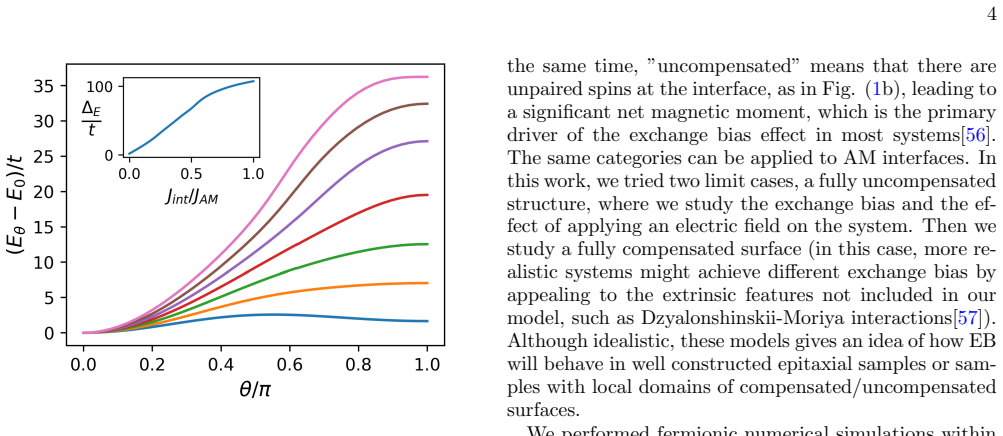
- [Sec. III E, Fig. 6] The compensated-surface claim is load-bearing and is not yet established. Section II explicitly states that the last altermagnetic row is a 'magnetically tunable layer', so the self-consistent mean-field solution need not preserve a strictly compensated interface. If the FM exchange field induces a net moment on that layer, the nonzero Heb has the usual uncompensated-surface origin rather than the proposed spin-split interference mechanism. The near-independence of Heb on Jint (Fig. 6b) does not exclude this, because a proximity-induced moment can also be controlled mainly by the FM stiffness. The authors should provide site-resolved spin profiles across the interface, the net interfacial magnetic moment as a function of Jint and JFM, and a system-size scaling for the compensated geometry. This diagnostic is necessary to support the statement in Sec. III E that the anisotropy is a bulk property rather than a surface-compensation artifact.
- [Sec. III D] The quantitative electric-field control of exchange bias rests on identifying the coercive fields with the condition that the energy difference between the up and down FM states equals the phenomenological domain-wall nucleation energy epsilon_180. No argument is given that this criterion, originally introduced for metallic AFM/FM films (refs [58,59]), applies to the present AM/FM interface, where the interfacial layer is explicitly described as magnetically soft and the reversal mechanism is asserted rather than demonstrated. The electric-field trends in Fig. 5 are therefore conditional on this criterion. The authors should either justify the transfer of epsilon_180 to altermagnetic interfaces or test an alternative reversal criterion (for example, local instability of the uniform state) and show whether the predicted Heb(E) behavior survives.
- [Sec. III C, Fig. 4] The hysteresis loops are generated by mean-field relaxation along a prescribed field path, but the paper does not specify the field-step protocol, the initialization and field-cooling procedure, or the convergence criteria for the self-consistent solution. Since Heb is defined as the midpoint of two coercive fields, even a small asymmetry in the reversal path could produce a spurious shift. The authors should state the exact protocol used to trace the loop, including the starting point, the direction of field sweeping, and the number of steps, and show representative order-parameter trajectories for both field directions to demonstrate that the coercive fields are well defined.
minor comments (6)
- [Abstract and Sec. I] The text uses 'alter-magnet' and 'all-fermion calculations'; please correct to 'altermagnet' and clarify what is meant by 'all-fermion' (e.g., 'fermionic many-body mean-field calculations').
- [Fig. 1 caption] The caption states that 'the last row of the altermagnet is commensurate with the first row of the altermagnet'; this should presumably read 'with the first row of the ferromagnet'.
- [Eq. (7)] The notation in Eq. (7) uses r both as a site index and as the position vector in the dot product with the electric field; please use explicit components (r_x, r_y) and a separate site index to remove the ambiguity.
- [Sec. III A and Fig. 2] In the sentence describing the band structure, the text refers to 'the square lattice Fig. (1b)' after already referring to the centered square lattice as Fig. (1b); the second reference should be to Fig. (1a), and the caption of Fig. 2 repeats this mislabeling.
- [Sec. III E] There are typographical errors in this section: 'varely dependent' should be 'barely dependent', and 'amisotropy' should be 'anisotropy'. Also, please state whether the zero exchange bias for the ferro-orbital-ordering case is zero within numerical precision.
- [Sec. II] The expression '[ H, Sr] = 0' should be typeset with a proper commutator bracket, and the definition of Sr in Eq. (6) uses the Pauli vector tau without indicating whether it acts in spin space; please make the notation consistent.
Circularity Check
No significant circularity; minor methodological self-citations are not load-bearing, and the epsilon180 nucleation parameter is an external input, not a fitted target.
full rationale
The derivation chain is not circular. Exchange bias is obtained by self-consistent mean-field relaxation of a Hamiltonian whose hopping parameters and interaction strengths are taken from the external model of Leeb et al. [21]; no parameter is fitted to the exchange-bias value or to the hysteresis midpoint. The reversal fields are defined by a domain-wall nucleation criterion with a phenomenological epsilon_180 taken from Cowburn et al. [59] and Zhan et al. [58]; this is an external, sample-dependent input that shifts quantitative magnitudes but does not construct the existence of Heb, and the paper's Fig. 6c explicitly shows weak sensitivity to it. The only self-citations are methodological: Sec. III B says 'The strategy is similar to the one in [52-54]' (papers co-authored by Nunez), and the introduction draws a motivational analogy to current-driven exchange bias via refs. [46-48]; neither carries the load of the compensated-surface claim. The central qualitative result of Sec. III E—nonzero Heb for a compensated altermagnetic interface—is a computed output of the model, and it is compared against the V<0 ferro-orbital-ordering case that gives zero exchange bias; this is a controlled model comparison, not a definitional equivalence. The paper itself flags the limitations a skeptical reader would raise: the last altermagnetic row is described as 'a magnetically tunable layer whose magnetization will fluctuate as it is subjected to external fields' (Sec. II), and epsilon_180 'depends typically on the sample used, being affected by impurities and other artifacts' (Sec. III D). Whether a proximity-induced interfacial moment rather than spin-density interference actually causes the compensated-surface shift is a physical-interpretation and validity question, not a circularity. No equation reduces to its own input by construction, and no fitted parameter is renamed as a prediction.
Assumptions & free parameters
free parameters (6)
- Interface exchange coupling Jint =
varied from 0 to 0.3 JAM
- Phenomenological domain-wall nucleation energy epsilon_180 =
not specified; varied in Fig 6c
- Spin exchange coupling J and orbital exchange coupling V in the altermagnet =
J = V = 3t in Fig 2; |V| = J = 3t in Fig 5
- Ferromagnetic exchange stiffness JFM =
JFM < JAM; varied in Fig 6a
- Filling / Fermi level =
half-, 1/4-, 3/4-filling in the phase diagram
- Two-orbital hopping parameters t1-t4 =
t1=-t, t2=-1.75t, t3=-0.85t, t4=-0.65t
assumptions (5)
- domain assumption Mean-field decoupling of the Heisenberg spin exchange (HJ) and Ising orbital exchange (HV) captures the interface physics.
- domain assumption The two-orbital square-lattice tight-binding model with the parameters of ref [21] is representative of real altermagnet/FM junctions.
- ad hoc to paper An applied electric field is represented by the local potential Delta_r = -e E dot (rx, ry, (-1)^r) l (Eq. 7), including a staggered out-of-plane component.
- ad hoc to paper The reversal fields are determined by the domain-wall nucleation criterion Delta E = epsilon_180 (Sec III D).
- domain assumption Spin is a good quantum number because the Hamiltonian contains no spin-orbit coupling.
Cite this review
Pith. "Pith review of Electrical Control of the Exchange Bias Effect at Model Ferromagnet-Altermagnet Junctions." pith.science (2026). https://pith.science/paper/ZU3E2YQK
@misc{pith2026250107716,
  author       = {Pith},
  title        = {Pith review of: Electrical Control of the Exchange Bias Effect at Model Ferromagnet-Altermagnet Junctions},
  year         = {2026},
  howpublished = {\url{https://pith.science/paper/ZU3E2YQK}},
  note         = {Machine review of arXiv:2501.07716}
}
read the original abstract
This work analyzes the behavior of the interface between a ferromagnetic material and an alter-magnet. We use a well-established line of arguments based on electronic mean-field calculations to show that new surface phenomena that lead to altermagnetic materials induce an exchange bias effect on the nearby ferromagnet. We reveal the physical mechanisms behind this phenomenon that lead to quantitative control over its strength. Interestingly, we predict exotic electric-field-induced phenomena. This is an analogy to the relationship between exchange bias and the injection of spin currents in spin-transfer-dominated scenarios, which has been reported earlier in the traditional antiferromagnetic/ferromagnetic junction.
Figures


Figures from the paper (3 more)


Reference graph
Works this paper leans on
-
[21]
Z. Feng, X. Zhou, L. ˇSmejkal, L. Wu, Z. Zhu, H. Guo, R. Gonz´ alez-Hern´ andez, X. Wang, H. Yan, P. Qin, X. Zhang, H. Wu, H. Chen, Z. Meng, L. Liu, Z. Xia, J. Sinova, T. Jungwirth, and Z. Liu, An anomalous hall effect in altermagnetic ruthenium dioxide, Nature Elec- tronics 5, 735–743 (2022)
work page 2022
-
[1]
(a) shows the dependence of exchange bias on the stiffness of the ferromagnet
that is more closely related to a normal antiferromagnet. (a) shows the dependence of exchange bias on the stiffness of the ferromagnet. (b) shows the dependence on the interface interaction between the two regions, with JF/JAM = 0.3. In (c) we show the dependence on the phenomenological factor of the energy necessary to nucleate the domain wall. ior of a...
-
[2]
X. Zhou, W. Feng, R.-W. Zhang, L. ˇSmejkal, J. Sinova, Y. Mokrousov, and Y. Yao, Crystal thermal transport in altermagnetic ruo 2, Physical review letters 132, 056701 (2024)
work page 2024
-
[3]
S. Reimers, L. Odenbreit, L. ˇSmejkal, V. N. Strocov, P. Constantinou, A. B. Hellenes, R. Jaeschke Ubiergo, W. H. Campos, V. K. Bharadwaj, A. Chakraborty, et al., Direct observation of altermagnetic band splitting in crsb thin films, Nature Communications 15, 2116 (2024)
work page 2024
-
[4]
Krempask` y, L
J. Krempask` y, L. ˇSmejkal, S. D’souza, M. Hajlaoui, G. Springholz, K. Uhl ´ ıˇ rov´ a, F. Alarab, P. Constantinou, V. Strocov, D. Usanov, et al., Altermagnetic lifting of kramers spin degeneracy, Nature 626, 517 (2024)
2024
-
[5]
O. Fedchenko, J. Min´ ar, A. Akashdeep, S. W. D’Souza, D. Vasilyev, O. Tkach, L. Odenbreit, Q. Nguyen, D. Kut- nyakhov, N. Wind, et al., Observation of time-reversal symmetry breaking in the band structure of altermag- netic ruo2, Science advances 10, eadj4883 (2024)
work page 2024
-
[6]
L. Bai, W. Feng, S. Liu, L. ˇSmejkal, Y. Mokrousov, and Y. Yao, Altermagnetism: Exploring new frontiers in mag- netism and spintronics, Advanced Functional Materials 34, 10.1002/adfm.202409327 (2024)
-
[7]
M. Hajlaoui, S. Wilfred D’Souza, L. ˇSmejkal, D. Krieg- ner, G. Krizman, T. Zakusylo, N. Olszowska, O. Caha, J. Michaliˇ cka, J. S´ anchez-Barriga, A. Marmodoro, K. V´ yborn´ y, A. Ernst, M. Cinchetti, J. Minar, T. Jung- wirth, and G. Springholz, Temperature dependence of relativistic valence band splitting induced by an al- termagnetic phase transition, ...
Show all 64 references
-
[8]
Hayami, Y
S. Hayami, Y. Yanagi, and H. Kusunose, Momentum- dependent spin splitting by collinear antiferromagnetic ordering, Journal of the Physical Society of Japan 88, 10.7566/jpsj.88.123702 (2019)
2019 doi
-
[9]
Hayami, Y
S. Hayami, Y. Yanagi, and H. Kusunose, Bottom-up de- sign of spin-split and reshaped electronic band structures in antiferromagnets without spin-orbit coupling: Proce- dure on the basis of augmented multipoles, Phys. Rev. B 102, 144441 (2020)
2020
-
[10]
ˇSmejkal, J
L. ˇSmejkal, J. Sinova, and T. Jungwirth, Emerging re- search landscape of altermagnetism, Phys. Rev. X 12, 040501 (2022)
2022
-
[11]
Aoyama and K
T. Aoyama and K. Ohgushi, Piezomagnetic properties in altermagnetic mnte, Phys. Rev. Mater. 8, L041402 (2024)
2024
-
[12]
Karube, T
S. Karube, T. Tanaka, D. Sugawara, N. Kadoguchi, M. Kohda, and J. Nitta, Observation of spin-splitter torque in collinear antiferromagnetic ruo 2, Phys. Rev. Lett. 129, 137201 (2022)
2022
-
[13]
ˇSmejkal, A
L. ˇSmejkal, A. Marmodoro, K.-H. Ahn, R. Gonz´ alez- Hern´ andez, I. Turek, S. Mankovsky, H. Ebert, S. W. D’Souza, O. c. v. ˇSipr, J. Sinova, and T. c. v. Jungwirth, Chiral magnons in altermagnetic ruo 2, Phys. Rev. Lett. 131, 256703 (2023)
2023
-
[14]
Z. Liu, M. Ozeki, S. Asai, S. Itoh, and T. Masuda, Chiral split magnon in altermagnetic mnte, Phys. Rev. Lett. 133, 156702 (2024)
2024
-
[15]
S. A. A. Ghorashi, T. L. Hughes, and J. Cano, Altermag- netic routes to majorana modes in zero net magnetiza- tion, Phys. Rev. Lett. 133, 106601 (2024)
2024
-
[16]
O. J. Amin, A. Dal Din, E. Golias, Y. Niu, A. Za- kharov, S. C. Fromage, C. J. B. Fields, S. L. Heywood, R. B. Cousins, F. Maccherozzi, J. Krempask´ y, J. H. Dil, D. Kriegner, B. Kiraly, R. P. Campion, A. W. Rushforth, K. W. Edmonds, S. S. Dhesi, L. ˇSmejkal, T. Jungwirth, and...
2024
-
[17]
Gomonay, V
O. Gomonay, V. P. Kravchuk, R. Jaeschke-Ubiergo, K. V. Yershov, T. Jungwirth, L. ˇSmejkal, J. v. d. Brink, and J. Sinova, Structure, control, and dynamics of altermag- netic textures, npj Spintronics 2, 10.1038/s44306-024- 00042-3 (2024)
2024 doi
-
[18]
Ferrari and R
F. Ferrari and R. Valent ´ ı, Altermagnetism on the shastry- sutherland lattice, Phys. Rev. B 110, 205140 (2024)
2024
-
[19]
D¨ urrnagel, H
M. D¨ urrnagel, H. Hohmann, A. Maity, J. Seufert, M. Klett, L. Klebl, and R. Thomale, Altermag- netic phase transition in a lieb metal, cond-mat 10.48550/ARXIV.2412.14251 (2024)
2024 doi
-
[20]
Cheong and F.-T
S.-W. Cheong and F.-T. Huang, Altermagnetism with non-collinear spins, npj Quantum Materials 9, 10.1038/s41535-024-00626-6 (2024)
2024 doi
-
[22]
V. Leeb, A. Mook, L. ˇSmejkal, and J. Knolle, Sponta- neous formation of altermagnetism from orbital ordering, Phys. Rev. Lett. 132, 236701 (2024)
2024
- [23]
-
[24]
Banerjee and M
S. Banerjee and M. S. Scheurer, Altermagnetic supercon- ducting diode effect, Phys. Rev. B 110, 024503 (2024). 8
2024
-
[25]
ˇSmejkal, A
L. ˇSmejkal, A. B. Hellenes, R. Gonz´ alez-Hern´ andez, J. Sinova, and T. Jungwirth, Giant and tunneling mag- netoresistance in unconventional collinear antiferromag- nets with nonrelativistic spin-momentum coupling, Phys. Rev. X 12, 011028 (2022)
2022
- [26]
-
[27]
M. Hu, O. Janson, C. Felser, P. McClarty, J. v. d. Brink, and M. G. Vergniory, Spin hall and edelstein effects in novel chiral noncollinear altermagnets, arXiv 10.48550/ARXIV.2410.17993 (2024)
2024 doi
- [28]
-
[29]
Binek, Ising-type Antiferromagnets (Springer Berlin Heidelberg, 2003)
C. Binek, Ising-type Antiferromagnets (Springer Berlin Heidelberg, 2003)
2003
-
[30]
Blachowicz, A
T. Blachowicz, A. Ehrmann, and M. Wortmann, Ex- change bias in nanostructures: An update, Nanomate- rials (Basel) 13 (2023)
2023
-
[31]
Nogu´ es and I
J. Nogu´ es and I. K. Schuller, Exchange bias, Journal of Magnetism and Magnetic Materials 192, 203 (1999)
1999
-
[32]
Nogu´ es, J
J. Nogu´ es, J. Sort, V. Langlais, V. Skumryev, S. Suri˜ nach, J. Mu˜ noz, and M. Bar´ o, Exchange bias in nanostructures, Physics reports 422, 65 (2005)
2005
-
[33]
Lin, B.-Y
P.-H. Lin, B.-Y. Yang, M.-H. Tsai, P.-C. Chen, K.- F. Huang, H.-H. Lin, and C.-H. Lai, Manipulating ex- change bias by spin–orbit torque, Nature Materials 18, 335 (2019)
2019
-
[34]
A. Kohn, A. Kov´ acs, R. Fan, G. McIntyre, R. Ward, and J. Goff, The antiferromagnetic structures of irmn3 and their influence on exchange-bias, Scientific reports 3, 1 (2013)
2013
-
[35]
S. K. Sharma, ed., Exchange bias, Monograph Series in Physical Sciences (CRC Press, London, England, 2021)
2021
-
[36]
R. Zhu, W. Zhang, W. Shen, P. K. J. Wong, Q. Wang, Q. Liang, Z. Tian, Y. Zhai, C.-w. Qiu, and A. T. Wee, Ex- change bias in van der waals crcl3/fe3gete2 heterostruc- tures, Nano Letters 20, 5030 (2020)
2020
-
[37]
M. U. Hasan, A. E. Kossak, and G. S. D. Beach, Large exchange bias enhancement and control of ferromagnetic energy landscape by solid-state hydrogen gating, Nature Communications 14, 10.1038/s41467-023-43955-z (2023)
2023 doi
-
[38]
B. Chen, X. Liu, Y. Li, H. Tay, T. Taniguchi, K. Watan- abe, M. H. Chan, J. Yan, F. Song, R. Cheng,et al., Even– odd layer-dependent exchange bias effect in mnbi2te4 chern insulator devices, Nano Letters 24, 8320 (2024)
2024
-
[39]
X. Bao, H. Yang, Y. Xie, J. Wang, R. He, P. Makushko, L. Pan, Y. Wang, J. Chen, M. Zou, et al., Flexible exchange-biased films with superior strain stability, Ad- vanced Functional Materials , 2409844 (2024)
2024
-
[40]
T. M. J. Cham, R. J. Dorrian, X. S. Zhang, A. H. Dis- mukes, D. G. Chica, A. F. May, X. Roy, D. A. Muller, D. C. Ralph, and Y. K. Luo, Exchange bias between van der waals materials: Tilted magnetic states and field- free spin–orbit-torque switching, Advanced Materials 36, 2305...
2024
-
[41]
S. M. Wu, S. A. Cybart, P. Yu, M. D. Rossell, J. X. Zhang, R. Ramesh, and R. C. Dynes, Reversible electric control of exchange bias in a multiferroic field-effect de- vice, Nature Materials 9, 756–761 (2010)
2010
-
[42]
O’Grady, L
K. O’Grady, L. Fernandez-Outon, and G. Vallejo- Fernandez, A new paradigm for exchange bias in poly- crystalline thin films, Journal of Magnetism and Mag- netic Materials 322, 883–899 (2010)
2010
-
[43]
M. U. Hasan and G. S. D. Beach, Disentangling nu- cleation and propagation of magnetization reversal in exchange-biased thin films, Phys. Rev. B 110, 064424 (2024)
2024
-
[44]
Kiwi, Exchange bias theory, Journal of Magnetism and Magnetic materials 234, 584 (2001)
M. Kiwi, Exchange bias theory, Journal of Magnetism and Magnetic materials 234, 584 (2001)
2001
-
[45]
R. L. Stamps, Mechanisms for exchange bias, Journal of Physics D: Applied Physics 33, R247–R268 (2000)
2000
-
[46]
D. Wang, H. Wang, L. Liu, J. Zhang, and H. Zhang, Electric-field-induced switchable two-dimensional alter- magnets, Nano Letters 10.1021/acs.nanolett.4c05384 (2024)
2024 doi
-
[47]
Z. Wei, A. Sharma, A. S. Nunez, P. M. Haney, R. A. Duine, J. Bass, A. H. MacDonald, and M. Tsoi, Chang- ing exchange bias in spin valves with an electric current, Phys. Rev. Lett. 98, 116603 (2007)
2007
-
[48]
A. H. MacDonald and M. Tsoi, Antiferromagnetic metal spintronics, Philosophical Transactions of the Royal Soci- ety A: Mathematical, Physical and Engineering Sciences 369, 3098–3114 (2011)
2011
-
[49]
Kim, S.-G
H.-J. Kim, S.-G. Je, D.-H. Jung, K.-S. Lee, and J.-I. Hong, Field-free control of exchange bias by spin hall cur- rents, Applied Physics Letters 115, 10.1063/1.5109967 (2019)
2019 doi
-
[50]
S. F. Weber, A. Urru, S. Bhowal, C. Ederer, and N. A. Spaldin, Surface magnetization in antiferromag- nets: Classification, example materials, and relation to magnetoelectric responses, Phys. Rev. X 14, 021033 (2024)
2024
-
[51]
I. V. Solovyev, R. Ono, and S. A. Nikolaev, Ferromag- netic ferroelectricity due to the kugel-khomskii mecha- nism of orbital ordering assisted by atomic hund’s second rule effects, Phys. Rev. B 110, 205116 (2024)
2024
-
[52]
Raghu, X.-L
S. Raghu, X.-L. Qi, C.-X. Liu, D. J. Scalapino, and S.-C. Zhang, Minimal two-band model of the superconducting iron oxypnictides, Phys. Rev. B 77, 220503 (2008)
2008
-
[53]
A. S. N´ u˜ nez, R. A. Duine, P. Haney, and A. H. MacDon- ald, Theory of spin torques and giant magnetoresistance in antiferromagnetic metals, Phys. Rev. B 73, 214426 (2006)
2006
-
[54]
P. M. Haney, D. Waldron, R. A. Duine, A. S. N´ u˜ nez, H. Guo, and A. H. MacDonald, Ab initio giant magne- toresistance and current-induced torques in Cr /Au/Cr multilayers, Phys. Rev. B 75, 174428 (2007)
2007
-
[55]
P. M. Haney, D. Waldron, R. A. Duine, A. S. N´ u˜ nez, H. Guo, and A. H. MacDonald, Current-induced or- der parameter dynamics: Microscopic theory applied to Co/Cu/Co spin valves, Phys. Rev. B 76, 024404 (2007)
2007
-
[56]
Auerbach, Interacting Electrons and Quantum Magnetism (Springer New York, 1994)
A. Auerbach, Interacting Electrons and Quantum Magnetism (Springer New York, 1994)
1994
-
[57]
Cheon, Z
M. Cheon, Z. Liu, and D. Lederman, Giant un- compensated magnetization and exchange bias in fexni1−xf2/co bilayers, Journal of Applied Physics 101, 10.1063/1.2670517 (2007)
2007 doi
-
[58]
S. Dong, K. Yamauchi, S. Yunoki, R. Yu, S. Liang, A. Moreo, J.-M. Liu, S. Picozzi, and E. Dagotto, Ex- change bias driven by the dzyaloshinskii-moriya interac- tion and ferroelectric polarization atg-type antiferromag- netic perovskite interfaces, Phys. Rev. Lett. 103, 127201 ...
2009
-
[59]
Q.-f. Zhan, W. Zhang, and K. M. Krishnan, Antiferro- magnetic layer thickness dependence of the magnetiza- tion reversal in the epitaxial mnpd/fe exchange bias sys- tem, Phys. Rev. B 83, 094404 (2011)
2011
-
[60]
Cowburn, S
R. Cowburn, S. Gray, and J. Bland, Multijump mag- netic switching in in-plane magnetized ultrathin epitax- ial ag/fe/ag (001) films, Physical review letters 79, 4018 (1997)
1997
-
[61]
Dal Din, O
A. Dal Din, O. J. Amin, P. Wadley, and K. W. Edmonds, Antiferromagnetic spintronics and beyond, npj Spintron- ics 2, 10.1038/s44306-024-00029-0 (2024)
2024 doi
-
[62]
Sun and J
C. Sun and J. Linder, Spin pumping from a ferromagnetic insulator into an altermagnet, Phys. Rev. B108, L140408 (2023)
2023
-
[63]
Zhang, C
R.-W. Zhang, C. Cui, R. Li, J. Duan, L. Li, Z.-M. Yu, and Y. Yao, Predictable gate-field control of spin in alter- magnets with spin-layer coupling, Phys. Rev. Lett. 133, 056401 (2024)
2024
-
[64]
Guo, X.-S
S.-D. Guo, X.-S. Guo, K. Cheng, K. Wang, and Y. S. Ang, Piezoelectric altermagnetism and spin-valley polar- ization in janus monolayer cr2so, Applied Physics Letters 123, 10.1063/5.0161431 (2023)
2023 doi
Reviewed August 10, 2026 · model on record in the stance chip above.
Discussion (0). Continue with ORCID to comment.