REVIEW 3 major objections 6 minor 87 references
Learning Motion and Temporal Cues for Unsupervised Video Object Segmentation
T0 review · 3 major / 6 minor · reviewed 2026-08-10 · deepseek-v4-flash
Pith's one-line read MTNet fuses motion and temporal cues to reach state of the art in unsupervised video object segmentation.
desk verdict MTNet is a competent real-time UVOS system with plausible SOTA numbers, but the inference protocol's silence about discarded tail frames puts the main comparison on shaky ground. read the letter →
The pith
A machine-rendered reading of the paper's core claim, the machinery that carries it, and where it could break.
The reading
What carries the argument
The central object is the MTNet architecture, whose three load-bearing components are the Bi-modal Fusion Module (BFM), the Mixed Temporal Transformer (MTT), and the Cascaded Transformer Decoder (CTD). BFM combines appearance and motion features inside each encoder stage using a multi-modal gate and co-attention; MTT stacks a local-window temporal transformer layer with a global temporal transformer layer that compresses keys and values to keep self-attention tractable; CTD progressively refines multi-level feature maps from deep to shallow. Together they carry the argument that motion cues and temporal context must be fused jointly, not sequentially, to track the primary object under occlusion and fast motion.
What would settle it
A direct falsifier would be an independent re-evaluation of MTNet and GSA on DAVIS-16 under identical inference settings (same clip length, same flow, no post-processing), checking whether the 0.7-point J&F gap persists; if it vanishes under a slightly different clip length or augmentation, the state-of-the-art claim would be protocol-dependent rather than architectural.
Extended reading notes
Core claim
The central claim is that a single end-to-end network can exploit both cross-modal (RGB plus optical flow) and cross-frame (temporal) information more effectively than prior methods that use one or the other. Concretely, MTNet's Bi-modal Fusion Module fuses appearance and motion features at every encoder stage using co-channel and co-spatial attention, while the Mixed Temporal Transformer combines a local-window temporal self-attention layer with a global summarization layer to capture long-range temporal dependencies. The Cascaded Transformer Decoder then propagates information from deep to shallow levels. On DAVIS-16 the method reports 89.7 J&F mean, beating GSA's 89.0, and on FBMS it reports 83.8 J mean, beating TMO's 79.9, with the ablation study attributing the gain to the joint use of all three components rather than to any single module.
Load-bearing premise
The reported state-of-the-art margins rely on the assumption that the comparison protocol is fair and stable: the re-measured baseline numbers and the shared training recipe (YouTube-VOS pretraining, DAVIS-16 fine-tuning, three-frame sampling) match those of the prior methods they are compared with.
Editorial extensions
If this is right
- MTNet's reported numbers on DAVIS-16, YouTube-Objects, FBMS, and Long-Videos suggest that joint motion-temporal fusion can replace heavier post-processing such as CRF or multi-scale testing without sacrificing accuracy.
- The method's clip-level inference at 43.4 fps on a 2080Ti indicates that a transformer-based temporal model can be practical for near-real-time UVOS, not just offline processing.
- The same network, without dataset-specific fine-tuning, transfers to video salient object detection on ViSal, SegTrack-V2, and DAVSOD, implying that the learned objectness and motion priors are task-generic.
- The ablation results imply that each of the three proposed modules contributes positively, with the full combination needed to reach the reported state-of-the-art numbers.
Reading between the lines
- The role of the Mixed Temporal Transformer could be tested more sharply by comparing against a plain 3D conv or a single non-local block with similar parameter count; the paper's ablation isolates modules but not the temporal attention mechanism itself.
- Because the method clips videos into fixed-length segments, the improvement on Long-Videos as clip length grows suggests a saturation point that, if mapped precisely, could tell whether longer-range memory beyond one clip would help or whether per-clip processing is enough.
- The robustness to ImageNet-C corruptions is tested only on DAVIS-16; extending the corruption protocol to FBMS and Long-Videos would clarify whether the reported robustness is specific to the benchmark's object scale and motion patterns.
- The paper's failure cases show confusion in multi-instance and crowded scenes, so a natural extension would be to add an explicit instance-discrimination or slot-based mechanism, which recent slot-attention UVOS methods already explore.
Editorial analysis
A structured set of objections, weighed in public.
Referee Report
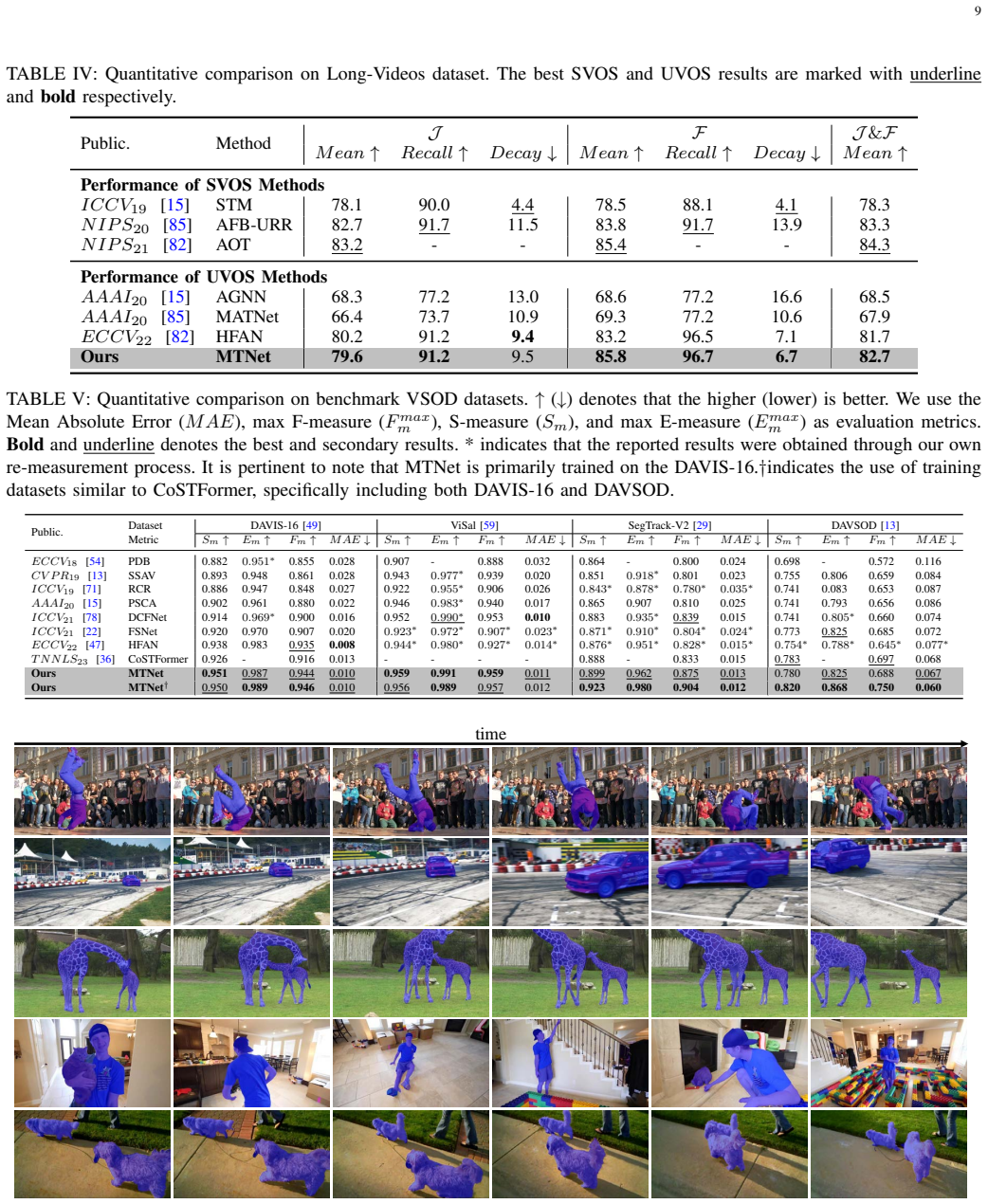
Summary. MTNet is a two-stream unsupervised video object segmentation architecture that fuses RGB and RAFT optical flow through a Bi-modal Fusion Module, models cross-frame dependencies with a Mixed Temporal Transformer, and refines multi-scale features via Cascaded Transformer Decoders. The paper reports state-of-the-art results on DAVIS-16 (J&F 89.7), FBMS (J mean 83.8), YouTube-Objects (J mean 74.6), and Long-Videos, plus competitive results on four VSOD benchmarks, with inference speed of 43.4 fps. The manuscript includes extensive ablations, robustness tests, visualizations, a failure-case analysis, and a link to source code.
Significance. Assuming the evaluation protocol is fair and fully specified, this is a solid empirical contribution. The architecture is a coherent combination of known components, the ablations in Table VI show that each proposed module contributes, and the robustness study in Fig. 7 and the failure analysis in Fig. 9 add useful evidence. The main risk is not the architecture itself but the measurement protocol: the inference rule C = floor(N/T) defined in Section IV-A.5 can discard trailing frames, which would make the headline comparisons with methods evaluated on full benchmark sequences unreliable. The paper also makes source code available, which is a reproducibility strength.
major comments (3)
- [IV-A.5 / Tables I and III] The inference protocol partitions a test video of N frames into C = floor(N/T) clips and obtains clip-level results directly, leaving N mod T frames unprocessed. The paper never states how these tail frames enter the reported J&F means. For example, a 30-frame DAVIS-16 sequence with T = 12 would have 6 of 30 frames excluded if the text is taken literally, so the reported 89.7 J&F in Table I would not be computed over the same frames as the 89.0 reported for GSA. The FBMS result in Table III is subject to the same ambiguity. Please specify the exact tail-frame handling (padding, overlapping clips, a final shorter clip, or deliberate exclusion), state the number of frames actually scored per benchmark, and provide results evaluated over all annotated frames.
- [IV-B / Table I] The central state-of-the-art claims rest on margins of 0.7 J&F on DAVIS-16 and 3.9 J mean on FBMS, but no error bars, confidence intervals, or number of training runs are reported. Because training uses random augmentations, stochastic clip sampling, and random initialization, a single run may not reliably establish superiority over GSA or TMO. Please report mean and standard deviation over at least three independent runs, or clearly justify why single-run benchmark numbers are sufficient under the evaluation protocol used.
- [IV-B.5 / Table V] The re-measured baseline numbers marked with asterisks in Table V are load-bearing for the VSOD comparisons, but the text gives no details about the re-measurement protocol, including preprocessing, clip length, frame coverage, and whether the same floor-based clip partitioning was used. Without these details, the reader cannot judge whether the improvements over HFAN and other methods are due to the architecture or to protocol differences. Please document the re-measurement settings, release the evaluation scripts, and clarify which entries were re-measured and under which exact conditions.
minor comments (6)
- [III-B, Eq. (1)] The text says the appearance and motion features are initially compressed with two separate 3x3 convolutional layers, but Eq. (1) and the subsequent definition of ConvS describe a 1x1 convolution; please reconcile the notation.
- [III-C] The local window dimension is described as 'T x W x W x d'; this should presumably read 'T x M x M x d' to match the stated windowing into H*W/M^2 windows.
- [Table IV] The citation labels in Table IV do not match the bibliography: STM is reference [4] rather than [15], AFB-URR is reference [33] rather than [85], AOT is reference [73] rather than [82], and HFAN is reference [47] rather than [82]. Please renumber the table entries.
- [Table I] In the DFNet row of Table I, the F Mean value '8.8' appears to be a typo, likely '88.0'; please verify all numeric entries for consistency with the metric definitions.
- [Conclusion / III-C] The module is called 'Mixed Temporal Transformer' in Section III-C but 'Mixed Temporal Module' in the conclusion; please use a single consistent name throughout.
- [Abstract and code link] Providing a commit hash or an archived version of the repository would improve reproducibility, since the current link points to an unversioned repository state.
Circularity Check
No circularity: MTNet's performance claims come from benchmark evaluation of an independently trained architecture, not from a derivation that assumes its conclusions.
full rationale
The paper's central claims are empirical: MTNet is trained with a BCE loss against ground-truth masks on YouTube-VOS and DAVIS-16 and then evaluated on held-out benchmarks (DAVIS-16 validation, FBMS test, YouTube-Objects, Long-Videos). No stated equation or module definition reduces a reported number to a fitted input. Hyperparameters such as lambda = 0.5 and test clip length t = 12 are set by hand or by ablation, and even if they were tuned on validation data, that would be standard model selection rather than circularity. The VSOD table's re-measured baselines are obtained 'employing the original testing codes and model weights in their projects' (Section IV-B.5), which is external evidence, not self-citation. The paper does not invoke a uniqueness theorem from the authors' own prior work, and although it follows HFAN for training details and RAFT for optical flow, those are external methods cited for procedure, not for the target result. The reviewer-flagged concern about clip partitioning (C = floor(N/T), Section IV-A.5, potentially discarding tail frames) is a possible evaluation-protocol fairness issue affecting comparability with baselines, but it is not circularity: the output masks are still produced by the trained network and scored by the official metric. No circular step can be exhibited, so the score is 0.
Assumptions & free parameters
free parameters (4)
- loss weight lambda =
0.5
- training clip length T =
3
- inference clip length t =
12
- encoder feature stages K =
4
assumptions (4)
- domain assumption Pretrained ConvNeXt weights and RAFT optical flow provide reliable feature extractors without task-specific adaptation.
- domain assumption Benchmark ground-truth masks are accurate and the evaluation metrics are uniformly applied.
- standard math Standard transformer attention, Softmax(QK^T / sqrt(d)) V, is a valid building block.
- domain assumption Pretraining on YouTube-VOS followed by fine-tuning on DAVIS-16 is a valid transfer setting that does not unfairly favor MTNet.
Cite this review
Pith. "Pith review of Learning Motion and Temporal Cues for Unsupervised Video Object Segmentation." pith.science (2026). https://pith.science/paper/FDVDUD73
@misc{pith2026250107806,
  author       = {Pith},
  title        = {Pith review of: Learning Motion and Temporal Cues for Unsupervised Video Object Segmentation},
  year         = {2026},
  howpublished = {\url{https://pith.science/paper/FDVDUD73}},
  note         = {Machine review of arXiv:2501.07806}
}
read the original abstract
In this paper, we address the challenges in unsupervised video object segmentation (UVOS) by proposing an efficient algorithm, termed MTNet, which concurrently exploits motion and temporal cues. Unlike previous methods that focus solely on integrating appearance with motion or on modeling temporal relations, our method combines both aspects by integrating them within a unified framework. MTNet is devised by effectively merging appearance and motion features during the feature extraction process within encoders, promoting a more complementary representation. To capture the intricate long-range contextual dynamics and information embedded within videos, a temporal transformer module is introduced, facilitating efficacious inter-frame interactions throughout a video clip. Furthermore, we employ a cascade of decoders all feature levels across all feature levels to optimally exploit the derived features, aiming to generate increasingly precise segmentation masks. As a result, MTNet provides a strong and compact framework that explores both temporal and cross-modality knowledge to robustly localize and track the primary object accurately in various challenging scenarios efficiently. Extensive experiments across diverse benchmarks conclusively show that our method not only attains state-of-the-art performance in unsupervised video object segmentation but also delivers competitive results in video salient object detection. These findings highlight the method's robust versatility and its adeptness in adapting to a range of segmentation tasks. Source code is available on https://github.com/hy0523/MTNet.
Figures


Figures from the paper (5 more)


Reference graph
Works this paper leans on
-
[85]
Motion-attentive transition for zero- shot video object segmentation
Tianfei Zhou et al. “Motion-attentive transition for zero- shot video object segmentation”. In: Proceedings of the AAAI conference on artificial intelligence . 2020, pp. 13066–13073
work page 2020
-
[1]
Frequency-tuned salient region detection
Radhakrishna Achanta et al. “Frequency-tuned salient region detection”. In: IEEE Conf. Comput. Vis. Pattern Recog. IEEE. 2009, pp. 1597–1604
2009
-
[2]
Is space-time attention all you need for video under- standing?
Gedas Bertasius, Heng Wang, and Lorenzo Torresani. “Is space-time attention all you need for video under- standing?” In: Int. Conf. Mach. Learn. V ol. 2. 3. 2021, p. 4
2021
-
[3]
The 2019 davis challenge on vos: Unsupervised multi-object segmentation
Sergi Caelles et al. “The 2019 davis challenge on vos: Unsupervised multi-object segmentation”. In:arXiv preprint arXiv:1905.00737 (2019)
arXiv 2019
-
[4]
Re- thinking space-time networks with improved memory coverage for efficient video object segmentation
Ho Kei Cheng, Yu-Wing Tai, and Chi-Keung Tang. “Re- thinking space-time networks with improved memory coverage for efficient video object segmentation”. In: Adv. Neural Inform. Process. Syst. (2021), pp. 11781– 11794
2021
-
[5]
Structure- measure: A new way to evaluate foreground maps
Ming-Ming Cheng and Deng-Ping Fan. “Structure- measure: A new way to evaluate foreground maps”. In: Int. J. Comput. Vis. (2021), pp. 2622–2638
2021
-
[6]
Dual Prototype Attention for Unsupervised Video Object Segmentation
Suhwan Cho et al. “Domain Alignment and Temporal Aggregation for Unsupervised Video Object Segmenta- tion”. In: arXiv preprint arXiv:2211.12036 (2022)
work page Pith review arXiv 2022
-
[7]
Treating motion as option to re- duce motion dependency in unsupervised video object segmentation
Suhwan Cho et al. “Treating motion as option to re- duce motion dependency in unsupervised video object segmentation”. In: IEEE Int. Conf. Appli. Comp. Vision. 2023, pp. 5140–5149
2023
Show all 87 references
-
[8]
High-performance long-term track- ing with meta-updater
Kenan Dai et al. “High-performance long-term track- ing with meta-updater”. In: IEEE Conf. Comput. Vis. Pattern Recog. 2020, pp. 6298–6307
2020
-
[9]
FEANet: Feature-enhanced attention network for RGB-thermal real-time semantic segmen- tation
Fuqin Deng et al. “FEANet: Feature-enhanced attention network for RGB-thermal real-time semantic segmen- tation”. In: Int. Conf. Intel. Robots Syst. IEEE. 2021, pp. 4467–4473
2021
-
[10]
Scaling up your kernels to 31x31: Revisiting large kernel design in cnns
Xiaohan Ding et al. “Scaling up your kernels to 31x31: Revisiting large kernel design in cnns”. In: IEEE Conf. Comput. Vis. Pattern Recog. 2022, pp. 11963–11975
2022
-
[11]
An image is worth 16x16 words: Transformers for image recognition at scale
Alexey Dosovitskiy et al. “An image is worth 16x16 words: Transformers for image recognition at scale”. In: Int. Conf. Learn. Represent. 2020
2020
-
[12]
Enhanced-alignment measure for binary foreground map evaluation
Deng-Ping Fan et al. “Enhanced-alignment measure for binary foreground map evaluation”. In: arXiv preprint arXiv:1805.10421 (2018)
2018 arXiv
-
[13]
Shifting more attention to video salient object detection
Deng-Ping Fan et al. “Shifting more attention to video salient object detection”. In: IEEE Conf. Comput. Vis. Pattern Recog. 2019, pp. 8554–8564
2019
-
[14]
Multiscale vision transformers
Haoqi Fan et al. “Multiscale vision transformers”. In: Int. Conf. Comput. Vis. 2021, pp. 6824–6835
2021
-
[15]
Pyramid constrained self-attention network for fast video salient object detection
Yuchao Gu et al. “Pyramid constrained self-attention network for fast video salient object detection”. In: AAAI Conf. Arti. Intell. 2020, pp. 10869–10876
2020
-
[16]
Cmt: Convolutional neural net- works meet vision transformers
Jianyuan Guo et al. “Cmt: Convolutional neural net- works meet vision transformers”. In: IEEE Conf. Com- put. Vis. Pattern Recog. 2022, pp. 12175–12185
2022
-
[17]
Benchmarking neural network robustness to common corruptions and perturbations
Dan Hendrycks and Thomas Dietterich. “Benchmarking neural network robustness to common corruptions and perturbations”. In: Int. Conf. Learn. Represent. 2019
2019
-
[18]
Squeeze-and- excitation networks
Jie Hu, Li Shen, and Gang Sun. “Squeeze-and- excitation networks”. In: IEEE Conf. Comput. Vis. Pat- tern Recog. 2018, pp. 7132–7141
2018
-
[19]
Goal-oriented Autonomous Driving
Yihan Hu et al. “Goal-oriented Autonomous Driving”. In: IEEE Conf. Comput. Vis. Pattern Recog. 2023
2023
-
[20]
Unsupervised video object segmentation us- ing motion saliency-guided spatio-temporal propaga- tion
Yuan-Ting Hu, Jia-Bin Huang, and Alexander G Schwing. “Unsupervised video object segmentation us- ing motion saliency-guided spatio-temporal propaga- tion”. In: Eur. Conf. Comput. Vis. 2018, pp. 786–802
2018
-
[21]
Video instance segmentation us- ing inter-frame communication transformers
Sukjun Hwang et al. “Video instance segmentation us- ing inter-frame communication transformers”. In: Adv. Neural Inform. Process. Syst. (2021), pp. 13352–13363
2021
-
[22]
Full-duplex strategy for video ob- ject segmentation
Ge-Peng Ji et al. “Full-duplex strategy for video ob- ject segmentation”. In: Int. Conf. Comput. Vis. 2021, pp. 4922–4933
2021
-
[23]
CASNet: A cross-attention siamese net- work for video salient object detection
Yuzhu Ji et al. “CASNet: A cross-attention siamese net- work for video salient object detection”. In: IEEE Trans. Neural Netw. Learn. Syst. 32.6 (2020), pp. 2676–2690. DOI: 10.1109/TNNLS.2020.3007534
2020
-
[24]
Efficient in- ference in fully connected crfs with gaussian edge po- tentials
Philipp Kr ¨ahenb¨uhl and Vladlen Koltun. “Efficient in- ference in fully connected crfs with gaussian edge po- tentials”. In: Adv. Neural Inform. Process. Syst. (2011)
2011
-
[25]
Guided Slot Attention for Unsu- pervised Video Object Segmentation
Minhyeok Lee et al. “Guided Slot Attention for Unsu- pervised Video Object Segmentation”. In: Proceedings of the IEEE/CVF conference on computer vision and pattern recognition. 2024
2024
-
[26]
Unsupervised Video Object Seg- mentation via Prototype Memory Network
Minhyeok Lee et al. “Unsupervised Video Object Seg- mentation via Prototype Memory Network”. In: IEEE Int. Conf. Appli. Comp. Vision . 2023, pp. 5924–5934
2023
-
[27]
Tsanet: Temporal and Scale Alignment for Unsupervised Video Object Segmenta- tion
Seunghoon Lee et al. “Tsanet: Temporal and Scale Alignment for Unsupervised Video Object Segmenta- tion”. In: 2023 IEEE International Conference on Image Processing (ICIP). IEEE. 2023, pp. 1535–1539
2023
-
[28]
Itera- tively selecting an easy reference frame makes unsu- pervised video object segmentation easier
Youngjo Lee, Hongje Seong, and Euntai Kim. “Itera- tively selecting an easy reference frame makes unsu- pervised video object segmentation easier”. In: AAAI Conf. Arti. Intell. 2022, pp. 1245–1253
2022
-
[29]
Video segmentation by tracking many figure-ground segments
Fuxin Li et al. “Video segmentation by tracking many figure-ground segments”. In: Int. Conf. Comput. Vis. 2013, pp. 2192–2199
2013
-
[30]
Self Supervised Progressive Network for High Performance Video Object Segmentation
Guorong Li et al. “Self Supervised Progressive Network for High Performance Video Object Segmentation”. In: IEEE Trans. Neural Netw. Learn. Syst. (2022). 14
2022
-
[31]
Efficient long-short temporal attention network for unsupervised video object segmentation
Ping Li et al. “Efficient long-short temporal attention network for unsupervised video object segmentation”. In: Pattern Recognition 146 (2024), p. 110078
2024
-
[32]
Instance embedding transfer to un- supervised video object segmentation
Siyang Li et al. “Instance embedding transfer to un- supervised video object segmentation”. In: IEEE Conf. Comput. Vis. Pattern Recog. 2018, pp. 6526–6535
2018
-
[33]
Video object segmentation with adaptive feature bank and uncertain-region refinement
Yongqing Liang et al. “Video object segmentation with adaptive feature bank and uncertain-region refinement”. In: Adv. Neural Inform. Process. Syst. (2020), pp. 3430– 3441
2020
-
[34]
F2net: Learning to focus on the fore- ground for unsupervised video object segmentation
Daizong Liu et al. “F2net: Learning to focus on the fore- ground for unsupervised video object segmentation”. In: AAAI Conf. Arti. Intell. 2021, pp. 2109–2117
2021
-
[35]
CMX: Cross-modal fusion for RGB- X semantic segmentation with transformers
Huayao Liu et al. “CMX: Cross-modal fusion for RGB- X semantic segmentation with transformers”. In: arXiv preprint arXiv:2203.04838 (2022)
2022 arXiv
-
[36]
Learning Complementary Spatial- Temporal Transformer for Video Salient Object Detec- tion
Nian Liu et al. “Learning Complementary Spatial- Temporal Transformer for Video Salient Object Detec- tion”. In: IEEE Trans. Neural Netw. Learn. Syst. (2023), pp. 1–11. DOI: 10.1109/TNNLS.2023.3243246
2023
-
[37]
A survey of visual transformers
Yang Liu et al. “A survey of visual transformers”. In: IEEE Trans. Neural Netw. Learn. Syst. (2023)
2023
-
[38]
Swin transformer: Hierarchical vision transformer using shifted windows
Ze Liu et al. “Swin transformer: Hierarchical vision transformer using shifted windows”. In: Int. Conf. Com- put. Vis. 2021, pp. 10012–10022
2021
-
[39]
Video swin transformer
Ze Liu et al. “Video swin transformer”. In: IEEE Conf. Comput. Vis. Pattern Recog. 2022, pp. 3202–3211
2022
-
[40]
A convnet for the 2020s
Zhuang Liu et al. “A convnet for the 2020s”. In: IEEE Conf. Comput. Vis. Pattern Recog. 2022, pp. 11976– 11986
2022
-
[41]
Fully convolutional networks for semantic segmenta- tion
Jonathan Long, Evan Shelhamer, and Trevor Darrell. “Fully convolutional networks for semantic segmenta- tion”. In: IEEE Conf. Comput. Vis. Pattern Recog.2015, pp. 3431–3440
2015
-
[42]
Learning video object segmenta- tion from unlabeled videos
Xiankai Lu et al. “Learning video object segmenta- tion from unlabeled videos”. In: Proceedings of the IEEE/CVF conference on computer vision and pattern recognition. 2020, pp. 8960–8970
2020
-
[43]
See more, know more: Unsupervised video object segmentation with co-attention siamese networks
Xiankai Lu et al. “See more, know more: Unsupervised video object segmentation with co-attention siamese networks”. In: IEEE Conf. Comput. Vis. Pattern Recog. 2019, pp. 3623–3632
2019
-
[44]
Mixed precision training
Paulius Micikevicius et al. “Mixed precision training”. In: arXiv preprint arXiv:1710.03740 (2017)
2017 arXiv
-
[45]
Seg- mentation of moving objects by long term video analy- sis
Peter Ochs, Jitendra Malik, and Thomas Brox. “Seg- mentation of moving objects by long term video analy- sis”. In: IEEE Trans. Pattern Anal. Mach. Intell. (2013), pp. 1187–1200
2013
-
[46]
Fast object segmentation in unconstrained video
Anestis Papazoglou and Vittorio Ferrari. “Fast object segmentation in unconstrained video”. In: Int. Conf. Comput. Vis. 2013, pp. 1777–1784
2013
-
[47]
Hierarchical feature alignment net- work for unsupervised video object segmentation
Gensheng Pei et al. “Hierarchical feature alignment net- work for unsupervised video object segmentation”. In: Eur. Conf. Comput. Vis. Springer. 2022, pp. 596–613
2022
-
[48]
Hierarchical Graph Pattern Under- standing for Zero-Shot Video Object Segmentation
Gensheng Pei et al. “Hierarchical Graph Pattern Under- standing for Zero-Shot Video Object Segmentation”. In: IEEE Trans. Image Process. 32 (2023), pp. 5909–5920. DOI: 10.1109/TIP.2023.3326395
2023
-
[49]
A benchmark dataset and evaluation methodology for video object segmentation
Federico Perazzi et al. “A benchmark dataset and evaluation methodology for video object segmentation”. In: IEEE Conf. Comput. Vis. Pattern Recog. 2016, pp. 724–732
2016
-
[50]
Saliency filters: Contrast based filtering for salient region detection
Federico Perazzi et al. “Saliency filters: Contrast based filtering for salient region detection”. In: IEEE Conf. Comput. Vis. Pattern Recog. IEEE. 2012, pp. 733–740
2012
-
[51]
Learning object class detectors from weakly annotated video
Alessandro Prest et al. “Learning object class detectors from weakly annotated video”. In: IEEE Conf. Comput. Vis. Pattern Recog. IEEE. 2012, pp. 3282–3289
2012
-
[52]
Optical flow augmented seman- tic segmentation networks for automated driving
Hazem Rashed et al. “Optical flow augmented seman- tic segmentation networks for automated driving”. In: arXiv preprint arXiv:1901.07355 (2019)
2019 arXiv
-
[53]
Reciprocal transformations for un- supervised video object segmentation
Sucheng Ren et al. “Reciprocal transformations for un- supervised video object segmentation”. In: IEEE Conf. Comput. Vis. Pattern Recog. 2021, pp. 15455–15464
2021
-
[54]
Pyramid dilated deeper convl- stm for video salient object detection
Hongmei Song et al. “Pyramid dilated deeper convl- stm for video salient object detection”. In: Eur. Conf. Comput. Vis. 2018, pp. 715–731
2018
-
[55]
Raft: Recurrent all-pairs field transforms for optical flow
Zachary Teed and Jia Deng. “Raft: Recurrent all-pairs field transforms for optical flow”. In: Eur. Conf. Com- put. Vis. Springer. 2020, pp. 402–419
2020
-
[56]
Learning video object segmentation with visual memory
Pavel Tokmakov, Karteek Alahari, and Cordelia Schmid. “Learning video object segmentation with visual memory”. In: Int. Conf. Comput. Vis. 2017, pp. 4481–4490
2017
-
[57]
Attention is all you need
Ashish Vaswani et al. “Attention is all you need”. In: Adv. Neural Inform. Process. Syst. (2017)
2017
-
[58]
MASK-RL: Multiagent video object segmentation framework through reinforcement learning
Giuseppe Vecchio et al. “MASK-RL: Multiagent video object segmentation framework through reinforcement learning”. In: IEEE Trans. Neural Netw. Learn. Syst. (2020), pp. 5103–5115
2020
-
[59]
Con- sistent video saliency using local gradient flow opti- mization and global refinement
Wenguan Wang, Jianbing Shen, and Ling Shao. “Con- sistent video saliency using local gradient flow opti- mization and global refinement”. In: IEEE Trans. Image Process. (2015), pp. 4185–4196
2015
-
[60]
Video salient object detection via fully convolutional net- works
Wenguan Wang, Jianbing Shen, and Ling Shao. “Video salient object detection via fully convolutional net- works”. In: IEEE Trans. Image Process. (2017), pp. 38– 49
2017
-
[61]
Learning unsupervised video object segmentation through visual attention
Wenguan Wang et al. “Learning unsupervised video object segmentation through visual attention”. In: IEEE Conf. Comput. Vis. Pattern Recog. 2019, pp. 3064– 3074
2019
-
[62]
Saliency-aware video object seg- mentation
Wenguan Wang et al. “Saliency-aware video object seg- mentation”. In: IEEE transactions on pattern analysis and machine intelligence 40.1 (2017), pp. 20–33
2017
-
[63]
Salient object detection in the deep learning era: An in-depth survey
Wenguan Wang et al. “Salient object detection in the deep learning era: An in-depth survey”. In: IEEE Trans- actions on Pattern Analysis and Machine Intelligence 44.6 (2021), pp. 3239–3259
2021
-
[64]
Zero-shot video object segmenta- tion via attentive graph neural networks
Wenguan Wang et al. “Zero-shot video object segmenta- tion via attentive graph neural networks”. In: Int. Conf. Comput. Vis. 2019, pp. 9236–9245
2019
-
[65]
Pyramid vision transformer: A versatile backbone for dense prediction without convo- lutions
Wenhai Wang et al. “Pyramid vision transformer: A versatile backbone for dense prediction without convo- lutions”. In: Int. Conf. Comput. Vis. 2021, pp. 568–578. 15
2021
-
[66]
Non-local neural networks
Xiaolong Wang et al. “Non-local neural networks”. In: IEEE Conf. Comput. Vis. Pattern Recog. 2018, pp. 7794–7803
2018
-
[67]
Multimodal token fusion for vision transformers
Yikai Wang et al. “Multimodal token fusion for vision transformers”. In: IEEE Conf. Comput. Vis. Pattern Recog. 2022, pp. 12186–12195
2022
-
[68]
End-to-end video instance segmen- tation with transformers
Yuqing Wang et al. “End-to-end video instance segmen- tation with transformers”. In: IEEE Conf. Comput. Vis. Pattern Recog. 2021, pp. 8741–8750
2021
-
[69]
Youtube-vos: Sequence-to-sequence video object segmentation
Ning Xu et al. “Youtube-vos: Sequence-to-sequence video object segmentation”. In: Eur. Conf. Comput. Vis. 2018, pp. 585–601
2018
-
[70]
Video enhancement with task- oriented flow
Tianfan Xue et al. “Video enhancement with task- oriented flow”. In: Int. J. Comput. Vis.(2019), pp. 1106– 1125
2019
-
[71]
Semi-supervised video salient object detection using pseudo-labels
Pengxiang Yan et al. “Semi-supervised video salient object detection using pseudo-labels”. In: Int. Conf. Comput. Vis. 2019, pp. 7284–7293
2019
-
[72]
Learning motion-appearance co- attention for zero-shot video object segmentation
Shu Yang et al. “Learning motion-appearance co- attention for zero-shot video object segmentation”. In: Int. Conf. Comput. Vis. 2021, pp. 1564–1573
2021
-
[73]
Associating objects with transformers for video object segmenta- tion
Zongxin Yang, Yunchao Wei, and Yi Yang. “Associating objects with transformers for video object segmenta- tion”. In: Adv. Neural Inform. Process. Syst. (2021), pp. 2491–2502
2021
-
[74]
Directional deep embedding and appearance learning for fast video object segmentation
Yingjie Yin et al. “Directional deep embedding and appearance learning for fast video object segmentation”. In: IEEE Trans. Neural Netw. Learn. Syst. (2021), pp. 3884–3894
2021
-
[75]
Learning joint spatial-temporal transformations for video inpainting
Yanhong Zeng, Jianlong Fu, and Hongyang Chao. “Learning joint spatial-temporal transformations for video inpainting”. In: Eur. Conf. Comput. Vis. Springer. 2020, pp. 528–543
2020
-
[76]
Adaptive semantic-enhanced trans- former for image captioning
Jing Zhang et al. “Adaptive semantic-enhanced trans- former for image captioning”. In: IEEE Trans. Neural Netw. Learn. Syst. (2022), pp. 1–12. DOI: 10 . 1109 / TNNLS.2022.3185320
2022
-
[77]
Deep transport network for un- supervised video object segmentation
Kaihua Zhang et al. “Deep transport network for un- supervised video object segmentation”. In: Int. Conf. Comput. Vis. 2021, pp. 8781–8790
2021
-
[78]
Dynamic context-sensitive filtering network for video salient object detection
Miao Zhang et al. “Dynamic context-sensitive filtering network for video salient object detection”. In: Int. Conf. Comput. Vis. 2021, pp. 1553–1563
2021
-
[79]
Learning regression and verifica- tion networks for robust long-term tracking
Yunhua Zhang et al. “Learning regression and verifica- tion networks for robust long-term tracking”. In: Int. J. Comput. Vis. (2021), pp. 2536–2547
2021
-
[80]
Mitigating modality discrepancies for RGB-T semantic segmentation
Shenlu Zhao et al. “Mitigating modality discrepancies for RGB-T semantic segmentation”. In: IEEE Trans. Neural Netw. Learn. Syst. (2023)
2023
-
[81]
Multi-source fusion and automatic predictor selection for zero-shot video object segmenta- tion
Xiaoqi Zhao et al. “Multi-source fusion and automatic predictor selection for zero-shot video object segmenta- tion”. In: ACM Int. Conf. Multimedia . 2021, pp. 2645– 2653
2021
-
[82]
Learning discriminative feature with crf for unsupervised video object segmentation
Mingmin Zhen et al. “Learning discriminative feature with crf for unsupervised video object segmentation”. In: Eur. Conf. Comput. Vis. Springer. 2020, pp. 445– 462
2020
-
[83]
Self-teaching video object seg- mentation
Chuanwei Zhou et al. “Self-teaching video object seg- mentation”. In: IEEE Trans. Neural Netw. Learn. Syst. (2021), pp. 1623–1637
2021
-
[84]
A survey on deep learning tech- nique for video segmentation
Tianfei Zhou et al. “A survey on deep learning tech- nique for video segmentation”. In: IEEE transactions on pattern analysis and machine intelligence 45.6 (2022), pp. 7099–7122
2022
-
[86]
Deep feature flow for video recogni- tion
Xizhou Zhu et al. “Deep feature flow for video recogni- tion”. In: IEEE Conf. Comput. Vis. Pattern Recog.2017, pp. 2349–2358
2017
-
[87]
Perception-aware multi- sensor fusion for 3d lidar semantic segmentation
Zhuangwei Zhuang et al. “Perception-aware multi- sensor fusion for 3d lidar semantic segmentation”. In: Int. Conf. Comput. Vis. 2021, pp. 16280–16290
2021
Reviewed August 10, 2026 · model on record in the stance chip above.
Discussion (0). Continue with ORCID to comment.