REVIEW 3 major objections 5 minor 1 cited by
The VMC Survey : LI. Classifying extragalactic sources using a probabilistic random forest supervised machine learning algorithm
T0 review · 3 major / 5 minor · reviewed 2026-08-10 · deepseek-v4-flash
Pith's one-line read A probabilistic random forest sorts 130 million Magellanic Cloud sources into stars, galaxies, and AGN, recovering 77,600 extragalactic sources including 49,500 new AGN candidates.
desk verdict A solid, honest ML classification of the VMC catalogue with useful new AGN/galaxy samples; headline accuracies are proven only for bright spectroscopic sources, so the faint-tail counts are the main caveat. read the letter →
The pith
A machine-rendered reading of the paper's core claim, the machinery that carries it, and where it could break.
The reading
What carries the argument
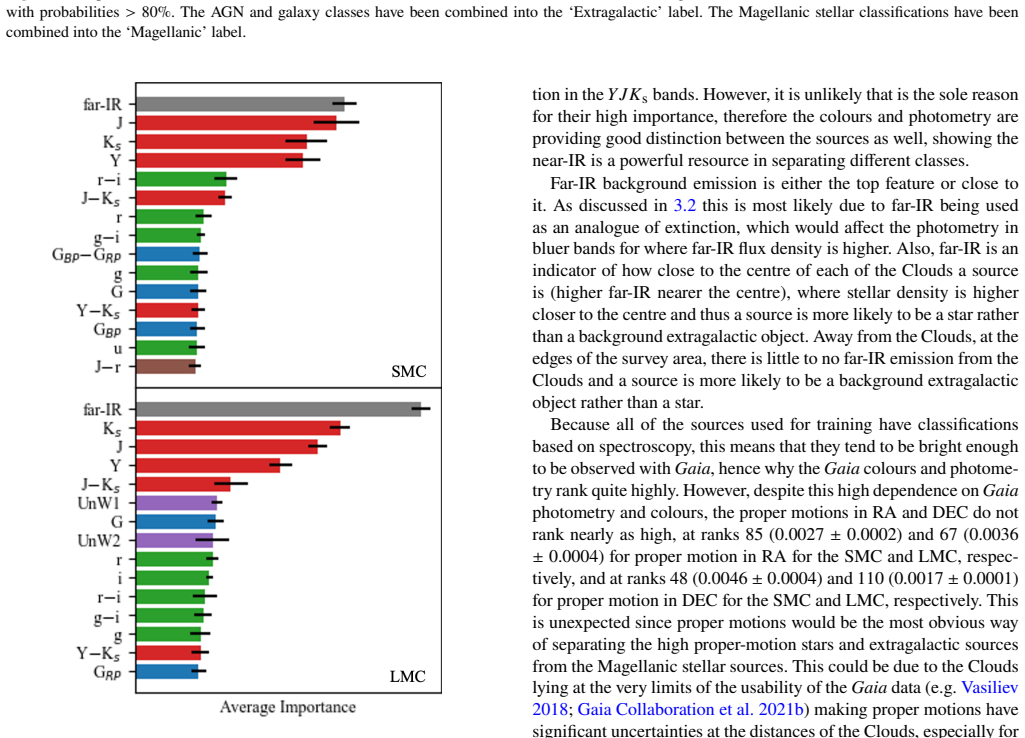
The load-bearing mechanism is the probabilistic random forest (PRF), a random-forest variant that handles missing data by propagating each object down both branches of a decision node, weighted by the probability that each path is correct, and that outputs a probability per class rather than a single hard label. Around it the paper builds a 237-dimensional feature space: magnitudes, photometric errors, point-spread-function sharpness values, Gaia proper motions, colours formed from all pairwise band differences, and the local far-infrared background at 250 microns, which acts as a proxy for extinction and for how close a source sits to the centre of a Cloud. A deliberately unstructured 'Unknown' class, formed by randomly drawing sources from the VMC catalogues themselves, absorbs anything the spectroscopic training set does not represent; this is what lets the pipeline report honest confidence, because the faint majority of sources land in Unknown while the headline extragalactic counts come from the subset with class probability above 80%.
What would settle it
Spectroscopically observe a random sample of the PRF's high-confidence AGN and galaxy candidates in the faint regime where the training set is thinnest (for example $G > 18.8$ mag or $K_s > 18$ mag) and measure the confirmation rate. If that rate falls far below the ~90–98% accuracy quoted for the bright test set, the headline extragalactic counts would be inflated.
Extended reading notes
Core claim
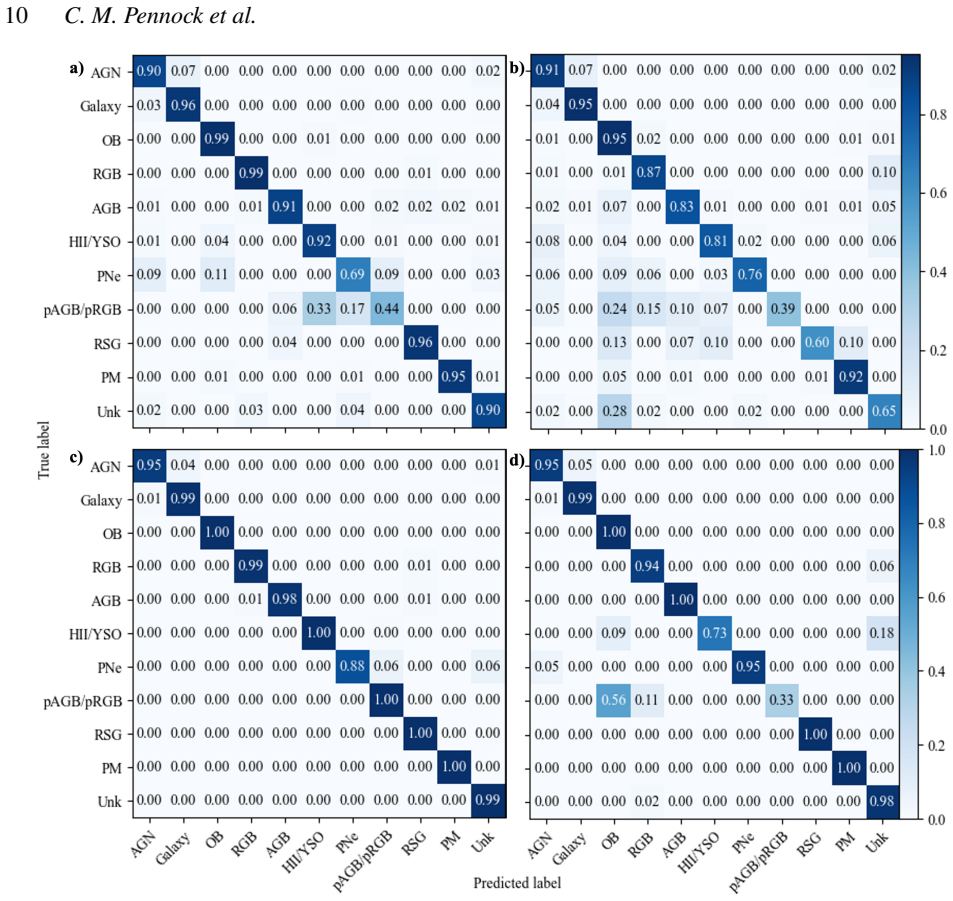
The paper's central claim is that the probabilistic random forest assigns reliable astrophysical labels, with honest per-class probabilities, to essentially the whole VMC catalogue. The authors report average test-set accuracies of $0.79 \pm 0.01$ (SMC) and $0.87 \pm 0.01$ (LMC), rising to $0.90$ and $0.98$ when restricted to sources with $P_{\rm class} > 80\%$, and they report that 99.8–99.9% of true extragalactic test sources are placed into extragalactic classes at high confidence. After removing the Unknown class they classify 707,939 (SMC) and 397,899 (LMC) sources at high confidence, of which more than 77,600 are extragalactic: over 49,500 previously unknown AGN candidates, over 26,500 new galaxy candidates, and over 2,800 new young-stellar-object candidates. Independent checks support the physical content of the labels: the majority of X-ray sources (554/883) are classified as AGN, the majority of radio sources (1756/2694) as AGN with a further 659/2694 as galaxies, and about 86% of the spectroscopically confirmed quasars in the Quaia catalogue receive AGN labels.
Load-bearing premise
The spectroscopically confirmed training sources are taken to represent the entire 130-million-source catalogue, even though spectroscopy is systematically biased toward bright objects; the reported ~79–87% and ~90–98% accuracies are measured only on that brighter test split, so the accuracy on the faint majority of the catalogue is not directly known.
Editorial extensions
If this is right
- More than 49,500 previously unknown AGN candidates, over 26,500 new galaxy candidates, and over 2,800 new young-stellar-object candidates become prioritized targets for spectroscopic follow-up.
- Radio and X-ray detected sources are predominantly classified as AGN or galaxies, providing reliable multi-wavelength counterparts and tentative AGN labels for X-ray- or radio-detected Unknowns.
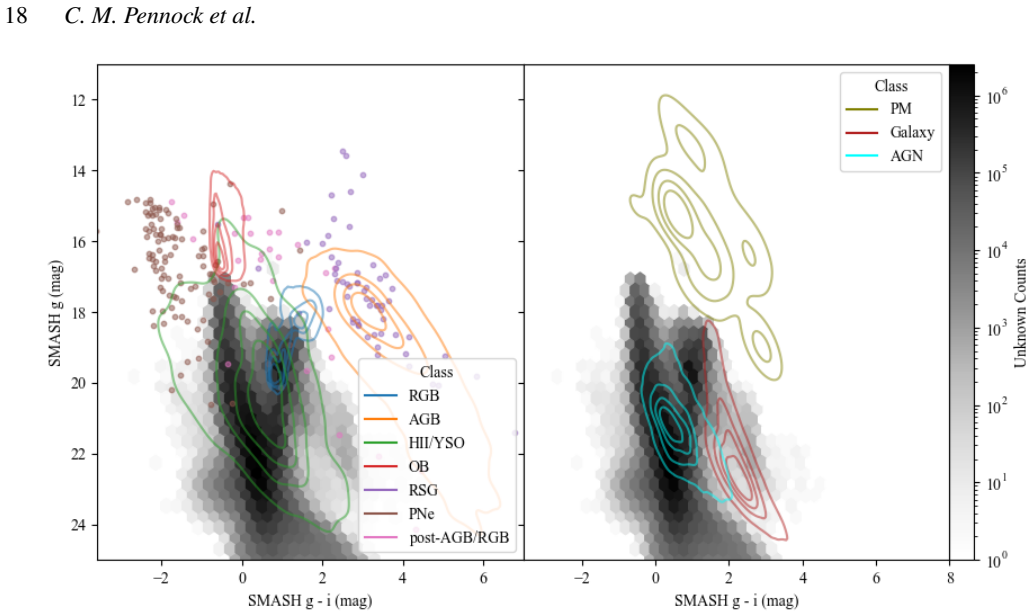
- The spatial distributions match physical expectation — extragalactic sources spread uniformly, Magellanic stellar sources concentrate toward the Cloud centres — which supports the validity of the labels for population studies.
- Stellar classes absent from the training set (Wolf-Rayet stars, R Coronae Borealis stars, supernova remnants) are classified as other stellar classes rather than as extragalactic, implying low stellar contamination of the AGN and galaxy samples.
- The Unknown class maps where the training set is incomplete — mostly faint main-sequence and RGB stars — indicating where new spectroscopy of faint sources would most improve the classifier.
Reading between the lines
- Combining the PRF probabilities with the X-ray and radio flags that were deliberately kept out of the feature space would yield a cheap, testable obscured-AGN candidate list; the paper already shows that X-ray- or radio-detected Unknowns concentrate in AGN-like regions of magnitude–flux space.
- The brightness bias of the spectroscopic training set means the high-confidence extragalactic counts are not directly usable as population statistics; converting them into number counts or luminosity functions would require a completeness correction calibrated on the Unknown class.
- Retraining without the 250-micron far-infrared background, which ranks as the top or near-top feature and encodes position and extinction rather than the source's own emission, would reveal how much of the extragalactic separation rests on where a source sits in the Cloud, and how portable the classifier is to fields outside the Magellanic Clouds.
- Because the published catalogue carries a probability for every class, the Unknown probability can serve as a continuous novelty score for prioritising unusual or underrepresented sources in future spectroscopic campaigns.
Editorial analysis
A structured set of objections, weighed in public.
Referee Report
Summary. The paper trains probabilistic random forest classifiers on spectroscopically labelled sources with 237 multi-wavelength features and applies them to the ~130 million sources of the VMC PSF catalogue, producing separate SMC and LMC classifications into ten astrophysical classes plus an Unknown class. The authors report test-set accuracies of 0.79±0.01 (SMC) and 0.87±0.01 (LMC), rising to 0.90 and 0.98 for sources with P_class > 80%. They report 707,939 (SMC) and 397,899 (LMC) high-confidence non-Unknown sources, including >77,600 extragalactic sources and >49,500 previously unknown AGN candidates, and validate the classifications using X-ray, radio, Quaia, and YSO catalogues.
Significance. If the quantitative claims hold for the full VMC population, the paper delivers a valuable public classification product for a large, deep survey and demonstrates a practical pipeline for separating extragalactic sources from Magellanic stellar populations. The use of held-out test splits, the publication of training data and feature importances, and the cross-checks with independent wavelength regimes are genuine strengths that go beyond a purely internal accuracy assessment. However, the headline counts of new AGN and galaxy candidates depend on unvalidated extrapolation to the faint, class-imbalanced catalogue population, and there is an internal inconsistency in the definition of the high-confidence sample. These issues affect the central quantitative claims and require attention before the results can be taken at face value.
major comments (3)
- [§3.3.4, §5.8, Table 3] The reported accuracies (79%/87% overall, 90%/98% at P_class>80%) are measured on a test split drawn from the spectroscopically labelled training set, which Section 3.3.4 admits is biased toward sources bright enough for optical spectroscopy. Section 5.8 shows that the majority of the faint catalogue population lands in the Unknown class, yet the headline counts (e.g., >49,500 new AGN candidates) are obtained by applying the classifier to the full catalogue, including the 56.7M sources with P_class>80%, of which roughly 55.6M are Unknown. The independent tests in Sections 5.4–5.6 (radio, X-ray, Quaia) are drawn from populations that are themselves brighter or extreme and do not measure the purity of the faint high-confidence extragalactic selection. The claim that the high-confidence extragalactic counts are accurate therefore rests on an assumption of robustness to covariate shift that is not tested. The authors should either restrict the quantitative claims to the magnitude range actually populated by the training set, or provide a faint-source validation (e.g., a spectroscopic or SED-based check on a random faint subset).
- [§4.2, Table 3, Abstract] The definition of the high-confidence catalogue is internally inconsistent. Section 4.2 states that sources with combined AGN+Galaxy probability ≥80% (56,134 for SMC and 140,212 for LMC) are 'moved to the high confidence catalogue', and that the rest of the paper refers to these high-confidence sources. However, the totals quoted in the Abstract and in Table 3—707,939 (SMC) and 397,899 (LMC) known sources, and >77,600 extragalactic sources—correspond exactly to the P_class>80% rows of Table 3 and do not include these combined-threshold sources. Moreover, the accuracy of the combined-threshold selection is not measured by the confusion matrices in Figure 2, which are restricted to P_class>80%. The paper thus mixes a validated subset (individual P_class>80%) with an unvalidated, differently defined subset in the description of the final catalogue, and the headline counts do not reflect the procedure described. Please clarify which catalogue the numbers refer to, and provide accuracy estimates for the combined-threshold selection if it is retained.
- [§5.1, Table 4, §6] The statement in the conclusions that 'all the AGN were classified correctly' for the dust-dominated AGN sample is an overstatement. Table 4 shows that most of the sources in this sample, including all of the SMC sources classified as AGN and many of the LMC AGN, were included in the training set (column 'T?' = Y). The held-out sources (T? = N) include several that are not confidently classified as AGN (e.g., SMCtSNE8 at P=0.45; LMCtSNE13 as Hii/YSO at P=0.21; LMCtSNE16 as Hii/YSO at P=0.41). Section 5.1 itself acknowledges the role of training-set inclusion, but the conclusion bullet in Section 6 does not carry this caveat. Please either restrict the claim to the held-out subset or report the performance separately for training and held-out sources.
minor comments (5)
- [§3.3.1] The description of combining the validation and test sets into a single test set is acceptable given the repeated random splits, but the wording could be tightened to clarify that parameter tuning and final evaluation are not performed on the same fixed split.
- [§2.2.6] The construction of the Unknown class from randomly selected VMC sources is a key modelling assumption; it is described clearly in the text, but it would be helpful to state explicitly in the conclusions that the reliability of the Unknown class as a catch-all depends on this assumption, which is not directly testable with the current data.
- [Table 3 caption] The caption should specify whether the columns labelled 'P_class>80%' include sources moved to the high-confidence catalogue via the combined AGN+Galaxy probability criterion of Section 4.2; the current text implies they do not, which contradicts the procedure described in the body.
- [Figure 2] Since Section 4.2 introduces a combined AGN+Galaxy probability threshold for the high-confidence catalogue, it would be helpful to show the confusion matrix for the resulting combined selection, or to state explicitly that the reported accuracies apply only to the individual P_class>80% selection.
- [Throughout] There are a number of typographical errors, e.g., 'deccreasing' in Section 5.4, 'inclde' in Section 5.5, and 'anologue' in Section 3.2; a careful proofread is recommended.
Circularity Check
The central PRF accuracy claims rest on held-out test splits and independent external checks; only the Section 5.1 validation of dust-dominated AGN is mildly circular because many of those sources were in the training set.
-
fitted input called prediction
[Section 5.1, Table 4]
"Note that some of these sources were used in the training set, indicated by the ‘T?’ column, by either ‘Y’ (yes) or ‘N’ (no). ... This shows that unusual dust-dominated AGN that have often been mistaken for dusty Magellanic objects are being classified correctly by the PRF, most likely helped by the inclusion of similar sources in the training set."
Table 4 presents the PRF classifications of the dust-dominated AGN sample from Pennock et al. (2022) and the extended LMC sample as evidence that the classifier handles these unusual AGN correctly. However, many of these sources have T? = Y, meaning they were part of the training set. For those rows, the PRF output is not an independent prediction but a reproduction of labels the model has already seen, so the agreement cannot validate generalization. The text itself concedes that the result was 'most likely helped by the inclusion of similar sources in the training set.' This is a genuine but mild circularity: it affects only this supporting validation, not the main held-out test-set accuracy claims.
full rationale
The main derivation chain is not circular. The headline accuracies (0.79/0.87 overall and 0.90/0.98 for P_class > 80%) are computed on a 25% held-out test split of the spectroscopic training set, as described in Section 3.3.5, so they measure generalization to unseen labelled examples rather than fitting. The full-catalogue classifications and the counts of >49,500 new AGN candidates and >77,600 extragalactic sources are applications of the trained model to previously unlabelled data, not fitted parameters renamed as predictions. Independent validation using X-ray sources, radio sources, Quaia spectroscopic quasars, and Kokusho et al. (2023) YSOs is external to the training labels. The bright-magnitude bias of the spectroscopic training sample is an acknowledged limitation and a potential generalisation/covariate-shift risk, but it is not circularity. The only circular element I can exhibit is in Section 5.1, where the validation sample of unusual dust-dominated AGN includes sources that were used in training; the paper discloses this with the T? column and even attributes the success partly to training-set inclusion. This is a minor, non-load-bearing circularity because the central accuracy and source-count claims do not depend on Section 5.1. Accordingly, the circularity score is 2.
Assumptions & free parameters
free parameters (4)
- Probability threshold p_th =
0.05
- Number of trees n_trees =
100
- High-confidence class probability threshold =
P_class > 80%
- Combined AGN+Galaxy probability threshold =
>= 80% for high-confidence, >=60% for mid-confidence
assumptions (4)
- domain assumption Spectroscopic labels in the training set are correct
- standard math The PRF algorithm (Reis et al. 2018) correctly handles missing data and uncertainties
- ad hoc to paper The Unknown class built from random VMC sources approximates the distribution of unlabelled sources
- domain assumption A 1-arcsec cross-matching radius yields reliable multi-wavelength counterparts
Cite this review
Pith. "Pith review of The VMC Survey : LI. Classifying extragalactic sources using a probabilistic random forest supervised machine learning algorithm." pith.science (2026). https://pith.science/paper/4YSLDXX7
@misc{pith2026250108196,
  author       = {Pith},
  title        = {Pith review of: The VMC Survey : LI. Classifying extragalactic sources using a probabilistic random forest supervised machine learning algorithm},
  year         = {2026},
  howpublished = {\url{https://pith.science/paper/4YSLDXX7}},
  note         = {Machine review of arXiv:2501.08196}
}
abstract
We used a supervised machine learning algorithm (probabilistic random forest) to classify ~130 million sources in the VISTA Survey of the Magellanic Clouds (VMC). We used multi-wavelength photometry from optical to far-infrared as features to be trained on, and spectra of Active Galactic Nuclei (AGN), galaxies and a range of stellar classes including from new observations with the Southern African Large Telescope (SALT) and SAAO 1.9m telescope. We also retain a label for sources that remain unknown. This yielded average classifier accuracies of ~79% (SMC) and ~87% (LMC). Restricting to the 56,696,719 sources with class probabilities (P$_{class}$) > 80% yields accuracies of ~90% (SMC) and ~98% (LMC). After removing sources classed as 'Unknown', we classify a total of 707,939 (SMC) and 397,899 (LMC) sources, including > 77,600 extragalactic sources behind the Magellanic Clouds. The extragalactic sources are distributed evenly across the field, whereas the Magellanic sources concentrate at the centres of the Clouds, and both concentrate in optical/IR colour-colour/magnitude diagrams as expected. We also test these classifications using independent datasets, finding that, as expected, the majority of X-ray sources are classified as AGN (554/883) and the majority of radio sources are classed as AGN (1756/2694) or galaxies (659/2694), where the relative AGN-galaxy proportions vary substantially with radio flux density. We have found: > 49,500 hitherto unknown AGN candidates, likely including more AGN dust dominated sources which are in a critical phase of their evolution; > 26,500 new galaxy candidates and > 2800 new Young Stellar Object (YSO) candidates.
Figures


Figures from the paper (12 more)




Forward citations
Cited by 1 Pith paper
-
Uncertainty-Aware Tidal Disruption Event Classification : A Host-Agnostic Probabilistic Random Forest Approach
Uncertainty-aware Probabilistic Random Forest on 11 photometric light-curve features classifies TDEs without host data more stably than XGBoost and recovers 14 new candidates from ZTF.
Reference graph
Works this paper leans on
-
[1]
write newline
" write newline "" before.all 'output.state := FUNCTION fin.entry write newline FUNCTION new.block output.state before.all = 'skip after.block 'output.state := if FUNCTION new.sentence output.state after.block = 'skip output.state before.all = 'skip after.sentence 'output.state := if if FUNCTION not #0 #1 if FUNCTION and 'skip pop #0 if FUNCTION or pop #1...
-
[2]
Adams J. J., et al., 2013, @doi [ ] 10.1088/0004-637X/771/2/112 , https://ui.adsabs.harvard.edu/abs/2013ApJ...771..112A 771, 112
-
[3]
Ahumada R., et al., 2020, @doi [ ] 10.3847/1538-4365/ab929e , https://ui.adsabs.harvard.edu/abs/2020ApJS..249....3A 249, 3
-
[4]
Assef R. J., et al., 2013, @doi [ ] 10.1088/0004-637X/772/1/26 , https://ui.adsabs.harvard.edu/abs/2013ApJ...772...26A 772, 26
-
[5]
J., Stern D., Noirot G., Jun H
Assef R. J., Stern D., Noirot G., Jun H. D., Cutri R. M., Eisenhardt P. R. M., 2018, @doi [ ] 10.3847/1538-4365/aaa00a , https://ui.adsabs.harvard.edu/abs/2018ApJS..234...23A 234, 23
-
[6]
Astropy Collaboration et al., 2013, @doi [ ] 10.1051/0004-6361/201322068 , https://ui.adsabs.harvard.edu/abs/2013A&A...558A..33A 558, A33
-
[7]
Astropy Collaboration et al., 2018, @doi [ ] 10.3847/1538-3881/aabc4f , https://ui.adsabs.harvard.edu/abs/2018AJ....156..123A 156, 123
-
[8]
Bell C. P. M., et al., 2019, @doi [ ] 10.1093/mnras/stz2325 , https://ui.adsabs.harvard.edu/abs/2019MNRAS.489.3200B 489, 3200
Show all 162 references
-
[9]
Bell C. P. M., et al., 2020, @doi [ ] 10.1093/mnras/staa2786 , https://ui.adsabs.harvard.edu/abs/2020MNRAS.499..993B 499, 993
2020 doi
-
[10]
Bell C. P. M., et al., 2022, @doi [ ] 10.1093/mnras/stac1545 , https://ui.adsabs.harvard.edu/abs/2022MNRAS.516..824B 516, 824
2022 doi
-
[11]
R., et al., 2017, @doi [ ] 10.3847/1538-3881/aa7567 , https://ui.adsabs.harvard.edu/abs/2017AJ....154...28B 154, 28
Blanton M. R., et al., 2017, @doi [ ] 10.3847/1538-3881/aa7567 , https://ui.adsabs.harvard.edu/abs/2017AJ....154...28B 154, 28
2017 doi
-
[12]
Breiman L., 2001, @doi [Machine Learning] 10.1023/A:1010933404324 , 45
2001 doi
-
[13]
Buckley D. A. H., Swart G. P., Meiring J. G., 2006, in Stepp L. M., ed., Society of Photo-Optical Instrumentation Engineers (SPIE) Conference Series Vol. 6267, Society of Photo-Optical Instrumentation Engineers (SPIE) Conference Series. p. 62670Z, @doi 10.1117/12.673750
2006 doi
-
[14]
B., Nordsieck K
Burgh E. B., Nordsieck K. H., Kobulnicky H. A., Williams T. B., O'Donoghue D., Smith M. P., Percival J. W., 2003, in Iye M., Moorwood A. F. M., eds, Society of Photo-Optical Instrumentation Engineers (SPIE) Conference Series Vol. 4841, Instrument Design and Performance for Opt...
2003 doi
-
[15]
C., No \"e l N
Carrera R., Conn B. C., No \"e l N. E. D., Read J. I., L \'o pez S \'a nchez \'A . R., 2017, @doi [ ] 10.1093/mnras/stx1932 , https://ui.adsabs.harvard.edu/abs/2017MNRAS.471.4571C 471, 4571
2017 doi
-
[16]
Choudhury S., et al., 2021, @doi [ ] 10.1093/mnras/stab2446 , https://ui.adsabs.harvard.edu/abs/2021MNRAS.507.4752C 507, 4752
2021 doi
-
[18]
Cioni M. R. L., et al., 2011b, @doi [ ] 10.1051/0004-6361/201016137 , https://ui.adsabs.harvard.edu/abs/2011A&A...527A.116C 527, A116
-
[19]
Cioni M. R. L., et al., 2013, @doi [ ] 10.1051/0004-6361/201219696 , https://ui.adsabs.harvard.edu/abs/2013A&A...549A..29C 549, A29
2013 doi
-
[21]
Cioni M. R. L., et al., 2014b, @doi [ ] 10.1051/0004-6361/201322100 , https://ui.adsabs.harvard.edu/abs/2014A&A...562A..32C 562, A32
-
[23]
L., et al., 2016b, @doi [ ] 10.1051/0004-6361/201527004 , https://ui.adsabs.harvard.edu/abs/2016A&A...586A..77C 586, A77
Cioni M.-R. L., et al., 2016b, @doi [ ] 10.1051/0004-6361/201527004 , https://ui.adsabs.harvard.edu/abs/2016A&A...586A..77C 586, A77
-
[24]
Civano F., et al., 2015, @doi [ ] 10.1088/0004-637X/808/2/185 , https://ui.adsabs.harvard.edu/abs/2015ApJ...808..185C 808, 185
2015 doi
-
[25]
A., Tolstoy E., Gallagher John S
Cole A. A., Tolstoy E., Gallagher John S. I., Smecker-Hane T. A., 2005, @doi [ ] 10.1086/428007 , https://ui.adsabs.harvard.edu/abs/2005AJ....129.1465C 129, 1465
2005 doi
-
[26]
P., Crampton D., Hutchings J
Cowley A. P., Crampton D., Hutchings J. B., Remillard R., Penfold J. E., 1983, @doi [ ] 10.1086/161267 , https://ui.adsabs.harvard.edu/abs/1983ApJ...272..118C 272, 118
1983 doi
-
[27]
A., et al., 2019, @doi [Journal of Astronomical Telescopes, Instruments, and Systems] 10.1117/1.JATIS.5.2.024007 , https://ui.adsabs.harvard.edu/abs/2019JATIS...5b4007C 5, 024007
Crause L. A., et al., 2019, @doi [Journal of Astronomical Telescopes, Instruments, and Systems] 10.1117/1.JATIS.5.2.024007 , https://ui.adsabs.harvard.edu/abs/2019JATIS...5b4007C 5, 024007
2019 doi
-
[28]
M., et al., 2010, in Silva D
Crawford S. M., et al., 2010, in Silva D. R., Peck A. B., Soifer B. T., eds, Society of Photo-Optical Instrumentation Engineers (SPIE) Conference Series Vol. 7737, Observatory Operations: Strategies, Processes, and Systems III. p. 773725, @doi 10.1117/12.857000
2010 doi
-
[29]
Cusano F., et al., 2021, @doi [ ] 10.1093/mnras/stab901 , https://ui.adsabs.harvard.edu/abs/2021MNRAS.504....1C 504, 1
2021 doi
-
[30]
M., et al., 2013, Explanatory Supplement to the AllWISE Data Release Products , Explanatory Supplement to the AllWISE Data Release Products
Cutri R. M., et al., 2013, Explanatory Supplement to the AllWISE Data Release Products , Explanatory Supplement to the AllWISE Data Release Products
2013
-
[31]
B., et al., 2006, in McLean I
Dalton G. B., et al., 2006, in McLean I. S., Iye M., eds, Society of Photo-Optical Instrumentation Engineers (SPIE) Conference Series Vol. 6269, Society of Photo-Optical Instrumentation Engineers (SPIE) Conference Series. p. 62690X, @doi 10.1117/12.670018
2006 doi
-
[32]
S., Ramsay S
Dalton G., et al., 2012, in McLean I. S., Ramsay S. K., Takami H., eds, Society of Photo-Optical Instrumentation Engineers (SPIE) Conference Series Vol. 8446, Ground-based and Airborne Instrumentation for Astronomy IV. p. 84460P, @doi 10.1117/12.925950
2012 doi
-
[33]
J., Parisi M
De Bortoli B. J., Parisi M. C., Bassino L. P., Geisler D., Dias B., Gimeno G., Angelo M. S., Mauro F., 2022, @doi [ ] 10.1051/0004-6361/202243762 , https://ui.adsabs.harvard.edu/abs/2022A&A...664A.168D 664, A168
2022 doi
-
[34]
R., et al., 2009, @doi [IEEE Proceedings] 10.1109/JPROC.2009.2016516 , https://ui.adsabs.harvard.edu/abs/2009IEEEP..97.1507D 97, 1507
DeBoer D. R., et al., 2009, @doi [IEEE Proceedings] 10.1109/JPROC.2009.2016516 , https://ui.adsabs.harvard.edu/abs/2009IEEEP..97.1507D 97, 1507
2009
-
[35]
M., et al., 2013, @doi [ ] 10.1017/pasa.2012.003 , https://ui.adsabs.harvard.edu/abs/2013PASA...30....3D 30, e003
Dickey J. M., et al., 2013, @doi [ ] 10.1017/pasa.2012.003 , https://ui.adsabs.harvard.edu/abs/2013PASA...30....3D 30, e003
2013 doi
-
[36]
S., Paggeot K., Castro N., Moe M., 2020, @doi [ ] 10.3847/1538-4357/abbc6b , https://ui.adsabs.harvard.edu/abs/2020ApJ...903...43D 903, 43
Dorigo Jones J., Oey M. S., Paggeot K., Castro N., Moe M., 2020, @doi [ ] 10.3847/1538-4357/abbc6b , https://ui.adsabs.harvard.edu/abs/2020ApJ...903...43D 903, 43
2020 doi
-
[37]
P., et al., 2011, @doi [ ] 10.1111/j.1365-2966.2010.18188.x , https://ui.adsabs.harvard.edu/abs/2011MNRAS.413..971D 413, 971
Driver S. P., et al., 2011, @doi [ ] 10.1111/j.1365-2966.2010.18188.x , https://ui.adsabs.harvard.edu/abs/2011MNRAS.413..971D 413, 971
2011
-
[38]
El Youssoufi D., et al., 2019, @doi [ ] 10.1093/mnras/stz2400 , https://ui.adsabs.harvard.edu/abs/2019MNRAS.490.1076E 490, 1076
2019 doi
-
[39]
Emerson J., McPherson A., Sutherland W., 2006, The Messenger, https://ui.adsabs.harvard.edu/abs/2006Msngr.126...41E 126, 41
2006
-
[40]
Esquej P., et al., 2013, @doi [ ] 10.1051/0004-6361/201218832 , https://ui.adsabs.harvard.edu/abs/2013A&A...557A.123E 557, A123
2013 doi
-
[41]
J., et al., 2015a, @doi [ ] 10.1051/0004-6361/201424414 , https://ui.adsabs.harvard.edu/abs/2015A&A...574A..13E 574, A13
Evans C. J., et al., 2015a, @doi [ ] 10.1051/0004-6361/201424414 , https://ui.adsabs.harvard.edu/abs/2015A&A...574A..13E 574, A13
-
[42]
J., van Loon J
Evans C. J., van Loon J. T., Hainich R., Bailey M., 2015b, @doi [ ] 10.1051/0004-6361/201525882 , https://ui.adsabs.harvard.edu/abs/2015A&A...584A...5E 584, A5
-
[43]
P., et al., 2004, @doi [ ] 10.1086/425050 , https://ui.adsabs.harvard.edu/abs/2004AJ....128.2577F 128, 2577
Finkbeiner D. P., et al., 2004, @doi [ ] 10.1086/425050 , https://ui.adsabs.harvard.edu/abs/2004AJ....128.2577F 128, 2577
2004 doi
-
[44]
W., 2019a, VizieR Online Data Catalog, https://ui.adsabs.harvard.edu/abs/2019yCat.7283....0F p
Flesch E. W., 2019a, VizieR Online Data Catalog, https://ui.adsabs.harvard.edu/abs/2019yCat.7283....0F p. VII/283
-
[45]
W., 2019b, arXiv e-prints, https://ui.adsabs.harvard.edu/abs/2019arXiv191205614F p
Flesch E. W., 2019b, arXiv e-prints, https://ui.adsabs.harvard.edu/abs/2019arXiv191205614F p. arXiv:1912.05614
1912 arXiv
-
[46]
Gaia Collaboration et al., 2016, @doi [ ] 10.1051/0004-6361/201629272 , https://ui.adsabs.harvard.edu/abs/2016A&A...595A...1G 595, A1
2016 doi
-
[47]
Gaia Collaboration et al., 2021a, @doi [ ] 10.1051/0004-6361/202039657 , https://ui.adsabs.harvard.edu/abs/2021A&A...649A...1G 649, A1
-
[48]
Gaia Collaboration et al., 2021b, @doi [ ] 10.1051/0004-6361/202039588 , https://ui.adsabs.harvard.edu/abs/2021A&A...649A...7G 649, A7
-
[49]
arXiv:2208.00211
Gaia Collaboration et al., 2022, arXiv e-prints, https://ui.adsabs.harvard.edu/abs/2022arXiv220800211G p. arXiv:2208.00211
2022 arXiv
-
[50]
Gaia Collaboration et al., 2023, @doi [ ] 10.1051/0004-6361/202243232 , https://ui.adsabs.harvard.edu/abs/2023A&A...674A..41G 674, A41
2023 doi
-
[51]
P., et al., 2006, @doi [ ] 10.1007/s11214-006-8315-7 , https://ui.adsabs.harvard.edu/abs/2006SSRv..123..485G 123, 485
Gardner J. P., et al., 2006, @doi [ ] 10.1007/s11214-006-8315-7 , https://ui.adsabs.harvard.edu/abs/2006SSRv..123..485G 123, 485
2006 doi
-
[52]
Geha M., et al., 2003, @doi [ ] 10.1086/344947 , https://ui.adsabs.harvard.edu/abs/2003AJ....125....1G 125, 1
2003 doi
-
[53]
D., Meixner M., Meade M., Whitney B
Gordon K. D., Meixner M., Meade M., Whitney B. A., Engelbracht C. W., Bot C., 2011, @doi [ ] 10.1088/0004-6256/142/4/102 , 142
2011 doi
-
[54]
J., et al., 2010, @doi [ ] 10.1051/0004-6361/201014519 , https://ui.adsabs.harvard.edu/abs/2010A&A...518L...3G 518, L3
Griffin M. J., et al., 2010, @doi [ ] 10.1051/0004-6361/201014519 , https://ui.adsabs.harvard.edu/abs/2010A&A...518L...3G 518, L3
2010 doi
-
[55]
J., et al., 2017, @doi [ ] 10.1051/0004-6361/201629225 , https://ui.adsabs.harvard.edu/abs/2017A&A...600A..82G 600, A82
Grin N. J., et al., 2017, @doi [ ] 10.1051/0004-6361/201629225 , https://ui.adsabs.harvard.edu/abs/2017A&A...600A..82G 600, A82
2017 doi
-
[56]
Groenewegen M. A. T., Blommaert J. A. D. L., 1998, , https://ui.adsabs.harvard.edu/abs/1998A&A...332...25G 332, 25
1998
-
[57]
Groenewegen M. A. T., et al., 2019, @doi [ ] 10.1051/0004-6361/201833904 , https://ui.adsabs.harvard.edu/abs/2019A&A...622A..63G 622, A63
2019 doi
-
[58]
Groenewegen M. A. T., et al., 2020, @doi [ ] 10.1051/0004-6361/201937271 , https://ui.adsabs.harvard.edu/abs/2020A&A...636A..48G 636, A48
2020 doi
-
[59]
Gullieuszik M., et al., 2012, @doi [ ] 10.1051/0004-6361/201117493 , https://ui.adsabs.harvard.edu/abs/2012A&A...537A.105G 537, A105
2012 doi
-
[60]
M., Buckley D
Haberl F., Maitra C., Vasilopoulos G., Maggi P., Udalski A., Monageng I. M., Buckley D. A. H., 2022, @doi [ ] 10.1051/0004-6361/202243301 , https://ui.adsabs.harvard.edu/abs/2022A&A...662A..22H 662, A22
2022 doi
-
[61]
Haberl F., et al., 2023, @doi [ ] 10.1051/0004-6361/202245807 , https://ui.adsabs.harvard.edu/abs/2023A&A...671A..90H 671, A90
2023 doi
-
[62]
B., Heathcote S
Hamuy M., Suntzeff N. B., Heathcote S. R., Walker A. R., Gigoux P., Phillips M. M., 1994, @doi [ ] 10.1086/133417 , https://ui.adsabs.harvard.edu/abs/1994PASP..106..566H 106, 566
1994 doi
-
[63]
C., Alexander D
Hickox R. C., Alexander D. M., 2018, @doi [ ] 10.1146/annurev-astro-081817-051803 , https://ui.adsabs.harvard.edu/abs/2018ARA&A..56..625H 56, 625
2018 doi
-
[64]
Hony S., et al., 2011, @doi [ ] 10.1051/0004-6361/201116845 , https://ui.adsabs.harvard.edu/abs/2011A&A...531A.137H 531, A137
2011 doi
-
[65]
M., et al., 2013, @doi [ ] 10.1093/mnras/stt030 , https://ui.adsabs.harvard.edu/abs/2013MNRAS.430.2047H 430, 2047
Hopkins A. M., et al., 2013, @doi [ ] 10.1093/mnras/stt030 , https://ui.adsabs.harvard.edu/abs/2013MNRAS.430.2047H 430, 2047
2013 doi
-
[66]
E., et al., 2001, @doi [ ] 10.1086/321420 , https://ui.adsabs.harvard.edu/abs/2001ApJ...554..742H 554, 742
Hornschemeier A. E., et al., 2001, @doi [ ] 10.1086/321420 , https://ui.adsabs.harvard.edu/abs/2001ApJ...554..742H 554, 742
2001 doi
-
[67]
W., et al., 2014, @doi [ ] 10.1017/pasa.2014.36 , https://ui.adsabs.harvard.edu/abs/2014PASA...31...41H 31, e041
Hotan A. W., et al., 2014, @doi [ ] 10.1017/pasa.2014.36 , https://ui.adsabs.harvard.edu/abs/2014PASA...31...41H 31, e041
2014 doi
-
[68]
W., et al., 2021, @doi [ ] 10.1017/pasa.2021.1 , https://ui.adsabs.harvard.edu/abs/2021PASA...38....9H 38, e009
Hotan A. W., et al., 2021, @doi [ ] 10.1017/pasa.2021.1 , https://ui.adsabs.harvard.edu/abs/2021PASA...38....9H 38, e009
2021 doi
-
[69]
D., et al., 2016, @doi [ ] 10.1051/0004-6361/201527398 , https://ui.adsabs.harvard.edu/abs/2016A&A...588A..93I 588, A93
Ivanov V. D., et al., 2016, @doi [ ] 10.1051/0004-6361/201527398 , https://ui.adsabs.harvard.edu/abs/2016A&A...588A..93I 588, A93
2016 doi
-
[70]
Ivezi \'c Z ., et al., 2019, @doi [ ] 10.3847/1538-4357/ab042c , https://ui.adsabs.harvard.edu/abs/2019ApJ...873..111I 873, 111
2019 doi
-
[71]
J., et al., 2013, @doi [ ] 10.1093/mnras/sts118 , https://ui.adsabs.harvard.edu/abs/2013MNRAS.428.1281J 428, 1281
Jarvis M. J., et al., 2013, @doi [ ] 10.1093/mnras/sts118 , https://ui.adsabs.harvard.edu/abs/2013MNRAS.428.1281J 428, 1281
2013 doi
-
[72]
Johnston S., et al., 2008, @doi [Experimental Astronomy] 10.1007/s10686-008-9124-7 , https://ui.adsabs.harvard.edu/abs/2008ExA....22..151J 22, 151
2008 doi
-
[73]
P., Woudt P
Jones H., Saunders W., Colless M., Read M., Parker Q., Watson F., Campbell L., 2005, in Fairall A. P., Woudt P. A., eds, Astronomical Society of the Pacific Conference Series Vol. 329, Nearby Large-Scale Structures and the Zone of Avoidance. p. 11
2005
-
[75]
C., et al., 2017, @doi [ ] 10.1093/mnras/stx1101 , https://ui.adsabs.harvard.edu/abs/2017MNRAS.470.3250J 470, 3250
Jones O. C., et al., 2017, @doi [ ] 10.1093/mnras/stx1101 , https://ui.adsabs.harvard.edu/abs/2017MNRAS.470.3250J 470, 3250
2017 doi
-
[76]
D., et al., 2019, @doi [ ] 10.1093/mnras/stz2650 , https://ui.adsabs.harvard.edu/abs/2019MNRAS.490.1202J 490, 1202
Joseph T. D., et al., 2019, @doi [ ] 10.1093/mnras/stz2650 , https://ui.adsabs.harvard.edu/abs/2019MNRAS.490.1202J 490, 1202
2019 doi
-
[77]
R., Van Winckel H., 2014, @doi [ ] 10.1093/mnras/stt2033 , https://ui.adsabs.harvard.edu/abs/2014MNRAS.439.2211K 439, 2211
Kamath D., Wood P. R., Van Winckel H., 2014, @doi [ ] 10.1093/mnras/stt2033 , https://ui.adsabs.harvard.edu/abs/2014MNRAS.439.2211K 439, 2211
2014 doi
-
[78]
M., Golawala M., Hulse J
Khoshgoftaar T. M., Golawala M., Hulse J. V., 2007, in 19th IEEE International Conference on Tools with Artificial Intelligence(ICTAI 2007). pp 310--317, @doi 10.1109/ICTAI.2007.46
2007 doi
-
[79]
A., Oliveira J
Kinson D. A., Oliveira J. M., van Loon J. T., 2021, @doi [ ] 10.1093/mnras/stab2386 , https://ui.adsabs.harvard.edu/abs/2021MNRAS.507.5106K 507, 5106
2021 doi
-
[80]
A., Oliveira J
Kinson D. A., Oliveira J. M., van Loon J. T., 2022, @doi [ ] 10.1093/mnras/stac2692 , https://ui.adsabs.harvard.edu/abs/2022MNRAS.517..140K 517, 140
2022 doi
-
[81]
A., Nordsieck K
Kobulnicky H. A., Nordsieck K. H., Burgh E. B., Smith M. P., Percival J. W., Williams T. B., O'Donoghue D., 2003, in Iye M., Moorwood A. F. M., eds, Society of Photo-Optical Instrumentation Engineers (SPIE) Conference Series Vol. 4841, Instrument Design and Performance for Opt...
2003 doi
-
[82]
Kokusho T., Torii H., Kaneda H., Fukui Y., Tachihara K., 2023, @doi [ ] 10.3847/1538-4357/ace10e , https://ui.adsabs.harvard.edu/abs/2023ApJ...953..104K 953, 104
2023 doi
-
[83]
S., Udalski A., 2011, @doi [ ] 10.1088/0067-0049/194/2/22 , 194
Koz owski S., Kochanek C. S., Udalski A., 2011, @doi [ ] 10.1088/0067-0049/194/2/22 , 194
2011 doi
-
[84]
Koz owski S., et al., 2012, @doi [ ] 10.1088/0004-637X/746/1/27 , https://ui.adsabs.harvard.edu/abs/2012ApJ...746...27K 746, 27
2012 doi
-
[85]
Koz owski S., et al., 2013, @doi [ ] 10.1088/0004-637X/775/2/92 , https://ui.adsabs.harvard.edu/abs/2013ApJ...775...92K 775, 92
2013 doi
-
[86]
Kumar A., et al., 2012, @doi [Journal of Astronomical Telescopes, Instruments, and Systems] 10.1117/12.924507 , 8443
2012 doi
-
[87]
Lacy M., et al., 2004, @doi [ ] 10.1086/422816 , https://ui.adsabs.harvard.edu/abs/2004ApJS..154..166L 154, 166
2004 doi
-
[88]
B., Oey M
Lamb J. B., Oey M. S., Segura-Cox D. M., Graus A. S., Kiminki D. C., Golden-Marx J. B., Parker J. W., 2016, @doi [ ] 10.3847/0004-637X/817/2/113 , https://ui.adsabs.harvard.edu/abs/2016ApJ...817..113L 817, 113
2016 doi
-
[89]
Maitra C., et al., 2019, @doi [ ] 10.1093/mnras/stz2831 , https://ui.adsabs.harvard.edu/abs/2019MNRAS.490.5494M 490, 5494
2019 doi
-
[90]
J., Vasilopoulos G., Sasaki M., Filipovi \'c M
Maitra C., Haberl F., Maggi P., Kavanagh P. J., Vasilopoulos G., Sasaki M., Filipovi \'c M. D., Udalski A., 2021a, @doi [ ] 10.1093/mnras/stab716 , https://ui.adsabs.harvard.edu/abs/2021MNRAS.504..326M 504, 326
-
[91]
Maitra C., Haberl F., Vasilopoulos G., Ducci L., Dennerl K., Carpano S., 2021b, @doi [ ] 10.1051/0004-6361/202039468 , https://ui.adsabs.harvard.edu/abs/2021A&A...647A...8M 647, A8
-
[92]
J., Curran J., Hunstead R
Mauch T., Murphy T., Buttery H. J., Curran J., Hunstead R. W., Piestrzynski B., Robertson J. G., Sadler E. M., 2003, @doi [ ] 10.1046/j.1365-8711.2003.06605.x , https://ui.adsabs.harvard.edu/abs/2003MNRAS.342.1117M 342, 1117
2003
-
[93]
McConnell D., et al., 2016, @doi [ ] 10.1017/pasa.2016.37 , https://ui.adsabs.harvard.edu/abs/2016PASA...33...42M 33, e042
2016 doi
-
[94]
McConnell D., et al., 2020, @doi [ ] 10.1017/pasa.2020.41 , https://ui.adsabs.harvard.edu/abs/2020PASA...37...48M 37, e048
2020 doi
-
[95]
Meixner M., et al., 2006, @doi [ ] 10.1086/508185 , https://ui.adsabs.harvard.edu/abs/2006AJ....132.2268M 132, 2268
2006 doi
-
[96]
Meixner M., et al., 2010, @doi [ ] 10.1051/0004-6361/201014662 , https://ui.adsabs.harvard.edu/abs/2010A&A...518L..71M 518, L71
2010 doi
-
[97]
S., Rana D
More A. S., Rana D. P., 2017, in 2017 1st International Conference on Intelligent Systems and Information Management (ICISIM). pp 72--78, @doi 10.1109/ICISIM.2017.8122151
2017
-
[98]
Murphy T., et al., 2010, @doi [ ] 10.1111/j.1365-2966.2009.15961.x , 402, 2403
2010
-
[99]
Nandra K., et al., 2015, @doi [ ] 10.1088/0067-0049/220/1/10 , https://ui.adsabs.harvard.edu/abs/2015ApJS..220...10N 220, 10
2015 doi
-
[100]
Netzer H., 2015, @doi [ ] 10.1146/annurev-astro-082214-122302 , https://ui.adsabs.harvard.edu/abs/2015ARA&A..53..365N 53, 365
2015 doi
-
[101]
F., Levesque E
Neugent K. F., Levesque E. M., Massey P., Morrell N. I., Drout M. R., 2020, @doi [ ] 10.3847/1538-4357/ababaa , https://ui.adsabs.harvard.edu/abs/2020ApJ...900..118N 900, 118
2020 doi
-
[102]
L., et al., 2017, @doi [ ] 10.3847/1538-3881/aa8d1c , https://ui.adsabs.harvard.edu/abs/2017AJ....154..199N 154, 199
Nidever D. L., et al., 2017, @doi [ ] 10.3847/1538-3881/aa8d1c , https://ui.adsabs.harvard.edu/abs/2017AJ....154..199N 154, 199
2017 doi
-
[103]
Nikutta R., Hunt-Walker N., Nenkova M., Ivezi\' c v., Elitzur M., 2014, @doi [ ] 10.1093/mnras/stu1087 , 442, 3361
2014 doi
-
[104]
No \"e l N. E. D., Conn B. C., Carrera R., Read J. I., Rix H. W., Dolphin A., 2013, @doi [ ] 10.1088/0004-637X/768/2/109 , https://ui.adsabs.harvard.edu/abs/2013ApJ...768..109N 768, 109
2013 doi
-
[105]
No \"e l N. E. D., Conn B. C., Read J. I., Carrera R., Dolphin A., Rix H. W., 2015, @doi [ ] 10.1093/mnras/stv1614 , https://ui.adsabs.harvard.edu/abs/2015MNRAS.452.4222N 452, 4222
2015 doi
-
[106]
P., Hopkins A
Norris R. P., Hopkins A. M., Afonso J., Brown S., Condon J. J., 2011, @doi [ ] 10.1071/AS11021 , 28
2011 doi
-
[107]
M., et al., 2011, @doi [ ] 10.1111/j.1745-3933.2010.00990.x , https://ui.adsabs.harvard.edu/abs/2011MNRAS.411L..36O 411, L36
Oliveira J. M., et al., 2011, @doi [ ] 10.1111/j.1745-3933.2010.00990.x , https://ui.adsabs.harvard.edu/abs/2011MNRAS.411L..36O 411, L36
2011
-
[108]
M., et al., 2013, @doi [ ] 10.1093/mnras/sts250 , https://ui.adsabs.harvard.edu/abs/2013MNRAS.428.3001O 428, 3001
Oliveira J. M., et al., 2013, @doi [ ] 10.1093/mnras/sts250 , https://ui.adsabs.harvard.edu/abs/2013MNRAS.428.3001O 428, 3001
2013 doi
-
[109]
M., et al., 2019, @doi [ ] 10.1093/mnras/stz2810 , 490, 3909
Oliveira J. M., et al., 2019, @doi [ ] 10.1093/mnras/stz2810 , 490, 3909
2019 doi
-
[110]
Padovani P., et al., 2017, @doi [ ] 10.1007/s00159-017-0102-9 , https://ui.adsabs.harvard.edu/abs/2017A&ARv..25....2P 25, 2
2017 doi
-
[111]
C., Grocholski A
Parisi M. C., Grocholski A. J., Geisler D., Sarajedini A., Clari \'a J. J., 2009, @doi [ ] 10.1088/0004-6256/138/2/517 , https://ui.adsabs.harvard.edu/abs/2009AJ....138..517P 138, 517
2009 doi
-
[112]
C., Geisler D., Grocholski A
Parisi M. C., Geisler D., Grocholski A. J., Clari \'a J. J., Sarajedini A., 2010, @doi [ ] 10.1088/0004-6256/139/3/1168 , https://ui.adsabs.harvard.edu/abs/2010AJ....139.1168P 139, 1168
2010 doi
-
[113]
C., Gramajo L
Parisi M. C., Gramajo L. V., Geisler D., Dias B., Clari \'a J. J., Da Costa G., Grebel E. K., 2022, @doi [ ] 10.1051/0004-6361/202142597 , https://ui.adsabs.harvard.edu/abs/2022A&A...662A..75P 662, A75
2022 doi
-
[114]
Pedregosa F., et al., 2011, Journal of Machine Learning Research, 12, 2825
2011
-
[115]
M., et al., 2021, @doi [ ] 10.1093/mnras/stab1858 , https://ui.adsabs.harvard.edu/abs/2021MNRAS.506.3540P 506, 3540
Pennock C. M., et al., 2021, @doi [ ] 10.1093/mnras/stab1858 , https://ui.adsabs.harvard.edu/abs/2021MNRAS.506.3540P 506, 3540
2021 doi
-
[116]
M., et al., 2022, @doi [ ] 10.1093/mnras/stac2096 , https://ui.adsabs.harvard.edu/abs/2022MNRAS.515.6046P 515, 6046
Pennock C. M., et al., 2022, @doi [ ] 10.1093/mnras/stac2096 , https://ui.adsabs.harvard.edu/abs/2022MNRAS.515.6046P 515, 6046
2022 doi
-
[117]
L., et al., 2010, @doi [ ] 10.1051/0004-6361/201014759 , https://ui.adsabs.harvard.edu/abs/2010A&A...518L...1P 518, L1
Pilbratt G. L., et al., 2010, @doi [ ] 10.1051/0004-6361/201014759 , https://ui.adsabs.harvard.edu/abs/2010A&A...518L...1P 518, L1
2010 doi
-
[118]
Poglitsch A., et al., 2010, @doi [ ] 10.1051/0004-6361/201014535 , https://ui.adsabs.harvard.edu/abs/2010A&A...518L...2P 518, L2
2010 doi
-
[119]
A., Parker Q
Reid W. A., Parker Q. A., 2012, @doi [ ] 10.1111/j.1365-2966.2012.21471.x , https://ui.adsabs.harvard.edu/abs/2012MNRAS.425..355R 425, 355
2012
-
[120]
Reis I., Baron D., Shahaf S., 2018, @doi [ ] 10.3847/1538-3881/aaf101 , 157
2018 doi
-
[121]
T., 2014, @doi [ ] 10.1093/mnras/stu1807 , https://ui.adsabs.harvard.edu/abs/2014MNRAS.445.2214R 445, 2214
Rezaeikh S., Javadi A., Khosroshahi H., van Loon J. T., 2014, @doi [ ] 10.1093/mnras/stu1807 , https://ui.adsabs.harvard.edu/abs/2014MNRAS.445.2214R 445, 2214
2014 doi
-
[122]
Ripepi V., et al., 2015, @doi [ ] 10.1093/mnras/stu2260 , https://ui.adsabs.harvard.edu/abs/2015MNRAS.446.3034R 446, 3034
2015 doi
-
[123]
Roman-Duval J., et al., 2019, @doi [ ] 10.3847/1538-4357/aaf8bb , https://ui.adsabs.harvard.edu/abs/2019ApJ...871..151R 871, 151
2019 doi
-
[124]
Rubele S., et al., 2012, @doi [ ] 10.1051/0004-6361/201117863 , https://ui.adsabs.harvard.edu/abs/2012A&A...537A.106R 537, A106
2012 doi
-
[125]
Rubele S., et al., 2015, @doi [ ] 10.1093/mnras/stv141 , https://ui.adsabs.harvard.edu/abs/2015MNRAS.449..639R 449, 639
2015 doi
-
[126]
Rubele S., et al., 2018, @doi [ ] 10.1093/mnras/sty1279 , https://ui.adsabs.harvard.edu/abs/2018MNRAS.478.5017R 478, 5017
2018 doi
-
[127]
Ruffle P. M. E., et al., 2015, @doi [ ] 10.1093/mnras/stv1106 , https://ui.adsabs.harvard.edu/abs/2015MNRAS.451.3504R 451, 3504
2015 doi
-
[128]
Salvato M., et al., 2018, @doi [ ] 10.1093/mnras/stx2651 , https://ui.adsabs.harvard.edu/abs/2018MNRAS.473.4937S 473, 4937
2018 doi
-
[129]
F., Finkbeiner D
Schlafly E. F., Finkbeiner D. P., 2011, @doi [ ] 10.1088/0004-637X/737/2/103 , https://ui.adsabs.harvard.edu/abs/2011ApJ...737..103S 737, 103
2011 doi
-
[130]
F., Meisner A
Schlafly E. F., Meisner A. M., Green G. M., 2019, @doi [ ] 10.3847/1538-4365/aafbea , https://ui.adsabs.harvard.edu/abs/2019ApJS..240...30S 240, 30
2019 doi
-
[131]
J., Finkbeiner D
Schlegel D. J., Finkbeiner D. P., Davis M., 1998, @doi [ ] 10.1086/305772 , https://ui.adsabs.harvard.edu/abs/1998ApJ...500..525S 500, 525
1998 doi
-
[132]
Schumacher G., Mondaca E., Warner M., Martinez M., Estay O., Abbott T. M. C., 2010, in Radziwill N. M., Bridger A., eds, Society of Photo-Optical Instrumentation Engineers (SPIE) Conference Series Vol. 7740, Software and Cyberinfrastructure for Astronomy. p. 77402H, @doi 10.11...
2010 doi
-
[133]
P., Looney L
Seale J. P., Looney L. W., Chu Y.-H., Gruendl R. A., Brandl B., Chen C. H. R., Brandner W., Blake G. A., 2009, @doi [ ] 10.1088/0004-637X/699/1/150 , https://ui.adsabs.harvard.edu/abs/2009ApJ...699..150S 699, 150
2009 doi
-
[134]
J., Dudik R
Secrest N. J., Dudik R. P., Dorland B. N., Zacharias N., Makarov V., Fey A., Frouard J., Finch C., 2015, @doi [ ] 10.1088/0067-0049/221/1/12 , https://ui.adsabs.harvard.edu/abs/2015ApJS..221...12S 221, 12
2015 doi
-
[135]
A., Stanghellini L., Mutchler M., Balick B., Blades J
Shaw R. A., Stanghellini L., Mutchler M., Balick B., Blades J. C., 2001, @doi [ ] 10.1086/319013 , https://ui.adsabs.harvard.edu/abs/2001ApJ...548..727S 548, 727
2001 doi
-
[136]
A., Bolatto A
Sheets H. A., Bolatto A. D., van Loon J. T., Sandstrom K., Simon J. D., Oliveira J. M., Barb \'a R. H., 2013, @doi [ ] 10.1088/0004-637X/771/2/111 , https://ui.adsabs.harvard.edu/abs/2013ApJ...771..111S 771, 111
2013 doi
-
[137]
F., et al., 2006, @doi [ ] 10.1086/498708 , https://ui.adsabs.harvard.edu/abs/2006AJ....131.1163S 131, 1163
Skrutskie M. F., et al., 2006, @doi [ ] 10.1086/498708 , https://ui.adsabs.harvard.edu/abs/2006AJ....131.1163S 131, 1163
2006 doi
-
[138]
J., Sakelliou I., 2001, @doi [ ] 10.1051/0004-6361:20000065 , https://ui.adsabs.harvard.edu/abs/2001A&A...365L.273S 365, L273
Soria R., Wu K., Page M. J., Sakelliou I., 2001, @doi [ ] 10.1051/0004-6361:20000065 , https://ui.adsabs.harvard.edu/abs/2001A&A...365L.273S 365, L273
2001 doi
-
[139]
Stern D., Eisenhardt P., Gorjian V., Kochanek C., 2005, @doi [ ] 10.1086/432523 , 631
2005 doi
-
[140]
Stern D., et al., 2012, @doi [ ] 10.1088/0004-637X/753/1/30 , https://ui.adsabs.harvard.edu/abs/2012ApJ...753...30S 753, 30
2012 doi
-
[141]
W., Rix H.-W., Eilers A.-C., Fabbian G., Blanton M., Alonso D., 2023, @doi [arXiv e-prints] 10.48550/arXiv.2306.17749 , https://ui.adsabs.harvard.edu/abs/2023arXiv230617749S p
Storey-Fisher K., Hogg D. W., Rix H.-W., Eilers A.-C., Fabbian G., Blanton M., Alonso D., 2023, @doi [arXiv e-prints] 10.48550/arXiv.2306.17749 , https://ui.adsabs.harvard.edu/abs/2023arXiv230617749S p. arXiv:2306.17749
-
[142]
Sturm R., Haberl F., Pietsch W., Ballet J., Hatzidimitriou D., Buckley D. A. H., 2013a, @doi [ ] 10.3847/1538-4365/aa7053 , 558
-
[143]
Sturm R., et al., 2013b, @doi [ ] 10.1051/0004-6361/201219935 , https://ui.adsabs.harvard.edu/abs/2013A&A...558A...3S 558, A3
-
[144]
B., 2005, in Shopbell P., Britton M., Ebert R., eds, Astronomical Society of the Pacific Conference Series Vol
Taylor M. B., 2005, in Shopbell P., Britton M., Ebert R., eds, Astronomical Society of the Pacific Conference Series Vol. 347, Astronomical Data Analysis Software and Systems XIV. p. 29
2005
-
[145]
A., Bianchi L., Simons R., 2014, in American Astronomical Society Meeting Abstracts \#223
Thilker D. A., Bianchi L., Simons R., 2014, in American Astronomical Society Meeting Abstracts \#223. p. 355.11
2014
-
[146]
L., ed., Society of Photo-Optical Instrumentation Engineers (SPIE) Conference Series Vol
Tody D., 1986, in Crawford D. L., ed., Society of Photo-Optical Instrumentation Engineers (SPIE) Conference Series Vol. 627, Instrumentation in astronomy VI. p. 733, @doi 10.1117/12.968154
1986 doi
-
[147]
J., Brissenden R
Tody D., 1993, in Hanisch R. J., Brissenden R. J. V., Barnes J., eds, Astronomical Society of the Pacific Conference Series Vol. 52, Astronomical Data Analysis Software and Systems II. p. 173
1993
-
[148]
Vasiliev E., 2018, @doi [ ] 10.1093/mnrasl/sly168 , https://ui.adsabs.harvard.edu/abs/2018MNRAS.481L.100V 481, L100
2018 doi
-
[149]
R., et al., 2014, @doi [ ] 10.1051/0004-6361/201323082 , https://ui.adsabs.harvard.edu/abs/2014A&A...564A..40W 564, A40
Walborn N. R., et al., 2014, @doi [ ] 10.1051/0004-6361/201323082 , https://ui.adsabs.harvard.edu/abs/2014A&A...564A..40W 564, A40
2014 doi
-
[151]
A., et al., 2020b, @doi [ ] 10.1051/0004-6361/201937353 , https://ui.adsabs.harvard.edu/abs/2020A&A...641A.136W 641, A136
Webb N. A., et al., 2020b, @doi [ ] 10.1051/0004-6361/201937353 , https://ui.adsabs.harvard.edu/abs/2020A&A...641A.136W 641, A136
-
[152]
Wenger M., et al., 2000, @doi [ ] 10.1051/aas:2000332 , https://ui.adsabs.harvard.edu/abs/2000A&AS..143....9W 143, 9
2000 doi
-
[153]
T., 2020, in Ballester P., Ibsen J., Solar M., Shortridge K., eds, Astronomical Society of the Pacific Conference Series Vol
Whiting M. T., 2020, in Ballester P., Ibsen J., Solar M., Shortridge K., eds, Astronomical Society of the Pacific Conference Series Vol. 522, Astronomical Data Analysis Software and Systems XXVII. p. 469
2020
-
[154]
L., et al., 2010, @doi [ ] 10.1088/0004-6256/140/6/1868 , https://ui.adsabs.harvard.edu/abs/2010AJ....140.1868W 140, 1868
Wright E. L., et al., 2010, @doi [ ] 10.1088/0004-6256/140/6/1868 , https://ui.adsabs.harvard.edu/abs/2010AJ....140.1868W 140, 1868
2010 doi
-
[155]
Zivkov V., et al., 2018, @doi [ ] 10.1051/0004-6361/201833951 , https://ui.adsabs.harvard.edu/abs/2018A&A...620A.143Z 620, A143
2018 doi
-
[156]
Zivkov V., et al., 2020, @doi [ ] 10.1093/mnras/staa626 , https://ui.adsabs.harvard.edu/abs/2020MNRAS.494..458Z 494, 458
2020 doi
-
[157]
S., et al., 2012, in McLean I
de Jong R. S., et al., 2012, in McLean I. S., Ramsay S. K., Takami H., eds, Society of Photo-Optical Instrumentation Engineers (SPIE) Conference Series Vol. 8446, Ground-based and Airborne Instrumentation for Astronomy IV. p. 84460T ( @eprint arXiv 1206.6885 ), @doi 10.1117/12.926239
2012 arXiv
-
[158]
de Jong J. T. A., et al., 2017, @doi [ ] 10.1051/0004-6361/201730747 , https://ui.adsabs.harvard.edu/abs/2017A&A...604A.134D 604, A134
2017 doi
-
[159]
L., et al., 2020, @doi [ ] 10.1051/0004-6361/201936361 , https://ui.adsabs.harvard.edu/abs/2020A&A...636A..54V 636, A54
van Gelder M. L., et al., 2020, @doi [ ] 10.1051/0004-6361/201936361 , https://ui.adsabs.harvard.edu/abs/2020A&A...636A..54V 636, A54
2020 doi
-
[160]
van Jaarsveld N., Buckley D. A. H., McBride V. A., Haberl F., Vasilopoulos G., Maitra C., Udalski A., Miszalski B., 2018, @doi [ ] 10.1093/mnras/stx3270 , https://ui.adsabs.harvard.edu/abs/2018MNRAS.475.3253V 475, 3253
2018 doi
-
[161]
T., Sansom A., 2015, @doi [ ] 10.1093/mnras/stv1787 , 453
van Loon J. T., Sansom A., 2015, @doi [ ] 10.1093/mnras/stv1787 , 453
2015 doi
-
[162]
T., et al., 1998, , https://ui.adsabs.harvard.edu/abs/1998A&A...329..169V 329, 169
van Loon J. T., et al., 1998, , https://ui.adsabs.harvard.edu/abs/1998A&A...329..169V 329, 169
1998
-
[163]
T., Zijlstra A
van Loon J. T., Zijlstra A. A., Groenewegen M. A. T., 1999a, , https://ui.adsabs.harvard.edu/abs/1999A&A...346..805V 346, 805
-
[164]
T., Groenewegen M
van Loon J. T., Groenewegen M. A. T., de Koter A., Trams N. R., Waters L. B. F. M., Zijlstra A. A., Whitelock P. A., Loup C., 1999b, , https://ui.adsabs.harvard.edu/abs/1999A&A...351..559V 351, 559
-
[165]
T., Cioni M
van Loon J. T., Cioni M. R. L., Zijlstra A. A., Loup C., 2005, @doi [ ] 10.1051/0004-6361:20042555 , https://ui.adsabs.harvard.edu/abs/2005A&A...438..273V 438, 273
2005 doi
-
[166]
T., Marshall J
van Loon J. T., Marshall J. R., Cohen M., Matsuura M., Wood P. R., Yamamura I., Zijlstra A. A., 2006, @doi [ ] 10.1051/0004-6361:20054222 , https://ui.adsabs.harvard.edu/abs/2006A&A...447..971V 447, 971
2006 doi
-
[167]
T., Cohen M., Oliveira J
van Loon J. T., Cohen M., Oliveira J. M., Matsuura M., McDonald I., Sloan G. C., Wood P. R., Zijlstra A. A., 2008, @doi [ ] 10.1051/0004-6361:200810036 , https://ui.adsabs.harvard.edu/abs/2008A&A...487.1055V 487, 1055
2008 doi
Reviewed August 10, 2026 · model on record in the stance chip above.
Discussion (0). Continue with ORCID to comment.