REVIEW 4 major objections 6 minor 1 cited by
Modeling Feature Maps for Quantum Machine Learning
T0 review · 4 major / 6 minor · reviewed 2026-08-10 · deepseek-v4-flash
Pith's one-line read Using six simulated noise models on a genomic classification task, this paper finds that the Quantum Support Vector Classifier stays robust while the PauliFeatureMap is the most fragile encoding.
desk verdict A broad but numerically thin noise sweep; the plausible robustness ranking is not actually supported by the reported evidence. read the letter →
The pith
A machine-rendered reading of the paper's core claim, the machinery that carries it, and where it could break.
The reading
What carries the argument
The argument runs on the pairing of Kraus-operator noise channels with three Qiskit feature maps—ZFeatureMap, ZZFeatureMap, and PauliFeatureMap—and four classifier families: QSVC, Pegasos-QSVC, QNN, and VQC. Each noise type is modeled as a completely positive, trace-preserving map on the qubit density matrix, and the same noisy state preparations feed both kernel-based and circuit-based classifiers. The feature maps are the load-bearing variable: ZZFeatureMap and PauliFeatureMap add entanglement and multi-axis rotations for expressiveness, and that added complexity is what makes them more fragile under noise.
What would settle it
Rerun the same four algorithms and three feature maps on the full genomic benchmark with a sequence-preserving encoding, or with PCA dimension varied from 4 to, say, 32, under hardware-calibrated T1/T2 noise; if QSVC's lead or PauliFeatureMap's vulnerability inverts, the paper's central robustness ranking is an artifact of the preprocessing and default settings.
Extended reading notes
Core claim
The central claim is a robustness ordering of QML pipelines under simulated NISQ noise on a protein-coding versus non-coding genome classification task. QSVC remains notably robust under all six noise models, Pegasos-QSVC and QNN are more sensitive, particularly to depolarizing and amplitude-damping noise, and the PauliFeatureMap is especially vulnerable. The authors also find that training accuracy stays relatively stable while testing accuracy drops as noise increases, indicating that noise damages generalization more than fitting. They conclude that feature-map selection and noise mitigation are critical for genomic classification on NISQ devices.
Load-bearing premise
The central ordering is assumed to transfer from a small, dimension-reduced subset of one genomic benchmark, with default hyperparameters and uniform simulated noise rates, to real genomic classification on NISQ hardware.
Editorial extensions
If this is right
- On noisy near-term hardware, QSVC with the ZFeatureMap is the safer default for genomic classification.
- Depolarizing and amplitude-damping noise should be the first targets for mitigation because they cause the largest drops in testing accuracy.
- Expressive encodings such as the PauliFeatureMap should not be paired with Pegasos-QSVC or QNN without error mitigation.
- The train/test accuracy gap implies that noise hurts generalization more than model fitting, so noise-aware validation is necessary.
- Sequence-aware feature maps are needed before QML can exploit genomic order; the maps studied here lose sequential information.
Reading between the lines
- The QSVC advantage may come from kernel smoothing averaging out noise-induced kernel perturbations, which would predict that its robustness grows with dataset size; this could be tested by scaling the subset.
- On real IBM hardware the six isolated noise channels act jointly with calibration-dependent T1/T2 times, so the ordering suggests depolarizing and amplitude-damping terms will dominate observed genomic classification errors.
- A natural next experiment is to replace PCA with a sequence-preserving embedding, such as k-mer or positional encoding, and see whether PauliFeatureMap's expressiveness recovers enough accuracy to offset its noise sensitivity.
Editorial analysis
A structured set of objections, weighed in public.
Referee Report
Summary. The paper studies how six single-qubit quantum noise channels (dephasing, amplitude damping, depolarizing, thermal relaxation, bit-flip, and phase-flip) affect four QML algorithms (QSVC, Peg-QSVC, QNN, VQC) and three feature maps (ZFeatureMap, ZZFeatureMap, PauliFeatureMap) on a binary genomic classification task. Data from the Genomic Benchmarks 'democoding vs intergenic' dataset are PCA-reduced to four dimensions, encoded into four qubits, and simulated in Qiskit AerSimulator at error rates 0.01-0.3. The paper reports qualitative observations that QSVC is notably robust, Peg-QSVC and QNN are more sensitive especially to depolarizing and amplitude-damping noise, and PauliFeatureMap is especially vulnerable, and it concludes that feature-map selection and noise mitigation are critical for genomic classification on NISQ devices.
Significance. If the robustness ordering were quantitatively established, this would be a useful empirical data point for QML benchmarking on noisy simulators, and the paper's noise inventory is reasonably complete. The strengths are the systematic scope of six noise models, the consistent comparison across four algorithms and three feature maps, and the use of a real genomic benchmark. However, as presented the central ordering is supported only by narrative descriptions of figures, with no numeric accuracies, error bars, or statistical tests; the experimental protocol is underspecified; and the PCA preprocessing makes the connection to genomic sequence classification indirect. The central claim is therefore plausible but not demonstrated.
major comments (4)
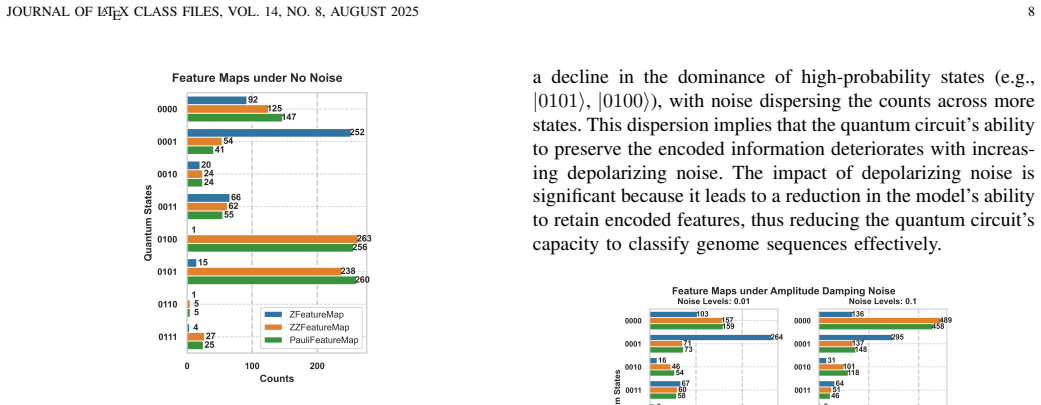
- [Section IV.B, Figs. 9-14] The central ordering (QSVC robust, Peg-QSVC/QNN sensitive, PauliFeatureMap vulnerable) is supported only by qualitative statements such as 'shows the most stability' and 'testing accuracy varies significantly'; no numeric accuracies, standard deviations, number of independent runs, or statistical tests are reported. Without these, the reader cannot distinguish a genuine effect from shot noise or seed-to-seed variation. Please report mean and standard deviation (or confidence intervals) for each model/feature-map/noise combination, and apply a paired comparison or equivalent test to support the claimed ranking.
- [Section IV, experimental setup] The experimental protocol is underspecified. The text says 'We used a subset' but gives no subset size, train/test ratio, stratification, or sequence-selection rule; Section IV.B mentions 'varying shots' without listing shot counts; and the noise application is not stated precisely, including which gates are affected, whether single- and two-qubit gates have separate error rates, and whether the error rate is per gate or per circuit. This prevents replication and makes the Abstract's 'systematic evaluation' claim unverifiable. Please add a full configuration table with dataset subset, split, shots, and noise placement.
- [Section IV.A] Because each 200-base-pair sequence is reduced to four PCA components before encoding, and the paper itself concedes that the feature maps 'lack the ability to preserve the sequential information of the genomics data,' the experiments do not actually classify genomic sequences in the usual sense. The observed robustness ranking could be an artifact of PCA preprocessing and the four-dimensional numerical encoding. Please either test a sequence-appropriate encoding (for example, k-mer or positional encodings) or explicitly reframe the conclusions as applying to PCA-reduced feature vectors rather than to genomic sequence classification.
- [Section IV.B, baseline comparison] The paper does not report noiseless test accuracies or a classical baseline. 'Robust' is a comparative statement; without the noise-free test accuracy of each model and without a classical SVM or other baseline on the same PCA features, a small drop under noise could still mean a model that is already inaccurate when noiseless. Please include noiseless test accuracies and a classical baseline to calibrate the robustness claims.
minor comments (6)
- [Section II.D] The phrase 'we have get' should be corrected to 'we get'.
- [Section III.C] The word 'disccused' in 'as disccused above' is a typo and should read 'discussed'.
- [Fig. 11 caption] The caption 'dephase damping noise' should read 'dephasing (phase damping) noise' for consistency with the main text.
- [Table I, Phase-Flip row] The table entry 'Changes diagonal elements based on flip probability' is inconsistent with Section II.F, where phase-flip noise leaves populations |α|^2 and |β|^2 unchanged and instead multiplies the off-diagonal terms by (1-2p); the table should be corrected.
- [Section III.D] The symbol ρ'_i is used both for the noisy input state and for the post-circuit state ('ρ′_i = U(θ)ρ′_iU†(θ)'); using distinct symbols for the encoded noisy state and the transformed state would avoid confusion.
- [General] Please add a reproducibility statement with Qiskit/Aer versions and, if possible, a link to the code and exact hyperparameter defaults used.
Circularity Check
No significant circularity: the noise-robustness ranking is an empirical simulation result, not a construction from fitted inputs or self-cited premises.
full rationale
The paper's central claims are observational: it simulates standard Qiskit feature maps and QML models under six Kraus-form noise channels and reports qualitative accuracy trends. The robustness ordering (QSVC robust; Peg-QSVC and QNN sensitive; PauliFeatureMap vulnerable) is presented as a measured outcome of training and testing under noise, not as the output of an equation that already contains that ordering. No parameter is fitted to a subset and then renamed a prediction; the settings are described as Qiskit defaults. The feature-map and noise-channel formalisms are cited to external, non-self sources (e.g., Havlicek et al., Preskill, standard noise references). The only self-citation, Ref. [10] by the same authors, is used for PCA preprocessing and a general statement about QML for genomics; the central robustness comparison does not rest on any result from that prior work, and no uniqueness theorem or ansatz is imported from it. The paper's explicit concession that the feature maps do not preserve sequential information, and the absence of numeric accuracy tables, error bars, and full experimental parameters, are substantive reproducibility and validity concerns, but they are not circularity: the conclusions are not equivalent to the inputs by definition or by construction. The derivation chain is therefore self-contained with respect to circularity, and the appropriate score is 0.
Assumptions & free parameters
assumptions (4)
- domain assumption AerSimulator noise channels with error rates 0.01-0.3 faithfully represent NISQ device noise.
- domain assumption PCA to four dimensions preserves enough genomic signal for the classification conclusions.
- domain assumption Qiskit default parameter values provide a fair comparison across algorithms and feature maps.
- domain assumption The democoding versus intergenomic subset represents genomic sequence classification broadly.
Cite this review
Pith. "Pith review of Modeling Feature Maps for Quantum Machine Learning." pith.science (2026). https://pith.science/paper/7FWD2CBD
@misc{pith2026250108205,
  author       = {Pith},
  title        = {Pith review of: Modeling Feature Maps for Quantum Machine Learning},
  year         = {2026},
  howpublished = {\url{https://pith.science/paper/7FWD2CBD}},
  note         = {Machine review of arXiv:2501.08205}
}
read the original abstract
Quantum Machine Learning (QML) offers significant potential for complex tasks like genome sequence classification, but quantum noise on Noisy Intermediate-Scale Quantum (NISQ) devices poses practical challenges. This study systematically evaluates how various quantum noise models including dephasing, amplitude damping, depolarizing, thermal noise, bit-flip, and phase-flip affect key QML algorithms (QSVC, Peg-QSVC, QNN, VQC) and feature mapping techniques (ZFeatureMap, ZZFeatureMap, and PauliFeatureMap). Results indicate that QSVC is notably robust under noise, whereas Peg-QSVC and QNN are more sensitive, particularly to depolarizing and amplitude-damping noise. The PauliFeatureMap is especially vulnerable, highlighting difficulties in maintaining accurate classification under noisy conditions. These findings underscore the critical importance of feature map selection and noise mitigation strategies in optimizing QML for genomic classification, with promising implications for personalized medicine.
Figures


Figures from the paper (10 more)


Forward citations
Cited by 1 Pith paper
-
A Non-Monotonic Relationship: An Empirical Analysis of Hybrid Quantum Classifiers for Unseen Ransomware Detection
A hybrid PCA+VQC quantum classifier achieves at best 55% recall on unseen ransomware detection, far below the 97.7% classical baseline, with performance degrading from 4 to 8 qubits before improving at 12.
Reference graph
Works this paper leans on
-
[1]
Y . Alexeev et al. , “Quantum-centric supercomputing for materials science: A perspective on challenges and future directions,” Future Generation Computer Systems , vol. 160, pp. 666–710, 2024. JOURNAL OF LATEX CLASS FILES, VOL. 14, NO. 8, AUGUST 2025 13
work page 2024
-
[2]
Systematic literature review: Quantum machine learning and its applications,
D. Peral-Garc ´ıa, J. Cruz-Benito, and F. J. Garc ´ıa-Pe˜nalvo, “Systematic literature review: Quantum machine learning and its applications,” Computer Science Review , vol. 51, p. 100619, 2024
work page 2024
-
[3]
A biological sequence comparison algorithm using quantum computers,
B. K ¨osoglu-Kind, R. Loredo, M. Grossi, C. Bernecker, J. M. Burks, and R. Buchkremer, “A biological sequence comparison algorithm using quantum computers,” Scientific Reports, vol. 13, no. 1, p. 14552, 2023
work page 2023
-
[4]
Parameterized quantum circuits as machine learning models,
M. Benedetti, E. Lloyd, S. Sack, and M. Fiorentini, “Parameterized quantum circuits as machine learning models,” Quantum Science and Technology, vol. 4, no. 4, p. 043001, 2019
2019
-
[5]
Taking advantage of noise in quantum reservoir computing,
L. Domingo, G. Carlo, and F. Borondo, “Taking advantage of noise in quantum reservoir computing,” Scientific Reports, vol. 13, no. 8790, 2023
work page 2023
-
[6]
Fast quantum algorithm for protein structure prediction in hydrophobic-hydrophilic model,
R. Wong and W.-L. Chang, “Fast quantum algorithm for protein structure prediction in hydrophobic-hydrophilic model,” Journal of Parallel and Distributed Computing, vol. 164, pp. 178–190, 2022
work page 2022
-
[7]
Quantum computing in the nisq era and beyond,
J. Preskill, “Quantum computing in the nisq era and beyond,” Quantum, vol. 2, p. 79, 2018
2018
-
[8]
Bench- marking quantum (-inspired) annealing hardware on practical use cases,
T. Huang, J. Xu, T. Luo, X. Gu, R. Goh, and W.-F. Wong, “Bench- marking quantum (-inspired) annealing hardware on practical use cases,” IEEE Transactions on Computers , vol. 72, no. 6, pp. 1692–1705, 2022
work page 2022
Show all 40 references
-
[9]
A variation-aware quantum circuit mapping approach based on multi-agent cooperation,
P. Zhu, W. Ding, L. Wei, X. Cheng, Z. Guan, and S. Feng, “A variation-aware quantum circuit mapping approach based on multi-agent cooperation,” IEEE Transactions on Computers, vol. 72, no. 8, pp. 2237– 2249, 2023
2023
-
[10]
An independent implementation of quantum machine learning algorithms in qiskit for genomic data,
N. Singh and S. R. Pokhrel, “An independent implementation of quantum machine learning algorithms in qiskit for genomic data,” arXiv preprint arXiv:2405.09781, 2024
2024 arXiv
-
[11]
Quantum support vector machine for classifying noisy data,
J. Li, Y . Li, J. Song, J. Zhang, and S. Zhang, “Quantum support vector machine for classifying noisy data,” IEEE Transactions on Computers , 2024
2024
-
[12]
Impact of quantum noise on the training of quantum generative adversarial networks,
K. Borras, S. Y . Chang, L. Funcke, M. Grossi, T. Hartung, K. Jansen, D. Kruecker, S. K ¨uhn, F. Rehm, C. T ¨uys¨uz et al., “Impact of quantum noise on the training of quantum generative adversarial networks,” in Journal of Physics: Conference Series, vol. 2438, no. 1. IOP Pub...
2023
-
[13]
Assess- ing the impact of noise on quantum neural networks: An experimental analysis,
E. T. Escudero, D. A. Alamo, O. M. G ´omez, and P. G. Bringas, “Assess- ing the impact of noise on quantum neural networks: An experimental analysis,” in International Conference on Hybrid Artificial Intelligence Systems. Springer, 2023, pp. 314–325
2023
-
[14]
Investigating the effect of noise on the training performance of hybrid quantum neural networks,
M. Kashif, E. Sychiuco, and M. Shafique, “Investigating the effect of noise on the training performance of hybrid quantum neural networks,” arXiv preprint arXiv:2402.08523 , 2024
2024 arXiv
-
[15]
Genomic benchmarks: a collection of datasets for genomic sequence classification,
K. Gre ˇsov´a, V . Martinek, D. ˇCech´ak, P. ˇSimeˇcek, and P. Alexiou, “Genomic benchmarks: a collection of datasets for genomic sequence classification,” BMC Genomic Data , vol. 24, no. 1, p. 25, 2023
2023
-
[16]
Complexity of life sciences in quantum and ai era,
A. Pyrkov, A. Aliper, D. Bezrukov, D. Podolskiy, F. Ren, and A. Zha- voronkov, “Complexity of life sciences in quantum and ai era,” Wiley Interdisciplinary Reviews: Computational Molecular Science , vol. 14, no. 1, p. e1701, 2024
2024
-
[17]
Introduction to quantum noise, measurement, and ampli- fication,
A. A. Clerk, M. H. Devoret, S. M. Girvin, F. Marquardt, and R. J. Schoelkopf, “Introduction to quantum noise, measurement, and ampli- fication,” Reviews of Modern Physics , vol. 82, no. 2, pp. 1155–1208, 2010
2010
-
[18]
Pre-and postselected quantum states: Density matrices, tomography, and kraus operators,
R. Silva, Y . Guryanova, N. Brunner, N. Linden, A. J. Short, and S. Popescu, “Pre-and postselected quantum states: Density matrices, tomography, and kraus operators,” Physical Review A , vol. 89, no. 1, p. 012121, 2014
2014
-
[19]
Quantum metrology for noisy systems,
B. Escher, R. de Matos Filho, and L. Davidovich, “Quantum metrology for noisy systems,” Brazilian Journal of Physics , vol. 41, no. 4, pp. 229–247, 2011
2011
-
[20]
Quantum simulation of open quantum systems using a unitary decomposition of operators,
A. W. Schlimgen, K. Head-Marsden, L. M. Sager, P. Narang, and D. A. Mazziotti, “Quantum simulation of open quantum systems using a unitary decomposition of operators,” Physical Review Letters , vol. 127, no. 27, p. 270503, 2021
2021
-
[21]
Classical simulation of quantum dephasing and depolarizing noise,
D. Crow and R. Joynt, “Classical simulation of quantum dephasing and depolarizing noise,” Physical Review A, vol. 89, no. 4, p. 042123, 2014
2014
-
[22]
Effects of quantum noise on quantum approximate optimization algorithm,
C. Xue, Z.-Y . Chen, Y .-C. Wu, and G.-P. Guo, “Effects of quantum noise on quantum approximate optimization algorithm,” Chinese Physics Letters, vol. 38, no. 3, p. 030302, 2021
2021
-
[23]
Low-rank density-matrix evolution for noisy quantum circuits,
Y .-T. Chen, C. Farquhar, and R. M. Parrish, “Low-rank density-matrix evolution for noisy quantum circuits,” npj Quantum Information, vol. 7, no. 1, p. 61, 2021
2021
-
[24]
Squeezed generalized amplitude damping channel,
R. Srikanth and S. Banerjee, “Squeezed generalized amplitude damping channel,” Physical Review A—Atomic, Molecular, and Optical Physics , vol. 77, no. 1, p. 012318, 2008
2008
-
[25]
Suppressing amplitude damping in trapped ions: Discrete weak measurements for a nonunitary probabilistic noise filter,
A. Rodriguez-Blanco, K. B. Whaley, and A. Bermudez, “Suppressing amplitude damping in trapped ions: Discrete weak measurements for a nonunitary probabilistic noise filter,” Physical Review A, vol. 107, no. 5, p. 052409, 2023
2023
-
[26]
High- dimensional optical quantum logic in large operational spaces,
P. Imany, J. A. Jaramillo-Villegas, M. S. Alshaykh, J. M. Lukens, O. D. Odele, A. J. Moore, D. E. Leaird, M. Qi, and A. M. Weiner, “High- dimensional optical quantum logic in large operational spaces,” npj Quantum Information, vol. 5, no. 1, p. 59, 2019
2019
-
[27]
Asymptotic improvements to quantum circuits via qutrits,
P. Gokhale, J. M. Baker, C. Duckering, N. C. Brown, K. R. Brown, and F. T. Chong, “Asymptotic improvements to quantum circuits via qutrits,” in Proceedings of the 46th International Symposium on Computer Architecture, 2019, pp. 554–566
2019
-
[28]
Simulation of thermal relaxation in spin chemistry systems on a quantum computer using inherent qubit decoherence,
B. Rost, B. Jones, M. Vyushkova, A. Ali, C. Cullip, A. Vyushkov, and J. Nabrzyski, “Simulation of thermal relaxation in spin chemistry systems on a quantum computer using inherent qubit decoherence,” arXiv preprint arXiv:2001.00794 , 2020
2001 arXiv
-
[29]
Hamil- tonian simulation of quantum beats in radical pairs undergoing thermal relaxation on near-term quantum computers,
M. Tolunay, I. Liepuoniute, M. Vyushkova, and B. A. Jones, “Hamil- tonian simulation of quantum beats in radical pairs undergoing thermal relaxation on near-term quantum computers,” Physical Chemistry Chem- ical Physics, vol. 25, no. 22, pp. 15 115–15 134, 2023
2023
-
[30]
Measurement error mitigation in quantum computers through classical bit-flip correction,
L. Funcke, T. Hartung, K. Jansen, S. K ¨uhn, P. Stornati, and X. Wang, “Measurement error mitigation in quantum computers through classical bit-flip correction,” Physical Review A, vol. 105, no. 6, p. 062404, 2022
2022
-
[31]
Teleportation of an arbitrary two- qubit state via four-qubit cluster state in noisy environment,
C. Jiang, Y .-Z. Wei, and M. Jiang, “Teleportation of an arbitrary two- qubit state via four-qubit cluster state in noisy environment,” Interna- tional Journal of Theoretical Physics , vol. 61, no. 6, p. 154, 2022
2022
-
[32]
Supervised learning with quantum- enhanced feature spaces,
V . Havl ´ıˇcek, A. D. C ´orcoles, K. Temme, A. W. Harrow, A. Kandala, J. M. Chow, and J. M. Gambetta, “Supervised learning with quantum- enhanced feature spaces,” Nature, vol. 567, no. 7747, pp. 209–212, 2019
2019
-
[33]
Circuit-centric quantum classifiers,
M. Schuld, A. Bocharov, K. M. Svore, and N. Wiebe, “Circuit-centric quantum classifiers,” Physical Review A , vol. 101, no. 3, p. 032308, 2020
2020
-
[34]
A generative modeling approach for benchmark- ing and training shallow quantum circuits,
M. Benedetti, D. Garcia-Pintos, O. Perdomo, V . Leyton-Ortega, Y . Nam, and A. Perdomo-Ortiz, “A generative modeling approach for benchmark- ing and training shallow quantum circuits,” npj Quantum Information , vol. 5, no. 1, p. 45, 2019
2019
-
[35]
Quantum support vector machine for big data classification,
P. Rebentrost, M. Mohseni, and S. Lloyd, “Quantum support vector machine for big data classification,” Physical review letters , vol. 113, no. 13, p. 130503, 2014
2014
-
[36]
The complexity of quantum support vector machines,
G. Gentinetta, A. Thomsen, D. Sutter, and S. Woerner, “The complexity of quantum support vector machines,” Quantum, vol. 8, p. 1225, 2024
2024
-
[37]
Universal expressiveness of variational quantum classifiers and quantum kernels for support vector machines,
J. J ¨ager and R. V . Krems, “Universal expressiveness of variational quantum classifiers and quantum kernels for support vector machines,” Nature Communications, vol. 14, no. 1, p. 576, 2023
2023
-
[38]
Pegasos: Primal estimated sub-gradient solver for svm,
S. Shalev-Shwartz, Y . Singer, and N. Srebro, “Pegasos: Primal estimated sub-gradient solver for svm,” in Proceedings of the 24th international conference on Machine learning , 2007, pp. 807–814
2007
-
[39]
The power of quantum neural networks,
A. Abbas, D. Sutter, C. Zoufal, A. Lucchi, A. Figalli, and S. Woerner, “The power of quantum neural networks,” Nature Computational Sci- ence, vol. 1, no. 6, pp. 403–409, 2021
2021
-
[40]
Quantum computing with qiskit,
A. Javadi-Abhari, M. Treinish, K. Krsulich, C. J. Wood, J. Lishman, J. Gacon, S. Martiel, P. D. Nation, L. S. Bishop, A. W. Cross et al. , “Quantum computing with qiskit,” arXiv preprint arXiv:2405.08810 , 2024
2024 arXiv
Reviewed August 10, 2026 · model on record in the stance chip above.
Discussion (0). Continue with ORCID to comment.