REVIEW 4 major objections 6 minor 68 references
Scalable and High-Quality Neural Implicit Representation for 3D Reconstruction
T0 review · 4 major / 6 minor · reviewed 2026-08-10 · deepseek-v4-flash
Pith's one-line read Modeling a scene as overlapping local neural SDFs, registered and blended, yields higher-fidelity and scalable 3D reconstruction than a single global network.
desk verdict A solid engineering contribution: the core claim that local SDFs beat a global one survives scrutiny, but the scalability story is under-validated and the registration evaluation is partly self-referential. read the letter →
The pith
A machine-rendered reading of the paper's core claim, the machinery that carries it, and where it could break.
The reading
What carries the argument
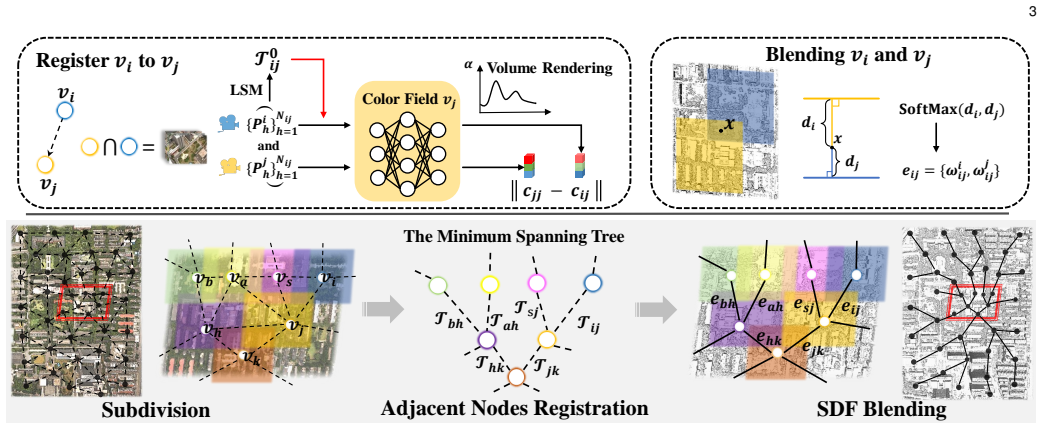
The signed distance function (SDF) is the function whose zero set is the surface, and each graph node stores one local SDF. Two mechanisms carry the argument. First, overlap-based registration: because shared images see the same 3D point in both local coordinate systems, the relation $P^i_h \mathcal{T}'_{ij}=P^j_h$ yields an overdetermined linear system whose least-squares solution is an initial similarity transform; this transform is then optimized by volume-rendering the registered node's color field in the reference node and minimizing the color difference over the shared-image masks. Second, softmax SDF blending: instead of taking $\min(f_i(x),f_j(x))$ in overlapping regions, the method averages with weights that decay with distance to each node's boundary, eliminating the seam while staying close to a valid SDF. The graph's minimum spanning tree is used so that each pair of adjacent nodes is registered only once and the global coordinate frame is propagated from node to node.
What would settle it
Take a pair of overlapping nodes from a large scene, apply a smooth non-rigid warp (for example, a 5% scale gradient across the overlap) to one node's structure-from-motion output, then run the full registration; if the optimized color-consistency loss converges to a visible seam or a wrong transform, the single-similarity-transform assumption is falsified.
Extended reading notes
Core claim
The central claim is that a single global MLP is the bottleneck in neural SDF reconstruction, and that representing a scene as a Neural SDF-Graph removes that bottleneck. The graph $G=(V,E)$ has one node $v_k$ per local SDF, each reconstructed from its own subset of images and its own camera poses; an edge $e_{ij}$ marks two nodes that share images and therefore overlap in space. Adjacent nodes are aligned by an initial similarity transform $\mathcal{T}'_{ij}$ (rotation, translation, scale) obtained in closed form from the shared camera poses, then refined by minimizing a color-consistency loss through volume rendering. The aligned local SDFs are fused with softmax weights $\omega^k_{ij}(x)=e^{-\beta d_k(x)}/(e^{-\beta d_i(x)}+e^{-\beta d_j(x)})$, where $d_k(x)$ is the distance to the boundary of node $v_k$, producing a global SDF without the seam that a plain min-union creates. The quantitative evidence is that reconstruction error falls steadily as node count rises—45.6% better Chamfer distance on Lego with eight nodes than the single-network baseline—and that the same recipe handles a 25-node, roughly 1200 m by 800 m campus.
Load-bearing premise
The pipeline assumes that any two overlapping node reconstructions differ only by one global rotation, translation, and scale; if per-node camera estimation leaves non-rigid drift or locally varying scale, the registration has no model for it and the color-based refinement must silently compensate.
Editorial extensions
If this is right
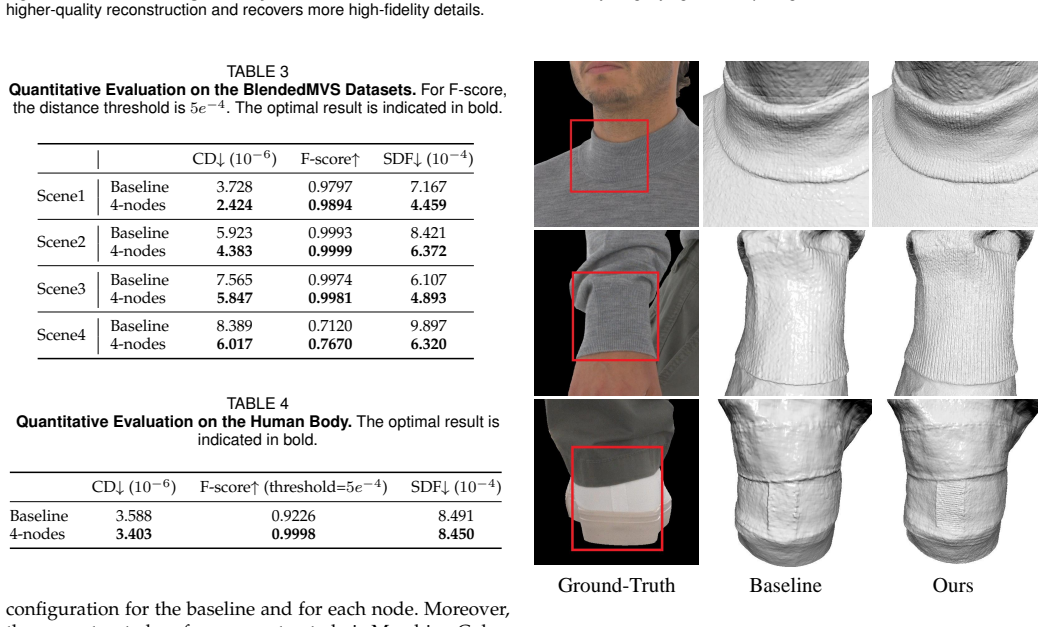
- With more local nodes, reconstruction detail improves monotonically in the reported tests: the Lego Chamfer distance drops from $5.209\times 10^{-4}$ for a single network to $2.836\times 10^{-4}$ with eight nodes.
- Scene size is no longer bounded by one network: adding nodes along the data-collection path produced a 25-node reconstruction of a roughly 1200 m by 800 m campus from 5973 oblique aerial images.
- Per-node camera estimation is much cheaper than global pose estimation: on the Sub-Campus scene, structure-from-motion time fell from 14 h 25 min to 5 h 8 min.
- The independence of nodes supports downstream uses: each node's mesh and texture can be extracted and optimized separately, and a node's registration transformation can be changed to move objects within the scene.
- Softmax-based SDF blending removes the seam at overlap boundaries while preserving reconstruction accuracy in the overlap area.
Reading between the lines
- Not stated in the paper: the registration step is agnostic to what the local field represents, so the same overlapping-node graph could wrap explicit representations such as 3D Gaussian splatting or mesh blocks; the softmax blending would need an SDF-like overlap analogue.
- Not stated in the paper: because the global frame is propagated along a minimum spanning tree, any residual registration error on an early edge is inherited by all later nodes, so a loop-closure or global bundle-adjustment pass over the whole graph is the natural stress test for very large scenes.
- Not stated in the paper: the overlap fraction is chosen by hand in the experiments (roughly 15-42% for Lego divisions, 20% for Jade), so an automatic schedule that trades registration reliability against wasted training is a testable extension.
- Not stated in the paper: the authors note that neural SDF methods assume watertight surfaces; a non-watertight local SDF model would remove the irregular iso-surface shapes they observe near node boundaries.
Signed reviews
Editorial analysis
A structured set of objections, weighed in public.
Referee Report
Summary. The paper proposes Neural SDF-Graph, a divide-and-conquer representation for neural implicit surface reconstruction. A scene is decomposed into overlapping local SDF nodes, each reconstructed independently with an existing method such as NeuS or Bakedangelo; adjacent nodes are registered using a least-squares similarity transform initialized from shared COLMAP poses and then refined by a volume-rendering color loss; finally the local SDFs are combined with a softmax-weighted blending scheme. Experiments on Lego, Jade, BlendedMVS, Actors-HQ, and two drone-captured campus datasets report improved Chamfer distance and F-score relative to single-network baselines, and demonstrate scaling to 25 nodes over a roughly 1200m x 800m area, along with texture generation and scene editing applications.
Significance. The central claim—that partitioning a scene into multiple overlapping local SDFs improves reconstruction fidelity and enables scalable reconstruction—is supported by consistent quantitative gains on external benchmarks with ground-truth meshes, e.g., Lego Chamfer distance improving from 5.209e-4 (baseline) to 2.836e-4 (8 nodes) in Table 1 and Jade from 2.507e-4 to 0.958e-4 (4 nodes) in Table 2. The paper also includes a parameter-count ablation (Table 7) and a comparison against recent 3DGS-based reconstructions, and it uses publicly available components (COLMAP, NeuS, SDFStudio), which helps reproducibility. The main open risk is the validation of the registration chain underlying the city-scale claim: only five of the twenty-four Campus edges are reported in Table 6, the registration optimization is self-supervised with no independent geometric ground truth, and the effect of error accumulation along the MST is not quantified.
major comments (4)
- [Sec. 3.3 and Sec. 4.4] The city-scale claim rests on composing 24 pairwise similarity transforms along the MST to obtain a global coordinate system, but the paper reports rendering metrics for only 5 of the 24 edges (Table 6) and provides no analysis of how rotation, translation, and scale residuals propagate through the composition. Please add either a global geometric validation (e.g., distances between fixed landmarks, comparison with a global COLMAP alignment, or loop-closure errors) or a quantitative residual analysis along the full chain; without this, the absence of visible seams in Figures 10–11 cannot rule out accumulated misalignment.
- [Sec. 3.3, Eq. (12)] The registration optimization minimizes the color difference between two renderings from the target node's color field C_j, and the Table 6 metrics are computed against those same rendered images. This is a self-supervised validation: a local minimum of Eq. (12) can leave a systematic geometric bias (e.g., a small rotation or scale error) that rendering metrics would not reveal. Please validate the final alignment with an independent geometric criterion on at least one scene, such as a global bundle adjustment or manually measured control points.
- [Sec. 3.3, Eqs. (4)-(9)] The initial registration in Eq. (8) assumes that the two per-node COLMAP reconstructions are related by a single similarity transform over the whole overlap region. If the per-node reconstructions contain non-rigid drift or spatially varying scale, the least-squares initial guess is biased and the color-based refinement may not compensate. The manuscript does not analyze the magnitude of such residuals or the sensitivity of the final reconstruction to them; please add an experiment that perturbs the initial transform and measures the resulting registration error, or report drift statistics over the overlap regions.
- [Sec. 4.2, Tables 1-3] All quantitative claims, including the headline '45.6% improvement in Lego Chamfer distance,' are based on single runs with no error bars or multiple random seeds. Given that the core assertion is a consistent quality gain from increasing the number of nodes, please provide at least three runs per configuration or otherwise report the variance, so that the significance of the gains relative to training stochasticity can be assessed.
minor comments (6)
- [Throughout] There are several typos and grammatical slips, e.g., 'loacl' (Sec. 1), 'ddemonstrate' (Sec. 4.3), 'basline' (Sec. 4.3), 'specfied' (Sec. 3.4), and 'T raining' (Appendix A.1.1).
- [Sec. 3.3, Eq. (8)] The summation index and matrix dimension use 'N12' in Eq. (8), but the text defines the number of shared images as Nij; please correct the notation.
- [Sec. 4.2] The reported overlap percentages for the Lego two-node division (41.67%, 24.75%, 18.38%) are stated without explaining which denominator each percentage refers to; please clarify the definitions of 'lower node range,' 'upper node range,' and 'global range.'
- [Table 5] The COLMAP runtimes for the four Sub-Campus nodes sum to 5h2m (1h47m + 58m + 1h33m + 44m), but the table reports 'Total: 5h8m'; please check the arithmetic.
- [Fig. 14 and Sec. 4.6] Figure 14 shows ablation results labeled 'Lego,' 'Campus,' and 'Human body,' but the text of Section 4.6 appears to describe only the Lego case; please clarify which dataset each quantitative pair corresponds to.
- [Sec. 4.4] The statement that each overlapping node pair shares 'around 100' images is vague; please provide a range or a small table of shared-image counts for the Campus nodes.
Circularity Check
Central reconstruction claims are grounded in external ground-truth benchmarks, but the registration-optimization validation is partly circular: the reported 'final' rendering metrics are the very objective minimized in Eq. (12).
-
fitted input called prediction
[Section 3.3, Eq. (12); Section 4.4, Table 6]
"Therefore, we employ a color loss to optimize the registration matrix: ∆Tij = arg min X h ∥(cij h − cjj h ) · M ij h ∥. (12) ... We expect the optimized “final” to reach the “target” metrics, which means that the registration is aligned."
The registration parameters are optimized by minimizing the masked color difference between renders from the transformed pose and renders from the target node's pose (Eq. 12). Table 6 then reports PSNR/SSIM/LPIPS of 'final' versus 'target' on exactly those rendered views. PSNR is monotonic in the color error minimized by Eq. (12), so 'final' approaching 'target' is forced by the optimization rather than by any independent geometric check. A transform that overfits the color field could also reduce this loss, so this validation cannot by itself establish geometric alignment.
full rationale
The paper's central claims—higher-fidelity reconstruction and scalability via multiple local SDFs—are checked against external ground-truth meshes (Lego CD/F-score, BlendedMVS, Actors-HQ) and against single-MLP baselines under matched settings, so those claims are not circular. The MST error-accumulation concern is a real correctness risk but is not a circularity. The one genuine circular element is the registration-optimization validation: the metric used to declare success (Table 6 'final' vs 'target' rendering metrics) is the same color-rendering objective being minimized in Eq. (12), so the improvement is partly by construction. No load-bearing self-citation chain, imported uniqueness theorem, or self-defined equivalence was found.
Assumptions & free parameters
free parameters (2)
- softmax blending temperature beta =
10
- node partition and overlap ratios =
e.g., Lego overlaps 41.67%, 24.75%, 18.38% of ranges; Jade 20%
assumptions (4)
- domain assumption Independent COLMAP reconstructions of overlapping nodes are related by a single similarity transformation (rotation, translation, scale) over the whole overlap region.
- domain assumption The target node's trained radiance field provides an accurate appearance in the overlap, so the color loss in Eq. (12) is a valid proxy for geometric alignment.
- ad hoc to paper The softmax-weighted combination of two SDFs in Eq. (15)-(16) yields a valid global SDF whose zero level set approximates the true surface.
- domain assumption Existing neural implicit reconstruction methods assume watertight surfaces, which may not hold for each node's shape.
Cite this review
Pith. "Pith review of Scalable and High-Quality Neural Implicit Representation for 3D Reconstruction." pith.science (2026). https://pith.science/paper/R5KOZBAX
@misc{pith2026250108577,
  author       = {Pith},
  title        = {Pith review of: Scalable and High-Quality Neural Implicit Representation for 3D Reconstruction},
  year         = {2026},
  howpublished = {\url{https://pith.science/paper/R5KOZBAX}},
  note         = {Machine review of arXiv:2501.08577}
}
read the original abstract
Various SDF-based neural implicit surface reconstruction methods have been proposed recently, and have demonstrated remarkable modeling capabilities. However, due to the global nature and limited representation ability of a single network, existing methods still suffer from many drawbacks, such as limited accuracy and scale of the reconstruction. In this paper, we propose a versatile, scalable and high-quality neural implicit representation to address these issues. We integrate a divide-and-conquer approach into the neural SDF-based reconstruction. Specifically, we model the object or scene as a fusion of multiple independent local neural SDFs with overlapping regions. The construction of our representation involves three key steps: (1) constructing the distribution and overlap relationship of the local radiance fields based on object structure or data distribution, (2) relative pose registration for adjacent local SDFs, and (3) SDF blending. Thanks to the independent representation of each local region, our approach can not only achieve high-fidelity surface reconstruction, but also enable scalable scene reconstruction. Extensive experimental results demonstrate the effectiveness and practicality of our proposed method.
Figures


Figures from the paper (12 more)







Reference graph
Works this paper leans on
-
[1]
Accurate, dense, and robust multi- view stereopsis,
Y. Furukawa and J. Ponce, “Accurate, dense, and robust multi- view stereopsis,” IEEE T ransactions on Pattern Analysis and Machine Intelligence, vol. 32, no. 8, pp. 1362–1376, 2010. 1
work page 2010
-
[2]
Photorealistic scene reconstruction by voxel coloring,
S. Seitz and C. Dyer, “Photorealistic scene reconstruction by voxel coloring,” in Proceedings of IEEE Computer Society Conference on Computer Vision and Pattern Recognition , 1997, pp. 1067–1073. 1, 2
work page 1997
-
[3]
Efficient large-scale multi-view stereo for ultra high-resolution image sets,
E. Tola, C. Strecha, and P . Fua, “Efficient large-scale multi-view stereo for ultra high-resolution image sets,” Mach. Vision Appl. , vol. 23, no. 5, p. 903–920, sep 2012. [Online]. Available: https://doi.org/10.1007/s00138-011-0346-8 1
-
[4]
Nerf: Representing scenes as neural radiance fields for view synthesis,
B. Mildenhall, P . P . Srinivasan, M. Tancik, J. T. Barron, R. Ra- mamoorthi, and R. Ng, “Nerf: Representing scenes as neural radiance fields for view synthesis,” in ECCV, 2020. 1, 6, 18
work page 2020
-
[5]
Volume rendering of neural implicit surfaces,
L. Yariv, J. Gu, Y. Kasten, and Y. Lipman, “Volume rendering of neural implicit surfaces,” in Thirty-Fifth Conference on Neural Information Processing Systems , 2021. 1, 2, 4
work page 2021
-
[6]
Neus: Learning neural implicit surfaces by volume rendering for multi-view reconstruction,
P . Wang, L. Liu, Y. Liu, C. Theobalt, T. Komura, and W. Wang, “Neus: Learning neural implicit surfaces by volume rendering for multi-view reconstruction,” in Proc. Advances in Neural Information Processing Systems (NeurIPS) , vol. 34, 2021, pp. 27 171–27 183. 1, 2, 4, 8
work page 2021
-
[7]
Neus2: Fast learning of neural implicit surfaces for multi- view reconstruction,
Y. Wang, Q. Han, M. Habermann, K. Daniilidis, C. Theobalt, and L. Liu, “Neus2: Fast learning of neural implicit surfaces for multi- view reconstruction,” in Proceedings of the IEEE/CVF International Conference on Computer Vision (ICCV) , 2023. 1, 2, 4
work page 2023
-
[8]
Neuralangelo: High-fidelity neural surface reconstruction,
Z. Li, T. M ¨uller, A. Evans, R. H. Taylor, M. Unberath, M.-Y. Liu, and C.-H. Lin, “Neuralangelo: High-fidelity neural surface reconstruction,” in IEEE Conference on Computer Vision and Pattern Recognition (CVPR), 2023. 1, 2, 4, 10, 18
work page 2023
Show all 68 references
-
[9]
Structure-from-motion re- visited,
J. L. Sch ¨onberger and J.-M. Frahm, “Structure-from-motion re- visited,” in Conference on Computer Vision and Pattern Recognition (CVPR), 2016. 1, 5, 8
2016
-
[10]
Pixelwise view selection for unstructured multi-view stereo,
J. L. Sch ¨onberger, E. Zheng, M. Pollefeys, and J.-M. Frahm, “Pixelwise view selection for unstructured multi-view stereo,” in European Conference on Computer Vision (ECCV) , 2016. 1, 8
2016
-
[11]
From coarse to fine: Robust hierarchical localization at large scale,
P .-E. Sarlin, C. Cadena, R. Siegwart, and M. Dymczyk, “From coarse to fine: Robust hierarchical localization at large scale,” in CVPR, 2019. 1
2019
-
[12]
Block-nerf: Scalable large scene neural view synthesis,
M. Tancik, V . Casser, X. Yan, S. Pradhan, B. Mildenhall, P . P . Srinivasan, J. T. Barron, and H. Kretzschmar, “Block-nerf: Scalable large scene neural view synthesis,” in Proceedings of the IEEE/CVF Conference on Computer Vision and Pattern Recognition (CVPR) , June 2022, pp...
2022
-
[13]
Mega-nerf: Scal- able construction of large-scale nerfs for virtual fly-throughs,
H. Turki, D. Ramanan, and M. Satyanarayanan, “Mega-nerf: Scal- able construction of large-scale nerfs for virtual fly-throughs,” in Proceedings of the IEEE/CVF Conference on Computer Vision and Pattern Recognition (CVPR) , June 2022, pp. 12 922–12 931. 1, 2
2022
-
[14]
A probabilistic framework for space carving,
A. Broadhurst, T. Drummond, and R. Cipolla, “A probabilistic framework for space carving,” in Proceedings Eighth IEEE Inter- national Conference on Computer Vision. ICCV 2001 , vol. 1, 2001, pp. 388–393 vol.1. 2
2001
-
[15]
Three-dimensional reconstruction of complex shapes based on the Delaunay triangulation,
J.-D. Boissonnat and B. Geiger, “Three-dimensional reconstruction of complex shapes based on the Delaunay triangulation,” in Biomedical Image Processing and Biomedical Visualization , R. S. Acharya and D. B. Goldgof, Eds., vol. 1905, International Society for Optics and Photon...
1905 doi
-
[16]
Coarse-to-fine surface reconstruction from silhouettes and range data using mesh deformation,
Y. Sahillio ˘glu and Y. Yemez, “Coarse-to-fine surface reconstruction from silhouettes and range data using mesh deformation,” Computer Vision and Image Understanding , vol. 114, no. 3, pp. 334–348, 2010. [Online]. Available: https://www.sciencedirect. com/science/article/pii/...
2010
-
[17]
Multiview neural surface reconstruction by disentan- gling geometry and appearance,
L. Yariv, Y. Kasten, D. Moran, M. Galun, M. Atzmon, B. Ronen, and Y. Lipman, “Multiview neural surface reconstruction by disentan- gling geometry and appearance,” Advances in Neural Information Processing Systems, vol. 33, 2020. 2
2020
-
[18]
Monosdf: Exploring monocular geometric cues for neural implicit surface reconstruction,
Z. Yu, S. Peng, M. Niemeyer, T. Sattler, and A. Geiger, “Monosdf: Exploring monocular geometric cues for neural implicit surface reconstruction,” Advances in Neural Information Processing Systems (NeurIPS), 2022. 2, 4
2022
-
[19]
Geo-neus: Geometry- consistent neural implicit surfaces learning for multi-view re- construction,
Q. Fu, Q. Xu, Y.-S. Ong, and W. Tao, “Geo-neus: Geometry- consistent neural implicit surfaces learning for multi-view re- construction,” Advances in Neural Information Processing Systems (NeurIPS), 2022. 2, 4
2022
-
[20]
Instant neural graphics primitives with a multiresolution hash encoding,
T. M ¨uller, A. Evans, C. Schied, and A. Keller, “Instant neural graphics primitives with a multiresolution hash encoding,” ACM T rans. Graph., vol. 41, no. 4, pp. 102:1–102:15, Jul. 2022. [Online]. Available: https://doi.org/10.1145/3528223.3530127 2
2022
-
[21]
Large scale multi-view stereopsis evaluation,
R. Jensen, A. Dahl, G. Vogiatzis, E. Tola, and H. Aanæs, “Large scale multi-view stereopsis evaluation,” in 2014 IEEE Conference on Computer Vision and Pattern Recognition , 2014, pp. 406–413. 2, 18
2014
-
[22]
Building rome in a day,
S. Agarwal, N. Snavely, I. Simon, S. M. Seitz, and R. Szeliski, “Building rome in a day,” in2009 IEEE 12th International Conference on Computer Vision, 2009, pp. 72–79. 2
2009
-
[23]
An automated method for large-scale, ground-based city model acquisition,
C. Fr ¨uh and A. Zakhor, “An automated method for large-scale, ground-based city model acquisition,” International Journal of Com- puter Vision, vol. 60, pp. 5–24, 10 2004. 2
2004
-
[24]
Modeling and recognition of landmark image collections using iconic scene graphs,
R. Raguram, C. Wu, J. M. Frahm, and S. Lazebnik, “Modeling and recognition of landmark image collections using iconic scene graphs,” International Journal of Computer Vision , vol. 95, no. 3, pp. 213–239, 2011. 2
2011
-
[25]
Detailed real-time urban 3d reconstruction from video,
M. Pollefeys, D. Nist ´er, J. M. Frahm, A. Akbarzadeh, P . Mordohai, B. Clipp, C. Engels, D. Gallup, S. J. Kim, P . Merrell, C. Salmi, S. Sinha, B. Talton, L. Wang, Q. Yang, H. Stew ´enius, R. Yang, G. Welch, and H. Towles, “Detailed real-time urban 3d reconstruction from vide...
2008 doi
-
[26]
Structure-from-motion re- visited,
J. L. Sch ¨onberger and J.-M. Frahm, “Structure-from-motion re- visited,” in 2016 IEEE Conference on Computer Vision and Pattern Recognition (CVPR), 2016, pp. 4104–4113. 2 16
2016
-
[27]
Photo tourism: Exploring photo collections in 3d,
N. Snavely, S. M. Seitz, and R. Szeliski, “Photo tourism: Exploring photo collections in 3d,” vol. 25, no. 3, 2006. [Online]. Available: https://doi.org/10.1145/1141911.1141964 2
2006 arXiv
-
[28]
Very large-scale global sfm by distributed motion averaging,
S. Zhu, R. Zhang, L. Zhou, T. Shen, T. Fang, P . Tan, and L. Quan, “Very large-scale global sfm by distributed motion averaging,” in 2018 IEEE/CVF Conference on Computer Vision and Pattern Recogni- tion, 2018, pp. 4568–4577. 2
2018
-
[29]
Fast training of neural lumigraph representations using meta learning,
A. Bergman, P . Kellnhofer, and G. Wetzstein, “Fast training of neural lumigraph representations using meta learning,” in Advances in Neural Information Processing Systems , M. Ranzato, A. Beygelzimer, Y. Dauphin, P . Liang, and J. W. Vaughan, Eds., vol. 34. Curran Associates,...
2021
-
[30]
Learned initializations for optimizing coordinate-based neural representations,
M. Tancik, B. Mildenhall, T. Wang, D. Schmidt, P . P . Srinivasan, J. T. Barron, and R. Ng, “Learned initializations for optimizing coordinate-based neural representations,” CoRR, vol. abs/2012.02189, 2020. [Online]. Available: https://arxiv.org/abs/ 2012.02189 2
2012 arXiv
-
[32]
Ibrnet: Learning multi-view image-based rendering,
Q. Wang, Z. Wang, K. Genova, P . P . Srinivasan, H. Zhou, J. T. Barron, R. Martin-Brualla, N. Snavely, and T. A. Funkhouser, “Ibrnet: Learning multi-view image-based rendering,” CoRR, vol. abs/2102.13090, 2021. [Online]. Available: https://arxiv.org/abs/ 2102.13090 2
2021 arXiv
-
[34]
Nerfusion: Fusing radiance fields for large-scale scene reconstruction,
X. Zhang, S. Bi, K. Sunkavalli, H. Su, and Z. Xu, “Nerfusion: Fusing radiance fields for large-scale scene reconstruction,”CVPR,
-
[35]
Direct voxel grid optimization: Super-fast convergence for radiance fields reconstruction,
C. Sun, M. Sun, and H. Chen, “Direct voxel grid optimization: Super-fast convergence for radiance fields reconstruction,” CoRR, vol. abs/2111.11215, 2021. [Online]. Available: https: //arxiv.org/abs/2111.11215 2
2021 arXiv
-
[36]
Direct voxel grid optimization: Super-fast convergence for radiance fields reconstruction,
C. Sun, M. Sun, and H.-T. Chen, “Direct voxel grid optimization: Super-fast convergence for radiance fields reconstruction,” in 2022 IEEE/CVF Conference on Computer Vision and Pattern Recognition (CVPR), 2022, pp. 5449–5459. 2
2022
-
[37]
Plenoxels: Radiance fields without neural net- works,
S. Fridovich-Keil, A. Yu, M. Tancik, Q. Chen, B. Recht, and A. Kanazawa, “Plenoxels: Radiance fields without neural net- works,” in CVPR, 2022. 2
2022
-
[38]
Grid-guided neural radiance fields for large urban scenes,
L. Xu, Y. Xiangli, S. Peng, X. Pan, N. Zhao, C. Theobalt, B. Dai, and D. Lin, “Grid-guided neural radiance fields for large urban scenes,” 2023. 2
2023
-
[39]
Switch-nerf: Learning scene decomposition with mixture of experts for large-scale neural radiance fields,
Z. Mi and D. Xu, “Switch-nerf: Learning scene decomposition with mixture of experts for large-scale neural radiance fields,” in International Conference on Learning Representations (ICLR) ,
-
[40]
nerf2nerf: Pairwise registration of neural radiance fields,
L. Goli, D. Rebain, S. Sabour, A. Garg, and A. Tagliasacchi, “nerf2nerf: Pairwise registration of neural radiance fields,” 2022. 2
2022
-
[41]
Barf: Bundle- adjusting neural radiance fields,
C.-H. Lin, W.-C. Ma, A. Torralba, and S. Lucey, “Barf: Bundle- adjusting neural radiance fields,” 2021. 2
2021
-
[42]
Local-to-global registration for bundle-adjusting neural radiance fields,
Y. Chen, X. Chen, X. Wang, Q. Zhang, Y. Guo, Y. Shan, and F. Wang, “Local-to-global registration for bundle-adjusting neural radiance fields,” 2023. 2
2023
-
[43]
Visual-inertial odometry priors for bundle-adjusting neural radiance fields,
H. Kim, M. Song, D. Lee, and P . Kim, “Visual-inertial odometry priors for bundle-adjusting neural radiance fields,” in 2022 22nd International Conference on Control, Automation and Systems (ICCAS), 2022, pp. 1131–1136. 2
2022
-
[44]
Zero nerf: Registra- tion with zero overlap,
C. Peat, O. Batchelor, R. Green, and J. Atlas, “Zero nerf: Registra- tion with zero overlap,” 2022. 2
2022
-
[45]
iNeRF: Inverting neural radiance fields for pose estima- tion,
L. Yen-Chen, P . Florence, J. T. Barron, A. Rodriguez, P . Isola, and T.-Y. Lin, “iNeRF: Inverting neural radiance fields for pose estima- tion,” in IEEE/RSJ International Conference on Intelligent Robots and Systems (IROS), 2021. 5
2021
-
[46]
Parallel inversion of neural radiance fields for robust pose estimation,
Y. Lin, T. M ¨uller, J. Tremblay, B. Wen, S. Tyree, A. Evans, P . A. Vela, and S. Birchfield, “Parallel inversion of neural radiance fields for robust pose estimation,” 2023. 5
2023
-
[47]
Adam: A method for stochastic optimiza- tion,
D. P . Kingma and J. Ba, “Adam: A method for stochastic optimiza- tion,” 2017. 5
2017
-
[48]
Designing with distance fields,
S. F. Frisken and R. N. Perry, “Designing with distance fields,” ACM SIGGRAPH 2006 Courses , pp. 60–66, 2006. 6
2006
-
[49]
Object-compositional neural implicit surfaces,
Q. Wu, X. Liu, Y. Chen, K. Li, C. Zheng, J. Cai, and J. Zheng, “Object-compositional neural implicit surfaces,” in European Con- ference on Computer Vision . Springer, 2022, pp. 197–213. 6
2022
-
[50]
Objectsdf++: Im- proved object-compositional neural implicit surfaces,
Q. Wu, K. Wang, K. Li, J. Zheng, and J. Cai, “Objectsdf++: Im- proved object-compositional neural implicit surfaces,” 2023. 6
2023
-
[51]
Marching cubes: A high resolution 3d surface construction algorithm,
W. E. Lorensen and H. E. Cline, “Marching cubes: A high resolution 3d surface construction algorithm,” ser. SIGGRAPH ’87. New York, NY, USA: Association for Computing Machinery, 1987, p. 163–169. [Online]. Available: https://doi.org/10.1145/ 37401.37422 6
1987
-
[52]
MeshLab: an Open-Source Mesh Processing Tool,
P . Cignoni, M. Callieri, M. Corsini, M. Dellepiane, F. Ganovelli, and G. Ranzuglia, “MeshLab: an Open-Source Mesh Processing Tool,” in Eurographics Italian Chapter Conference , V . Scarano, R. D. Chiara, and U. Erra, Eds. The Eurographics Association, 2008. 6
2008
-
[53]
Blendedmvs: A large-scale dataset for generalized multi-view stereo networks,
Y. Yao, Z. Luo, S. Li, J. Zhang, Y. Ren, L. Zhou, T. Fang, and L. Quan, “Blendedmvs: A large-scale dataset for generalized multi-view stereo networks,” CoRR, vol. abs/1911.10127, 2019. [Online]. Available: http://arxiv.org/abs/1911.10127 6, 7
1911 arXiv
-
[54]
Humanrf: High-fidelity neural radiance fields for humans in motion,
M. Is ¸ık, M. R ¨unz, M. Georgopoulos, T. Khakhulin, J. Starck, L. Agapito, and M. Nießner, “Humanrf: High-fidelity neural radiance fields for humans in motion,” ACM T ransactions on Graphics (TOG), vol. 42, no. 4, pp. 1–12, 2023. [Online]. Available: https://doi.org/10.1145/3...
2023 doi
-
[55]
Pointnet: Deep learning on point sets for 3d classification and segmentation,
C. R. Qi, H. Su, K. Mo, and L. J. Guibas, “Pointnet: Deep learning on point sets for 3d classification and segmentation,” CoRR, vol. abs/1612.00593, 2016. [Online]. Available: http: //arxiv.org/abs/1612.00593 7
2016 arXiv
-
[56]
Tanks and temples: Benchmarking large-scale scene reconstruction,
A. Knapitsch, J. Park, Q.-Y. Zhou, and V . Koltun, “Tanks and temples: Benchmarking large-scale scene reconstruction,” ACM T ransactions on Graphics, vol. 36, no. 4, 2017. 7
2017
-
[57]
Multiscale structural similarity for image quality assessment,
Z. Wang, E. P . Simoncelli, and A. C. Bovik, “Multiscale structural similarity for image quality assessment,” in The Thrity-Seventh Asilomar Conference on Signals, Systems & Computers, 2003 , vol. 2. IEEE, 2003, pp. 1398–1402. 8
2003
-
[58]
The unreasonable effectiveness of deep features as a perceptual metric,
R. Zhang, P . Isola, A. A. Efros, E. Shechtman, and O. Wang, “The unreasonable effectiveness of deep features as a perceptual metric,” in Proceedings of the IEEE conference on computer vision and pattern recognition, 2018, pp. 586–595. 8
2018
-
[59]
Sdfstudio: A unified framework for surface reconstruction,
Z. Yu, A. Chen, B. Antic, S. Peng, A. Bhattacharyya, M. Niemeyer, S. Tang, T. Sattler, and A. Geiger, “Sdfstudio: A unified framework for surface reconstruction,” 2022. [Online]. Available: https://github.com/autonomousvision/sdfstudio 8
2022
-
[60]
Bakedsdf: Meshing neural sdfs for real-time view synthesis,
L. Yariv, P . Hedman, C. Reiser, D. Verbin, P . P . Srinivasan, R. Szeliski, J. T. Barron, and B. Mildenhall, “Bakedsdf: Meshing neural sdfs for real-time view synthesis,” arXiv, 2023. 10
2023
-
[61]
Accelerating 3d deep learning with py- torch3d,
N. Ravi, J. Reizenstein, D. Novotny, T. Gordon, W.-Y. Lo, J. John- son, and G. Gkioxari, “Accelerating 3d deep learning with py- torch3d,” arXiv:2007.08501, 2020. 13
2007 arXiv
-
[62]
3d gaussian splatting for real-time radiance field rendering,
B. Kerbl, G. Kopanas, T. Leimk ¨uhler, and G. Drettakis, “3d gaussian splatting for real-time radiance field rendering,” ACM T ransactions on Graphics, vol. 42, no. 4, July 2023. [Online]. Avail- able: https://repo-sam.inria.fr/fungraph/3d-gaussian-splatting/ 14
2023
-
[63]
Gaussian opacity fields: Effi- cient adaptive surface reconstruction in unbounded scenes,
Z. Yu, T. Sattler, and A. Geiger, “Gaussian opacity fields: Effi- cient adaptive surface reconstruction in unbounded scenes,” ACM T ransactions on Graphics, 2024. 14
2024
-
[64]
Pgsr: Planar-based gaussian splatting for efficient and high-fidelity surface reconstruction,
D. Chen, H. Li, W. Ye, Y. Wang, W. Xie, S. Zhai, N. Wang, H. Liu, H. Bao, and G. Zhang, “Pgsr: Planar-based gaussian splatting for efficient and high-fidelity surface reconstruction,” arXiv preprint arXiv:2406.06521, 2024. 14
2024 arXiv
-
[65]
2d gaus- sian splatting for geometrically accurate radiance fields,
B. Huang, Z. Yu, A. Chen, A. Geiger, and S. Gao, “2d gaus- sian splatting for geometrically accurate radiance fields,” in SIG- GRAPH 2024 Conference Papers . Association for Computing Machinery, 2024. 14
2024
-
[66]
Mip-nerf 360: Unbounded anti-aliased neural radiance fields,
J. T. Barron, B. Mildenhall, D. Verbin, P . P . Srinivasan, and P . Hed- man, “Mip-nerf 360: Unbounded anti-aliased neural radiance fields,” CVPR, 2022. 18
2022
-
[67]
Zip-nerf: Anti-aliased grid-based neural radiance fields,
——, “Zip-nerf: Anti-aliased grid-based neural radiance fields,” ICCV, 2023. 18 17 Leyuan Yang is currently working as a master student in the School of Mathematical Science, University of Science and Technology of China. His research interests include computer vision, 3D visio...
2005
-
[2021]
Available: https://arxiv.org/abs/2107.12512 2
[Online]. Available: https://arxiv.org/abs/2107.12512 2
-
[2022]
Available: https://arxiv.org/abs/2201.12204 2
[Online]. Available: https://arxiv.org/abs/2201.12204 2
-
[2023]
Available: https://openreview.net/forum?id= PQ2zoIZqvm 2
[Online]. Available: https://openreview.net/forum?id= PQ2zoIZqvm 2
Reviewed August 10, 2026 · model on record in the stance chip above.
Discussion (0). Continue with ORCID to comment.