REVIEW 4 major objections 6 minor 47 references
RealVVT: Towards Photorealistic Video Virtual Try-on via Spatio-Temporal Consistency
T0 review · 4 major / 6 minor · reviewed 2026-08-10 · deepseek-v4-flash
Pith's one-line read RealVVT claims that video virtual try-on can be made photorealistic and temporally stable by feeding one randomly selected frame's attention features plus the reference garment into the denoising U-Net, and reports state-of-the-art scores…
desk verdict A useful video try-on recipe with real gains on public benchmarks, but the paper's central temporal-attention module is described two incompatible ways and the SOTA claim overshoots the evidence. read the letter →
The pith
A machine-rendered reading of the paper's core claim, the machinery that carries it, and where it could break.
The reading
What carries the argument
The load-bearing object is the Clothing & Temporal Consistency Attention (C&T), defined by Eq. (9): for each frame i, the key and value pair fed to self-attention is Concat(Xattn_i, Xattn_j, Xattn_c), where j is a randomly selected frame from anywhere else in the clip and Xattn_c is the ReferenceNet's features of the target garment. This single concat carries the entire temporal-consistency claim: it connects every frame's denoising to one other frame and to the fixed garment image, with no flow or temporal layers. Two supporting mechanisms are the Agnostic Mask-Guided Attention Loss (Eq. 4), which maximizes attention in the mask region and suppresses it outside, and the Pose-guided Long VVT strategy (Algorithm 1), which picks keyframes by L2 distance between DensePose frames and replaces keyframe latents with previously denoised outputs.
What would settle it
A controlled ablation that swaps the randomly selected frame in Eq. (9) for a fixed first frame, combined with a stress test on clips with fast limb motion or occlusion, would show whether the random-frame attention itself carries the reported VFID gains or whether the improvements come from the mask-guided loss and training setup.
Extended reading notes
Core claim
RealVVT's central claim is that a video virtual try-on system can achieve photorealistic, temporally coherent results by treating the task as exemplar-based video inpainting on Stable Video Diffusion and modifying only the attention pathway. Instead of warping the garment with optical flow or adding a dedicated temporal module, it concatenates the current frame's key and value features with those of one randomly selected frame and with the reference garment's features, so every frame is denoised while looking at the same clothing evidence. An agnostic-mask-guided attention loss pushes the model to concentrate generation inside the masked clothing region, and a pose-guided keyframe replacement strategy extends generation to long videos. The paper reports that this combination gives state-of-the-art SSIM, LPIPS, FID, KID, and VFID scores on VITON-HD, DressCode, VVT, and ViViD.
Load-bearing premise
Everything rests on the assumption that the attention features of a single randomly picked frame, added to the garment reference, are enough to keep the clothing from flickering during arbitrary motion; if that frame is unrepresentative, the temporal coherence gains disappear.
Editorial extensions
If this is right
- On the paper's own numbers, RealVVT beats StableVITON, ViViD, VITON-DiT, Tunnel Try-on, and GPD-VVTO on the VVT dataset for SSIM, LPIPS, and VFID-ResNeXt, and beats all listed image methods on FID and KID for VITON-HD and DressCode.
- Because the method is built on Stable Video Diffusion with only the first convolution layer changed to accept 9 channels, the same recipe can be transferred to other image-to-video diffusion backbones.
- The joint image-video training means one checkpoint handles both single-image and video try-on, so a retailer could use the same model for product photos and motion previews.
- The Pose-guided Long VVT strategy is zero-shot: it does not retrain for length, so arbitrarily long clips can be generated by concatenating overlapping segments.
Reading between the lines
- If the random-frame attention genuinely beats a fixed first-frame control, which the paper does not ablate, it would imply that temporal consistency in generative video can be bought with a one-frame attention change rather than motion modules—a result worth testing on other object-transfer tasks like face swapping or style transfer.
- The DensePose-distance keyframe selection is the least constrained piece; a natural extension is to replace the unspecified thresholds dpose and smax with a learned motion-saliency score, and to test the strategy on dance or sports footage where pose estimates jitter.
- Because the paper's own limitation section reports that precomputed masks and DensePose from existing datasets are noisy and jittery, a clean test of RealVVT's robustness would be to feed it hand-corrected segmentation on a few clips and see how much of the reported VFID gain comes from input quality rather than the model itself.
Editorial analysis
A structured set of objections, weighed in public.
Referee Report
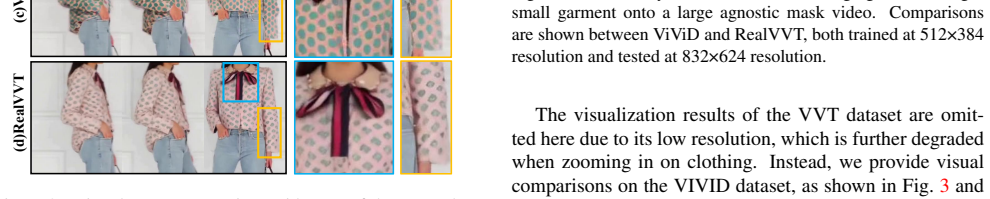
Summary. The paper proposes RealVVT, a video virtual try-on framework built on Stable Video Diffusion with a dual U-Net (ReferenceNet + Denoising UNet), and claims state-of-the-art performance on both single-image and video try-on tasks. It introduces three components: an Agnostic Mask-Guided Attention Loss for spatial consistency, a Clothing & Temporal Consistency (C&T) attention mechanism for temporal coherence, and a Pose-guided Long VVT strategy for long videos. Experiments are reported on VVT, VITON-HD, and DressCode (upper/lower/dresses), with quantitative metrics including SSIM, LPIPS, FID, KID, VFID_I3D, and VFID_ResNeXt, plus qualitative comparisons on ViViD.
Significance. If the method and its reported results are reproducible, RealVVT would be a meaningful advance in video virtual try-on, particularly because it avoids expensive optical-flow or dedicated temporal modules and instead augments attention with a single reference frame and garment features. The paper also provides useful qualitative evidence of improved temporal garment consistency on challenging cases. However, the central novelty (C&T attention) is underspecified and internally inconsistent as written, the ablation supporting it is confounded by an unreported hyperparameter change, and the long-video algorithm has a likely infinite loop in its pseudocode. These issues directly affect the validity of the headline SOTA claims, so the paper needs substantial revision before the results can be trusted.
major comments (4)
- [§3.4, Eq. (9)] The definition of the Clothing & Temporal Consistency attention is internally contradictory. Eq. (9) states that j is 'a randomly selected frame' from {0, ..., i-2, i, ..., N-1}, which includes the current frame and future frames. The prose immediately before Eq. (9), however, describes a 'heuristic rule that selects frames based on adjacent frame differences' where for small i the model gathers information from later frames and for large i it uses earlier frames. These are two different mechanisms. No training-time vs. inference-time protocol is given, and no ablation comparing the random choice, the heuristic, and fixed first-frame selection is provided. Since Table 6 attributes the largest consistency gains (SSIM 0.910→0.976, VFID_I3D 4.761→2.689) to this component, the exact implemented behavior must be specified and an ablation with controlled variants must be added.
- [§4.2, Table 6 vs §4 Implementation Details] The ablation is confounded by an inconsistent value of λ_N. The implementation details in §4 state 'λ_N is set to 0.01', but the ablation in §4.2 says 'with a fixed λ_N of 0.1'. The four rows of Table 6 that vary λ_agn are therefore not directly comparable to the final C&T row if the two experiments use different λ_N values. The effect attributed to C&T may be partly due to the λ_N change. The authors should rerun the ablation with a single fixed λ_N (or explicitly disclose and justify the discrepancy) and report the full configuration for each row.
- [§3.5, Algorithm 1] The Pose-guided Long VVT algorithm is not reproducible as written. First, the thresholds dpose (Algorithm 1) and ddense (§3.5 text) are inconsistent names and neither value is specified. Second, the pseudocode has a control-flow error: if the condition in the while loop is false, j is never incremented, which leads to an infinite loop. Third, the logic 'if ∥pi − pj∥2 < dpose or |i − j| < smax then Ω.insert(i)' appears to select a keyframe when the pose distance is small, which contradicts the stated goal of selecting frames with large pose/motion changes. The authors should provide a correct, unambiguous algorithm with concrete parameter values and a worked example.
- [Tables 1–5 and Abstract/Conclusion] The claim of a 'clear performance advantage across all datasets' is not supported by the reported numbers. In Table 1, RealVVT's VFID_I3D (2.689) is worse than VITON-DiT (2.498) and GPD-VVTO (1.28). In the image tables, LPIPS is worse than at least one baseline on three of the four datasets: VITON-HD (Ours 0.101 vs. DCI-VTON 0.0786 and WildVidFit 0.0773), DressCode-Upper (Ours 0.0608 vs. WildVidFit 0.0432), and DressCode-Lower (Ours 0.0743 vs. MGD 0.0689). No error bars or significance tests are reported, so it is also unclear whether the numerical gaps are meaningful. The abstract and conclusion should be softened to state where the method is competitive and where it is not, rather than claiming universal state-of-the-art performance.
minor comments (6)
- [§1, Introduction] The sentence 'Spatial Inconsistency: Garments tend to adhere to the target mask’s shape and color...' is duplicated verbatim twice in the list of challenges.
- [§3.4, Eq. (9)] The text says 'prensent' instead of 'present' in §3 (second sentence of the section overview).
- [§3.5 vs Algorithm 1] The threshold name is inconsistent: the text uses 'ddense' while Algorithm 1 uses 'dpose'. Please unify the notation.
- [§4.1] In the visualization section, 'VIVID' is used as an alternative spelling of 'ViViD'; please be consistent.
- [§3.3, Eq. (3)] The text says 'λn ontrols' (typo) and later uses 'λN'; please fix the symbol and its capitalization consistently.
- [Algorithm 1] The pseudocode formatting is ambiguous (e.g., 'do j+ = 1' inside the if block) and should be rewritten with clear loop semantics and an else branch.
Circularity Check
No significant circularity: RealVVT's components are trained losses and architectural mechanisms evaluated on external benchmarks; no reported result reduces to a fitted input or a self-citation chain.
full rationale
The paper's central claims are empirical comparisons on VITON-HD, DressCode, VVT, and ViViD using standard metrics (SSIM, LPIPS, FID, KID, VFID). The proposed components—Agnostic Mask-Guided loss (Eq. 4–5), Clothing & Temporal Consistency Attention (Eq. 9), and Pose-guided Long VVT (Algorithm 1)—are training objectives and network design choices, not quantities fitted to the test metrics. The tunable constants are loss weights λ_agn and λ_N and thresholds dpose and smax, and the paper does not report fitting these to the evaluation set. No equation is defined in terms of the metric it is said to predict; for example, Lagn operates on attention probabilities S_a^i, while SSIM and FID are computed on generated frames. The C&T attention concatenates current, temporally selected, and reference features; it does not encode SSIM or VFID. The Pose-guided strategy uses DensePose L2 distances and is not derived from the target metrics. There are no load-bearing self-citations: SVD, Animate Anyone, and Rerender-A-Video are external pretrained or published systems used as backbones or inspirations, and the paper does not invoke a uniqueness theorem from its own authors. In-scope transparency issues appear and are weighed but are not circular: Sec. 4 states λ_N = 0.01 while Sec. 4.2's ablation says λ_N = 0.1; Eq. (9) says 'randomly selected frame' while the prose describes a heuristic adjacent-frame-difference rule; dpose and smax are never specified; and Appendix B candidly lists segmentation and DensePose limitations. These are reproducibility and correctness concerns, not circularity, because they do not make any reported result equal to its input by construction. Evaluation against external datasets and baselines gives the SOTA claim independent empirical content. Therefore no circular step is established.
Assumptions & free parameters
free parameters (4)
- lambda_agn =
0.5
- lambda_N =
0.01 (implementation) vs 0.1 (ablation)
- dpose =
not reported
- smax =
not reported
assumptions (5)
- domain assumption Pretrained Stable Video Diffusion XT and Stable Diffusion 2.1 provide a prior that transfers to video try-on after fine-tuning.
- domain assumption The agnostic masks and DensePose maps computed by Detectron2/SAPIENS are accurate enough to train and evaluate the model.
- ad hoc to paper Randomly sampling one reference frame's K/V features is sufficient temporal context for maintaining garment consistency.
- domain assumption DensePose L2 distance between frames is a reliable proxy for motion and viewpoint change in keyframe selection.
- standard math EDM preconditioning and the denoising score-matching loss remain valid with the modified 9-channel input and the auxiliary attention loss.
Cite this review
Pith. "Pith review of RealVVT: Towards Photorealistic Video Virtual Try-on via Spatio-Temporal Consistency." pith.science (2026). https://pith.science/paper/I6SYYD6J
@misc{pith2026250108682,
  author       = {Pith},
  title        = {Pith review of: RealVVT: Towards Photorealistic Video Virtual Try-on via Spatio-Temporal Consistency},
  year         = {2026},
  howpublished = {\url{https://pith.science/paper/I6SYYD6J}},
  note         = {Machine review of arXiv:2501.08682}
}
read the original abstract
Virtual try-on has emerged as a pivotal task at the intersection of computer vision and fashion, aimed at digitally simulating how clothing items fit on the human body. Despite notable progress in single-image virtual try-on (VTO), current methodologies often struggle to preserve a consistent and authentic appearance of clothing across extended video sequences. This challenge arises from the complexities of capturing dynamic human pose and maintaining target clothing characteristics. We leverage pre-existing video foundation models to introduce RealVVT, a photoRealistic Video Virtual Try-on framework tailored to bolster stability and realism within dynamic video contexts. Our methodology encompasses a Clothing & Temporal Consistency strategy, an Agnostic-guided Attention Focus Loss mechanism to ensure spatial consistency, and a Pose-guided Long Video VTO technique adept at handling extended video sequences.Extensive experiments across various datasets confirms that our approach outperforms existing state-of-the-art models in both single-image and video VTO tasks, offering a viable solution for practical applications within the realms of fashion e-commerce and virtual fitting environments.
Figures


Figures from the paper (4 more)


Reference graph
Works this paper leans on
-
[1]
Stable video diffusion: Scaling latent video diffusion models to large datasets,
A. Blattmann, T. Dockhorn, S. Kulal, D. Mendelevitch, M. Kilian, D. Lorenz, Y . Levi, Z. English, V . V oleti, A. Letts et al., “Stable video diffusion: Scaling latent video diffusion models to large datasets,” arXiv preprint arXiv:2311.15127,
-
[2]
Elucidating the design space of diffusion-based generative models,
T. Karras, M. Aittala, T. Aila, and S. Laine, “Elucidating the design space of diffusion-based generative models,” Ad- vances in neural information processing systems, vol. 35, pp. 26 565–26 577, 2022. 4
work page 2022
-
[3]
Auto-encoding variational bayes,
D. P. Kingma, “Auto-encoding variational bayes,” arXiv preprint arXiv:1312.6114, 2013. 4
arXiv 2013
-
[4]
Single stage virtual try-on via deformable attention flows,
S. Bai, H. Zhou, Z. Li, C. Zhou, and H. Yang, “Single stage virtual try-on via deformable attention flows,” in European Conference on Computer Vision. Springer, 2022, pp. 409–
work page 2022
-
[5]
Sapiens: Foundation for human vision models,
R. Khirodkar, T. Bagautdinov, J. Martinez, S. Zhaoen, A. James, P. Selednik, S. Anderson, and S. Saito, “Sapiens: Foundation for human vision models,” in European Confer- ence on Computer Vision. Springer, 2025, pp. 206–228. 6, 1
work page 2025
-
[6]
Animate anyone: Consistent and controllable image- to-video synthesis for character animation,
L. Hu, “Animate anyone: Consistent and controllable image- to-video synthesis for character animation,” in Proceedings of the IEEE/CVF Conference on Computer Vision and Pat- tern Recognition, 2024, pp. 8153–8163. 2, 4
work page 2024
-
[7]
Dress code: High-resolution multi-category virtual try-on,
D. Morelli, M. Fincato, M. Cornia, F. Landi, F. Cesari, and R. Cucchiara, “Dress code: High-resolution multi-category virtual try-on,” in Proceedings of the IEEE/CVF conference on computer vision and pattern recognition, 2022, pp. 2231–
work page 2022
-
[8]
Rerender a video: Zero-shot text-guided video-to-video translation,
S. Yang, Y . Zhou, Z. Liu, and C. C. Loy, “Rerender a video: Zero-shot text-guided video-to-video translation,” in SIG- GRAPH Asia 2023 Conference Papers, 2023, pp. 1–11. 6
work page 2023
Show all 47 references
-
[9]
Diffusion models beat gans on image synthesis,
P. Dhariwal and A. Nichol, “Diffusion models beat gans on image synthesis,”Advances in neural information processing systems, vol. 34, pp. 8780–8794, 2021. 3
2021
-
[10]
Learning transferable visual models from natural language supervision,
A. Radford, J. W. Kim, C. Hallacy, A. Ramesh, G. Goh, S. Agarwal, G. Sastry, A. Askell, P. Mishkin, J. Clark et al., “Learning transferable visual models from natural language supervision,” in International conference on machine learn- ing. PmLR, 2021, pp. 8748–8763. 4
2021
-
[11]
Animatediff: Animate your personalized text-to-image diffusion models without specific tuning,
Y . Guo, C. Yang, A. Rao, Z. Liang, Y . Wang, Y . Qiao, M. Agrawala, D. Lin, and B. Dai, “Animatediff: Animate your personalized text-to-image diffusion models without specific tuning,” arXiv preprint arXiv:2307.04725, 2023. 3
2023 arXiv
-
[12]
Ootdiffusion: Out- fitting fusion based latent diffusion for controllable virtual try-on,
Y . Xu, T. Gu, W. Chen, and C. Chen, “Ootdiffusion: Out- fitting fusion based latent diffusion for controllable virtual try-on,” arXiv preprint arXiv:2403.01779, 2024. 4
2024 arXiv
-
[13]
Gpd-vvto: Preserving garment details in video virtual try- on,
Y . Wang, W. Dai, L. Chan, H. Zhou, A. Zhang, and S. Liu, “Gpd-vvto: Preserving garment details in video virtual try- on,” in Proceedings of the 32nd ACM International Confer- ence on Multimedia, 2024, pp. 7133–7142. 4, 7, 8
2024
-
[14]
Latte: Latent diffusion transformer for video generation,
X. Ma, Y . Wang, G. Jia, X. Chen, Z. Liu, Y .-F. Li, C. Chen, and Y . Qiao, “Latte: Latent diffusion transformer for video generation,” arXiv preprint arXiv:2401.03048, 2024. 3
2024 arXiv
-
[15]
High-resolution image synthesis with latent diffusion models,
R. Rombach, A. Blattmann, D. Lorenz, P. Esser, and B. Om- mer, “High-resolution image synthesis with latent diffusion models,” in Proceedings of the IEEE/CVF conference on computer vision and pattern recognition , 2022, pp. 10 684– 10 695. 3
2022
-
[16]
Viton-dit: Learning in-the-wild video try-on from human dance videos via diffusion transformers,
J. Zheng, F. Zhao, Y . Xu, X. Dong, and X. Liang, “Viton-dit: Learning in-the-wild video try-on from human dance videos via diffusion transformers,” arXiv preprint arXiv:2405.18326, 2024. 2, 3, 4, 7
2024 arXiv
-
[17]
Tunnel try-on: Excavating spatial- temporal tunnels for high-quality virtual try-on in videos,
Z. Xu, M. Chen, Z. Wang, L. Xing, Z. Zhai, N. Sang, J. Lan, S. Xiao, and C. Gao, “Tunnel try-on: Excavating spatial- temporal tunnels for high-quality virtual try-on in videos,” in Proceedings of the 32nd ACM International Conference on Multimedia, 2024, pp. 3199–3208. 2, 3, 4, 7
2024
-
[18]
Clothformer: Tam- ing video virtual try-on in all module,
J. Jiang, T. Wang, H. Yan, and J. Liu, “Clothformer: Tam- ing video virtual try-on in all module,” in Proceedings of the IEEE/CVF Conference on Computer Vision and Pattern Recognition, 2022, pp. 10 799–10 808. 2, 3, 7
2022
-
[19]
Improving diffusion models for authentic virtual try-on in the wild,
Y . Choi, S. Kwak, K. Lee, H. Choi, and J. Shin, “Improving diffusion models for authentic virtual try-on in the wild,” in European Conference on Computer Vision , 2024, pp. 206–
2024
-
[20]
Stablevi- ton: Learning semantic correspondence with latent diffusion model for virtual try-on,
J. Kim, G. Gu, M. Park, S. Park, and J. Choo, “Stablevi- ton: Learning semantic correspondence with latent diffusion model for virtual try-on,” in Proceedings of the IEEE/CVF Conference on Computer Vision and Pattern Recognition , 2024, pp. 8176–8185. 7, 1, 2, 3
2024
-
[21]
Dit: Self- supervised pre-training for document image transformer,
J. Li, Y . Xu, T. Lv, L. Cui, C. Zhang, and F. Wei, “Dit: Self- supervised pre-training for document image transformer,” in Proceedings of the 30th ACM International Conference on Multimedia, 2022, pp. 3530–3539. 3
2022
-
[22]
Flownet: Learning optical flow with convolutional net- works,
A. Dosovitskiy, P. Fischer, E. Ilg, P. Hausser, C. Hazirbas, V . Golkov, P. Van Der Smagt, D. Cremers, and T. Brox, “Flownet: Learning optical flow with convolutional net- works,” in Proceedings of the IEEE international conference on computer vision, 2015, pp. 2758–2766. 3
2015
-
[23]
Shineon: Illuminating design choices for practical video-based virtual clothing try-on,
G. Kuppa, A. Jong, X. Liu, Z. Liu, and T.-S. Moh, “Shineon: Illuminating design choices for practical video-based virtual clothing try-on,” in Proceedings of the IEEE/CVF Winter Conference on Applications of Computer Vision , 2021, pp. 191–200. 3
2021
-
[24]
Mv-ton: Memory-based video virtual try-on network,
X. Zhong, Z. Wu, T. Tan, G. Lin, and Q. Wu, “Mv-ton: Memory-based video virtual try-on network,” inProceedings of the 29th ACM International Conference on Multimedia , 2021, pp. 908–916. 2
2021
-
[25]
Fw-gan: Flow-navigated warping gan for video virtual try- on,
H. Dong, X. Liang, X. Shen, B. Wu, B.-C. Chen, and J. Yin, “Fw-gan: Flow-navigated warping gan for video virtual try- on,” in Proceedings of the IEEE/CVF international confer- ence on computer vision, 2019, pp. 1161–1170. 2, 3
2019
-
[26]
Gentron: Diffusion transformers for image and video generation,
S. Chen, M. Xu, J. Ren, Y . Cong, S. He, Y . Xie, A. Sinha, P. Luo, T. Xiang, and J.-M. Perez-Rua, “Gentron: Diffusion transformers for image and video generation,” in Proceed- ings of the IEEE/CVF Conference on Computer Vision and Pattern Recognition, 2024, pp. 6441–6451. 3
2024
-
[27]
Dive: Dit-based video generation with enhanced control,
J. Jiang, G. Hong, L. Zhou, E. Ma, H. Hu, X. Zhou, J. Xiang, F. Liu, K. Yu, H. Sun et al. , “Dive: Dit-based video generation with enhanced control,” arXiv preprint arXiv:2409.01595, 2024
2024 arXiv
-
[28]
Sora: A review on back- ground, technology, limitations, and opportunities of large vision models,
Y . Liu, K. Zhang, Y . Li, Z. Yan, C. Gao, R. Chen, Z. Yuan, Y . Huang, H. Sun, J. Gao et al., “Sora: A review on back- ground, technology, limitations, and opportunities of large vision models,” arXiv preprint arXiv:2402.17177, 2024. 3
2024 arXiv
-
[29]
Nuwa-xl: Diffusion over dif- fusion for extremely long video generation,
S. Yin, C. Wu, H. Yang, J. Wang, X. Wang, M. Ni, Z. Yang, L. Li, S. Liu, F. Yang et al., “Nuwa-xl: Diffusion over dif- fusion for extremely long video generation,” arXiv preprint arXiv:2303.12346, 2023. 3
2023 arXiv
-
[30]
Trip: Temporal residual learning with image noise prior for image-to-video diffusion models,
Z. Zhang, F. Long, Y . Pan, Z. Qiu, T. Yao, Y . Cao, and T. Mei, “Trip: Temporal residual learning with image noise prior for image-to-video diffusion models,” in Proceedings of the IEEE/CVF Conference on Computer Vision and Pat- tern Recognition, 2024, pp. 8671–8681. 3
2024
-
[31]
Latent video diffusion models for high-fidelity long video genera- tion,
Y . He, T. Yang, Y . Zhang, Y . Shan, and Q. Chen, “Latent video diffusion models for high-fidelity long video genera- tion,” arXiv preprint arXiv:2211.13221, 2022. 3
2022 arXiv
-
[32]
Multi-concept customization of text-to-image diffu- sion,
N. Kumari, B. Zhang, R. Zhang, E. Shechtman, and J.-Y . Zhu, “Multi-concept customization of text-to-image diffu- sion,” in Proceedings of the IEEE/CVF Conference on Com- puter Vision and Pattern Recognition, 2023, pp. 1931–1941. 3
2023
-
[33]
Distill- ing diffusion models into conditional gans,
M. Kang, R. Zhang, C. Barnes, S. Paris, S. Kwak, J. Park, E. Shechtman, J.-Y . Zhu, and T. Park, “Distill- ing diffusion models into conditional gans,” arXiv preprint arXiv:2405.05967, 2024. 3
2024 arXiv
-
[34]
Toward characteristic-preserving image-based virtual try- on network,
B. Wang, H. Zheng, X. Liang, Y . Chen, L. Lin, and M. Yang, “Toward characteristic-preserving image-based virtual try- on network,” in Proceedings of the European conference on computer vision (ECCV), 2018, pp. 589–604. 7, 8
2018
-
[35]
High- resolution virtual try-on with misalignment and occlusion- handled conditions,
S. Lee, G. Gu, S. Park, S. Choi, and J. Choo, “High- resolution virtual try-on with misalignment and occlusion- handled conditions,” in European Conference on Computer Vision. Springer, 2022, pp. 204–219. 7, 8
2022
-
[36]
Ladi-vton: Latent diffusion textual- inversion enhanced virtual try-on,
D. Morelli, A. Baldrati, G. Cartella, M. Cornia, M. Bertini, and R. Cucchiara, “Ladi-vton: Latent diffusion textual- inversion enhanced virtual try-on,” in Proceedings of the 31st ACM International Conference on Multimedia , 2023, pp. 8580–8589. 7, 8
2023
-
[37]
Tam- ing the power of diffusion models for high-quality virtual try- on with appearance flow,
J. Gou, S. Sun, J. Zhang, J. Si, C. Qian, and L. Zhang, “Tam- ing the power of diffusion models for high-quality virtual try- on with appearance flow,” in Proceedings of the 31st ACM International Conference on Multimedia , 2023, pp. 7599–
2023
-
[38]
Viton-hd: High- resolution virtual try-on via misalignment-aware normaliza- tion,
S. Choi, S. Park, M. Lee, and J. Choo, “Viton-hd: High- resolution virtual try-on via misalignment-aware normaliza- tion,” in Proceedings of the IEEE/CVF conference on com- puter vision and pattern recognition , 2021, pp. 14 131– 14 140. 4, 6
2021
-
[39]
Sam 2: Segment anything in images and videos,
N. Ravi, V . Gabeur, Y .-T. Hu, R. Hu, C. Ryali, T. Ma, H. Khedr, R. R ¨adle, C. Rolland, L. Gustafson et al., “Sam 2: Segment anything in images and videos,” arXiv preprint arXiv:2408.00714, 2024. 1
2024 arXiv
-
[40]
Wild- vidfit: Video virtual try-on in the wild via image-based con- trolled diffusion models,
Z. He, P. Chen, G. Wang, G. Li, P. H. Torr, and L. Lin, “Wild- vidfit: Video virtual try-on in the wild via image-based con- trolled diffusion models,” arXiv preprint arXiv:2407.10625,
-
[41]
Cat-dm: Controllable accelerated virtual try-on with diffu- sion model,
J. Zeng, D. Song, W. Nie, H. Tian, T. Wang, and A.-A. Liu, “Cat-dm: Controllable accelerated virtual try-on with diffu- sion model,” inProceedings of the IEEE/CVF Conference on Computer Vision and Pattern Recognition, 2024, pp. 8372–
2024
-
[42]
Multimodal garment designer: Human- centric latent diffusion models for fashion image editing,
A. Baldrati, D. Morelli, G. Cartella, M. Cornia, M. Bertini, and R. Cucchiara, “Multimodal garment designer: Human- centric latent diffusion models for fashion image editing,” in Proceedings of the IEEE/CVF International Conference on Computer Vision, 2023, pp. 23 393–23 402. 8
2023
-
[43]
Paint by example: Exemplar-based image editing with diffusion models,
B. Yang, S. Gu, B. Zhang, T. Zhang, X. Chen, X. Sun, D. Chen, and F. Wen, “Paint by example: Exemplar-based image editing with diffusion models,” in Proceedings of the IEEE/CVF Conference on Computer Vision and Pattern Recognition, 2023, pp. 18 381–18 391. 8
2023
-
[44]
Vivid: Video virtual try-on using diffusion models,
Z. Fang, W. Zhai, A. Su, H. Song, K. Zhu, M. Wang, Y . Chen, Z. Liu, Y . Cao, and Z.-J. Zha, “Vivid: Video virtual try-on using diffusion models,” arXiv preprint arXiv:2405.11794 ,
-
[45]
Fresco: Spatial- temporal correspondence for zero-shot video translation,
S. Yang, Y . Zhou, Z. Liu, and C. C. Loy, “Fresco: Spatial- temporal correspondence for zero-shot video translation,” in Proceedings of the IEEE/CVF Conference on Computer Vi- sion and Pattern Recognition, 2024, pp. 8703–8712. 6
2024
-
[46]
Lvcd: reference-based lineart video colorization with diffusion models,
Z. Huang, M. Zhang, and J. Liao, “Lvcd: reference-based lineart video colorization with diffusion models,” ACM Transactions on Graphics (TOG) , vol. 43, no. 6, pp. 1–11,
-
[47]
Detectron2,
Y . Wu, A. Kirillov, F. Massa, W. Liu, A. C. Berg, and P. Dollar, “Detectron2,” 2019, accessed: 2024-12-24. [Online]. Available: https://github.com/facebookresearch/ detectron2 6 RealVVT: Towards Photorealistic Video Virtual Try-on via Spatio-Temporal Consistency Supplementary...
2019
Reviewed August 10, 2026 · model on record in the stance chip above.
Discussion (0). Continue with ORCID to comment.