REVIEW 4 major objections 6 minor 50 references
Multi-visual modality micro drone-based structural damage detection
T0 review · 4 major / 6 minor · reviewed 2026-08-10 · deepseek-v4-flash
Pith's one-line read Two added modules make micro-drone damage detection more accurate and stable in bad imaging conditions.
desk verdict Plausible empirical comparison, but the central RL training loop is underspecified to the point of non-implementability, and the conclusion contradicts the body's extreme-robustness numbers. read the letter →
The pith
A machine-rendered reading of the paper's core claim, the machinery that carries it, and where it could break.
The reading
What carries the argument
The load-bearing mechanism is the stem block backed by event-based reward reinforcement learning, plus spiral pooling. The stem block is a learned image-transform gate: the adapted EfficientNet-B4 outputs two tuples, Te = (colormap, alpha) for a thermal-like effect and Dt = (brightness, contrast, gamma, saturation, hue) for a dark overlay, and the transformed views are concatenated with RGB features at layer P1/2 of EfficientDet-D4. Event-based reward reinforcement learning couples the transform generator to the detector by treating the detector's normalized detection confidence as a parent reward with weight 0.4 and the two modality predictions as child rewards with weight 0.3 each. Spiral pooling takes an average or max pooled feature map, reads it in spiral order, fuses the spiraled map with the original via an element-wise operation, and concatenates the result before the next layer, functioning as an online augmentation that changes feature orientation during training.
What would settle it
Train the same DetectorX architecture but replace the reward signal used to train the transform generator with random or fixed values, keeping data, schedule, and detector identical; if mean average precision stays near 0.76, the reward loop is not the cause of the stem-block gain.
Extended reading notes
Core claim
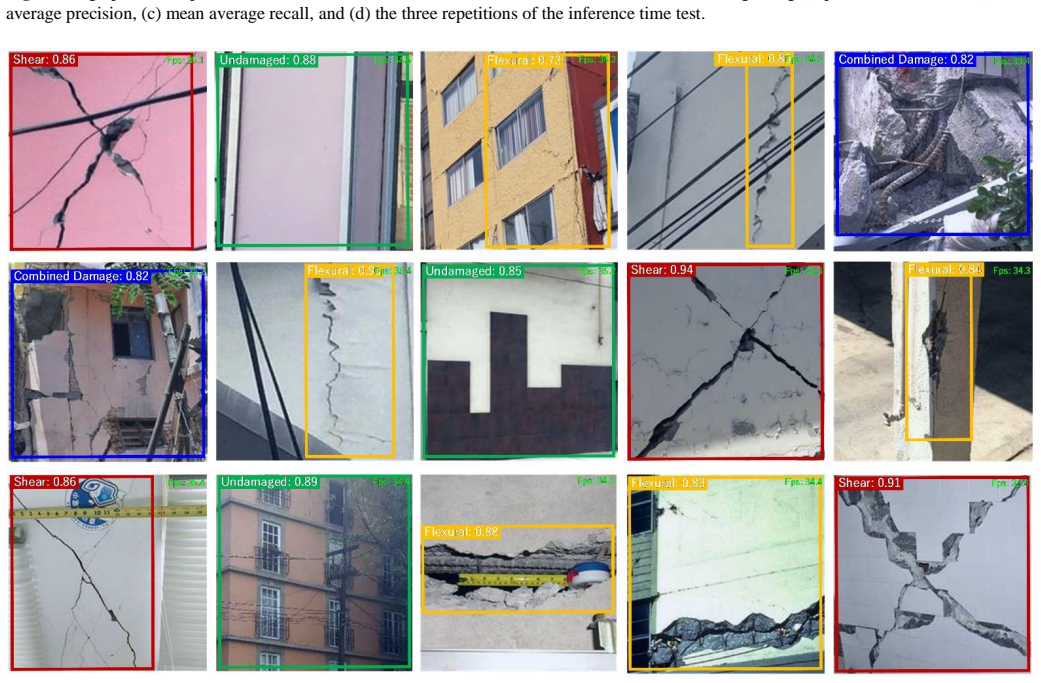
DetectorX's central claim is that robustness under difficult imaging conditions can be improved inside the detector rather than by preprocessing the training set. A modified EfficientNet-B4 is trained with event-based reward reinforcement learning to output transform parameters: a colormap/alpha tuple for a thermal-like view and brightness, contrast, gamma, saturation, and hue values for a dark-theme view. These two computationally generated modalities are concatenated with the RGB feature map inside an adapted EfficientDet-D4, and a spiral-pooling layer is inserted into both models to reorient and fuse pooled features online. Together the modules are claimed to let the detector maintain precision and recall under blur, illumination, noise, and fog, and to beat the comparison detectors on the PEER Hub ImageNet damage-type task as well as in a micro-drone field test.
Load-bearing premise
The load-bearing premise is that the detector-confidence reward used to train the modality generator teaches transformations that generalize to new scenes, rather than transformations that only help on the training split, and the paper does not validate this independently.
Editorial extensions
If this is right
- If the central claim is right, adding the stem block and spiral pooling to an EfficientDet-style detector should improve damage-detection accuracy without requiring a new detector training objective.
- The ablations reported in the paper imply the stem block contributes more than spiral pooling: removing the stem block drops most metrics by about 5 percentage points, while removing spiral pooling drops them by about 3 percentage points.
- The field results imply micro-drone inspections can use this model at 15-50 m standoff and 4-8 m/s flight speeds while keeping precision roughly between 0.74 and 0.84 and recall between 0.70 and 0.83.
- The robustness results imply the model is usable in low-to-mild blur, illumination, noise, and fog, and degrades gradually rather than collapsing in extreme conditions.
- Because spiral pooling is presented as a generic layer, it should transfer to other DCNN-based detectors beyond the two EfficientNet-family models used here.
Reading between the lines
- As an editorial inference, the closed-loop reward design may be the fragile part: because the transform generator is rewarded by the confidence of the same detector being evaluated, the learned transformations could be tuned to that detector's blind spots rather than to generally useful imagery, so an independent detector test would clarify whether the stem-block gain generalizes.
- Spiral pooling can be read as a structural way to add orientation and positional context to feature maps, and the same spiral traversal could be tested in segmentation or classification models, where the orientation-variation argument should also apply.
- The thermal-like and dark-theme transforms are chosen from a fixed parameter family, so a fair extension would test whether any diverse set of learned image filters produces similar robustness gains or whether these specific colormap and dark-theme choices matter.
- The reported gains come from one benchmark dataset and one drone platform; an out-of-distribution structural-damage dataset would separate module-level improvements from dataset-specific effects.
Editorial analysis
A structured set of objections, weighed in public.
Referee Report
Summary. The paper proposes DetectorX, a structural-damage-detection framework built on EfficientNet-B4 and EfficientDet-D4. A stem block uses predictions from an adapted EfficientNet-B4 to create thermal-like and dark-theme visual modalities alongside RGB, guided by a proposed "event-based reward reinforcement learning" (EbRRL); a second contribution, spiral pooling, is presented as an online feature-map augmentation. The method is evaluated on PEER Hub ImageNet task 8 (damage type) in a comparative experiment, a robustness experiment under blur, illumination, noise, and fog, and a micro-drone field test. The authors report that DetectorX outperforms DetectorX-SB, DetectorX-SP, EfficientDet-D5, YOLOX-m, YOLOv5-m, SSD500, and Faster-R-CNN on precision, recall, F1, AP, mAP, and mAR, and that it degrades more gracefully under adverse conditions.
Significance. If the results are correct, DetectorX makes a useful empirical contribution to robustness-oriented structural health monitoring with micro drones, and the field-test component is a practical strength. The main comparisons are against held-out test data, so the central empirical claim is not circular. The paper also reports clear ablations for both proposed modules and compares against a reasonable set of detectors. The significance is however tempered by three issues: the training algorithm for the stem block is not specified in a way that can be implemented; the robustness summary contains an internal numerical contradiction; and the claimed gains over the strongest competitor, YOLOX-m, are small enough that the missing training details and absent run-to-run variability matter.
major comments (4)
- [Section 3.5, Eqs. (6)-(8), Section 4.2, Algorithm 1] The EbRRL component is not actually specified as a learning algorithm. Eqs. (6)-(8) rewrite an MDP tuple with an aggregated reward R'_axr+ayr+azr, but no loss, policy-gradient term, or parameter update is defined. Section 4.2 lists "loss function = MSE", a discount factor, buffer size, and replay batch size, but it does not state what the MSE is computed against, how the scalar reward is converted into a learning signal, or how the reward reaches the parameters of the adapted EfficientNet-B4 that emit the continuous tuples (Te, Dt). Algorithm 1 only says "Update EfficientNet-B4 in DetectorX with a reward from EbRRL," which is a placeholder. As the text stands, the stem block's claimed dynamic visual modality cannot be implemented, reproduced, or independently tested; this is a load-bearing gap for the paper's main contribution.
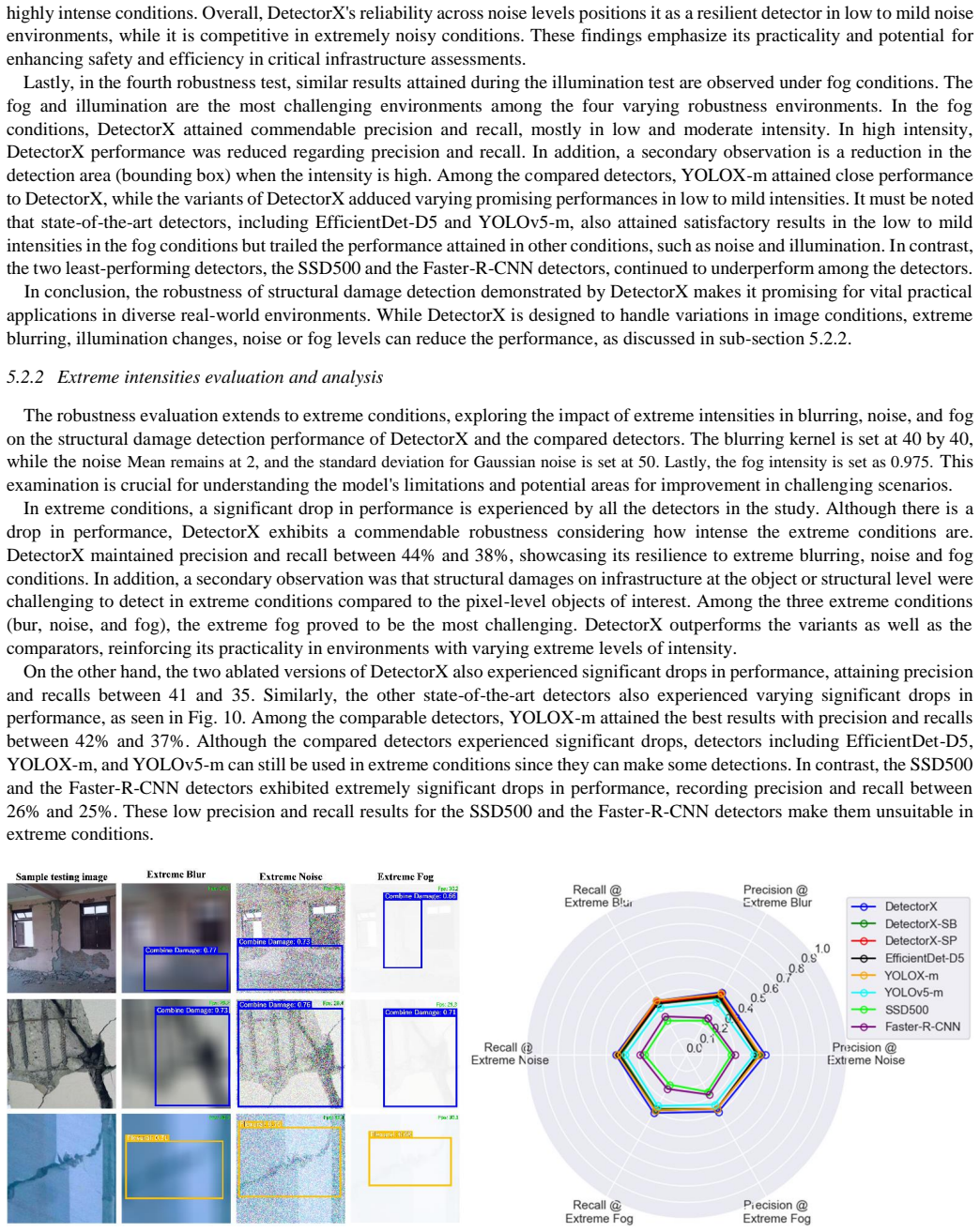
- [Section 5.2.2 versus Conclusion] The extreme-robustness numbers are internally inconsistent. Section 5.2.2 states that under extreme blur, noise, and fog, "DetectorX maintained precision and recall between 44% and 38%," and it says the ablated variants scored between 41 and 35, while YOLOX-m scored between 42% and 37%. The Conclusion, however, reports extreme-condition precision/recall for DetectorX as 0.74/0.71, 0.70/0.68, and 0.72/0.70, which are roughly the low-intensity values from Fig. 9, not the extreme-intensity values described in Section 5.2.2. These two sets of numbers cannot both describe the same experiment, and the contradiction undermines the robustness claim as currently written. The authors need to correct the reported values and clarify which table or figure supports each claim.
- [Section 3.3, Eqs. (1)-(4)] The spiral pooling operation is not defined precisely enough to implement. Eq. (2) appears to place a linear spiral traversal back into a matrix with ellipses rather than defining a rearranged feature map of the same dimensions, and the text does not specify how arbitrary rectangular feature maps are handled, how the element-wise fusion in Eq. (3) treats channel counts, or why the "spiraled" output preserves spatial alignment for concatenation in Eq. (4). Since spiral pooling is one of the paper's two claimed contributions and the ablation attributes about a 3% performance drop to it, the operation must be specified in a way that is unambiguous and differentiable.
- [Section 3.5 and Section 5.1.1] The reward design rests on unverified assumptions. The parent reward is the detection confidence of the same adapted EfficientDet-D4 being evaluated, aggregated with fixed hand-chosen child-reward weights of 0.4, 0.3, and 0.3 in Eq. (8). No sensitivity analysis, convergence analysis, or multi-seed variability is reported, so the reader cannot tell whether the reward loop makes the stem block generalize or simply overfit the training split. Given that the ablation DetectorX-SB is only about 5% lower on most metrics, the entire advantage attributed to the dynamic visual modality depends on this unvalidated reward scheme. At minimum, the authors should report reward-weight sensitivity and repeated-run statistics.
minor comments (6)
- [Throughout] There are numerous typos and inconsistent names that should be corrected in revision: "framwork," "enconder-decoder," "Mirco drone," "DeetctorX-SP," "EfficienDet-D5," and "SDD500" (should be SSD500).
- [Data availability] The data availability statement says the data is "specifically reference [48]", but the PEER Hub ImageNet dataset is cited as reference [49] in Section 4.1; the reference number is wrong.
- [Section 3.3 and Fig. 3] The text in Section 3.3 says "Fig. 2 gives a graphical insight into the procedure of the proposed spiral pooling," but Fig. 2 is the figure showing random samples and visual modalities, while the spiral-pooling figure is Fig. 3. The cross-reference should be fixed.
- [Table 1 and Section 3.1] The adapted EfficientNet-B4 is described as a regressor predicting continuous tuples, but the colormap value in Te is discrete (1-4). The text does not specify how the continuous regressor output is mapped to the discrete colormap choice or whether this mapping is differentiable during training.
- [Section 5.1.1 and Table 2] The text says DetectorX has "an fps of approximately 35ms," but FPS is a rate, not a duration; the table lists 35.16 frames per second. The sentence should be reworded for correctness.
- [Section 4.2] The phrase "sampling frequency = 1,000 per training step" for the adapted EfficientNet-B4 is unclear; it is not explained what is sampled or why the value is 1,000.
Circularity Check
No significant circularity: DetectorX's central comparison is against held-out PEER Hub data and external baselines; self-citations are background or deployment-only.
full rationale
The paper's core empirical claim—that DetectorX with the stem block and spiral pooling outperforms YOLOX-m, EfficientDet-D5, YOLOv5-m, SSD500, and Faster-R-CNN on PEER Hub ImageNet task 8—is supported by Table 2 and Figs. 9–12, with metrics computed against ground-truth labels on a held-out test split (3000/1000/585, §4.2). No equation in the paper defines the reported precision/recall/AP/mAP as the output of the method's own training signal; Eq. (8) only restates the MDP tuple for EbRRL, and the reward is the weighted detection confidence of the adapted EfficientDet-D4. That is a self-referential optimization loop—the visual-modality generator is trained on the detector's confidence—but it is not a case of a predicted quantity being equal to an input by construction, and the test-set evaluation is external to the reward. The self-citations [11,19,23,26,32,33,37,46] are literature-review context or the field-test app (§4.2), none load-bearing for the main claim. The missing specification of an actual parameter update for EbRRL (§3.5, Algorithm 1) is a reproducibility/completeness gap, not a circular reduction. No self-citation chain or uniqueness theorem is used to forbid alternatives, so the derivation is not circular.
Assumptions & free parameters
free parameters (3)
- Parent reward weight xr =
0.4
- Child reward weight yr =
0.3
- Child reward weight zr =
0.3
assumptions (4)
- domain assumption Spiral feature-map rearrangement during training improves detector robustness.
- ad hoc to paper Detection confidence of the adapted EfficientDet-D4 is a valid reward signal for training the EfficientNet-B4 visual-modality generator.
- ad hoc to paper The fixed reward weights 0.4, 0.3, and 0.3 correctly balance the parent and child actions.
- domain assumption The PEER Hub ImageNet train/validation/test split of 3000/1000/585 and one manually flown wall are representative of structural-damage inspection conditions.
Cite this review
Pith. "Pith review of Multi-visual modality micro drone-based structural damage detection." pith.science (2026). https://pith.science/paper/A3K5LXMY
@misc{pith2026250108807,
  author       = {Pith},
  title        = {Pith review of: Multi-visual modality micro drone-based structural damage detection},
  year         = {2026},
  howpublished = {\url{https://pith.science/paper/A3K5LXMY}},
  note         = {Machine review of arXiv:2501.08807}
}
read the original abstract
Accurate detection and resilience of object detectors in structural damage detection are important in ensuring the continuous use of civil infrastructure. However, achieving robustness in object detectors remains a persistent challenge, impacting their ability to generalize effectively. This study proposes DetectorX, a robust framework for structural damage detection coupled with a micro drone. DetectorX addresses the challenges of object detector robustness by incorporating two innovative modules: a stem block and a spiral pooling technique. The stem block introduces a dynamic visual modality by leveraging the outputs of two Deep Convolutional Neural Network (DCNN) models. The framework employs the proposed event-based reward reinforcement learning to constrain the actions of a parent and child DCNN model leading to a reward. This results in the induction of two dynamic visual modalities alongside the Red, Green, and Blue (RGB) data. This enhancement significantly augments DetectorX's perception and adaptability in diverse environmental situations. Further, a spiral pooling technique, an online image augmentation method, strengthens the framework by increasing feature representations by concatenating spiraled and average/max pooled features. In three extensive experiments: (1) comparative and (2) robustness, which use the Pacific Earthquake Engineering Research Hub ImageNet dataset, and (3) field-experiment, DetectorX performed satisfactorily across varying metrics, including precision (0.88), recall (0.84), average precision (0.91), mean average precision (0.76), and mean average recall (0.73), compared to the competing detectors including You Only Look Once X-medium (YOLOX-m) and others. The study's findings indicate that DetectorX can provide satisfactory results and demonstrate resilience in challenging environments.
Figures


Figures from the paper (3 more)


Reference graph
Works this paper leans on
-
[23]
I.O. Agyemang, X. Zhang, D. Acheampong, I. Adjei-Mensah, E. Opanin Gyamfi, W. Ayivi, C. Ijeoma Amuche, E.O. Gyamfi, J .R. Arhin, W. Ayivi, C.I. Amuche, Rpnet: Rotational Pooling Net for Efficient Micro Aerial Vehicle Trail Navigation, Engineering Applications of A rtificial Intelligence 116 (May) (2022), p. 105468, https://doi.org/10.1016/j.engappai.2022.105468
-
[1]
W. Wang, C. Su, G. Han, H. Zhang, A lightweight crack segmentation network based on knowledge distillation, Journal of Buildi ng Engineering 76 (June) (2023), p. 107200, https://doi.org/10.1016/j.jobe.2023.107200
arXiv 2023
-
[2]
Y. Gao, J. Yang, H. Qian, K.M. Mosalam, Multiattribute multitask transformer framework for vision -based structural health monitoring, Computer- Aided Civil and Infrastructure Engineering (2023), pp. 1–20, https://doi.org/10.1111/mice.13067
-
[3]
E. Asadi Shamsabadi, C. Xu, A.S. Rao, T. Nguyen, T. Ngo, D. Dias -da-Costa, Vision transformer-based autonomous crack detection on asphalt and concrete surfaces, Automation in Construction 140 (December 2021) (2022), p. 104316, https://doi.org/10.1016/j.autcon.2022.104316
- [4]
-
[5]
M. Bolognini, G. Izzo, D. Marchisotti, L. Fagiano, M.P. Limongelli, E. Zappa, Vision -based modal analysis of built environment structures with multiple drones, Automation in Construction 143 (August) (2022), p. 104550, https://doi.org/10.1016/j.autcon.2022.104550
arXiv 2022
-
[6]
A.M. Roy, J. Bhaduri, DenseSPH-YOLOv5: An automated damage detection model based on DenseNet and Swin-Transformer prediction head-enabled YOLOv5 with attention mechanism, Advanced Engineering Informatics 56 (October 2022) (2023),, https://doi.org/10.1016/j.aei.2023.102007
arXiv 2023
-
[7]
M.A. Jayaram, Computer vision applications in construction material and structural health monitoring: A scoping review, Materials Today: Proceedings (xxxx) (2023),, https://doi.org/10.1016/j.matpr.2023.06.031
Show all 50 references
-
[8]
Soleymani , H
A. Soleymani , H. Jahangir, M.L. Nehdi, Damage detection and monitoring in heritage masonry structures: Systematic review, Construction an d Building Materials 397 (January) (2023), p. 132402, https://doi.org/10.1016/j.conbuildmat.2023.132402
2023
-
[10]
Dong, F.N
C.Z. Dong, F.N. Catbas, A review of computer visio n–based structural health monitoring at local and global levels, Structural Health Monitoring 20 (2) (2021), pp. 692–743, https://doi.org/10.1177/1475921720935585
2021 doi
-
[12]
Kheradmandi, V
N. Kheradmandi, V. Mehranfar, A critical review and comparative study on image segmentation -based techniques for pavement crack detection, Construction and Building Materials 321 (December 2021) (2022), p. 126162, https://doi.org/10.1016/j.conbuildmat.2021.126162
2022
-
[14]
Nagesh, K
N. Nagesh, K. Raisi, N.A. Valente, J. Benoit, T. Yu, A. Sabato, Deep learning augmented infrared thermography for unmanned aerial vehicles structural health monitoring of roadways, Automation in Construction 148 (October 2022) (2023), p. 104784, https://doi.org/10.1016/j.autco...
2023
-
[15]
X.W. Ye, T. Jin, P.Y. Chen, Structural crack detection using deep learning–based fully convolutional networks, Advances in Structural Engineering 22 (16) (2019), pp. 3412–3419, https://doi.org/10.1177/1369433219836292
2019 doi
-
[16]
Pantoja -rosero, R
B.G. Pantoja -rosero, R. Achanta, K. Beyer, Damage -augmented digital twins towards the automated inspection of buildings, Automation in Construction 150 (March) (2023), p. 104842, https://doi.org/10.1016/j.autcon.2023.104842
2023
-
[17]
Baffour, Z
A.A. Baffour, Z. Qin, Y. Wang, Z. Qin, K.K.R. Choo, Spatial self-attention network with self-attention distillation for fine-grained image recognition, Journal of Visual Communication and Image Representation 81 (2021), p. 103368, https://doi.org/10.1016/j.jvcir.2021.103368
2021
-
[18]
Y. Zhou, A. Ji, L. Zhang, X. Xue, Attention -enhanced sampling point cloud network (ASPCNet) for efficient 3D tunnel semantic segmentation, Automation in Construction 146 (January 2022) (2023), p. 104667, https://doi.org/10.1016/j.autcon.2022.104667
2023
-
[19]
Agyemang, X
I.O. Agyemang, X. Zhang, I. Adjei -mensah, J.R. Arhin, E. Agyei, Lightweight Real -time Detection of Components via a Micro Aerial Vehicle with Domain Randomization Towards Structural Health Monitoring, Periodica Polytechnica Civil Engineering 66 (2) (2022), pp. 1–16, [Online]...
2022 doi
-
[20]
Ramezani Dooraki, D.J
A. Ramezani Dooraki, D.J. Lee, An innovative bio-inspired flight controller for quad-rotor drones: Quad-rotor drone learning to fly using reinforcement learning, Robotics and Autonomous Systems 135 (2021), p. 103671, https://doi.org/10.1016/j.robot.2020.103671
2021
-
[21]
Falanga, K
D. Falanga, K. Kleber, D. Scaramuzza, Dynamic obstacle avoidance for quadroto rs with event cameras, Science Robotics 5 (40) (2020),, https://doi.org/10.1126/scirobotics.aaz9712
2020 doi
-
[22]
C. Gao, X. Wang, R. Wang, Z. Zhao, Y. Zhai, X. Chen, B.M. Chen, A UAV -based explore-then-exploit system for autonomous indoor facility inspection and scene reconstruction, Automation in Construction 148 (December 2022) (2023), p. 104753, https://doi.org/10.1016/j.autcon.2023.104753
2023
-
[24]
Yu an, J
Y. Yu an, J. Zhang, Q. Wang, Deep Gabor convolution network for person re -identification, Neurocomputing 378 (2020), pp. 387 –398, https://doi.org/10.1016/j.neucom.2019.10.083
2020 doi
-
[25]
Loquercio, E
A. Loquercio, E. Kaufmann, R. Ranftl, A. Dosovitskiy, V. Koltun, D. Scaramuzza, D eep Drone Racing: From Simulation to Reality with Domain Randomization, IEEE Transactions on Robotics 36 (1) (2020), pp. 1–14, https://doi.org/10.1109/TRO.2019.2942989
2020
-
[26]
Agyemang, X
I.O. Agyemang, X. Zhang, I. Adjei -Mensah, B.L.Y. Agbley, B.C. Mawuli, L.D. Fiasam, C. Sey, Accelerating trail navigation for unmanned aerial vehicle: A denoising deep-net with 3D-NLGL, Journal of Intelligent and Fuzzy Systems 43 (6) (2022), pp. 7277 –7295, https://doi.org/10....
2022 doi
-
[27]
Q. Qiu, D. Lau, Real -time detection of cracks in tiled sidewalks using YOLO -based method applied to unmanned aerial vehicle ( UAV ) images, Automation in Construction 147 (May 2022) (2023), p. 104745, https://doi.org/10.1016/j.autcon.2023.104745
2023
-
[28]
Kang, Y.J
D.H. Kang, Y.J. Cha, Efficient attention -based deep encoder and decoder for automatic crack segmentation, Structural Health Monitoring (2021),, https://doi.org/10.1177/14759217211053776
2021 doi
-
[29]
J. Deng, A. Singh, Y. Zhou, Y. Lu, V.C.S. Lee, Review on computer vision-based crack detection and quantification methodologies for civil structures, Construction and Building Materials 356 (June) (2022),, https://doi.org/10.1016/j.conbuildmat.2022.129238
2022
-
[30]
Alsakka, S
F. Alsakka, S. Assaf, I. El-Chami, M. Al-Hussein, Computer vision applications in offsite construction, Automation in Construction 154 (May) (2023), p. 104980, https://doi.org/10.1016/j.autcon.2023.104980
2023
-
[31]
D. Ai, G. Jiang, S.K. Lam, P. He, C. Li, Computer vision framewor k for crack detection of civil infrastructure—A review, Engineering Applications of Artificial Intelligence 117 (August 2022) (2023), p. 105478, https://doi.org/10.1016/j.engappai.2022.105478
2023
-
[32]
Agyemang, X
I.O. Agyemang, X. Zhang, I.A. Mensah, B.C. Mawuli, B.L.Y. Agbley, J.R. Arhin, Enhanced deep convolutional neural network for building component detection towards structural health monitoring, , in 2021 4th International Conference on Pattern Recognition and Artificial Intellig...
2021
-
[33]
Agyemang, X
I.O. Agyemang, X. Zhang, I. Adjei -mensah, D. Acheampong, L. Delali, C. Sey, S. Banaamwini, D. Effah, Automated vision -based structural health inspection and assessment for post -construction civil infrastr ucture, Automation in Construction 156 (October) (2023), p. 105153, h...
2023
-
[34]
G. Ye, J. Qu, J. Tao, W. Dai, Y. Mao, Q. Jin, Autonomous surface crack identification of concrete structures based on the YOLOv7 algorithm, Journal of Building Engineering 73 (April) (2023), p. 106688, https://doi.org/10.1016/j.jobe.2023.106688
2023
-
[35]
M. Dang, H. Wang, T.-H. Nguyen, L. Tightiz, L. Dinh Tien, T.N. Nguyen, N.P. Nguyen, CDD-TR: Automated concrete defect investigation using an improved deformable transformers, Journal of Building Engineering 75 (May) (2023), p. 106976, https://doi.org/10.1016/j.jobe.2023.106976
2023
-
[36]
Katsigiannis, S
S. Katsigiannis, S. Seyedzadeh, A. Agapiou, N. Ramzan, Deep learning for crack detection on masonry façades using limited data and transfer learning, Journal of Building Engineering 76 (June) (2023), p. 107105, https://doi.org/10.1016/j.jobe.2023.107105
2023
-
[37]
Agyemang, X
I.O. Agyemang, X. Zhang, I. Adjei-Mensah, B.C. Mawuli, B.L.Y. Agbley, L.D. Fiasam, C. Sey, On Salient Concrete Crack Detection Via Improved Yolov5, , in 2021 18th International Computer Conference on Wavelet Active Media Technology and Information Processing, ICCWAMTIP 2021 , ...
2021
-
[38]
Andrushia, N
A.D. Andrushia, N. Anand, T.M. Neebha, M.Z. Naser, E. Lubloy, Autonomous detection of concrete damage under fire conditions, , Automation in Construction, 140. 2022. https://doi.org/10.1016/j.autcon.2022.104364
2022
-
[39]
X. Weng, Y. Huang, Y. Li, H. Yang, S. Yu, Unsupervised domain adaptation for crack detection, Automation in Construction 153 (April 2022) (2023), p. 104939, https://doi.org/10.1016/j.autcon.2023.104939
2023
-
[40]
R. Li, Y. Yuan, W. Zhang, Y. Yuan, Unified Vision-Based Methodology for Simultaneous Concrete Defect Detection and Geolocalization, Computer- Aided Civil and Infrastructure Engineering 33 (7) (2018), pp. 527–544, https://doi.org/10.1111/mice.12351
2018 doi
-
[41]
Garilli, N
E. Garilli, N. Bruno, F. Autelitano, R. Roncella, F. Giuliani, Automatic detection of stone pavement ’s pattern based on UAV photogrammetry, Automation in Construction 122 (October 2020) (2021), p. 103477, https://doi.org/10.1016/j.autcon.2020.103477
2021
-
[42]
W. Ding, H. Yang, K. Yu, J. Shu, Crack detection and quantification for concrete structures using UAV and transformer, Automation in Construction 152 (April) (2023),, https://doi.org/10.1016/j.autcon.2023.104929
2023
-
[43]
Cheng, Z
C. Cheng, Z. Shang, Z. Shen, Automatic delamination segmentation for bridge deck based on encoder -decoder deep learning through UAV -based thermography, NDT and E International 116 (August) (2020), p. 102341, https://doi.org/10.1016/j.ndteint.2020.102341
2020
-
[44]
Jiang, J
S. Jiang, J. Zhang, Real -time crack assessment using deep neural networks with wall -climbing unmanned aerial system, Computer -Aided Civil and Infrastructure Engineering 35 (6) (2020), pp. 549–564, https://doi.org/10.1111/mice.12519
2020 doi
-
[45]
Tavasoli, X
S. Tavasoli, X. Pan, T.Y. Yang, Real-time autonomous indoor navigation and vision-based damage assessment of reinforced concrete structures using low-cost nano aerial vehicles, Journal of Building Engineering 68 (January) (2023), p. 106193, https://doi.org/10.1016/j.jobe.2023.106193
2023
-
[46]
Agyemang, X
I.O. Agyemang, X. Zhang, D. Acheampong, I. Adjei -Mensah, G.A. Kusi, B.C. Mawuli, B.L.Y. Agbley, Autonomous health assessm ent of civil infrastructure using deep learning and smart devices, Automation in Construction 141 (February) (2022), p. 104396, https://doi.org/10.1016/j....
2022
-
[47]
M. Tan, Q. V. Le, EfficientNet: Rethinking model scaling for convolutional neural networks, , in International Conference on Machine Learning, ICML 2019, 2019, 2019-June, pp. 10691–10700. [Online]. Available: https://proceedings.mlr.press/v97/tan19a/tan19a.pdf
2019
-
[48]
M. Tan, R. Pang, Q. V. Le, EfficientDet: Scalable and efficient obj ect detection, , in Proceedings of the IEEE Computer Society Conference on Computer Vision and Pattern Recognition, 2020, pp. 10778–10787. https://doi.org/10.1109/CVPR42600.2020.01079
2020
-
[49]
Gao, K.M
Y. Gao, K.M. Mosalam, PEER Hub ImageNet: A Large -Scale Multiattrib ute Benchmark Data Set of Structural Images, Journal of Structural Engineering 146 (10) (2020), p. 04020198, https://doi.org/10.1061/(asce)st.1943-541x.0002745
2020 doi
-
[50]
Z. Ge, S. Liu, F. Wang, Z. Li, J. Sun, YOLOX: Exceeding YOLO Series in 2021, , (2021),. [Online]. Available: http://arxiv.org/abs/2107.08430
2021 arXiv
-
[51]
https://doi.org/https://docs.ultralytics.com/yolov5/
Ultralytics, YOLOv5: A state-of-the-art real-time object detection system, . https://doi.org/https://docs.ultralytics.com/yolov5/
-
[52]
W. Liu, D. Anguelov, D. Erhan, C. Szegedy, S. Reed, C.-Y. Fu, A.C. Berg, SSD: Single Shot MultiBox Detector, , in European Conference on Computer Vision, 2016, 1, pp. 398–413. https://doi.org/10.1007/978-3-319-46448-0
2016 doi
-
[53]
S. Ren, K. He, R. Girshick, J. Sun, Faster R-CNN: Towards Real-Time Object Detection with Region Proposal Networks, IEEE Transactions on Pattern Analysis and Machine Intelligence 39 (6) (2017), pp. 1137–1149, https://doi.org/10.1109/TPAMI.2016.2577031
2017
Reviewed August 10, 2026 · model on record in the stance chip above.
Discussion (0). Continue with ORCID to comment.