REVIEW 4 major objections 7 minor 69 references
Joint Detection and Decoding: A Graph Neural Network Approach
T0 review · 4 major / 7 minor · reviewed 2026-08-10 · deepseek-v4-flash
Pith's one-line read A graph neural network whose learned message functions replace sum-product updates on channel factor graphs matches optimal MAP detection on the severe Proakis-C channel, and a joint detection-and-decoding variant with a flooding schedule…
desk verdict Solid detector-only GNN results, but the 6.25 dB TDD headline is shaky because the extrinsic-LLR subtraction in Eq. (5) does not hold for a nonlinear GNN—the authors admit this in Sec. IV-C. read the letter →
The pith
A machine-rendered reading of the paper's core claim, the machinery that carries it, and where it could break.
The reading
What carries the argument
The central object is a factor-graph GNN in which every variable node, factor node, and directed edge carries a learned d-dimensional state updated by a shared MLP; the edge attributes encode which tap of the CIR an edge corresponds to, and the messages are updated in a four-phase loop of factor-to-variable, variable, variable-to-factor, and factor updates. For joint detection and decoding, the detection factor graph and the code's Tanner graph are joined at the variable nodes, and a flooding schedule updates both factor-node sets in parallel. This machinery replaces SPA's fixed max-star computations with learned feature vectors, providing adaptive damping and the ability to encode inter-observation dependencies that SPA omits.
What would settle it
Run the high-rate 16-QAM TDD setup of Fig. 13 but feed the GNN detector the actual extrinsic LLRs of the SPA decoder instead of the Gaussian priors of equation (6), and compare the EXIT trajectory to the transfer characteristic. If the trajectory diverges before the decoder converges, or if the BER gain over EP drops below 1 dB, the central generalization claim is falsified.
Extended reading notes
Core claim
The paper's central claim is that a graph neural network formed by attaching a small multilayer perceptron to every variable node, factor node, and directed edge of a Forney or Ungerboeck factor graph can learn message-passing rules that are substantially more robust than sum-product message passing on the same graph. Because the MLPs are shared across nodes of the same type and edge attributes encode which tap of the channel impulse response an edge corresponds to, the network respects the channel's shift-invariant structure and stays sparse, which is what lets it scale to block lengths and modulation orders where BCJR detection is computationally infeasible. When the same message-passing framework is applied to the Tanner graph of a 5G LDPC code and the two graphs share variable nodes, the combined network performs joint detection and decoding, and updating all factor nodes in parallel—the flooding schedule—improves both error rate and latency. For the severe Proakis-C channel, the paper reports that the GNN matches MAP performance for BPSK, outperforms all baselines for 16-QAM, and in the high-rate TDD scenario beats the best feasible classical baseline by about 6.25 dB.
Load-bearing premise
The learned message functions, trained on Gaussian-distributed a priori LLRs and a fixed Proakis-C training setup, remain accurate when the decoder feeds back real, non-Gaussian LLRs and when the channel changes.
Editorial extensions
If this is right
- GNN detection can serve as a near-MAP detector for severe ISI channels where BCJR is infeasible because the number of states grows exponentially with memory and modulation order.
- The robustness to CSI uncertainty demonstrated for the GNN means receivers built this way can operate with imperfect channel estimates, where classical APP-based detectors degrade sharply.
- The flooding schedule shows that exchanging information between detection and decoding in every iteration, rather than waiting for full decoder runs, improves both BER and latency for short block lengths.
- In high-rate turbo detection and decoding, the GNN detector provides a gain of about 6.25 dB over the best feasible classical baseline, making learned detection attractive in the regime where BCJR is infeasible and LMMSE-based methods are suboptimal.
Reading between the lines
- Because the learned edge messages are not tied to the linear Gaussian likelihood structure, the same architecture may transfer to nonlinear ISI or faster-than-Nyquist signaling; the paper only evaluates linear AWGN ISI channels.
- The 6.25 dB gain is measured against deliberately over-parameterized neural networks and feasible classical baselines; under hardware constraints such as pruning and fixed-point quantization the margin may shrink, a comparison the paper leaves for implementation-level work.
- The Gaussian-prior training for TDD is the main fragility; a natural next experiment is to train with decoder-produced LLRs or add a cycle-loss penalty, which could remove the EXIT divergence observed after three turbo iterations.
Editorial analysis
A structured set of objections, weighed in public.
Referee Report
Summary. The paper proposes graph neural network (GNN) detectors built on Forney and Ungerboeck factor graphs for intersymbol-interference channels, together with channel-agnostic input embeddings, a joint detection and decoding architecture with shared variable nodes, and a flooding schedule for reduced latency. The detection results claim near-MAP performance for BPSK on the Proakis-C channel and gains over feasible classical and neural baselines for 16-QAM and 64-QAM. The joint detection and decoding results claim that a flooding GNN outperforms a turbo BCJR-SPA receiver at lower latency, and the turbo detection and decoding results claim a gain of more than 6 dB over the best feasible non-neural baseline in a high-rate 16-QAM scenario.
Significance. If the results hold, the paper makes a useful contribution by showing that GNN message passing on sparse factor graphs can bridge part of the gap between sum-product detection and optimal MAP detection, while providing flexibility for joint receiver optimization. The study is extensive, with comparisons to BCJR, SPA, N-SPA, CNN, FGNN, EP, and LMMSE baselines, an analysis of learned messages, operation-count estimates, and explicit robustness experiments under CSI uncertainty. I find no circularity in the detection evaluation: the GNN weights are trained parameters, and the rate/BER results are measured from trained models. The main weakness is the turbo detection and decoding claim, which rests on the assumption that the nonlinear GNN's total LLRs can be turned into extrinsic LLRs by subtracting the a priori LLRs; the paper itself acknowledges that this assumption fails in the relevant regime.
major comments (4)
- [Sec. IV-B, IV-C; Eq. (5); Figs. 12-13] The TDD receiver computes the extrinsic LLRs fed to the SPA decoder as ℓE = ℓT − ℓA (Eq. (5)). This decomposition is exact only for components whose total LLR is additively separable in the a priori LLR; the GNN is a nonlinear function of the a priori LLRs injected at the VN embedding (Algorithm 3), so additivity does not follow. The paper itself concedes in Sec. IV-C that 'equation (5) does not hold for GNNs' when RSDD ≪ IA and that the loops lead to 'too significant amplification'; Fig. 12 further shows the turbo trajectory diverging after three outer iterations. Since the headline 6.25 dB gain over EP in Fig. 13 (and the abstract) and the RBMI_TDD curves in Fig. 11 are computed from these extrinsic messages, the gain may be an artifact of double-counted a priori information rather than a genuine detection advantage. Please re-evaluate the TDD scheme with a genuinely extrinsic GNN output (e.g., training against actual decoder feedback or using a separate a priori input with a loss that forces extrinsic behavior) and report the resulting BER and EXIT trajectories.
- [Sec. IV-C; Fig. 12 and Algorithm 3] The Fig. 12 caption states that 'The GNN trajectory matches the prediction from the transfer characteristic,' but the body text states that the high-rate trajectory does not match precisely and that the low-rate case diverges after three turbo iterations because the a priori information from the GNN 'might be not extrinsic.' This contradiction, combined with the fact that Algorithm 3 trains the TDD detector only on Gaussian priors drawn from Eq. (6), means the EXIT-area rate predictions of Eq. (8) and Fig. 11 are not validated for the actual non-Gaussian decoder feedback. Please either provide matching trajectories under the actual turbo loop or explicitly label the Fig. 11 curves as approximate or optimistic bounds.
- [Sec. III-E; Fig. 4] The baseline description states that training of N-SPA does not converge for NIt > 7, yet the legends in Fig. 4 show N-SPA with NIt = 8. If the N-SPA curve is produced by an unconverged or differently configured model, it is not a fair baseline, and the claim that the GNN outperforms the other NN-based baselines is not fully established. Please correct the number of iterations or report the best converged N-SPA configuration together with its training status.
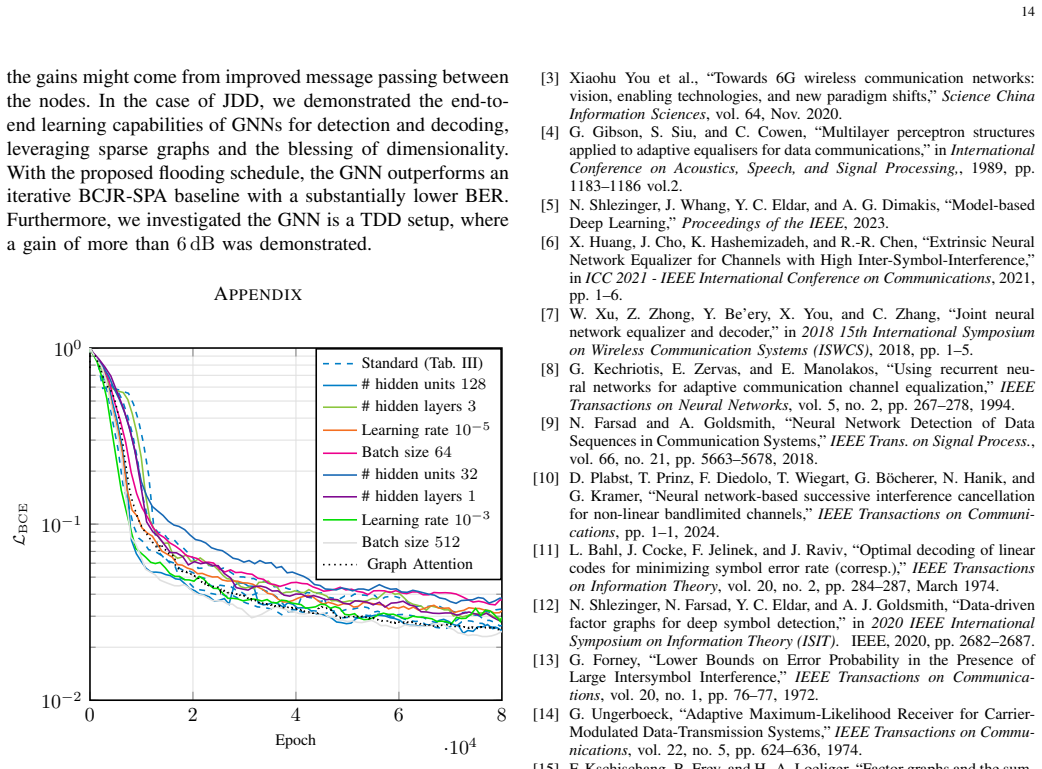
- [Secs. III-E and IV-C; Figs. 4, 9, 11, 13] The main empirical claims are presented without confidence intervals or multiple-seed results. The appendix demonstrates training-loss stability for JDD, but it does not quantify the variability of BER or BMI across random initializations and test realizations for the headline figures. Please add error bars or multiple-seed curves for the key comparisons (SDD rates, JDD BER, and TDD BER) or, alternatively, provide a reproducibility package (code and data) so that the comparisons can be independently verified.
minor comments (7)
- [Abstract and Sec. I] There are several typos, e.g., 'the GNN is build upon' in the abstract; please copy-edit the manuscript.
- [Fig. 4(b)] The y-axis of Fig. 4(b) is labeled 'test' in the manuscript; this appears to be a placeholder and should be RBMI_SDD.
- [Fig. 9] The caption describes the plotted quantity as 'BER of the bits u' while the y-axis label reads 'BLER.' Please clarify which metric is shown and keep the two consistent.
- [Sec. III-F] The derivation comparing optimal messages with SPA messages contains unbalanced parentheses and is hard to follow; please rewrite it in a clearer step-by-step form.
- [Algorithm 3] The algorithm sets LBCE but then updates with SGD(LMulti, θ); LMulti is not defined in Algorithm 3. Please align the notation with Eq. (12).
- [Sec. III-E, QPSK setup] The phrase 'for QPSK (with memory L = 6)' should read 'with channel memory L = 6'; QPSK itself has no memory.
- [References] References [16] and [44] refer to the same paper by Colavolpe and Germi; please merge or distinguish them appropriately.
Circularity Check
No circular reduction: results are simulated/empirical, self-citations are methodological, and the Eq. (5) caveat is explicitly acknowledged as a limitation rather than hidden.
full rationale
The paper's central claims are empirical evaluations, not derivations from fitted constants: GNN detectors are trained on randomly generated bits over simulated Proakis-C channels and evaluated on held-out SNRs against BCJR, SPA, EP, LMMSE and CNN baselines, so 'matching MAP' and the 16-QAM/64-QAM gains are measurement outcomes. The only self-citations are the ISIT companion [1] in the footnote and ref. [61] for Gaussian-prior training; both are methodological and are accompanied by external references ([6], [60] for priors), so they are not load-bearing. The TDD/EXIT pipeline does use the standard turbo identity ℓE = ℓT − ℓA (Eq. 5), and the paper itself flags its failure for the nonlinear GNN in Sec. IV-C: 'equation (5) does not hold for GNNs, if RSDD ≪ IA. In this case the a priori LLRs dominate inference and the loops lead to too significant amplification.' The same passage and Fig. 12 admit that the GNN turbo trajectory diverges from the Gaussian-prior EXIT characteristic. That is an explicit validity limitation and a possible source of optimistic BER gains in the TDD scenario, but it is not a circular reduction: the 6.25 dB result is a simulated outcome, not a quantity reconstructed from its own assumption. No fitted parameter is relabeled as a prediction, and no uniqueness claim is imported from the authors' prior work. Score 1 reflects only minor, non-load-bearing self-citations.
Assumptions & free parameters
free parameters (5)
- GNN trainable weights (MLP and embedding parameters) =
learned via Adam, not enumerated
- Feature size d =
16
- MLP hidden layers and units =
2 layers, 64 units
- SPA damping factor (baseline) =
0.38
- Training SNR range =
10-14 dB
assumptions (5)
- domain assumption Discrete-time ISI channel with known CIR and AWGN (eq. 1)
- standard math Factor graph factorization of the joint APP (eqs. 2-4) and SPA message updates
- domain assumption Generated training data follows the same distribution as test data (i.i.d. bits, fixed CIR)
- domain assumption Gaussian prior LLR model (eq. 6) approximates decoder feedback during TDD
- ad hoc to paper GNN parameterization is sufficient to learn good message-passing functions
Cite this review
Pith. "Pith review of Joint Detection and Decoding: A Graph Neural Network Approach." pith.science (2026). https://pith.science/paper/LCSZR64R
@misc{pith2026250108871,
  author       = {Pith},
  title        = {Pith review of: Joint Detection and Decoding: A Graph Neural Network Approach},
  year         = {2026},
  howpublished = {\url{https://pith.science/paper/LCSZR64R}},
  note         = {Machine review of arXiv:2501.08871}
}
read the original abstract
Narrowing the performance gap between optimal and feasible detection in inter-symbol interference (ISI) channels, this paper proposes to use graph neural networks (GNNs) for detection that can also be used to perform joint detection and decoding (JDD). For detection, the GNN is build upon the factor graph representations of the channel, while for JDD, the factor graph is expanded by the Tanner graph of the parity-check matrix (PCM) of the channel code, sharing the variable nodes (VNs). A particularly advantageous property of the GNN is a) the robustness against cycles in the factor graphs which is the main problem for sum-product algorithm (SPA)-based detection, and b) the robustness against channel state information (CSI) uncertainty at the receiver. Additionally, we propose using an input embedding resulting in a GNN independent of the channel impulse response (CIR). Consequently, a fully deep learning-based receiver enables joint optimization instead of individual optimization of the components, so-called end-to-end learning. Furthermore, we propose a parallel flooding schedule that also reduces the latency, which turns out to improve the error correcting performance. The proposed approach is analyzed and compared to state-of-the-art baselines for different modulations and codes in terms of error correcting capability and latency. The gain compared to SPA-based detection might be explained with improved messages between nodes and adaptive damping of messages. For a higher order modulation in a high-rate turbo detection and decoding (TDD) scenario the GNN shows a, at first glance, surprisingly high gain of 6.25 dB compared to the best, feasible non-neural baseline.
Figures


Figures from the paper (11 more)


Reference graph
Works this paper leans on
-
[24]
Graph Neural Networks for Channel Decoding,
S. Cammerer, J. Hoydis, F. A. Aoudia, and A. Keller, “Graph Neural Networks for Channel Decoding,” in IEEE Global Communications Conference (GLOBECOM) Workshop, 2022
work page 2022
-
[1]
Graph Neural Network-Based Joint Equalization and Decoding,
J. Clausius, M. Geiselhart, D. Tandler, and S. ten Brink, “Graph Neural Network-Based Joint Equalization and Decoding,” in 2024 IEEE International Symposium on Information Theory (ISIT), 2024, pp. 1203– 1208
work page 2024
-
[2]
Proakis, Digital Communications
J. Proakis, Digital Communications. McGraw-Hill, 2001
work page 2001
-
[3]
Towards 6G wireless communication networks: vision, enabling technologies, and new paradigm shifts,
Xiaohu You et al., “Towards 6G wireless communication networks: vision, enabling technologies, and new paradigm shifts,” Science China Information Sciences, vol. 64, Nov. 2020
work page 2020
-
[4]
Multilayer perceptron structures applied to adaptive equalisers for data communications,
G. Gibson, S. Siu, and C. Cowen, “Multilayer perceptron structures applied to adaptive equalisers for data communications,” in International Conference on Acoustics, Speech, and Signal Processing, , 1989, pp. 1183–1186 vol.2
work page 1989
-
[5]
N. Shlezinger, J. Whang, Y . C. Eldar, and A. G. Dimakis, “Model-based Deep Learning,” Proceedings of the IEEE , 2023
work page 2023
-
[6]
Extrinsic Neural Network Equalizer for Channels with High Inter-Symbol-Interference,
X. Huang, J. Cho, K. Hashemizadeh, and R.-R. Chen, “Extrinsic Neural Network Equalizer for Channels with High Inter-Symbol-Interference,” in ICC 2021 - IEEE International Conference on Communications, 2021, pp. 1–6
work page 2021
-
[7]
Joint neural network equalizer and decoder,
W. Xu, Z. Zhong, Y . Be’ery, X. You, and C. Zhang, “Joint neural network equalizer and decoder,” in 2018 15th International Symposium on Wireless Communication Systems (ISWCS) , 2018, pp. 1–5
work page 2018
Show all 69 references
-
[8]
Using recurrent neu- ral networks for adaptive communication channel equalization,
G. Kechriotis, E. Zervas, and E. Manolakos, “Using recurrent neu- ral networks for adaptive communication channel equalization,” IEEE Transactions on Neural Networks , vol. 5, no. 2, pp. 267–278, 1994
1994
-
[9]
Neural Network Detection of Data Sequences in Communication Systems,
N. Farsad and A. Goldsmith, “Neural Network Detection of Data Sequences in Communication Systems,” IEEE Trans. on Signal Process., vol. 66, no. 21, pp. 5663–5678, 2018
2018
-
[10]
Neural network-based successive interference cancellation for non-linear bandlimited channels,
D. Plabst, T. Prinz, F. Diedolo, T. Wiegart, G. Böcherer, N. Hanik, and G. Kramer, “Neural network-based successive interference cancellation for non-linear bandlimited channels,” IEEE Transactions on Communi- cations, pp. 1–1, 2024
2024
-
[11]
Optimal decoding of linear codes for minimizing symbol error rate (corresp.),
L. Bahl, J. Cocke, F. Jelinek, and J. Raviv, “Optimal decoding of linear codes for minimizing symbol error rate (corresp.),” IEEE Transactions on Information Theory , vol. 20, no. 2, pp. 284–287, March 1974
1974
-
[12]
Data-driven factor graphs for deep symbol detection,
N. Shlezinger, N. Farsad, Y . C. Eldar, and A. J. Goldsmith, “Data-driven factor graphs for deep symbol detection,” in 2020 IEEE International Symposium on Information Theory (ISIT). IEEE, 2020, pp. 2682–2687
2020
-
[13]
Lower Bounds on Error Probability in the Presence of Large Intersymbol Interference,
G. Forney, “Lower Bounds on Error Probability in the Presence of Large Intersymbol Interference,” IEEE Transactions on Communica- tions, vol. 20, no. 1, pp. 76–77, 1972
1972
-
[14]
Adaptive Maximum-Likelihood Receiver for Carrier- Modulated Data-Transmission Systems,
G. Ungerboeck, “Adaptive Maximum-Likelihood Receiver for Carrier- Modulated Data-Transmission Systems,” IEEE Transactions on Commu- nications, vol. 22, no. 5, pp. 624–636, 1974
1974
-
[15]
Factor graphs and the sum- product algorithm,
F. Kschischang, B. Frey, and H.-A. Loeliger, “Factor graphs and the sum- product algorithm,” IEEE Transactions on Information Theory , vol. 47, no. 2, pp. 498–519, 2001
2001
-
[16]
On the application of factor graphs and the sum-product algorithm to ISI channels,
G. Colavolpe and G. Germi, “On the application of factor graphs and the sum-product algorithm to ISI channels,” IEEE Transactions on Communications, vol. 53, no. 5, pp. 818–825, 2005
2005
-
[17]
SISO Detection Over Linear Channels With Linear Complexity in the Number of Interferers,
G. Colavolpe, D. Fertonani, and A. Piemontese, “SISO Detection Over Linear Channels With Linear Complexity in the Number of Interferers,” IEEE Journal of Selected Topics in Signal Processing , vol. 5, no. 8, pp. 1475–1485, 2011
2011
-
[18]
A Novel Sum-Product Detection Algorithm for Faster-Than-Nyquist Signaling: A Deep Learning Ap- proach,
B. Liu, S. Li, Y . Xie, and J. Yuan, “A Novel Sum-Product Detection Algorithm for Faster-Than-Nyquist Signaling: A Deep Learning Ap- proach,” IEEE Transactions on Communications , vol. 69, no. 9, pp. 5975–5987, 2021
2021
-
[19]
Low-Complexity Near-Optimum Symbol Detection Based on Neural Enhancement of Factor Graphs,
L. Schmid and L. Schmalen, “Low-Complexity Near-Optimum Symbol Detection Based on Neural Enhancement of Factor Graphs,” IEEE Transactions on Communications, vol. 70, no. 11, pp. 7562–7575, 2022
2022
-
[20]
Learning to decode linear codes using deep learning,
E. Nachmani, Y . Be’ery, and D. Burshtein, “Learning to decode linear codes using deep learning,” in Allerton Conf. IEEE, 2016, pp. 341–346
2016
-
[21]
The graph neural network model,
F. Scarselli, M. Gori, A. C. Tsoi, M. Hagenbuchner, and G. Monfardini, “The graph neural network model,” IEEE Transactions on Neural Networks, vol. 20, no. 1, pp. 61–80, 2009
2009
-
[22]
Factor graph neural networks,
Z. Zhang, M. H. Dupty, F. Wu, J. Q. Shi, and W. S. Lee, “Factor graph neural networks,” Journal of Machine Learning Research , vol. 24, no. 181, pp. 1–54, 2023
2023
-
[23]
Neural Enhanced Belief Propagation on Factor Graphs,
V . G. Satorras and M. Welling, “Neural Enhanced Belief Propagation on Factor Graphs,” in International Conference on Artificial Intelligence and Statistics. PMLR, 2021, pp. 685–693
2021
-
[25]
Graph Neural Networks for Massive MIMO Detection,
A. Scotti, N. N. Moghadam, D. Liu, K. Gafvert, and J. Huang, “Graph Neural Networks for Massive MIMO Detection,” ArXiv, vol. abs/2007.05703, 2020
2007 arXiv
-
[26]
A Neural Receiver for 5G NR Multi-User MIMO,
S. Cammerer, F. A. Aoudia, J. Hoydis, A. Oeldemann, A. Roessler, T. Mayer, and A. Keller, “A Neural Receiver for 5G NR Multi-User MIMO,” 2023 IEEE Globecom Workshops (GC Wkshps) , pp. 329–334, 2023. 15
2023
-
[27]
Graph Neural Network Aided MU-MIMO Detectors,
A. Kosasih, V . Onasis, V . Miloslavskaya, W. Hardjawana, V . Andrean, and B. Vucetic, “Graph Neural Network Aided MU-MIMO Detectors,” IEEE Journal on Selected Areas in Communications , vol. 40, no. 9, pp. 2540–2555, 2022
2022
-
[29]
Initial Results on Deep Learning for Joint Channel Equalization and Decoding,
H. Ye and G. Y . Li, “Initial Results on Deep Learning for Joint Channel Equalization and Decoding,” in 2017 IEEE 86th Vehicular Technology Conference (VTC-Fall), 2017, pp. 1–5
2017
-
[30]
Neural Network- Aided BCJR Algorithm for Joint Symbol Detection and Channel De- coding,
W.-C. Tsai, C.-F. Teng, H.-M. Ou, and A.-Y . A. Wu, “Neural Network- Aided BCJR Algorithm for Joint Symbol Detection and Channel De- coding,” in 2020 IEEE Workshop on Signal Processing Systems (SiPS) , 2020, pp. 1–6
2020
-
[31]
Joint Equalization and LDPC Decoding,
W. Henkel, N. S. Islam, and M. A. Leghari, “Joint Equalization and LDPC Decoding,” in 2019 11th International Congress on Ultra Modern Telecommunications and Control Systems and Workshops (ICUMT) , 2019, pp. 1–5
2019
-
[32]
A comparison of optimal and sub-optimal MAP decoding algorithms operating in the log domain,
P. Robertson, E. Villebrun, and P. Hoeher, “A comparison of optimal and sub-optimal MAP decoding algorithms operating in the log domain,” in Proceedings IEEE International Conference on Communications ICC ’95, vol. 2, 1995, pp. 1009–1013 vol.2
1995
-
[33]
Convergence behavior of iteratively decoded parallel concatenated codes,
S. ten Brink, “Convergence behavior of iteratively decoded parallel concatenated codes,” IEEE Transactions on Communications , vol. 49, no. 10, pp. 1727–1737, 2001
2001
-
[34]
Convergence analysis and optimal scheduling for multiple concatenated codes,
F. Brannstrom, L. Rasmussen, and A. Grant, “Convergence analysis and optimal scheduling for multiple concatenated codes,” IEEE Transactions on Information Theory , vol. 51, no. 9, pp. 3354–3364, 2005
2005
-
[35]
The turbo principle in mobile communications,
J. Hagenauer, “The turbo principle in mobile communications,” Proc. ISITA, XI’AN, Peoples Republic of China, Oct. 2002 , 2002
2002
-
[36]
A mathematical theory of communication,
C. E. Shannon, “A mathematical theory of communication,” The Bell System Technical Journal, vol. 27, no. 3, pp. 379–423, 1948
1948
-
[37]
Extrinsic information transfer functions: model and erasure channel properties,
A. Ashikhmin, G. Kramer, and S. ten Brink, “Extrinsic information transfer functions: model and erasure channel properties,” IEEE Trans- actions on Information Theory , vol. 50, no. 11, pp. 2657–2673, 2004
2004
-
[38]
Achievable rates for probabilistic shaping,
G. Böcherer, “Achievable rates for probabilistic shaping,” arXiv preprint arXiv:1707.01134, 2017
2017 arXiv
-
[39]
Trainable Communication Systems: Concepts and Prototype,
S. Cammerer, F. Ait Aoudia, S. Dörner, M. Stark, J. Hoydis, and S. ten Brink, “Trainable Communication Systems: Concepts and Prototype,” IEEE Transactions on Communications , vol. 68, no. 9, pp. 5489–5503, 2020
2020
-
[40]
Understanding the difficulty of training deep feedforward neural networks,
X. Glorot and Y . Bengio, “Understanding the difficulty of training deep feedforward neural networks,” in International Conference on Artificial Intelligence and Statistics , 2010
2010
-
[41]
Graph attention networks,
P. Veli ˇckovi´c, G. Cucurull, A. Casanova, A. Romero, P. Liò, and Y . Bengio, “Graph attention networks,” 2018. [Online]. Available: https://arxiv.org/abs/1710.10903
2018 arXiv
-
[42]
Adaptive channel memory truncation for maximum likelihood sequence estimation,
D. D. Falconer and F. R. Magee, “Adaptive channel memory truncation for maximum likelihood sequence estimation,” The Bell System Techni- cal Journal, vol. 52, no. 9, pp. 1541–1562, 1973
1973
-
[43]
Optimal Channel Shortening for MIMO and ISI Channels,
F. Rusek and A. Prlja, “Optimal Channel Shortening for MIMO and ISI Channels,” IEEE Transactions on Wireless Communications , vol. 11, no. 2, pp. 810–818, 2012
2012
-
[44]
On the application of factor graphs and the sum-product algorithm to isi channels,
G. Colavolpe and G. Germi, “On the application of factor graphs and the sum-product algorithm to isi channels,” IEEE Transactions on Communications, vol. 53, no. 5, pp. 818–825, 2005
2005
-
[45]
Block expectation propagation equalization for ISI channels,
I. Santos, J. J. Murillo-Fuentes, and P. M. Olmos, “Block expectation propagation equalization for ISI channels,” in 2015 23rd European Signal Processing Conference (EUSIPCO) . IEEE, 2015, pp. 379–383
2015
-
[46]
Learned Belief- Propagation Decoding with Simple Scaling and SNR Adaptation,
M. Lian, F. Carpi, C. Häger, and H. D. Pfister, “Learned Belief- Propagation Decoding with Simple Scaling and SNR Adaptation,” in 2019 IEEE International Symposium on Information Theory (ISIT) , 2019, pp. 161–165
2019
-
[47]
Adam: A Method for Stochastic Optimization,
D. P. Kingma and J. Ba, “Adam: A Method for Stochastic Optimization,” arXiv preprint arXiv:1412.6980 , 2014
2014 arXiv
-
[48]
Joint equalization and decoding: why choose the iterative solution?
A. Roumy, I. Fijalkow, and D. Pirez, “Joint equalization and decoding: why choose the iterative solution?” in Gateway to 21st Century Commu- nications Village. VTC 1999-Fall. IEEE VTS 50th Vehicular Technology Conference (Cat. No.99CH36324) , vol. 5, 1999, pp. 2989–2993 vol.5
1999
-
[49]
Szczecinski and A
L. Szczecinski and A. Alvarado, Bit-interleaved coded modulation: fundamentals, analysis and design . John Wiley & Sons, 2015
2015
-
[50]
Maximum-likelihood sequence estimation of digital sequences in the presence of intersymbol interference,
J. G. Forney, “Maximum-likelihood sequence estimation of digital sequences in the presence of intersymbol interference,” IEEE Trans. Inf. Theory, vol. 18, pp. 363–378, 1972
1972
-
[51]
Explainability in Graph Neural Networks: A Taxonomic Survey,
H. Yuan, H. Yu, S. Gui, and S. Ji, “Explainability in Graph Neural Networks: A Taxonomic Survey,”IEEE Transactions on Pattern Analysis and Machine Intelligence , vol. 45, no. 5, pp. 5782–5799, 2023
2023
-
[52]
Local message passing on frustrated systems,
L. Schmid, J. Brenk, and L. Schmalen, “Local message passing on frustrated systems,” in Uncertainty in Artificial Intelligence . PMLR, 2023, pp. 1837–1846
2023
-
[53]
ViterbiNet: A Deep Learning Based Viterbi Algorithm for Symbol Detection,
N. Shlezinger, N. Farsad, Y . C. Eldar, and A. J. Goldsmith, “ViterbiNet: A Deep Learning Based Viterbi Algorithm for Symbol Detection,” IEEE Transactions on Wireless Communications , vol. 19, no. 5, pp. 3319– 3331, 2020
2020
-
[54]
Sionna: An Open-Source Library for Next-Generation Physical Layer Research,
J. Hoydis, S. Cammerer, F. Ait Aoudia, A. Vem, N. Binder, G. Marcus, and A. Keller, “Sionna: An Open-Source Library for Next-Generation Physical Layer Research,” arXiv preprint, Mar. 2022
2022
-
[55]
Bellman, Adaptive Control Processes: A Guided Tour
R. Bellman, Adaptive Control Processes: A Guided Tour . Princeton University Press, 1961
1961
-
[56]
High-Dimensional Data Analysis: The Curses and Bless- ings of Dimensionality,
D. Donoho, “High-Dimensional Data Analysis: The Curses and Bless- ings of Dimensionality,” AMS Math Challenges Lecture , pp. 1–32, 01 2000
2000
-
[57]
Bit-interleaved coded modula- tion,
G. Caire, G. Taricco, and E. Biglieri, “Bit-interleaved coded modula- tion,” IEEE Transactions on Information Theory , vol. 44, no. 3, pp. 927–946, 1998
1998
-
[58]
Iterative correction of intersymbol interference: Turbo-equalization,
C. Douillard, M. Jézéquel, C. Berrou, D. Electronique, A. Picart, P. Di- dier, and A. Glavieux, “Iterative correction of intersymbol interference: Turbo-equalization,” European Transactions on Telecommunications , vol. 6, no. 5, pp. 507–511, 1995
1995
-
[59]
DUIDD: Deep- Unfolded Interleaved Detection and Decoding for MIMO Wireless Systems,
R. Wiesmayr, C. Dick, J. Hoydis, and C. Studer, “DUIDD: Deep- Unfolded Interleaved Detection and Decoding for MIMO Wireless Systems,” in 2022 56th Asilomar Conference on Signals, Systems, and Computers. IEEE, 2022, pp. 181–188
2022
-
[60]
Neural Turbo Equalization: Deep Learning for Fiber-Optic Nonlinearity Compensation,
T. Koike-Akino, Y . Wang, D. S. Millar, K. Kojima, and K. Parsons, “Neural Turbo Equalization: Deep Learning for Fiber-Optic Nonlinearity Compensation,” Journal of Lightwave Technology , 2020
2020
-
[61]
Serial vs. Parallel Turbo-Autoencoders and Accelerated Training for Learned Channel Codes,
J. Clausius, S. Dörner, S. Cammerer, and S. ten Brink, “Serial vs. Parallel Turbo-Autoencoders and Accelerated Training for Learned Channel Codes,” in 2021 11th International Symposium on Topics in Coding (ISTC), 2021
2021
-
[62]
Minimum mean squared error equalization using a priori information,
M. Tuchler, A. Singer, and R. Koetter, “Minimum mean squared error equalization using a priori information,” IEEE Transactions on Signal Processing, vol. 50, no. 3, pp. 673–683, 2002
2002
-
[63]
Turbo EP-Based Equalization: A Filter-Type Implementation,
I. Santos, J. J. Murillo-Fuentes, E. Arias-de Reyna, and P. M. Olmos, “Turbo EP-Based Equalization: A Filter-Type Implementation,” IEEE Transactions on Communications, vol. 66, no. 9, pp. 4259–4270, 2018
2018
-
[64]
A fast algorithm for the inversion of general Toeplitz matrices,
P. G. Martinsson, V . Rokhlin, and M. Tygert, “A fast algorithm for the inversion of general Toeplitz matrices,” Computers & Mathematics with Applications, vol. 50, no. 5, pp. 741–752, Sept. 2005
2005
-
[65]
Expectation Propagation as Turbo Equalizer in ISI Channels,
I. Santos, J. J. Murillo-Fuentes, R. Boloix-Tortosa, E. Arias-de Reyna, and P. M. Olmos, “Expectation Propagation as Turbo Equalizer in ISI Channels,” IEEE Transactions on Communications , vol. 65, no. 1, pp. 360–370, 2017
2017
-
[66]
Learning Joint Detection, Equalization and Decoding for Short-Packet Communica- tions,
S. Dörner, J. Clausius, S. Cammerer, and S. ten Brink, “Learning Joint Detection, Equalization and Decoding for Short-Packet Communica- tions,” IEEE Transactions on Communications , vol. 71, no. 2, pp. 837– 850, 2023
2023
-
[67]
Sparse Neural Network for Detection and Decoding of Non-Binary Polar-Coded SCMA,
C. Han, H. Zhao, Z. Chen, and F. Wang, “Sparse Neural Network for Detection and Decoding of Non-Binary Polar-Coded SCMA,” IEEE Transactions on Wireless Communications , vol. 22, no. 7, pp. 4475– 4488, 2023
2023
-
[68]
Design of a Standard-Compliant Real-Time Neural Receiver for 5G NR,
R. Wiesmayr, S. Cammerer, F. A. Aoudia, J. Hoydis, J. Zakrzewski, and A. Keller, “Design of a Standard-Compliant Real-Time Neural Receiver for 5G NR,” arXiv preprint arXiv:2409.02912 , 2024
2024 arXiv
-
[69]
From Algorithm to Implementation: Enabling High-Throughput CNN- Based Equalization on FPGA for Optical Communications,
J. Ney, C. Füllner, V . Lauinger, L. Schmalen, S. Randel, and N. Wehn, “From Algorithm to Implementation: Enabling High-Throughput CNN- Based Equalization on FPGA for Optical Communications,” in Em- bedded Computer Systems: Architectures, Modeling, and Simulation , C. Silvano,...
2023
-
[70]
Implementing neural network-based equalizers in a coherent optical transmission system using field-programmable gate arrays,
P. J. Freire et al., “Implementing neural network-based equalizers in a coherent optical transmission system using field-programmable gate arrays,” Journal of Lightwave Technology , vol. 41, no. 12, pp. 3797– 3815, 2023
2023
Reviewed August 10, 2026 · model on record in the stance chip above.
Discussion (0). Continue with ORCID to comment.