REVIEW 3 major objections 5 minor 29 references
CityLoc: 6DoF Pose Distributional Localization for Text Descriptions in Large-Scale Scenes with Gaussian Representation
T0 review · 3 major / 5 minor · reviewed 2026-08-10 · deepseek-v4-flash
Pith's one-line read Diffusion turns text descriptions into distributions of camera poses for whole cities
desk verdict The Gaussian-refinement gains likely come from test views memorized in the trained splat; the diffusion-based task formulation is reasonable but the evaluation is too weak to support the headline claims. read the letter →
The pith
A machine-rendered reading of the paper's core claim, the machinery that carries it, and where it could break.
The reading
What carries the argument
The central object is a conditional denoising diffusion model over SE(3) poses: a transformer denoiser $F_\theta$ takes a noisy pose, diffusion time step, and CLIP text or image embedding, and predicts the clean pose, trained with the DDPM denoising loss. The paper couples this with a mixup training algorithm that randomly swaps text and image embeddings in each batch, so the same pose predictor accepts either modality. The second mechanism is a Gaussian-refinement loop: a hierarchical 3D Gaussian splatting scene $G$ renders an image $\hat{I}=G(P)$ at a candidate pose, a CLIP image encoder produces $\hat{T}_f$, and the pose is optimized to maximize $\hat{T}_f^\top T_t/(\|\hat{T}_f\|\|T_t\|)$; samples below thresholds $\tau_1,\tau_2$ are rejected. That coupling is what the paper claims turns coarse text-conditioned pose samples into accurate, text-consistent camera poses.
What would settle it
Take one of the five datasets, rebuild the hierarchical 3D Gaussian scene using only the 90% of poses used to train the diffusion model, then evaluate refinement on the held-out 10%; if the RDA gain from refinement disappears or shrinks sharply, the reported improvement depends on the splat having memorized the test views.
Extended reading notes
Core claim
On the paper's own terms, the central discovery is that text-conditioned pose distribution estimation is feasible at city scale: a diffusion model can map CLIP embeddings of descriptions to 6DoF camera pose samples whose density concentrates near locations matching the text, and the concentration improves when the text is more specific. The paper further claims that its Gaussian-splatting refinement step, which renders each coarse pose, encodes the rendered view with CLIP, and backpropagates the negative text-image cosine similarity into the pose, systematically filters out mismatched samples and increases RDA scores on most of the five datasets. A user study of rendered versus ground-truth images is reported as showing that the refined renders match text descriptions at a rate comparable to real ground-truth images.
Load-bearing premise
The load-bearing premise is that the Gaussian scene used for refinement is built only from training views, so matching a rendered test pose to the text is genuine visual generalization rather than recall of an image already stored in the splat.
Editorial extensions
If this is right
- A text description can return a full set of candidate poses, so an agent can plan visits to every location that matches "traffic light with zebra crossing" rather than being forced to pick one.
- The reported granularity results imply that the quality of the caption generator directly limits localization; stronger vision-language models should translate into tighter pose distributions.
- The mixup training implies the same pipeline works when only an image, only text, or both are available as the query.
- The Gaussian refinement requires a prebuilt 3D Gaussian scene, so the method presupposes a prior reconstruction of the environment; it localizes within, not across, known scenes.
- The RDA metric establishes a way to compare distributional pose estimators beyond single-pose error.
Reading between the lines
- A natural extension the paper does not pursue is zero-shot localization in a scene whose Gaussian map was built from different images; the refinement step's gain would then test whether it generalizes rather than recalls.
- The CLIP-similarity refinement could be applied to any differentiable scene renderer, so the same distribution-to-pose alignment might transfer to mesh-based or other radiance-field maps.
- Because the generated captions are used both to train and to cue the diffusion model, caption diversity, not just granularity, is a hidden variable; measuring RDA against manually written descriptions would separate caption quality from pose-learning quality.
Editorial analysis
A structured set of objections, weighed in public.
Referee Report
Summary. The paper proposes CityLoc, a diffusion-based method for 6DoF camera pose distribution estimation conditioned on text descriptions in large-scale scenes. The method trains a DDPM-style transformer to denoise noisy poses conditioned on CLIP text/image embeddings, uses a mixup training strategy to combine textual and visual modalities, and refines sampled poses by rendering from a 3D Gaussian splatting scene and maximizing CLIP similarity between the rendered image and the text. The evaluation is conducted on five urban datasets (Small Town, UrbanScene3D Residence and SciArt, MatrixCity Street and Aerial) with a new metric RDA, and the full pipeline is reported to outperform a Monte Carlo Dropout baseline. The paper also includes a user study and qualitative visual results.
Significance. If the central claims hold, the paper would be a meaningful contribution to text-based localization in city-scale scenes, introducing distributional pose output and a refinement stage using 3D Gaussian rendering. The constructed pose-text pairs and the multi-granularity captioning procedure could be a useful resource for the community. The user study and the breadth of test scenes are also strengths. However, the evaluation is compromised by a potential leakage of test views into the Gaussian scene, and the baseline comparison is much weaker than the abstract claims. With the leakage resolved and stronger baselines, the contribution could be significant; as presented, the evidence does not fully support the headline claims.
major comments (3)
- [Appendix B, Gaussian Training] The text states: 'For each dataset, we first use the training views from regarding dataset to construct the Gaussian splats. Subsequently, we randomly select 10% of the poses as the validation set, while the remaining 90% are used to train the diffusion model.' This does not assert that the validation/test poses were excluded from the Gaussian reconstruction. Since Algorithm 2 renders the Gaussian scene at the candidate pose and optimizes CLIP similarity to the text, if the test images were used to build the Gaussian, the rendered view can reproduce the test image, and the refinement improvements in Table 1 (e.g., Town k=15 from 22.62 to 26.37; Street k=15 from 7.96 to 15.11) could be due to view memorization rather than semantic localization. This is a load-bearing issue for contribution 3 and for the paper's claim of superior performance. The authors must clarify whether the validation/test poses were held out from Gaussian training and, if they were not, re-run the refinement evaluation with strictly held-out views.
- [§4.2, Experimental Results] The only distributional baseline reported is Monte Carlo Dropout, while Text2Loc, Text2Pos, and RET are mentioned in the related work but no quantitative comparison is given. The abstract's claim of 'consistent outperformance' against standard distribution estimation methods is therefore not supported by the presented evidence. The authors should either adapt these published methods to the same task and report their RDA numbers, or justify concretely why they cannot be applied. Additionally, no error bars or multiple-seed results are reported, so the reader cannot assess the variability of the RDA values.
- [§4.1, Evaluation Metrics] The RDA metric in Fig. 6 and Eq. (5) is a ratio of the accuracy of the predicted distribution to the accuracy of a random distribution. The denominator is not reported anywhere, which makes the RDA values hard to interpret; for instance, a high RDA could arise from an extremely low random-accuracy baseline. The paper should report absolute metrics such as median translation/rotation error and success rate within a specified distance threshold, in addition to RDA, so that the reader can judge the absolute quality of the estimated pose distributions.
minor comments (5)
- [Algorithm 1, line 4] The line 'Random Sample embeddings: Tmix ←...' is a sentence fragment; please rephrase, for instance as 'Randomly sample the embedding Tmix from {Tt, Tf} with swap ratio β.'
- [Table 1 caption] The caption states 'Best results per row are highlighted in red'; in grayscale print red is indistinguishable from black, so please also define the best value explicitly or use a distinct formatting, and clarify in the text what 'Ours' versus 'Ours Mixup' versus 'Ours Refined' denote.
- [§3.1, paragraph after Multi-model Conditioning] Two consecutive paragraphs both begin with 'By minimizing the mean squared error between the predicted and ground truth poses...' and are almost identical; they should be merged to avoid duplication.
- [Fig. 6 caption] The phrase 'Translation is measured in units of 10% of the scene scale' is imprecise; please specify how the scene scale is computed and how the 10% normalization is applied.
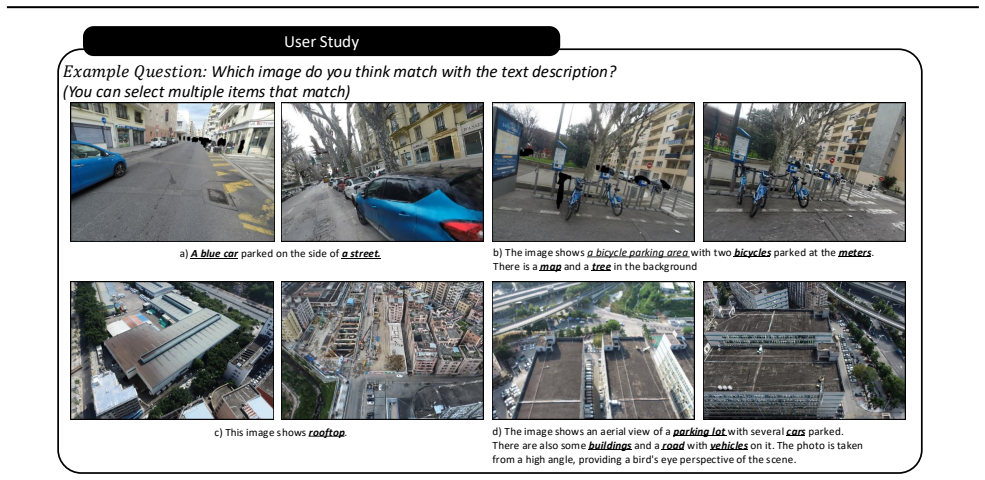
- [§4.3, User Studies] The text says 'in 30% cases the performance of rendered images exceeds that of the ground-truth (GT) images,' but Table 3 reports match rates of 56.5% (GT) and 50.8% (Ours); the derivation of the 30% figure from the table is unclear and should be explained.
Circularity Check
Gaussian-refinement evaluation is circular: test poses are drawn from the views used to build the Gaussian scene, so refined-pose gains reduce to matching a memorized render to text generated from that same image.
-
fitted input called prediction
[Appendix B ('Experimental Setups', Gaussian Training); Algorithm 2 (Section 3.2)]
"For each dataset, we first use the training views from regarding dataset to construct the Gaussian splats. Subsequently, we randomly select 10% of the poses as the validation set, while the remaining 90% are used to train the diffusion model. ... Render ˆI ← G(Ppred) ... Lclip ← ˆTf⊤·Tt / (∥ˆTf∥2·∥Tt∥2)."
The validation/test poses are selected from the views used to build the Gaussian scene, and Section 3.1 generates the textual query from the image at that pose. Therefore at a test pose P, G(P) reconstructs the very source image whose caption is the query text; maximizing CLIP similarity between the caption and G(P) can succeed by retrieving the memorized training view rather than by semantic text-to-pose localization. Table 1's 'Ours Refined' gains are thus not predictions on held-out views—they are re-identification of images already fitted into the 3D representation. The diffusion-only rows are unaffected, but the paper's headline claim and Contribution 3 depend on the refined row, so the central superiority claim is not independently supported.
full rationale
The diffusion stage itself is not circular: the diffusion model is trained on 90% of the poses and evaluated on the remaining 10%, and the RDA metric is an external, independently defined measure. Self-citations in the paper (e.g., ShapeSplat, H3DGS usage) are methodological and not load-bearing for any forced conclusion. The circularity is confined to the Gaussian-refinement evaluation. As written in Appendix B, the Gaussian splats are constructed from the dataset's training views before the 10% validation poses are selected, and the text prompts are generated from the images at those poses. Algorithm 2 then optimizes a pose by maximizing CLIP similarity between the text embedding and the image rendered from the Gaussian at that pose. If the validation image is part of the Gaussian reconstruction, the render at the ground-truth pose is a near-reproduction of the caption's source image, so the refinement objective is solvable by memory rather than by generalization. The reported 'Ours Refined' improvements in Table 1 are therefore not interpretable as evidence for text-based distributional localization, and the paper's central claim of consistent outperformance is only partially supported by the non-circular diffusion-only rows. This is a genuine evaluation circularity, not merely a correctness concern, because the test signal is contained in the fitted representation by the protocol the paper describes.
Assumptions & free parameters
free parameters (3)
- Swap ratio β =
0.7 (tuned by ablation, Fig. 8)
- Refinement acceptance thresholds τ1, τ2 =
τ1=0.17, τ2=0.2
- Diffusion timesteps and noise schedule =
T=100, β linear 1e-4 to 0.1
assumptions (5)
- domain assumption LLaVA-generated captions are accurate and discriminative descriptors for localization.
- domain assumption The 3D Gaussian scene is an accurate representation that supports rendering from arbitrary poses with sufficient fidelity for CLIP matching.
- ad hoc to paper RDA is a valid measure of distributional localization accuracy despite multiple valid poses for ambiguous text.
- ad hoc to paper The test poses are not used in constructing the Gaussian scene.
- standard math DDPM reverse process and CLIP embedding spaces behave as in their original publications.
Cite this review
Pith. "Pith review of CityLoc: 6DoF Pose Distributional Localization for Text Descriptions in Large-Scale Scenes with Gaussian Representation." pith.science (2026). https://pith.science/paper/YKVVL2WY
@misc{pith2026250108982,
  author       = {Pith},
  title        = {Pith review of: CityLoc: 6DoF Pose Distributional Localization for Text Descriptions in Large-Scale Scenes with Gaussian Representation},
  year         = {2026},
  howpublished = {\url{https://pith.science/paper/YKVVL2WY}},
  note         = {Machine review of arXiv:2501.08982}
}
read the original abstract
Localizing textual descriptions within large-scale 3D scenes presents inherent ambiguities, such as identifying all traffic lights in a city. Addressing this, we introduce a method to generate distributions of camera poses conditioned on textual descriptions, facilitating robust reasoning for broadly defined concepts. Our approach employs a diffusion-based architecture to refine noisy 6DoF camera poses towards plausible locations, with conditional signals derived from pre-trained text encoders. Integration with the pretrained Vision-Language Model, CLIP, establishes a strong linkage between text descriptions and pose distributions. Enhancement of localization accuracy is achieved by rendering candidate poses using 3D Gaussian splatting, which corrects misaligned samples through visual reasoning. We validate our method's superiority by comparing it against standard distribution estimation methods across five large-scale datasets, demonstrating consistent outperformance. Code, datasets and more information will be publicly available at our project page.
Figures


Figures from the paper (11 more)



Reference graph
Works this paper leans on
-
[3]
D., Dhariwal, P., Neelakantan, A., Shyam, P., Sastry, G., Askell, A., et al
Brown, T., Mann, B., Ryder, N., Subbiah, M., Kaplan, J. D., Dhariwal, P., Neelakantan, A., Shyam, P., Sastry, G., Askell, A., et al. Language models are few-shot learners. Advances in neural information processing systems, 33: 1877–1901,
1901
-
[5]
Ho, J., Salimans, T., Gritsenko, A., Chan, W., Norouzi, M., and Fleet, D. J. Video diffusion models. arXiv preprint arXiv:2204.03458,
-
[6]
Hoffmann, J., Borgeaud, S., Mensch, A., Buchatskaya, E., Cai, T., Rutherford, E., Casas, D. d. L., Hendricks, L. A., Welbl, J., Clark, A., et al. Training compute-optimal large language models. arXiv preprint arXiv:2203.15556,
-
[9]
S., Yvon, F., Gallé, M., et al
Le Scao, T., Fan, A., Akiki, C., Pavlick, E., Ili´c, S., Hesslow, D., Castagné, R., Luccioni, A. S., Yvon, F., Gallé, M., et al. Bloom: A 176b-parameter open-access multilingual language model. arXiv preprint arXiv:2211.05100,
-
[10]
9 Li, J., Li, D., Savarese, S., and Hoi, S. Blip-2: Bootstrapping language-image pre-training with frozen image encoders and large language models. In International conference on machine learning, pp. 19730–19742. PMLR, 2023b. Li, X. L., Thickstun, J., Gulrajani, I., Liang, P., and Hashimoto, T. B. Diffusion-lm improves controllable text generation. arXiv...
-
[11]
Matrixcity: A large-scale city dataset for city-scale neural rendering and beyond
Li, Y ., Jiang, L., Xu, L., Xiangli, Y ., Wang, Z., Lin, D., and Dai, B. Matrixcity: A large-scale city dataset for city-scale neural rendering and beyond. In Proceedings of the IEEE/CVF International Conference on Computer Vision, pp. 3205–3215, 2023c. Lin, B., Tang, Z., Ye, Y ., Cui, J., Zhu, B., Jin, P., Huang, J., Zhang, J., Pang, Y ., Ning, M., et al...
-
[12]
Spatio- temporal graph diffusion for text-driven human motion generation
Liu, C., Zhao, M., Ren, B., Liu, M., Sebe, N., et al. Spatio- temporal graph diffusion for text-driven human motion generation. In BMVC, pp. 722–729, 2023a. Liu, H., Li, C., Wu, Q., and Lee, Y . J. Visual instruction tuning, 2023b. Liu, H., Li, C., Wu, Q., and Lee, Y . J. Visual instruction tuning, 2023c. URL https://arxiv.org/abs/ 2304.08485. Liu, H., Li...
arXiv 2024
-
[13]
A conditional point diffusion-refinement paradigm for 3d point cloud completion
Lyu, Z., Kong, Z., Xu, X., Pan, L., and Lin, D. A conditional point diffusion-refinement paradigm for 3d point cloud completion. arXiv preprint arXiv:2112.03530,
Show all 29 references
-
[14]
URL https: //doi.org/10.1145/3528223.3530127
doi: 10.1145/3528223.3530127. URL https: //doi.org/10.1145/3528223.3530127. Peng, Z., Wang, W., Dong, L., Hao, Y ., Huang, S., Ma, S., and Wei, F. Kosmos-2: Grounding multimodal large language models to the world. arXiv preprint arXiv:2306.14824,
-
[15]
Ramesh, A., Pavlov, M., Goh, G., Gray, S., V oss, C., Rad- ford, A., Chen, M., and Sutskever, I
URL https://arxiv.org/abs/2103.00020. Ramesh, A., Pavlov, M., Goh, G., Gray, S., V oss, C., Rad- ford, A., Chen, M., and Sutskever, I. Zero-shot text-to- image generation,
-
[16]
Ren, B., Liu, M., Ding, R., and Liu, H
URL https://arxiv.org/ abs/2102.12092. Ren, B., Liu, M., Ding, R., and Liu, H. A survey on 3d skeleton-based action recognition using learning method. Cyborg and Bionic Systems, 5:0100,
-
[17]
Make-a- video: Text-to-video generation without text-video data
Singer, U., Polyak, A., Hayes, T., Yin, X., An, J., Zhang, S., Hu, Q., Yang, H., Ashual, O., Gafni, O., et al. Make-a- video: Text-to-video generation without text-video data. arXiv preprint arXiv:2209.14792,
-
[19]
icomma: Inverting 3d gaussians splatting for camera pose estimation via comparing and matching
10 Sun, Y ., Wang, X., Zhang, Y ., Zhang, J., Jiang, C., Guo, Y ., and Wang, F. icomma: Inverting 3d gaussians splatting for camera pose estimation via comparing and matching. arXiv preprint arXiv:2312.09031,
-
[20]
Llama: Open and efficient foundation lan- guage models
Touvron, H., Lavril, T., Izacard, G., Martinet, X., Lachaux, M.-A., Lacroix, T., Rozière, B., Goyal, N., Hambro, E., Azhar, F., et al. Llama: Open and efficient foundation lan- guage models. arXiv preprint arXiv:2302.13971,
-
[21]
Spectrally pruned gaus- sian fields with neural compensation
Yang, R., Zhu, Z., Jiang, Z., Ye, B., Chen, X., Zhang, Y ., Chen, Y ., Zhao, J., and Zhao, H. Spectrally pruned gaus- sian fields with neural compensation. arXiv preprint arXiv:2405.00676,
-
[22]
mplug-owl: Modulariza- tion empowers large language models with multimodality
Ye, Q., Xu, H., Xu, G., Ye, J., Yan, M., Zhou, Y ., Wang, J., Hu, A., Shi, P., Shi, Y ., et al. mplug-owl: Modulariza- tion empowers large language models with multimodality. arXiv preprint arXiv:2304.14178,
-
[24]
A survey on multimodal large language models
Yin, S., Fu, C., Zhao, S., Li, K., Sun, X., Xu, T., and Chen, E. A survey on multimodal large language models. arXiv preprint arXiv:2306.13549,
-
[25]
Ferret: Refer and ground anything anywhere at any granularity
You, H., Zhang, H., Gan, Z., Du, X., Zhang, B., Wang, Z., Cao, L., Chang, S.-F., and Yang, Y . Ferret: Refer and ground anything anywhere at any granularity. arXiv preprint arXiv:2310.07704,
-
[26]
Next-chat: An lmm for chat, detection and segmentation
Zhang, A., Zhao, L., Xie, C.-W., Zheng, Y ., Ji, W., and Chua, T.-S. Next-chat: An lmm for chat, detection and segmentation. arXiv preprint arXiv:2311.04498,
-
[27]
Denois- ing diffusion probabilistic models for action-conditioned 3d motion generation
Zhao, M., Liu, M., Ren, B., Dai, S., and Sebe, N. Denois- ing diffusion probabilistic models for action-conditioned 3d motion generation. In ICASSP 2024-2024 IEEE In- ternational Conference on Acoustics, Speech and Signal Processing (ICASSP), pp. 4225–4229. IEEE,
2024
-
[28]
Gaussiangrasper: 3d language gaussian splatting for open-vocabulary robotic grasping
Zheng, Y ., Chen, X., Zheng, Y ., Gu, S., Yang, R., Jin, B., Li, P., Zhong, C., Wang, Z., Liu, L., et al. Gaussiangrasper: 3d language gaussian splatting for open-vocabulary robotic grasping. arXiv preprint arXiv:2403.09637,
-
[29]
Minigpt-4: Enhancing vision-language understanding with advanced large language models
Zhu, D., Chen, J., Shen, X., Li, X., and Elhoseiny, M. Minigpt-4: Enhancing vision-language understanding with advanced large language models. arXiv preprint arXiv:2304.10592, 2023a. Zhu, D., Chen, J., Shen, X., Li, X., and Elhoseiny, M. Minigpt-4: Enhancing vision-language un...
2020 arXiv
-
[2015]
Denoising diffusion implicit models
Song, J., Meng, C., and Ermon, S. Denoising diffusion implicit models. arXiv preprint arXiv:2010.02502,
2010 arXiv
-
[2016]
Kendall, A., Grimes, M., and Cipolla, R
URL https: //arxiv.org/abs/1509.05909. Kendall, A., Grimes, M., and Cipolla, R. Posenet: A convo- lutional network for real-time 6-dof camera relocalization. In Proceedings of the IEEE international conference on computer vision, pp. 2938–2946,
-
[2020]
Shikra: Unleashing multimodal llm’s referential dialogue magic
Chen, K., Zhang, Z., Zeng, W., Zhang, R., Zhu, F., and Zhao, R. Shikra: Unleashing multimodal llm’s referential dialogue magic. arXiv preprint arXiv:2306.15195,
-
[2021]
Qwen-vl: A frontier large vision- language model with versatile abilities
Bai, J., Bai, S., Yang, S., Wang, S., Tan, S., Wang, P., Lin, J., Zhou, C., and Zhou, J. Qwen-vl: A frontier large vision- language model with versatile abilities. arXiv preprint arXiv:2308.12966,
-
[2022]
Segdiff: Image segmentation with diffusion probabilistic models
Amit, T., Nachmani, E., Shaharbany, T., and Wolf, L. Segdiff: Image segmentation with diffusion probabilistic models. arXiv preprint arXiv:2112.00390,
-
[2023]
T., Rodriguez, A., Isola, P., and Lin, T.-Y
Yen-Chen, L., Florence, P., Barron, J. T., Rodriguez, A., Isola, P., and Lin, T.-Y . inerf: Inverting neural radi- ance fields for pose estimation. In 2021 IEEE/RSJ Inter- national Conference on Intelligent Robots and Systems (IROS), pp. 1323–1330. IEEE,
2021
-
[2024]
Kolmet, M., Zhou, Q., Ošep, A., and Leal-Taixé, L
URL https://arxiv.org/abs/ 2406.12080. Kolmet, M., Zhou, Q., Ošep, A., and Leal-Taixé, L. Text2pos: Text-to-point-cloud cross-modal localization. In Proceedings of the IEEE/CVF Conference on Com- puter Vision and Pattern Recognition , pp. 6687–6696,
Reviewed August 10, 2026 · model on record in the stance chip above.
Discussion (0). Continue with ORCID to comment.