REVIEW 4 major objections 4 minor 2 cited by
Improving the stellar age determination through joint modeling of binarity and asteroseismology -- Grid modeling of the seismic red-giant binary KIC 9163796
T0 review · 4 major / 4 minor · reviewed 2026-08-10 · deepseek-v4-flash
Pith's one-line read Combining binary, spectroscopic, and asteroseismic constraints dates the red-giant binary KIC 9163796 to 2.44 billion years with a 9 percent uncertainty.
desk verdict First joint grid model of KIC 9163796 shows binarity plus seismology can pin a giant's age to ~10-15%, but the headline 9% is built on an ad hoc error recipe that needs to be fixed before the precision claim holds. read the letter →
The pith
A machine-rendered reading of the paper's core claim, the machinery that carries it, and where it could break.
The reading
What carries the argument
The central machinery is a 12,096-model grid of single-star evolutionary tracks computed with MESA and processed with GYRE, searched pairwise with a reduced chi-square figure of merit. Each model pair must satisfy binary conditions: the primary mass is at least the secondary mass, the two stars have exactly the same age, the same initial helium, and, in the constrained cases, equal or spectroscopically fixed metallicity, with the observed mass ratio $q=1.015\pm0.005$ entering the fit. The fit compares effective temperatures, surface gravity, mass ratio, the primary's $\nu_{\max}$ from scaling relations, a local large-frequency separation $\Delta\nu$ derived from GYRE radial modes and corrected with the empirical factor $f_{\Delta\nu}$, and, in the final cases, the V-band magnitude difference between the components. This grid-plus-chi-square machinery is what lets the two stars' distinct positions in the Hertzsprung–Russell diagram act as two independent clocks reading out the same age.
What would settle it
Re-run the same grid and observables with a standard likelihood that includes all chi-square values and no outlier rejection: if the resulting 1-$\sigma$ credible interval is wider than roughly 30 percent relative, the claimed 9 percent precision is not supported. An independent measurement of the secondary's $\nu_{\max}$ that falls outside the best-fit model predictions would also rule out the adopted solution.
Extended reading notes
Core claim
For KIC 9163796, modeling the red-giant primary and subgiant secondary simultaneously with the physical requirement that both components share one age and one initial composition yields a system age of $2.44^{+0.25}_{-0.20}$ Gyr (Case D2). The best-fitting models also require initial helium $Y\simeq0.27$–$0.30$, above the primordial helium abundance, initial metallicity at or below the spectroscopic value, and masses that agree with asteroseismic scaling relations. The authors conclude that adding binarity and asteroseismic constraints progressively breaks degeneracies—especially the mass–initial-helium degeneracy—and brings the reduced chi-square minima closer to unity, so the preferred solutions are both more precise and less overfitted.
Load-bearing premise
The quoted 9 percent age error rests on a non-standard error recipe: every model pair with reduced chi-square below one is treated as statistically equal, and outliers are then removed if judged inconsistent with the observed mass and metallicity; if that pruning is too aggressive, the true age uncertainty is larger than reported.
Editorial extensions
If this is right
- Red-giant ages in double-lined spectroscopic binaries with both seismic and binary constraints can reach relative uncertainties near 9 percent, roughly an order of magnitude better than the 30–50 percent typical of single-star isochrone fitting.
- Adding the binary conditions of co-evality, equal initial composition, and a fixed mass ratio moves best-fit reduced chi-square values closer to unity, indicating less overfitting and more realistic models.
- The same fits recover parameters normally inaccessible to observations, such as initial helium abundance and the mixing-length parameter, and can test whether the mixing length changes as stars climb the subgiant and red-giant branches.
- The approach is portable: the paper points to roughly 900 newly identified oscillating binary systems from Gaia DR3 cross-matches, plus PLATO target catalogs, as a future sample for this joint modeling.
Reading between the lines
- If the 9 percent precision survives a full Bayesian re-analysis of the same grid, the method could be applied to many SB2 oscillating giants to map Galactic stellar ages far more sharply than single-star fits allow.
- The gap between 9 percent (Case D2) and 13 percent (Case D3) shows that part of the quoted precision is borrowed from trusting the spectroscopic metallicity; higher-resolution spectroscopy would directly buy age precision.
- The secondary's super-Nyquist $\nu_{\max}$ was deliberately left out of the fit, so future observations that resolve it offer a clean, independent check of the model's predicted luminosity difference.
- Because the recovered helium values sit at the edge of the explored grid, and the paper itself cites a known grid-edge bias for helium, the absolute $Y$ estimates should be read as tentative until independent helium diagnostics are added.
Editorial analysis
A structured set of objections, weighed in public.
Referee Report
Summary. This manuscript presents a grid-modeling study of the SB2 system KIC 9163796 with MESA and GYRE, combining constraints from binarity, spectroscopy, and asteroseismology. The authors construct a 12,096-model grid varying mass, initial metallicity, initial helium, and mixing length, and use a reduced chi-square figure of merit over effective temperatures, surface gravity, mass ratio, nu_max, Delta_nu, and magnitude difference, with common-age and common-composition constraints. They report a best age of 2.44(+0.25,-0.20) Gyr for Case D2 (9% relative uncertainty), masses near 1.3 solar masses, Y about 0.27-0.30, and Z around 0.004-0.006, and conclude that joint binary and asteroseismic modeling reduces giant-star age uncertainties by an order of magnitude.
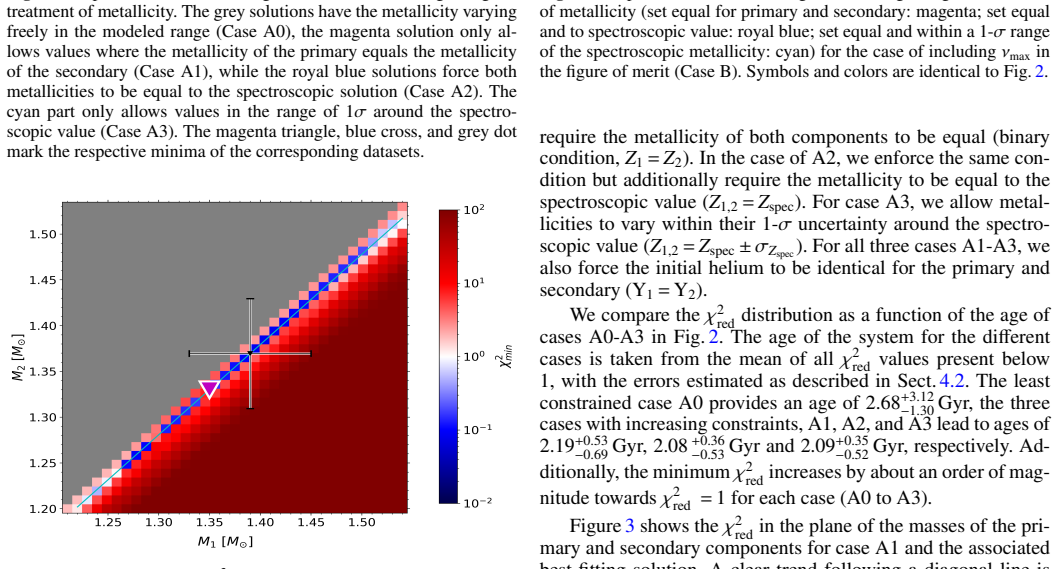
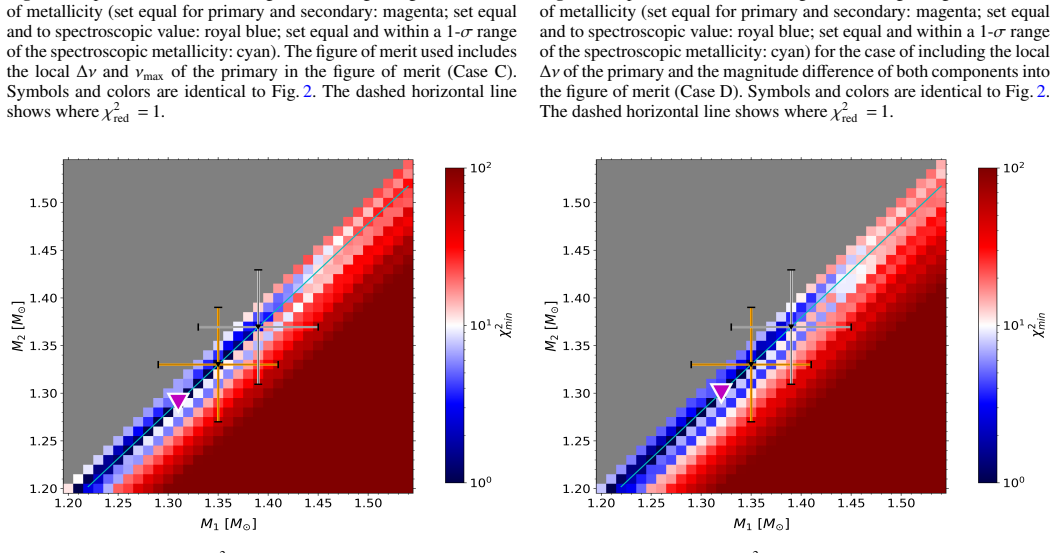
Significance. If the quoted precision holds, this is a valuable demonstration for a rare benchmark system: an SB2 red-giant/subgiant pair with seismic detections, a well-determined mass ratio, and coevality constraints. The technical effort is substantial and should be credited: a large MESA grid, GYRE-based Delta_nu computation, a re-derived local Delta_nu, and explicit tests of alpha_MLT, overshooting, and T-tau choices. The mass-ratio constraint clearly shapes the solution, as seen in the diagonal M1-M2 structure of the residual maps. The main caveat is that the headline 9% uncertainty rests on a nonstandard and insufficiently documented error recipe; the more conservative Case D3 already gives 13%, and systematic terms from metallicity, alpha_MLT, and the helium grid-edge bias are not folded into the quoted uncertainty.
major comments (4)
- [Section 4.2] The error-estimation recipe used for the headline age is not a confidence interval. The text states that all models with chi2_red < 1 have the same significance and that the scatter in age of these models defines the 1-sigma boundaries, but the accepted models are a discrete set of correlated evolutionary tracks rather than independent measurements, and the outlier-removal step ('test if those are consistent with stellar models for the observational mass/metallicity, and if not, remove them') is never quantified. Neither the number of accepted models nor the number and identity of removed outliers is reported, so the reader cannot check whether the 2.44(+0.25,-0.20) Gyr range is stable. This is load-bearing because Case D2's 9% uncertainty is the paper's central claim; the paper itself notes that standard error propagation does not work for age estimation, which makes validation of the replacement procedure mandatory.
- [Eq. (2), Tables 3 and 4] The reduced chi-square used throughout depends on an unspecified number of fitted parameters m. For Case C the observables in the figure of merit are six (Teff1, Teff2, logg2, q, nu_max1, Delta_nu1) while the grid has six free parameters (M1, M2, Z, Y, alpha_MLT,1, alpha_MLT,2), so n-m can be zero and chi2_red is formally undefined; nevertheless Table 4 reports values between 0.05 and 0.9. Reporting m for each case is necessary because the chi2_red < 1 threshold used to define statistically equivalent models depends directly on this denominator. This issue affects the validity of the whole selection criterion, not just the size of the error bars.
- [Table 4 and Section 7] The adopted best age comes from Case D2, which forces Z1 = Z2 = Zspec = 0.006, while the grid's best-fit metallicities in the less constrained cases are lower (Z about 0.004-0.005). Case D3, which allows Z within its 1-sigma spectroscopic range, yields 2.52(+0.31,-0.36) Gyr (about 13%), and D1 gives 2.58(+0.39,-0.42) Gyr. The 9% figure therefore reflects a single, deliberately chosen metallicity slice and does not include systematic uncertainty from Z, alpha_MLT, the f_Delta_nu correction, or the Y grid-edge bias acknowledged in Section 6.4. The paper should either adopt the more conservative D3 result as the headline or explicitly add these systematics to the quoted age uncertainty.
- [Section 3 and Section 6.2] The grid's mass range is centered on BKP18's asteroseismic mass of 1.39 solar masses and extends three times its reported uncertainty, so the agreement between the modeled and scaling-relation masses in Section 6.2 is partly by construction. This should be stated explicitly; it does not invalidate the age analysis, but it weakens the claim that the mass agreement independently validates the models.
minor comments (4)
- [Abstract and Table 4] The abstract states that the initial heavy-metal abundance is below the spectroscopic value, but this is not true for Case D2, where Z is forced to Zspec; clarify that this refers to the less constrained cases such as D3.
- [Appendix B.2, Listing 2] The example inlist sets initial_z = 0.015, which is outside the grid range [0.004, 0.010] defined in Table 2; this is presumably a typo and should be corrected.
- [Section 4.2, Eq. (3)] Equation (3) defines sigma_i,y but is never used in the paper; remove it or explain how it relates to the final uncertainty estimates.
- [Throughout] There are numerous typographical artifacts such as 'di fferent' and 'ef fects' throughout the text; a careful copyedit is needed before publication.
Circularity Check
No equation-level circularity; the age is genuinely fitted, but the mass-agreement validation is partially circular because the grid's mass prior is centered on the same BKP18 asteroseismic mass.
-
other
[Sect. 3 (grid construction) and Sect. 6.2 (mass agreement)]
"Sect. 3: "For the stellar mass range of the grid, we chose an interval centered on the mass of the primary reported by BKP18 from an asteroseismic analysis and extended three times the reported uncertainty towards higher and lower masses." Sect. 6.2: "All values from our modeling fall well within the 1-σ uncertainties of the scaling-based mass of both components (Fig. 12) and also agree with one another within uncertainties. This is an important indication of our model correctly reproducing the two stellar components of KIC 9163796.""
The grid's mass range (roughly 1.20-1.54 Msun) is constructed by centering on BKP18's asteroseismic mass for the primary (1.39 ± 0.06 Msun), which is the same quantity the modeling later claims to reproduce in Sect. 6.2. Because the output masses are selected from a grid whose prior is centered on that seismic mass, the 'agreement' with scaling-based masses is partly assured by construction and is not a fully independent confirmation. This circularity is partial and confined to the validation claim: the grid extends well beyond the 1-sigma band, and the central age result does not depend on the mass-agreement statement.
full rationale
The central age is produced by forward grid fitting: MESA/GYRE models with varied M, Z, Y, and alpha_MLT are compared via chi2 to spectroscopic (Teff, log g, q), seismic (nu_max, Delta_nu), and photometric (Delta m) observables under binary constraints Age1=Age2 and shared composition, with no age assumed as input. Metallicity is deliberately excluded from the figure of merit to avoid circularity ('we did not include it in the figure of merit, to avoid a circular argument'). The only concrete circular element is the validation of masses, since the grid's mass range is centered on BKP18's asteroseismic mass; this makes the Sect. 6.2 mass agreement a partially prior-driven consistency check rather than an independent prediction, but it does not feed back into the age derivation. The chi2_red<1 uncertainty recipe, unspecified degrees-of-freedom count, and unquantified outlier removal are statistical-validity concerns, not circularity. Self-citations (Beck et al. 2014, 2018, 2024) supply observational data and sample context that are externally falsifiable and are not used as an unverified theorem, so they do not raise the circularity score beyond this minor, non-load-bearing caveat.
Assumptions & free parameters
free parameters (6)
- Initial stellar mass M =
1.29 to 1.37 M_sun depending on case (Table 4)
- Initial heavy-element abundance Z =
0.004 to 0.007; D2 forced to 0.006
- Initial helium abundance Y =
0.27 to 0.30; some subcases at 0.32 to 0.33 when the grid is expanded
- Mixing length alpha_MLT per component =
1.4, 1.5, or 1.6 (Table 4)
- Overshooting parameter fov =
0.02 (fixed)
- Delta_nu correction factor f_Delta_nu =
0.974
assumptions (6)
- domain assumption The two stars formed together and share age, initial helium, and initial metallicity.
- domain assumption 1D MESA models with the chosen microphysics, Eddington T-tau relation, and exponential overshoot describe both stars.
- domain assumption The asteroseismic scaling relations for nu_max and the f_Delta_nu correction of Li et al. (2023) are valid for both components.
- domain assumption The BKP18 measurements of mass ratio, Teff, log g, nu_max, Delta_nu, Delta m_V, and [M/H] are accurate.
- domain assumption Initial Z equals current surface Z.
- ad hoc to paper Removing models younger than 0.5 Gyr and treating all chi2_red<1 models as equally significant, with ad hoc outlier deletion, yields valid confidence intervals.
Cite this review
Pith. "Pith review of Improving the stellar age determination through joint modeling of binarity and asteroseismology -- Grid modeling of the seismic red-giant binary KIC 9163796." pith.science (2026). https://pith.science/paper/W2MBJTAT
@misc{pith2026250109018,
  author       = {Pith},
  title        = {Pith review of: Improving the stellar age determination through joint modeling of binarity and asteroseismology -- Grid modeling of the seismic red-giant binary KIC 9163796},
  year         = {2026},
  howpublished = {\url{https://pith.science/paper/W2MBJTAT}},
  note         = {Machine review of arXiv:2501.09018}
}
abstract
Context. Typical uncertainties of ages determined for single star giants from isochrone fitting using single-epoch spectroscopy and photometry without any additional constraints are 30-50 %. Binary systems, particularly double-lined spectroscopic (SB2) binaries, provide an opportunity to study the intricacies of internal stellar physics and better determine stellar parameters, particularly the stellar age. Aims. By using the constraints from binarity and asteroseismology, we aim to obtain precise age and stellar parameters for the red giant-subgiant binary system KIC 9163796, a system with a mass ratio of 1.015 but distinctly different positions in the Hertzsprung-Russell diagram (HRD). Methods. We compute a multidimensional model grid of individual stellar models. From different combinations of figures of merit, we use the constraints drawn from binarity, spectroscopy, and asteroseismology to determine the stellar mass, chemical composition, and age of KIC 9163796. Results. Our combined-modeling approach leads to an age estimation of the binary system KIC 9163796 of 2.44$^{+0.25}_{-0.20}$ Gyr, which corresponds to a relative error in the age of 9 %. Furthermore, we found both components exhibiting equal initial helium abundance of 0.27 to 0.30, significantly higher than the primordial helium abundance, and an initial heavy metal abundance below the spectroscopic value. The masses of our models are in agreement with masses derived from the asteroseismic scaling relations. Conclusions. By exploiting the unique, distinct positions of KIC 9163796, we successfully demonstrated that combining asteroseismic and binary constraints leads to a significant improvement of precision in age estimation, that have a relative error below 10% for a giant star.
Figures


Figures from the paper (6 more)



Forward citations
Cited by 2 Pith papers
-
Power density spectra morphologies of seismically unresolved red-giant asteroseismic binaries
Combining two red-giant light curves into unresolved binaries mostly produces low-power, high-entropy power spectra, implying that some complex Kepler stars could be hidden binary systems.
-
Kepler meets Gaia DR3: homogeneous extinction-corrected color-magnitude diagram and binary classification
A new public catalog classifies nearly 200,000 Kepler stars by evolutionary stage and binarity using Gaia DR3 astrometry, photometry, and extinction-corrected colors.
Reference graph
Works this paper leans on
-
[1]
, " * write output.state after.block = add.period write newline
ENTRY address archiveprefix author booktitle chapter edition editor howpublished institution eprint journal key month note number organization pages publisher school series title type volume year label extra.label sort.label short.list INTEGERS output.state before.all mid.sentence after.sentence after.block FUNCTION init.state.consts #0 'before.all := #1 ...
-
[2]
write newline
" write newline "" before.all 'output.state := FUNCTION n.dashify 't := "" t empty not t #1 #1 substring "-" = t #1 #2 substring "--" = not "--" * t #2 global.max substring 't := t #1 #1 substring "-" = "-" * t #2 global.max substring 't := while if t #1 #1 substring * t #2 global.max substring 't := if while FUNCTION word.in bbl.in " " * FUNCTION format....
-
[3]
2023, , 674, A27
Andrae , R., Fouesneau , M., Sordo , R., et al. 2023, , 674, A27
2023
-
[4]
1999, , 656, 3
Angulo , C., Arnould , M., Rayet , M., et al. 1999, , 656, 3
1999
-
[5]
M., Sip H o cz , B
Astropy Collaboration , Price-Whelan , A. M., Sip H o cz , B. M., et al. 2018, aj, 156, 123
2018
-
[6]
P., Tollerud , E
Astropy Collaboration , Robitaille , T. P., Tollerud , E. J., et al. 2013, , 558, A33
2013
-
[7]
A., et al
Badenes , C., Mazzola , C., Thompson , T. A., et al. 2018, , 854, 147
2018
-
[8]
Bailer-Jones , C. A. L., Rybizki , J., Fouesneau , M., Demleitner , M., & Andrae , R. 2021, , 161, 147
2021
Show all 126 references
-
[9]
G., do Nascimento , J
Beck , P. G., do Nascimento , J. D., J., Duarte , T., et al. 2017, , 602, A63
2017
-
[10]
G., Grossmann , D
Beck , P. G., Grossmann , D. H., Steinwender , L., et al. 2024, , 682, A7
2024
-
[11]
G., Hambleton, K., Vos, J., et al
Beck, P. G., Hambleton, K., Vos, J., et al. 2014, , 564, A36
2014
-
[12]
G., Kallinger , T., Pavlovski , K., et al
Beck , P. G., Kallinger , T., Pavlovski , K., et al. 2018, , 612, A22
2018
-
[13]
G., Mathur , S., Hambleton , K., et al
Beck , P. G., Mathur , S., Hambleton , K., et al. 2022, , 667, A31
2022
-
[14]
& Robinson, D
Bevington, P. & Robinson, D. 2003, Data Reduction and Error Analysis for the Physical Sciences ( McGraw-Hill Education )
2003
-
[15]
R., Saumon , D., & Starrett , C
Blouin , S., Shaffer , N. R., Saumon , D., & Starrett , C. E. 2020, , 899, 46
2020
-
[16]
J., Koch, D., Basri, G., et al
Borucki, W. J., Koch, D., Basri, G., et al. 2010, Science, 327, 977
2010
-
[17]
2023, , 679, A23
Brogaard , K., Arentoft , T., Miglio , A., et al. 2023, , 679, A23
2023
-
[18]
M., Gilliland, R
Brown, T. M., Gilliland, R. L., Noyes , R. W., & Ramsey , L. W. 1991, , 368, 599
1991
-
[19]
L., Li , T., Ong , J
Campante , T. L., Li , T., Ong , J. M. J., et al. 2023, , 165, 214
2023
-
[20]
J., et al
Casagrande , L., Silva Aguirre , V., Schlesinger , K. J., et al. 2016, , 455, 987
2016
-
[21]
Y., Pietrinferni , A., Catelan , M., & Salaris , M
Cassisi , S., Potekhin , A. Y., Pietrinferni , A., Catelan , M., & Salaris , M. 2007, , 661, 1094
2007
-
[22]
& Salaris , M
Cassisi , S. & Salaris , M. 2011, , 728, L43
2011
-
[23]
2017, , 605, A102
Charbonnel , C., Decressin , T., Lagarde , N., et al. 2017, , 605, A102
2017
-
[24]
I., Dewitt , H
Chugunov , A. I., Dewitt , H. E., & Yakovlev , D. G. 2007, , 76, 025028
2007
-
[25]
W., Christensen-Dalsgaard , J., Lattanzio , J
Constantino , T., Campbell , S. W., Christensen-Dalsgaard , J., Lattanzio , J. C., & Stello , D. 2015, , 452, 123
2015
-
[26]
L., Cassisi , S., Th \'e venin , F., Salaris , M., & Pietrinferni , A
Creevey , O. L., Cassisi , S., Th \'e venin , F., Salaris , M., & Pietrinferni , A. 2024, arXiv e-prints, arXiv:2404.04010
2024 arXiv
-
[27]
H., Amthor , A
Cyburt , R. H., Amthor , A. M., Ferguson , R., et al. 2010, , 189, 240
2010
-
[28]
& Allende Prieto , C
del Burgo , C. & Allende Prieto , C. 2018, , 479, 1953
2018
-
[29]
W., Alexander , D
Ferguson , J. W., Alexander , D. R., Allard , F., et al. 2005, , 623, 585
2005
-
[30]
& Bland-Hawthorn , J
Freeman , K. & Bland-Hawthorn , J. 2002, , 40, 487
2002
-
[31]
M., Fowler , W
Fuller , G. M., Fowler , W. A., & Newman , M. J. 1985, , 293, 1
1985
-
[32]
2023 a , , 674, A34
Gaia Collaboration , Arenou , F., Babusiaux , C., et al. 2023 a , , 674, A34
2023
-
[33]
Gaia Collaboration , Prusti , T., de Bruijne , J. H. J., et al. 2016, , 595, A1
2016
-
[34]
Gaia Collaboration , Vallenari , A., Brown , A. G. A., et al. 2023 b , , 674, A1
2023
-
[35]
A., Ceillier , T., Salabert , D., et al
Garc \' a , R. A., Ceillier , T., Salabert , D., et al. 2014 a , , 572, A34
2014
-
[36]
A., Hekker , S., Stello , D., et al
Garc \' a , R. A., Hekker , S., Stello , D., et al. 2011, MNRAS, 414, L6
2011
-
[37]
A., Mathur , S., Pires , S., et al
Garc \' a , R. A., Mathur , S., Pires , S., et al. 2014 b , A&A, 568, A10
2014
-
[38]
2022, , 668, A173
Gaulme , P., Borkovits , T., Appourchaux , T., et al. 2022, , 668, A173
2022
-
[39]
M., Brasseur , C
Ginsburg , A., Sip o cz , B. M., Brasseur , C. E., et al. 2019, , 157, 98
2019
-
[40]
2024, A&A (submitted)
Godoy-Rivera , D., Mathur , S., Garcia , R., et al. 2024, A&A (submitted)
2024
-
[41]
H., et al
Godoy-Rivera , D., Tayar , J., Pinsonneault , M. H., et al. 2021, , 915, 19
2021
-
[42]
& Sauval , A
Grevesse , N. & Sauval , A. J. 1998, Space Science Reviews, 85, 161
1998
-
[43]
2008, , 486, 951
Gustafsson , B., Edvardsson , B., Eriksson , K., et al. 2008, , 486, 951
2008
-
[44]
R., Millman, K
Harris, C. R., Millman, K. J., van der Walt, S. J., et al. 2020, Nature, 585, 357–362
2020
-
[45]
2015, , 90, 054010
Heiter , U., Lind , K., Asplund , M., et al. 2015, , 90, 054010
2015
-
[46]
W., Stello , D., & De Silva , G
Howell , M., Campbell , S. W., Stello , D., & De Silva , G. M. 2024, , 527, 7974
2024
-
[47]
Hunter , J. D. 2007, Computing in Science Engineering, 9, 90
2007
-
[48]
Iglesias , C. A. & Rogers , F. J. 1993, , 412, 752
1993
-
[49]
Iglesias , C. A. & Rogers , F. J. 1996, , 464, 943
1996
-
[50]
Ilijic , S., Hensberge , H., Pavlovski , K., & Freyhammer , L. M. 2004, in Astronomical Society of the Pacific Conference Series, Vol. 318, Spectroscopically and Spatially Resolving the Components of the Close Binary Stars, ed. R. W. Hilditch , H. Hensberge , & K. Pavlovski , 111--113
2004
-
[51]
Irwin , A. W. 2004, The FreeEOS Code for Calculating the Equation of State for Stellar Interiors
2004
-
[52]
1996, , 102, 411
Itoh , N., Hayashi , H., Nishikawa , A., & Kohyama , Y. 1996, , 102, 411
1996
-
[53]
S., Bauer , E
Jermyn , A. S., Bauer , E. B., Schwab , J., et al. 2023, , 265, 15
2023
-
[54]
S., Schwab , J., Bauer , E., Timmes , F
Jermyn , A. S., Schwab , J., Bauer , E., Timmes , F. X., & Potekhin , A. Y. 2021, , 913, 72
2021
-
[55]
2019 a , , 628, A25
Johnston , C., Pavlovski , K., & Tkachenko , A. 2019 a , , 628, A25
2019
-
[56]
2019 b , , 482, 1231
Johnston , C., Tkachenko , A., Aerts , C., et al. 2019 b , , 482, 1231
2019
-
[57]
& Tayar , J
Joyce , M. & Tayar , J. 2023, Galaxies, 11, 75
2023
-
[58]
2014, , 570, A41
Kallinger , T., De Ridder , J., Hekker , S., et al. 2014, , 570, A41
2014
-
[59]
& Bedding, T
Kjeldsen, H. & Bedding, T. R. 1995, , 293, 87
1995
-
[60]
O., & Quataert , E
Kumar , P., Ao , C. O., & Quataert , E. J. 1995, , 449, 294
1995
-
[61]
& Martinez-Pinedo , G
Langanke , K. & Martinez-Pinedo , G. 2000, Nuclear Physics A, 673, 481
2000
-
[62]
& Goupil , M
Lebreton , Y. & Goupil , M. J. 2014, , 569, A21
2014
-
[63]
R., et al
Li , T., Bi , S., Davies , G. R., et al. 2024, , 530, 2810
2024
-
[64]
2022, , 927, 167
Li , T., Li , Y., Bi , S., et al. 2022, , 927, 167
2022
-
[65]
R., Stello , D., et al
Li , Y., Bedding , T. R., Stello , D., et al. 2023, , 523, 916
2023
-
[66]
R., Schiavon , R
Majewski , S. R., Schiavon , R. P., Frinchaboy , P. M., et al. 2017, , 154, 94
2017
-
[67]
2016, BACCHUS: Brussels Automatic Code for Characterizing High accUracy Spectra , Astrophysics Source Code Library, record ascl:1605.004
Masseron , T., Merle , T., & Hawkins , K. 2016, BACCHUS: Brussels Automatic Code for Characterizing High accUracy Spectra , Astrophysics Source Code Library, record ascl:1605.004
2016
-
[68]
A., Breton , S., et al
Mathur , S., Garc \' a , R. A., Breton , S., et al. 2022, , 657, A31
2022
-
[69]
J., Farmer , R., et al
Miglio , A., Chaplin , W. J., Farmer , R., et al. 2014, , 784, L3
2014
-
[70]
& Di Stefano , R
Moe , M. & Di Stefano , R. 2017, , 230, 15
2017
-
[71]
Moser , S., Valle , G., Dell'Omodarme , M., Degl'Innocenti , S., & Prada Moroni , P. G. 2023, , 671, A78
2023
-
[72]
J., Li , T., Sekaran , S., et al
Murphy , S. J., Li , T., Sekaran , S., et al. 2021, , 505, 2336
2021
-
[73]
Nissen , P. E. & Gustafsson , B. 2018, , 26, 6
2018
-
[74]
1994, Atomic Data and Nuclear Data Tables, 56, 231
Oda , T., Hino , M., Muto , K., Takahara , M., & Sato , K. 1994, Atomic Data and Nuclear Data Tables, 56, 231
1994
-
[75]
Offner , S. S. R., Moe , M., Kratter , K. M., et al. 2023, in Astronomical Society of the Pacific Conference Series, Vol. 534, Protostars and Planets VII, ed. S. Inutsuka , Y. Aikawa , T. Muto , K. Tomida , & M. Tamura , 275
2023
-
[76]
2006, NumPy : A guide to NumPy , USA: Trelgol Publishing
Oliphant, T. 2006, NumPy : A guide to NumPy , USA: Trelgol Publishing
2006
-
[77]
2011, , 192, 3
Paxton , B., Bildsten , L., Dotter , A., et al. 2011, , 192, 3
2011
-
[78]
2013, , 208, 4
Paxton , B., Cantiello , M., Arras , P., et al. 2013, , 208, 4
2013
-
[79]
2015, , 220, 15
Paxton , B., Marchant , P., Schwab , J., et al. 2015, , 220, 15
2015
-
[80]
B., et al
Paxton , B., Schwab , J., Bauer , E. B., et al. 2018, , 234, 34
2018
-
[81]
2019, , 243, 10
Paxton , B., Smolec , R., Schwab , J., et al. 2019, , 243, 10
2019
-
[82]
2007, , 666, 636
Peimbert , M., Luridiana , V., & Peimbert , A. 2007, , 666, 636
2007
-
[83]
H., Elsworth , Y
Pinsonneault , M. H., Elsworth , Y. P., Tayar , J., et al. 2018, , 239, 32
2018
-
[84]
H., Zinn , J
Pinsonneault , M. H., Zinn , J. C., Tayar , J., et al. 2024, arXiv e-prints, arXiv:2410.00102
2024
-
[85]
A., et al
Pires , S., Mathur , S., Garc \' a , R. A., et al. 2015, , 574, A18
2015
-
[86]
Potekhin , A. Y. & Chabrier , G. 2010, Contributions to Plasma Physics, 50, 82
2010
-
[87]
2017, , 835, 119
Poutanen , J. 2017, , 835, 119
2017
-
[88]
2018, Phoebe 2 - Modeling and Analysis of Eclipsing Binary Stars (Prsa)
Pr s a , A. 2018, Phoebe 2 - Modeling and Analysis of Eclipsing Binary Stars (Prsa)
2018
-
[89]
A., Henry , T
Raghavan , D., McAlister , H. A., Henry , T. J., et al. 2010, , 190, 1
2010
-
[90]
2011, , 526, A69
Raskin, G., Van Winckel, H., Hensberge, H., et al. 2011, , 526, A69
2011
-
[91]
2024, arXiv e-prints, arXiv:2406.05447
Rauer , H., Aerts , C., Cabrera , J., et al. 2024, arXiv e-prints, arXiv:2406.05447
2024 arXiv
-
[92]
2014, Experimental Astronomy, 38, 249
Rauer, H., Catala, C., Aerts, C., et al. 2014, Experimental Astronomy, 38, 249
2014
-
[93]
L., Gaulme , P., McKeever , J., et al
Rawls , M. L., Gaulme , P., McKeever , J., et al. 2016, , 818, 108
2016
-
[94]
Remus , F., Mathis , S., & Zahn , J. P. 2012, , 544, A132
2012
-
[95]
2024, , 532, 2860
Reyes , C., Stello , D., Hon , M., et al. 2024, , 532, 2860
2024
-
[96]
R., Winn , J
Ricker , G. R., Winn , J. N., Vanderspek , R., et al. 2014, in Society of Photo-Optical Instrumentation Engineers (SPIE) Conference Series, Vol. 9143, Space Telescopes and Instrumentation 2014: Optical, Infrared, and Millimeter Wave, ed. J. Oschmann , Jacobus M., M. Clampin , ...
2014
-
[97]
D., Pinsonneault , M
Roberts , J. D., Pinsonneault , M. H., Johnson , J. A., et al. 2024, , 530, 149
2024
-
[98]
Rogers , F. J. & Nayfonov , A. 2002, , 576, 1064
2002
-
[99]
M., Stanek , K
Rowan , D. M., Stanek , K. Z., Kochanek , C. S., et al. 2024, arXiv e-prints, arXiv:2409.02983
2024 arXiv
-
[100]
A., Beck , P
Salabert , D., Garc \' a , R. A., Beck , P. G., et al. 2016, , 596, A31
2016
-
[101]
From theory to observation
Salaris, M. 2006, "From theory to observation" (John Wiley & Sons, Ltd), 239--257
2006
-
[102]
P., & Pietrinferni , A
Salaris , M., Cassisi , S., Schiavon , R. P., & Pietrinferni , A. 2018, , 612, A68
2018
-
[103]
Saumon , D., Chabrier , G., & van Horn , H. M. 1995, , 99, 713
1995
-
[104]
2019, , 624, A140
Sekaran , S., Johnston , C., Tkachenko , A., et al. 2019, , 624, A140
2019
-
[105]
Soderblom , D. R. 2010, , 48, 581
2010
-
[106]
H., et al
Tayar , J., Somers , G., Pinsonneault , M. H., et al. 2017, , 840, 17
2017
-
[107]
E., Everett, M., Mullally, F., et al
Thompson, S. E., Everett, M., Mullally, F., et al. 2012, , 753, 86
2012
-
[108]
Timmes , F. X. & Swesty , F. D. 2000, , 126, 501
2000
-
[109]
Townsend , R. H. D. & Teitler , S. A. 2013, , 435, 3406
2013
-
[110]
F., Christensen-Dalsgaard , J., Nordlund , A ., & Asplund , M
Trampedach , R., Stein , R. F., Christensen-Dalsgaard , J., Nordlund , A ., & Asplund , M. 2014, , 445, 4366
2014
-
[111]
L., \'A lvarez , M
Ulla , A., Creevey , O. L., \'A lvarez , M. A., et al. 2022, Gaia DR3 documentation Chapter 11: Astrophysical parameters , Gaia DR3 documentation, European Space Agency; Gaia Data Processing and Analysis Consortium. id. 11
2022
-
[112]
G., & Degl'Innocenti , S
Valle , G., Dell'Omodarme , M., Prada Moroni , P. G., & Degl'Innocenti , S. 2013, , 549, A50
2013
-
[113]
G., & Degl'Innocenti , S
Valle , G., Dell'Omodarme , M., Prada Moroni , P. G., & Degl'Innocenti , S. 2014, , 561, A125
2014
-
[114]
G., & Degl'Innocenti , S
Valle , G., Dell'Omodarme , M., Prada Moroni , P. G., & Degl'Innocenti , S. 2015, , 575, A12
2015
-
[115]
G., & Degl'Innocenti , S
Valle , G., Dell'Omodarme , M., Prada Moroni , P. G., & Degl'Innocenti , S. 2018, , 615, A62
2018
-
[116]
G., & Degl'Innocenti , S
Valle , G., Dell'Omodarme , M., Prada Moroni , P. G., & Degl'Innocenti , S. 2019, , 623, A59
2019
-
[117]
G., & Degl'Innocenti , S
Valle , G., Dell'Omodarme , M., Prada Moroni , P. G., & Degl'Innocenti , S. 2023, , 673, A133
2023
-
[118]
G., & Degl'Innocenti , S
Valle , G., Dell'Omodarme , M., Prada Moroni , P. G., & Degl'Innocenti , S. 2024, , 687, A294
2024
-
[119]
& Drake, F
Van Rossum, G. & Drake, F. L. 2009, Python 3 Reference Manual (Scotts Valley, CA: CreateSpace)
2009
-
[120]
2019, , 483, 4678
Verma , K., Raodeo , K., Basu , S., et al. 2019, , 483, 4678
2019
-
[121]
L., Serenelli , A
Verma , K., R rsted , J. L., Serenelli , A. M., et al. 2022, , 515, 1492
2022
-
[122]
E., et al
Virtanen , P., Gommers , R., Oliphant , T. E., et al. 2020, Nature Methods, 17, 261
2020
-
[123]
2024, , 533, L31
Wang , T., Chen , B.-Q., Lian , J.-H., Xiang , M.-S., & Liu , X.-W. 2024, , 533, L31
2024
-
[124]
T., Zinn , J
Warfield , J. T., Zinn , J. C., Schonhut-Stasik , J., et al. 2024, , 167, 208
2024
-
[125]
F., Orosz, J
Welsh, W. F., Orosz, J. A., Aerts, C., et al. 2011, The Astrophysical Journal Supplement Series, 197, 4
2011
-
[126]
1975, , 41, 329
Zahn , J.-P. 1975, , 41, 329
1975
Reviewed August 10, 2026 · model on record in the stance chip above.
Discussion (0). Continue with ORCID to comment.