REVIEW 4 major objections 4 minor 66 references
CookingDiffusion: Cooking Procedural Image Generation with Stable Diffusion
T0 review · 4 major / 4 minor · reviewed 2026-08-10 · deepseek-v4-flash
Pith's one-line read This paper presents CookingDiffusion, a Stable Diffusion-based model that generates a consistent image for every step of a cooking recipe by conditioning on the history of previous steps, and reports that it beats standard baselines on…
desk verdict Useful new task and benchmark, but the Avg-PCon metric measures text alignment rather than cross-image visual consistency, so the headline claim is not yet supported. read the letter →
The pith
A machine-rendered reading of the paper's core claim, the machinery that carries it, and where it could break.
The reading
What carries the argument
The operative mechanism is a procedural Memory Net: a thin module that builds a representation of all previous steps and injects it into the diffusion model's time embedding. For text history it uses a CLIP text encoder, for image history a CLIP vision encoder, and for mixed history both encoders are aligned and processed together. A masked self-attention block over the encoded sequence lets the model attend to earlier steps, and a zero-initialized linear layer preserves the pre-trained Stable Diffusion's behavior at the start of training. The paper also introduces Average Procedure Consistency, a CLIP-based score that weights each generated image's similarity to other steps' texts by the normalized similarity of the texts themselves, as the task-specific evaluation of procedural consistency.
What would settle it
Take the same generated procedures and compute a direct image-to-image consistency measure, such as average CLIP similarity between generated images of the same recipe, or collect pairwise human judgments asking whether each image logically follows from the previous one; if the ranking of methods under Avg-PCon does not match the ranking under this direct measure, the paper's central consistency claim is not supported.
Extended reading notes
Core claim
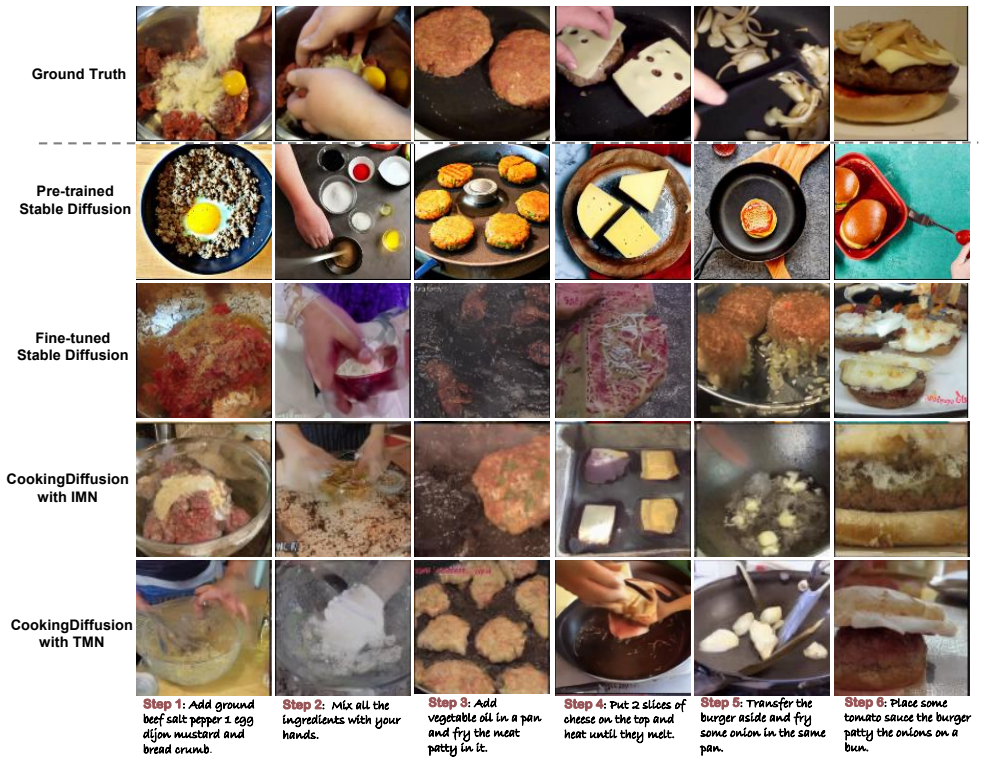
CookingDiffusion's central discovery is that feeding the diffusion model the history of a recipe, not just the current step's text, makes generated step images more consistent without sacrificing image quality. The history is encoded by three Memory Nets: a Text Memory Net for previous step descriptions, an Image Memory Net for previous step images, and a Multi-modality Memory Net for mixed text-image history. Each Memory Net encodes the history with CLIP-based text or vision encoders, applies masked self-attention over the sequence to form a procedural representation, and injects it into the time embedding of Stable Diffusion through a zero-initialized linear layer. The model is evaluated on a preprocessed YouCookII benchmark and, according to FID and Avg-PCon, outperforms the adapted baselines in both text-only and image-history scenarios. The paper further shows that editing the step text changes the generated content coherently, for example by removing, adding, or replacing ingredients and by changing cooking methods.
Load-bearing premise
The paper's whole consistency claim stands on the assumption that its Average Procedure Consistency score, which is computed by matching each generated image against the descriptions of the other steps and never compares images with images, actually measures whether a set of images forms one coherent cooking procedure.
Editorial extensions
If this is right
- Text-only procedural history already improves consistency over the current-step-only baseline, so recipe sites can illustrate instructions step by step even when no step photos exist.
- When ground-truth images of earlier steps are available, image-based memory gives the best reported FID and consistency scores, making visual history the strongest tested consistency signal.
- The multi-modal Memory Net can generate images for steps that lack photos, so a partially illustrated recipe can be turned into a full visual guide.
- Ingredient and cooking-method manipulations transfer to the generated images, so interactive recipe editing could update step visuals when a substitution or method change is made.
- Adapting procedural context into StackGAN, VQ Diffusion, or ControlNet does not reproduce the same trade-off, indicating the benefit depends on how the memory is injected, not just on having context.
Reading between the lines
- The same memory-injection design could be applied to other step-by-step visual domains, such as assembly instructions, lab protocols, or repair guides, where procedural consistency matters more than temporal continuity.
- Because the image-history scenarios use ground-truth earlier images, a deployed system that re-feeds its own generated images would have to run autoregressively; measuring how much error accumulates in that loop is a direct test the paper does not perform.
- A natural next test is whether a direct image-to-image consistency measure, for example pairwise similarity between generated step images, ranks methods the same way Avg-PCon does; that would clarify what part of the reported consistency gain is visual coherence.
- The paper leaves temporal modeling out of scope; extending the same procedural-memory mechanism to step-wise video generation is an explicit future direction.
Editorial analysis
A structured set of objections, weighed in public.
Referee Report
Summary. The paper introduces 'cooking procedural image generation,' in which a recipe's step texts are used to generate a sequence of images that are both faithful to each step and mutually consistent. The proposed CookingDiffusion extends Stable Diffusion with three Memory Nets: Text Memory Net (TMN), Image Memory Net (IMN), and Multi-modality Memory Net (MMN), which inject procedural representations from previous step texts, previous step images, or their mixture into the denoising U-Net. The authors preprocess YouCookII into 1185 training and 446 validation recipes and benchmark three scenarios: text-only procedural prompts, image-only procedural prompts, and mixed prompts with a fraction p of available images. They report FID and a new Average Procedure Consistency (Avg-PCon) metric, and claim that CookingDiffusion outperforms fine-tuned Stable Diffusion and adapted StackGAN, VQ Diffusion, and ControlNet baselines on both metrics, with additional qualitative ingredient and cooking-method manipulation results.
Significance. If the claim holds, this is a useful task formulation and a simple, modular contribution to conditional generation: the zero-initialized additive memory path preserves pre-trained Stable Diffusion behavior, the unified CLIP-based design lets TMN, IMN, and MMN share structure across modalities, and the preprocessed YouCookII benchmark plus the promised release would support future work. The FID improvements on the validation set are substantively large (e.g., 34.547 versus 40.394 for scenario 1 in Table 1), which gives independent evidence for image-quality gains. However, the paper's headline consistency evidence rests entirely on Avg-PCon, whose validity as a measure of procedural consistency is not established; the consistency claim therefore needs additional support before the contribution can be fully credited.
major comments (4)
- [Section 5.2.2, Eqs. (7)-(8)] The Avg-PCon metric does not compare generated images with one another; it is a weighted average of CLIP text-image similarities between each generated image and the texts of the other steps. It therefore cannot detect persistence of the same pan, ingredients, or background, which is the sequential consistency the paper claims. Because the self-term <I_gen_i, C_i> is omitted, an image that is a generic match to the recipe's other steps can score highly even if it does not depict its own step, and the text-text weights suppress exactly the cross-step comparisons where a consistent kitchen state should remain visible despite different action texts. The central consistency claim should not rest on this metric unless it is validated against human judgments or an image-image consistency measure.
- [Sections 3.3-3.5 and 5.2.2] There is a circularity concern: Avg-PCon is computed with CLIP text and vision encoders, and the same CLIP embedding family is used by the Text, Image, and Multi-modality Memory Nets as well as by the keyframe selection in Section 5.1. A model trained to align with CLIP-based procedural representations may therefore score higher on Avg-PCon without being more consistent for human viewers. The paper should add an independent evaluation, e.g., a human study or a metric using features not involved in training, to support the headline consistency result.
- [Section 3.2 and Sections 5.3-5.4] In Scenarios 2 and 3 the historical image prompts are ground-truth keyframes, and the paper itself states in Section 3.2 that this is an upper bound on the improvement obtainable from image-based procedural prompts. The experiments therefore do not exercise the actual deployment setting in which previously generated images would be fed back as context, and the scenario-3 goal of 'generating the missing images for all the steps' is not evaluated end-to-end. Either an autoregressive evaluation with generated images should be reported, or the claims should be explicitly limited to conditioning on ground-truth images.
- [Section 5.3, Table 1] All quantitative results are single runs without error bars or significance tests, and several Avg-PCon differences in Table 1 are very small (e.g., 18.541 versus 18.470 on the validation set in Scenario 1). It is therefore unclear whether the reported consistency improvements are statistically meaningful. The authors should report means and standard deviations over multiple seeds and include significance tests; they should also avoid using FID computed on the training set as evidence of superiority, since it is not a generalization measure.
minor comments (4)
- [Section 3.5 and Section 5.3] The heading 'Multi-modalilty Memory Net' contains a typo, and the text later uses 'Avg-PCON' inconsistently; both should be corrected to 'Multi-modality Memory Net' and 'Avg-PCon'.
- [Equation (7)] The term 'normalized <C_i, C_j>' is never defined; the paper should specify the exact normalization (e.g., softmax over j) and any temperature, since this weighting determines how much the cross-step text-image terms are downweighted.
- [Section 5.1] The statement that the authors evaluate on both the validation and training sets 'due to a perceived lack of samples' is vague; the paper should report the number of procedures and explain what the training-set FID is intended to show.
- [Section 4] The adapted baselines differ in optimization scope (ControlNet freezes the Stable Diffusion backbone while CookingDiffusion fine-tunes it); a sentence acknowledging this asymmetry and its effect on the comparison would improve the fairness of the benchmark.
Circularity Check
No significant circularity: the consistency metric is self-referential in embedding space but not fitted to or derived from the model, and the headline results are benchmarked against external baselines and FID.
full rationale
The paper's central claim is that CookingDiffusion generates procedurally consistent cooking images. Its dedicated metric, Avg-PCon (Eqs. 7-8), is a weighted CLIP text-image alignment score that never compares generated images to one another, and the model's Text/Image Memory Nets use CLIP-based encoders (Eqs. 1, 4). This is a genuine construct-validity risk: the metric may reward text-aligned images rather than cross-image visual persistence, and a model could in principle inflate Avg-PCon with generic images. However, this is not a circular derivation. Avg-PCon is not a training loss, no parameter is fitted to it, and the same metric is applied to all baselines; the FID results and qualitative comparisons provide independent, external evidence. The paper explicitly acknowledges that scenario 2/3 results use ground-truth historical images as procedural prompts and therefore constitute an upper bound on the benefit of image-based procedural prompts. Self-citations (e.g., CookGAN [60]) appear only in related-work positioning and are not load-bearing for the method or evaluation. No equation in the paper reduces a claimed prediction to a fitted input or to a self-citation chain, so under the requirement to exhibit a specific reduction, no circular step can be identified.
Assumptions & free parameters
free parameters (4)
- learning_rate =
1e-5
- training_epochs =
75
- image_available_ratio_p =
0.2, 0.3, 0.4
- CLIP_keyframe_selection_threshold =
unspecified
assumptions (4)
- standard math Self-attention and latent diffusion models operate as described in the cited prior literature.
- domain assumption YouCookII step annotations and timestamps are accurate enough to define ground-truth step images.
- ad hoc to paper Avg-PCon, computed from CLIP text-image similarity, is a valid measure of procedural consistency.
- domain assumption In scenarios 2 and 3, ground-truth images of previous steps are the appropriate procedural context.
invented entities (4)
-
Text Memory Net (TMN)
-
Image Memory Net (IMN)
-
Multi-modality Memory Net (MMN)
-
Average Procedure Consistency (Avg-PCon)
Cite this review
Pith. "Pith review of CookingDiffusion: Cooking Procedural Image Generation with Stable Diffusion." pith.science (2026). https://pith.science/paper/2PLW5TFH
@misc{pith2026250109042,
  author       = {Pith},
  title        = {Pith review of: CookingDiffusion: Cooking Procedural Image Generation with Stable Diffusion},
  year         = {2026},
  howpublished = {\url{https://pith.science/paper/2PLW5TFH}},
  note         = {Machine review of arXiv:2501.09042}
}
read the original abstract
Recent advancements in text-to-image generation models have excelled in creating diverse and realistic images. This success extends to food imagery, where various conditional inputs like cooking styles, ingredients, and recipes are utilized. However, a yet-unexplored challenge is generating a sequence of procedural images based on cooking steps from a recipe. This could enhance the cooking experience with visual guidance and possibly lead to an intelligent cooking simulation system. To fill this gap, we introduce a novel task called \textbf{cooking procedural image generation}. This task is inherently demanding, as it strives to create photo-realistic images that align with cooking steps while preserving sequential consistency. To collectively tackle these challenges, we present \textbf{CookingDiffusion}, a novel approach that leverages Stable Diffusion and three innovative Memory Nets to model procedural prompts. These prompts encompass text prompts (representing cooking steps), image prompts (corresponding to cooking images), and multi-modal prompts (mixing cooking steps and images), ensuring the consistent generation of cooking procedural images. To validate the effectiveness of our approach, we preprocess the YouCookII dataset, establishing a new benchmark. Our experimental results demonstrate that our model excels at generating high-quality cooking procedural images with remarkable consistency across sequential cooking steps, as measured by both the FID and the proposed Average Procedure Consistency metrics. Furthermore, CookingDiffusion demonstrates the ability to manipulate ingredients and cooking methods in a recipe. We will make our code, models, and dataset publicly accessible.
Figures


Figures from the paper (6 more)



Reference graph
Works this paper leans on
-
[1]
Hong Chen, Yipeng Zhang, Xin Wang, Xuguang Duan, Yuwei Zhou, and Wenwu Zhu. 2024. DisenDreamer: Subject-Driven Text-to-Image Generation with Sample- aware Disentangled Tuning. IEEE Transactions on Circuits and Systems for Video Technology (2024), 1–1
work page 2024
-
[2]
Jingjing Chen and Chong-Wah Ngo. 2016. Deep-based ingredient recognition for cooking recipe retrieval. In Proceedings of the 24th ACM International Conference on Multimedia. 32–41
work page 2016
-
[3]
Jingjing Chen, Bin Zhu, Chong-Wah Ngo, Tat-Seng Chua, and Yu-Gang Jiang
-
[4]
Jun Cheng, Fuxiang Wu, Yanling Tian, Lei Wang, and Dapeng Tao. 2022. RiFe- GAN2: Rich Feature Generation for Text-to-Image Synthesis From Constrained Prior Knowledge. IEEE Transactions on Circuits and Systems for Video Technology 32, 8 (2022), 5187–5200
work page 2022
-
[5]
Prateek Chhikara, Dhiraj Chaurasia, Yifan Jiang, Omkar Masur, and Filip Ilievski
-
[6]
Prafulla Dhariwal and Alexander Nichol. 2021. Diffusion models beat gans on image synthesis. Advances in Neural Information Processing Systems 34 (2021), 8780–8794
2021
-
[7]
Patrick Esser, Robin Rombach, and Bjorn Ommer. 2021. Taming transformers for high-resolution image synthesis. In Proceedings of the IEEE/CVF Conference on Computer Vision and Pattern Recognition . 12873–12883
work page 2021
-
[8]
Ian Goodfellow. 2016. Nips 2016 tutorial: Generative adversarial networks. arXiv preprint arXiv:1701.00160 (2016)
arXiv 2016
Show all 66 references
-
[9]
Ian Goodfellow, Jean Pouget-Abadie, Mehdi Mirza, Bing Xu, David Warde-Farley, Sherjil Ozair, Aaron Courville, and Yoshua Bengio. 2014. Generative adversarial nets. Advances in Neural Information Processing Systems 27 (2014)
2014
-
[10]
Shuyang Gu, Dong Chen, Jianmin Bao, Fang Wen, Bo Zhang, Dongdong Chen, Lu Yuan, and Baining Guo. 2022. Vector Quantized Diffusion Model for Text-to- Image Synthesis. In Proceedings of the IEEE/CVF Conference on Computer Vision and Pattern Recognition (CVPR) . 10696–10706
2022
-
[11]
Fangda Han, Ricardo Guerrero, and Vladimir Pavlovic. 2019. The art of food: Meal image synthesis from ingredients. arXiv preprint arXiv:1905.13149 (2019)
2019 arXiv
-
[12]
Martin Heusel, Hubert Ramsauer, Thomas Unterthiner, Bernhard Nessler, and Sepp Hochreiter. 2017. Gans trained by a two time-scale update rule converge to a local nash equilibrium. Advances in Neural Information Processing Systems 30 (2017)
2017
-
[13]
Jonathan Ho, William Chan, Chitwan Saharia, Jay Whang, Ruiqi Gao, Alexey Gritsenko, Diederik P Kingma, Ben Poole, Mohammad Norouzi, David J Fleet, et al. 2022. Imagen video: High definition video generation with diffusion models. arXiv preprint arXiv:2210.02303 (2022)
2022 arXiv
-
[14]
Jonathan Ho, Ajay Jain, and Pieter Abbeel. 2020. Denoising diffusion probabilistic models. Advances in Neural Information Processing Systems 33 (2020), 6840–6851
2020
-
[15]
Jonathan Ho, Tim Salimans, Alexey Gritsenko, William Chan, Moham- mad Norouzi, and David J. Fleet. 2022. Video Diffusion Models. arXiv:2204.03458 [cs.CV]
2022 arXiv
-
[16]
Daichi Horita, Wataru Shimoda, and Keiji Yanai. 2019. Unseen food creation by mixing existing food images with conditional stylegan. In Proceedings of the 5th International Workshop on Multimedia Assisted Dietary Management . 19–24
2019
-
[17]
Yoshifumi Ito, Wataru Shimoda, and Keiji Yanai. 2018. Food image generation us- ing a large amount of food images with conditional gan: ramengan and recipegan. In Proceedings of the Joint Workshop on Multimedia for Cooking and Eating Activi- ties and Multimedia Assisted Dietar...
2018
-
[18]
Chengxu Liu, Yuanzhi Liang, Yao Xue, Xueming Qian, and Jianlong Fu. 2021. Food and Ingredient Joint Learning for Fine-Grained Recognition. IEEE Transactions on Circuits and Systems for Video Technology 31, 6 (2021), 2480–2493. https: //doi.org/10.1109/TCSVT.2020.3020079
2021
-
[19]
Guoshan Liu, Yang Jiao, Jingjing Chen, Bin Zhu, and Yu-Gang Jiang. 2024. From Canteen Food to Daily Meals: Generalizing Food Recognition to More Practical 11 Scenarios. IEEE Transactions on Multimedia (2024)
2024
-
[20]
Guoshan Liu, Hailong Yin, Bin Zhu, Jingjing Chen, Chong-Wah Ngo, and Yu- Gang Jiang. 2025. Retrieval Augmented Recipe Generation. In Proceedings of the IEEE/CVF Winter Conference on Applications of Computer Vision
2025
-
[22]
Cheng Lu, Yuhao Zhou, Fan Bao, Jianfei Chen, Chongxuan Li, and Jun Zhu
-
[23]
Yujie Lu, Pan Lu, Zhiyu Chen, Wanrong Zhu, Xin Eric Wang, and William Yang Wang. 2023. Multimodal procedural planning via dual text-image prompting. arXiv preprint arXiv:2305.01795 (2023)
2023 arXiv
-
[24]
Elman Mansimov, Emilio Parisotto, Jimmy Lei Ba, and Ruslan Salakhutdinov. 2015. Generating images from captions with attention. arXiv preprint arXiv:1511.02793 (2015)
2015 arXiv
-
[25]
Weiqing Min, Shuqiang Jiang, Linhu Liu, Yong Rui, and Ramesh Jain. 2019. A survey on food computing. ACM Computing Surveys (CSUR) 52, 5 (2019), 1–36
2019
-
[26]
Weiqing Min, Shuqiang Jiang, Jitao Sang, Huayang Wang, Xinda Liu, and Luis Herranz. 2016. Being a supercook: Joint food attributes and multimodal content modeling for recipe retrieval and exploration. IEEE transactions on multimedia 19, 5 (2016), 1100–1113
2016
-
[27]
Weiqing Min, Zhiling Wang, Yuxin Liu, Mengjiang Luo, Liping Kang, Xiaoming Wei, Xiaolin Wei, and Shuqiang Jiang. 2023. Large scale visual food recognition. IEEE Transactions on Pattern Analysis and Machine Intelligence (2023)
2023
-
[28]
Zhao-Yan Ming, Jingjing Chen, Yu Cao, Ciarán Forde, Chong-Wah Ngo, and Tat Seng Chua. 2018. Food photo recognition for dietary tracking: System and experiment. In MultiMedia Modeling: 24th International Conference, MMM 2018, Bangkok, Thailand, February 5-7, 2018, Proceedings, ...
2018
-
[29]
Mehdi Mirza and Simon Osindero. 2014. Conditional generative adversarial nets. arXiv preprint arXiv:1411.1784 (2014)
2014 arXiv
-
[30]
Jianing Qiu, Frank P-W Lo, Yingnan Sun, Siyao Wang, and Benny Lo. 2022. Mining discriminative food regions for accurate food recognition. arXiv preprint arXiv:2207.03692 (2022)
2022 arXiv
-
[31]
Alec Radford, Jong Wook Kim, Chris Hallacy, Aditya Ramesh, Gabriel Goh, Sandhini Agarwal, Girish Sastry, Amanda Askell, Pamela Mishkin, Jack Clark, et al. 2021. Learning transferable visual models from natural language supervision. In International Conference on Machine Learni...
2021
-
[32]
Scott Reed, Zeynep Akata, Xinchen Yan, Lajanugen Logeswaran, Bernt Schiele, and Honglak Lee. 2016. Generative adversarial text to image synthesis. In Inter- national Conference on Machine Learning . PMLR, 1060–1069
2016
-
[33]
Scott Reed, Aäron van den Oord, Nal Kalchbrenner, Victor Bapst, Matt Botvinick, and Nando De Freitas. 2016. Generating interpretable images with controllable structure. (2016)
2016
-
[34]
Scott E Reed, Zeynep Akata, Santosh Mohan, Samuel Tenka, Bernt Schiele, and Honglak Lee. 2016. Learning what and where to draw. Advances in Neural Information Processing Systems 29 (2016)
2016
-
[35]
Robin Rombach, Andreas Blattmann, Dominik Lorenz, Patrick Esser, and Björn Ommer. 2022. High-resolution image synthesis with latent diffusion models. In Proceedings of the IEEE/CVF Conference on Computer Vision and Pattern Recognition. 10684–10695
2022
-
[36]
Doyen Sahoo, Wang Hao, Shu Ke, Wu Xiongwei, Hung Le, Palakorn Achananu- parp, Ee-Peng Lim, and Steven CH Hoi. 2019. FoodAI: Food image recognition via deep learning for smart food logging. In Proceedings of the 25th ACM SIGKDD International Conference on Knowledge Discovery & ...
2019
-
[37]
Amaia Salvador, Michal Drozdzal, Xavier Giró-i Nieto, and Adriana Romero
-
[38]
Amaia Salvador, Erhan Gundogdu, Loris Bazzani, and Michael Donoser. 2021. Revamping cross-modal recipe retrieval with hierarchical transformers and self- supervised learning. In Proceedings of the IEEE/CVF Conference on Computer Vision and Pattern Recognition. 15475–15484
2021
-
[39]
Amaia Salvador, Nicholas Hynes, Yusuf Aytar, Javier Marin, Ferda Ofli, Ingmar Weber, and Antonio Torralba. 2017. Learning cross-modal embeddings for cook- ing recipes and food images. In Proceedings of the IEEE Conference on Computer Vision and Pattern Recognition . 3020–3028
2017
-
[40]
Sheng Shen, Liunian Harold Li, Hao Tan, Mohit Bansal, Anna Rohrbach, Kai- Wei Chang, Zhewei Yao, and Kurt Keutzer. 2022. How much can clip benefit vision-and-language tasks?. In The Tenth International Conference on Learning Representations
2022
-
[41]
Ivan Skorokhodov, Sergey Tulyakov, and Mohamed Elhoseiny. 2022. Stylegan- v: A continuous video generator with the price, image quality and perks of stylegan2. In Proceedings of the IEEE/CVF Conference on Computer Vision and Pattern Recognition. 3626–3636
2022
-
[42]
Fangzhou Song, Bin Zhu, Yanbin Hao, and Shuo Wang. 2025. Enhancing recipe retrieval with foundation models: A data augmentation perspective. In European Conference on Computer Vision . Springer, 111–127
2025
-
[43]
Jiaming Song, Chenlin Meng, and Stefano Ermon. 2021. Denoising diffusion implicit models. In9th International Conference on Learning Representations. Open- Review.net
2021
-
[44]
Christian Szegedy, Vincent Vanhoucke, Sergey Ioffe, Jon Shlens, and Zbigniew Wojna. 2016. Rethinking the inception architecture for computer vision. In Proceedings of the IEEE Conference on Computer Vision and Pattern Recognition . 2818–2826
2016
-
[45]
Ming Tao, Hao Tang, Fei Wu, Xiao-Yuan Jing, Bing-Kun Bao, and Changsheng Xu. 2022. Df-gan: A simple and effective baseline for text-to-image synthesis. In Proceedings of the IEEE/CVF Conference on Computer Vision and Pattern Recognition. 16515–16525
2022
-
[46]
Aaron Van Den Oord, Oriol Vinyals, et al. 2017. Neural discrete representation learning. Advances in Neural Information Processing Systems 30 (2017)
2017
-
[47]
Ruben Villegas, Mohammad Babaeizadeh, Pieter-Jan Kindermans, Hernan Moraldo, Han Zhang, Mohammad Taghi Saffar, Santiago Castro, Julius Kunze, and Dumitru Erhan. 2022. Phenaki: Variable length video generation from open domain textual description. arXiv preprint arXiv:2210.02399 (2022)
2022 arXiv
-
[48]
Hao Wang, Doyen Sahoo, Chenghao Liu, Ke Shu, Palakorn Achananuparp, Ee- peng Lim, and Steven CH Hoi. 2021. Cross-modal food retrieval: learning a joint embedding of food images and recipes with semantic consistency and attention mechanism. IEEE Transactions on Multimedia 24 (2...
2021
-
[49]
Tao Xu, Pengchuan Zhang, Qiuyuan Huang, Han Zhang, Zhe Gan, Xiaolei Huang, and Xiaodong He. 2018. Attngan: Fine-grained text to image generation with attentional generative adversarial networks. InProceedings of the IEEE Conference on Computer Vision and Pattern Recognition . ...
2018
-
[50]
Shengming Yin, Chenfei Wu, Huan Yang, Jianfeng Wang, Xiaodong Wang, Min- heng Ni, Zhengyuan Yang, Linjie Li, Shuguang Liu, Fan Yang, et al. 2023. NUWA- XL: Diffusion over Diffusion for eXtremely Long Video Generation.arXiv preprint arXiv:2303.12346 (2023)
2023 arXiv
-
[51]
Yuehao Yin, Huiyan Qi, Bin Zhu, Jingjing Chen, Yu-Gang Jiang, and Chong-Wah Ngo. 2023. Foodlmm: A versatile food assistant using large multi-modal model. arXiv preprint arXiv:2312.14991 (2023)
2023 arXiv
-
[52]
Sihyun Yu, Kihyuk Sohn, Subin Kim, and Jinwoo Shin. 2023. Video probabilis- tic diffusion models in projected latent space. In Proceedings of the IEEE/CVF Conference on Computer Vision and Pattern Recognition . 18456–18466
2023
-
[53]
Han Zhang, Jing Yu Koh, Jason Baldridge, Honglak Lee, and Yinfei Yang. 2021. Cross-modal contrastive learning for text-to-image generation. In Proceedings of the IEEE/CVF Conference on Computer Vision and Pattern Recognition . 833–842
2021
-
[54]
Han Zhang, Tao Xu, Hongsheng Li, Shaoting Zhang, Xiaogang Wang, Xiaolei Huang, and Dimitris N Metaxas. 2017. Stackgan: Text to photo-realistic image synthesis with stacked generative adversarial networks. In Proceedings of the IEEE International Conference on Computer Vision ....
2017
-
[55]
Han Zhang, Tao Xu, Hongsheng Li, Shaoting Zhang, Xiaogang Wang, Xiaolei Huang, and Dimitris N Metaxas. 2018. Stackgan++: Realistic image synthesis with stacked generative adversarial networks. IEEE Transactions on Pattern Analysis and Machine Intelligence 41, 8 (2018), 1947–1962
2018
-
[56]
Lvmin Zhang, Anyi Rao, and Maneesh Agrawala. 2023. Adding conditional con- trol to text-to-image diffusion models. InProceedings of the IEEE/CVF International Conference on Computer Vision . 3836–3847
2023
-
[57]
Heng Zhao, Kim-Hui Yap, and Alex Chichung Kot. 2021. Fusion learning using semantics and graph convolutional network for visual food recognition. In Pro- ceedings of the IEEE/CVF Winter Conference on Applications of Computer Vision . 1711–1720
2021
-
[58]
Liang Zhao, Pingda Huang, Tengtuo Chen, Chunjiang Fu, Qinghao Hu, and Yangqianhui Zhang. 2023. Multi-Sentence Complementarily Generation for Text-to-Image Synthesis. IEEE Transactions on Multimedia (2023)
2023
-
[59]
Luowei Zhou, Chenliang Xu, and Jason Corso. 2018. Towards automatic learn- ing of procedures from web instructional videos. In Proceedings of the AAAI Conference on Artificial Intelligence, Vol. 32
2018
-
[60]
Bin Zhu and Chong-Wah Ngo. 2020. CookGAN: Causality based text-to-image synthesis. In Proceedings of the IEEE/CVF Conference on Computer Vision and Pattern Recognition. 5519–5527
2020
-
[61]
Bin Zhu, Chong-Wah Ngo, and Wing-Kwong Chan. 2021. Learning from web recipe-image pairs for food recognition: Problem, baselines and performance. IEEE Transactions on Multimedia 24 (2021), 1175–1185
2021
-
[62]
Bin Zhu, Chong-Wah Ngo, Jingjing Chen, and Yanbin Hao. 2019. R2gan: Cross- modal recipe retrieval with generative adversarial network. In Proceedings of the IEEE/CVF Conference on Computer Vision and Pattern Recognition . 11477–11486. 12
2019
-
[2019]
In Proceedings of the IEEE/CVF Conference on Computer Vision and Pattern Recognition
Inverse cooking: Recipe generation from food images. In Proceedings of the IEEE/CVF Conference on Computer Vision and Pattern Recognition . 10453–10462
-
[2020]
IEEE Transactions on Image Processing 30 (2020), 1514–1526
A study of multi-task and region-wise deep learning for food ingredient recognition. IEEE Transactions on Image Processing 30 (2020), 1514–1526
2020
-
[2022]
Advances in Neural Information Processing Systems 35 (2022), 5775–5787
Dpm-solver: A fast ode solver for diffusion probabilistic model sampling in around 10 steps. Advances in Neural Information Processing Systems 35 (2022), 5775–5787
2022
-
[2023]
arXiv:2211.01095 [cs.LG]
DPM-Solver++: Fast Solver for Guided Sampling of Diffusion Probabilistic Models. arXiv:2211.01095 [cs.LG]
-
[2024]
InProceedings of the IEEE/CVF Winter Conference on Applications of Computer Vision
Fire: Food image to recipe generation. InProceedings of the IEEE/CVF Winter Conference on Applications of Computer Vision . 8184–8194
Reviewed August 10, 2026 · model on record in the stance chip above.
Discussion (0). Continue with ORCID to comment.