REVIEW 5 major objections 4 minor 69 references
Physics-informed deep learning for infectious disease forecasting
T0 review · 5 major / 4 minor · reviewed 2026-08-10 · deepseek-v4-flash
Pith's one-line read A physics-informed neural network that enforces a nine-compartment epidemic model forecasts California COVID-19 outcomes up to four weeks ahead, beating data-only deep learning baselines.
desk verdict A workmanlike incremental PINN forecasting study; the empirical results are plausible but hinge on a potentially non-causal moving average and a partly circular GISST baseline. read the letter →
The pith
A machine-rendered reading of the paper's core claim, the machinery that carries it, and where it could break.
The reading
What carries the argument
The central mechanism is the physics-informed loss: a weighted sum of a data term on observable outcomes and covariates, an initial-condition term, and a residual term enforcing the nine ODEs of the compartmental model. The lower sub-network maps time to mobility, cumulative vaccine doses, and $\beta_t$, so the transmission rate is not a fitted constant but a learned time-varying function that couples the covariates into the ODE system. This is the piece that makes trajectories epidemiologically plausible and prevents the network from fitting noise.
What would settle it
Re-run the same rolling-window protocol on California data that include the Omicron wave (weeks after the paper's cutoff), and check whether the 1-week-ahead MASE for cases stays below 1.0; if it rises above the naive baseline, the fixed-parameter compartmental structure does not generalize across variant regimes. A complementary check is to withhold the mobility and vaccine covariate inputs and retrain: if accuracy is unchanged, the covariate sub-network is not the source of the claimed gains.
Extended reading notes
Core claim
On the paper's own terms, the central discovery is that embedding the nine-compartment ODE model of reference [22] into the loss of a two-part neural network produces stable, accurate weekly forecasts. The upper sub-network outputs the nine state variables—susceptible, latent, infectious, diagnosed-not-yet-reported, reported cases, hospitalized, new admissions, deaths-not-yet-reported, and reported deaths—with reported cases, hospitalizations, and reported deaths supervised by data; the lower sub-network outputs mobility, cumulative vaccine doses, and the transmission rate $\beta_t$. The total loss is $L_{\text{data}} + w_{\text{ODE}}L_{\text{ODE}}$, where the ODE loss penalizes residuals of the nine equations and the initial conditions. Trained on California data from July 2020 to April 2022 with a weekly rolling window, the model reports MASE values at or below 1.0 for every target and horizon, and scaled WIS generally below 1.0, with the single exception of 1-week-ahead death quantiles. Compared with a purely data-driven network, the ODE constraint lowers error on nearly all horizons; compared with sequence models, it reduces fluctuation and overfitting; compared with a sophisticated Gaussian state-space forecast, it is competitive and structurally simpler.
Load-bearing premise
The load-bearing assumption is that the nine-compartment structure taken from reference [22], with its fixed parameter values (including incubation and removal rates of 0.25 per day), and with only mobility and cumulative vaccine doses driving the time-varying transmission rate, adequately represents California's infection, reporting, hospitalization, and death processes in the period evaluated.
Editorial extensions
If this is right
- Weekly 1- to 4-week-ahead forecasts for cases, deaths, and hospitalizations can be produced from one compact architecture with no separate parameter-inference step.
- The ODE constraint acts as a regularizer: dropping it (the pure NN ablation) raises MASE and WIS at nearly every horizon, and removing L2 regularization degrades cases by 22.48%, deaths by 9.16%, and hospitalizations by 42.54%.
- The method stays competitive with a Gaussian state-space model while using a simpler structure, so it is a practical option for jurisdictions that lack elaborate inference pipelines.
- Because training length beyond about 16 weeks gives little benefit, forecasts can be updated on a rolling window of recent data, which suits non-stationary outbreaks.
- Quantile forecasts with a fixed Gaussian error assumption give intervals that widen with horizon, matching the typical demand for probabilistic epidemic forecasts.
Reading between the lines
- A natural extension the paper leaves untested is transferring the same architecture to other states or pathogens; the fixed parameter set and covariate definitions would need re-estimation, and that re-estimation could be checked against held-out regions.
- The comparison with the state-space model is not uniform: the PINN wins on hospitalizations while the state-space model wins on cases and point forecasts of deaths. That asymmetry suggests per-target weighting of the ODE loss could push the method further, but the paper does not explore it.
- The single-constant-Gaussian approximation of predictive uncertainty is a simplification; replacing it with ensemble or Bayesian posterior over network weights could improve quantile coverage at longer horizons, a direction the paper itself flags.
- Because the paper deliberately stops before the Omicron-dominated period, the strongest test of the claim would be an out-of-sample run on later variant waves; the paper's own training-length analysis hints that a short rolling window would adapt, but that is my inference, not its result.
Signed reviews
Editorial analysis
A structured set of objections, weighed in public.
Referee Report
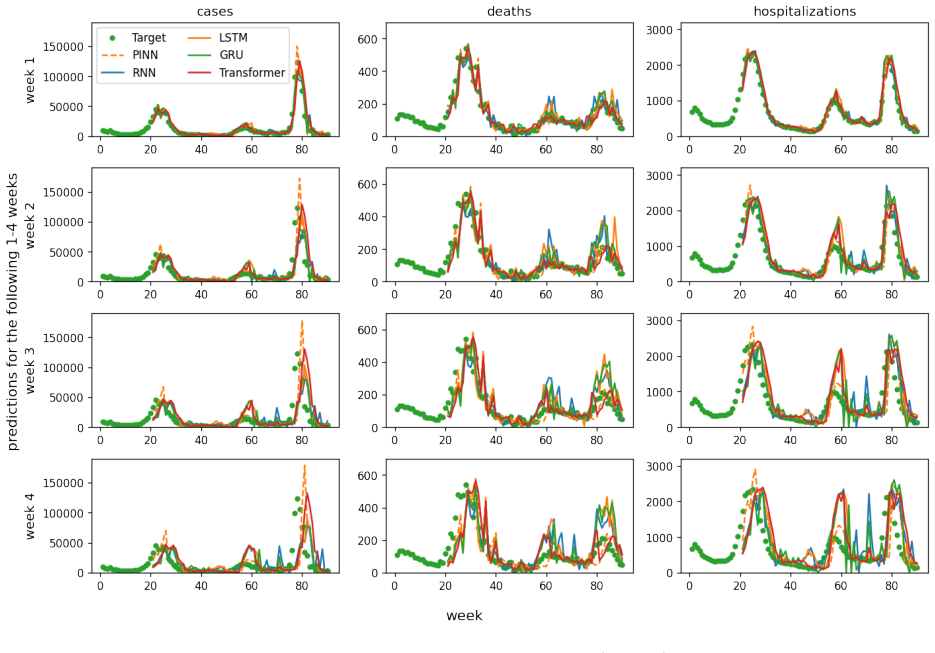
Summary. The manuscript proposes a physics-informed neural network (PINN) for weekly COVID-19 forecasting in California. The model embeds the nine-compartment ODE model of O'Dea and Drake into the loss function, while a second sub-network maps time to mobility, cumulative vaccine doses, and transmission rate. The method is evaluated in a rolling-window design for 1-4 week-ahead forecasts of cases, deaths, and hospitalizations, and is compared with a data-only neural network, the GISST model, and RNN/LSTM/GRU/Transformer baselines using MASE and WIS. The central claim is that this compact PINN outperforms naive and sequence-learning baselines and is comparable to or better than GISST, while being simpler to implement.
Significance. If the claims hold, the paper provides a useful demonstration that a compact PINN with a nine-compartment ODE constraint can produce competitive weekly COVID-19 forecasts. Strengths include the use of standardized Forecast Hub targets and metrics, the inclusion of several baselines (naive, data-only NN, GISST, and four sequence models), and ablation studies for training-window length and L2 regularization. The authors also state that code and data are publicly available. At present, however, the quantitative comparison in Table 3 is not fully validated because of unresolved preprocessing, uncertainty-reporting, and statistical-support issues; the contribution is a promising proof-of-concept rather than a definitive benchmark.
major comments (5)
- [§2.1.2, §2.2, Eq. (2)-(5)] Section 2.1.2 states that the daily series are preprocessed by 'computing a 7-day moving average and aggregating the daily values into a weekly time series,' but it does not state that the moving average is trailing. Under the rolling-window protocol of Section 2.2, training data are available only up to the forecast origin. If the implementation uses a centered moving average (e.g., pandas rolling(7, center=True) or np.convolve with 'same'), the smoothed value at the last training time uses observations from the following three days; those observations enter the data loss in Eq. (2), the initial-condition loss in Eq. (4), and the ODE residual in Eq. (5). This would make the 1-week-ahead forecasts partly in-sample and would affect all horizons through the ODE state, invalidating the comparison in Table 3. The authors should state explicitly that the moving average is causal/trailing and confirm this in the released code; if it is centered, the experiments must be rerun.
- [§2.1.2] The evaluation period is restricted by design: the first 20 weeks of hospitalization data are excluded, and all data after week 110 are discarded to 'maintain focus on well-characterized dynamics' (the two major Beta/Delta peaks). This is a post-hoc selection of the evaluation window, and it means the favorable results in Table 3 are established only for two variant waves, not for the full California record. The general claim in the abstract and Section 4 that the model 'accurately predicts cases, deaths, and hospitalizations' should be tempered to this selected period, or the authors should provide results on the full available record as a robustness check.
- [§2.3, Table 3] MASE and WIS are reported as single point estimates for each method, horizon, and target, with no standard errors, confidence intervals, or significance tests. The neural-network methods are stochastic, and several differences are modest (for example, 1-week-ahead death MASE is 1.00 for PINN versus 0.88 for GISST, and 2-week cases MASE is 0.77 for PINN versus 0.75 for GISST). As written, the claims in Section 3.3 that PINNs 'consistently outperform' the alternatives, or are 'comparable' to GISST, are not statistically supported. Please provide multiple-seed results with interval estimates, or at least a bootstrapped assessment of the score differences.
- [§2.3] The WIS computation assumes a Gaussian predictive distribution with a constant standard deviation σ, described as 'the standard deviation of all prediction errors.' The manuscript does not state how σ is obtained or whether it is fixed before seeing the evaluation period. If σ is computed from the full set of forecast errors over the evaluation period, the quantile forecasts are not out-of-sample and the WIS values in Table 3 are not a valid comparison. Please specify the estimation procedure (for example, from training residuals at each forecast origin) and confirm that it is causal.
- [§2.2, Table 2] The ODE constraint is imported with fixed parameter values from O'Dea and Drake [22] (η=0.25, γ=0.25, etc.), while only β_t, p_h, and p_d are estimated. These fixed values are not re-validated for the California Beta/Delta waves. Because the ODE loss acts as a regularizer in every training run, a misspecified fixed parameter could bias the forecasts. A sensitivity analysis over the fixed parameters (or a version of the model that estimates them) would address this concern and is well within the scope of the paper.
minor comments (4)
- [§2.4, Fig. 3 caption] The GISST baseline is cited as [23] in Section 2.4 but as [22] in the caption of Fig. 3; please reconcile the references and state clearly which published model is used.
- [Data Availability] The repository URL is given as 'https://github.com/dpdclub/PINNs-for-Epidemiology- ' with a trailing hyphen; this appears truncated and should be corrected.
- [§2.3] The quantity in Eq. (7) is defined as the ratio of the model MAE to the naive model MAE. This is a relative MAE, not the standard MASE defined in [61]; please use a less misleading name or explicitly define the deviation from the standard definition.
- [§2.2] The ODE weight w_ODE and the L2 coefficient were 'manually tuned to optimize predictive accuracy'; a brief sensitivity analysis over w_ODE would reassure readers that the reported gains do not depend on a single hand-picked value.
Circularity Check
No significant circularity: held-out forecast evaluation with an externally published compartmental model; no fitted quantity is renamed as a prediction.
full rationale
The paper's central empirical claim is that its PINN model produces accurate 1- to 4-week-ahead forecasts of COVID-19 cases, deaths, and hospitalizations in California. This is evaluated with MASE and WIS against held-out observations in a rolling-window design (Section 2.2 and Table 3), so the forecasts are not fitted values renamed as predictions. The compartmental model and fixed parameter values are adopted from O'Dea and Drake [22]; although the author lists overlap with the present paper, that prior model is an independently published, externally falsifiable modeling choice, not a theorem whose conclusion is the PINN forecast. The GISST baseline solves the same compartmental model, which makes the comparison an implementation and calibration contrast rather than a circular reduction. The Gaussian quantile construction uses a constant sigma derived from prediction errors; this is a standard way to convert point forecasts into intervals and is applied to all compared methods, so it does not define the target as the input. The only notable validity concern is that the 7-day moving average in Section 2.1.2 is not explicitly stated to be trailing; a centered average would leak near-future observations into training. That is a data-leakage and correctness issue, not a circularity of definition or self-citation, and it cannot be established as circular from the text alone.
Assumptions & free parameters
free parameters (6)
- transmission rate beta_t =
time-varying function estimated by lower sub-network
- probability of hospitalization p_h =
estimated during training
- probability of death given hospitalization p_d =
estimated during training
- quantile spread sigma =
standard deviation of all prediction errors, constant in time
- ODE loss weight w_ODE =
0.1
- L2 regularization coefficient =
1e-5
assumptions (4)
- domain assumption The O'Dea-Drake nine-compartment model with eleven parameters correctly describes COVID-19 dynamics in California.
- domain assumption Fixed parameter values from [22] (incubation rate 0.25, removal rate 0.25, reporting rates, etc.) are appropriate for the studied period.
- ad hoc to paper The predictive distribution is Gaussian with a constant standard deviation.
- domain assumption Unobserved latent initial conditions for the nine state variables are set consistently with observed data.
Cite this review
Pith. "Pith review of Physics-informed deep learning for infectious disease forecasting." pith.science (2026). https://pith.science/paper/L5N6L7XS
@misc{pith2026250109298,
  author       = {Pith},
  title        = {Pith review of: Physics-informed deep learning for infectious disease forecasting},
  year         = {2026},
  howpublished = {\url{https://pith.science/paper/L5N6L7XS}},
  note         = {Machine review of arXiv:2501.09298}
}
read the original abstract
Accurate forecasting of contagious diseases is critical for public health policymaking and pandemic preparedness. We propose a new infectious disease forecasting model based on physics-informed neural networks (PINNs), an emerging scientific machine learning approach. By embedding a compartmental model into the loss function, our method integrates epidemiological theory with data, helping to prevent model overfitting. We further enhance the model with a sub-network that accounts for covariates such as mobility and cumulative vaccine doses, which influence the transmission rate. Using state-level COVID-19 data from California, we demonstrate that the PINN model accurately predicts cases, deaths, and hospitalizations, aligning well with existing benchmarks. Notably, the PINN model outperforms naive baseline forecasts and several sequence deep learning models, including Recurrent Neural Networks (RNNs), Long Short-Term Memory (LSTM) networks, Gated Recurrent Units (GRUs), and Transformers. It also achieves performance comparable to a sophisticated Gaussian infection state forecasting model that combines compartmental dynamics, a data observation model, and parameter regression. However, the PINN model features a simpler structure and is easier to implement. In summary, we systematically evaluate the PINN model's ability to forecast infectious disease dynamics, demonstrating its potential as an efficient computational tool to strengthen forecasting capabilities.
Figures


Figures from the paper (4 more)



Reference graph
Works this paper leans on
-
[22]
Eamon B O’Dea and John M Drake. A semi-parametric, state-space compartmental model with time-dependent parameters for forecasting covid-19 cases, hospitalizations and deaths. Journal of the Royal Society Interface , 19(187):20210702, 2022
work page 2022
-
[1]
Provisional mortality data—united states, 2021
Farida B Ahmad, Jodi A Cisewski, and Robert N Anderson. Provisional mortality data—united states, 2021. Morbidity and Mortality Weekly Report , 71(17):597, 2022
work page 2021
-
[2]
The challenge of emerging and re-emerging infectious diseases
David M Morens, Gregory K Folkers, and Anthony S Fauci. The challenge of emerging and re-emerging infectious diseases. Nature, 430(6996):242–249, 2004
work page 2004
-
[3]
Climate change increases cross-species viral transmission risk
Colin J Carlson, Gregory F Albery, Cory Merow, Christopher H Trisos, Casey M Zipfel, Evan A Eskew, Kevin J Olival, Noam Ross, and Shweta Bansal. Climate change increases cross-species viral transmission risk. Nature, 607(7919):555–562, 2022
work page 2022
-
[4]
Improving pandemic response: employing mathematical modeling to confront coronavirus disease 2019
Matthew Biggerstaff, Rachel B Slayton, Michael A Johansson, and Jay C Butler. Improving pandemic response: employing mathematical modeling to confront coronavirus disease 2019. Clinical Infectious Diseases, 74(5):913–917, 2022
work page 2019
-
[5]
Chelsea S Lutz, Mimi P Huynh, Monica Schroeder, Sophia Anyatonwu, F Scott Dahlgren, Gregory Danyluk, Danielle Fernandez, Sharon K Greene, Nodar Kipshidze, Leann Liu, et al. Applying infectious disease forecasting to public health: a path forward using influenza fore- casting examples. BMC Public Health , 19(1):1–12, 2019
work page 2019
-
[6]
An accurate hierarchical model to forecast diverse seasonal infectious diseases
B KM Case, Mariah Victoria Salcedo, and Spencer J Fox. An accurate hierarchical model to forecast diverse seasonal infectious diseases. medRxiv, pages 2025–03, 2025
work page 2025
-
[7]
R M Anderson and R M May. Infectious Diseases of Humans. Oxford University Press. Oxford University Press, 1991
work page 1991
Show all 69 references
-
[8]
Modelling Infectious Diseases: In Humans and Animals
M J Keeling and P Rohani. Modelling Infectious Diseases: In Humans and Animals . Princeton University Press. Princeton University Press, 2008
2008
-
[9]
Compartmental models in epidemiology
Fred Brauer. Compartmental models in epidemiology. Mathematical epidemiology, pages 19– 79, 2008
2008
-
[10]
Mathematical models in epidemiology, volume 32
Fred Brauer, Carlos Castillo-Chavez, Zhilan Feng, et al. Mathematical models in epidemiology, volume 32. Springer, 2019. 17
2019
-
[11]
An introduction to mathematical epidemiology , volume 61
Maia Martcheva. An introduction to mathematical epidemiology , volume 61. Springer, 2015
2015
-
[12]
Mathematical modelling and prediction in infectious disease epidemiology
Amit Huppert and Guy Katriel. Mathematical modelling and prediction in infectious disease epidemiology. Clinical microbiology and infection , 19(11):999–1005, 2013
2013
-
[13]
Appropriate Models for the Manage- ment of Infectious Diseases
Helen J Wearing, Pejman Rohani, and Matt J Keeling. Appropriate Models for the Manage- ment of Infectious Diseases. PLoS Medicine, 2(7):e174, 2005
2005
-
[14]
Structural identifiability and observability of compartmental models of the covid-19 pandemic
Gemma Massonis, Julio R Banga, and Alejandro F Villaverde. Structural identifiability and observability of compartmental models of the covid-19 pandemic. Annual reviews in control , 51:441–459, 2021
2021
-
[15]
A fractional-order compartmental model for the spread of the covid-19 pandemic
Toheeb A Biala and AQM Khaliq. A fractional-order compartmental model for the spread of the covid-19 pandemic. Communications in Nonlinear Science and Numerical Simulation , 98:105764, 2021
2021
-
[16]
Mathematical modeling of covid-19 transmission dynamics with a case study of wuhan
Fa ¨ ı¸ cal Nda ¨ ırou, Iv´ an Area, Juan J Nieto, and Delfim FM Torres. Mathematical modeling of covid-19 transmission dynamics with a case study of wuhan. Chaos, Solitons & Fractals , 135:109846, 2020
2020
-
[17]
Compartmental models of the covid-19 pandemic for physicians and physician-scientists
Anas Abou-Ismail. Compartmental models of the covid-19 pandemic for physicians and physician-scientists. SN comprehensive clinical medicine , 2(7):852–858, 2020
2020
-
[18]
Sirsi compartmental model for covid-19 pandemic with immunity loss
Cristiane M Batistela, Diego PF Correa, ´Atila M Bueno, and Jos´ e Roberto C Piqueira. Sirsi compartmental model for covid-19 pandemic with immunity loss. Chaos, Solitons & Fractals , 142:110388, 2021
2021
-
[19]
New compartment model for covid-19
Takashi Odagaki. New compartment model for covid-19. Scientific Reports, 13(1):5409, 2023
2023
-
[20]
Matthieu Domenech de Cell` es, Felicia M. G. Magpantay, Aaron A. King, and Pejman Ro- hani. The impact of past vaccination coverage and immunity on pertussis resurgence. Science Translational Medicine, 10(434):eaaj1748, 03 2018
2018
-
[21]
Measuring the impact of Ebola control measures in Sierra Leone
Adam J Kucharski, Anton Camacho, Stefan Flasche, Rebecca E Glover, W John Edmunds, and Sebastian Funk. Measuring the impact of Ebola control measures in Sierra Leone. Proceedings of the National Academy of Sciences of the United States of America , 112(46):14366 – 14371, 11 2015
2015
-
[23]
A data-driven semi-parametric model of sars-cov-2 trans- mission in the united states
John M Drake, Andreas Handel, ´Eric Marty, Eamon B O’Dea, Tierney O’Sullivan, Giovanni Righi, and Andrew T Tredennick. A data-driven semi-parametric model of sars-cov-2 trans- mission in the united states. PLOS Computational Biology , 19(11):e1011610, 2023
2023
-
[24]
Real-time mechanistic bayesian forecasts of covid-19 mortality
Graham C Gibson, Nicholas G Reich, and Daniel Sheldon. Real-time mechanistic bayesian forecasts of covid-19 mortality. medRxiv, 2020
2020
-
[25]
Deep learning for epidemio- logical predictions
Yuexin Wu, Yiming Yang, Hiroshi Nishiura, and Masaya Saitoh. Deep learning for epidemio- logical predictions. In The 41st International ACM SIGIR Conference on Research & Devel- opment in Information Retrieval , pages 1085–1088, 2018. 18
2018
-
[26]
Deep learning for few-shot white blood cell image classification and feature learning
Yixiang Deng and He Li. Deep learning for few-shot white blood cell image classification and feature learning. Computer Methods in Biomechanics and Biomedical Engineering: Imaging & Visualization , 11(6):2081–2091, 2023
2023
-
[27]
A systematic study of the performance of machine learning models on analyzing the association between semen quality and environmental pollutants
Lu Lu, Ying Qian, Yihang Dong, Han Su, Yunxin Deng, Qiang Zeng, and He Li. A systematic study of the performance of machine learning models on analyzing the association between semen quality and environmental pollutants. Frontiers in Physics, 11:1259273, 2023
2023
-
[28]
A deep learning model for efficient end-to-end stratification of thrombotic risk in left atrial appendage
Qi Gao, Hongtao Lin, Jianghong Qian, Xingli Liu, Shengze Cai, He Li, Hongguang Fan, and Zhe Zheng. A deep learning model for efficient end-to-end stratification of thrombotic risk in left atrial appendage. Engineering Applications of Artificial Intelligence , 126:107187, 2023
2023
-
[29]
Mathematical models for predicting covid-19 pandemic: a review
Vishnu Vytla, Sravanth Kumar Ramakuri, Anudeep Peddi, K Kalyan Srinivas, and N Nithish Ragav. Mathematical models for predicting covid-19 pandemic: a review. In Journal of Physics: Conference Series , volume 1797, page 012009. IOP Publishing, 2021
2021
-
[30]
Kevrekidis, Lu Lu, Paris Perdikaris, Sifan Wang, and Liu Yang
George Em Karniadakis, Ioannis G. Kevrekidis, Lu Lu, Paris Perdikaris, Sifan Wang, and Liu Yang. Physics-informed machine learning. Nature Reviews Physics , 3(6):422–440, 2021
2021
-
[31]
Hidden fluid mechanics: Learning velocity and pressure fields from flow visualizations
Maziar Raissi, Alireza Yazdani, and George Em Karniadakis. Hidden fluid mechanics: Learning velocity and pressure fields from flow visualizations. Science, 367(6481):1026–1030, 2020
2020
-
[32]
Extraction of mechanical properties of materials through deep learning from instru- mented indentation
Lu Lu, Ming Dao, Punit Kumar, Upadrasta Ramamurty, George Em Karniadakis, and Subra Suresh. Extraction of mechanical properties of materials through deep learning from instru- mented indentation. Proceedings of the National Academy of Sciences , 117(13):7052–7062, 2020
2020
-
[33]
Multi-head physics-informed neural networks for learning functional priors and uncertainty quantification
Zongren Zou and George Em Karniadakis. Multi-head physics-informed neural networks for learning functional priors and uncertainty quantification. Journal of Computational Physics , page 113947, 2025
2025
-
[34]
Correcting model misspecification in physics-informed neural networks (PINNs)
Zongren Zou, Xuhui Meng, and George Em Karniadakis. Correcting model misspecification in physics-informed neural networks (PINNs). Journal of Computational Physics , 505:112918, 2024
2024
-
[35]
Discovering a reaction– diffusion model for Alzheimer’s disease by combining PINNs with symbolic regression
Zhen Zhang, Zongren Zou, Ellen Kuhl, and George Em Karniadakis. Discovering a reaction– diffusion model for Alzheimer’s disease by combining PINNs with symbolic regression. Com- puter Methods in Applied Mechanics and Engineering , 419:116647, 2024
2024
-
[36]
Uncertainty quantification for noisy inputs–outputs in physics-informed neural networks and neural operators
Zongren Zou, Xuhui Meng, and George Em Karniadakis. Uncertainty quantification for noisy inputs–outputs in physics-informed neural networks and neural operators. Computer Methods in Applied Mechanics and Engineering , 433:117479, 2025
2025
-
[37]
NeuralUQ: A com- prehensive library for uncertainty quantification in neural differential equations and operators
Zongren Zou, Xuhui Meng, Apostolos F Psaros, and George E Karniadakis. NeuralUQ: A com- prehensive library for uncertainty quantification in neural differential equations and operators. SIAM Review, 66(1):161–190, 2024
2024
-
[38]
B-pinns: Bayesian physics-informed neu- ral networks for forward and inverse PDE problems with noisy data
Liu Yang, Xuhui Meng, and George Em Karniadakis. B-pinns: Bayesian physics-informed neu- ral networks for forward and inverse PDE problems with noisy data. Journal of Computational Physics, 425:109913, 2021. 19
2021
-
[39]
Ppinn: Parareal physics- informed neural network for time-dependent pdes
Xuhui Meng, Zhen Li, Dongkun Zhang, and George Em Karniadakis. Ppinn: Parareal physics- informed neural network for time-dependent pdes. Computer Methods in Applied Mechanics and Engineering, 370:113250, 2020
2020
-
[40]
Gradient-enhanced physics- informed neural networks for forward and inverse pde problems
Jeremy Yu, Lu Lu, Xuhui Meng, and George Em Karniadakis. Gradient-enhanced physics- informed neural networks for forward and inverse pde problems. Computer Methods in Applied Mechanics and Engineering , 393:114823, 2022
2022
-
[41]
Physics-informed neural networks for solving forward and inverse flow problems via the boltzmann-bgk formulation
Qin Lou, Xuhui Meng, and George Em Karniadakis. Physics-informed neural networks for solving forward and inverse flow problems via the boltzmann-bgk formulation. Journal of Computational Physics , 447:110676, 2021
2021
-
[42]
Deepxde: A deep learning library for solving differential equations
Lu Lu, Xuhui Meng, Zhiping Mao, and George Em Karniadakis. Deepxde: A deep learning library for solving differential equations. SIAM review, 63(1):208–228, 2021
2021
-
[43]
From PINNs to PIKANs: Recent advances in physics-informed machine learning
Juan Diego Toscano, Vivek Oommen, Alan John Varghese, Zongren Zou, Nazanin Ah- madi Daryakenari, Chenxi Wu, and George Em Karniadakis. From PINNs to PIKANs: Recent advances in physics-informed machine learning. Machine Learning for Computational Science and Engineering, 1(1):1...
2025
-
[44]
Physics-informed neural networks: A deep learning framework for solving forward and inverse problems involving nonlinear partial differential equations
Maziar Raissi, Paris Perdikaris, and George E Karniadakis. Physics-informed neural networks: A deep learning framework for solving forward and inverse problems involving nonlinear partial differential equations. Journal of Computational Physics , 378:686–707, 2019
2019
-
[45]
Aoslo-net: a deep learning-based method for automatic segmentation of retinal microaneurysms from adaptive optics scanning laser ophthalmoscopy images
Qian Zhang, Konstantina Sampani, Mengjia Xu, Shengze Cai, Yixiang Deng, He Li, Jennifer K Sun, and George Em Karniadakis. Aoslo-net: a deep learning-based method for automatic segmentation of retinal microaneurysms from adaptive optics scanning laser ophthalmoscopy images. Tra...
2022
-
[46]
Tgm-nets: A deep learning framework for enhanced forecasting of tumor growth by integrating imaging and modeling
Qijing Chen, Qi Ye, Weiqi Zhang, He Li, and Xiaoning Zheng. Tgm-nets: A deep learning framework for enhanced forecasting of tumor growth by integrating imaging and modeling. Engineering Applications of Artificial Intelligence , 126:106867, 2023
2023
-
[47]
Transfer learning on physics-informed neural networks for tracking the hemodynamics in the evolving false lumen of dissected aorta
Mitchell Daneker, Shengze Cai, Ying Qian, Eric Myzelev, Arsh Kumbhat, He Li, and Lu Lu. Transfer learning on physics-informed neural networks for tracking the hemodynamics in the evolving false lumen of dissected aorta. Nexus, 1(2), 2024
2024
-
[48]
A deep neural network for operator learning enhanced by attention and gating mechanisms for long-time forecasting of tumor growth
Qijing Chen, He Li, and Xiaoning Zheng. A deep neural network for operator learning enhanced by attention and gating mechanisms for long-time forecasting of tumor growth. Engineering with Computers , pages 1–111, 2024
2024
-
[49]
Coagulo-net: Enhancing the mathematical modeling of blood coagulation using physics-informed neural networks
Ying Qian, Ge Zhu, Zhen Zhang, Susree Modepalli, Yihao Zheng, Xiaoning Zheng, Galit Frydman, and He Li. Coagulo-net: Enhancing the mathematical modeling of blood coagulation using physics-informed neural networks. Neural Networks, page 106732, 2024
2024
-
[50]
Artificial intelligence velocimetry and microaneurysm-on-a-chip for three-dimensional analysis of blood flow in physiology and disease
Shengze Cai, He Li, Fuyin Zheng, Fang Kong, Ming Dao, George Em Karniadakis, and Subra Suresh. Artificial intelligence velocimetry and microaneurysm-on-a-chip for three-dimensional analysis of blood flow in physiology and disease. Proceedings of the National Academy of Science...
2021
-
[51]
Bayesian physics informed neural networks for real-world nonlinear dynamical systems
Kevin Linka, Amelie Sch¨ afer, Xuhui Meng, Zongren Zou, George Em Karniadakis, and Ellen Kuhl. Bayesian physics informed neural networks for real-world nonlinear dynamical systems. Computer Methods in Applied Mechanics and Engineering , 402:115346, 2022. 20
2022
-
[52]
Thermodynamically consistent physics-informed neural networks for hyperbolic systems
Ravi G Patel, Indu Manickam, Nathaniel A Trask, Mitchell A Wood, Myoungkyu Lee, Ignacio Tomas, and Eric C Cyr. Thermodynamically consistent physics-informed neural networks for hyperbolic systems. Journal of Computational Physics , 449:110754, 2022
2022
-
[53]
A physics-informed op- erator regression framework for extracting data-driven continuum models
Ravi G Patel, Nathaniel A Trask, Mitchell A Wood, and Eric C Cyr. A physics-informed op- erator regression framework for extracting data-driven continuum models. Computer Methods in Applied Mechanics and Engineering , 373:113500, 2021
2021
-
[54]
Learning and discovering mul- tiple solutions using physics-informed neural networks with random initialization and deep ensemble
Zongren Zou, Zhicheng Wang, and George Em Karniadakis. Learning and discovering mul- tiple solutions using physics-informed neural networks with random initialization and deep ensemble. arXiv preprint arXiv:2503.06320 , 2025
2025 arXiv
-
[55]
Evaluating epidemic forecasts in an interval format
Johannes Bracher, Evan L Ray, Tilmann Gneiting, and Nicholas G Reich. Evaluating epidemic forecasts in an interval format. PLoS computational biology, 17(2):e1008618, 2021
2021
-
[56]
Ensemble forecasts of coronavirus disease 2019 (covid-19) in the us
Evan L Ray, Nutcha Wattanachit, Jarad Niemi, Abdul Hannan Kanji, Katie House, Estee Y Cramer, Johannes Bracher, Andrew Zheng, Teresa K Yamana, Xinyue Xiong, et al. Ensemble forecasts of coronavirus disease 2019 (covid-19) in the us. MedRXiv, pages 2020–08, 2020
2019
-
[57]
An interactive web-based dashboard to track covid-19 in real time
Ensheng Dong, Hongru Du, and Lauren Gardner. An interactive web-based dashboard to track covid-19 in real time. The Lancet infectious diseases , 20(5):533–534, 2020
2020
-
[58]
An open reposi- tory of real-time covid-19 indicators
Alex Reinhart, Logan Brooks, Maria Jahja, Aaron Rumack, Jingjing Tang, Sumit Agrawal, Wael Al Saeed, Taylor Arnold, Amartya Basu, Jacob Bien, et al. An open reposi- tory of real-time covid-19 indicators. Proceedings of the National Academy of Sciences , 118(51):e2111452118, 2021
2021
-
[59]
Google covid-19 community mobility reports
Google LLC. Google covid-19 community mobility reports. See https://www.google.com/ covid19/mobility/, 2020
2020
-
[60]
Adam: A method for stochastic optimization
Diederik P Kingma and Jimmy Ba. Adam: A method for stochastic optimization. arXiv preprint arXiv:1412.6980, 2014
2014 arXiv
-
[61]
Another look at measures of forecast accuracy
Rob J Hyndman and Anne B Koehler. Another look at measures of forecast accuracy. Inter- national journal of forecasting , 22(4):679–688, 2006
2006
-
[62]
Recurrent neural networks
Stephen Grossberg. Recurrent neural networks. Scholarpedia, 8(2):1888, 2013
2013
-
[63]
Long short-term memory
Sepp Hochreiter and J¨ urgen Schmidhuber. Long short-term memory. Neural computation , 9(8):1735–1780, 1997
1997
-
[64]
Gate-variants of gated recurrent unit (gru) neural networks
Rahul Dey and Fathi M Salem. Gate-variants of gated recurrent unit (gru) neural networks. In 2017 IEEE 60th international midwest symposium on circuits and systems (MWSCAS) , pages 1597–1600. IEEE, 2017
2017
-
[65]
Attention mechanism, transformers, bert, and gpt: tuto- rial and survey
Benyamin Ghojogh and Ali Ghodsi. Attention mechanism, transformers, bert, and gpt: tuto- rial and survey. 2020
2020
-
[66]
A physics-informed neural network to model covid- 19 infection and hospitalization scenarios
Sarah Berkhahn and Matthias Ehrhardt. A physics-informed neural network to model covid- 19 infection and hospitalization scenarios. Advances in continuous and discrete models , 2022(1):61, 2022. 21
2022
-
[67]
Einns: epidemiologically-informed neural networks
Alexander Rodr ´ ıguez, Jiaming Cui, Naren Ramakrishnan, Bijaya Adhikari, and B Aditya Prakash. Einns: epidemiologically-informed neural networks. In Proceedings of the AAAI conference on artificial intelligence , volume 37, pages 14453–14460, 2023
2023
-
[68]
Physics-informed machine learning for the covid-19 pandemic: Adherence to social distancing and short-term predictions for eight coun- tries
Georgios D Barmparis and Giorgos P Tsironis. Physics-informed machine learning for the covid-19 pandemic: Adherence to social distancing and short-term predictions for eight coun- tries. Quantitative Biology, 10(2):139–149, 2022
2022
-
[69]
Neural networks for endemic measles dynamics: compar- ative analysis and integration with mechanistic models
Wyatt Madden, Wei Jin, Ben Lopman, Andreas Zufle, Benjamin D Dalziel, Jessica Metcalf, Bryan D Grenfell, and Max SY Lau. Neural networks for endemic measles dynamics: compar- ative analysis and integration with mechanistic models. medRxiv, pages 2024–05, 2024. 22
2024
Reviewed August 10, 2026 · model on record in the stance chip above.
Discussion (0). Continue with ORCID to comment.