REVIEW 2 major objections 6 minor 1 cited by
Optimizing hypergraph product codes with random walks, simulated annealing and reinforcement learning
T0 review · 2 major / 6 minor · reviewed 2026-08-10 · deepseek-v4-flash
Pith's one-line read Optimized quantum codes beat the large-girth design heuristic on erasure channels.
desk verdict A useful empirical correction to the large-girth heuristic, but the authors must verify that their edge-swap search preserves the code dimension before the headline comparison is trustworthy. read the letter →
The pith
A machine-rendered reading of the paper's core claim, the machinery that carries it, and where it could break.
The reading
What carries the argument
The optimization runs on a state space of Tanner graphs of fixed row and column weight, here regular or almost-regular (3,4)-LDPC codes, with one local action: pick two edges and swap their endpoints. The cost function is a Monte Carlo estimate of the erasure logical error rate, computed with the Delfosse-Zemor criterion that checks via Gaussian elimination whether an erasure pattern supports a nontrivial logical operator, so no full decoding simulation is needed. Three search strategies navigate this space: a plain random walk over neighbors, simulated annealing with a time-dependent temperature, and Projective Simulation, a reinforcement-learning agent with a thresholded reward. All three share the same state space and cost, so the comparison isolates the exploration strategy.
What would settle it
Re-evaluate the selected codes at low erasure rates (for example below 0.15) with enough Monte Carlo samples to resolve logical error rates near $10^{-5}$, and check whether the ranking matches the ranking at the training rate p = 9/32; if a code chosen at 9/32 is not consistently among the best at low p, the one-rate selection proxy is invalid.
Extended reading notes
Core claim
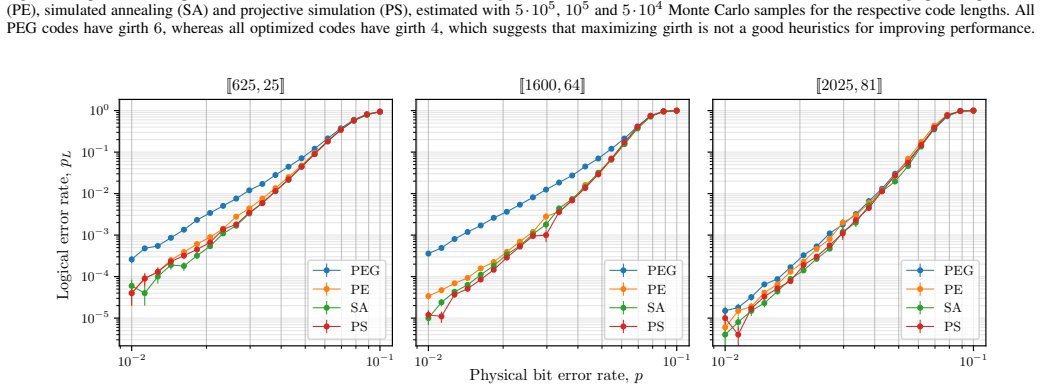
The central discovery is that direct optimization of hypergraph product codes against the quantum erasure channel improves on the state of the art achieved by Progressive Edge-Growth. For the [[625, 25]] and [[1600, 64]] code families, the best codes found by any of the three search strategies reach distances 8 and 10 respectively, versus 6 for the PEG codes, and their logical error rates are lower over the whole range of erasure rates tested. For the [[2025, 81]] family the gains are marginal, with only simulated annealing finding a distance-11 code. The optimized codes also outperform the PEG codes under bit-flip noise when decoded with BP+OSD, even though they were trained only on erasures. Because plain random exploration already captures most of the improvement and all optimized codes have girth 4 while the PEG codes have girth 6, the paper concludes that girth maximization is not a good heuristic and that exploring the Tanner graph space is the key ingredient.
Load-bearing premise
The optimization selects the best code using a noisy Monte Carlo estimate of the logical error rate at one fixed, fairly high erasure rate (9/32 or 12/32), and assumes that a code that wins at that rate will also be best at the low erasure rates of practical interest rather than being a lucky outlier.
Editorial extensions
If this is right
- For HGP codes of length roughly 625 and 1600 qubits, erasure-channel optimization finds codes with distance 8-10 that outperform PEG codes with distance 6 over the full tested erasure range.
- Erasure-optimized codes also show lower logical error rates under bit-flip noise with BP+OSD decoding, so the erasure channel appears to be a workable proxy for more realistic noise.
- Because plain exploration already yields most of the gain, the structure of the state space and the quality of the cost function matter more than the sophistication of the search algorithm.
- The near-identical performance of all three methods for a given length suggests they may be converging to close-to-optimal codes for these parameters.
- For the largest tested length, 2025, the optimization does not significantly improve the logical error rate, so the method's gains do not yet scale to larger codes.
Reading between the lines
- If the one-rate proxy holds, the same recipe of an efficiently computable decoder-based cost plus a local edge-swap action could be applied to other quantum code families with efficient decoders, such as lifted products or generalized hypergraph products.
- The fact that all optimized codes have girth 4 rather than 6 suggests the relevant structural quantity is not girth itself but the distribution of short cycles relative to logical operators; a testable extension would be to optimize with cycle-structure features and see if they predict performance.
- The RL policy, unlike the random walk or annealing schedules, is reusable: a policy trained on small codes could be applied directly to larger Tanner graphs, which would address the observed lack of improvement at length 2025.
- A cheaper surrogate cost, such as exact minimum distance or a graph-theoretic score, could replace the Monte Carlo erasure estimate if it correlates with the one-rate proxy; comparing surrogate rankings on the discovered codes would settle this.
Editorial analysis
A structured set of objections, weighed in public.
Referee Report
Summary. The paper addresses the selection of classical LDPC constituent codes for hypergraph product (HGP) quantum codes, aiming to optimize the logical error rate under the quantum erasure channel. It introduces three search strategies—plain random exploration, simulated annealing, and projective-simulation reinforcement learning—over the space of regular bipartite graphs with fixed degree sequences, using a Monte Carlo estimate of the maximum-likelihood erasure decoding failure probability as the cost function. The authors report that the optimized codes outperform the Progressive Edge-Growth (PEG) codes of Connolly et al. for [[625,25]], [[1600,64]], and [[2025,81]] HGP codes, both under erasures and (for the first two lengths) under bit-flip noise with BP+OSD decoding. They also observe that the optimized codes have girth 4 while the PEG codes have girth 6, suggesting that large girth is not the decisive figure of merit.
Significance. The paper is a useful contribution to the practical engineering of finite-length qLDPC codes. Its methodology is sound in outline: the erasure channel admits an efficient maximum-likelihood decoding criterion (condition (3)), making the cost function computable enough for iterative search; the final performance curves use substantial Monte Carlo samples (5e5, 1e5, 5e4); exact distances are reported for the found codes; and the code is publicly released. If the parameter claims are verified, the result that simple local search can beat the large-girth heuristic for HGP codes is an interesting and potentially valuable message for the community. The authors are also candid about the limitation of selecting codes at a single training erasure rate.
major comments (2)
- [Section II.B.2 and II.A] The edge-swap action can change the rank of the classical parity-check matrix H, and the paper never verifies that the explored or reported codes have full row rank. The formula K = k^2 and the stated parameters [[625,25]], [[1600,64]], [[2025,81]] assume H has rank m = n-k; a 2-switch is a rank-1 update over F2 and can reduce the rank (e.g., H = [[1,1,0],[0,1,1]] becomes rank 1 after swapping edges (1,1) and (2,2)). If a reported code has rank m-1, its kernel dimension is k+1 and the HGP code dimension is larger than k^2 (approximately (k+1)^2), so the comparison to the PEG [[N,K]] baseline would not be same-parameter. Please check the rank of the final codes, report their actual [[N,K]], and either enforce rank preservation in the state space or adjust the comparison accordingly.
- [Section II.B.2] The handling of parallel edges is ambiguous and can alter the evaluated code. The text says 'we consider only one instance of each edge for the evaluation', but it does not specify whether the state is a multigraph or a simple graph, nor how this rule interacts with the binary matrix representation in which two parallel edges cancel modulo 2. As a result, the evaluated matrix may not have the fixed row and column weights defining the state space, and its rank and code parameters may drift in an uncontrolled way. Please specify the exact graph-to-matrix mapping used in the cost evaluation and prove (or verify computationally) that the state space is closed under the implemented action.
minor comments (6)
- [Section II.A] The phrase 'Assuming that H has full rank equal to k' is inconsistent with the notation, since H is an m × n matrix with m = n - k; it should read 'full rank equal to m = n - k' or 'rank n - k'.
- [Section II.C.1 and Table I] The symbol N is used both for the HGP code length (e.g., N = 625) and for the number of neighbors sampled by plain exploration (Table I, 'plain N'), which is confusing; please use a different symbol for the latter.
- [Section III] The best code is chosen from many candidates using a single noisy Monte Carlo estimate at one erasure rate p, and the paper does not provide confidence intervals or a multiple-comparison correction. While the authors acknowledge this limitation and the exact distance improvements partially mitigate it, error bars on the final curves in Fig. 1 would substantially strengthen the claim.
- [Section II.B.3] The notation 'v ∈ (ker HX \ im HZ^T) ∪ (...)' uses a backslash that could be read as quotient space; please clarify that it denotes set difference in F2^N.
- [Section III] The statement that the training erasure rates were chosen 'to yield a ratio between standard error and mean of at most 5%' is not justified by the figures; please report the actual logical error rates at the chosen p values and verify that the 5% condition holds.
- [Section IV] The conclusion says 'several optimization techniques including Simulated Annealing and Reinforcement Learning' but omits the plain-exploration method, which is one of the three strategies studied; either include it in the list or rephrase to clarify that the statement refers only to the learning-based methods.
Circularity Check
No significant circularity: the optimization target is an external Monte Carlo metric, and the reported gains are measured, not derived from the fitting procedure.
full rationale
The paper's central claim is that codes found by random walks, simulated annealing, and reinforcement learning outperform Progressive Edge-Growth codes on the quantum erasure channel. The search objective is the logical error rate under erasure, computed via the ML-correctability criterion (3), which is an external quantity evaluated by Monte Carlo. No parameter is fitted and then renamed as a prediction: the fixed-rate selection (p=9/32 or 12/32) is openly acknowledged, and the paper re-measures the chosen codes at many rates (Figs. 1 and 2) with independent samples. The baseline codes and initial states come from Connolly et al. [24], a paper with overlapping authorship, but those codes are published and externally checkable, and the PEG algorithm itself is from Hu et al. [19]; this is a benchmark, not an argument that reduces to the present paper's output. The cost-function criterion is taken from Delfosse-Zemor [41], a peer-reviewed result, not an unverified self-citation. No uniqueness theorem is imported, and no ansatz is smuggled in via citation. A potential correctness concern—edge swaps are rank-1 updates that could reduce the rank of H and thereby change K and d—is not a circularity issue; it is an empirical validation gap. On the circularity spectrum, the derivation is self-contained.
Assumptions & free parameters
free parameters (6)
- training erasure rate p =
9/32 for lengths 625 and 1600, 12/32 for length 2025
- SA temperature schedule parameter beta =
4, 10, 1
- PS inverse temperature beta =
6.79, 9.12, 7.97 (hard threshold); 6.79, 8.43, 8.66 (easy threshold)
- PS forgetting gamma and glow damping eta =
Values in Table I, e.g. gamma 4.56e-4, eta 1.90e-3 for hard threshold on length 625
- reward thresholds theta_hard and theta_easy =
e.g. 1e-2 and 2e-2 for length 625
- Monte Carlo sample count for cost =
1e4 during optimization, up to 5e5 for final curves
assumptions (6)
- standard math CSS and hypergraph product parameter formula: an [n,k,d] classical code yields an HGP code with [[n^2+(n-k)^2, k^2, d]].
- domain assumption Maximum-likelihood erasure decoding succeeds iff condition (3) has no solution supported in the erasure.
- domain assumption Gaussian elimination provides an efficient maximum-likelihood erasure decoder.
- domain assumption Edge-swap actions preserve the space of regular or almost-regular parity-check matrices.
- domain assumption BP+OSD decoding performance is a meaningful proxy for bit-flip channel quality.
- domain assumption Monte Carlo estimates of the cost function are reliable enough to rank codes during optimization.
Cite this review
Pith. "Pith review of Optimizing hypergraph product codes with random walks, simulated annealing and reinforcement learning." pith.science (2026). https://pith.science/paper/ONAVX5IT
@misc{pith2026250109622,
  author       = {Pith},
  title        = {Pith review of: Optimizing hypergraph product codes with random walks, simulated annealing and reinforcement learning},
  year         = {2026},
  howpublished = {\url{https://pith.science/paper/ONAVX5IT}},
  note         = {Machine review of arXiv:2501.09622}
}
read the original abstract
Hypergraph products are quantum low-density parity-check (LDPC) codes constructed from two classical LDPC codes. Although their dimension and distance depend only on the parameters of the underlying classical codes, optimizing their performance against various noise channels remains challenging. This difficulty partly stems from the complexity of decoding in the quantum setting. The standard, ad hoc approach typically involves selecting classical LDPC codes with large girth. In this work, we focus on optimizing performance against the quantum erasure channel. A key advantage of this channel is the existence of an efficient maximum-likelihood decoder, which enables us to employ optimization techniques based on sampling random codes, such as Reinforcement Learning (RL) and Simulated Annealing (SA). Our results indicate that these techniques improve performance relative to the state-of-the-art.
Figures

Forward citations
Cited by 1 Pith paper
-
Discovering autonomous quantum error correction via deep reinforcement learning
An RL agent with curriculum learning discovered the autonomous QEC code |0L>=|4>, |1L>=|7> with a distance-1 cascaded recovery operator, which the paper claims beats breakeven under single- and double-photon loss.
Reference graph
Works this paper leans on
-
[1]
Quantum low-density parity-check codes,
N. P. Breuckmann and J. N. Eberhardt, “Quantum low-density parity-check codes,” PRX Quantum, vol. 2, no. 4, Oct. 2021. [Online]. Available: http://dx.doi.org/10.1103/PRXQuantum.2.040101
-
[2]
Fault-tolerant quantum computation with constant over- head,
D. Gottesman, “Fault-tolerant quantum computation with constant over- head,” Quantum Information & Computation, vol. 14, no. 15-16, pp. 1338–1372, 2014
work page 2014
-
[3]
Constant overhead quantum fault-tolerance with quantum expander codes,
O. Fawzi, A. Grospellier, and A. Leverrier, “Constant overhead quantum fault-tolerance with quantum expander codes,” in 2018 IEEE 59th Annual Symposium on Foundations of Computer Science (FOCS). IEEE, Oct. 2018. [Online]. Available: http://dx.doi.org/10.1109/FOCS. 2018.00076
arXiv 2018
-
[4]
Constant-overhead quantum error correction with thin planar connectivity,
M. A. Tremblay, N. Delfosse, and M. E. Beverland, “Constant-overhead quantum error correction with thin planar connectivity,”Physical Review Letters, vol. 129, no. 5, p. 050504, 2022
work page 2022
-
[5]
Quantum computing with neutral atoms,
L. Henriet, L. Beguin, A. Signoles, T. Lahaye, A. Browaeys, G.-O. Reymond, and C. Jurczak, “Quantum computing with neutral atoms,” Quantum, vol. 4, p. 327, Sep. 2020. [Online]. Available: http://dx.doi.org/10.22331/q-2020-09-21-327
-
[6]
Constant- overhead fault-tolerant quantum computation with reconfigurable atom arrays,
Q. Xu, J. P. B. Ataides, C. A. Pattison, N. Raveendran, D. Bluvstein, J. Wurtz, B. Vasic, M. D. Lukin, L. Jiang, and H. Zhou, “Constant- overhead fault-tolerant quantum computation with reconfigurable atom arrays,” 2023. [Online]. Available: https://arxiv.org/abs/2308.08648
arXiv 2023
-
[7]
Large-scale modular quantum-computer architecture with atomic memory and photonic interconnects,
C. Monroe, R. Raussendorf, A. Ruthven, K. R. Brown, P. Maunz, L.-M. Duan, and J. Kim, “Large-scale modular quantum-computer architecture with atomic memory and photonic interconnects,” Physical Review A, vol. 89, no. 2, p. 022317, 2014
work page 2014
-
[8]
A race-track trapped-ion quantum processor,
S. A. Moses, C. H. Baldwin, M. S. Allman, R. Ancona, L. Ascarrunz, C. Barnes, J. Bartolotta, B. Bjork, P. Blanchard, M. Bohn et al., “A race-track trapped-ion quantum processor,” Physical Review X, vol. 13, no. 4, p. 041052, 2023
work page 2023
Show all 53 references
-
[9]
Benchmarking a trapped-ion quantum computer with 30 qubits,
J.-S. Chen, E. Nielsen, M. Ebert, V . Inlek, K. Wright, V . Chaplin, A. Maksymov, E. Páez, A. Poudel, P. Maunz et al., “Benchmarking a trapped-ion quantum computer with 30 qubits,” Quantum, vol. 8, p. 1516, 2024
2024
-
[10]
Entangling four logical qubits beyond break-even in a nonlocal code,
Y . Hong, E. Durso-Sabina, D. Hayes, and A. Lucas, “Entangling four logical qubits beyond break-even in a nonlocal code,” Physical Review Letters, vol. 133, no. 18, Oct. 2024. [Online]. Available: http://dx.doi.org/10.1103/PhysRevLett.133.180601
2024 doi
-
[11]
High-threshold and low-overhead fault-tolerant quantum memory,
S. Bravyi, A. W. Cross, J. M. Gambetta, D. Maslov, P. Rall, and T. J. Yoder, “High-threshold and low-overhead fault-tolerant quantum memory,” Nature, vol. 627, no. 8005, pp. 778–782, 2024
2024
-
[12]
Quantum ldpc codes with positive rate and minimum distance proportional to the square root of the blocklength,
J.-P. Tillich and G. Zemor, “Quantum ldpc codes with positive rate and minimum distance proportional to the square root of the blocklength,” IEEE Transactions on Information Theory, vol. 60, no. 2, p. 1193–1202, Feb. 2014. [Online]. Available: http://dx.doi.org/10.1109/ TIT.20...
2014
-
[13]
Asymptotically good quantum and locally testable classical LDPC codes,
P. Panteleev and G. Kalachev, “Asymptotically good quantum and locally testable classical LDPC codes,” in Proceedings of the 54th Annual ACM SIGACT Symposium on Theory of Computing, 2022, pp. 375–388
2022
-
[14]
Quantum Tanner codes,
A. Leverrier and G. Zémor, “Quantum Tanner codes,” in 2022 IEEE 63rd Annual Symposium on Foundations of Computer Science (FOCS), 2022, pp. 872–883
2022
-
[15]
Good Quantum LDPC Codes with Linear Time Decoders,
I. Dinur, M.-H. Hsieh, T.-C. Lin, and T. Vidick, “Good Quantum LDPC Codes with Linear Time Decoders,” in Proceedings of the 55th Annual ACM Symposium on Theory of Computing, ser. STOC 2023. New York, NY , USA: Association for Computing Machinery, 2023, p. 905–918. [Online]. Av...
2023
-
[16]
On the iterative decoding of sparse quantum codes,
D. Poulin and Y . Chung, “On the iterative decoding of sparse quantum codes,” Quantum Information & Computation, vol. 8, no. 10, pp. 987– 1000, 2008
2008
-
[17]
Degenerate quantum ldpc codes with good finite length performance,
P. Panteleev and G. Kalachev, “Degenerate quantum ldpc codes with good finite length performance,” Quantum, vol. 5, p. 585, 2021
2021
-
[18]
Decoding across the quantum low-density parity-check code landscape,
J. Roffe, D. R. White, S. Burton, and E. Campbell, “Decoding across the quantum low-density parity-check code landscape,” Physical Review Research, vol. 2, no. 4, Dec. 2020. [Online]. Available: http://dx.doi.org/10.1103/PhysRevResearch.2.043423
2020 doi
-
[19]
Progressive edge-growth tanner graphs,
X.-Y . Hu, E. Eleftheriou, and D.-M. Arnold, “Progressive edge-growth tanner graphs,” GLOBECOM’01. IEEE Global Telecommunications Conference (Cat. No.01CH37270), vol. 2, pp. 995–1001 vol.2, 2001
2001
-
[20]
Erasure conversion for fault-tolerant quantum computing in alkaline earth rydberg atom arrays,
Y . Wu, S. Kolkowitz, S. Puri, and J. D. Thompson, “Erasure conversion for fault-tolerant quantum computing in alkaline earth rydberg atom arrays,” Nature Communications, vol. 13, no. 1, Aug. 2022. [Online]. Available: http://dx.doi.org/10.1038/s41467-022-32094-6
2022 doi
-
[21]
Erasure conversion in a high-fidelity rydberg quantum simulator,
P. Scholl, A. L. Shaw, R. B.-S. Tsai, R. Finkelstein, J. Choi, and M. Endres, “Erasure conversion in a high-fidelity rydberg quantum simulator,” Nature, vol. 622, no. 7982, p. 273–278, Oct. 2023. [Online]. Available: http://dx.doi.org/10.1038/s41586-023-06516-4
2023 doi
-
[22]
Quantum error correction with metastable states of trapped ions using erasure conversion,
M. Kang, W. C. Campbell, and K. R. Brown, “Quantum error correction with metastable states of trapped ions using erasure conversion,” PRX Quantum, vol. 4, no. 2, Jun. 2023. [Online]. Available: http://dx.doi.org/10.1103/PRXQuantum.4.020358
2023 doi
-
[23]
Erasure qubits: Overcoming the t1 limit in superconducting circuits,
A. Kubica, A. Haim, Y . Vaknin, H. Levine, F. Brandão, and A. Retzker, “Erasure qubits: Overcoming the t1 limit in superconducting circuits,” Physical Review X, vol. 13, no. 4, Nov. 2023. [Online]. Available: http://dx.doi.org/10.1103/PhysRevX.13.041022
2023 doi
-
[24]
Fast erasure decoder for hypergraph product codes,
N. Connolly, V . Londe, A. Leverrier, and N. Delfosse, “Fast erasure decoder for hypergraph product codes,” Quantum, vol. 8, p. 1450, Aug. 2024. [Online]. Available: http://dx.doi.org/10.22331/ q-2024-08-27-1450
2024
-
[25]
Erasure decoding for quantum ldpc codes via belief propagation with guided decimation,
M. Gökduman, H. Yao, and H. D. Pfister, “Erasure decoding for quantum ldpc codes via belief propagation with guided decimation,” in 2024 60th Annual Allerton Conference on Communication, Control, and Computing. IEEE, 2024, pp. 1–8
2024
-
[26]
Cluster decomposition for improved erasure decoding of quantum ldpc codes,
H. Yao, M. Gökduman, and H. D. Pfister, “Cluster decomposition for improved erasure decoding of quantum ldpc codes,” arXiv preprint arXiv:2412.08817, 2024
2024 arXiv
-
[27]
Discovery of optimal quantum error correcting codes via reinforcement learning,
V . P. Su, C. Cao, H.-Y . Hu, Y . Yanay, C. Tahan, and B. Swingle, “Discovery of optimal quantum error correcting codes via reinforcement learning,” 2023. [Online]. Available: https://arxiv.org/abs/2305.06378
2023 arXiv
-
[28]
Optimization of tensor network codes with reinforcement learning,
C. Mauron, T. Farrelly, and T. M. Stace, “Optimization of tensor network codes with reinforcement learning,” 2023. [Online]. Available: https://arxiv.org/abs/2305.11470
2023 arXiv
-
[29]
Projective simulation for artificial intelligence,
H. J. Briegel and G. D. las Cuevas, “Projective simulation for artificial intelligence,” 2013. [Online]. Available: https://arxiv.org/abs/1104.3787
2013 arXiv
-
[30]
Projective simulation with generalization,
A. A. Melnikov, A. Makmal, V . Dunjko, and H. J. Briegel, “Projective simulation with generalization,” Scientific Reports, vol. 7, no. 1, Oct. 2017. [Online]. Available: http://dx.doi.org/10.1038/ s41598-017-14740-y
2017
-
[31]
Surface codes: Towards practical large-scale quantum computation,
A. G. Fowler, M. Mariantoni, J. M. Martinis, and A. N. Cleland, “Surface codes: Towards practical large-scale quantum computation,” Physical Review A, vol. 86, no. 3, Sep. 2012. [Online]. Available: http://dx.doi.org/10.1103/PhysRevA.86.032324
2012 doi
-
[32]
Optimizing Quantum Error Correction Codes with Reinforcement Learning,
H. P. Nautrup, N. Delfosse, V . Dunjko, H. J. Briegel, and N. Friis, “Optimizing Quantum Error Correction Codes with Reinforcement Learning,” Quantum, vol. 3, p. 215, Dec. 2019. [Online]. Available: https://doi.org/10.22331/q-2019-12-16-215
2019 doi
-
[33]
A linear-time benchmarking tool for generalized surface codes,
N. Delfosse, P. Iyer, and D. Poulin, “A linear-time benchmarking tool for generalized surface codes,” 2016
2016
-
[34]
Engineering quantum error correction codes using evolutionary algorithms,
M. Webster and D. Browne, “Engineering quantum error correction codes using evolutionary algorithms,” arXiv preprint arXiv:2409.13017, 2024
2024 arXiv
-
[35]
Simultaneous discovery of quantum error correction codes and encoders with a noise-aware reinforcement learning agent,
J. Olle, R. Zen, M. Puviani, and F. Marquardt, “Simultaneous discovery of quantum error correction codes and encoders with a noise-aware reinforcement learning agent,” 2024
2024
-
[36]
Ps hgp qec,
B. C. A. Freire, “Ps hgp qec,” https://github.com/BrunoCAF/ps-hgp-qec, 2024, accessed: 2024-12-10
2024
-
[37]
Good quantum error-correcting codes exist,
A. R. Calderbank and P. W. Shor, “Good quantum error-correcting codes exist,” Phys. Rev. A, vol. 54, pp. 1098–1105, Aug 1996. [Online]. Available: https://link.aps.org/doi/10.1103/PhysRevA.54.1098
1996 doi
-
[38]
Multiple-particle interference and quantum error correction,
A. Steane, “Multiple-particle interference and quantum error correction,” Proceedings of the Royal Society of London. Series A: Mathematical, Physical and Engineering Sciences, vol. 452, no. 1954, pp. 2551–2577, 1996
1954
-
[39]
Localized statistics decoding: A parallel decoding algo- rithm for quantum low-density parity-check codes,
T. Hillmann, L. Berent, A. O. Quintavalle, J. Eisert, R. Wille, and J. Roffe, “Localized statistics decoding: A parallel decoding algo- rithm for quantum low-density parity-check codes,” arXiv preprint arXiv:2406.18655, 2024
2024
-
[40]
Ambiguity clustering: an accurate and efficient decoder for qldpc codes,
S. Wolanski and B. Barber, “Ambiguity clustering: an accurate and efficient decoder for qldpc codes,” arXiv preprint arXiv:2406.14527, 2024
2024 arXiv
-
[41]
Upper bounds on the rate of low density stabilizer codes for the quantum erasure channel,
N. Delfosse and G. Zémor, “Upper bounds on the rate of low density stabilizer codes for the quantum erasure channel,” Quantum Information & Computation, vol. 13, no. 9-10, pp. 793–826, 2013
2013
-
[42]
Simulated annealing,
D. Bertsimas and J. Tsitsiklis, “Simulated annealing,” Statistical Science, vol. 8, no. 1, pp. 10–15, 1993
1993
-
[43]
Albrecht and G
M. Albrecht and G. Bard, The M4RI Library, The M4RI Team. Avail- able at https://bitbucket.org/malb/m4ri
-
[44]
A. A. Melnikov, Projective Simulation, Available at https://github.com/ qic-ibk/projectivesimulation
-
[45]
Exploring network struc- ture, dynamics, and function using networkx,
A. Hagberg, P. Swart, and D. S Chult, “Exploring network struc- ture, dynamics, and function using networkx,” Los Alamos National Lab.(LANL), Los Alamos, NM (United States), Tech. Rep., 2008
2008
-
[46]
Array programming with NumPy,
C. R. Harris, K. J. Millman, S. J. van der Walt, R. Gommers, P. Virtanen, D. Cournapeau, E. Wieser, J. Taylor, S. Berg, N. J. Smith, R. Kern, M. Picus, S. Hoyer, M. H. van Kerkwijk, M. Brett, A. Haldane, J. F. del Río, M. Wiebe, P. Peterson, P. Gérard-Marchant, K. Sheppard, T....
2020 doi
-
[47]
SciPy 1.0: Fundamental Algorithms for Scientific Computing in Python,
P. Virtanen, R. Gommers, T. E. Oliphant, M. Haberland, T. Reddy, D. Cournapeau, E. Burovski, P. Peterson, W. Weckesser, J. Bright, S. J. van der Walt, M. Brett, J. Wilson, K. J. Millman, N. Mayorov, A. R. J. Nelson, E. Jones, R. Kern, E. Larson, C. J. Carey,˙I. Polat, Y . Feng...
2020
-
[48]
LDPC: Python tools for low density parity check codes,
J. Roffe, “LDPC: Python tools for low density parity check codes,”
-
[49]
A survey of actor-critic reinforcement learning: Standard and natural policy gradients,
I. Grondman, L. Busoniu, G. A. D. Lopes, and R. Babuska, “A survey of actor-critic reinforcement learning: Standard and natural policy gradients,” IEEE Transactions on Systems, Man, and Cybernetics, Part C (Applications and Reviews), vol. 42, no. 6, pp. 1291–1307, 2012
2012
-
[50]
Re- inforcement learning decoders for fault-tolerant quantum computation,
R. Sweke, M. S. Kesselring, E. P. van Nieuwenburg, and J. Eisert, “Re- inforcement learning decoders for fault-tolerant quantum computation,” Machine Learning: Science and Technology, vol. 2, no. 2, p. 025005, 2020
2020
-
[51]
Optimization of decoder priors for accurate quantum error correction,
V . Sivak, M. Newman, and P. Klimov, “Optimization of decoder priors for accurate quantum error correction,” Physical Review Letters, vol. 133, no. 15, p. 150603, 2024
2024
-
[52]
Machine Learning Message-Passing for the Scalable Decoding of QLDPC Codes,
A. S. Maan and A. Paler, “Machine Learning Message-Passing for the Scalable Decoding of QLDPC Codes,” arXiv preprint arXiv:2408.07038, 2024
2024 arXiv
-
[2022]
Available: https://pypi.org/project/ldpc/
[Online]. Available: https://pypi.org/project/ldpc/
Reviewed August 10, 2026 · model on record in the stance chip above.
Discussion (0). Continue with ORCID to comment.