REVIEW 2 major objections 5 minor 1 cited by
Optimal paths and dynamical symmetry breaking in the current fluctuations of driven diffusive media
T0 review · 2 major / 5 minor · reviewed 2026-08-10 · deepseek-v4-flash
Pith's one-line read These lecture notes argue that in d>1 the optimal trajectory for a current fluctuation carries a mobility-weighted, curl-free structure (Eq.
desk verdict A clear, honest lecture-note synthesis of current large deviation theory, with a speculative packing-field proposal; the real caveat is the unproven single-principal-direction ansatz, not the flagged C^2 regularity issue. read the letter →
The pith
A machine-rendered reading of the paper's core claim, the machinery that carries it, and where it could break.
The reading
What carries the argument
The load-bearing object is the reduced optimal excess current $\chi_q\equiv [j_q+D_q\nabla\rho_q-\sigma_q E]/\sigma_q$, whose Jacobian equals the Hessian of the Lagrange-multiplier field $\psi_q$; Schwarz's theorem makes that Hessian symmetric when $\psi_q$ is $C^2$, and the symmetry propagates to the mobility-weighted curl-free condition $\partial_\beta(j_{\alpha,q}/\sigma_q)=\partial_\alpha(j_{\beta,q}/\sigma_q)$ on the optimal current field. The second piece of machinery is the weak additivity principle, which assumes time-independent optimal paths with structure along one principal direction, a divergence-free current, and the nonlocal transverse-current formula (45) or (46). A comparison via the reverse Hölder inequality shows the weak-additivity functional always dominates the strong-additivity functional by $\Delta F_q=\frac{q_\perp^2}{2}[\int dx\,\sigma^{-1}-(\int dx\,\sigma)^{-1}]\geq 0$. The spectral machinery is the tilted or Doob-transformed generator: dynamical phase transitions appear as a closing of the spectral gap, with phase probability vectors built from the subleading eigenvectors of the degenerate leading eigenspace.
What would settle it
Take a d>1 driven diffusive model with density-dependent mobility (for example, two-dimensional WASEP or KMP on a ring with a current bias), compute the optimal trajectory numerically by action minimization or rare-event cloning, and measure the orthogonal current component $j_{\perp,q}(x_\parallel)$ along the optimal path. If $j_{\perp,q}(x_\parallel)$ is not proportional to $\sigma[\rho_q(x_\parallel)]$ with the global normalization of Eq. (45), or if the Jacobian of $\chi_q$ is not symmetric, the central theorem fails. A sharper test is to construct a regime with a known singular $\psi_q$—for instance a boundary or constraint producing a shock in the multiplier field—and check whether Eq. (43) is violated at the singularity.
Extended reading notes
Core claim
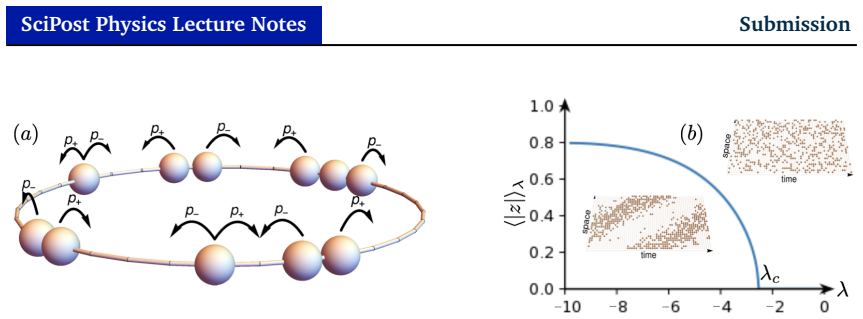
The central claim is a structural theorem for optimal paths: for any d-dimensional driven diffusive system described by macroscopic fluctuation theory, the optimal current field $j_q(r,t)$ of a fluctuation $q$ satisfies $\partial_\beta(j_{\alpha,q}/\sigma_q)=\partial_\alpha(j_{\beta,q}/\sigma_q)$ for all $\alpha,\beta$ (Eq. 43), provided the optimal Lagrange-multiplier field $\psi_q$ is twice continuously differentiable. For optimal paths with structure along one principal direction, this forces every orthogonal component to take the nonlocal form $j_{\beta,q}(x_\parallel,t)=q_\beta\,\tau\,\sigma[\rho_q(x_\parallel,t)]/\int_0^\tau ds\int_0^1 dy\,\sigma[\rho_q(y,s)]$ (Eq. 45), so the transverse current is set by the space-time averaged mobility of the whole optimal density profile. Consequently, the correct d>1 extension of the additivity principle is the weak version, in which the optimal current is divergence-free and structured, and this strictly dominates the strong version whenever $q_\perp\neq 0$ and the mobility depends on density. The notes further establish that the dynamical phase transitions seen in these systems—Z2 particle-hole symmetry breaking in open channels and traveling-wave/time-crystal phases in periodic rings—share a common spectral origin: an emergent degeneracy of the leading eigenspace of the tilted generator, with the subleading eigenvectors carrying the symmetry-breaking structure.
Load-bearing premise
Everything rests on the optimal Lagrange-multiplier field $\psi_q$ being twice continuously differentiable in space so that its Hessian is symmetric; if some driven system realizes a singular $\psi_q$, the claimed mobility-weighted curl-free architecture of optimal currents can fail.
Editorial extensions
If this is right
- For any d>1 driven diffusive system, the current large-deviation function must be computed from structured optimal current fields; the strong additivity principle is strictly suboptimal whenever the current has transverse components and the mobility depends on density.
- During a fluctuation, every component of the optimal current orthogonal to the principal direction is slaved to the whole optimal density profile through Eq. (45), making current statistics in d>1 spatiotemporally nonlocal.
- For currents with no transverse component, $q_\perp=0$, the weak and strong additivity principles coincide, which reconciles apparently conflicting earlier results on the validity of additivity in higher dimensions.
- Open and periodic driven systems both exhibit dynamical phase transitions at the fluctuation level: Z2 particle-hole symmetry breaking in open channels, and traveling-wave phases that break continuous time-translation symmetry in rings.
- The microscopic signature of these transitions is an emergent degeneracy of the leading eigenspace of the tilted generator; in the traveling-wave case the degenerate eigenvalues form a band with constant imaginary spacing, giving time-crystal order that the Doob/packing-field mechanism can make programmable.
Reading between the lines
- A direct but unstated corollary is that rare-event simulation and path-contraction schemes in d>1 that parameterize optimal paths by spatially uniform currents are systematically biased away from the true minimizer; optimal biasing protocols should propose divergence-free structured currents of the mobility-weighted nonlocal form.
- The same mobility-weighted curl-free argument should extend to fluctuations of several coupled conserved currents, where the optimal vector field of each current would be coupled to the mobility tensor of the whole set; this is a natural generalization the notes do not spell out.
- The regularity caveat on $\psi_q$ identifies a testable boundary: models with hard constraints, shocks, or singular optimal density profiles may realize the singular-$\psi_q$ case, and in those models the claim that weak additivity always dominates strong additivity could fail.
- The packing-field route to time crystals suggests experimental feedback protocols for colloidal or active-matter systems, where configuration-dependent fields can be imposed in real time; the notes only sketch this as a future direction.
Formalized claims in Lean
-
Claim #1: The central claim is a structural theorem for optimal paths: for any d-dimensional driven diffusive system described by macroscopic fluctuation theory, the optimal current field $j_q(r,t)$ of a fluctuation $q$ satisfies $\partial_\beta(j_{\alpha,q}/\sigma_q)=\partial_\alpha(j_{\beta,q}/\sigma_q)$ for all $\alpha,\beta$ (Eq. 43), provided the optimal Lagrange-multiplier field $\psi_q$ is twice cont
/-- @claim 1 The central claim is a structural theorem for optimal paths: for any d-dimensional driven diffusive system described by macroscopic fluctuation theory, the optimal current field $j_q(r,t)$ of a fluctuation $q$ satisfies $\partial_\beta(j_{\alpha,q}/\sigma_q)=\partial_\alpha(j_{\beta,q}/\sigma_q)$ for all $\alpha,\beta$ (Eq. 43), provided the optimal Lagrange-multiplier field $\psi_q$ is twice cont -/
def central_claim : Prop :=
Editorial analysis
A structured set of objections, weighed in public.
Referee Report
Summary. These lecture notes use macroscopic fluctuation theory and microscopic spectral methods to analyze large deviations of the time-averaged current in driven diffusive systems. After reviewing the 1d additivity principle, the author derives a symmetry constraint (Eq. 43) on the optimal current vector field in d>1, uses it to formulate the weak additivity principle with nonlocal orthogonal current components (Eqs. 45-49), and proves that this wAP dominates the strong additivity principle. The notes then analyze a Z2 symmetry-breaking dynamical phase transition in open particle-hole-symmetric systems via a Landau-like theory and joint mass-current LDF, conjecturing an instanton/Maxwell construction in the non-convex regime. They analyze a time-translation-breaking DPT in periodic systems (traveling waves), connect it to spectral degeneracies of the tilted/Doob generator, and propose a packing-field mechanism for programmable time crystals. Conjectural steps are explicitly flagged.
Significance. The central claim that current fluctuations in d>1 are carried by structured, mobility-coupled nonlocal current fields, rather than uniform ones, is important and, if correct, changes how current LDFs should be computed in higher dimensions. The proof that wAP dominates sAP (Eq. 52) is clean and the derivation of the critical thresholds in the stability analyses is internally consistent. The lecture notes are pedagogically valuable and unusually transparent: the C²-smoothness limitation on ψ_q and the conjectural status of the instanton (Section 4.4) and the traveling-wave ansatz (Section 5.2) are acknowledged. The spectral viewpoint of Section 6 provides a concrete microscopic mechanism for DPTs and leads to falsifiable predictions for programmable time crystals via the packing field of Section 7, which is a strength of the manuscript.
major comments (2)
- [§3.1, Eq. (45)] The derivation of Eq. (45) is presented as a consequence of Eq. (43), which holds only if the optimal multiplier ψ_q is twice continuously differentiable; the text itself acknowledges that singular ψ_q could violate Eq. (43). Because Eq. (45) is the quantitative core of the weak additivity principle, this smoothness assumption is load-bearing as written. The gap can be closed by deriving Eq. (45) directly from the variational equation (36) and the single-direction ansatz (44): under that ansatz the transverse component of Eq. (36) implies that j⊥,q/σq is constant, and the empirical-current constraint fixes that constant to q⊥/(τ^{-1}∫∫σ). The manuscript should present this direct route, or prove C² regularity, and remove the implication that the nonlocal structure of Eq. (45) rests on Schwarz's theorem.
- [§3.1–3.2, Eqs. (44) and (49)] The wAP functional (49) and the dominance result (52) are derived under the ansatz that optimal fields have structure along a single principal direction and, for the wAP itself, are time-independent. This ansatz is asserted as 'typical' rather than derived. If the true MFT optimum develops genuine d-dimensional transverse structure or time dependence not captured by Eq. (44), then Eq. (45) and the wAP functional are not exact variational bounds. This is a load-bearing assumption for the central claim that wAP is the relevant simplifying principle in d>1. The manuscript should state this limitation wherever Eq. (45) is used and ideally provide a concrete test, for example by checking transverse gradients of the optimal density and current fields in the 2D simulations cited after Eq. (49).
minor comments (5)
- [§3, opening paragraph] The word 'Aditivity' appears as a typo for 'additivity', and similar typos occur throughout ('excersise' near Eq. (14), 'constat' near Eq. (24), 'precission' in §3.3, 'assymetric' in §6.7).
- [§5.1, after Eq. (115)] The phrase 'to simplify the calculation the calculation' contains a duplicated word and should be corrected.
- [Fig. 6 caption] The caption reads 'eigenvertors' where 'eigenvectors' is intended; please correct this and similar spelling errors in the figure captions.
- [§7.2, Eq. (174)] The numerical coefficient 1/10 in Eq. (174) is introduced from a fit to WASEP data at specific parameters, yet the text calls the expression 'quite generically'; either qualify this coefficient as model-dependent or provide a derivation.
- [§7.4, after Eq. (186)] The jump from the linear instability threshold (Eq. (186)) to the claim of rotating multi-condensate states for all η>η_c^{(m)} goes beyond linear theory; the numerical solutions of Eq. (179) support the claim, but the text should explicitly mark this as a conjecture for the nonlinear regime.
Circularity Check
No significant circularity: the d>1 optimal-current architecture is derived from the MFT variational equations and the explicitly stated principal-direction ansatz, not assumed from the target LDF.
full rationale
The derivation chain is self-contained. The current LDF is defined through the MFT action (Eq. 28), and the variational equations (35)-(36) are obtained by functional differentiation. Eq. (43) follows from the symmetry of the Hessian of the Lagrange-multiplier field ψ_q via Schwarz's theorem, a mathematical consequence of the Euler-Lagrange equation (36), not an input assumption. Eq. (45) follows from Eq. (43) together with the explicitly stated single-principal-direction ansatz (44) and the empirical-current constraint; it is a derived consequence, not a fitted or renamed input. The wAP-vs-sAP comparison is a direct reverse-Hölder inequality (Eqs. 52-53), independent of any fitted data. The self-citations to refs. [27,50,52,53,71,101-103] are used for prior context and for independent simulation/exact checks, and the notes re-derive the central results rather than importing them as black boxes. The C^2 regularity caveat for ψ_q and the principal-direction ansatz are validity/assumption risks, not circular reductions; a failure of these assumptions would make Eq. (43)/(45) inapplicable, but would not make the derivation equivalent to its inputs.
Assumptions & free parameters
free parameters (2)
- η (packing field coupling) =
control parameter, not fitted
- coefficient 1/10 in g_{λ,L}(r) =
1/10
assumptions (6)
- domain assumption MFT action (weak-noise Gaussian field theory with local equilibrium)
- domain assumption Additivity principle (time-independent optimal path)
- ad hoc to paper C2 smoothness of ψ_q
- ad hoc to paper Traveling wave ansatz beyond the instability
- ad hoc to paper Packing-field ansatz for programmable time crystals
- standard math Perron-Frobenius and spectral decomposition of the tilted generator
invented entities (2)
-
Packing field E_k^{(m)}(C) (and hydrodynamic E_x^{(m)}[ρ])
independent evidence
-
Time-crystal lattice gas (TCLG) model
independent evidence
Cite this review
Pith. "Pith review of Optimal paths and dynamical symmetry breaking in the current fluctuations of driven diffusive media." pith.science (2026). https://pith.science/paper/6DEXTRMP
@misc{pith2026250109629,
  author       = {Pith},
  title        = {Pith review of: Optimal paths and dynamical symmetry breaking in the current fluctuations of driven diffusive media},
  year         = {2026},
  howpublished = {\url{https://pith.science/paper/6DEXTRMP}},
  note         = {Machine review of arXiv:2501.09629}
}
read the original abstract
Large deviation theory provides a framework to understand macroscopic fluctuations and collective phenomena in many-body nonequilibrium systems in terms of microscopic dynamics. In these lecture notes we discuss the large deviation statistics of the current, a central observable out of equilibrium, using mostly macroscopic fluctuation theory (MFT) but also microscopic spectral methods. Special emphasis is put on describing the optimal path leading to a rare fluctuation, as well as on different dynamical symmetry breaking phenomena that appear at the fluctuating level. We start with an overview of trajectory statistics in driven diffusive systems as described by MFT. We discuss the additivity principle, a simplifying conjecture to compute the current distribution in one-dimensional nonequilibrium systems, and extend this idea to higher dimensions, where the nonlocal structure of the optimal current vector field becomes crucial. Next we explore dynamical phase transitions (DPTs) in current fluctuations, which manifest as symmetry-breaking events in trajectory statistics. These include particle-hole symmetry-breaking DPTs in open channels, for which we work out a Landau-like theory as well as the joint statistics of the current and the order parameter. Time-translation symmetry-breaking DPTs in periodic systems are also discussed, where coherent traveling condensates emerge to facilitate current deviations. We also discuss the microscopic spectral mechanism leading to these DPTs, which is linked to an emerging degeneracy of the leading eigenspace. Using this spectral perspective, we find the signatures of the recently discovered time-crystal phases of matter in traveling-wave DPTs, and use Doob's transform to propose a packing-field mechanism to create programmable time-crystals in driven systems. Finally, we address open challenges and future directions in this rapidly evolving field.
Figures


Figures from the paper (6 more)




Forward citations
Cited by 1 Pith paper
-
Taming nonlinear energy diffusion: The case of time-crystal energy condensates
A bulk-driven nonlinear KMP model is shown to exhibit controllable nonlinear energy diffusion and programmable time-crystal phases via packing fields.
Reference graph
Works this paper leans on
-
[1]
Derrida, Non-equilibrium steady states: fluctuations and large deviations of the density and of the current, J
B. Derrida, Non-equilibrium steady states: fluctuations and large deviations of the density and of the current, J. Stat. Mech. P07023 (2007)
2007
-
[2]
Bertini, A
L. Bertini, A. D. Sole, D. Gabrielli, G. Jona-Lasinio and C. Landim, Macroscopic fluctua- tion theory, Rev. Mod. Phys. 87(2), 593 (2015)
2015
-
[3]
Livi and P
R. Livi and P . Politi,Nonequilibrium Statistical Physics: A Modern Perspective, Cambridge University Press, doi:10.1017 /9781107278974 (2017)
2017
-
[4]
Marro and R
J. Marro and R. Dickman,Nonequilibrium phase transitions in lattice models, Cambridge University Press (2005)
2005
-
[5]
De Groot and P
S. De Groot and P . Mazur,Non-Equilibrium Thermodynamics, Dover Books on Physics. Dover Publications, New York, ISBN 9780486153506 (2013)
2013
-
[6]
Peliti and S
L. Peliti and S. Pigolotti, Stochastic Thermodynamics: An Introduction , Princeton Uni- versity Press, ISBN 9780691201771 (2021)
2021
-
[7]
Seifert, Stochastic thermodynamics, fluctuation theorems and molecular machines , Rep
U. Seifert, Stochastic thermodynamics, fluctuation theorems and molecular machines , Rep. Prog. Phys. 75(12), 126001 (2012)
2012
-
[8]
Touchette, The large deviation approach to statistical mechanics, Phys
H. Touchette, The large deviation approach to statistical mechanics, Phys. Rep. 478(1-3), 1 (2009)
2009
Show all 187 references
-
[9]
Gallavotti and E
G. Gallavotti and E. G. D. Cohen, Dynamical ensembles in nonequilibrium statistical mechanics, Phys. Rev. Lett. 74(14), 2694 (1995). 63 SciPost Physics Lecture Notes Submission
1995
-
[10]
Gallavotti and E
G. Gallavotti and E. G. D. Cohen,Dynamical ensembles in stationary states, J. Stat. Phys. 80(5-6), 931 (1995)
1995
-
[11]
Kurchan, Fluctuation theorem for stochastic dynamics, J
J. Kurchan, Fluctuation theorem for stochastic dynamics, J. Phys. A31(16), 3719 (1998)
1998
-
[12]
J. L. Lebowitz and H. Spohn, A Gallavotti-Cohen-type symmetry in the large deviation functional for stochastic dynamics, J. Stat. Phys. 95(1-2), 333 (1999)
1999
-
[13]
Andrieux and P
D. Andrieux and P . Gaspard,A fluctuation theorem for currents and non-linear response coefficients, J. Stat. Mech. P02006 (2007)
2007
-
[14]
P . I. Hurtado and P . L. Garrido,Spontaneous symmetry breaking at the fluctuating level, Phys. Rev. Lett.107(18), 180601 (2011)
2011
-
[15]
Jarzynski, Equilibrium free-energy differences from nonequilibrium measurements: A master-equation approach, Phys
C. Jarzynski, Equilibrium free-energy differences from nonequilibrium measurements: A master-equation approach, Phys. Rev. E 56(5), 5018 (1997)
1997
-
[16]
Jarzynski, Nonequilibrium equality for free energy differences, Phys
C. Jarzynski, Nonequilibrium equality for free energy differences, Phys. Rev. Lett.78(14), 2690 (1997)
1997
-
[17]
Crooks, Nonequilibrium measurements of free energy differences for microscopically reversible Markovian systems, J
G. Crooks, Nonequilibrium measurements of free energy differences for microscopically reversible Markovian systems, J. Stat. Phys. 90(5-6), 1481 (1998)
1998
-
[18]
G. E. Crooks, Path-ensemble averages in systems driven far from equilibrium, Phys. Rev. E 61(3), 2361 (2000)
2000
-
[19]
Hatano and S
T . Hatano and S. Sasa,Steady-state thermodynamics of Langevin systems, Phys. Rev. Lett. 86(16), 3463 (2001)
2001
-
[20]
Bertini, D
L. Bertini, D. Gabrielli, G. Jona-Lasinio and C. Landim,Thermodynamic transformations of nonequilibrium states, J. Stat. Phys. 149(5), 773 (2012)
2012
-
[21]
Bertini, D
L. Bertini, D. Gabrielli, G. Jona-Lasinio and C. Landim,Clausius inequality and optimal- ity of quasistatic transformations for nonequilibrium stationary states , Phys. Rev. Lett. 110(2), 020601 (2013)
2013
-
[22]
A. C. Barato and U. Seifert, Thermodynamic uncertainty relation for biomolecular pro- cesses, Phys. Rev. Lett. 114(15), 158101 (2015)
2015
-
[23]
T . R. Gingrich, J. M. Horowitz, N. Perunov and J. L. England, Dissipation bounds all steady-state current fluctuations, Phys. Rev. Lett. 116(12), 120601 (2016)
2016
-
[24]
Pietzonka and U
P . Pietzonka and U. Seifert, Universal trade-off between power, efficiency, and constancy in steady-state heat engines , Phys. Rev. Lett. 120, 190602 (2018), doi:10.1103/PhysRevLett.120.190602
2018 doi
-
[25]
J. M. Horowitz and T . R. Gingrich,Thermodynamic uncertainty relations constrain non- equilibrium fluctuations, Nature Physics 16(1), 15 (2020), doi:10.1038 /s41567-019- 0702-6
2020
-
[26]
Bertini, A
L. Bertini, A. D. Sole, D. Gabrielli, G. Jona-Lasinio and C. Landim, Fluctuations in stationary nonequilibrium states of irreversible processes, Phys. Rev. Lett. 87(4), 040601 (2001)
2001
-
[27]
Bodineau and B
T . Bodineau and B. Derrida,Current fluctuations in nonequilibrium diffusive systems: An additivity principle, Phys. Rev. Lett. 92(18), 180601 (2004). 64 SciPost Physics Lecture Notes Submission
2004
-
[28]
Bertini, A
L. Bertini, A. D. Sole, D. Gabrielli, G. Jona-Lasinio and C. Landim, Current fluctuations in stochastic lattice gases, Phys. Rev. Lett. 94(3), 030601 (2005)
2005
-
[29]
Bodineau and B
T . Bodineau and B. Derrida, Distribution of current in nonequilibrium diffusive systems and phase transitions, Phys. Rev. E 72(6), 066110 (2005)
2005
-
[30]
R. J. Harris, A. Rakos and G. M. Schutz, Current fluctuations in the zero-range process with open boundaries, J. Stat. Mech. p. P08003 (2005)
2005
-
[31]
Giardinà, J
C. Giardinà, J. Kurchan and L. Peliti,Direct evaluation of large-deviation functions, Phys. Rev. Lett.96(12), 120603 (2006)
2006
-
[32]
Bertini, A
L. Bertini, A. D. Sole, D. Gabrielli, G. Jona-Lasinio and C. Landim,Stochastic interacting particle systems out of equilibrium, J. Stat. Mech. p. P07014 (2007)
2007
-
[33]
Derezinski, W
J. Derezinski, W . D. Roeck and C. Maes,Fluctuations of quantum currents and unravelings of master equations, J. Stat. Phys. 131(2), 341 (2008)
2008
-
[34]
Derrida and A
B. Derrida and A. Gerschenfeld, Current Fluctuations in One Dimensional Diffusive Sys- tems with a Step Initial Density profile, J. Stat. Phys. 137(5-6), 978 (2009)
2009
-
[35]
Derrida and A
B. Derrida and A. Gerschenfeld, Current Fluctuations of the One Dimensional Symmetric Simple Exclusion Process with Step Initial condition, J. Stat. Phys. 136(1), 1 (2009)
2009
-
[36]
P . I. Hurtado and P . L. Garrido,Test of the additivity principle for current fluctuations in a model of heat conduction, Phys. Rev. Lett. 102(25), 250601 (2009)
2009
-
[37]
Gorissen, J
M. Gorissen, J. Hooyberghs and C. Vanderzande,Density-matrix renormalization-group study of current and activity fluctuations near nonequilibrium phase transitions , Phys. Rev. E79, 020101 (2009), doi:10.1103 /PhysRevE.79.020101
2009
-
[38]
P . I. Hurtado and P . L. Garrido,Large fluctuations of the macroscopic current in diffusive systems: A numerical test of the additivity principle, Phys. Rev. E 81(4), 041102 (2010)
2010
-
[39]
P . L. Krapivsky and B. Meerson,Fluctuations of current in nonstationary diffusive lattice gases, Phys. Rev. E 86(3), 031106 (2012)
2012
-
[40]
Gorissen and C
M. Gorissen and C. Vanderzande,Current fluctuations in the weakly asymmetric exclusion process with open boundaries, Phys. Rev. E 86(5), 051114 (2012)
2012
-
[41]
Akkermans, T
E. Akkermans, T . Bodineau, B. Derrida and O. Shpielberg,Universal current fluctuations in the symmetric exclusion process and other diffusive systems , Europhys. Lett. 103(2), 20001 (2013)
2013
-
[42]
Meerson and P
B. Meerson and P . V . Sasorov,Extreme current fluctuations in a nonstationary stochastic heat flow, J. Stat. Mech. P12011 (2013)
2013
-
[43]
Pérez-Espigares, P
C. Pérez-Espigares, P . L. Garrido and P . I. Hurtado,Dynamical phase transition for current statistics in a simple driven diffusive system, Phys. Rev. E 87(3), 032115 (2013)
2013
-
[44]
P . I. Hurtado, C. P . Espigares, J. J. del Pozo and P . L. Garrido,Thermodynamics of currents in nonequilibrium diffusive systems: theory and simulation, J. Stat. Phys. 154(1-2), 214 (2014)
2014
-
[45]
Meerson and P
B. Meerson and P . V . Sasorov, Extreme current fluctuations in lattice gases: Beyond nonequilibrium steady states, Phys. Rev. E 89(1), 010101 (2014). 65 SciPost Physics Lecture Notes Submission
2014
-
[46]
Kumar, H
N. Kumar, H. Soni, S. Ramaswamy and A. K. Sood, Anisotropic isometric fluctuation relations in experiment and theory on a self-propelled rod , Phys. Rev. E 91(3), 030102 (2015)
2015
-
[47]
Lazarescu, The physicist’s companion to current fluctuations: one-dimensional bulk- driven lattice gases, J
A. Lazarescu, The physicist’s companion to current fluctuations: one-dimensional bulk- driven lattice gases, J. Phys. A 48(50), 503001 (2015)
2015
-
[48]
Mendl and H
C. Mendl and H. Spohn, Current fluctuations for anharmonic chains in thermal equilib- rium, J. Stat. Mech. P03007 (2015)
2015
-
[49]
Becker, K
T . Becker, K. Nelissen and B. Cleuren,Current fluctuations in boundary driven diffusive systems in different dimensions: a numerical study, New J. Phys. 17, 055023 (2015)
2015
-
[50]
Pérez-Espigares, P
C. Pérez-Espigares, P . L. Garrido and P . I. Hurtado,Weak additivity principle for current statistics in d-dimensions, Phys. Rev. E 93(4), 040103(R) (2016)
2016
-
[51]
Villavicencio-Sanchez and R
R. Villavicencio-Sanchez and R. J. Harris, Local structure of current fluctuations in diffu- sive systems beyond one dimension, Phys. Rev. E 93(3), 032134 (2016)
2016
-
[52]
Y. Baek, Y. Kafri and V . Lecomte,Dynamical symmetry breaking and phase transitions in driven diffusive systems, Phys. Rev. Lett. 118, 030604 (2017)
2017
-
[53]
Tizón-Escamilla, P
N. Tizón-Escamilla, P . I. Hurtado and P . L. Garrido,Structure of the optimal path to a fluctuation, Phys. Rev. E 95, 002100 (2017)
2017
-
[54]
Carollo, J
F . Carollo, J. P . Garrahan, I. Lesanovsky and C. Pérez-Espigares,Fluctuating hydrodynam- ics, current fluctuations, and hyperuniformity in boundary-driven open quantum chains , Phys. Rev. E96, 052118 (2017), doi:10.1103 /PhysRevE.96.052118
2017
-
[55]
Lazarescu, Generic dynamical phase transition in one-dimensional bulk-driven lattice gases with exclusion, J
A. Lazarescu, Generic dynamical phase transition in one-dimensional bulk-driven lattice gases with exclusion, J. Phys. A 50(25), 254004 (2017)
2017
-
[56]
Tizón-Escamilla, C
N. Tizón-Escamilla, C. Pérez-Espigares, P . L. Garrido and P . I. Hurtado, Order and symmetry-breaking in the fluctuations of driven systems , Phys. Rev. Lett. 119, 090602 (2017), doi:10.1103 /PhysRevLett.119.090602
2017
-
[57]
Chleboun, S
P . Chleboun, S. Grosskinsky and A. Pizzoferrato, Current large deviations for partially asymmetric particle systems on a ring, J. Phys. A 51(40), 405001 (2018)
2018
-
[58]
Carollo, J
F . Carollo, J. P . Garrahan and I. Lesanovsky , Current fluctuations in boundary-driven quantum spin chains , Phys. Rev. B 98, 094301 (2018), doi:10.1103/PhysRevB.98.094301
2018 doi
-
[59]
D. J. Evans, E. G. D. Cohen and G. P . Morriss,Probability of 2nd law violations in shearing steady-states, Phys. Rev. Lett. 71(15), 2401 (1993)
1993
-
[60]
Gallavotti, Nonequilibrium and Irreversibility, Theoretical and Mathematical Physics
G. Gallavotti, Nonequilibrium and Irreversibility, Theoretical and Mathematical Physics. Springer, doi:10.1007/978-3-319-06758-2 (2014)
2014 doi
-
[61]
P . I. Hurtado, C. Pérez-Espigares, J. J. del Pozo and P . L. Garrido,Symmetries in fluctua- tions far from equilibrium, Proc. Natl. Acad. Sci. USA 108(19), 7704 (2011)
2011
-
[62]
Villavicencio-Sanchez, R
R. Villavicencio-Sanchez, R. J. Harris and H. Touchette, Fluctuation relations for anisotropic systems, Europhys. Lett. 105(3), 30009 (2014)
2014
-
[63]
Lacoste and P
D. Lacoste and P . Gaspard, Isometric fluctuation relations for equilibrium states with broken symmetry, Phys. Rev. Lett. 113(24), 240602 (2014). 66 SciPost Physics Lecture Notes Submission
2014
-
[64]
Gaspard, Multivariate fluctuation relations for currents , New J
P . Gaspard, Multivariate fluctuation relations for currents , New J. Phys. 15, 115014 (2013)
2013
-
[65]
Pérez-Espigares, F
C. Pérez-Espigares, F . Redig and C. Giardinà, Spatial fluctuation theorem , J. Phys. A 48(35), 35FT01 (2015)
2015
-
[66]
Zarfaty and B
L. Zarfaty and B. Meerson, Statistics of large currents in the Kipnis-Marchioro-Presutti model in a ring geometry, J. Stat. Mech. P033304 (2016)
2016
-
[67]
Vaikuntanathan, T
S. Vaikuntanathan, T . R. Gingrich and P . L. Geissler,Dynamic phase transitions in simple driven kinetic networks, Phys. Rev. E 89(6), 062108 (2014)
2014
-
[68]
K. D. N. T . Lam, J. Kurchan and D. Levine,Order in extremal trajectories, J. Stat. Phys. 137(5-6), 1079 (2009)
2009
-
[69]
Chandler and J
D. Chandler and J. P . Garrahan,Dynamics on the way to forming glass: bubbles in space- time., Annu. Rev. Phys. Chem. 61, 191 (2010)
2010
-
[70]
Shpielberg and E
O. Shpielberg and E. Akkermans, Le Chatelier principle for out-of-equilibrium and boundary-driven systems: Application to dynamical phase transitions , Phys. Rev. Lett. 116(24), 240603 (2016)
2016
-
[71]
Y. Baek, Y. Kafri and V . Lecomte,Dynamical phase transitions in the current distribution of driven diffusive channels, J. Phys. A 51(10), 105001 (2018)
2018
-
[72]
Yang and T .-D
C.-N. Yang and T .-D. Lee,Statistical theory of equations of state and phase transitions. i. Theory of condensation, Phys. Rev. 87(3), 404 (1952)
1952
-
[73]
Arndt,Yang-Lee theory for a nonequilibrium phase transition, Phys
P . Arndt,Yang-Lee theory for a nonequilibrium phase transition, Phys. Rev. Lett. 84, 814 (2000)
2000
-
[74]
R. A. Blythe and M. R. Evans, Lee-Yang zeros and phase transitions in nonequilibrium steady states, Phys. Rev. Lett. 89(8), 080601 (2002)
2002
-
[75]
Dammer, S
S. Dammer, S. Dahmen and H. Hinrichsen, Yang-Lee zeros for a nonequilibrium phase transition, J. Phys. A 35(21), 4527 (2002)
2002
-
[76]
Blythe and M
R. Blythe and M. Evans, The Lee-Yang theory of equilibrium and nonequilibrium phase transitions, Braz. J. Phys. 33, 464 (2003)
2003
-
[77]
Flindt and J
C. Flindt and J. Garrahan, Trajectory phase transitions, Lee-Yang zeros, and high-order cumulants in full counting statistics, Phys. Rev. Lett. 110(5), 050601 (2013)
2013
-
[78]
Hickey , C
J. Hickey , C. Flindt and J. Garrahan,Intermittency and dynamical Lee-Yang zeros of open quantum systems, Phys. Rev. E 90(6) (2014)
2014
-
[79]
Brandner, V
K. Brandner, V . Maisi, J. Pekola, J. Garrahan and C. Flindt,Experimental determination of dynamical Lee-Yang zeros, Phys. Rev. Lett. 118(18), 180601 (2017)
2017
-
[80]
J. P . Garrahan, R. L. Jack, V . Lecomte, E. Pitard, K. van Duijvendijk and F . van Wijland, Dynamical first-order phase transition in kinetically constrained models of glasses , Phys. Rev. Lett.98(19), 195702 (2007)
2007
-
[81]
J. P . Garrahan, R. L. Jack, V . Lecomte, E. Pitard, K. van Duijvendijk and F . van Wijland, First-order dynamical phase transition in models of glasses: an approach based on ensem- bles of histories, J. Phys. A 42(7), 075007 (2009). 67 SciPost Physics Lecture Notes Submission
2009
-
[82]
L. O. Hedges, R. L. Jack, J. P . Garrahan and D. Chandler, Dynamic order-disorder in atomistic models of structural glass formers, Science 323(5919), 1309 (2009)
2009
-
[83]
Pitard, V
E. Pitard, V . Lecomte and F . Van Wijland,Dynamic transition in an atomic glass former: A molecular-dynamics evidence, Europhys. Lett. 96(5), 56002 (2011)
2011
-
[84]
Speck, A
T . Speck, A. Malins and C. P . Royall,First-order phase transition in a model glass former: Coupling of local structure and dynamics, Phys. Rev. Lett. 109(19), 195703 (2012)
2012
-
[85]
Pinchaipat, M
R. Pinchaipat, M. Campo, F . Turci, J. Hallett, T . Speck and C. P . Royall,Experimental evidence for a structural-dynamical transition in trajectory space , Phys. Rev. Lett. 119, 028004 (2017)
2017
-
[86]
B. Abou, R. Colin, V . Lecomte, E. Pitard and F . van Wijland,Activity statistics in a colloidal glass former: experimental evidence for a dynamical transition , J. Chem. Phys. 148, 164502 (2018)
2018
-
[87]
J. P . Garrahan, A. D. Armour and I. Lesanovsky ,Quantum trajectory phase transitions in the micromaser, Phys. Rev. E 84(2), 021115 (2011)
2011
-
[88]
Genway , J
S. Genway , J. P . Garrahan, I. Lesanovsky and A. D. Armour,Phase transitions in trajec- tories of a superconducting single-electron transistor coupled to a resonator, Phys. Rev. E 85(5), 051122 (2012)
2012
-
[89]
Manzano and P
D. Manzano and P . I. Hurtado, Symmetry and the thermodynamics of currents in open quantum systems, Phys. Rev. B 90(12), 125138 (2014)
2014
-
[90]
Manzano and P
D. Manzano and P . Hurtado, Harnessing symmetry to control quantum transport , Ad- vances in Physics 67, 1 (2018)
2018
-
[91]
Manzano, M
D. Manzano, M. Martínez-García and P . Hurtado, Coupled activity-current fluctuations in open quantum systems under strong symmetries, New J. Phys. 23(7), 073044 (2021), doi:https://doi.org/10.1088/1367-2630/ac0f19
2021 doi
-
[92]
J. L. Doob, Conditional Brownian motion and the boundary limits of harmonic functions, Bull. Soc. Math. Fr. 85, 431 (1957)
1957
-
[93]
R. L. Jack and P . Sollich, Large deviations and ensembles of trajectories in stochastic models, Prog. Theor. Phys. Supp. 184, 304 (2010), doi:10.1143 /PTPS.184.304
2010
-
[94]
Chetrite and H
R. Chetrite and H. Touchette, Variational and optimal control representations of condi- tioned and driven processes, J. Stat. Mech. P12001 (2015)
2015
-
[95]
Chetrite and H
R. Chetrite and H. Touchette, Nonequilibrium Markov processes conditioned on large deviations, Ann. Henri Poincare 16, 2005 (2015)
2015
-
[96]
Carollo, J
F . Carollo, J. P . Garrahan, I. Lesanovsky and C. Pérez-Espigares, Making rare events typical in Markovian open quantum systems , Phys. Rev. A 98, 010103 (2018), doi:10.1103/PhysRevA.98.010103
2018 doi
-
[97]
Wilczek, Quantum time crystals , Phys
F . Wilczek, Quantum time crystals , Phys. Rev. Lett. 109(16), 160401 (2012), doi:10.1103/PhysRevLett.109.160401
2012 doi
-
[98]
Zakrzewski, Crystals of time, Physics 5, 116 (2012)
J. Zakrzewski, Crystals of time, Physics 5, 116 (2012)
2012
-
[99]
Sacha and J
K. Sacha and J. Zakrzewski, Time crystals: a review , Rep. Prog. Phys. 81(1), 016401 (2018), doi:10.1088 /1361-6633/aa8b38. 68 SciPost Physics Lecture Notes Submission
2018
-
[100]
Sacha, Time crystals, vol
K. Sacha, Time crystals, vol. 114 of Springer Series on Atomic, Optical, and Plasma Physics, Springer (2020)
2020
-
[101]
Hurtado-Gutiérrez, F
R. Hurtado-Gutiérrez, F . Carollo, C. Pérez-Espigares and P . I. Hurtado, Building continuous time crystals from rare events , Phys. Rev. Lett. 125, 160601 (2020), doi:10.1103/PhysRevLett.125.160601
2020 doi
-
[102]
Hurtado-Gutiérrez, P
R. Hurtado-Gutiérrez, P . I. Hurtado and C. Pérez-Espigares, Spectral signatures of symmetry-breaking dynamical phase transitions, Phys. Rev. E 108, 014107 (2023)
2023
-
[103]
Hurtado-Gutiérrez, C
R. Hurtado-Gutiérrez, C. Pérez-Espigares and P . I. Hurtado,Programmable time crystals from higher-order packing fields, arXiv:2406.08581 (2024)
2024 arXiv
-
[104]
Lecomte and J
V . Lecomte and J. Tailleur,A numerical approach to large deviations in continuous time, J. Stat. Mech. P03004 (2007)
2007
-
[105]
Giardinà, J
C. Giardinà, J. Kurchan, V . Lecomte and J. Tailleur,Simulating rare events in dynamical processes, J. Stat. Phys. 145(4), 787 (2011)
2011
-
[106]
G. M. Schutz, Exactly solvable models for many-body systems far from equilibrium , Phase Transitions Critical Phenomena, Vol 19 pp. 1–251 (2001), doi:10.1016 /S1062- 7901(01)80015-X
2001
-
[107]
Lecomte, C
V . Lecomte, C. Appert-Rolland and F . van Wijland,Thermodynamic formalism for systems with Markov dynamics , J. Stat. Phys. 127(1), 51 (2007), doi:10.1007 /s10955-006- 9254-0
2007
-
[108]
Pérez-Espigares and P
C. Pérez-Espigares and P . I. Hurtado,Sampling rare events across dynamical phase tran- sitions, Chaos 29, 083106 (2019), doi:10.1063 /1.5091669
2019
-
[109]
Pérez-Espigares, F
C. Pérez-Espigares, F . Carollo, J. P . Garrahan and P . I. Hurtado,Dynamical criticality in open systems: Nonperturbative physics, microscopic origin, and direct observation , Phys. Rev. E98, 060102 (2018), doi:10.1103 /PhysRevE.98.060102
2018
-
[110]
Bodineau and B
T . Bodineau and B. Derrida,Current large deviations for asymmetric exclusion processes with open boundaries, J. Stat. Phys. 123(2), 277 (2006)
2006
-
[111]
Prados, A
A. Prados, A. Lasanta and P . I. Hurtado,Nonlinear driven diffusive systems with dissipa- tion: Fluctuating hydrodynamics, Phys. Rev. E 86(3), 031134 (2012)
2012
-
[112]
P . I. Hurtado and P . L. Krapivsky ,Compact waves in microscopic nonlinear diffusion, Phys. Rev. E85(6), 060103 (2012)
2012
-
[113]
Gutiérrez-Ariza and P
C. Gutiérrez-Ariza and P . I. Hurtado,The kinetic exclusion process: a tale of two fields, J. Stat. Mech. 103203 (2019)
2019
-
[114]
P . I. Hurtado and P . L. Garrido,Current fluctuations and statistics during a large deviation event in an exactly solvable transport model, J. Stat. Mech. P02032 (2009)
2009
-
[115]
Prados, A
A. Prados, A. Lasanta and P . I. Hurtado, Large fluctuations in driven dissipative media , Phys. Rev. Lett.107(14), 140601 (2011)
2011
-
[116]
P . I. Hurtado, A. Lasanta and A. Prados,Typical and rare fluctuations in nonlinear driven diffusive systems with dissipation, Phys. Rev. E 88(2), 022110 (2013)
2013
-
[117]
Žnidariˇc, Large-deviation statistics of a diffusive quantum spin chain and the additivity principle, Phys
M. Žnidariˇc, Large-deviation statistics of a diffusive quantum spin chain and the additivity principle, Phys. Rev. E 89(4) (2014), doi:10.1103 /PhysRevE.89.042140. 69 SciPost Physics Lecture Notes Submission
2014
-
[118]
Agranov, S
T . Agranov, S. Ro, Y. Kafri and V . Lecomte, Macroscopic fluctuation theory and current fluctuations in active lattice gases , SciPost Phys. 14, 045 (2023), doi:10.21468/SciPostPhys.14.3.045
2023 doi
-
[119]
Kipnis, C
C. Kipnis, C. Marchioro and E. Presutti, Heat-flow in an exactly solvable model, J. Stat. Phys. 27(1), 65 (1982)
1982
-
[120]
Spitzer, Interaction of markov processes , Adv
F . Spitzer, Interaction of markov processes , Adv. Math. 5(2), 246 (1970), doi:10.1016/0001-8708(70)90034-4
1970 doi
-
[121]
Gärtner, Convergence towards Burger’s equation and propagation of chaos for weakly asymmetric exclusion processes, Stoch
J. Gärtner, Convergence towards Burger’s equation and propagation of chaos for weakly asymmetric exclusion processes, Stoch. Proc. Appl. 27, 233 (1987)
1987
-
[122]
De Masi, E
A. De Masi, E. Presutti and E. Scacciatelli, The weakly asymmetric simple exclusion process, Ann. Inst. Henri Poincaré 25(1), 1 (1989)
1989
-
[123]
P . C. Martin, E. D. Siggia and H. A. Rose,Statistical dynamics of classical systems, Phys. Rev. A8, 423 (1973), doi:10.1103 /PhysRevA.8.423
1973
-
[124]
G. B. Arfken, H. J. Weber and F . E. Harris,Mathematical methods for physicists: a com- prehensive guide, Academic Press (2011)
2011
-
[125]
Saito and A
K. Saito and A. Dhar,Additivity principle in high-dimensional deterministic systems, Phys. Rev. Lett.107(25), 250601 (2011)
2011
-
[126]
Hardy , J
G. Hardy , J. Littlewood and G. Pólya, Inequalities, Cambridge Mathematical Library . Cambridge University Press, ISBN 9780521358804 (1952)
1952
-
[127]
M. R. Evans and T . Hanney ,Nonequilibrium statistical mechanics of the zero-range process and related models, J. Phys. A 38(19), R195 (2005)
2005
-
[128]
Levine, D
E. Levine, D. Mukamel and G. M. Schutz, Zero-range process with open boundaries , J. Stat. Phys. 120(5-6), 759 (2005)
2005
-
[129]
Bertini, A
L. Bertini, A. D. Sole, D. Gabrielli, G. Jona-Lasinio and C. Landim, Nonequilibrium current fluctuations in stochastic lattice gases, J. Stat. Phys. 123(2), 237 (2006)
2006
-
[130]
R. L. Jack, I. R. Thompson and P . Sollich,Hyperuniformity and phase separation in biased ensembles of trajectories for diffusive systems, Phys. Rev. Lett. 114(6), 060601 (2015)
2015
-
[131]
Baek and Y
Y. Baek and Y. Kafri, Singularities in large deviation functions, J. Stat. Mech. 2015(8), P08026 (2015)
2015
-
[132]
Pérez-Espigares, I
C. Pérez-Espigares, I. Lesanovsky , J. P . Garrahan and R. Gutiérrez,Glassy dynamics due to a trajectory phase transition in dissipative Rydberg gases , Phys. Rev. A 98, 021804 (2018), doi:10.1103 /PhysRevA.98.021804
2018
-
[133]
Dematteis, T
G. Dematteis, T . Grafke, M. Onorato and E. Vanden-Eijnden, Experimental evidence of hydrodynamic instantons: The universal route to rogue waves , Phys. Rev. X 9, 041057 (2019), doi:10.1103 /PhysRevX.9.041057
2019
-
[134]
Gutiérrez and C
R. Gutiérrez and C. Pérez-Espigares,Dynamical phase transition to localized states in the two-dimensional random walk conditioned on partial currents, Phys. Rev. E104, 044134 (2021), doi:10.1103 /PhysRevE.104.044134. 70 SciPost Physics Lecture Notes Submission
2021
-
[135]
Cagnetta, F
F . Cagnetta, F . Corberi, G. Gonnella and A. Suma,Large fluctuations and dynamic phase transition in a system of self-propelled particles , Phys. Rev. Lett. 119, 158002 (2017), doi:10.1103/PhysRevLett.119.158002
2017 doi
-
[136]
Whitelam, K
S. Whitelam, K. Klymko and D. Mandal, Phase separation and large de- viations of lattice active matter , J. Chem. Phys. 148(15), 154902 (2018), doi:https://doi.org/10.1063/1.5023403
2018 doi
-
[137]
Tociu, E
L. Tociu, E. Fodor, T . Nemoto and S. Vaikuntanathan,How dissipation constrains fluctu- ations in nonequilibrium liquids: Diffusion, structure, and biased interactions, Phys. Rev. X 9, 041026 (2019), doi:10.1103 /PhysRevX.9.041026
2019
-
[138]
Gradenigo and S
G. Gradenigo and S. Majumdar, A first-order dynamical transition in the displacement distribution of a driven run-and-tumble particle, J. Stat. Mech. 053206 2019(5) (2019), doi:10.1088/1742-5468/ab11be
2019 doi
-
[139]
Nemoto, E
T . Nemoto, E. Fodor, M. E. Cates, R. L. Jack and J. Tailleur, Optimizing active work: Dynamical phase transitions, collective motion, and jamming , Phys. Rev. E 99, 022605 (2019), doi:10.1103 /PhysRevE.99.022605
2019
-
[140]
Cagnetta and E
F . Cagnetta and E. Mallmin,Efficiency of one-dimensional active transport conditioned on motility, Phys. Rev. E 101, 022130 (2020), doi:10.1103 /PhysRevE.101.022130
2020
-
[141]
Chiarantoni, F
P . Chiarantoni, F . Cagnetta, F . Corberi, G. Gonnella and A. Suma,Work fluctuations of self-propelled particles in the phase separated state , J. Phys. A 53(36), 36LT02 (2020), doi:https://doi.org/10.1088/1751-8121/ab8f3c
2020 doi
-
[142]
Fodor, T
E. Fodor, T . Nemoto and S. Vaikuntanathan, Dissipation controls transport and phase transitions in active fluids: mobility, diffusion and biased ensembles, New J. Phys. 22(1), 013052 (2020), doi:10.1088 /1367-2630/ab6353
2020
-
[143]
GrandPre, K
T . GrandPre, K. Klymko, K. K. Mandadapu and D. T . Limmer,Entropy production fluc- tuations encode collective behavior in active matter , Phys. Rev. E 103, 012613 (2021), doi:10.1103/PhysRevE.103.012613
2021 doi
-
[144]
Y.-E. Keta, E. Fodor, F . van Wijland, M. E. Cates and R. L. Jack, Collective mo- tion in large deviations of active particles , Phys. Rev. E 103, 022603 (2021), doi:10.1103/PhysRevE.103.022603
2021 doi
-
[145]
J. Yan, H. Touchette and G. M. Rotskoff, Learning nonequilibrium control forces to characterize dynamical phase transitions , Phys. Rev. E 105, 024115 (2022), doi:10.1103/PhysRevE.105.024115
2022 doi
-
[146]
Flindt, C
C. Flindt, C. Fricke, F . Hohls, T . Novotn`y, K. Netoˇcn`y, T . Brandes and R. Haug,Universal oscillations in counting statistics, Proc. Natl. Acad. Sci. USA 106(25), 10116 (2009)
2009
-
[147]
J. P . Garrahan and I. Lesanovsky ,Thermodynamics of quantum jump trajectories, Phys. Rev. Lett.104(16), 160601 (2010)
2010
-
[148]
C. Ates, B. Olmos, J. P . Garrahan and I. Lesanovsky ,Dynamical phases and intermittency of the dissipative quantum Ising model, Phys. Rev. A 85(4), 043620 (2012)
2012
-
[149]
Hickey , S
J. Hickey , S. Genway , I. Lesanovsky and J. Garrahan, Thermodynamics of quadrature trajectories in open quantum systems, Phys. Rev. A 86(6), 063824 (2012). 71 SciPost Physics Lecture Notes Submission
2012
-
[150]
Lesanovsky , M
I. Lesanovsky , M. van Horssen, M. Guta and J. P . Garrahan,Characterization of dynamical phase transitions in quantum jump trajectories beyond the properties of the stationary state, Phys. Rev. Lett. 110(15), 150401 (2013)
2013
-
[151]
Maisi, D
V . Maisi, D. Kambly , C. Flindt and J. Pekola,Full counting statistics of Andreev tunneling, Phys. Rev. Lett.112(3), 036801 (2014)
2014
-
[152]
J. J. Binney , N. J. Dowrick, A. J. Fisher and M. Newman,The Theory of Critical Phenom- ena: An Introduction to the Renormalization Group , Oxford University Press, Inc., New York, NY, USA, ISBN 0198513933, 9780198513933 (1992)
1992
-
[153]
Vroylandt and G
H. Vroylandt and G. Verley ,Non-equivalence of dynamical ensembles and emergent non- ergodicity, Journal of Statistical Physics174(2), 404 (2019), doi:10.1007/s10955-018- 2186-7
2019 doi
-
[154]
Shapere and F
A. Shapere and F . Wilczek, Classical time crystals , Phys. Rev. Lett. 109(16), 160402 (2012), doi:10.1103 /PhysRevLett.109.160402
2012
-
[155]
Richerme,How to create a time crystal, Physics 10, 5 (2017)
P . Richerme,How to create a time crystal, Physics 10, 5 (2017)
2017
-
[156]
N. Y. Yao and C. Nayak,Time crystals in periodically driven systems, Physics Today71(9), 40 (2018), doi:10.1063 /pt.3.4020
2018
-
[157]
Shpielberg, T
O. Shpielberg, T . Nemoto and J. Caetano,Universality in dynamical phase transitions of diffusive systems, Phys. Rev. E 98, 052116 (2018)
2018
-
[158]
Simon, Construction of a coordinate Bethe ansatz for the asymmetric simple exclusion process with open boundaries, J
D. Simon, Construction of a coordinate Bethe ansatz for the asymmetric simple exclusion process with open boundaries, J. Stat. Mech. P07017 (07) (2009), doi:10.1088 /1742- 5468/2009/07/p07017
2009
-
[159]
Popkov, G
V . Popkov, G. M. Schütz and D. Simon,ASEP on a ring conditioned on enhanced flux, J. Stat. Mech. P10007 (10) (2010)
2010
-
[160]
Van Kampen, Stochastic Processes in Physics and Chemistry, North-Holland Personal Library
N. Van Kampen, Stochastic Processes in Physics and Chemistry, North-Holland Personal Library. Elsevier Science, ISBN 978-0-08-047536-3 (2011)
2011
-
[161]
Tailleur and J
J. Tailleur and J. Kurchan, Probing rare physical trajectories with Lyapunov weighted dynamics, Nature Phys. 3(3), 203 (2007)
2007
-
[162]
Tailleur and V
J. Tailleur and V . Lecomte,Simulation of large deviation functions using population dy- namics, Modeling Simulation New Materials 1091, 212 (2009)
2009
-
[163]
Gaveau and L
B. Gaveau and L. S. Schulman, Theory of nonequilibrium first-order phase transitions for stochastic dynamics, J. Math. Phys. 39(3), 1517 (1998), doi:10.1063 /1.532394
1998
-
[164]
Hänggi and H
P . Hänggi and H. Thomas, Stochastic processes: Time evolution, symmetries and lin- ear response , Phys. Rep. 88(4), 207 (1982), doi:https: //doi.org/10.1016/0370- 1573(82)90045-X
1982 doi
-
[165]
Ledermann, On the asymptotic probability distribution for certain Markoff processes , Math
W . Ledermann, On the asymptotic probability distribution for certain Markoff processes , Math. Proc. Cambr. Phil. Soc. 46(4), 581 (1950), doi:https://doi.org/10.1017/S0305004100026141
1950 doi
-
[166]
Gaveau and L
B. Gaveau and L. S. Schulman, Multiple phases in stochastic dynamics: Geometry and probabilities, Phys. Rev. E 73, 036124 (2006), doi:10.1103 /PhysRevE.73.036124. 72 SciPost Physics Lecture Notes Submission
2006
-
[167]
Minganti, A
F . Minganti, A. Biella, N. Bartolo and C. Ciuti,Spectral theory of liouvillians for dissipative phase transitions, Phys. Rev. A98, 042118 (2018), doi:10.1103/PhysRevA.98.042118
2018 doi
-
[168]
Derrida, An exactly soluble non-equilibrium system: The asymmetric simple exclusion process, Phys
B. Derrida, An exactly soluble non-equilibrium system: The asymmetric simple exclusion process, Phys. Rep. 301(1-3), 65 (1998)
1998
-
[169]
R. B. Potts, Some generalized order-disorder transformations, In Mathematical proceed- ings of the cambridge philosophical society, vol. 48, p. 106. Cambridge University Press (1952)
1952
-
[170]
Moessner and S
R. Moessner and S. L. Sondhi,Equilibration and order in quantum Floquet matter, Nature Physics 13(5), 424 (2017), doi:10.1038 /nphys4106
2017
-
[171]
Kaviani and F
S. Kaviani and F . H. Jafarpour, Current fluctuations in a stochastic system of classical particles with next-nearest-neighbor interactions , J. Stat. Mech. (1), 013210 (2020), doi:10.1088/1742-5468/ab5d0a
2020 doi
-
[172]
Kuramoto, Chemical Oscillations, Waves and Turbulence, Springer, New York (1984)
Y. Kuramoto, Chemical Oscillations, Waves and Turbulence, Springer, New York (1984)
1984
-
[173]
Kuramoto and I
Y. Kuramoto and I. Nishikawa, Statistical macrodynamics of large dynamical systems. Case of a phase transition in oscillator communities , J. Stat. Phys. 49(3), 569 (1987), doi:10.1007/BF01009349
1987 doi
-
[174]
Daido, Order function and macroscopic mutual entrainment in uniformly coupled limit- cycle oscillators, Prog
H. Daido, Order function and macroscopic mutual entrainment in uniformly coupled limit- cycle oscillators, Prog. Theor. Phys. 88(6), 1213 (1992), doi:10.1143 /ptp/88.6.1213
1992
-
[175]
Pikovsky , M
A. Pikovsky , M. Rosenblum and J. Kurths, Synchronization: A Universal Concept in Nonlinear Sciences, Cambridge University Press, Cambridge (2003)
2003
-
[176]
J. A. Acebrón, L. L. Bonilla, C. J. Pérez Vicente, F . Ritort and R. Spigler, The Kuramoto model: A simple paradigm for synchronization phenomena , Rev. Mod. Phys. 77(1), 137 (2005), doi:10.1103 /RevModPhys.77.137
2005
-
[177]
Watanabe and M
H. Watanabe and M. Oshikawa, Absence of quantum time crystals , Phys. Rev. Lett. 114(25), 251603 (2015), doi:10.1103 /PhysRevLett.114.251603
2015
-
[178]
Spohn, Large Scale Dynamics of Interacting Particles, Theoretical and Mathematical Physics
H. Spohn, Large Scale Dynamics of Interacting Particles, Theoretical and Mathematical Physics. Springer Berlin Heidelberg, ISBN 9783642843716 (2012)
2012
-
[179]
Cereceda-López, A
E. Cereceda-López, A. P . Antonov, A. Ryabov, P . Maass and P . Tierno, Overcrowding induces fast colloidal solitons in a slowly rotating potential landscape , Nature Comm. 14(1), 6448 (2023), doi:10.1038 /s41467-023-41989-x
2023
-
[180]
Cereceda-López, Non-Equilibrium Dynamics of Driven and Confined Colloidal Systems, Ph.D
E. Cereceda-López, Non-Equilibrium Dynamics of Driven and Confined Colloidal Systems, Ph.D. thesis, Universidad de Barcelona (2023)
2023
-
[181]
Cereceda-López, M
E. Cereceda-López, M. Ostinato, A. Ortiz-Ambriz, A. V . Straube, M. Palassini and P . Tierno, Excluded volume induces buckling in optically driven colloidal rings , Phys. Rev. Res.6, L012044 (2024), doi:10.1103 /PhysRevResearch.6.L012044
2024
-
[182]
C. Lutz, M. Kollmann and C. Bechinger,Single-file diffusion of colloids in one-dimensional channels, Phys. Rev. Lett.93(2), 026001 (2004), doi:10.1103/PhysRevLett.93.026001
2004 doi
-
[183]
Villada-Balbuena, A
A. Villada-Balbuena, A. Ortiz-Ambriz, P . Castro-Villarreal, P . Tierno, R. Castañeda Priego and J. M. Méndez-Alcaraz, Single-file dynamics of colloids in circular channels: Time scales, scaling laws and their universality , Phys. Rev. Res. 3, 033246 (2021), doi:10.1103/PhysRe...
2021 doi
-
[184]
Lindblad, Generators of quantum dynamical semigroups , Comm
G. Lindblad, Generators of quantum dynamical semigroups , Comm. In Math. Phys. 48(2), 119 (1976)
1976
-
[185]
Breuer and F
H. Breuer and F . Petruccione, The theory of open quantum systems , Oxford University Press (2002)
2002
-
[186]
Tejero, D
A. Tejero, D. Manzano and P . I. Hurtado, Atom-doped photon engine: Extracting me- chanical work from a quantum system via radiation pressure, Phys. Rev. E 109, 024141 (2024), doi:10.1103 /PhysRevE.109.024141
2024
-
[187]
Tejero, D
A. Tejero, D. Manzano and P . I. Hurtado, Squeezing light to get non-classical work in quantum engines, arxiv:2408.15085 (2024), doi:10.48550 /arXiv.2408.15085. 74
2024 doi
Reviewed August 10, 2026 · model on record in the stance chip above.
Discussion (0). Continue with ORCID to comment.