pith. machine review for the scientific record. sign in

nlin.PS

Pattern Formation and Solitons

Pattern formation, coherent structures, solitons

0
nlin.PS 2026-05-13 2 theorems

Modulated oscillations persist across SNIPER bifurcations

Nonuniform relaxation oscillations near SNIPER bifurcations

Long-wavelength instabilities turn uniform relaxation orbits into spatially varying states that continue on both sides of the point in media
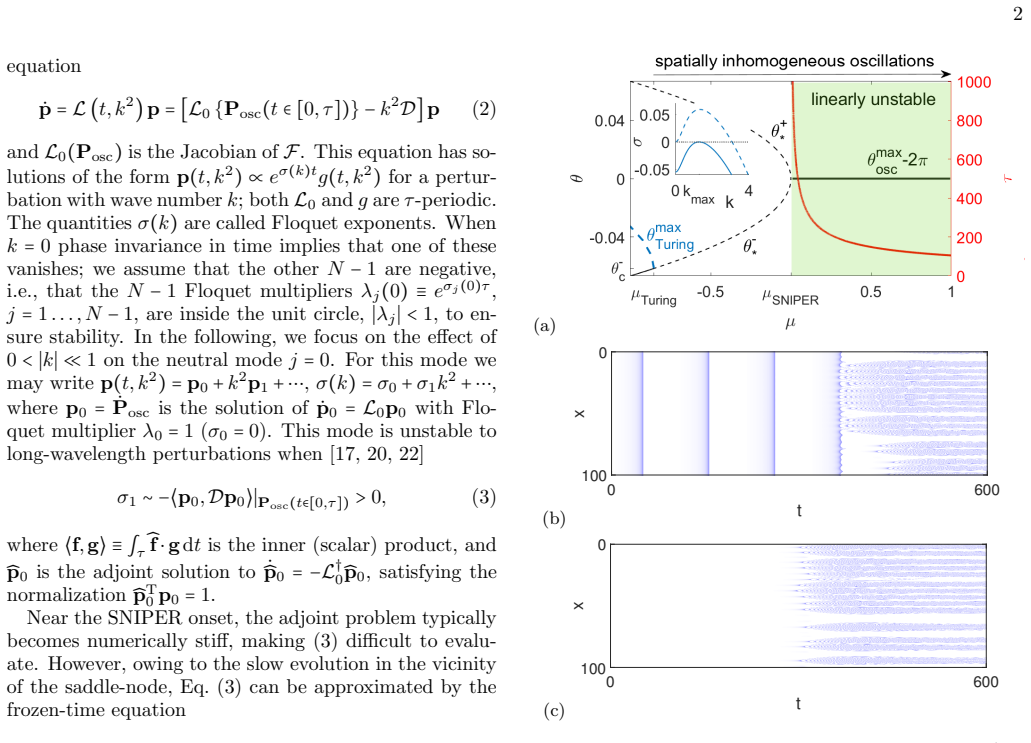
Figure from the paper full image
abstract click to expand
Properties of spatially dependent relaxation oscillations near a SNIPER bifurcation are described. A SNIPER bifurcation creates a large-amplitude long-period periodic orbit via the annihilation of a pair of fixed points in a saddle-node bifurcation. We show that in spatially extended media, this orbit may undergo a long-wavelength instability, leading to spatially modulated oscillations that persist on both sides of the SNIPER. The oscillations take different forms depending on the system: a chimera state in a theta-reaction-diffusion model, and chaotic spiking in an activator-inhibitor-substrate model. The results are expected to have applications in a number of physical systems exhibiting SNIPER bifurcations, ranging from models of the nervous system through chemical reactions to nonlinear optics.
0
0
nlin.PS 2026-05-12 2 theorems

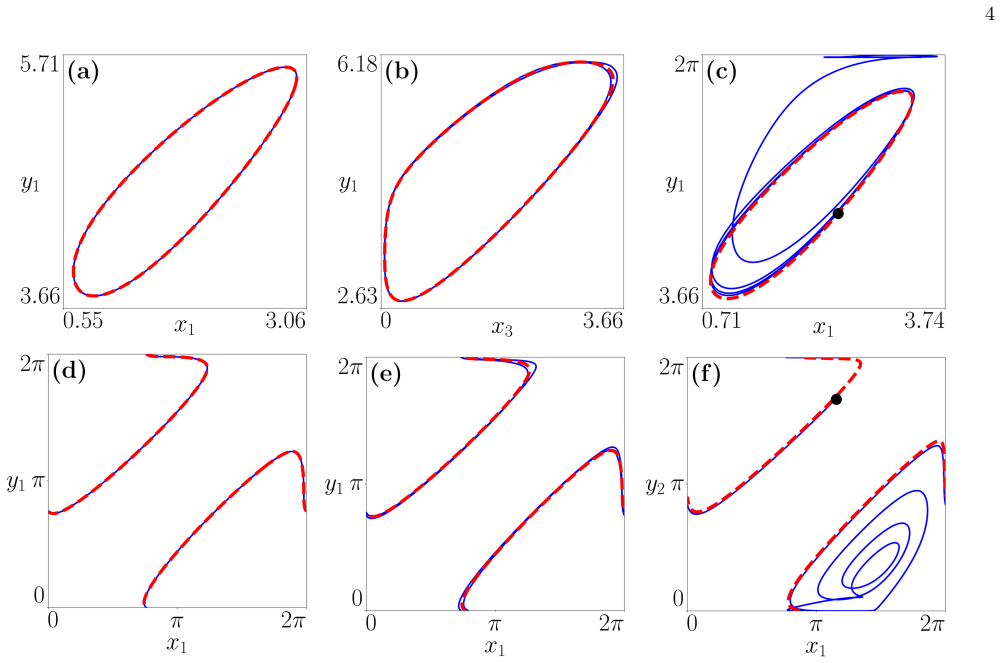
Breathing cyclops states fill large parameter regions in oscillator networks

Breathing and Rotobreathing Cyclops States in Phase Oscillators with Inertia and Two-Harmonic Coupling

Nonstationary three-cluster configurations with inertia and dual harmonics emerge as central features rather than exceptions.

Figure from the paper full image
abstract click to expand
Cyclops states - three-cluster configurations consisting of two synchronous groups and a solitary oscillator - dominate in ensembles of phase oscillators with inertia and multiple coupling harmonics [Phys. Rev. E 109, 054202 (2024)]. In this work, for the first time, we systematically study nonstationary cyclops states that preserve the three-cluster structure: breathing and rotobreathing cyclops states. We identify two scenarios for their destabilization: period doubling, leading to quasicyclops states while preserving frequency synchronization within the clusters, and the destruction of one or two clusters, resulting in the emergence of switching cyclops or multicluster states. We show that breathing and rotobreathing cyclops states occupy vast parameter regions of the second coupling harmonic and are key elements of the dynamics. The results are important for predicting and controlling complex collective states in ensembles with higher-order interaction harmonics of various natures.
0
0
nlin.PS 2026-05-12 Recognition

Kagome lattice yields new coupled equations for localized waves

Asymptotic Analysis of discrete nonlinear localised modes in a Kagome lattice

Asymptotic analysis near a flat-band degeneracy produces a 2+1D system whose solitary-wave solutions match lattice simulations.

Figure from the paper full image
abstract click to expand
We describe a nonlinear kagome lattice with nonlinear dynamics described by Klein-Gordon interactions with a scalar unknown at each node, such as might occur in a nonlinear electrical lattice. We show that the dispersion relation has three bands - a flat band and two other surfaces which may meet in Dirac points or be separated by a gap. By using multiple scales asymptotic methods, we find a variety of reductions to nonlinear Schrodinger (NLS) systems, some of which are similar to those obtained previously, and have the Townes soliton as a solution. We find a novel system of coupled NLS equations, by forming an asymptotic expansion for small amplitude weakly nonlinear waves around the point where the flat band meets the upper surface of the dispersion relation. We analyse this 2+1 dimensional system using Lie symmetries, and find further reductions to more complicated solitary wave solutions. Numerical simulations of the wave are also presented.
0
0
nlin.PS 2026-05-12 2 theorems

Simulations tie ball lightning to stable topological solitons

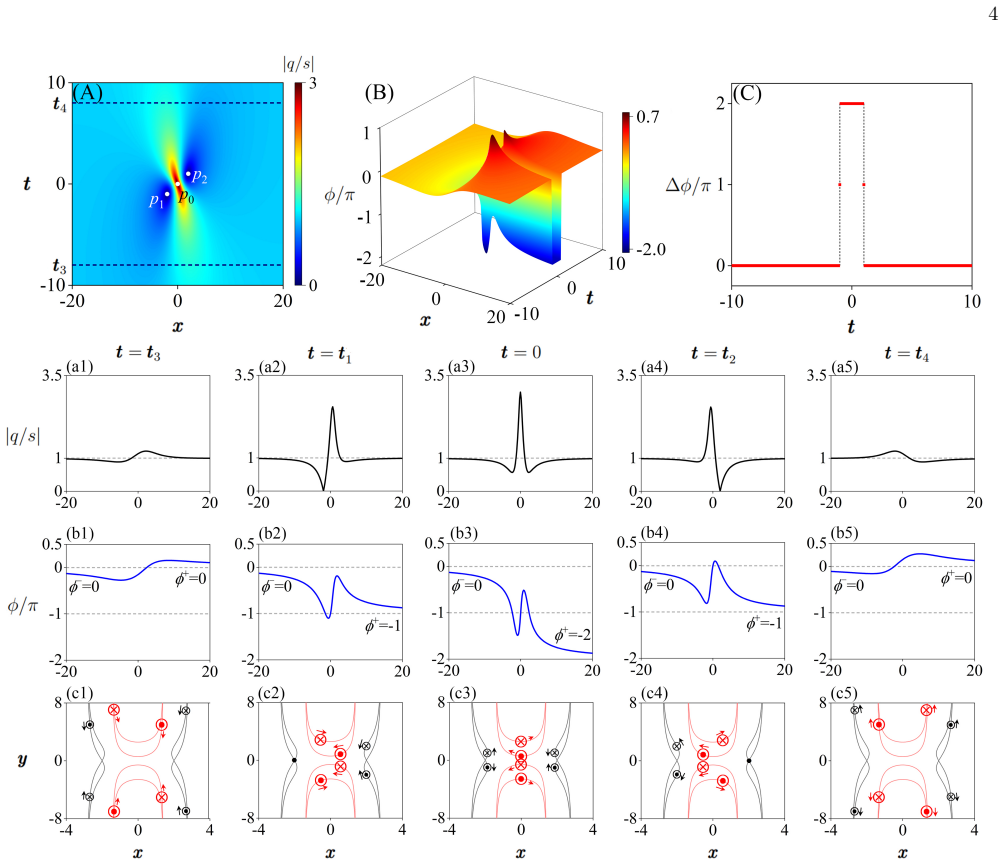
A Topological Soliton Model for Ball Lightning: Theory and Numerical Verification with the 3D Gross-Pitaevskii Equation

Charged objects in the 3D Gross-Pitaevskii equation live long, resist transmission, and match observed energies and sizes.

Figure from the paper full image
abstract click to expand
Ball lightning is one of the most mysterious atmospheric phenomena, whose long lifetime, penetrative ability, and stability are difficult to explain with traditional physical models. This paper proposes a novel theoretical framework, interpreting ball lightning as a projection of a high-dimensional topological soliton into three-dimensional space. Its essence is described by a nonlinear Schr\"odinger equation with attractive interaction, protected by a non-zero topological charge. Through numerical simulation of the three-dimensional Gross-Pitaevskii equation, we verify the core predictions of this model: in a Bose-Einstein condensate with attractive interactions, solitons carrying topological charge exhibit: (1)long-lived stability (topological charge conserved under perturbations); (2)low transmission probability (due to minimal overlap integral resulting from orthogonality with the ground state wavefunction); (3)energy and size scales consistent with actual observations. Theoretical analysis indicates that the soliton lifetime is governed by the system's decoherence rate, providing a natural explanation for the observed second-scale lifetimes. This work not only offers a self-consistent physical explanation for ball lightning but also provides a concrete scheme for the experimental preparation and observation of three-dimensional topological solitons.
0
0
nlin.PS 2026-05-12 2 theorems

Topological solitons model ball lightning as stable 3D structures

A Topological Soliton Model for Ball Lightning: Theory and Numerical Verification with the 3D Gross-Pitaevskii Equation

Simulations of the 3D Gross-Pitaevskii equation show conserved charge protects solitons at observed scales

Figure from the paper full image
abstract click to expand
Ball lightning is one of the most mysterious atmospheric phenomena, whose long lifetime, penetrative ability, and stability are difficult to explain with traditional physical models. This paper proposes a novel theoretical framework, interpreting ball lightning as a projection of a high-dimensional topological soliton into three-dimensional space. Its essence is described by a nonlinear Schr\"odinger equation with attractive interaction, protected by a non-zero topological charge. Through numerical simulation of the three-dimensional Gross-Pitaevskii equation, we verify the core predictions of this model: in a Bose-Einstein condensate with attractive interactions, solitons carrying topological charge exhibit: (1)long-lived stability (topological charge conserved under perturbations); (2)low transmission probability (due to minimal overlap integral resulting from orthogonality with the ground state wavefunction); (3)energy and size scales consistent with actual observations. Theoretical analysis indicates that the soliton lifetime is governed by the system's decoherence rate, providing a natural explanation for the observed second-scale lifetimes. This work not only offers a self-consistent physical explanation for ball lightning but also provides a concrete scheme for the experimental preparation and observation of three-dimensional topological solitons.
0
0
nlin.PS 2026-05-11 Recognition

Fourier features and clustering sort chimera state types

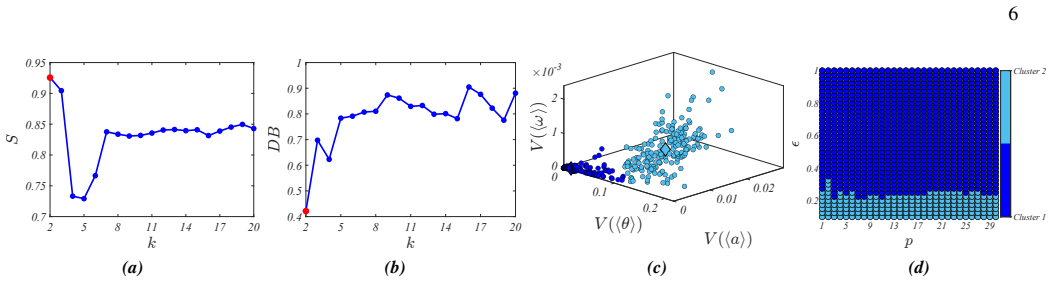
Classification of Chimera States via Fourier Analysis and Unsupervised Learning

Method maps parameter regions and distinguishes coherent-incoherent patterns in networks of Rayleigh oscillators

Figure from the paper full image
abstract click to expand
Chimera states are among the most intriguing phenomena in nonlinear dynamics, characterized by the coexistence of coherent and incoherent behavior in systems of coupled identical oscillators. Many methods have been proposed to detect chimera states and to distinguish their different types. However, such methods often suffer from important limitations that prevent sufficiently precise classification. In this work, we overcome the issue by considering a method based on Fourier analysis to determine key signal characteristics such as amplitude, phase, and frequency, jointly with an unsupervised clustering step acting on normalized total variations, measures of local spatial changes of the above-mentioned dynamical features. The proposed method allows us to identify regions in parameter space returning chimera states, but also to further distinguish between the different types. The method is applied to a network of Rayleigh oscillators, which has been shown to exhibit a rich variety of dynamical patterns.
0
0
nlin.PS 2026-05-08

The paper develops an analytical framework to compute the probability distribution of…

Soliton gas resolution and statistics of random wave fields in semiclassical integrable turbulence

A soliton gas resolution conjecture combined with a stochastic inverse scattering transform yields an explicit integral formula for the…

Figure from the paper full image
abstract click to expand
We develop a general analytical framework for determining the probability distribution of random nonlinear wave fields governed by the focusing nonlinear Schr\"odinger equation (fNLSE) in regimes where typical realizations are dominated by solitons. We formulate the soliton gas resolution conjecture for the long-time evolution of slowly varying ("semiclassical") random initial states and implement a stochastic analogue of the inverse scattering transform by establishing a relationship between the spectral density of states of the underlying bound-state soliton gas and the probability density function (PDF) of the intensity of the resulting turbulent wave field. The derived explicit integral representation for the PDF is shown to be in excellent agreement with direct numerical simulations across several representative regimes of fNLSE integrable turbulence. The results have broad applicability to physical systems including water waves, nonlinear optics, and superfluids.
0
0
nlin.PS 2026-05-07

Distance-matrix spectra preserve static template during ring collapse

Frustrated Dynamics of Distance Matrices

Mass redistribution inside the fixed BBS shape flags the fast transition from uniform points to a one-dimensional ring on the sphere.

Figure from the paper full image
abstract click to expand
We introduce the Frustrated Distance Matrix (FDM) model, a dynamic extension of the static distance-matrix ensemble on S^2 analyzed by Bogomolny, Bohigas, and Schmit (BBS). Its entries are pairwise geodesic distances between N Brownian particles on the sphere evolving under quenched random pairwise couplings linear in those distances. Where the static BBS theory recovers geometric information about the underlying manifold from spectra of distance matrices on i.i.d.\ samples, the time-resolved FDM spectrum carries information about structural changes of the underlying point process. The particle dynamics realize one such change: a fast collapse from a uniform configuration onto a one-dimensional ring, followed by slow rotational drift of the ring orientation; the particle-level picture provides the ground truth against which spectral diagnostics are calibrated. We find that the static BBS template is preserved at every time, with the dynamics entering as a redistribution of spectral mass within that template, sharp enough to flag ring formation. We propose self-averaging of the bulk density as the mechanism behind this preservation, verified by an i.i.d.-resample comparison, and extract a small set of spectral diagnostics of the structural change computable from the distance matrix alone. We suggest that our diagnostics can be applied in other similar inverse-problem settings: financial correlation matrices, graph and network adjacency spectra, similarity matrices in molecular dynamics, and dynamics on parameter manifolds.
0
0
nlin.PS 2026-05-07

The paper shows that a single morphogen diffusing through layered two-dimensional media…

Patterns in Time and Space from a Single Morphogen via Nonlinear Layering

Nonlinear coupling across layers allows a single morphogen to produce Turing, Hopf, and Turing-wave instabilities in a reduced…

abstract click to expand
Spatial and temporal pattern formation in reaction-diffusion systems is typically studied with two or more equations, as scalar reaction-diffusion equations confined to convex domains do not admit stable inhomogeneous states in time or space on long timescales. Here, we show that a single morphogen diffusing across layered two-dimensional media, with nonlinear coupling between layers, is able to generate stable patterns in time and space. This $N$-layer model is analysed via a thin-domain limit, which reduces to an $N$-component reaction-diffusion system on a homogeneous one-dimensional domain. This reduced model can be analysed via linear stability techniques, showing that non-diffusive, or reactive, coupling between regions is necessary for pattern-forming instabilities, at least in the reduced model. This reduced system can exhibit Turing, Hopf, and Turing-wave instabilities, with emergent structures that are numerically shown to persist even away from the thin-domain regime of the full 2D single-morphogen system. These results suggest that heterogeneous stratification and nonlinear coupling can broaden the class of systems which exhibit complex spatiotemporal behaviours, which may be relevant in scenarios where only a single morphogen is known to act.
0
0
nlin.PS 2026-05-07

Stronger initial noise raises rogue wave odds in GI equation

Rogue wave statistics and integrable turbulence in the Gerdjikov-Ivanov equation

Simulations show disturbance intensity speeds chaos, shifts turbulence type, and fattens extreme-wave tails with lasting spectral asymmetry.

Figure from the paper full image
abstract click to expand
This paper numerically investigates the statistical properties of rogue waves and their generation mechanisms in integrable turbulence, taking the Gerdjikov-Ivanov (GI) equation as the research object. The eigenvalue spectra of the analytical solutions and the chaotic wave field are calculated using the Fourier collocation method. Subsequently, taking a plane wave with random noise as the initial condition, the evolution of chaotic wave fields is simulated using the split-step Fourier (SSF) method. Numerical results show that the larger the initial disturbance intensity, the faster the wave field converges to a chaotic state, and the higher the peak amplitude after convergence, the higher the tail of the probability density function, and the significantly higher probability of rogue wave occurrence. Moreover, as the initial disturbance intensity increases, the turbulence type transitions from breather turbulence to soliton turbulence. In addition, the evolution of the wave-action spectrum is studied. The research has found that the wave-action spectrum of the GI equation shows an asymmetric distribution during the time evolution process, and this asymmetry persists even after the system reaches a steady state.
0
0
nlin.PS 2026-04-30

Poles in nonlinear waves create monopoles of charge 3/2 and 5/2

Dirac monopole potentials with high charges underlying nonlinear waves

Simple poles and third-order poles of density functions produce higher quantized charges than zeros, shown via rogue waves and solitons.

Figure from the paper full image
abstract click to expand
We investigate topological vector potentials underlying the phases of nonlinear waves by performing Dirac's magnetic monopole theory in an extended complex plane, taking into account self-steepening effects while ignoring the usual cubic nonlinearities. We uncover that the simple poles and third-order poles of the density function constitute virtual monopole fields with higher charges $\pm3/2$ and $\pm5/2$, respectively. These results are in sharp contrast to the previous findings, where the simple zeros of the density function yield charges $\pm1/2$. We choose scalar and vector rogue waves as well as bright solitons to demonstrate the Dirac monopole potentials. These results confirm a series of quantized magnetic charges for virtual monopoles underlying nonlinear waves, and reveal new relations between poles of density functions and topological charges.
0
0
nlin.PS 2026-04-30

Turing patterns on fixed lattices respond to mechanical stress

Turing patterns on non-fluctuating surfaces under mechanical stresses

Finsler modeling with directional internal vectors shows patterns change under force the same way they do on fluctuating membranes, and lets

Figure from the paper full image
abstract click to expand
This paper presents a numerical investigation of Turing patterns (TPs) utilizing the reaction-diffusion equation for the activator $u$ and the inhibitor $v$ on two- and three-dimensional lattices, discarding vertex fluctuations. The absence of vertex fluctuations means the absence of positional movement of $u$ and $v$. Consequently, $u$ and $v$ have values at spatially discrete points, such as the pigment cells in zebrafish and sea shells. Furthermore, the mechanical property is implemented through the Finsler geometry modeling technique. This technique incorporates the internal degree of freedom $\vec{\tau}$, corresponding to the direction of mechanical stress. Additionally, a stress formula based on Gaussian bond potential is shown to be well-defined on the non-fluctuating lattices, and therefore, it enables the calculation of entropy for capturing the stress relaxation phenomenon in a manner analogous to that on fluctuating surfaces. The results of the study indicate that these biological patterns also exhibit responses to external mechanical forces similar to TPs on fluctuating membranes.
0
0
nlin.PS 2026-04-29

Space-time pulse splits into soliton train in multimode fiber

Space-time excitation creates soliton trains in multimode fibers

One input with topological charge β„“ produces |β„“| + 1 multimode solitons whose energies and modes are set by β„“.

abstract click to expand
In this work, we show that injecting a single space-time-coupled light pulse-beam into a multimode graded-index fiber generates a train of multimode solitons. Space-time couplings excite the spatial modes with distinct temporal profiles. Due to nonlinear interactions, with a properly chosen input power these profiles split into several unique multimode solitons. In the case of a spatially chirped input pulse, two solitons composed of modes $LP_{01}$ and $LP_{11}$ are formed. In the case of the injection of a space-time optical vortex, characterized by its topological charge $\ell$, a train composed of $|\ell| + 1$ multimode solitons is generated. Their energy and modal composition are directly determined by the absolute value of the topological charge.
1 0
0
nlin.PS 2026-04-28

Repulsive interactions stabilize dark-bright solitons in 2D BEC mixtures

Impurity localization, and collision properties of symbiotic dark-bright solitons in superfluid-impurity system

Phase differences between bright components decide whether colliding solitons merge or repel.

Figure from the paper full image
abstract click to expand
We investigate the dynamics of a binary mixture of Bose-Einstein condensates in the impurity limit -- where one component is dilute enough to be treated like an impurity -- and confined to two dimensions. Using the mean-field coupled Gross-Pitaevskii equations, we find that the binary mixture supports the formation of stable symbiotic dark-bright solitons when the inter- and intra-component interactions are repulsive. We further study the interaction between solitons and observe that the solitons undergo merging and repulsion depending on the relative phase between the bright component of the composite structure.
0
0
nlin.PS 2026-04-27

Shock waves in spherical and cylindrical KdV-B follow stable superposition

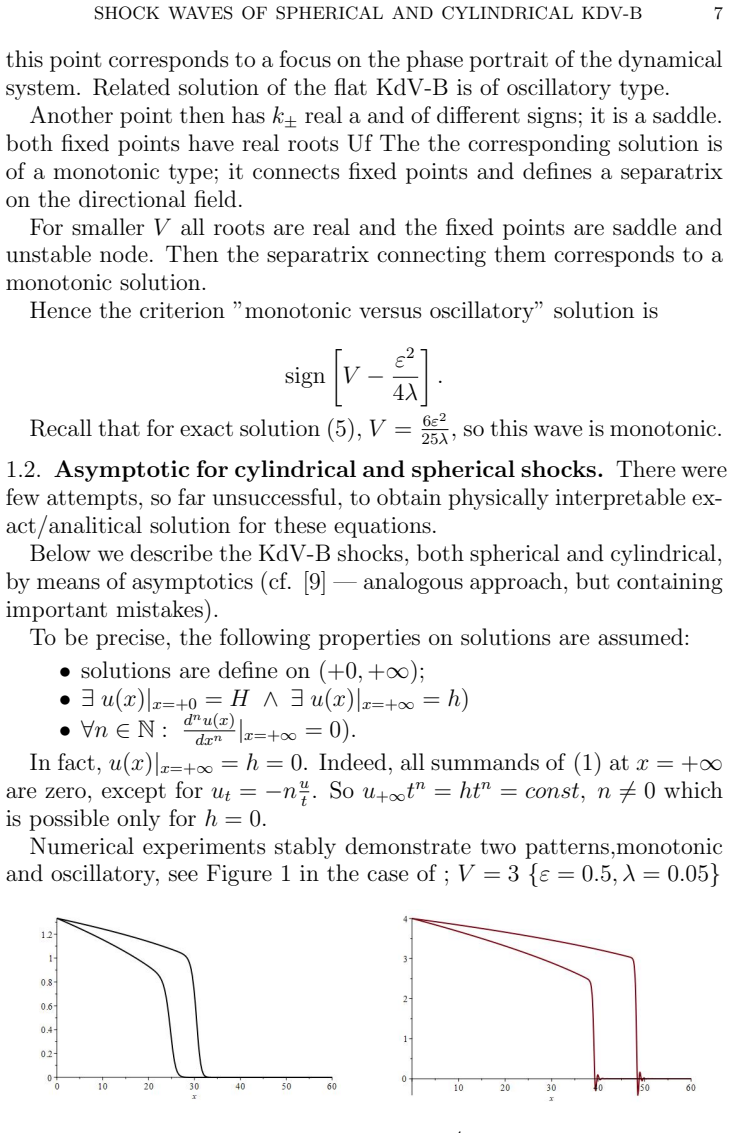
Shock waves of spherical/cylindrical KdV-B: Asymptotic, stability, superposition

One-parameter families of diverging shocks have explicit asymptotics, are stable by conservation, and combine simply even if discontinuous.

Figure from the paper full image
abstract click to expand
Spherical and cylindrical KdV-B equations have few known exact solutions, yet these solutions are hard to be interpreted physically. But these equations do have a family of diverging shock waves. Their properties such as asymptotic modes, stability, rules of their interactions/superposition are the subject of this paper. It gives a detailed asymptotic description of the one-parameter families of shock wave solutions and proves their stability using a conservation law. Based on these results, effective rules of superposition are obtained. Moreover these rules are applicable to a wide class of shock waves, in particular discontinuous. Typical examples are illustrated by graphs.
0
0
nlin.PS 2026-04-24

Delays induce waves and breathing bumps in theta neuron rings

Dynamic solutions of next generation neural field models with delays

Hopf bifurcations in delayed continuum models create dynamic solutions whose parameter variation maps delay effects on neural patterns.

Figure from the paper full image
abstract click to expand
We study networks of theta neurons arranged on a ring with delayed interactions. In the continuum limit the systems are described by next generation neural field models with delays. We consider distributed delays with both finite and infinite support, and conduction delays. The stability of spatially uniform and localized bump states is determined, and we find that they undergo Hopf bifurcations as parameters related to the delays are varied. These bifurcations create traveling waves and ``breathing'' bump solutions. These dynamic solutions satisfy self-consistency equations and we show how to efficiently solve these equations. Following traveling waves and periodic solutions as parameters are varied provides a global picture of the influence of different delays on pattern formation processes in spatially extended networks of theta neurons.
0
0
nlin.PS 2026-04-22

Exact solitary waves in PT-symmetric Dirac equation independent of k

Generalized PT-symmetric nonlinear Dirac equation: exact solitary waves solutions, stability and conservation laws

PT-transition set by existence condition alone with conserved energy but restricted stability domain

Figure from the paper full image
abstract click to expand
We derive an exact solitary wave solution for the $\PTb$-symmetric nonlinear Dirac equation with a scalar-scalar interaction. We consider a power-law nonlinearity of the form $|\bar{\Psi}\,\Psi|^{k}\,\Psi$ for positive values of $k$. The system's energy is conserved despite the presence of a gain-loss term, which is quantified by the parameter $\Lambda$. We show that the $\PTb$-transition point is defined by the solution's existence condition and is independent of the nonlinearity exponent $k$. Furthermore, momentum is conserved, although neither the canonical momentum nor the charge is a conserved quantity. A notable result is that the stationary solution, obtained from the continuity equations, exhibits nonzero momentum in its rest frame. We also derive a moving soliton solution, where the gain-loss parameter allows the soliton's velocity to be precisely chosen so that the moving soliton possesses zero momentum. Finally, we establish that the presence of a gain-loss mechanism and higher-order nonlinearity restrict the stability domain of the solutions.
0
0
nlin.PS 2026-04-21

Nonlinear model supports traveling solitary waves on topological edges

Chiral solitary waves in a nonlinear topological insulator model

Chiral edge states persist and collide inelastically in this nonlinear topological model.

Figure from the paper full image
abstract click to expand
An outstanding challenge in the field of topological insulators is the realization of nonlinear systems that support coherent traveling waves. Highly nonlinear lattices can suffer from significant radiation losses due to Peierls-Nabarro effects. In this work a nonlinear tight-binding model that supports robust traveling edge states is proposed and examined. This system possess a nontrivial local Chern topology and soliton-like states. When a traveling solitary wave collides with a stationary mode, the two are observed to interact inelastically. These results suggest future directions for the modeling, realization, and application of nonlinear Chern insulators.
0
0
nlin.PS 2026-04-20

Dark solitons keep intensity dips intact in nonlinear SSH lattices

Dark solitons in nonlinear Su-Schrieffer-Heeger lattices

The dips stay preserved in bulk and edges within various gaps, stable only when intracell coupling is dominant.

Figure from the paper full image
abstract click to expand
The introduction of nonlinearities into lattices with topological band structures has led to the discovery of various types of solitons. The Su-Schrieffer-Heeger (SSH) lattice, as the most fundamental topological model, has been extended into the nonlinear regime. In particular, nonlinear edge states and bulk solitons exhibiting intensity humps against a zero background have been extensively studied in nonlinear SSH lattices. In this paper, we systematically investigate dark solitons in nonlinear SSH lattices. These dark solitons maintain a nonzero and constant background, featuring intensity dips either in the bulk of the lattice or at its edges, and residing spectrally in the semi-infinite gap or the middle finite gap. Regardless of the specific type of dark soliton, the intensity dip remains wellpreserved and is not affected by the band structure of the original linear lattice. Although the dark solitons we have identified are generally dynamically unstable across a broad range of parameters, several types exhibit linear stability when the intracell coupling is much larger than the intercell coupling. Our findings may provide valuable insights for the exploration of novel types of solitons in nonlinear topological lattices.
0
0
nlin.PS 2026-04-15

Reduced equation tracks wave number to predict Ginzburg-Landau singularities

Reduced wave number dynamics in the real and complex Ginzburg-Landau equations

Scalar model from WKB expansion yields exact shock profiles and instability criteria confirmed by simulations in real and nearly-real cases

Figure from the paper full image
abstract click to expand
We study large-scale dynamics in the Ginzburg-Landau equation (GLE) using a reduced description derived from a WKB expansion. Rigorous mathematical results establishing that this reduced equation accurately approximates the full GLE are currently limited to the real GLE (RGLE) and exclude phase-slip dynamics. For the RGLE, we find that the reduced equation has conserved gradient form and show that, upon inclusion of a higher-order regularization, it admits exact stationary solutions. In the reduced dynamics, all nonuniform steady states are linearly unstable and among them, localized hole solutions identified through the reduced description differ from the classical hole solution of the RGLE due to Langer and Ambegaokar. In the Eckhaus-unstable regime, we derive a self-similar description of the approach to finite-time singularities in the reduced equation, with scaling exponents that agree with direct numerical simulations (DNS), and a similarity profile obtained from a nonlinear 4th-order boundary value problem. Extending the reduction to the complex GLE (CGLE) with nearly real coefficients introduces a Burgers nonlinearity that generates traveling shocks connecting two distinct plane-waves. We obtain exact expressions for the shock profile and perform extensive DNS to demonstrate convergence to the predicted profile in the appropriate large-scale, nearly real-coefficient limit of the CGLE. Away from this limit, the wave number profile loses monotonicity, which we explain in the framework of spatial dynamics. We further show that the exact shock solutions found here are qualitatively distinct from the Nozaki-Bekki solutions. Taken together, our results reveal how a single, scalar reduced equation elucidates unstable stationary states, self-similar collapse toward phase slips, and shock formation, providing an understanding large-scale phase dynamics in pattern-forming systems.
0
0
nlin.PS 2026-04-13

Magnetic kink overlaps create triadic forces in continuous fields

The Simplicial Bridge: Mapping quantum multi-spin exchange to higher-order topological networks in continuous magnetic fields

Higher-order simplicial interactions from defect compression stabilize 2D solitons without DMI by bypassing Derrick's theorem.

Figure from the paper full image
abstract click to expand
The macroscopic dynamics of topological defects in magnetic materials are traditionally modeled using pairwise interactions. However, higher-order quantum exchange mechanisms - such as biquadratic and 4-spin ring exchange-play a critical role in strongly correlated systems. In this work, we introduce the "Simplicial Bridge," an exact analytical framework that maps these high-dimensional, non-linear Landau-Lifshitz partial differential equations onto generalized Kuramoto phase-oscillator networks operating on abstract simplicial complexes. We rigorously demonstrate that spatial overlap in the continuous limit natively generates higher-order topological forces without requiring a supportive discrete atomic lattice. Specifically, the overlap of 1D helimagnetic kinks generates 2-simplices (triadic forces), while the spatial compression of 2D skyrmion tails - governed by modified Bessel function asymptotics - generates true 3-simplices (tetradic forces). Furthermore, we establish that the higher-order spatial derivatives inherent to these multi-spin interactions provide an intrinsic energetic barrier that bypasses Derrick's Theorem, stabilizing 2D topological solitons without the strict need for Dzyaloshinskii-Moriya Interaction (DMI).
0
0
nlin.PS 2026-04-13

Soliton heat engine beats few-level limit via spectral channels

Spectral thermodynamics of a soliton heat engine

A sine-Gordon soliton in a Josephson junction converts heat using its internal bound states, yielding higher efficiency than two-level trunc

Figure from the paper full image
abstract click to expand
We demonstrate a thermodynamic engine whose working substance is a sine-Gordon soliton in a heterogeneous current-driven Josephson junction. We show that solitons can act as thermodynamic working substances whose internal spectral structure enables energy conversion beyond conventional few-level engines. By dynamically deforming the soliton using a controllable dipole current, the internal bound-state spectrum of the soliton can be engineered in time, enabling a finite-time Carnot-like cycle based on spectral control, in close analogy with quantum heat engines. Mapping the instantaneous nonlinear field configuration to an effective Schr\"odinger operator, we reveal how bound states appear, approach the continuum threshold, and disappear during the cycle. Comparing three thermodynamic descriptions (full nonlinear field dynamics, a coarse-grained mesoscopic model, and a two-level spectral model), we show that few-level descriptions systematically underestimate the engine performance. The enhanced efficiency arises from the extended nature of the soliton, whose internal spectral degrees of freedom provide additional energy storage and transfer channels. Our results reveal a general thermodynamic principle: extended nonlinear excitations with particle-like behavior can serve as tunable working media, whose internal spectral degrees of freedom provide additional reversible channels for energy storage and transfer beyond those of few-level systems.
0
0
nlin.PS 2026-04-10

Wadati potential supports homoclinic NLS solutions to plane waves

Homoclinic and heteroclinic solutions of the nonlinear Schr\"odinger equation with a complex Wadati potential

The potential with gain-loss and repulsion enables connections between nonlinear plane waves in dispersive media.

Figure from the paper full image
abstract click to expand
Stationary solutions asymptoting to nonlinear plane waves of the nonlinear Schr\"odinger equation with a PT-symmetric, complex linear potential are characterized. The potential includes both a spatially varying gain-loss profile and a repulsive real part, generated by a Wadati potential function,that support the existence of homoclinic and heteroclinic solutions that asymptote to the same or different, respectively, nonlinear plane waves in the far field. Asymptotic analysis and numerical simulations are used to examine solution existence, bifurcations, and structure. Such solutions play an important role in resonant nonlinear wave generation of dispersive media with localized gain and loss.
0
0
nlin.PS 2026-04-07 2 theorems

Reply shows Vlasov comment due to paramagnetic phase definition

Reply to: Comment on: Discontinuous codimension-two bifurcation in a Vlasov equation (arXiv:2603.22066)

Once definitions match, the original bifurcation analysis and comment have no further conflicts.

Figure from the paper full image
abstract click to expand
The Comment criticizes the bifurcation analysis performed in the original paper on a Vlasov equation. This criticism can be traced back to a discrepancy in the definition of the paramagnetic phase. Apart from this discrepancy, there is no conflict between the Comment and the original paper.
1 0
0
nlin.PS 2026-04-06 2 theorems

Water coupling drives uphill vegetation band migration

Vegetation Pattern Formation via Energy-Balance-Constrained Modeling

On slopes the constrained model reproduces wavelength growth with aridity and uphill band motion; flat ground permits independent energy-BAL

abstract click to expand
Vegetation in semi-arid environments self-organizes into striking spatial patterns -- bands, spots, labyrinths, and gaps -- with characteristic wavelengths on the order of tens to hundreds of meters. Existing reaction-diffusion models postulate nonlinearities and transport laws from qualitative physical reasoning, making it hard to distinguish essential structural features from artifacts of the chosen forms. Here we show how energy-balance and water-conservation principles can constrain the admissible model class before a specific closure is chosen. These constraints motivate a family of semilinear closures; an Euler--Lagrange representative yields a fourth-order vegetation equation coupled to quasi-steady water transport on a one-dimensional hillslope. Linear stability analysis identifies three instability mechanisms: classical water-mediated feedback, energy-balance spatial coupling, and water deflection by vegetation gradients. Their balance depends on terrain geometry. On slopes, the water-mediated coupling dominates and the model reproduces two empirical observations: pattern wavelength increases with aridity, and vegetation bands migrate uphill. On flat terrain, the energy-balance spatial coupling can drive instability independently. Numerical simulations confirm the linear predictions, and exploratory continuation reveals a narrow hysteresis region consistent with subcritical bifurcation.
0
0
nlin.PS 2026-04-06 1 theorem

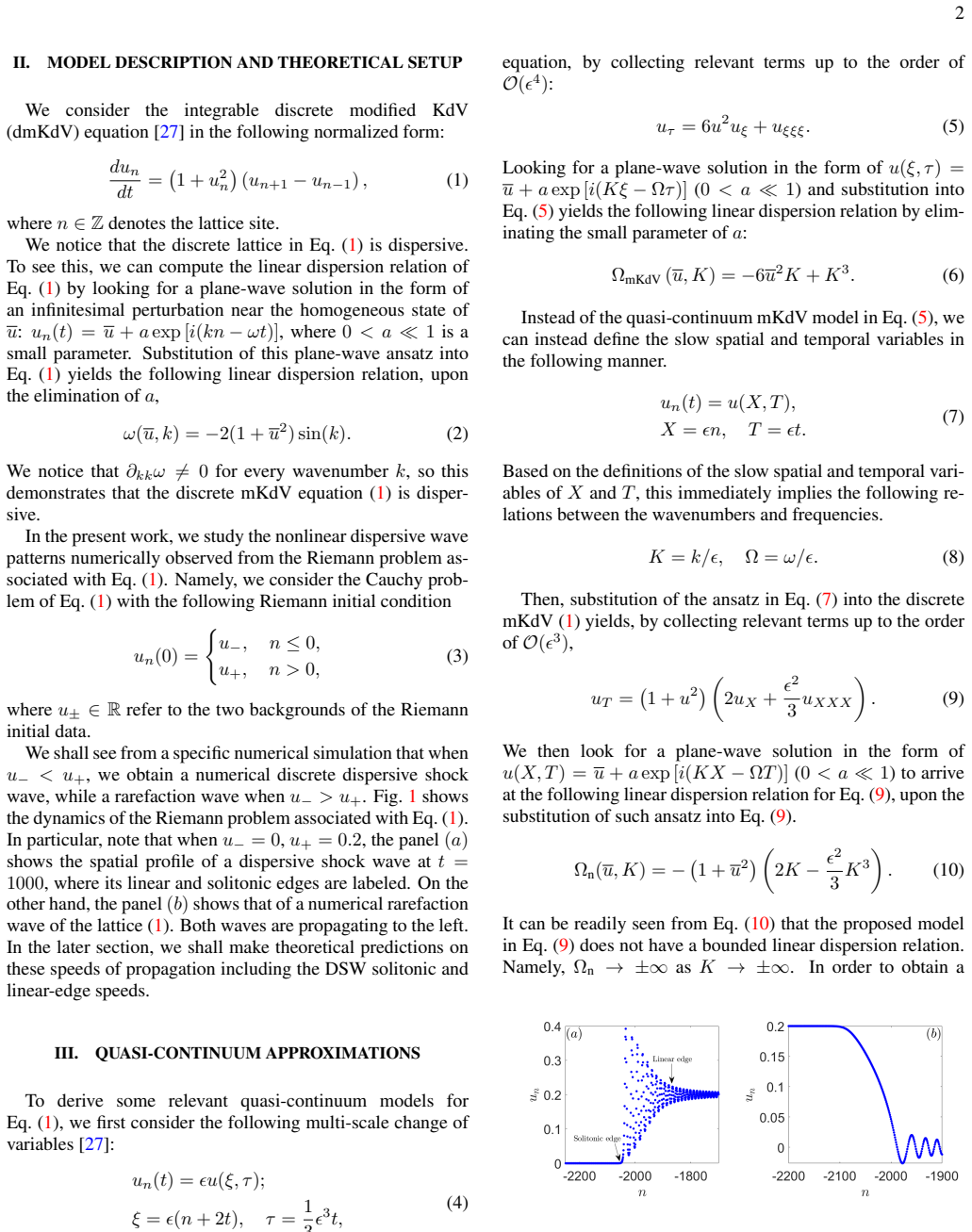
Quasi-continuum models predict discrete mKdV wave edges

Nonlinear dispersive waves in the discrete modified KdV equation

DSW-fitting and self-similar solutions match numerical rarefaction and shock structures in lattice simulations.

Figure from the paper full image
abstract click to expand
In this paper, we study the nonlinear dispersive waves including the rarefaction and dispersive shock waves in the discrete modified KdV equation through the numerical simulations of the dispersive Riemann problems. In particular, we propose distinct quasi-continuum models to approximate both the spatial profiles and distinct edge features of these two specific dispersive wave structures. Whitham analysis is performed to construct a closed system of partial differential equations which describe the slowly-varying dynamics of all the relevant parameters associated with the periodic traveling waves of the proposed quasi-continuum models. We then perform reduction on such modulation system to obtain a system of two simple-wave ordinary differential equations which lead to the DSW-fitting method that shall provide useful theoretical insights on different edge characteristics of the dispersive shock waves. Furthermore, we compute analytically the self-similar solutions corresponding to the dispersionless systems of the quasi-continuum models, which can be utilized to approximate the numerically observed rarefaction waves of the discrete mKdV equation. A systematic numerical comparison of these theoretical findings with their associated numerical counterparts finally demonstrate the good performance of the proposed quasi-continuum models in approximating both nonlinear dispersive wave patterns.
1 0

browse all of nlin.PS β†’ full archive Β· search Β· sub-categories