REVIEW 2 major objections 4 minor 38 references
Stacking disorder in novel ABAC-stacked brochantite, Cu$_4$SO$_4$(OH)$_6$
T0 review · 2 major / 4 minor · reviewed 2026-08-10 · deepseek-v4-flash
Pith's one-line read Synthetic brochantite crystals are grown for the first time and show a weak tendency toward a new ABAC stacking polytype, with the observed sulfate-site doubling interpreted as stacking disorder rather than chemical disorder.
desk verdict Real crystal-growth advance; the 'new ABAC polytype' claim is overstated and needs toning down. read the letter →
The pith
A machine-rendered reading of the paper's core claim, the machinery that carries it, and where it could break.
The reading
What carries the argument
The central object is a stacking model built from three layer types A, B, and C, which are assumed to be identical ideal brochantite layers that differ only by a flip along [100] or a shift along b. A Monte Carlo algorithm orders these layers according to a correlation parameter, with -1 giving pure ABAC stacking and +1 giving clusters of like layers (ABAB or ACAC), and the simulated (H0L) and (HK1) scattering planes are compared with synchrotron diffuse-scattering data. The comparison indicates nearly random stacking with a slight ABAC tendency. The diffuse rods running along H in reciprocal space, with sharp odd-H Bragg peaks on top, are the signature that the Monte Carlo model reproduces.
What would settle it
If a chemically disordered model—one with real sulfate vacancies and no stacking faults—could reproduce the observed diffuse rods and the doubled sulfate sites equally well, the new-polytype interpretation would be falsified. Concretely, a resonant or anomalous x-ray scattering experiment that directly maps sulfate occupancy layer by layer, or a neutron diffraction study that resolves whether the half-occupied sites are hydroxyl rather than sulfate in an ordered way, would settle whether the stacking is genuinely ABAC-tending.
Extended reading notes
Core claim
The paper's central claim is that hydrothermally grown brochantite crystals represent a new polytype: the layers stack nearly randomly, but with a weak preference for an ABAC sequence, where the A, B, and C layers are presumably identical ideal brochantite layers that differ by flips along [100] or shifts along b. This ABAC arrangement had not been reported for brochantite before; the known ordered forms are the MDO1 and MDO2 polytypes. In the refined structure, the A layers carry twice as many sulfate sites that are roughly half occupied; the authors interpret this as the fingerprint of faulted stacking rather than genuine anion vacancies, a reading supported by neutron refinements in which the vacant sulfate sites are instead occupied by hydroxyl groups. Specific heat and magnetization data show a likely double transition into the magnetically ordered state around 6.8 and 7.5 K, and the overall behavior suggests that the previously proposed collinear magnetic structure needs modification.
Load-bearing premise
The load-bearing premise is that the A, B, and C layers are identical ideal brochantite layers, so that the half-occupied sulfate sites observed in some layers represent stacking faults rather than a genuinely different local chemistry.
Editorial extensions
If this is right
- Deuterated synthetic crystals can be grown, enabling neutron scattering to determine the full magnetic structure of brochantite, including the canting responsible for the metamagnetic transitions.
- Tuning growth temperature and chemistry may give control over the stacking disorder, allowing systematic study of how stacking faults affect magnetic order.
- The comparison with natural mineral samples implies that cation (copper-site) purity has a stronger effect on magnetic sharpness than stacking or anion disorder.
- The double specific-heat jump near 6.8 and 7.5 K suggests two successive transitions or a more complex ordering process than a single antiferromagnetic transition.
- The proposed magnetic ground state must be revised: magnetization data imply a spin component along b and a possible spin-flop transition for fields along [100].
Reading between the lines
- If ABAC stacking appears even weakly in synthetic crystals grown at 180 °C, the same polytype likely exists in natural mineral samples; a re-examination of mineral diffraction data might find it.
- The near-random stacking combined with a weak ABAC tendency suggests the stacking energies of MDO1 and MDO2 are so close that minor growth conditions tip the balance; this could be probed by growing crystals at different temperatures.
- The paper's assumption that the half-occupied sulfate sites are purely a stacking artifact implies the chemical formula is essentially stoichiometric; an alternative check would be high-resolution electron microscopy of the layer sequence.
- If the double transition reflects two magnetic order parameters, brochantite could join antlerite and rouaite as another copper mineral where weak interlayer couplings select a complex ground state.
Editorial analysis
A structured set of objections, weighed in public.
Referee Report
Summary. The paper reports the first hydrothermal growth of single crystals of brochantite, Cu4SO4(OH)6, together with their structural and magnetic characterization. X-ray and neutron refinements give a doubled orthorhombic cell (25.52 × 9.86 × 6.03 Å) in space group Bb21m with half-occupied sulfate sites, which the authors interpret as the average of ABAC-type layer stacking with stacking faults. Diffuse x-ray scattering shows rods along H consistent with stacking disorder, and Monte Carlo simulations with a layer-correlation parameter are compared visually to the data. Magnetization and specific heat measurements reveal a double magnetic transition near 7.5 and 6.85 K, strongly anisotropic Curie-Weiss behavior with large frustration ratios, and metamagnetic transitions for fields along [100] and b. The headline claim is that the crystals form a new polytype with a tendency toward ABAC stacking.
Significance. The first reported synthetic single crystals of brochantite are a genuine and useful advance: they make deuterated crystals for neutron studies feasible and open a route toward controlled investigation of stacking disorder; the growth recipe, refinement details, CIF files, and a data repository DOI are provided. The magnetic characterization is careful and consistent with prior work on natural samples, and the metamagnetic behavior for H along [100] and b adds new constraints on the magnetic structure. However, the paper's central novelty claim, a new ABAC polytype, currently rests on a qualitative visual comparison between observed diffuse scattering and Monte Carlo simulations with an unfitted correlation parameter, combined with an assumed equivalence of the stacked layers. The experimental facts (doubled-cell average structure, half-occupied sulfate sites, diffuse rods) are solid; the polytype interpretation is not yet quantitatively established.
major comments (2)
- [VI (Fig. 10); VII] The central claim that the crystals show 'a weak tendency toward ABAC stacking, which would be a new polytype' (Section VII) is not quantitatively supported. The Monte Carlo comparison in Section VI is made by eye: three simulated patterns with layer correlations of -0.81, +0.11, and +0.87 are shown, and the text states only that 'a comparison to Fig. 9 suggests nearly random layer stacking.' No fitted correlation value, residual, or uncertainty is reported, so the sign and magnitude of the B/C alternation correlation are not distinguished from zero, and they are not distinguished from a weak clustering (ABAB/ACAC) tendency. The title and abstract ('ABAC-stacked', 'a new polytype with a tendency toward ABAC stacking') therefore overstate the evidence, which at present supports a description in terms of nearly random stacking disorder within a doubled-cell average structure. I request either a quantitative analysis (for example, fitted line cuts through the diffuse rods of Fig. 9 yielding a correlation parameter and its uncertainty, or a measure of the fraction of coherent ABAC-ordered material from the sharp odd-H reflections) or a clear revision of the title, abstract, and conclusion to remove the new-polytype claim.
- [VI] The interpretation of the doubled, half-occupied sulfate sites as a stacking-disorder artifact rests on the assumption, stated in the text, that 'the A, B, and C layers are presumably identical, but flipped along [100] or shifted along b relative to each other' and that the layers are 'what we assume to be ideal brochantite layers.' This assumption is load-bearing: if the half-occupied sites instead reflect genuine anion disorder (SO4 to OH substitution), the diffuse scattering could have a different origin and the ABAC identification would be undermined. The neutron Laue refinement, which places two OH groups at the 'vacant' sulfate positions and underlies the abstract's mention of 'anion disorder,' is in tension with the pure stacking-disorder picture, and the average-structure refinements alone cannot distinguish the two scenarios. Please either show that simulated diffuse scattering from the stacking model reproduces the full rod structure quantitatively, including the sharp odd-H component, or test an anion-disorder contribution and discuss whether the data can distinguish the models.
minor comments (4)
- [VI (Fig. 10)] The color assignments for the Monte Carlo layers are inconsistent: the body text of Section VI says 'yellow, red, and blue correspond to layers A, B, and C,' while the Fig. 10 caption assigns blue to B and red to C; please make the assignments consistent.
- [VI (Fig. 10)] The body text states that the simulations produce '(HK0) and (1KL)' scattering planes, while the Fig. 10 caption lists '(H0L)' and '(HK1)'; this mismatch should be reconciled so that the reader can verify which measured plane of Fig. 9 was used for the comparison.
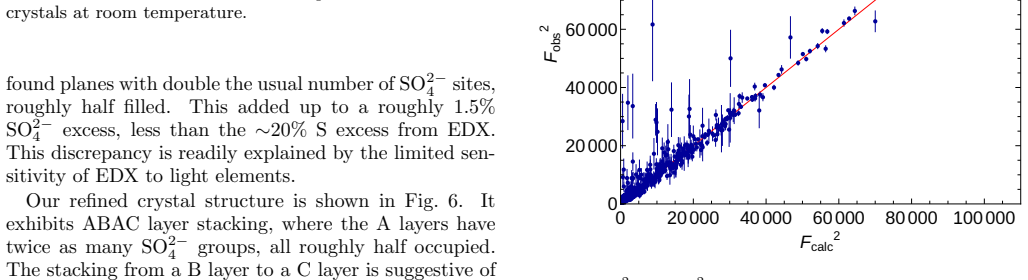
- [Fig. 8] The caption of Fig. 8 refers to 'F2calc vs. F2meas' while the axis labels read 'Fcalc^2' and 'Fobs^2'; the notation should be unified.
- [II] The statement that the discrepancy between the roughly 1.5% sulfate excess from refinement and the roughly 20% S excess from EDX is 'readily explained by the limited sensitivity of EDX to light elements' is plausible but would benefit from one sentence of justification, since the measured quantity is a Cu:S ratio rather than an absolute sulfur content.
Circularity Check
No significant circularity: the structural and magnetic claims are inferred from measured diffraction, magnetization, and specific-heat data, not from model inputs or self-citations.
full rationale
The paper's central claims — synthesis of brochantite single crystals, a possible new ABAC-type stacking tendency, anion disorder, and a double magnetic transition — are all derived from experimental data: single-crystal x-ray and neutron refinements, diffuse scattering, magnetization, and specific heat. The ABAC interpretation is a structural model tested against observed Bragg reflections and diffuse rods, not a quantity fitted from the same data and then re-presented as a prediction. The Monte Carlo stacking simulation is compared visually to the diffuse scattering and the text itself states the stacking is 'nearly random', so the later phrase 'weak tendency toward ABAC' is an interpretive summary rather than a parameter extracted by construction. The phonon background used to isolate the magnetic specific heat is a standard Debye-Einstein fit to high-temperature data; the magnetic entropy and transitions follow from the residual, and no claim is made that the fit predicts the same data. The paper's self-citations to prior work on antlerite and rouaite are comparisons of similar copper minerals and are not load-bearing for the brochantite structure determination. The main weakness is quantitative: no fitted layer-correlation value or uncertainty is reported, so the 'weak tendency' is under-supported; however, that is an evidentiary or reporting concern, not circularity. No equation or argument in the paper reduces to its own inputs by definition.
Assumptions & free parameters
free parameters (3)
- Debye-Einstein phonon fit parameters =
nD = 15.3, nE = 5.65, thetaD = 974 K, thetaE = 168.5 K
- Monte Carlo layer stacking correlation parameter =
not reported; values -0.81, +0.11, and +0.87 shown for illustration
- Curie-Weiss parameters =
mu_eff = 2.22, 2.09, 1.85 muB/Cu and theta_CW = -104, -82, -101 K for H along b, [100], c
assumptions (4)
- domain assumption The A, B, and C layers are identical ideal brochantite layers differing only by flips or shifts
- domain assumption Interlayer coupling is weak because layers are linked only through hydrogen bonds
- domain assumption A single layer-correlation parameter captures the stacking disorder
- standard math The Debye-Einstein model adequately represents the lattice specific heat down to low temperature
Cite this review
Pith. "Pith review of Stacking disorder in novel ABAC-stacked brochantite, Cu$_4$SO$_4$(OH)$_6$." pith.science (2026). https://pith.science/paper/2U6WFRFR
@misc{pith2026250109654,
  author       = {Pith},
  title        = {Pith review of: Stacking disorder in novel ABAC-stacked brochantite, Cu$_4$SO$_4$(OH)$_6$},
  year         = {2026},
  howpublished = {\url{https://pith.science/paper/2U6WFRFR}},
  note         = {Machine review of arXiv:2501.09654}
}
abstract
In geometrically frustrated magnetic systems, weak interactions or slight changes to the structure can tip the delicate balance of exchange interactions, sending the system into a different ground state. Brochantite, Cu$_4$SO$_4$(OH)$_6$, has a copper sublattice composed of distorted triangles, making it a likely host for frustrated magnetism, but exhibits stacking disorder. The lack of synthetic single crystals has limited research on the magnetism in brochantite to powders and natural mineral crystals. We grew crystals which we find to be a new polytype with a tendency toward ABAC stacking and some anion disorder, alongside the expected stacking disorder. Comparison to previous results on natural mineral specimens suggests that cation disorder is more deleterious to the magnetism than anion and stacking disorder. Our specific heat data suggest a double transition on cooling into the magnetically ordered state.
Figures


Figures from the paper (8 more)




Reference graph
Works this paper leans on
-
[100]
The scale of the changes indicates that the moments lie mainly along
and b, but the magnetization increases slightly be- low this transition in fields along c. The scale of the changes indicates that the moments lie mainly along
-
[1]
A. P. Ramirez, Strongly geometrically frustrated mag- nets, Annu. Rev. Mater. Sci. 24, 453 (1994)
work page 1994
-
[2]
and perpendicular to c, consistent with the mag- netic structure in Ref. [18]. The transitions from specific heat are indicated — the transition for all three direc- tions most likely corresponds to the 6.8-K transition in the specific heat, but due to the noise in the magnetiza- tion data this cannot be determined with certainty for b or c. Zero-field-co...
-
[3]
5(a) and 5(b) and replotted as M/H in Figs
and b, shown in Figs. 5(a) and 5(b) and replotted as M/H in Figs. 5(d) and 5(e), respectively, shows a mag- netic transition which is initially around 5.5 T at 2.3 K for H ∥ [100] and 14–15 T at 1.8 K for H ∥ b. These broaden and fall to lower field as the temperature increases, even- tually disappearing around TN. For H ∥ [100] this may well be TN, since...
-
[4]
C. D. Batista, S.-Z. Lin, S. Hayami, and Y. Kamiya, Frus- tration and chiral orderings in correlated electron sys- tems, Rep. Prog. Phys. 79, 084504 (2016). 10
work page 2016
-
[5]
C. Lacroix, P. Mendels, and F. Mila, eds., Introduction to Frustrated Magnetism, Springer Series in Solid-State Sciences, Vol. 164 (Springer, Berlin, 2011)
work page 2011
-
[6]
H. T. Diep, Frustrated Spin Systems, 2nd ed. (World Sci- entific, Singapore, 2013)
work page 2013
-
[7]
D. S. Inosov, Quantum magnetism in minerals, Adv. Phys. 67, 149 (2018)
work page 2018
Show all 38 references
-
[8]
Schmidt and P
B. Schmidt and P. Thalmeier, Frustrated two dimen- sional quantum magnets, Phys. Rep. 703, 1 (2017)
2017
-
[9]
Merlino, N
S. Merlino, N. Perchiazzi, and D. Franco, Brochantite, Cu4SO4(OH)6: OD character, polytypism and crystal structures, Eur. J. Mineral. 15, 267 (2003)
2003
-
[10]
Lancaster, Quantum spin liquids, Contemp
T. Lancaster, Quantum spin liquids, Contemp. Phys. 64, 127 (2023), arXiv:2310.19577 [cond-mat.str-el]
2023 arXiv
-
[11]
M. P. Shores, E. A. Nytko, B. M. Bartlett, and D. G. Nocera, A structurally perfect S = 1 2 kagom´ e antiferro- magnet, J. Am. Chem. Soc. 127, 13462 (2005)
2005
-
[12]
M. R. Norman, Colloquium: Herbertsmithite and the search for the quantum spin liquid, Rev. Mod. Phys. 88, 041002 (2016)
2016
-
[13]
A. A. Kulbakov, E. Sadrollahi, F. Rasch, M. Avdeev, S. Gaß, L. T. Corredor Bohorquez, A. U. B. Wolter, M. Feig, R. Gumeniuk, H. Poddig, M. St¨ otzer, F. J. Lit- terst, I. Puente-Orench, A. Wildes, E. Weschke, J. Geck, D. S. Inosov, and D. C. Peets, Incommensurate and multiple-...
2022
-
[14]
Heinze, H
L. Heinze, H. O. Jeschke, I. I. Mazin, A. Metavit- siadis, M. Reehuis, R. Feyerherm, J.-U. Hoffmann, M. Bartkowiak, O. Prokhnenko, A. U. B. Wolter, X. Ding, V. S. Zapf, C. Corval´ an Moya, F. Weickert, M. Jaime, K. C. Rule, D. Menzel, R. Valent ´ ı, W. Brenig, and S. S¨ ullow,...
2021
-
[15]
A. A. Kulbakov, D. Y. Kononenko, S. Nishimoto, Q. Stahl, A. Mannathanath Chakkingal, M. Feig, R. Gu- meniuk, Y. Skourski, L. Bhaskaran, S. A. Zvyagin, J. P. Embs, I. Puente-Orench, A. Wildes, J. Geck, O. Janson, D. S. Inosov, and D. C. Peets, Coupled frustrated ferromagnetic a...
2022
-
[16]
Cocco and F
G. Cocco and F. Mazzi, La struttura della brochantite, Period. Mineral. 28, 121 (1959)
1959
-
[17]
Zhang, Z
H. Zhang, Z. Zhao, D. Gautreau, M. Raczkowski, A. Saha, V. O. Garlea, H. Cao, T. Hong, H. O. Jeschke, S. D. Mahanti, T. Birol, F. F. Assaad, and X. Ke, Coexis- tence and interaction of spinons and magnons in an anti- ferromagnet with alternating antiferromagnetic and fer- roma...
2020
-
[18]
Mannathanath Chakkingal, A
A. Mannathanath Chakkingal, A. A. Kulbakov, J. Grum- bach, N. S. Pavlovskii, U. Stockert, K. K. Parui, M. Avdeev, R. Kumar, I. Niwata, E. H¨ außler, R. Gu- meniuk, J. R. Stewart, J. P. Tellam, V. Pomjakushin, S. Granovsky, M. Doerr, E. Hassinger, S. Zherlitsyn, Y. Ihara, D. S....
2024
-
[19]
orthobrochantite
S. J. Mills, A. R. Kampf, M. Pasero, and S. Merlino, Discreditation of “orthobrochantite” (IMA 78–64) as the MDO1 polytype of brochantite, Eur. J. Mineral. 22, 453 (2010)
2010
-
[20]
Helliwell and J
M. Helliwell and J. V. Smith, Brochantite, Acta Crystal- logr., Sect. C: Struct. Chem. 53, 1369 (1997)
1997
-
[21]
S. E. Nikitin, T. Xie, A. Gazizulina, B. Ouladdiaf, J. A. R. Velamaz´ an, I. F. D ´ ıaz-Ortega, H. Nojiri, L. M. Anovitz, A. M. dos Santos, O. Prokhnenko, and A. Podlesnyak, Helical spin dynamics in commensurate magnets: A study on brochantite, Cu 4SO4(OH)6, Phys. Rev. Res. 5,...
2023
-
[22]
G. M. Sheldrick, Crystal structure refinement with Shelxl, Acta Crystallogr. Sect. C – Struct. Chem. 71, 3 (2015)
2015
-
[23]
Vilminot, M
S. Vilminot, M. Richard-Plouet, G. Andr´ e, D. Swierczyn- ski, F. Bour´ ee-Vigneron, and M. Kurmoo, Nuclear and magnetic structures and magnetic properties of synthetic brochantite, Cu4(OH)6SO4, Dalton Trans. , 1455 (2006)
2006
-
[24]
G. M. Sheldrick, A short history of S helx, Acta Crystal- logr. A 64, 112 (2008)
2008
-
[25]
Girard, T
A. Girard, T. Nguyen-Thanh, S. M. Souliou, M. Stekiel, W. Morgenroth, L. Paolasini, A. Minelli, D. Gambetti, B. Winkler, and A. Bosak, A new diffractometer for diffuse scattering studies on the ID28 beamline at the ESRF, J. Synchrotron Radiat. 26, 272 (2019)
2019
-
[26]
L. J. Farrugia, WinGX and Ortep for Windows: an update, J. Appl. Crystallogr. 45, 849 (2012)
2012
-
[27]
Dyadkin, P
V. Dyadkin, P. Pattison, V. Dmitriev, and D. Chernyshov, A new multipurpose diffractometer PILATUS@SNBL, J. Synchrotron Radiat. 23, 825 (2016)
2016
-
[28]
R. O. Piltz, Accurate data processing for neutron Laue diffractometers, Journal of Applied Crystallography 51, 635 (2018)
2018
-
[29]
Rodr ´ ıguez-Carvajal, Recent advances in magnetic structure determination by neutron powder diffraction, Physica B 192, 55 (1993)
J. Rodr ´ ıguez-Carvajal, Recent advances in magnetic structure determination by neutron powder diffraction, Physica B 192, 55 (1993)
1993
-
[30]
A. J. Edwards, Neutron diffraction – recent applications to chemical structure determination, Aust. J. Chem. 64, 869 (2011)
2011
-
[31]
R. Bag, M. Ennis, C. Liu, S. E. Dissanayake, Z. Shi, J. Liu, L. Balents, and S. Haravifard, Realization of quan- tum dipoles in triangular lattice crystal Ba 3Yb(BO3)3, Phys. Rev. B 104, L220403 (2021)
2021
-
[32]
Petˇ r ´ ıˇ cek, L
V. Petˇ r ´ ıˇ cek, L. Palatinus, J. Pl´ aˇ sil, and M. Duˇ sek, Jana2020 — a new version of the crystallographic com- puting system Jana, Z. Kristallogr. Cryst. Mater. 238, 271 (2023)
2023
-
[33]
V. A. Ginga, B. Shen, E. Uykur, N. Giordano, P. Gegen- wart, and A. A. Tsirlin, Pressure-tuned spin chains in brochantite, Cu 4SO4(OH)6 (2025), arXiv:2504.12057 [cond-mat.str-el]
2025
-
[34]
K. K. Parui, A. A. Kulbakov, E. H¨ außler, N. S. Pavlovskii, A. Mannathanath Chakkingal, M. Avdeev, R. Gumeniuk, S. Granovsky, A. Mistonov, S. A. Zvya- gin, T. Doert, D. S. Inosov, and D. C. Peets, Disor- dered ground state in the 3D face-centred frustrated spin- 5 2 system Mn...
2025 arXiv
-
[35]
Bhattacharya, S
K. Bhattacharya, S. Mohanty, A. D. Hillier, M. T. F. Telling, R. Nath, and M. Majumder, Evidence of quan- tum spin liquid state in a Cu 2+-based S = 1 2 triangu- lar lattice antiferromagnet, Phys. Rev. B 110, L060403 (2024)
2024
-
[36]
V. K. Singh, K. Nam, M. Barik, K. Boya, E. Kermarrec, P. Khuntia, K. H. Kim, S. Bhowal, and B. Koteswararao, Bi2YbO4Cl: A two-dimensional square-lattice compound with Jeff = 1 2 magnetic moments, Phys. Rev. B 109, 075128 (2024)
2024
-
[38]
Mannathanath Chakkingal, C
A. Mannathanath Chakkingal, C. Fuller, M. Avdeev, R. Gumeniuk, M. C. Rahn, F. Pabst, Y. Wang, S. Gra- novsky, D. Chernyshov, D. S. Inosov, and D. C. Peets, Data underpinning: Stacking disorder in novel ABAC- stacked brochantite (2025), OPARA repository, Technis- che Universit¨...
2025 doi
Reviewed August 10, 2026 · model on record in the stance chip above.
Discussion (0). Continue with ORCID to comment.