REVIEW 4 major objections 5 minor 106 references
Magnetic-field effect on excitonic condensation emergent in extended Falicov-Kimball model
T0 review · 4 major / 5 minor · reviewed 2026-08-10 · deepseek-v4-flash
Pith's one-line read In the extended Falicov-Kimball model, an orbital magnetic field makes excitonic order nonmonotonic: enhanced at Landau level crossings, suppressed in a disordered insulator with opposite Chern numbers, and reentrant via Hofstadter bands.
desk verdict Honest, clearly written Hartree-Fock study with genuinely new field-axis phase diagrams; the DO phase's Chern-number claim is underdocumented and the central results are untested beyond mean-field, but the paper deserves a careful referee. read the letter →
The pith
A machine-rendered reading of the paper's core claim, the machinery that carries it, and where it could break.
The reading
What carries the argument
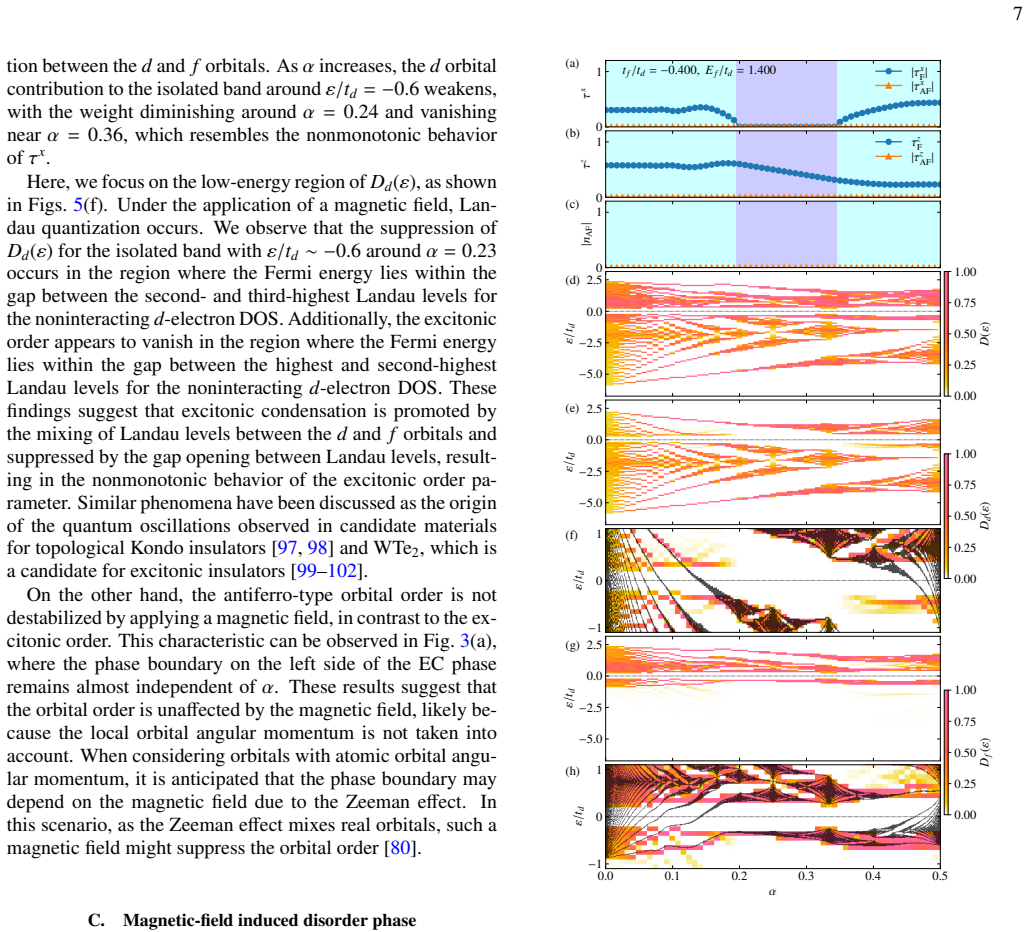
The machinery is the Peierls phase, which converts a uniform magnetic field into a site-dependent complex hopping factor $t_{ij} = t\,e^{i\theta_{ij}}$, plus its consequences: Landau quantization of the d and f orbitals and, at higher flux, the Hofstadter butterfly spectrum. The argument runs by comparing where the Fermi level sits relative to the Landau levels of the noninteracting d-electron density of states: when the Fermi level crosses a Landau level, the repulsion $U$ can spontaneously hybridize d and f electrons and drive excitonic order; when the Fermi level lies in a Landau gap, the hybridization is not profitable and order is suppressed. In the quantum-limit region the two orbitals fill their lowest and highest Landau levels with opposite Chern numbers, giving the DO phase, and at larger $\alpha$ the fractal Hofstadter bands widen enough to reestablish the mixing that stabilizes excitonic order.
What would settle it
A beyond-Hartree-Fock calculation—such as real-space dynamical mean-field theory on the same flux lattice at $U/t_d = 2$—that fails to find the disordered insulating phase with opposite-sign Chern numbers, or a pulsed-field experiment on a candidate excitonic insulator that does not show the predicted nonmonotonic gap and quantized Hall plateau near 1000 T, would refute the central claim.
Extended reading notes
Core claim
The central claim is that in the extended Falicov-Kimball model the magnetic field's effect on orbital motion, introduced through Peierls phases, yields an excitonic order parameter that oscillates, vanishes, and reemerges as the flux $\alpha$ grows from 0 to 1/2. Concretely, Hartree-Fock calculations on a 120-site cluster show that the excitonic order parameter $\tau_F^x$ is enhanced whenever a Landau level of the noninteracting d-electron spectrum crosses the Fermi level, suppressed when the Fermi level sits in a Landau gap, and driven to zero in an intermediate-field 'disordered' (DO) insulating phase. In the DO phase both orbitals remain partially occupied and carry Chern numbers of opposite sign, so the state is a magnetic-field-stabilized Chern insulator rather than the fully orbital-polarized state. At still higher fields the order parameter revives because the Hofstadter butterfly spectrum broadens the bands and restores the overlap between the two orbitals. The paper also shows that staggered orbital order is barely affected by the field, while coexisting excitonic order in the supersolid phase is suppressed, indicating that the field acts selectively on inter-orbital hybridization.
Load-bearing premise
The results assume that Hartree-Fock mean-field theory on a 120-site cluster correctly identifies the ordered phases at $U/t_d = 2$, and that the magnetic field enters only through Peierls phases because the local orbital angular momentum is quenched.
Editorial extensions
If this is right
- An orbital magnetic field alone can switch a spontaneously hybridized excitonic insulator into a Chern insulator with quantized Hall response, without any spin polarization.
- The excitonic gap and order parameter should oscillate with field strength, with maxima near Landau level crossings; these oscillations are a direct signature to look for in candidate materials.
- At ultra-high fields where the quantum limit is reached, excitonic order should be replaced by a disordered insulating state, and then reemerge as Hofstadter bands widen, making the reentrant phase a hallmark of lattice effects rather than continuum physics.
- Orbital order coexisting with excitonic order remains robust under the field, so the field selectively destroys only the inter-orbital coherence, offering a way to disentangle the two orders experimentally.
Reading between the lines
- Because the mechanism only needs Landau quantization and a repulsive inter-orbital interaction, the same nonmonotonic order parameter and intervening Chern-insulating phase should appear in any two-band lattice model with an excitonic instability, not just the Falicov-Kimball form.
- The model's assumption that orbital angular momentum is quenched can be tested by adding an orbital Zeeman term: if a material's orbitals carry unquenched angular momentum, the field would shift the phase boundaries and break the symmetry between $\alpha$ and $-\alpha$, which the present Peierls-only coupling does not.
- A beyond-mean-field calculation, for instance with real-space dynamical mean-field theory, would show whether the disordered Chern-insulating window survives strong correlations; if it does, the phase is a genuine strong-field effect, and if not, the reentrant order at high fields would be the more robust prediction.
Signed reviews
Editorial analysis
A structured set of objections, weighed in public.
Referee Report
Summary. The manuscript studies the square-lattice extended Falicov-Kimball model at half-filling under an orbital magnetic field introduced via Peierls phases. Using the Hartree-Fock approximation on clusters with Nx=120 sites, the authors compute phase diagrams in the (E_f, alpha) plane for t_f/t_d=-0.08 and -0.4 at U/t_d=2. They report a nonmonotonic excitonic order parameter as a function of flux, attributed to Landau-level crossings; a field-induced disordered insulating (DO) phase with opposite-sign Chern numbers for the two orbitals; and a reentrant excitonic condensate at higher fields due to Hofstadter butterfly bands. The paper also analyzes the excitonic supersolid phase and finds orbital order more robust than excitonic order.
Significance. If correct, the results establish a concrete mechanism by which ultra-high magnetic fields can destroy, create, and recreate excitonic order purely through orbital motion, and they identify a candidate topologically nontrivial insulating state in a correlated two-orbital model. The manuscript's internal consistency is good: the HF self-consistency is standard, cluster-size convergence is checked in Appendix A for representative order parameters, and the zero-field phase diagram reproduces Ref. [96]. The interpretation of the nonmonotonic order parameter in terms of noninteracting Landau-level DOS is plausible. However, the central claims rest entirely on HF at moderate coupling, with no independent non-mean-field check, and the Chern-number characterization of the DO phase is asserted without a described method. The significance is therefore conditional on the robustness of these HF results.
major comments (4)
- [Sec. III C and Fig. 6] The statement 'We have confirmed that the Chern numbers of the d and f orbitals are ±1 with opposite signs' is not accompanied by any computational description. To make the DO phase's topological characterization reproducible and verifiable, specify the method (e.g., twisted boundary conditions or Kubo formula), the gauge choice, the k-grid or number of flux sectors, and demonstrate convergence of the Chern number with respect to cluster size and numerical parameters.
- [Sec. III B/C and Fig. 3] The entire field-dependent phase diagram, including the DO phase and the reentrant EC region, is obtained solely from the Hartree-Fock approximation at U/t_d=2. In two dimensions, HF is known to overestimate excitonic order; the paper itself cites Refs. [86,90,92,93] showing that beyond-HF methods shift or eliminate zero-field excitonic phases in the same model. Since the paper's novel claims are precisely the field-induced phases, an independent non-mean-field calculation (e.g., CDMFT, slave-boson, or exact diagonalization on small clusters with the same Peierls phases) is needed to establish that the DO phase and reentrant EC are not HF artifacts. Please provide such a check or substantially qualify the conclusions.
- [Sec. II and Sec. IV] The assumption that local orbital angular momentum is quenched and hence no orbital Zeeman coupling exists is made at the outset and acknowledged only in the Discussion. Because the paper aims to make contact with real transition-metal compounds under ultra-high fields, this assumption should be justified from the orbital character of the intended materials, or the paper should clearly state that the predictions apply only to the idealized model without orbital Zeeman coupling. A brief quantitative estimate of when the Peierls-phase coupling dominates over the orbital Zeeman term would strengthen the claim.
- [Appendix A] The cluster-size convergence test covers only |tau^x_F| at three parameter sets, not the phase boundaries or the Chern numbers in the DO phase. Since the DO phase occupies a narrow alpha window and the reentrant EC occurs at high alpha where the Hofstadter spectrum is sensitive to system size, please report the size dependence of the DO-phase boundaries and of the reentrant EC region, or at least state why the current order-parameter convergence implies convergence of the full phase diagram.
minor comments (5)
- [Sec. II after Eq. (2)] The text 'theta_ij = 1 in the x direction' should read 'theta_ij = 0 in the x direction' for the Landau gauge A=(0,Bx,0), since the Peierls phase along x is zero in that gauge.
- [Fig. 3(b) caption] The caption should clarify that the DO phase is absent at alpha=0.5, as shown in Fig. 8, and the four-sublattice calculation for alpha=0.5 should be described in the main text rather than only in Appendix B.
- [Sec. I, Introduction] The statement that the impact of magnetic fields on orbital motion 'has often been considered negligible' may overstate previous literature, since several cited works [28,35-40] already study orbital effects in related models; consider rephrasing to 'less studied in the context of excitonic condensation.'
- [Sec. III B, order parameters] The notation tau^z_F = 1 for the FP phase is slightly misleading because this quantity is nonzero even without symmetry breaking for E_f != 0; consider calling it an occupation imbalance rather than an order parameter in the text.
- [Sec. IV, field estimate] The estimate that alpha=1 corresponds to h/(e a^2) ~ 10^4 T should explicitly state the assumed lattice constant a=10 angstrom and note that the mapping to tesla scales as 1/a^2.
Circularity Check
No significant circularity: the field-dependent phase diagram is obtained by self-consistent solution of the stated model, not by fitting or self-citation.
full rationale
The central claims, including the nonmonotonic excitonic order parameter, the disordered insulating (DO) phase, and the reentrant excitonic condensation, are computed by solving the Hartree-Fock equations for the Hamiltonian in Eq. (1) with Peierls phases, with all order parameters determined self-consistently on a finite cluster (Nx = 120). No quantity is fitted to a target result: the interaction strength U/td = 2 and the hopping parameters are fixed inputs, and the phase diagrams are read off from the self-consistent solutions. The Landau-level and Hofstadter-band explanations in Secs. III B and III C are interpretations of the computed DOS and order parameters, not assumptions used to produce them. The zero-field phase diagram is cross-checked against the independent Hartree-Fock study of Ref. [96]. The self-citations that appear (e.g., Refs. [48, 49, 76, 80]) are motivational or concern related but distinct models; the present phase diagram does not depend on those results. The authors' own discussion acknowledges that strong Coulomb interactions would require methods beyond Hartree-Fock, which is an accuracy limitation, not a circular step. The claim that the d and f orbitals have opposite-sign Chern numbers in the DO phase is not accompanied by a detailed calculation, but that is a missing-support or reproducibility concern rather than circularity. Overall, the derivation chain is self-contained and no predicted quantity reduces by construction to an input.
Assumptions & free parameters
free parameters (3)
- U/t_d =
2.0
- t_f/t_d =
-0.08 and -0.40
- E_f/t_d =
0.6, 1.4, 1.7
assumptions (5)
- standard math Peierls substitution: a uniform magnetic field enters the tight-binding Hamiltonian as hopping phases theta_ij = -(2 pi e / h) integral A dot dl.
- domain assumption Hartree-Fock decoupling of the Coulomb term U n_d n_f yields the correct ordered phases.
- ad hoc to paper Local orbital angular momentum of the d and f orbitals is quenched and no orbital Zeeman coupling is generated.
- domain assumption Half-filling is imposed via a chemical potential with n_F = 1, and the model's U(1) symmetry allows choosing tau_y = 0.
- standard math Periodic boundary conditions require alpha = m/N_x, and physical results are periodic in alpha with period 1.
Cite this review
Pith. "Pith review of Magnetic-field effect on excitonic condensation emergent in extended Falicov-Kimball model." pith.science (2026). https://pith.science/paper/BP5AVEHX
@misc{pith2026250109925,
  author       = {Pith},
  title        = {Pith review of: Magnetic-field effect on excitonic condensation emergent in extended Falicov-Kimball model},
  year         = {2026},
  howpublished = {\url{https://pith.science/paper/BP5AVEHX}},
  note         = {Machine review of arXiv:2501.09925}
}
read the original abstract
We investigate the effects of magnetic fields on excitonic condensation in the extended Falicov-Kimball model, which is a spinless two-orbital Hubbard model with orbital splitting. In lattice systems under magnetic fields up to several tens of teslas, Zeeman effects on electron spins have been extensively studied, while the impact on orbital motion has often been considered negligible. However, the recent capability to generate ultra-high magnetic fields exceeding 1000 T has renewed interest in understanding their influence on ordered phases in correlated electron systems, beyond spin-related phenomena. To examine these effects, we incorporate a magnetic field into the extended Falicov-Kimball model by introducing the Peierls phase into the transfer integrals, enabling the study of orbital motion. Using the Hartree-Fock approximation, we reveal a nonmonotonic response of the excitonic order parameter to increasing magnetic fields. At sufficiently high fields, the excitonic order is suppressed, resulting in a disordered insulating state characterized by partial occupation of the two orbitals with nonzero Chern numbers. This state is distinct from a fully orbital-polarized configuration. Furthermore, our analysis of an excitonic supersolid phase, in which excitonic and orbital orders coexist, demonstrates that orbital order remains robust under magnetic fields, while excitonic condensation is suppressed. These findings provide insights into the interplay between orbital motion and magnetic fields in multi-orbital correlated electron systems.
Figures


Figures from the paper (5 more)




Reference graph
Works this paper leans on
-
[96]
P. Farkašovský, Hartree-fock study of electronic ferroelectric- ity in the falicov-kimball model with f− f hopping, Phys. Rev. B 77, 155130 (2008)
work page 2008
-
[1]
Tokura and Y
Y . Tokura and Y . Tomioka, Colossal magnetoresistive man- ganites, J. Magn. Magn. Mater. 200, 1 (1999)
1999
-
[2]
Tokura and N
Y . Tokura and N. Nagaosa, Orbital physics in transition-metal oxides, Science 288, 462 (2000)
2000
-
[3]
J. Wang, J. Neaton, H. Zheng, V . Nagarajan, S. Ogale, B. Liu, D. Viehland, V . Vaithyanathan, D. Schlom, U. Waghmare, et al., Epitaxial bifeo3 multiferroic thin film heterostructures, science 299, 1719 (2003)
2003
-
[4]
Kimura, T
T. Kimura, T. Goto, H. Shintani, K. Ishizaka, T.-h. Arima, and Y . Tokura, Magnetic control of ferroelectric polarization, na- ture 426, 55 (2003)
2003
-
[5]
Katsura, N
H. Katsura, N. Nagaosa, and A. V . Balatsky, Spin current and magnetoelectric effect in noncollinear magnets, Phys. Rev. Lett. 95, 057205 (2005)
2005
-
[6]
Mostovoy, Ferroelectricity in spiral magnets, Phys
M. Mostovoy, Ferroelectricity in spiral magnets, Phys. Rev. Lett. 96, 067601 (2006)
2006
-
[7]
Cheong and M
S.-W. Cheong and M. Mostovoy, Multiferroics: a magnetic twist for ferroelectricity, Nature materials 6, 13 (2007)
2007
Show all 106 references
-
[8]
D. I. Khomskii, Multiferroics: Di fferent ways to combine magnetism and ferroelectricity, J. Magn. Magn. Mater. 306, 1 (2006)
2006
-
[9]
Honecker, J
A. Honecker, J. Schulenburg, and J. Richter, Magnetization plateaus in frustrated antiferromagnetic quantum spin models, J. Phys.: Condens. Matter 16, S749 (2004)
2004
-
[10]
Nishimoto, N
S. Nishimoto, N. Shibata, and C. Hotta, Controlling frustrated liquids and solids with an applied field in a kagome heisenberg antiferromagnet, Nat. Commun. 4, 2287 (2013)
2013
-
[11]
Ishikawa, M
H. Ishikawa, M. Yoshida, K. Nawa, M. Jeong, S. Krämer, M. Horvati´c, C. Berthier, M. Takigawa, M. Akaki, A. Miyake, M. Tokunaga, K. Kindo, J. Yamaura, Y . Okamoto, and Z. Hi- roi, One-third magnetization plateau with a preceding novel phase in volborthite, Phys. Rev. Lett. 114...
2015
-
[12]
Suetsugu, T
S. Suetsugu, T. Asaba, Y . Kasahara, Y . Kohsaka, K. Totsuka, B. Li, Y . Zhao, Y . Li, M. Tokunaga, and Y . Matsuda, Emer- gent spin-gapped magnetization plateaus in a spin-1/2 perfect kagome antiferromagnet, Phys. Rev. Lett.132, 226701 (2024)
2024
-
[13]
Nikuni, M
T. Nikuni, M. Oshikawa, A. Oosawa, and H. Tanaka, Bose- einstein condensation of dilute magnons in tlcucl3, Phys. Rev. Lett. 84, 5868 (2000)
2000
-
[14]
Giamarchi, C
T. Giamarchi, C. Rüegg, and O. Tchernyshyov, Bose–einstein condensation in magnetic insulators, Nat. Phys.4, 198 (2008)
2008
-
[15]
Willett, J
R. Willett, J. P. Eisenstein, H. L. Störmer, D. C. Tsui, A. C. Gossard, and J. H. English, Observation of an even- denominator quantum number in the fractional quantum hall effect, Phys. Rev. Lett. 59, 1776 (1987)
1987
-
[16]
R. B. Laughlin, Anomalous quantum hall e ffect: An incom- pressible quantum fluid with fractionally charged excitations, Phys. Rev. Lett. 50, 1395 (1983)
1983
-
[17]
G. Fano, F. Ortolani, and E. Colombo, Configuration- interaction calculations on the fractional quantum hall e ffect, Phys. Rev. B 34, 2670 (1986)
1986
-
[18]
X. G. Wen, Gapless boundary excitations in the quantum hall states and in the chiral spin states, Phys. Rev. B 43, 11025 (1991)
1991
-
[19]
I. L. Aleiner and L. I. Glazman, Novel edge excitations of two-dimensional electron liquid in a magnetic field, Phys. Rev. Lett. 72, 2935 (1994)
1994
-
[20]
Hatsugai, P.-A
Y . Hatsugai, P.-A. Bares, and X. G. Wen, Electron spectral function of an interacting two dimensional electron gas in a strong magnetic field, Phys. Rev. Lett. 71, 424 (1993). 10 0.0 0.5 1.0 |τx F| t f/td =−0.08, E f/td = 1.70(a) Nx =60 Nx =120 Nx =180 0.0 0.5 1.0 |τx F| t f/...
1993
-
[21]
A. M. Rudin, I. L. Aleiner, and L. I. Glazman, Interaction- induced oscillations of the tunneling density of states in a non- quantizing magnetic field, Phys. Rev. Lett. 78, 709 (1997)
1997
-
[22]
Gravier, M
L. Gravier, M. Potemski, P. Hawrylak, and B. Etienne, Electron-electron interactions in emission from a two- dimensional electron gas in quantizing magnetic fields, Phys. Rev. Lett. 80, 3344 (1998)
1998
-
[23]
D. R. Hofstadter, Energy levels and wave functions of bloch electrons in rational and irrational magnetic fields, Phys. Rev. B 14, 2239 (1976)
1976
-
[24]
Doh and S.-H
H. Doh and S.-H. S. Salk, E ffects of electron correlations on the hofstadter spectrum, Phys. Rev. B 57, 1312 (1998)
1998
-
[25]
Mastropietro, Persistence of gaps in the interacting anisotropic hofstadter model, Phys
V . Mastropietro, Persistence of gaps in the interacting anisotropic hofstadter model, Phys. Rev. B99, 155154 (2019)
2019
-
[26]
Czajka, A
K. Czajka, A. Gorczyca, M. M. Ma ´ska, and M. Mierzejewski, Hofstadter butterfly for a finite correlated system, Phys. Rev. B 74, 125116 (2006)
2006
-
[27]
J. K. Ding, W. O. Wang, B. Moritz, Y . Schattner, E. W. Huang, and T. P. Devereaux, Thermodynamics of correlated electrons in a magnetic field, Commun. Phys. 5, 204 (2022)
2022
-
[28]
Tran, Electronic structure of the falicov-kimball model with a magnetic field: Dynamical mean-field study, Phys
M.-T. Tran, Electronic structure of the falicov-kimball model with a magnetic field: Dynamical mean-field study, Phys. Rev. B 81, 115119 (2010)
2010
-
[29]
Pradhan, Hofstadter butterfly in the falicov–kimball model on some finite 2d lattices, J
S. Pradhan, Hofstadter butterfly in the falicov–kimball model on some finite 2d lattices, J. Phys.: Condens. Matter 28, 505502 (2016)
2016
-
[30]
Mishra, S
A. Mishra, S. R. Hassan, and R. Shankar, Effects of interaction in the hofstadter regime of the honeycomb lattice, Phys. Rev. B 93, 125134 (2016)
2016
-
[31]
Mishra, S
A. Mishra, S. R. Hassan, and R. Shankar, Translational sym- metry breaking and the disintegration of the hofstadter butter- fly, Phys. Rev. B95, 035140 (2017)
2017
-
[32]
Gudmundsson and R
V . Gudmundsson and R. R. Gerhardts, Effects of screening on the hofstadter butterfly, Phys. Rev. B52, 16744 (1995)
1995
-
[33]
Wróbel, M
M. Wróbel, M. Mierzejewski, and M. M. Ma´ska, The Falicov- Kimball model in external magnetic field: Orbital effects, Acta Phys. Pol. A 118, 379 (2010)
2010
-
[34]
V . M. Apalkov and T. Chakraborty, Gap structure of the hofs- tadter system of interacting dirac fermions in graphene, Phys. Rev. Lett. 112, 176401 (2014)
2014
-
[35]
Gruber and N
C. Gruber and N. Macris, The Falicov-Kimball model: a re- view of exact results and extensions, Helv. Phys. Acta 69, 5 (1996)
1996
-
[36]
Gruber, N
C. Gruber, N. Macris, A. Messager, and D. Ueltschi, Ground states and flux configurations of the two-dimensional Falicov- Kimball model, J. Stat. Phys. 86, 57 (1997)
1997
-
[37]
U. K. Yadav, Orbital magnetic field driven metal–insulator transition in spinless extended Falicov-Kimball model on a tri- angular lattice, Solid State Commun. 249, 12 (2017)
2017
-
[38]
U. K. Yadav, Metal-insulator transition and band magnetism in the spin-1 /2 Falicov-Kimball model on a triangular lattice with external magnetic field, Eur. Phys. J. B 93, 221 (2020)
2020
-
[39]
Pradhan, Interplay between superconductivity and charge- order in an extended Falicov-Kimball model under orbital magnetic field, Physics Letters A 469, 128747 (2023)
S. Pradhan, Interplay between superconductivity and charge- order in an extended Falicov-Kimball model under orbital magnetic field, Physics Letters A 469, 128747 (2023)
2023
-
[40]
Pandey, U
S. Pandey, U. K. Yadav, and P. K. Priya, Electron correla- tion and magnetic field induced phase transitions in spin-1 /2 Falicov-Kimball model on a triangular lattice, Eur. Phys. J. B 97, 169 (2024)
2024
-
[41]
Nakamura, A
D. Nakamura, A. Ikeda, H. Sawabe, Y . Matsuda, and S. Takeyama, Record indoor magnetic field of 1200 t gener- ated by electromagnetic flux-compression, Rev. Sci. Instrum. 89, 10.1063/1.5044557 (2018)
2018 doi
-
[42]
Y . H. Matsuda, D. Nakamura, A. Ikeda, S. Takeyama, Y . Suga, H. Nakahara, and Y . Muraoka, Magnetic-field- induced insulator–metal transition in w-doped vo2 at 500 t, Nat. Commun. 11, 3591 (2020)
2020
-
[43]
Y . H. Matsuda, Y . Muraoka, D. Nakamura, A. Ikeda, Y . Ishii, X.-G. Zhou, H. Sawabe, and S. Takeyama, Magnetic-field- induced insulator metal transition of w-doped vo2 observed by electromagnetic flux compression at issp, J. Phys. Soc. Jpn. 11 91, 101008 (2022)
2022
-
[44]
Tokura, Y
Y . Tokura, Y . Okimoto, S. Yamaguchi, H. Taniguchi, T. Kimura, and H. Takagi, Thermally induced insulator-metal transition in lacoo3 : a view based on the mott transition, Phys. Rev. B 58, R1699 (1998)
1998
-
[45]
K. Asai, A. Yoneda, O. Yokokura, J. Tranquada, G. Shirane, and K. Kohn, Two spin-state transitions in lacoo 3, J. Phys. Soc. Jpn. 67, 290 (1998)
1998
-
[46]
Ikeda, T
A. Ikeda, T. Nomura, Y . H. Matsuda, A. Matsuo, K. Kindo, and K. Sato, Spin state ordering of strongly correlating lacoo3 induced at ultrahigh magnetic fields, Phys. Rev. B 93, 220401 (2016)
2016
-
[47]
Ikeda, Y
A. Ikeda, Y . H. Matsuda, and K. Sato, Two spin-state crystal- lizations in lacoo3, Phys. Rev. Lett. 125, 177202 (2020)
2020
-
[48]
Ikeda, Y
A. Ikeda, Y . H. Matsuda, K. Sato, Y . Ishii, H. Sawabe, D. Nakamura, S. Takeyama, and J. Nasu, Signature of spin- triplet exciton condensations in LaCoO3 at ultrahigh magnetic fields up to 600 t, Nat. Commun. 14, 1744 (2023)
2023
-
[49]
Ikeda, Y
A. Ikeda, Y . H. Matsuda, K. Sato, and J. Nasu, A review on magnetic field induced spin crossover in lacoo3 up to 600 t, J. Phys. Soc. Jpn. 93, 121005 (2024)
2024
-
[50]
E. W. Fenton, Excitonic insulator in a magnetic field, Phys. Rev. 170, 816 (1968)
1968
-
[51]
Fukuyama and T
H. Fukuyama and T. Nagai, Excitonic instability and ultra- sonic attenuation in strong magnetic fields, Phys. Rev. B 3, 4413 (1971)
1971
-
[52]
Kuramoto and M
Y . Kuramoto and M. Morimoto, Electron-hole pair condensa- tion and liquefaction in strong magnetic fields, J. Phys. Soc. Jpn. 44, 1759 (1978)
1978
-
[53]
Yoshioka, Electronic phase transitions of semimetals in a strong magnetic field, J
D. Yoshioka, Electronic phase transitions of semimetals in a strong magnetic field, J. Magn. Magn. Mater. 11, 66 (1979)
1979
-
[54]
Kaneko and Y
T. Kaneko and Y . Ohta, A new era of excitonic insulators, J. Phys. Soc. Jpn. 94, 012001 (2025)
2025
-
[55]
J. C. Y . Teo, L. Fu, and C. L. Kane, Surface states and topo- logical invariants in three-dimensional topological insulators: Application to bi1−xsbx, Phys. Rev. B 78, 045426 (2008)
2008
-
[56]
Hsieh, D
D. Hsieh, D. Qian, L. Wray, Y . Xia, Y . S. Hor, R. J. Cava, and M. Z. Hasan, A topological dirac insulator in a quantum spin hall phase, Nature 452, 970 (2008)
2008
-
[57]
Zhang, C.-X
H.-J. Zhang, C.-X. Liu, X.-L. Qi, X.-Y . Deng, X. Dai, S.-C. Zhang, and Z. Fang, Electronic structures and surface states of the topological insulator bi1−xsbx, Phys. Rev. B 80, 085307 (2009)
2009
-
[58]
Hsieh, Y
D. Hsieh, Y . Xia, L. Wray, D. Qian, A. Pal, J. Dil, J. Oster- walder, F. Meier, G. Bihlmayer, C. Kane, et al., Observation of unconventional quantum spin textures in topological insu- lators, Science 323, 919 (2009)
2009
-
[59]
A. A. Taskin and Y . Ando, Quantum oscillations in a topolog- ical insulator bi1−xsbx, Phys. Rev. B 80, 085303 (2009)
2009
-
[60]
Wakisaka, T
Y . Wakisaka, T. Sudayama, K. Takubo, T. Mizokawa, M. Arita, H. Namatame, M. Taniguchi, N. Katayama, M. No- hara, and H. Takagi, Excitonic insulator state in ta 2nise5 probed by photoemission spectroscopy, Phys. Rev. Lett. 103, 026402 (2009)
2009
-
[61]
Kaneko, T
T. Kaneko, T. Toriyama, T. Konishi, and Y . Ohta, Orthorhombic-to-monoclinic phase transition of ta 2nise5 in- duced by the bose-einstein condensation of excitons, Phys. Rev. B 87, 035121 (2013)
2013
-
[62]
K. Seki, Y . Wakisaka, T. Kaneko, T. Toriyama, T. Kon- ishi, T. Sudayama, N. L. Saini, M. Arita, H. Namatame, M. Taniguchi, N. Katayama, M. Nohara, H. Takagi, T. Mi- zokawa, and Y . Ohta, Excitonic bose-einstein condensation in ta2nise5 above room temperature, Phys. Rev. B 90,...
2014
-
[63]
Y . Lu, H. Kono, T. Larkin, A. Rost, T. Takayama, A. Boris, B. Keimer, and H. Takagi, Zero-gap semiconductor to exci- tonic insulator transition in ta2nise5, Nat. Commun. 8, 14408 (2017)
2017
-
[64]
M. M. Traum, G. Margaritondo, N. V . Smith, J. E. Rowe, and F. J. Di Salvo, Tise2: Semiconductor, semimetal, or excitonic insulator, Phys. Rev. B17, 1836 (1978)
1978
-
[65]
Cercellier, C
H. Cercellier, C. Monney, F. Clerc, C. Battaglia, L. Despont, M. G. Garnier, H. Beck, P. Aebi, L. Patthey, H. Berger, and L. Forró, Evidence for an excitonic insulator phase in 1t−tise2, Phys. Rev. Lett. 99, 146403 (2007)
2007
-
[66]
Kogar, M
A. Kogar, M. S. Rak, S. Vig, A. A. Husain, F. Flicker, Y . I. Joe, L. Venema, G. J. MacDougall, T. C. Chiang, E. Fradkin, J. van Wezel, and P. Abbamonte, Signatures of exciton con- densation in a transition metal dichalcogenide, Science 358, 1314 (2017)
2017
-
[67]
P. Wang, G. Yu, Y . Jia, M. Onyszczak, F. A. Cevallos, S. Lei, S. Klemenz, K. Watanabe, T. Taniguchi, R. J. Cava,et al., Lan- dau quantization and highly mobile fermions in an insulator, Nature 589, 225 (2021)
2021
-
[68]
B. Sun, W. Zhao, T. Palomaki, Z. Fei, E. Runburg, P. Ma- linowski, X. Huang, J. Cenker, Y .-T. Cui, J.-H. Chu, et al. , Evidence for equilibrium exciton condensation in monolayer wte2, Nat. Phys. 18, 94 (2022)
2022
-
[69]
Y . Jia, P. Wang, C.-L. Chiu, Z. Song, G. Yu, B. Jäck, S. Lei, S. Klemenz, F. A. Cevallos, M. Onyszczak, et al. , Evidence for a monolayer excitonic insulator, Nat. Phys. 18, 87 (2022)
2022
-
[70]
Mazza and M
G. Mazza and M. Polini, Hidden excitonic quantum states with broken time-reversal symmetry, Phys. Rev. B 108, L241107 (2023)
2023
-
[71]
H. D. Scammell, J. Ingham, T. Li, and O. P. Sushkov, Chiral excitonic order from twofold van hove singularities in kagome metals, Nat. Commun. 14, 605 (2023)
2023
-
[72]
Jiang, S
Y .-X. Jiang, S. Shao, W. Xia, M. M. Denner, J. Ingham, M. S. Hossain, Q. Qiu, X. Zheng, H. Chen, Z.-J. Cheng, et al., Van hove annihilation and nematic instability on a kagome lattice, Nature Materials 23, 1214 (2024)
2024
-
[73]
Ingham, A
J. Ingham, A. Consiglio, D. di Sante, R. Thomale, and H. D. Scammell, Theory of excitonic order in kagome metal scv6sn6, arXiv:2410.16365 (unpublished)
-
[74]
Kuneš and P
J. Kuneš and P. Augustinský, Excitonic condensation of strongly correlated electrons: The case of pr0.5ca0.5coo3, Phys. Rev. B 90, 235112 (2014)
2014
-
[75]
Kuneš and P
J. Kuneš and P. Augustinský, Excitonic instability at the spin- state transition in the two-band hubbard model, Phys. Rev. B 89, 115134 (2014)
2014
-
[76]
J. Nasu, T. Watanabe, M. Naka, and S. Ishihara, Phase dia- gram and collective excitations in an excitonic insulator from an orbital physics viewpoint, Phys. Rev. B93, 205136 (2016)
2016
-
[77]
Kaneko and Y
T. Kaneko and Y . Ohta, Roles of hund’s rule coupling in exci- tonic density-wave states, Phys. Rev. B90, 245144 (2014)
2014
-
[78]
Kaneko, B
T. Kaneko, B. Zenker, H. Fehske, and Y . Ohta, Competition between excitonic charge and spin density waves: Influence of electron-phonon and hund’s rule couplings, Phys. Rev. B 92, 115106 (2015)
2015
-
[79]
J. Nasu, M. Naka, and S. Ishihara, Strong enhancement of magnetic susceptibility induced by spin-nematic fluctuations in an excitonic insulating system with spin-orbit coupling, Phys. Rev. B 102, 045143 (2020)
2020
-
[80]
Koga and J
R. Koga and J. Nasu, E ffects of magnetic fields and orbital angular momentum on excitonic condensation in two-orbital hubbard model, J. Phys. Soc. Jpn. 93, 054703 (2024)
2024
-
[81]
Kinoshita, T
Y . Kinoshita, T. Fujita, R. Kurihara, A. Miyake, Y . Izaki, Y . Fuseya, and M. Tokunaga, Field-induced reentrant insu- 12 lator state of a gap-closed topological insulator (bi 1−xsbx) in quantum-limit states, Phys. Rev. B 107, 125140 (2023)
2023
-
[82]
L. M. Falicov and J. C. Kimball, Simple model for semiconductor-metal transitions: Smb 6 and transition-metal oxides, Phys. Rev. Lett. 22, 997 (1969)
1969
-
[83]
C. D. Batista, J. E. Gubernatis, J. Bon ˇca, and H. Q. Lin, In- termediate coupling theory of electronic ferroelectricity, Phys. Rev. Lett. 92, 187601 (2004)
2004
-
[84]
P. M. R. Brydon, Slave-boson theory of the extended Falicov- Kimball model, Phys. Rev. B 77, 045109 (2008)
2008
-
[85]
Schneider and G
C. Schneider and G. Czycholl, Weak-coupling treatment of electronic (anti-)ferroelectricity in the extended Falicov- Kimball model, Eur. Phys. J. B 64, 43 (2008)
2008
-
[86]
Zenker, D
B. Zenker, D. Ihle, F. X. Bronold, and H. Fehske, Existence of excitonic insulator phase in the extended Falicov-Kimball model: So(2)-invariant slave-boson approach, Phys. Rev. B 81, 115122 (2010)
2010
-
[87]
V .-N. Phan, K. W. Becker, and H. Fehske, Spectral signatures of the BCS-BEC crossover in the excitonic insulator phase of the extended Falicov-Kimball model, Phys. Rev. B81, 205117 (2010)
2010
-
[88]
V .-N. Phan, H. Fehske, and K. W. Becker, Excitonic reso- nances in the 2d extended Falicov-Kimball model, EPL 95, 17006 (2011)
2011
-
[89]
D. I. Golosov, Collective excitations and stability of the ex- citonic phase in the extended Falicov-Kimball model, Phys. Rev. B 86, 155134 (2012)
2012
-
[90]
K. Seki, T. Kaneko, S. Yamaki, R. Eder, and Y . Ohta, Variational cluster approach to the extended Falicov-Kimball model: A BCS-BEC crossover in the excitonic insulators, J. Phys. Conf. Ser. 391, 012147 (2012)
2012
-
[91]
Farkašovský, The influence of the interband coulomb inter- action and the f-electron hopping on excitonic correlations in the extended Falicov-Kimball model, EPL110, 47007 (2015)
P. Farkašovský, The influence of the interband coulomb inter- action and the f-electron hopping on excitonic correlations in the extended Falicov-Kimball model, EPL110, 47007 (2015)
2015
-
[92]
Hamada, T
K. Hamada, T. Kaneko, S. Miyakoshi, and Y . Ohta, Excitonic insulator state of the extended Falicov–Kimball model in the cluster dynamical impurity approximation, J. Phys. Soc. Jpn. 86, 074709 (2017)
2017
-
[93]
Kadosawa, S
M. Kadosawa, S. Nishimoto, K. Sugimoto, and Y . Ohta, Finite-temperature properties of excitonic condensation in the extended Falicov–Kimball model: Cluster mean-field-theory approach, J. Phys. Soc. Jpn. 89, 053706 (2020)
2020
-
[94]
Farkašovský, Dmrg study of exciton condensation in the extended Falicov-Kimball model, Condens
P. Farkašovský, Dmrg study of exciton condensation in the extended Falicov-Kimball model, Condens. Matter Phys. 23, 43709 (2020)
2020
-
[95]
Farkašovský, Hartree-fock exploration of electronic ferro- electricity, valence transitions, and metal-insulator transitions in the extended Falicov-Kimball model, Phys
P. Farkašovský, Hartree-fock exploration of electronic ferro- electricity, valence transitions, and metal-insulator transitions in the extended Falicov-Kimball model, Phys. Rev. B 108, 075161 (2023)
2023
-
[97]
Knolle and N
J. Knolle and N. R. Cooper, Quantum oscillations without a fermi surface and the anomalous de haas–van alphen e ffect, Phys. Rev. Lett. 115, 146401 (2015)
2015
-
[98]
Peters, T
R. Peters, T. Yoshida, and N. Kawakami, Quantum oscillations in strongly correlated topological kondo insulators, Phys. Rev. B 100, 085124 (2019)
2019
-
[99]
P. A. Lee, Quantum oscillations in the activated conductivity in excitonic insulators: Possible application to monolayer wte 2, Phys. Rev. B 103, L041101 (2021)
2021
-
[100]
He and P
W.-Y . He and P. A. Lee, Quantum oscillation of thermally ac- tivated conductivity in a monolayer wte2-like excitonic insula- tor, Phys. Rev. B104, L041110 (2021)
2021
-
[101]
A. A. Allocca and N. R. Cooper, Quantum oscillations in interaction-driven insulators, SciPost Phys. 12, 123 (2022)
2022
-
[102]
A. A. Allocca and N. R. Cooper, Fluctuation-dominated quan- tum oscillations in excitonic insulators, Phys. Rev. Res. 6, 033199 (2024)
2024
-
[103]
Cresti, Convenient peierls phase choice for periodic atom- istic systems under magnetic field, Phys
A. Cresti, Convenient peierls phase choice for periodic atom- istic systems under magnetic field, Phys. Rev. B 103, 045402 (2021)
2021
-
[104]
Higuchi, D
K. Higuchi, D. B. Hamal, and M. Higuchi, Relativistic tight- binding approximation method for materials immersed in a uniform magnetic field: Application to crystalline silicon, Phys. Rev. B 91, 075122 (2015)
2015
-
[105]
Higuchi, D
K. Higuchi, D. B. Hamal, and M. Higuchi, Nonperturbative description of the butterfly diagram of energy spectra for ma- terials immersed in a magnetic field, Phys. Rev. B 97, 195135 (2018)
2018
-
[106]
Matsuura and M
H. Matsuura and M. Ogata, Theory of orbital susceptibility in the tight-binding model: Corrections to the peierls phase, J. Phys. Soc. Jpn. 85, 074709 (2016)
2016
Reviewed August 10, 2026 · model on record in the stance chip above.
Discussion (0). Continue with ORCID to comment.