REVIEW 3 major objections 4 minor 46 references
Discrete Prior-based Temporal-coherent Content Prediction for Blind Face Video Restoration
T0 review · 3 major / 4 minor · reviewed 2026-08-10 · deepseek-v4-flash
Pith's one-line read A two-bank discrete prior mechanism predicts face video content and modulates it with motion statistics to produce coherent, identity-stable restoration.
desk verdict Plausible, useful face-video restoration architecture whose printed motion-statistics modulation is not correctly stated: Eq. (7) cancels the variance term it claims to apply, so the central temporal-coherence mechanism is unsupported as written. read the letter →
The pith
A machine-rendered reading of the paper's core claim, the machinery that carries it, and where it could break.
The reading
What carries the argument
Two discrete banks carry the argument. The visual prior bank, built by vector quantization during high-quality face reconstruction, holds 1,024 visual tokens; a spatial-temporal-aware transformer predicts one bank index per degraded video token and extracts the matching entry as the restored content feature. The motion prior bank holds 16,384 cross-frame mean and variance vectors; the modulation module concatenates each predicted feature's frame-wise mean and variance, retrieves the nearest stored vector, and adjusts the predicted content so its temporal statistics align with the stored high-quality statistics. A cross-attention transformer then takes the original predicted content as the query and the modulated content as key and value, and a generator with 3D residual blocks and frame attention decodes the fused representation into a video clip. The training objective combines a cross-entropy loss on the predicted bank indices, a pixel and perceptual consistency loss, and an adversarial loss.
What would settle it
Measure the channel-wise mean and variance of DP-TempCoh's restored clips frame by frame and compare them with the nearest retrieved bank vectors and with ground-truth video statistics; if the output statistics do not match the bank vector, the stated mechanism is not what produces the reported IFD gains. A direct arithmetic check of the modulation formula on a synthetic tensor would reveal whether the output variance equals the retrieved variance, since the retrieved variance appears as both multiplier and denominator in the printed formula.
Extended reading notes
Core claim
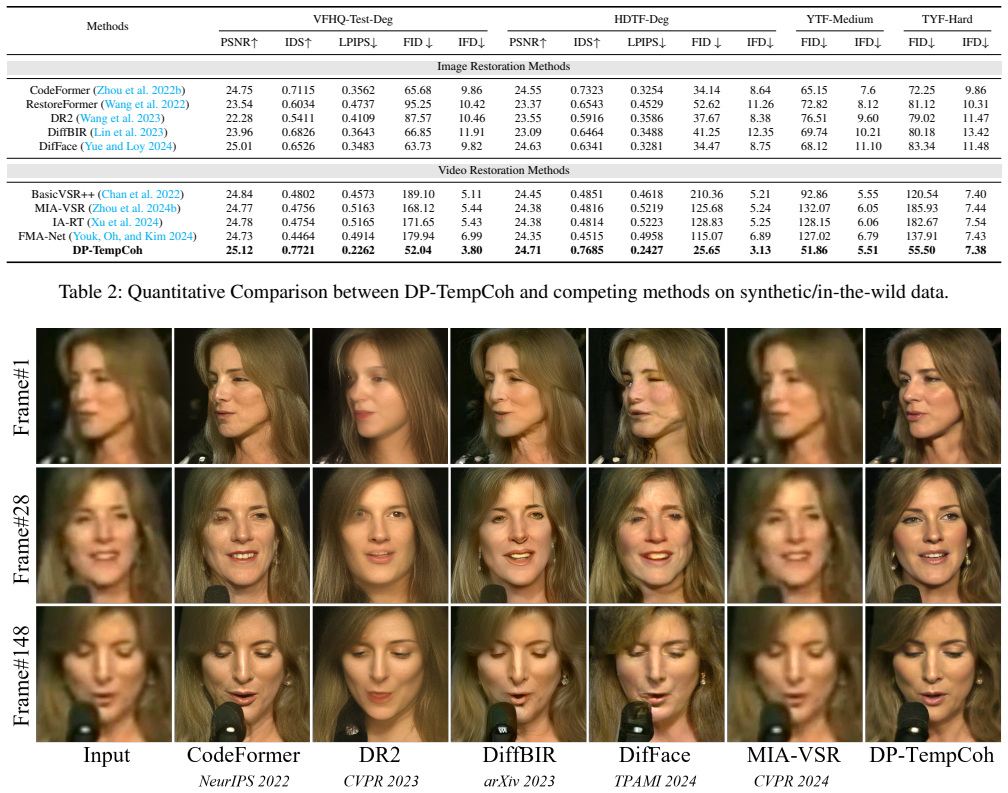
DP-TempCoh's central claim is that high-quality face video content can be synthesized by replacing degraded video tokens with entries from a discrete visual prior bank, and then made temporally coherent by matching each frame's channel-wise mean and variance to statistics retrieved from a bank learned from high-quality face videos. The content prediction module applies self-attention over tokens with learned spatial-temporal position embeddings, so the codebook index predicted for one frame is informed by neighboring frames rather than by that frame alone. The motion statistics modulation module then retrieves the nearest stored cross-frame mean and variance vector and adjusts the predicted content so that, in the paper's words, the statistics of the predicted content match those of real videos over time. In the reported experiments, the full model reports the best PSNR, IDS, LPIPS, FID, and IFD among all compared methods on VFHQ-Test-Deg and HDTF-Deg, including an IFD of 3.80 versus 5.11 for the second-best video method on VFHQ-Test-Deg and an IDS of 0.7721 versus 0.7115 for the best image method. On the in-the-wild YTF-Medium and YTF-Hard subsets, it reports the best FID values of 51.86 and 55.50, with IFD values of 5.51 and 7.38.
Load-bearing premise
The load-bearing premise is that retrieving nearest-neighbor cross-frame mean and variance statistics from a pre-built bank of high-quality videos and applying them to predicted content is a sufficient and reliable way to enforce temporal coherence; the bank's construction and the non-differentiable retrieval are not described, and as printed the variance scaling in the modulation formula cancels itself.
Editorial extensions
If this is right
- On VFHQ-Test-Deg, the reported inter-frame difference drops to 3.80, below the best image method (9.86) and the best video method (5.11), so discrete statistics modulation can suppress flicker in the compared setting.
- The reported identity similarity of 0.7721 versus 0.7115 for the nearest competitor suggests that shared codebook content keeps identity stable across frames better than per-frame generative priors.
- Because inference does not require diffusion sampling, restored videos avoid the per-frame randomness that produces flicker in sampling-based methods.
- The reported FID values of 51.86 and 55.50 on YTF-Medium and YTF-Hard indicate the two-bank design carries over to naturally degraded videos, not only to synthetic degradations.
- The separation of a content bank and a motion bank offers a template for other video-to-video tasks where content fidelity and temporal smoothness compete.
Reading between the lines
- If the printed modulation formula is read literally, the retrieved variance appears as both a multiplier and a denominator in the same term, making the operation a mean shift rather than a variance match; zeroing the variance component should then leave IFD essentially unchanged.
- The nearest-neighbor retrieval in the motion bank is non-differentiable, so that bank cannot be trained end-to-end with the rest of the network; shrinking or pruning the bank should measurably degrade temporal coherence if the bank's coverage is load-bearing.
- The ablation table shows that spatial-temporal prediction alone lowers IFD from 9.86 to 3.92, while adding motion modulation lowers it only to 3.80; freezing the spatial-temporal module and re-training the modulation alone would isolate how much coherence each component actually contributes.
- Applying the same two-bank design to non-face video restoration and measuring IFD would test whether the motion-statistics bank encodes face-specific dynamics or a general temporal-coherence principle.
Editorial analysis
A structured set of objections, weighed in public.
Referee Report
Summary. The paper introduces DP-TempCoh, a blind face video restoration method built around two discrete priors: a vision bank for spatial-temporal-aware content prediction and a motion statistics bank for cross-frame mean/variance modulation. The content prediction module predicts bank indices from degraded video tokens using self-attention, and the motion modulation module adjusts predicted features by retrieving nearest-neighbor statistics from a bank built from high-quality face videos. The method is evaluated on VFHQ-Test-Deg, HDTF-Deg, and YTF-Medium/Hard, with extensive comparisons to image- and video-level restoration baselines, and reports state-of-the-art results on all reported metrics, including temporal coherence measured by IFD. The paper also provides ablations, visualizations, and a user study.
Significance. If the proposed mechanisms work as described, the paper would make a solid empirical contribution to blind face video restoration, combining dictionary-style visual priors with temporally modulated statistics, and it would be notable for reporting consistent improvements across quality, identity, and temporal-coherence metrics on both synthetic and in-the-wild benchmarks. The authors promise code release, which strengthens the reproducibility potential. However, the significance is currently undermined by a central technical issue in the stated modulation mechanism and by ambiguity in the training objective, so the empirical results cannot be attributed to the method as written without clarification or correction.
major comments (3)
- [Motion Prior-based Statistics Modulation, Eq. (7)] Equation (7) as printed multiplies and divides by the same target standard deviation: z''_{f,w,h} = σ'_{f,w,h} (z'_{f,w,h} − μ_{f,w,h})/(σ'_{f,w,h} + ε) + μ'_{f,w,h}. For ε much smaller than σ', the factor σ'/(σ'+ε) is approximately 1, so the output is approximately z' − μ + μ'. The input feature's own standard deviation is never divided out, and the retrieved variance σ'^2 is never used to rescale the feature. The operation therefore reduces to a mean shift toward the retrieved μ', contradicting the abstract's claim that 'the statistics of the predicted content can match with that of real videos over time.' A correct variance-matching operation would use the input standard deviation in the denominator, e.g., z'' = σ'(z' − μ)/σ + μ'. This is load-bearing because the proposed temporal-coherence mechanism is explicitly built on variance matching, and Table 1 does not rescue the claim: row (c) shows that motion modulation alone severely degrades quality (PSNR 12.55, FID 210.12), and row (d) shows only a small IFD change (3.92 to 3.80), which could be produced by the mean-shift component alone.
- [Model Training, Eqs. (11)-(12)] The bank-index prediction loss L_bank in Eq. (11) uses ground-truth labels z^gt 'derived from the pre-trained encoder E and vision bank T,' while Eq. (12) jointly optimizes E, C, and G. If E is updated during training, the label distribution z^gt changes as E's tokenization changes, so L_bank can be minimized by adapting the encoder rather than by learning to predict meaningful high-quality indices from the degraded input. The paper does not state whether E is frozen after bank construction, whether labels are recomputed periodically, or whether a stop-gradient is applied. Without this specification, the content-prediction training objective is not well defined, and the reported contribution of the content prediction module is ambiguous.
- [Motion Prior-based Statistics Modulation and Implementation Details] The construction of the motion statistics bank M is not described. Equation (6) retrieves entries from a bank of size 16,384, but the paper does not specify how these entries were collected from high-quality videos, what each entry represents (per-frame scalar statistics or per-pixel maps), or how the nearest-neighbor search is performed and trained. The notation in Eqs. (4)-(7) is also internally inconsistent: Eqs. (4)-(5) compute per-pixel channel-wise mean and variance over the channel dimension, yielding W×H values per frame, whereas the text describes 'cross-frame mean and variance vectors whose components are the channel mean and variance corresponding to each frame.' This ambiguity makes Eq. (7) impossible to reproduce and impedes assessment of whether the proposed modulation actually operates on frame-level or pixel-level statistics.
minor comments (4)
- [Throughout] There are several typos and inconsistencies that should be corrected: 'detial' (Introduction), 'donotes' (Experiments), 'tenporal' (User Study), 'labeld' (Content Prediction), 'IDF' for IFD in Table 2 and its caption, 'TYF-Hard' for YTF-Hard in Table 2, 'BVFR' for BFVR in Related Work, and 'DiffFace' where the method is named 'DifFace.'
- [Experiments, Evaluation Protocol] The evaluation protocol states that video clips are 8 frames long, but it does not clarify whether the temporal statistics in Eqs. (4)-(7) are computed within each 8-frame clip or over longer sequences; this affects the interpretation of the motion bank and the reported IFD values.
- [Eq. (13)] The degradation ranges in Eq. (13) are specified as b' ∈ [b−1, b+1] with b ∈ {2:32}, which allows a downsampling factor as low as 1 (no downsampling) for b=2; please clarify whether this is intended and how the range is sampled in practice.
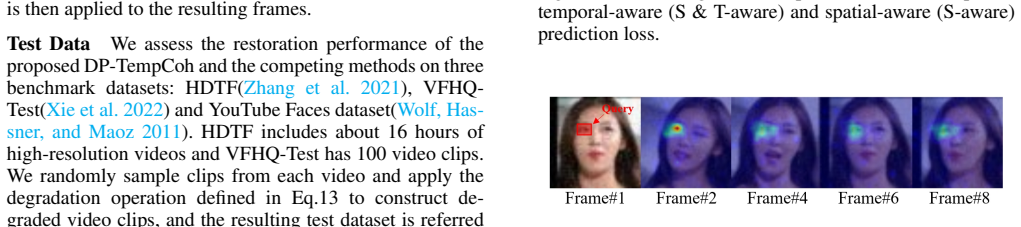
- [Content Prediction, Figure 3] The convergence comparison in Figure 3 reports that 'S-aware' requires 5.6 times more iterations, but the figure itself does not show the loss curves or the exact convergence criterion; please add the curves and define the criterion so the claim is verifiable.
Circularity Check
The paper's Eq. (7) cancels the retrieved variance, so the stated motion-statistics matching is not implemented; the bank-index target is also defined through the same encoder that Eq. (12) optimizes.
-
other
[Motion Prior-based Statistics Modulation, Eq. (7); Abstract]
"z''_{f,w,h} = σ'_{f,w,h} (z'_{f,w,h} − μ_{f,w,h}) / (σ'_{f,w,h} + ϵ) + μ'_{f,w,h} ... The modulation of mean and variance is tailored to maintain temporal coherence of predicted content ... the statistics of the predicted content can match with that of real videos over time."
The retrieved standard deviation σ' appears in both the numerator and the denominator, so Eq. (7) is approximately z'' ≈ z' − μ + μ'. The variance of z'' over channels is (σ'/(σ'+ε))^2 Var(z') ≈ Var(z'), not σ'^2; the retrieved variance never rescales the content. The 'variance matching' claimed in the abstract is therefore not realized by the paper's own equation; the implemented operation is only a mean shift toward the retrieved μ'. Temporal-coherence gains attributed to variance modulation reduce by construction to mean normalization, and the variance prior is inert.
-
self definitional
[Model Training, Eqs. (11)-(12)]
"Lbank = E_vlq[−Σ zgt log(ψ(ez))], ... zgt denotes the ground truth of bank index labels which is derived from the pre-trained encoder E and vision bank T. ... min_{E,C,G} Lconsi + Lsync_adv + λLbank"
The ground-truth bank indices zgt are defined as outputs of encoder E on the vision bank T, yet Eq. (12) optimizes E. If E is updated, zgt shifts with E, so the content-prediction target is not a fixed external prior but a moving label produced by the network being trained. The 'prediction from discrete visual priors' partly reduces to predicting the current encoder's own nearest-neighbor labels. Pixel and adversarial losses do ground the overall restoration, so this circularity is partial rather than total.
full rationale
The paper has no self-citation chain, imported uniqueness theorem, or ansatz smuggled through prior work; its main proposed novelty is motion-statistics modulation. However, the printed modulation equation cancels the retrieved variance, so the central 'statistics matching' claim is unsupported as stated and the module's effect is, by Eq. (7) itself, a mean shift. The bank-index loss is also partially self-referential because the labels are derived from an encoder that Eq. (12) jointly optimizes, although the pixel and adversarial losses provide independent grounding. The reported benchmark gains are substantially anchored by those external losses, so the circularity is partial rather than total.
Assumptions & free parameters
free parameters (5)
- Vision bank size N =
1,024
- Motion bank size |M| =
16,384
- Loss weighting lambda =
0.5
- Input clip length =
8 frames
- Degradation ranges in Eq. (13) =
rho 1:0.1:10, b 2:32, sigma 0:10, JPEG w 50:100
assumptions (4)
- domain assumption The synthetic degradation model in Eq. (13) covers the space of real-world degradations encountered at test time on YTF-Medium/Hard.
- domain assumption Cross-frame channel mean and variance are sufficient statistics for temporal coherence of restored face videos.
- domain assumption The encoder E used to compute bank index labels remains a stable target while E is optimized in Eq. (12).
- domain assumption A codebook trained on high-quality face videos remains a faithful representation for features extracted from heavily degraded videos.
invented entities (2)
-
Vision prior latent bank T
-
Motion statistics bank M
Cite this review
Pith. "Pith review of Discrete Prior-based Temporal-coherent Content Prediction for Blind Face Video Restoration." pith.science (2026). https://pith.science/paper/JXVIPFYZ
@misc{pith2026250109960,
  author       = {Pith},
  title        = {Pith review of: Discrete Prior-based Temporal-coherent Content Prediction for Blind Face Video Restoration},
  year         = {2026},
  howpublished = {\url{https://pith.science/paper/JXVIPFYZ}},
  note         = {Machine review of arXiv:2501.09960}
}
read the original abstract
Blind face video restoration aims to restore high-fidelity details from videos subjected to complex and unknown degradations. This task poses a significant challenge of managing temporal heterogeneity while at the same time maintaining stable face attributes. In this paper, we introduce a Discrete Prior-based Temporal-Coherent content prediction transformer to address the challenge, and our model is referred to as DP-TempCoh. Specifically, we incorporate a spatial-temporal-aware content prediction module to synthesize high-quality content from discrete visual priors, conditioned on degraded video tokens. To further enhance the temporal coherence of the predicted content, a motion statistics modulation module is designed to adjust the content, based on discrete motion priors in terms of cross-frame mean and variance. As a result, the statistics of the predicted content can match with that of real videos over time. By performing extensive experiments, we verify the effectiveness of the design elements and demonstrate the superior performance of our DP-TempCoh in both synthetically and naturally degraded video restoration.
Figures


Figures from the paper (4 more)


Reference graph
Works this paper leans on
-
[1]
, " * write output.state after.block = add.period write newline
ENTRY address archivePrefix author booktitle chapter edition editor eid eprint howpublished institution isbn journal key month note number organization pages publisher school series title type volume year label extra.label sort.label short.list INTEGERS output.state before.all mid.sentence after.sentence after.block FUNCTION init.state.consts #0 'before.a...
-
[2]
write newline
" write newline "" before.all 'output.state := FUNCTION n.dashify 't := "" t empty not t #1 #1 substring "-" = t #1 #2 substring "--" = not "--" * t #2 global.max substring 't := t #1 #1 substring "-" = "-" * t #2 global.max substring 't := while if t #1 #1 substring * t #2 global.max substring 't := if while FUNCTION word.in bbl.in capitalize " " * FUNCT...
-
[3]
Blattmann, A.; Rombach, R.; Ling, H.; Dockhorn, T.; Kim, S. W.; Fidler, S.; and Kreis, K. 2023. Align your latents: High-resolution video synthesis with latent diffusion models. In Proceedings of the IEEE/CVF Conference on Computer Vision and Pattern Recognition, 22563--22575
work page 2023
-
[4]
C.; Wang, X.; Yu, K.; Dong, C.; and Loy, C
Chan, K. C.; Wang, X.; Yu, K.; Dong, C.; and Loy, C. C. 2021. Basicvsr: The search for essential components in video super-resolution and beyond. In Proceedings of the IEEE/CVF conference on computer vision and pattern recognition, 4947--4956
work page 2021
-
[5]
C.; Zhou, S.; Xu, X.; and Loy, C
Chan, K. C.; Zhou, S.; Xu, X.; and Loy, C. C. 2022. Basicvsr++: Improving video super-resolution with enhanced propagation and alignment. In Proceedings of the IEEE/CVF conference on computer vision and pattern recognition, 5972--5981
work page 2022
-
[6]
Chen, C.; Li, X.; Yang, L.; Lin, X.; Zhang, L.; and Wong, K.-Y. K. 2021. Progressive semantic-aware style transformation for blind face restoration. In Proceedings of the IEEE/CVF conference on computer vision and pattern recognition, 11896--11905
work page 2021
-
[7]
Chen, H.; Xia, M.; He, Y.; Zhang, Y.; Cun, X.; Yang, S.; Xing, J.; Liu, Y.; Chen, Q.; Wang, X.; et al. 2023. Videocrafter1: Open diffusion models for high-quality video generation. arXiv preprint arXiv:2310.19512
arXiv 2023
-
[8]
Chen, X.; Duan, Y.; Houthooft, R.; Schulman, J.; Sutskever, I.; and Abbeel, P. 2016. InfoGAN: interpretable representation learning by information maximizing generative adversarial nets. In Proc. Neural Information Processing Systems
work page 2016
Show all 46 references
-
[9]
Dogan, B.; Gu, S.; and Timofte, R. 2019. Exemplar guided face image super-resolution without facial landmarks. In Proceedings of the IEEE/CVF conference on computer vision and pattern recognition workshops, 0--0
2019
-
[10]
Esser, P.; Chiu, J.; Atighehchian, P.; Granskog, J.; and Germanidis, A. 2023. Structure and content-guided video synthesis with diffusion models. In Proceedings of the IEEE/CVF International Conference on Computer Vision, 7346--7356
2023
-
[11]
Fuoli, D.; Gu, S.; and Timofte, R. 2019. Efficient video super-resolution through recurrent latent space propagation. In 2019 IEEE/CVF International Conference on Computer Vision Workshop (ICCVW), 3476--3485. IEEE
2019
-
[12]
Gu, Y.; Wang, X.; Xie, L.; Dong, C.; Li, G.; Shan, Y.; and Cheng, M.-M. 2022. Vqfr: Blind face restoration with vector-quantized dictionary and parallel decoder. In European Conference on Computer Vision, 126--143. Springer
2022
-
[13]
Heusel, M.; Ramsauer, H.; Unterthiner, T.; Nessler, B.; and Hochreiter, S. 2017. Gans trained by a two time-scale update rule converge to a local nash equilibrium. Advances in neural information processing systems, 30
2017
-
[14]
Ho, J.; Salimans, T.; Gritsenko, A.; Chan, W.; Norouzi, M.; and Fleet, D. J. 2022. Video diffusion models. Advances in Neural Information Processing Systems, 35: 8633--8646
2022
-
[15]
Hu, X.; Ren, W.; Yang, J.; Cao, X.; Wipf, D.; Menze, B.; Tong, X.; and Zha, H. 2021. Face restoration via plug-and-play 3D facial priors. IEEE Transactions on Pattern Analysis and Machine Intelligence, 44(12): 8910--8926
2021
-
[16]
Hu, Y.; Chen, Z.; and Luo, C. 2023. Lamd: Latent motion diffusion for video generation. arXiv preprint arXiv:2304.11603
2023 arXiv
-
[17]
Karras, T.; Laine, S.; Aittala, M.; Hellsten, J.; Lehtinen, J.; and Aila, T. 2020. Analyzing and improving the image quality of stylegan. In Proceedings of the IEEE/CVF conference on computer vision and pattern recognition, 8110--8119
2020
-
[18]
Kim, K.; Kim, Y.; Cho, S.; Seo, J.; Nam, J.; Lee, K.; Kim, S.; and Lee, K. 2022. Diffface: Diffusion-based face swapping with facial guidance. arXiv preprint arXiv:2212.13344
2022 arXiv
-
[19]
H.; Sajjadi, M
Kim, T. H.; Sajjadi, M. S.; Hirsch, M.; and Scholkopf, B. 2018. Spatio-temporal transformer network for video restoration. In Proceedings of the European conference on computer vision (ECCV), 106--122
2018
-
[20]
P.; and Ba, J
Kingma, D. P.; and Ba, J. 2014. Adam: A method for stochastic optimization. arXiv preprint arXiv:1412.6980
2014 arXiv
-
[21]
Li, X.; Liu, M.; Ye, Y.; Zuo, W.; Lin, L.; and Yang, R. 2018. Learning warped guidance for blind face restoration. In Proceedings of the European conference on computer vision (ECCV), 272--289
2018
-
[22]
Lin, S.; Zhang, J.; Pan, J.; Liu, Y.; Wang, Y.; Chen, J.; and Ren, J. 2020. Learning to deblur face images via sketch synthesis. In Proceedings of the AAAI Conference on Artificial Intelligence, 11523--11530
2020
-
[23]
Lin, X.; He, J.; Chen, Z.; Lyu, Z.; Fei, B.; Dai, B.; Ouyang, W.; Qiao, Y.; and Dong, C. 2023. Diffbir: Towards blind image restoration with generative diffusion prior. arXiv preprint arXiv:2308.15070
2023 arXiv
-
[24]
Liu, D.; Wang, Z.; Fan, Y.; Liu, X.; Wang, Z.; Chang, S.; and Huang, T. 2017. Robust video super-resolution with learned temporal dynamics. In Proceedings of the IEEE International Conference on Computer Vision, 2507--2515
2017
-
[25]
Menon, S.; Damian, A.; Hu, S.; Ravi, N.; and Rudin, C. 2020. Pulse: Self-supervised photo upsampling via latent space exploration of generative models. In Proceedings of the ieee/cvf conference on computer vision and pattern recognition, 2437--2445
2020
-
[26]
Rombach, R.; Blattmann, A.; Lorenz, D.; Esser, P.; and Ommer, B. 2021. High-Resolution Image Synthesis with Latent Diffusion Models. arXiv:2112.10752
2021 arXiv
-
[27]
Simonyan, K.; and Zisserman, A. 2014. Very deep convolutional networks for large-scale image recognition. arXiv preprint arXiv:1409.1556
2014 arXiv
-
[28]
Wang, H.; Wang, Y.; Zhou, Z.; Ji, X.; Gong, D.; Zhou, J.; Li, Z.; and Liu, W. 2018. CosFace: Large Margin Cosine Loss for Deep Face Recognition. In 2018 IEEE/CVF Conference on Computer Vision and Pattern Recognition, 5265--5274
2018
-
[29]
Wang, X.; Li, Y.; Zhang, H.; and Shan, Y. 2021. Towards Real-World Blind Face Restoration with Generative Facial Prior. In 2021 IEEE/CVF Conference on Computer Vision and Pattern Recognition (CVPR), 9164--9174
2021
-
[30]
Wang, X.; Yuan, H.; Zhang, S.; Chen, D.; Wang, J.; Zhang, Y.; Shen, Y.; Zhao, D.; and Zhou, J. 2024. Videocomposer: Compositional video synthesis with motion controllability. Advances in Neural Information Processing Systems, 36
2024
-
[31]
Wang, Y.; Hu, Y.; and Zhang, J. 2022. Panini-Net: GAN prior based degradation-aware feature interpolation for face restoration. In Proceedings of the AAAI Conference on Artificial Intelligence, 2576--2584
2022
-
[32]
Wang, Z.; Zhang, J.; Chen, R.; Wang, W.; and Luo, P. 2022. Restoreformer: High-quality blind face restoration from undegraded key-value pairs. In Proceedings of the IEEE/CVF conference on computer vision and pattern recognition, 17512--17521
2022
-
[33]
Wang, Z.; Zhang, Z.; Zhang, X.; Zheng, H.; Zhou, M.; Zhang, Y.; and Wang, Y. 2023. Dr2: Diffusion-based robust degradation remover for blind face restoration. In Proceedings of the IEEE/CVF Conference on Computer Vision and Pattern Recognition, 1704--1713
2023
-
[34]
Wolf, L.; Hassner, T.; and Maoz, I. 2011. Face recognition in unconstrained videos with matched background similarity. In CVPR 2011, 529--534. IEEE
2011
-
[35]
Xie, L.; Wang, X.; Zhang, H.; Dong, C.; and Shan, Y. 2022. Vfhq: A high-quality dataset and benchmark for video face super-resolution. In Proceedings of the IEEE/CVF Conference on Computer Vision and Pattern Recognition, 657--666
2022
-
[36]
B.; and Yao, A
Xu, K.; Yu, Z.; Wang, X.; Mi, M. B.; and Yao, A. 2024. Enhancing Video Super-Resolution via Implicit Resampling-based Alignment. In Proceedings of the IEEE/CVF Conference on Computer Vision and Pattern Recognition, 2546--2555
2024
-
[37]
Yang, T.; Ren, P.; Xie, X.; and Zhang, L. 2021. Gan prior embedded network for blind face restoration in the wild. In Proceedings of the IEEE/CVF conference on computer vision and pattern recognition, 672--681
2021
-
[38]
Youk, G.; Oh, J.; and Kim, M. 2024. FMA-Net: Flow-Guided Dynamic Filtering and Iterative Feature Refinement with Multi-Attention for Joint Video Super-Resolution and Deblurring. In Proceedings of the IEEE/CVF Conference on Computer Vision and Pattern Recognition, 44--55
2024
-
[39]
Yue, Z.; and Loy, C. C. 2024. Difface: Blind face restoration with diffused error contraction. IEEE Transactions on Pattern Analysis and Machine Intelligence
2024
-
[40]
Zhang, Z.; Li, L.; Ding, Y.; and Fan, C. 2021. Flow-guided one-shot talking face generation with a high-resolution audio-visual dataset. In Proceedings of the IEEE/CVF Conference on Computer Vision and Pattern Recognition, 3661--3670
2021
-
[41]
Zhao, Y.; Hou, T.; Su, Y.-C.; Jia, X.; Li, Y.; and Grundmann, M. 2023. Towards authentic face restoration with iterative diffusion models and beyond. In Proceedings of the IEEE/CVF International Conference on Computer Vision, 7312--7322
2023
-
[42]
Zhou, D.; Wang, W.; Yan, H.; Lv, W.; Zhu, Y.; and Feng, J. 2022 a . Magicvideo: Efficient video generation with latent diffusion models. arXiv preprint arXiv:2211.11018
2022 arXiv
-
[43]
Zhou, S.; Chan, K.; Li, C.; and Loy, C. C. 2022 b . Towards robust blind face restoration with codebook lookup transformer. Advances in Neural Information Processing Systems, 35: 30599--30611
2022
-
[44]
Zhou, S.; Yang, P.; Wang, J.; Luo, Y.; and Loy, C. C. 2024 a . Upscale-A-Video: Temporal-Consistent Diffusion Model for Real-World Video Super-Resolution. In Proceedings of the IEEE/CVF Conference on Computer Vision and Pattern Recognition, 2535--2545
2024
-
[45]
Zhou, X.; Zhang, L.; Zhao, X.; Wang, K.; Li, L.; and Gu, S. 2024 b . Video Super-Resolution Transformer with Masked Inter&Intra-Frame Attention. In Proceedings of the IEEE/CVF Conference on Computer Vision and Pattern Recognition, 25399--25408
2024
-
[46]
Zhu, F.; Zhu, J.; Chu, W.; Zhang, X.; Ji, X.; Wang, C.; and Tai, Y. 2022. Blind face restoration via integrating face shape and generative priors. In Proceedings of the IEEE/CVF conference on computer vision and pattern recognition, 7662--7671
2022
Reviewed August 10, 2026 · model on record in the stance chip above.
Discussion (0). Continue with ORCID to comment.