REVIEW 3 major objections 5 minor 3 cited by
One-D-Piece: Image Tokenizer Meets Quality-Controllable Compression
T0 review · 3 major / 5 minor · reviewed 2026-08-10 · deepseek-v4-flash
Pith's one-line read One-D-Piece is a variable-length discrete image tokenizer: training it with Tail Token Drop concentrates the essential information in the first tokens, so a single model lets users trade reconstruction quality against byte size from 1 to…
desk verdict A clean variable-length discrete tokenizer with real experimental support, but the headline compression claim against JPEG/WebP is not actually tested at matched byte sizes. read the letter →
The pith
A machine-rendered reading of the paper's core claim, the machinery that carries it, and where it could break.
The reading
What carries the argument
The load-bearing mechanism is Tail Token Drop, an adaptation of the earlier tail-drop idea from continuous latent vectors to discrete token sequences. During training, the sequence $q = [q_1, \dots, q_N]$ is truncated to $q' = [q_1, \dots, q_{N-k}]$ with $k$ drawn uniformly from $\{0, \dots, N-1\}$, and the decoder must reconstruct the image from the shorter sequence. Because the dropped tail is never seen at reconstruction time, gradients force the encoder to concentrate globally useful information in the head tokens. The architecture that makes this work is the 1D TiTok-style tokenizer, a ViT encoder with a vector quantizer and a mask-token decoder, which produces structure-free 1D tokens rather than 2D feature maps, so a well-defined tail exists and variable-length decoding is possible.
What would settle it
A direct test would take the trained One-D-Piece-L-256 model and measure perceptual metrics such as rFID and LPIPS, plus downstream-task accuracy, at every prefix length from 1 to 256 on the ImageNet validation set; the prefix property predicts a strictly improving quality curve, so any interval where adding tokens degrades reconstruction would break it. A stronger mechanistic test would train the same TiTok architecture with 256 tokens but replace Tail Token Drop with a control regularization, such as dropping a fixed middle block or applying uniform dropout, and check whether the head-concentration heatmaps and low-token-count rFID gains disappear; if they do not, the specific tail-truncation schedule is not what creates the variable-length behavior.
Extended reading notes
Core claim
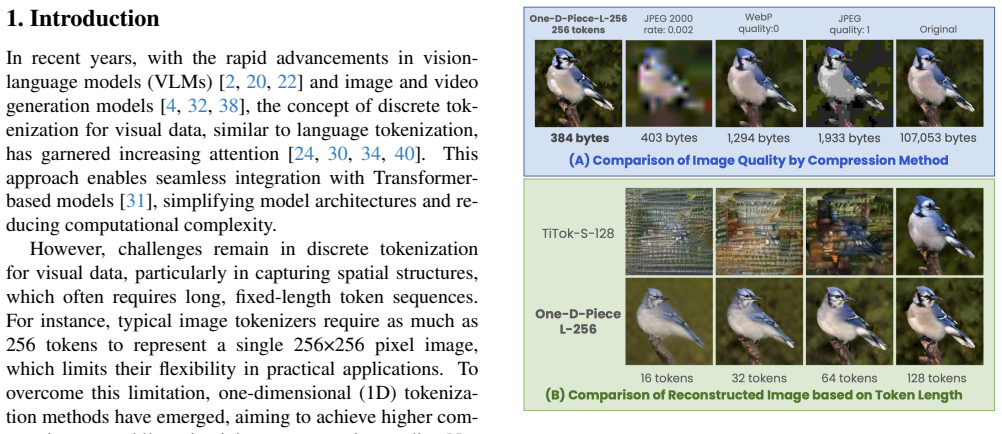
On its own terms, the paper's central discovery is that a 1D tokenizer can be taught to order its output so that information needed for reconstruction is a strict prefix of the token sequence. Applying Tail Token Drop, sampling a cutoff $k \sim U(0, N-1)$ and feeding only the first $N-k$ tokens to the decoder, changes where the encoder puts information: replacement analysis shows the head tokens carry global, image-level content, the first token clusters images by appearance, and the tail tokens contribute almost nothing. The result is a single model, One-D-Piece, that reports rFID 1.08 at 256 tokens and, per the paper's experiments, beats JPEG and WebP on perceptual quality at smaller byte sizes and outperforms WebP on five downstream tasks at 128 tokens, about 10% of WebP's bytes per image.
Load-bearing premise
The paper's load-bearing premise is empirical: after training with random tail truncation, the tokenizer will arrange its output so that every prefix length is a useful image description, with quality improving as tokens are added; the architecture does not enforce this ordering, and the evidence for it is post-hoc analysis rather than a mechanism or theorem.
Editorial extensions
If this is right
- A single One-D-Piece model can replace a family of fixed-rate tokenizers, since applications can pick any token count between 1 and 256 at inference time without retraining.
- At 128 tokens, the L-256 model reports better object detection, image classification, semantic segmentation, depth estimation, and CLIP embedding scores than WebP while using roughly 10% of WebP's bytes per image.
- Variable-length capability does not cost full-length quality: the 256-token rFID of 1.08 is in the same range as strong fixed-length 2D tokenizers such as Open-MAGVIT2 (1.17) and VQGAN+ (1.61).
- Tail Token Drop also keeps the tokens usable for generation: a MaskGIT trained on One-D-Piece-L-256 tokens reaches gFID 2.35, below the TiTok variants the method builds on.
Reading between the lines
- The prefix ordering suggests a natural progressive-transmission protocol: send the global head tokens first and stream refinements as bandwidth allows, so a receiver can render a useful image from any partial token stream.
- Because the first token captures global appearance, a learned length predictor could make token count content-adaptive, letting simple images use far fewer tokens and complex images use more, an extension the paper does not pursue.
- Tail Token Drop reduces stored or transmitted bytes, not encoding compute, since the encoder still produces all 256 tokens; an early-exit encoder is the natural next step to turn that saving into a runtime saving.
- A testable extension is applying the same 1D prefix trick to video or multi-image sequences, which could yield variable-rate neural video tokenization.
Editorial analysis
A structured set of objections, weighed in public.
Referee Report
Summary. The paper proposes One-D-Piece, a 1D discrete image tokenizer built on the TiTok architecture, together with a training regularizer called Tail Token Drop that randomly truncates the token sequence during training. This encourages information to concentrate in the head tokens, so the model can reconstruct images from any prefix of the 256-token sequence, enabling variable-length tokenization from 1 to 256 tokens. The authors evaluate reconstruction quality with rFID and PSNR, downstream-task performance (classification, detection, segmentation, depth estimation, CLIP embedding similarity), generation quality with MaskGIT, and provide analyses of token contributions and linear probing accuracy. The central claim is that One-D-Piece achieves better perceptual quality than JPEG and WebP at smaller byte sizes, and that it outperforms WebP on downstream tasks while using roughly 10% of WebP's byte size.
Significance. If the headline claim is supported, the contribution is significant: a simple, architecture-agnostic regularizer that converts a fixed-capacity 1D tokenizer into a variable-rate discrete codec, with extensive validation on reconstruction and downstream tasks. The paper's own analyses (contribution heatmaps, first-token clustering, linear probing) provide credible evidence that the proposed mechanism behaves as intended, concentrating global information in the head tokens. The experiments cover a broader downstream-task set than is typical for tokenizer papers, including detection, depth, and CLIP similarity, and the authors also check that generation quality does not degrade. However, the core compression comparison against JPEG and WebP is not conducted at matched bitrates, which directly affects the paper's main selling point. The missing rate-matched evaluation is a fixable but load-bearing issue; with that added, the method would be a worthwhile contribution. Reproducibility is currently limited because code and weights are not released, though the paper states they will be made available after acceptance.
major comments (3)
- [§4.1, Tables 1 and 4] The claimed advantage over JPEG and WebP at smaller byte sizes is not tested at matched byte budgets. One-D-Piece-L-256 at 256 tokens uses 384 bytes per 256×256 image, while JPEG (quality 1) and WebP (quality 0) in Table 1 produce 2063.3 and 1964.0 bytes, respectively. The text states that quality settings were chosen to align the average byte size with the models, but the reported settings do not align with 384 bytes; the only format near that size is JPEG 2000 at 406.3 bytes (rFID 299.4), which the paper does not highlight. To support the abstract's claim, the authors should evaluate JPEG and WebP at target sizes near 192 and 384 bytes (for example, using WebP target-size mode or JPEG with resizing) and re-measure rFID and downstream metrics at those rates.
- [§4.2.2, Table 3] The downstream-task comparison is not rate-matched. In Table 3, One-D-Piece at 128 tokens corresponds to 192 bytes (at 1.5 bytes per token), while the WebP column is a single condition at 1964 bytes. The claim that One-D-Piece 'uses only 128 tokens, approximately 10% of WebP's byte size per image, yet outperforms WebP across all tasks' compares a high-compression learned codec against a much lower-compression classical codec. This does not demonstrate superiority at the same byte size; it shows that One-D-Piece retains more task-relevant information at 192 bytes than WebP does at 1964 bytes. Rate-matched comparisons, such as task metric versus bytes per image for several operating points of each method, are needed to support the compression-efficiency claims.
- [§4.1 and Figure 4] The primary perceptual metric used for the compression comparison is rFID, a distribution-level metric that is not standard in lossy compression evaluation. The paper also reports PSNR, but not at matched bitrates against JPEG/WebP. The authors should present rate-distortion curves (e.g., rFID, PSNR, SSIM, LPIPS versus bytes per image) that include JPEG, WebP, and JPEG 2000 at multiple rate points, in addition to the token-count curves for One-D-Piece. This would make the perceptual-quality comparison with classical codecs more convincing and align the evaluation with common practice in the compression literature.
minor comments (5)
- [Table 4] In Table 4, the WebP rows for quality 8 and quality 16 both report a token count of 2729 and an rFID of 16.26, despite different byte sizes (3136.88 and 4029.67 bytes). This appears to be a copy-paste error; please verify the values.
- [Table 3 caption] The meaning of the 'Base' column differs across tasks: for Image Classification and Semantic Segmentation it appears to be the performance on original images, while for Object Detection, Depth Estimation, and CLIP Embedding Reconstruction it is based on model predictions. The caption should clarify this distinction explicitly to avoid confusion.
- [§4.1] The acronym 'rFID' is used without defining the 'r' prefix. Please define it (presumably 'reconstruction FID') at first use and distinguish it from the standard FID used in generation evaluation.
- [Figure 4] Figure 4 converts bytes per image to 'tokens' for JPEG/WebP, but the conversion rate (bytes per token) is not stated in the figure or caption. Clarify the conversion so the comparison is interpretable.
- [Abstract and Introduction] The statement 'Codes will be available after the acceptance of the paper' appears twice; since the current submission does not include code or weights, the numerical results are not independently verifiable. A reproducibility statement or a public preview release would strengthen the paper.
Circularity Check
No significant circularity: One-D-Piece is an empirical training scheme evaluated on external benchmarks; the paper contains no load-bearing self-citations or definitional reductions.
full rationale
The paper's central claim is that Tail Token Drop, applied to a TiTok-style 1D tokenizer during training, yields variable-length discrete representations whose prefixes support reconstruction and downstream tasks. This is not a derivation from first principles; it is an empirical training scheme. The training objective (Lstage2 = LL2 + LPerceptual + LGAN with random truncation k ~ U(0, N-1)) does not define rFID, PSNR, downstream accuracy, or byte size in terms of its own outputs. All headline numbers (rFID 1.08, token counts, downstream metrics) are measured with external metrics and models (FID, ConvNeXT, YOLO11, SERE, Depth Anything, CLIP) on ImageNet/COCO, relative to JPEG/JPEG 2000/WebP. The only cited prior mechanism, Tail Drop [18], is external and explicitly credited; TiTok [41] is also external. The paper does not invoke a self-authored uniqueness theorem or ansatz. The analysis sections (token contribution, first-token clustering, linear probing) are post-hoc behavioral validations of the intended effect and could in principle have failed, so they are not circular by construction. The byte-size comparison with JPEG/WebP is uneven and could be challenged as an unfair benchmark, but that is a correctness/experimental-design concern, not a circularity one.
Assumptions & free parameters
free parameters (4)
- Maximum latent tokens (256) =
256
- Truncation sampling distribution =
k ~ U(0, N-1)
- Codebook size and token size =
4096 codes, 12 bits per token
- Stage-2 loss weights =
L2=1.0, GAN=0.01, perceptual=0.1, commitment=0.25, codebook=1.0
assumptions (4)
- domain assumption Tail Drop regularization transfers from continuous latent dimensions to discrete token sequences.
- domain assumption The TiTok architecture and its two-stage training recipe are a suitable base for variable-length tokenization.
- domain assumption The pretrained MaskGIT tokenizer is a valid teacher for stage-1 logit prediction.
- domain assumption rFID is an appropriate measure of perceptual reconstruction quality for comparing neural tokenizers with classical codecs.
Cite this review
Pith. "Pith review of One-D-Piece: Image Tokenizer Meets Quality-Controllable Compression." pith.science (2026). https://pith.science/paper/56IYJEG6
@misc{pith2026250110064,
  author       = {Pith},
  title        = {Pith review of: One-D-Piece: Image Tokenizer Meets Quality-Controllable Compression},
  year         = {2026},
  howpublished = {\url{https://pith.science/paper/56IYJEG6}},
  note         = {Machine review of arXiv:2501.10064}
}
read the original abstract
Current image tokenization methods require a large number of tokens to capture the information contained within images. Although the amount of information varies across images, most image tokenizers only support fixed-length tokenization, leading to inefficiency in token allocation. In this study, we introduce One-D-Piece, a discrete image tokenizer designed for variable-length tokenization, achieving quality-controllable mechanism. To enable variable compression rate, we introduce a simple but effective regularization mechanism named "Tail Token Drop" into discrete one-dimensional image tokenizers. This method encourages critical information to concentrate at the head of the token sequence, enabling support of variadic tokenization, while preserving state-of-the-art reconstruction quality. We evaluate our tokenizer across multiple reconstruction quality metrics and find that it delivers significantly better perceptual quality than existing quality-controllable compression methods, including JPEG and WebP, at smaller byte sizes. Furthermore, we assess our tokenizer on various downstream computer vision tasks, including image classification, object detection, semantic segmentation, and depth estimation, confirming its adaptability to numerous applications compared to other variable-rate methods. Our approach demonstrates the versatility of variable-length discrete image tokenization, establishing a new paradigm in both compression efficiency and reconstruction performance. Finally, we validate the effectiveness of tail token drop via detailed analysis of tokenizers.
Figures


Figures from the paper (8 more)


Forward citations
Cited by 3 Pith papers
-
Single-pass Adaptive Image Tokenization for Minimum Program Search
KARL conditions a tokenizer on a target reconstruction loss and learns halting probabilities that produce an adaptive token count in a single forward pass.
-
ELT: Elastic Looped Transformers for Visual Generation
Weight-shared looped transformers trained with intra-loop self-distillation match MaskGIT-class FID/FVD at roughly 4x fewer parameters and support any-time inference across loop counts.
-
Missing Fine Details in Images: Last Seen in High Frequencies
A wavelet-based VAE that trains low- and high-frequency branches separately improves image reconstruction and diffusion generation.
Reference graph
Works this paper leans on
-
[1]
Information technology — jpeg 2000 image coding system — part 1: Core coding system, 2019. 2, 3, 5
work page 2000
-
[2]
Jinze Bai, Shuai Bai, Shusheng Yang, Shijie Wang, Sinan Tan, Peng Wang, Junyang Lin, Chang Zhou, and Jingren Zhou. Qwen-vl: A versatile vision-language model for un- derstanding, localization, text reading, and beyond. arXiv preprint arXiv:2308.12966, 2023. 2
arXiv 2023
-
[3]
Rethinking lossy com- pression: The rate-distortion-perception tradeoff
Yochai Blau and Tomer Michaeli. Rethinking lossy com- pression: The rate-distortion-perception tradeoff. In Inter- national Conference on Machine Learning , pages 675–685. PMLR, 2019. 2, 3, 5
work page 2019
-
[4]
Ge- nie: Generative interactive environments
Jake Bruce, Michael D Dennis, Ashley Edwards, Jack Parker-Holder, Yuge Shi, Edward Hughes, Matthew Lai, Aditi Mavalankar, Richie Steigerwald, Chris Apps, et al. Ge- nie: Generative interactive environments. InForty-first Inter- national Conference on Machine Learning, 2024. 2, 3
work page 2024
-
[5]
Maskgit: Masked generative image transformer
Huiwen Chang, Han Zhang, Lu Jiang, Ce Liu, and William T Freeman. Maskgit: Masked generative image transformer. In Proceedings of the IEEE/CVF Conference on Computer Vision and Pattern Recognition, pages 11315–11325, 2022. 3, 5
work page 2022
-
[6]
Imagenet: A large-scale hierarchical image database
Jia Deng, Wei Dong, Richard Socher, Li-Jia Li, Kai Li, and Li Fei-Fei. Imagenet: A large-scale hierarchical image database. In 2009 IEEE Conference on Computer Vision and Pattern Recognition, pages 248–255, 2009. 4
2009
-
[7]
Diffusion models beat gans on image synthesis
Prafulla Dhariwal and Alex Nichol. Diffusion models beat gans on image synthesis. In Proceedings of the 35th Inter- national Conference on Neural Information Processing Sys- tems, Red Hook, NY , USA, 2024. Curran Associates Inc. 1
work page 2024
-
[8]
An image is worth 16x16 words: Transformers for image recognition at scale
Alexey Dosovitskiy, Lucas Beyer, Alexander Kolesnikov, Dirk Weissenborn, Xiaohua Zhai, Thomas Unterthiner, Mostafa Dehghani, Matthias Minderer, Georg Heigold, Syl- vain Gelly, Jakob Uszkoreit, and Neil Houlsby. An image is worth 16x16 words: Transformers for image recognition at scale. In International Conference on Learning Representa- tions, 2021. 3
2021
Show all 43 references
-
[9]
Tam- ing transformers for high-resolution image synthesis
Patrick Esser, Robin Rombach, and Bj ¨orn Ommer. Tam- ing transformers for high-resolution image synthesis. In 2021 IEEE/CVF Conference on Computer Vision and Pat- tern Recognition (CVPR), pages 12868–12878. IEEE, 2021. 3, 5, 1
2021
-
[10]
Large- scale unsupervised semantic segmentation
Shanghua Gao, Zhong-Yu Li, Ming-Hsuan Yang, Ming- Ming Cheng, Junwei Han, and Philip Torr. Large- scale unsupervised semantic segmentation. arXiv preprint arXiv:2106.03149, 2021. 6
2021 arXiv
-
[11]
Making LLaMA SEE and draw with SEED tokenizer
Yuying Ge, Sijie Zhao, Ziyun Zeng, Yixiao Ge, Chen Li, Xintao Wang, and Ying Shan. Making LLaMA SEE and draw with SEED tokenizer. In The Twelfth International Conference on Learning Representations, 2024. 2, 3
2024
-
[12]
Seed-x: Mul- timodal models with unified multi-granularity comprehen- sion and generation
Yuying Ge, Sijie Zhao, Jinguo Zhu, Yixiao Ge, Kun Yi, Lin Song, Chen Li, Xiaohan Ding, and Ying Shan. Seed-x: Mul- timodal models with unified multi-granularity comprehen- sion and generation. arXiv preprint arXiv:2404.14396, 2024. 3
2024 arXiv
-
[13]
WebP: Compression techniques, 2024
Google. WebP: Compression techniques, 2024. Accessed: 2024-11-11. 2, 3, 5
2024
-
[14]
Masked autoencoders are scalable vision learners
Kaiming He, Xinlei Chen, Saining Xie, Yanghao Li, Piotr Doll´ar, and Ross Girshick. Masked autoencoders are scalable vision learners. In Proceedings of the IEEE/CVF conference on computer vision and pattern recognition , pages 16000– 16009, 2022. 8
2022
-
[15]
Gans trained by a two time-scale update rule converge to a local nash equilib- rium
Martin Heusel, Hubert Ramsauer, Thomas Unterthiner, Bernhard Nessler, and Sepp Hochreiter. Gans trained by a two time-scale update rule converge to a local nash equilib- rium. Advances in neural information processing systems , 30, 2017. 5
2017
-
[16]
Ultralytics YOLO11
Glenn Jocher and Jing Qiu. Ultralytics YOLO11. https: / / docs . ultralytics . com / models / yolo11/,
-
[17]
Kingma and Max Welling
Diederik P. Kingma and Max Welling. Auto-Encoding Vari- ational Bayes. In 2nd International Conference on Learning Representations, ICLR 2014, Banff, AB, Canada, April 14- 16, 2014, Conference Track Proceedings, 2014. 3
2014
-
[18]
Stochastic bottleneck: Rateless auto-encoder for flexible dimensionality reduction
Toshiaki Koike-Akino and Ye Wang. Stochastic bottleneck: Rateless auto-encoder for flexible dimensionality reduction. In 2020 IEEE International Symposium on Information The- ory (ISIT), pages 2735–2740, 2020. 3
2020
-
[19]
Sentencepiece: A sim- ple and language independent subword tokenizer and detok- enizer for neural text processing, 2018
Taku Kudo and John Richardson. Sentencepiece: A sim- ple and language independent subword tokenizer and detok- enizer for neural text processing, 2018. 3
2018
-
[20]
What matters when building vision-language models? In The Thirty-eighth Annual Conference on Neural Informa- tion Processing Systems, 2024
Hugo Laurenc ¸on, Leo Tronchon, Matthieu Cord, and Victor Sanh. What matters when building vision-language models? In The Thirty-eighth Annual Conference on Neural Informa- tion Processing Systems, 2024. 2
2024
-
[21]
Lawrence Zitnick
Tsung-Yi Lin, Michael Maire, Serge Belongie, James Hays, Pietro Perona, Deva Ramanan, Piotr Doll´ar, and C. Lawrence Zitnick. Microsoft coco: Common objects in context. In Computer Vision – ECCV 2014 , pages 740–755, Cham,
2014
-
[22]
Llava-next: Im- proved reasoning, ocr, and world knowledge, 2024
Haotian Liu, Chunyuan Li, Yuheng Li, Bo Li, Yuanhan Zhang, Sheng Shen, and Yong Jae Lee. Llava-next: Im- proved reasoning, ocr, and world knowledge, 2024. 2
2024
-
[23]
A convnet for the 2020s
Zhuang Liu, Hanzi Mao, Chao-Yuan Wu, Christoph Feicht- enhofer, Trevor Darrell, and Saining Xie. A convnet for the 2020s. In 2022 IEEE/CVF Conference on Computer Vision and Pattern Recognition (CVPR), pages 11966–11976, 2022. 6
2022
-
[24]
Open-magvit2: An open-source project toward democratizing auto-regressive visual gener- ation
Zhuoyan Luo, Fengyuan Shi, Yixiao Ge, Yujiu Yang, Limin Wang, and Ying Shan. Open-magvit2: An open-source project toward democratizing auto-regressive visual gener- ation. arXiv preprint arXiv:2409.04410, 2024. 2, 3, 5
2024 arXiv
-
[25]
Learning transferable visual models from natural language supervision, 2021
Alec Radford, Jong Wook Kim, Chris Hallacy, Aditya Ramesh, Gabriel Goh, Sandhini Agarwal, Girish Sastry, Amanda Askell, Pamela Mishkin, Jack Clark, Gretchen Krueger, and Ilya Sutskever. Learning transferable visual models from natural language supervision, 2021. 6
2021
-
[26]
Claude E. Shannon. Coding theorems for a discrete source with a fidelity criterion. In IRE National Convention Record, pages 142–163, 1959. 2, 3
1959
-
[27]
Very deep convo- lutional networks for large-scale image recognition
Karen Simonyan and Andrew Zisserman. Very deep convo- lutional networks for large-scale image recognition. arXiv preprint arXiv:1409.1556, 2014. 5
2014 arXiv
-
[28]
Autoregressive model 9 beats diffusion: Llama for scalable image generation
Peize Sun, Yi Jiang, Shoufa Chen, Shilong Zhang, Bingyue Peng, Ping Luo, and Zehuan Yuan. Autoregressive model 9 beats diffusion: Llama for scalable image generation. arXiv preprint arXiv:2406.06525, 2024. 5
2024 arXiv
-
[29]
Chameleon: Mixed-modal early-fusion foundation models, 2024
Chameleon Team. Chameleon: Mixed-modal early-fusion foundation models, 2024. 3
2024
-
[30]
Neural discrete representation learning
Aaron van den Oord, Oriol Vinyals, and koray kavukcuoglu. Neural discrete representation learning. In Advances in Neu- ral Information Processing Systems. Curran Associates, Inc.,
-
[31]
Attention is all you need
Ashish Vaswani, Noam Shazeer, Niki Parmar, Jakob Uszko- reit, Llion Jones, Aidan N Gomez, Ł ukasz Kaiser, and Illia Polosukhin. Attention is all you need. In Advances in Neu- ral Information Processing Systems. Curran Associates, Inc.,
-
[32]
Phenaki: Variable length video generation from open domain textual descriptions
Ruben Villegas, Mohammad Babaeizadeh, Pieter-Jan Kin- dermans, Hernan Moraldo, Han Zhang, Mohammad Taghi Saffar, Santiago Castro, Julius Kunze, and Dumitru Erhan. Phenaki: Variable length video generation from open domain textual descriptions. In International Conference on Le...
2022
-
[33]
The jpeg still picture compression stan- dard
Gregory K Wallace. The jpeg still picture compression stan- dard. Communications of the ACM, 34(4):30–44, 1991. 2, 3, 5
1991
-
[34]
Omnitokenizer: A joint image-video tokenizer for visual generation
Junke Wang, Yi Jiang, Zehuan Yuan, Binyue Peng, Zux- uan Wu, and Yu-Gang Jiang. Omnitokenizer: A joint image-video tokenizer for visual generation. arXiv preprint arXiv:2406.09399, 2024. 2, 3
2024 arXiv
-
[35]
Emu3: Next-token prediction is all you need
Xinlong Wang, Xiaosong Zhang, Zhengxiong Luo, Quan Sun, Yufeng Cui, Jinsheng Wang, Fan Zhang, Yueze Wang, Zhen Li, Qiying Yu, et al. Emu3: Next-token prediction is all you need. arXiv preprint arXiv:2409.18869, 2024. 3
2024 arXiv
-
[36]
Maskbit: Embedding-free image generation via bit tokens
Mark Weber, Lijun Yu, Qihang Yu, Xueqing Deng, Xiao- hui Shen, Daniel Cremers, and Liang-Chieh Chen. Maskbit: Embedding-free image generation via bit tokens. arXiv preprint arXiv:2409.16211, 2024. 3, 5
2024 arXiv
-
[37]
Google’s neural machine translation system: Bridging the gap be- tween human and machine translation
Yonghui Wu, Mike Schuster, Zhifeng Chen, Quoc V Le, Mohammad Norouzi, Wolfgang Macherey, Maxim Krikun, Yuan Cao, Qin Gao, Klaus Macherey, et al. Google’s neural machine translation system: Bridging the gap be- tween human and machine translation. arXiv preprint arXiv:1609.0814...
2016 arXiv
-
[38]
Videogpt: Video generation using vq-vae and trans- formers, 2021
Wilson Yan, Yunzhi Zhang, Pieter Abbeel, and Aravind Srinivas. Videogpt: Video generation using vq-vae and trans- formers, 2021. 2, 3
2021
-
[39]
Depth anything: Unleashing the power of large-scale unlabeled data
Lihe Yang, Bingyi Kang, Zilong Huang, Xiaogang Xu, Jiashi Feng, and Hengshuang Zhao. Depth anything: Unleashing the power of large-scale unlabeled data. In CVPR, 2024. 6
2024
-
[40]
Language model beats diffusion - tokenizer is key to visual generation
Lijun Yu, Jose Lezama, Nitesh Bharadwaj Gundavarapu, Luca Versari, Kihyuk Sohn, David Minnen, Yong Cheng, Agrim Gupta, Xiuye Gu, Alexander G Hauptmann, Boqing Gong, Ming-Hsuan Yang, Irfan Essa, David A Ross, and Lu Jiang. Language model beats diffusion - tokenizer is key to vi...
2024
-
[41]
An image is worth 32 tokens for reconstruction and generation
Qihang Yu, Mark Weber, Xueqing Deng, Xiaohui Shen, Daniel Cremers, and Liang-Chieh Chen. An image is worth 32 tokens for reconstruction and generation. In Advances in Neural Information Processing Systems, 2024. 2, 3, 4, 8, 1
2024
-
[42]
bookshop
Richard Zhang, Phillip Isola, Alexei A Efros, Eli Shechtman, and Oliver Wang. The unreasonable effectiveness of deep features as a perceptual metric. In CVPR, 2018. 5 10 A. Training Details For our experiments, we strictly adhered to the TiTok set- tings [41] as detailed in Ta...
2018
-
[2014]
Springer International Publishing. 6
Reviewed August 10, 2026 · model on record in the stance chip above.
Discussion (0). Continue with ORCID to comment.