REVIEW 4 major objections 6 minor 2 cited by
GauSTAR: Gaussian Surface Tracking and Reconstruction
T0 review · 4 major / 6 minor · reviewed 2026-08-10 · deepseek-v4-flash
Pith's one-line read GauSTAR claims a single representation—mesh-bound Gaussians that can be unbound and re-meshed—that simultaneously tracks, reconstructs, and renders dynamic surfaces through topology changes.
desk verdict GauSTAR is a serious method paper with a genuinely new topology-change mechanism; the main soft spot is an underspecified unbinding detector, which is fixable. read the letter →
The pith
A machine-rendered reading of the paper's core claim, the machinery that carries it, and where it could break.
The reading
What carries the argument
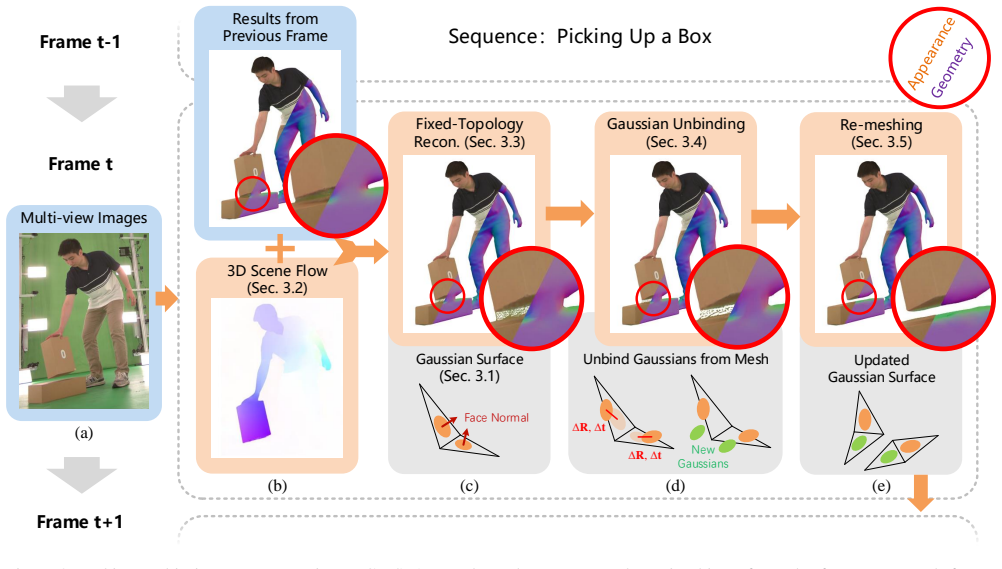
The central object is the Gaussian Surface: a triangle mesh with $N=6$ Gaussians rigidly attached to each face, each Gaussian positioned by a fixed barycentric coordinate so its center moves with the face vertices while its z-axis stays aligned with the face normal. The load-bearing mechanism is the unbinding weight $W(f)=G_{\mathrm{pos}}(f)+\lambda_{\mathrm{rgb}}L_{\mathrm{rgb}}(f)+\lambda_{\mathrm{depth}}L_{\mathrm{depth}}(f)$, which combines positional gradients and RGB/depth reconstruction errors to flag faces where topology is changing; a regularization loss $(1-W(f_g))(\|\Delta R(g)-I\|_1+\lambda_t\|\Delta t(g)\|_1)$ then lets flagged Gaussians move off their faces while keeping others glued. New surfaces are produced by rendering depth images from the unbound Gaussians and fusing them with TSDF, after which the new mesh is merged with the old one along boundary vertex correspondences. Scene flow warping, computed by projecting vertices into views, following 2D optical flow, and re-projecting with depth, supplies the frame-to-frame initialization.
What would settle it
Run GauSTAR on a sequence with a precisely known topology event—a surface splitting, or an object appearing from occlusion—and compare the faces flagged by the unbinding weight against the ground-truth topology-change region. If the flagged faces do not coincide with the true event, or if tracking error on that event is no better than the 'without unbinding' ablation, the claimed mechanism is not what is producing the result.
Extended reading notes
Core claim
The paper's central claim is that coupling meshes with Gaussians—binding each Gaussian to a face via barycentric coordinates—resolves the usual trade-off between trackable geometry and photorealistic appearance in dynamic scenes. For surfaces whose topology is stable between frames, the mesh is deformed and the attached Gaussians are optimized under RGB, depth, and mask supervision. For topology-changing regions, an unbinding weight per face, computed from positional gradients and reconstruction errors, decides which Gaussians should detach; those Gaussians are optimized freely and new Gaussians are introduced, then depth maps rendered from the optimized Gaussians are fused with TSDF and the resulting new surfaces are stitched into the original mesh. A surface-based scene flow, obtained by back-projecting optical flow through depth images, initializes each frame so large or fast motions do not trap the optimization. The authors report that this pipeline beats or matches prior dynamic reconstruction methods on appearance, geometry, and tracking, and that removing any of the three key components degrades all metrics, with tracking errors rising several-fold without scene flow.
Load-bearing premise
The load-bearing assumption is that the places where a surface's topology changes are exactly the places where its Gaussians both move a lot and reconstruct poorly; if that detection misfires, Gaussians stay glued to stale faces or detach from stable ones, and the re-meshing step inherits the error.
Editorial extensions
If this is right
- Dynamic scene tracking no longer requires a template or a fixed-topology mesh: surfaces that appear, split, or vanish are handled per frame by unbinding and re-meshing.
- Because the tracked output is an explicit mesh with attached appearance, edits made to one frame—object insertion or texture changes—propagate consistently to all frames.
- The method applies to general dynamic scenes (robots, multiple people, human-object interaction), not just human bodies, since no body model is assumed.
- The ablations imply that the three components are not optional extras: dropping unbinding, re-meshing, or scene flow raises 3D tracking error by roughly 5–15 times and substantially worsens geometry.
Reading between the lines
- The paper leaves open how its unbinding threshold and the coefficients $\lambda_{\mathrm{rgb}}$, $\lambda_{\mathrm{depth}}$, and $\lambda_t$ are chosen; a natural test is whether the same fixed settings transfer to sequences with very different scales, lighting, or sensor noise.
- Because the output is a trackable mesh, the representation invites downstream uses the paper only gestures at—physics simulation, rigging, spatial audio, or robotic manipulation planning—where a coherent surface is more useful than a cloud of point trajectories.
- The scene-flow module is an obvious upgrade point: swapping the optical-flow backbone for a learned 3D scene-flow network could extend the method to monocular or sparser multi-view settings, though the paper does not claim that.
- A testable extension would be to apply the unbind-and-remesh cycle to long-range static-scene reconstruction, where topology changes (new objects entering, surfaces merging) occur without any motion; the paper does not investigate that setting.
Editorial analysis
A structured set of objections, weighed in public.
Referee Report
Summary. The paper presents GauSTAR, a dynamic scene representation that binds 3D Gaussians to mesh faces and tracks/reconstructs surfaces across topology changes. At each frame the method warps the previous mesh with scene flow, performs fixed-topology reconstruction, detects topology-changing regions with an unbinding weight, unbinds Gaussians there, generates new surfaces by TSDF re-meshing, and then refines the updated Gaussian Surface. The central claim is state-of-the-art appearance, geometry, and tracking on four captured multi-view sequences, with ablations showing that unbinding, re-meshing, and scene flow are each necessary.
Significance. If the result holds, GauSTAR is a useful advance: it addresses topology changes without requiring a human template, it maintains an explicit mesh that supports editing, and its scene-flow initialization targets large deformations. The framework is well motivated and the ablations in Table 2 are informative: disabling unbinding, re-meshing, or scene flow degrades all metrics, which supports the claim that each component contributes. The paper also promises code release, reports quantitative comparisons on four sequences, and uses AprilTags as an external anchor for tracking evaluation. However, the load-bearing topology-change detector is described only at the level of intuition, the evaluation is on the authors' own studio data, and the geometry ground truth appears to come from the same system that provides the initialization. If these issues are addressed, this would be a solid contribution to dynamic surface tracking and reconstruction.
major comments (4)
- [Sec. 3.4, Eq. (10)] The unbinding weight W(f) is the sensor that decides where topology changes occur, but it is not defined precisely enough to reproduce or validate. The per-face terms G_pos, L_rgb(f), and L_depth(f) are not specified, and the threshold above which Gaussians are duplicated and unbound, as well as the coefficients λ_rgb, λ_depth, and λ_t (Eq. 11), are never reported. Because Table 2's "w/o unbinding" ablation is the evidence that unbinding is necessary, the reader cannot tell whether W detects genuine topology changes or merely high-magnitude deformation, occlusion, fast motion, or optimization noise. Please define all quantities, report the threshold and hyperparameters, and provide a quantitative validation of the detector, for example precision/recall of high-W regions against annotated topology-change regions or a sensitivity sweep over the threshold.
- [Sec. 4.2, Geometry evaluation] The geometry ground truth is obtained with the same multi-view reconstruction system [7] that provides the initial mesh for frame one. Since GauSTAR starts from [7] and performs local optimization, Chamfer distance and F-Score against [7] may partly measure how far the method moves from its own initialization rather than absolute geometric accuracy. Please evaluate geometry against an independent reconstruction or ground-truth scan, such as a different MVS/TSDF pipeline or a template scan, and at minimum quantify the drift from the initial mesh across each sequence.
- [Sec. 4.2, Table 1] The headline "best performance" claim is based on a single run on four in-house studio sequences with no error bars, per-sequence breakdown, or statistical testing. The margins over the strongest baselines are modest, for example PSNR 31.87 vs 30.59 for HumanRF and Chamfer distance 0.237 cm vs 0.284 cm. Please report per-sequence results and variance across at least a few optimization runs, or temper the claim accordingly.
- [Sec. 4.2, Baselines] The baseline geometry numbers are not all produced by methods designed for surface extraction: Dynamic 3D Gaussians meshes are obtained by post-hoc TSDF fusion, and HumanRF's mesh extraction is reimplemented from the paper because the original code is unavailable. To support the claim of best geometry, the evaluation protocol must be identical across all methods, including cropping, TSDF resolution, ground-truth alignment, and the set of evaluated frames, and the reimplemented HumanRF mesh extraction should be validated or replaced by a comparison restricted to methods with public surface outputs.
minor comments (6)
- [Sec. 4.2, "w/o IR input"] The description of the variant without IR input is ambiguous: it says rendered depth from HumanRF is used as depth input, but HumanRF itself is an RGB method; please specify how these depth maps are generated and whether they are used only for GauSTAR or also for depth-based baselines.
- [Sec. 4.3, first item] There is a typographical spacing issue in the heading "Gaussian unbinding ." (space before the period).
- [Sec. 2.1] The sentence "As 3D Gaussians are discrete presentations rather than continuous representations like NeRF" should read "representations".
- [Sec. 4.2, fourth bullet] "Dynamic 3D Gaussianss" is a typo for "Dynamic 3D Gaussians".
- [Table 1] The units for 2D ATE are not stated; please specify whether they are pixels or normalized image units.
- [Secs. 3.1, 3.2, 3.5] Several implementation choices are not reported, including the Gaussian z-scale δ, the scene-flow smoothing weights w(u,v), and the TSDF voxel resolution; please include these values in the main text or the supplementary material so the method is reproducible.
Circularity Check
No load-bearing circularity: Eq. (10) is an internal adaptive-density heuristic, not a fitted quantity renamed as a prediction, and the headline metrics are anchored to external AprilTag, Collet-mesh, and standard rendering benchmarks.
full rationale
GauSTAR's derivation chain is self-contained in the sense relevant to circularity. The three headline claims—appearance, geometry, and tracking—are evaluated against external anchors: PSNR/SSIM/LPIPS on held-out views, Chamfer distance and F-Score against Collet et al. [7] meshes, and 3D/2D ATE against AprilTag detections. The unbinding weight W(f) in Eq. (10) is a method-internal heuristic combining positional gradients and fixed-topology reconstruction errors; it is an operational rule for deciding where to add capacity rather than a fitted parameter later renamed as a prediction, and no reported 'predicted' quantity is derived from it by construction. No load-bearing premise is justified solely by a self-citation: the authors' prior works ([25,50,51,52]) appear only as contextual related-work references, while the technically load-bearing anchors (3DGS for Gaussian splatting, TSDF fusion, RAFT optical flow, and Collet et al. for initial geometry and depth refinement) are external. The ablation in Table 2 compares whole-pipeline variants, and the gains from unbinding, re-meshing, and scene flow are measured against the same external ground truth rather than being forced by construction. Two non-circular risks remain: Eq. (10) and the re-meshing threshold are underspecified (per-face G_pos, L_rgb, L_depth, the threshold, and lambda_rgb/lambda_depth are not reported), and the geometry ground truth is produced by the same Collet et al. pipeline that supplies the depth supervision and initial mesh, which is a correctness/fairness concern rather than a reduction of a prediction to its input. Overall, the central derivation does not reduce to its own inputs, so no significant circularity is found.
Assumptions & free parameters
free parameters (7)
- unbinding-weight coefficients lambda_rgb, lambda_depth =
not reported
- translation regularization weight lambda_t =
not reported
- unbinding-weight threshold =
not reported
- Gaussians per face N =
6
- Gaussian z-scale delta =
small predefined value
- scene-flow smoothing weights w(u,v) =
distance-based
- TSDF voxel resolution =
not reported
assumptions (6)
- domain assumption Volumetric Gaussian splatting rendering from 3DGS (Eqs. 1-2) is an accurate image formation model.
- domain assumption Gaussians glued to mesh faces via barycentric coordinates fully determine surface appearance and geometry (Eq. 3).
- ad hoc to paper Topology changes are detectable from high positional gradients and reconstruction errors at faces (Eq. 10).
- domain assumption TSDF fusion of rendered depth maps produces correct new surfaces that can be stitched to the old mesh (Sec. 3.5).
- domain assumption RAFT optical flow and depth reprojection provide reliable 3D scene flow between frames (Sec. 3.2).
- domain assumption Dense multi-view RGB-D captures are available (52 RGB + 52 IR cameras).
Cite this review
Pith. "Pith review of GauSTAR: Gaussian Surface Tracking and Reconstruction." pith.science (2026). https://pith.science/paper/6UXOLATD
@misc{pith2026250110283,
  author       = {Pith},
  title        = {Pith review of: GauSTAR: Gaussian Surface Tracking and Reconstruction},
  year         = {2026},
  howpublished = {\url{https://pith.science/paper/6UXOLATD}},
  note         = {Machine review of arXiv:2501.10283}
}
read the original abstract
3D Gaussian Splatting techniques have enabled efficient photo-realistic rendering of static scenes. Recent works have extended these approaches to support surface reconstruction and tracking. However, tracking dynamic surfaces with 3D Gaussians remains challenging due to complex topology changes, such as surfaces appearing, disappearing, or splitting. To address these challenges, we propose GauSTAR, a novel method that achieves photo-realistic rendering, accurate surface reconstruction, and reliable 3D tracking for general dynamic scenes with changing topology. Given multi-view captures as input, GauSTAR binds Gaussians to mesh faces to represent dynamic objects. For surfaces with consistent topology, GauSTAR maintains the mesh topology and tracks the meshes using Gaussians. For regions where topology changes, GauSTAR adaptively unbinds Gaussians from the mesh, enabling accurate registration and generation of new surfaces based on these optimized Gaussians. Additionally, we introduce a surface-based scene flow method that provides robust initialization for tracking between frames. Experiments demonstrate that our method effectively tracks and reconstructs dynamic surfaces, enabling a range of applications. Our project page with the code release is available at https://eth-ait.github.io/GauSTAR/.
Figures


Figures from the paper (3 more)


Forward citations
Cited by 2 Pith papers
-
Future Rendering $\neq$ Future Surface: A Benchmark and Dataset for Dynamic Surface Reconstruction Beyond the Observed Window
FutureSurf, a new benchmark for held-out future surface reconstruction, shows deformation-MLP methods leave a 2-6.6× future-surface gap while rendering quality stays flat.
-
UAV4D: Dynamic Neural Rendering of Human-Centric UAV Imagery using Gaussian Splatting
UAV4D reconstructs 4D scenes from monocular drone video by fitting a single global scale to align human meshes with the background mesh, then renders with separate Gaussian splats.
Reference graph
Works this paper leans on
-
[7]
High-quality streamable free-viewpoint video
Alvaro Collet, Ming Chuang, Pat Sweeney, Don Gillett, Den- nis Evseev, David Calabrese, Hugues Hoppe, Adam Kirk, and Steve Sullivan. High-quality streamable free-viewpoint video. ACM Transactions on Graphics (ToG) , 34(4):1–13,
-
[1]
Mip-nerf 360: Unbounded anti-aliased neural radiance fields
Jonathan T Barron, Ben Mildenhall, Dor Verbin, Pratul P Srinivasan, and Peter Hedman. Mip-nerf 360: Unbounded anti-aliased neural radiance fields. In Proceedings of the IEEE/CVF conference on computer vision and pattern recognition, pages 5470–5479, 2022. 2
2022
-
[2]
Dynasurfgs: Dynamic surface reconstruction with planar- based gaussian splatting
Weiwei Cai, Weicai Ye, Peng Ye, Tong He, and Tao Chen. Dynasurfgs: Dynamic surface reconstruction with planar- based gaussian splatting. arXiv preprint arXiv:2408.13972,
-
[3]
Neusg: Neural im- plicit surface reconstruction with 3d gaussian splatting guid- ance
Hanlin Chen, Chen Li, and Gim Hee Lee. Neusg: Neural im- plicit surface reconstruction with 3d gaussian splatting guid- ance. arXiv preprint arXiv:2312.00846, 2023. 3
arXiv 2023
-
[4]
Vcr-gaus: View consistent depth-normal regularizer for gaussian surface reconstruction
Hanlin Chen, Fangyin Wei, Chen Li, Tianxin Huang, Yun- song Wang, and Gim Hee Lee. Vcr-gaus: View consistent depth-normal regularizer for gaussian surface reconstruction. arXiv preprint arXiv:2406.05774, 2024. 3
arXiv 2024
-
[5]
Meshgs: Adaptive mesh-aligned gaus- sian splatting for high-quality rendering
Jaehoon Choi, Yonghan Lee, Hyungtae Lee, Heesung Kwon, and Dinesh Manocha. Meshgs: Adaptive mesh-aligned gaus- sian splatting for high-quality rendering. In Proceedings of the Asian Conference on Computer Vision , pages 3310– 3326, 2024. 2
work page 2024
-
[6]
Dream- scene4d: Dynamic multi-object scene generation from monocular videos
Wen-Hsuan Chu, Lei Ke, and Katerina Fragkiadaki. Dream- scene4d: Dynamic multi-object scene generation from monocular videos. arXiv preprint arXiv:2405.02280, 2024. 3
arXiv 2024
-
[8]
High-quality surface recon- struction using gaussian surfels
Pinxuan Dai, Jiamin Xu, Wenxiang Xie, Xinguo Liu, Huamin Wang, and Weiwei Xu. High-quality surface recon- struction using gaussian surfels. In ACM SIGGRAPH 2024 Conference Papers, pages 1–11, 2024. 2, 3
work page 2024
Show all 55 references
-
[9]
Tap-vid: A benchmark for track- ing any point in a video
Carl Doersch, Ankush Gupta, Larisa Markeeva, Adria Re- casens, Lucas Smaira, Yusuf Aytar, Joao Carreira, Andrew Zisserman, and Yi Yang. Tap-vid: A benchmark for track- ing any point in a video. Advances in Neural Information Processing Systems, 35:13610–13626, 2022. 3
2022
-
[10]
Tapir: Tracking any point with per-frame initialization and temporal refinement
Carl Doersch, Yi Yang, Mel Vecerik, Dilara Gokay, Ankush Gupta, Yusuf Aytar, Joao Carreira, and Andrew Zisserman. Tapir: Tracking any point with per-frame initialization and temporal refinement. In Proceedings of the IEEE/CVF In- ternational Conference on Computer Vision , pag...
2023
-
[11]
4d gaussian splatting: Towards efficient novel view synthesis for dynamic scenes
Yuanxing Duan, Fangyin Wei, Qiyu Dai, Yuhang He, Wen- zheng Chen, and Baoquan Chen. 4d gaussian splatting: Towards efficient novel view synthesis for dynamic scenes. arXiv preprint arXiv:2402.03307, 2024. 3
2024 arXiv
-
[12]
Trim 3d gaussian splatting for accurate geometry representation
Lue Fan, Yuxue Yang, Minxing Li, Hongsheng Li, and Zhaoxiang Zhang. Trim 3d gaussian splatting for accurate geometry representation. arXiv preprint arXiv:2406.07499,
-
[13]
K-planes: Explicit radiance fields in space, time, and appearance
Sara Fridovich-Keil, Giacomo Meanti, Frederik Rahbæk Warburg, Benjamin Recht, and Angjoo Kanazawa. K-planes: Explicit radiance fields in space, time, and appearance. In Proceedings of the IEEE/CVF Conference on Computer Vi- sion and Pattern Recognition, pages 12479–12488, 2023. 3
2023
-
[14]
Gaussianflow: Splatting gaussian dynamics for 4d content creation
Quankai Gao, Qiangeng Xu, Zhe Cao, Ben Mildenhall, Wen- chao Ma, Le Chen, Danhang Tang, and Ulrich Neumann. Gaussianflow: Splatting gaussian dynamics for 4d content creation. arXiv preprint arXiv:2403.12365, 2024. 3
2024 arXiv
-
[15]
Sugar: Surface- aligned gaussian splatting for efficient 3d mesh reconstruc- tion and high-quality mesh rendering
Antoine Gu ´edon and Vincent Lepetit. Sugar: Surface- aligned gaussian splatting for efficient 3d mesh reconstruc- tion and high-quality mesh rendering. In Proceedings of the IEEE/CVF Conference on Computer Vision and Pattern Recognition, pages 5354–5363, 2024. 2, 3
2024
-
[16]
Particle video revisited: Tracking through occlusions using point trajectories
Adam W Harley, Zhaoyuan Fang, and Katerina Fragkiadaki. Particle video revisited: Tracking through occlusions using point trajectories. In European Conference on Computer Vi- sion, pages 59–75. Springer, 2022. 3, 7
2022
-
[17]
2d gaussian splatting for geometrically ac- curate radiance fields
Binbin Huang, Zehao Yu, Anpei Chen, Andreas Geiger, and Shenghua Gao. 2d gaussian splatting for geometrically ac- curate radiance fields. In ACM SIGGRAPH 2024 Conference Papers, pages 1–11, 2024. 2, 3, 6, 7
2024
-
[18]
Humanrf: High-fidelity neural radiance fields for humans in motion
Mustafa Is ¸ık, Martin R ¨unz, Markos Georgopoulos, Taras Khakhulin, Jonathan Starck, Lourdes Agapito, and Matthias Nießner. Humanrf: High-fidelity neural radiance fields for humans in motion. ACM Transactions on Graphics (TOG), 42(4):1–12, 2023. 2, 3, 6, 7
2023
-
[19]
Hifi4g: High-fidelity human performance rendering via compact gaussian splatting
Yuheng Jiang, Zhehao Shen, Penghao Wang, Zhuo Su, Yu Hong, Yingliang Zhang, Jingyi Yu, and Lan Xu. Hifi4g: High-fidelity human performance rendering via compact gaussian splatting. In Proceedings of the IEEE/CVF Con- ference on Computer Vision and Pattern Recognition, pages 19...
2024
-
[20]
Co- tracker: It is better to track together
Nikita Karaev, Ignacio Rocco, Benjamin Graham, Natalia Neverova, Andrea Vedaldi, and Christian Rupprecht. Co- tracker: It is better to track together. arXiv preprint arXiv:2307.07635, 2023. 3
2023 arXiv
-
[21]
3d gaussian splatting for real-time radiance field rendering
Bernhard Kerbl, Georgios Kopanas, Thomas Leimkuehler, and George Drettakis. 3d gaussian splatting for real-time radiance field rendering. ACM Transactions on Graphics (TOG), 42(4):1–14, 2023. 2, 3, 5, 6
2023
-
[22]
Spacetime gaus- sian feature splatting for real-time dynamic view synthesis
Zhan Li, Zhang Chen, Zhong Li, and Yi Xu. Spacetime gaus- sian feature splatting for real-time dynamic view synthesis. In Proceedings of the IEEE/CVF Conference on Computer Vision and Pattern Recognition, pages 8508–8520, 2024. 3
2024
-
[23]
Mvg-splatting: Multi-view guided gaussian splatting with adaptive quantile-based geometric consistency densification
Zhuoxiao Li, Shanliang Yao, Yijie Chu, Angel F Garcia- Fernandez, Yong Yue, Eng Gee Lim, and Xiaohui Zhu. Mvg-splatting: Multi-view guided gaussian splatting with adaptive quantile-based geometric consistency densification. arXiv preprint arXiv:2407.11840, 2024. 3
2024 arXiv
-
[24]
Direct learning of mesh and appearance via 3d gaussian splatting
Ancheng Lin and Jun Li. Direct learning of mesh and appearance via 3d gaussian splatting. arXiv preprint arXiv:2405.06945, 2024. 3 9
2024 arXiv
-
[25]
Occlusionfusion: Occlusion-aware motion estimation for real-time dynamic 3d reconstruction
Wenbin Lin, Chengwei Zheng, Jun-Hai Yong, and Feng Xu. Occlusionfusion: Occlusion-aware motion estimation for real-time dynamic 3d reconstruction. In Proceedings of the IEEE/CVF Conference on Computer Vision and Pattern Recognition, pages 1736–1745, 2022. 2
2022
-
[26]
Dynamic gaus- sians mesh: Consistent mesh reconstruction from monocular videos
Isabella Liu, Hao Su, and Xiaolong Wang. Dynamic gaus- sians mesh: Consistent mesh reconstruction from monocular videos. arXiv preprint arXiv:2404.12379, 2024. 2, 3
2024 arXiv
-
[27]
Marching cubes: A high resolution 3d surface construction algorithm
William E Lorensen and Harvey E Cline. Marching cubes: A high resolution 3d surface construction algorithm. ACM SIGGRAPH Computer Graphics, 21(4):163–169, 1987. 2
1987
-
[28]
Dynamic 3d gaussians: Tracking by per- sistent dynamic view synthesis
Jonathon Luiten, Georgios Kopanas, Bastian Leibe, and Deva Ramanan. Dynamic 3d gaussians: Tracking by per- sistent dynamic view synthesis. In 2024 International Con- ference on 3D Vision (3DV), pages 800–809. IEEE, 2024. 2, 3, 6, 7
2024
-
[29]
Reconstructing and simulating dynamic 3d objects with mesh-adsorbed gaussian splatting
Shaojie Ma, Yawei Luo, and Yi Yang. Reconstructing and simulating dynamic 3d objects with mesh-adsorbed gaussian splatting. arXiv preprint arXiv:2406.01593, 2024. 3
2024 arXiv
-
[30]
Nerf: Representing scenes as neural radiance fields for view synthesis
B Mildenhall, PP Srinivasan, M Tancik, JT Barron, R Ra- mamoorthi, and R Ng. Nerf: Representing scenes as neural radiance fields for view synthesis. In European conference on computer vision, 2020. 2
2020
-
[31]
Kinectfusion: Real-time dense surface mapping and track- ing
Richard A Newcombe, Shahram Izadi, Otmar Hilliges, David Molyneaux, David Kim, Andrew J Davison, Pushmeet Kohi, Jamie Shotton, Steve Hodges, and Andrew Fitzgibbon. Kinectfusion: Real-time dense surface mapping and track- ing. In 2011 10th IEEE international symposium on mixed ...
2011
-
[32]
Nerfies: Deformable neural radiance fields
Keunhong Park, Utkarsh Sinha, Jonathan T Barron, Sofien Bouaziz, Dan B Goldman, Steven M Seitz, and Ricardo Martin-Brualla. Nerfies: Deformable neural radiance fields. In Proceedings of the IEEE/CVF International Conference on Computer Vision, pages 5865–5874, 2021. 2
2021
-
[33]
Hypernerf: a higher- dimensional representation for topologically varying neural radiance fields
Keunhong Park, Utkarsh Sinha, Peter Hedman, Jonathan T Barron, Sofien Bouaziz, Dan B Goldman, Ricardo Martin- Brualla, and Steven M Seitz. Hypernerf: a higher- dimensional representation for topologically varying neural radiance fields. ACM Transactions on Graphics (TOG) , 40 ...
2021
-
[34]
Expressive body capture: 3d hands, face, and body from a single image
Georgios Pavlakos, Vasileios Choutas, Nima Ghorbani, Timo Bolkart, Ahmed AA Osman, Dimitrios Tzionas, and Michael J Black. Expressive body capture: 3d hands, face, and body from a single image. In Proceedings of the IEEE/CVF conference on computer vision and pattern recognitio...
2019
-
[35]
You can find geodesic paths in triangle meshes by just flipping edges
Nicholas Sharp and Keenan Crane. You can find geodesic paths in triangle meshes by just flipping edges. ACM Trans- actions on Graphics (TOG), 39(6):1–15, 2020. 6
2020
-
[36]
Surface capture for performance-based animation
Jonathan Starck and Adrian Hilton. Surface capture for performance-based animation. IEEE computer graphics and applications, 27(3):21–31, 2007. 2
2007
-
[37]
What do single-view 3d reconstruction networks learn? In Proceed- ings of the IEEE/CVF conference on computer vision and pattern recognition, pages 3405–3414, 2019
Maxim Tatarchenko, Stephan R Richter, Ren ´e Ranftl, Zhuwen Li, Vladlen Koltun, and Thomas Brox. What do single-view 3d reconstruction networks learn? In Proceed- ings of the IEEE/CVF conference on computer vision and pattern recognition, pages 3405–3414, 2019. 7
2019
-
[38]
Raft: Recurrent all-pairs field transforms for optical flow
Zachary Teed and Jia Deng. Raft: Recurrent all-pairs field transforms for optical flow. In Computer Vision–ECCV 2020: 16th European Conference, Glasgow, UK, August 23– 28, 2020, Proceedings, Part II 16, pages 402–419. Springer,
2020
-
[39]
Neus: Learning neural implicit surfaces by volume rendering for multi-view reconstruction
Peng Wang, Lingjie Liu, Yuan Liu, Christian Theobalt, Taku Komura, and Wenping Wang. Neus: Learning neural implicit surfaces by volume rendering for multi-view reconstruction. arXiv preprint arXiv:2106.10689, 2021. 2
2021 arXiv
-
[40]
Tracking everything everywhere all at once
Qianqian Wang, Yen-Yu Chang, Ruojin Cai, Zhengqi Li, Bharath Hariharan, Aleksander Holynski, and Noah Snavely. Tracking everything everywhere all at once. In Proceedings of the IEEE/CVF International Conference on Computer Vi- sion, pages 19795–19806, 2023. 3
2023
-
[41]
Shape of motion: 4d reconstruc- tion from a single video
Qianqian Wang, Vickie Ye, Hang Gao, Jake Austin, Zhengqi Li, and Angjoo Kanazawa. Shape of motion: 4d reconstruc- tion from a single video. arXiv preprint arXiv:2407.13764,
-
[42]
Space-time 2d gaussian splatting for accurate sur- face reconstruction under complex dynamic scenes
Shuo Wang, Binbin Huang, Ruoyu Wang, and Shenghua Gao. Space-time 2d gaussian splatting for accurate sur- face reconstruction under complex dynamic scenes. arXiv preprint arXiv:2409.18852, 2024. 3
2024 arXiv
-
[43]
Neus2: Fast learning of neural implicit surfaces for multi-view recon- struction
Yiming Wang, Qin Han, Marc Habermann, Kostas Dani- ilidis, Christian Theobalt, and Lingjie Liu. Neus2: Fast learning of neural implicit surfaces for multi-view recon- struction. In Proceedings of the IEEE/CVF International Conference on Computer Vision, pages 3295–3306, 2023. 2, 3
2023
-
[44]
Gs2mesh: Sur- face reconstruction from gaussian splatting via novel stereo views
Yaniv Wolf, Amit Bracha, and Ron Kimmel. Gs2mesh: Sur- face reconstruction from gaussian splatting via novel stereo views. In ECCV 2024 Workshop on Wild 3D: 3D Modeling, Reconstruction, and Generation in the Wild, 2024. 3
2024
-
[45]
4d gaussian splatting for real-time dynamic scene rendering
Guanjun Wu, Taoran Yi, Jiemin Fang, Lingxi Xie, Xiaopeng Zhang, Wei Wei, Wenyu Liu, Qi Tian, and Xinggang Wang. 4d gaussian splatting for real-time dynamic scene rendering. In Proceedings of the IEEE/CVF Conference on Computer Vision and Pattern Recognition, pages 20310–20320, 2024. 3
2024
-
[46]
Monosdf: Exploring monocu- lar geometric cues for neural implicit surface reconstruc- tion
Zehao Yu, Songyou Peng, Michael Niemeyer, Torsten Sat- tler, and Andreas Geiger. Monosdf: Exploring monocu- lar geometric cues for neural implicit surface reconstruc- tion. Advances in neural information processing systems , 35:25018–25032, 2022. 2
2022
-
[47]
Gaussian opacity fields: Efficient adaptive surface reconstruction in unbounded scenes
Zehao Yu, Torsten Sattler, and Andreas Geiger. Gaussian opacity fields: Efficient adaptive surface reconstruction in unbounded scenes. ACM Transactions on Graphics, 2024. 3
2024
-
[48]
Nerf++: Analyzing and improving neural radiance fields
Kai Zhang, Gernot Riegler, Noah Snavely, and Vladlen Koltun. Nerf++: Analyzing and improving neural radiance fields. arXiv preprint arXiv:2010.07492, 2020. 2
2010 arXiv
-
[49]
Dynamic 2d gaussians: Geometrically accu- rate radiance fields for dynamic objects
Shuai Zhang, Guanjun Wu, Xinggang Wang, Bin Feng, and Wenyu Liu. Dynamic 2d gaussians: Geometrically accu- rate radiance fields for dynamic objects. arXiv preprint arXiv:2409.14072, 2024. 3
2024 arXiv
-
[50]
Dtexfusion: Dynamic texture fusion using a consumer rgbd sensor
Chengwei Zheng and Feng Xu. Dtexfusion: Dynamic texture fusion using a consumer rgbd sensor. IEEE Transactions on Visualization and Computer Graphics , 28(10):3365–3375,
-
[51]
A self- occlusion aware lighting model for real-time dynamic recon- struction
Chengwei Zheng, Wenbin Lin, and Feng Xu. A self- occlusion aware lighting model for real-time dynamic recon- struction. IEEE Transactions on Visualization and Computer Graphics, 29(10):4062–4073, 2022. 2
2022
-
[52]
Editablenerf: Editing topologically varying neural radiance fields by key points
Chengwei Zheng, Wenbin Lin, and Feng Xu. Editablenerf: Editing topologically varying neural radiance fields by key points. In Proceedings of the IEEE/CVF Conference on Computer Vision and Pattern Recognition , pages 8317– 8327, 2023. 3
2023
-
[53]
Pointodyssey: A large-scale synthetic dataset for long-term point tracking
Yang Zheng, Adam W Harley, Bokui Shen, Gordon Wet- zstein, and Leonidas J Guibas. Pointodyssey: A large-scale synthetic dataset for long-term point tracking. In Proceed- ings of the IEEE/CVF International Conference on Com- puter Vision, pages 19855–19865, 2023. 7
2023
-
[54]
Physa- vatar: Learning the physics of dressed 3d avatars from visual observations
Yang Zheng, Qingqing Zhao, Guandao Yang, Wang Yi- fan, Donglai Xiang, Florian Dubost, Dmitry Lagun, Thabo Beeler, Federico Tombari, Leonidas Guibas, et al. Physa- vatar: Learning the physics of dressed 3d avatars from visual observations. arXiv preprint arXiv:2404.04421, 2024....
2024 arXiv
-
[55]
Motiongs: Exploring explicit motion guidance for deformable 3d gaussian splatting
Ruijie Zhu, Yanzhe Liang, Hanzhi Chang, Jiacheng Deng, Jiahao Lu, Wenfei Yang, Tianzhu Zhang, and Yongdong Zhang. Motiongs: Exploring explicit motion guidance for deformable 3d gaussian splatting. arXiv preprint arXiv:2410.07707, 2024. 3 11
Reviewed August 10, 2026 · model on record in the stance chip above.
Discussion (0). Continue with ORCID to comment.