REVIEW 3 major objections 6 minor 1 cited by
Searching for substellar companion candidates with Gaia. III. Search for companions to members of young associations
T0 review · 3 major / 6 minor · reviewed 2026-08-10 · deepseek-v4-flash
Pith's one-line read Absolute astrometry from Gaia, combined with radial-velocity and direct-imaging data, uncovers a giant planet around the young M star G80-21 and produces the first well-constrained orbits for AB Pic c and HD 14082B b.
desk verdict A genuinely useful survey paper with solid validation and honest limits, but the flagship G80-21 planet rests on a 3.5-sigma excess whose activity treatment is not convincing. read the letter →
The pith
A machine-rendered reading of the paper's core claim, the machinery that carries it, and where it could break.
The reading
What carries the argument
The engine of the analysis is GaiaPMEX, which converts two numbers from the Gaia DR3 astrometric solution into a companion diagnostic: the astrometric signature $\alpha_{\rm ruwe}$ (the photocenter wander beyond proper motion, parallax and noise, derived from the renormalised unit weight error) and, when Hipparcos data exist, $\alpha_{\rm PMa}$ (the excess in the Gaia-Hipparcos proper-motion anomaly). A grid of Keplerian models with random orbital elements, parallaxes and stellar masses is used to compute the likelihood of the observed signatures, and Bayesian inversion then gives confidence regions in companion mass and semi-major axis; when no companion is detected, the same maps become exclusion limits. The second load-bearing element is the multi-technique characterization: long-baseline HARPS radial-velocity series and SPHERE/GPI direct-imaging detection limits are superimposed on the GaiaPMEX maps, with an MCMC including a stellar-jitter term for G80-21, so that the activity of young stars and the inclination degeneracy of astrometry are handled explicitly.
What would settle it
Extend HARPS/ESPRESSO RV monitoring of G80-21 across at least two years while modeling the 3.8-day activity signal: a remaining Keplerian signal with period and semi-amplitude matching a 2-6 $M_{\rm Jup}$ companion on a 0.5-2 au orbit would confirm the planet, whereas a flat residual after activity correction would falsify it, and Gaia DR4 astrometry should independently show the same periodic wobble.
Extended reading notes
Core claim
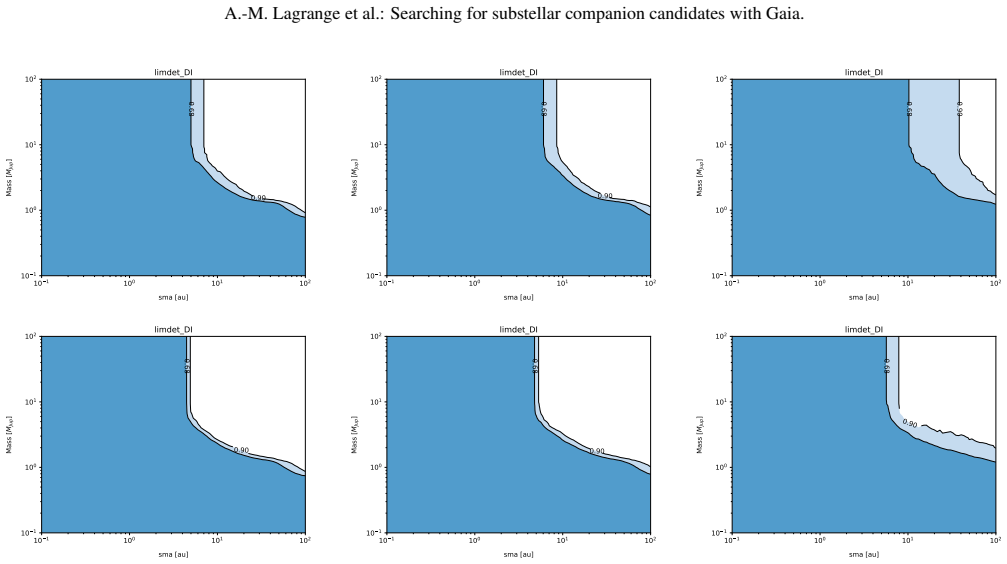
The central claim is that the Gaia astrometric excess, quantified by the renormalised unit weight error and by the Gaia-Hipparcos proper-motion anomaly, can be turned into a companion census for young moving groups once the noise budget is handled correctly. Applying this to 328 non-accreting members of eight nearby associations, the paper reports a new giant planet around the M3 star G80-21 ($N$-$\sigma_{\rm ruwe}=3.5$, no significant PMa excess), with a most likely mass of 2-6 $M_{\rm Jup}$ and semi-major axis 0.5-2 au from an MCMC analysis that combines ruwe, PMa, and activity-dominated HARPS radial velocities. For AB Pic and HD 14082B, it confirms the inner companions AB Pic c ($2.5$-$9\,M_{\rm Jup}$, $2.5$-$6$ au) and HD 14082B b ($8$-$20\,M_{\rm Jup}$, $3$-$5$ au for moderate inclinations) by adding SPHERE/GPI imaging and, for AB Pic, RV data to the astrometric solution, lifting the degeneracies that Gaia data alone leave. Finally, the paper argues that the previously announced planets HD 45270 b and HD 164249 b are not supported at the 2-$\sigma$ level once instrumental noise is included in the PMa. The survey also provides (sma, mass) detection limits for every target, showing that absolute astrometry detects all stellar-mass companions with 0.1-10 au separations and has excellent sensitivity to brown dwarfs and good sensitivity to giant planets in the 0.5-5 au range.
Load-bearing premise
The entire survey assumes that a 2-sigma excess in Gaia's astrometric noise or in the Gaia-Hipparcos proper-motion anomaly is caused by exactly one companion, and that the noise levels calibrated on the general Gaia catalog describe these young, magnetically active stars; if the true noise is larger or if spots and accretion shift photocenters near 0.05 mas, the detections, especially the 3.5-sigma signal around G80-21 whose radial-velocity signature looks like activity, could be spurious or misattributed.
Editorial extensions
If this is right
- G80-21 b would become one of the few young giant planets with a measured semi-major axis around an M dwarf, a direct probe of giant-planet formation and early disk evolution at low stellar masses.
- For AB Pic, a less massive inner planet with no more massive companion out to AB Pic b's separation disfavours the ejection scenario for AB Pic b and points instead to formation by gravitational instability or collapse.
- For HD 14082B, a giant planet at 3-5 au between the system's two suggested debris belts would provide a nearby laboratory for studying disk-planet interactions and would be a prime target for VLTI/Gravity and future ELT imaging.
- The published detection limits allow future RV and imaging surveys to skip targets where absolute astrometry already excludes companions, improving the efficiency of low-mass companion searches.
- With Gaia DR4, the same combination of astrometry plus RV and imaging will still be needed to break degeneracies for long-period companions, so the multi-technique route demonstrated here remains the path forward for characterizing astrometric planets.
Reading between the lines
- If G80-21 b is real, two to three years of dense RV monitoring after modelling the 3.8-day spot signal should reveal a Keplerian residual at the claimed 0.5-2 au period; a null residual would instead point to spots or to an unmodeled long-period signal.
- The non-detections of HD 45270 b and HD 164249 b suggest that other planet candidates built on the same proper-motion-anomaly method without an instrumental-noise term should be re-checked with the noise treatment used here, and some may not survive.
- The survey's detection limits, once corrected for the RV-friendly sample selection, could be combined with population synthesis to place model-independent constraints on companion occurrence between 0.1 and 10 au in young associations.
- For AB Pic, measuring the mutual inclination between the inner and outer companions would directly test the Kozai-Lidov timescale argument the paper uses to explain why only the outer planet was ejected.
Editorial analysis
A structured set of objections, weighed in public.
Referee Report
Summary. This paper applies the GaiaPMEX tool (Kiefer et al. 2024) to 328 members of young associations from the ZF21 RV sample, combining Gaia DR3 ruwe/AEN with Gaia-Hipparcos PMa to diagnose binarity, derive (sma, mass) detection limits, and characterize substellar companions. The survey recovers known binaries and benchmarks (HD 3221, HD 139084, PZ Tel, AF Lep), reports new or improved solutions for G80-21 b (2-6 M_Jup, 0.5-2 au), AB Pic c (2.5-9 M_Jup, 2.5-6 au), and HD 14082B b (8-20 M_Jup, 3-5 au), and argues that HD 45270 b and HD 164249 b are not supported at the 2-sigma level once instrumental noise is accounted for. The central new detection is G80-21 b, based on a 3.5-sigma ruwe excess with no significant PMa and activity-dominated RVs.
Significance. The paper is a useful survey product: detection limits for 328 targets, validation against several literature companions, and a quantitative comparison of Gaia absolute astrometry with RV sensitivity are valuable. If G80-21 b is real, it would be a rare young giant planet around a 0.46 M_sun M dwarf, and the AB Pic/HD 14082B solutions improve on earlier PMa-only estimates. However, the main new result rests on a single astrometric indicator whose noise model is calibrated on the general field population, and the paper's own activity-jitter estimate is internally inconsistent; this limits confidence in the flagship claim as it stands.
major comments (3)
- [§2.4.1, §6.1.1] The activity-jitter rejection is internally inconsistent. The paper quotes AJ(µas) = 0.2 × RVSA(m/s) for spots/faculae; G80-21's HARPS data show ~0.4 km/s peak-to-peak variations on the ~3.8 d rotation timescale, i.e., RVSA ≈ 200 m/s, which via this scaling gives AJ ≈ 0.04 mas. The paper then uses a single-spot geometric model (5% flux deficit, 0.05 R* shift) to obtain ~0.003 mas and concludes activity is negligible because 'all αruwe are larger than 0.05 mas'. For G80-21 the αruwe excess is only marginally above 0.05 mas (N-σruwe = 3.5; Table C.1), so a ~0.04 mas activity-induced jitter is a substantial fraction of the claimed excess. Since the K24 noise calibration is derived from the general G<16 population and is not validated for young, active M dwarfs, the 3.5σ detection is not secure. The MCMC posterior (§6.1.1, Fig. 9) is dominated by the ruwe likelihood, with the RVs absorbed by a 200 m/s jitter (Appendix E.4), so it does not independently corroborate the companion. I request either a dedicated spot/facula photocenter model for G80-21 using its measured photometric amplitude and rotation period, or a demonstration that the K24 noise distribution holds for this stellar type; until then the planet claim should be downgraded.
- [§2.2, Table 3] The 2-sigma detection threshold is not corrected for multiple comparisons across 328 targets. Under the null hypothesis of single stars, roughly 16 targets are expected to exceed 2σ in at least one of the two indicators; Table 3 reports many 2-3σ astrometric binaries without a false-positive budget, and the binary rates in §4.3 (29-43%) are presented without such a correction. The paper notes that some 2-3σ cases are known binaries, but this does not quantify contamination among the newly identified candidates (e.g., the 'promising candidates' of §5.2). Please add a false-positive estimate or explicitly state that the rates and candidate lists are upper limits pending confirmation.
- [§6.2.2, §6.3.1] The characterization of HD 14082B b is described as a 'robust solution' but uses no RV data: the 8-20 M_Jup, 3-5 au range is derived by overlaying GaiaPMEX (ruwe + PMa) solutions on SPHERE detection limits under three assumed inclinations (§6.3.1, Fig. 17). Given the sensitivity of the allowed mass interval to the assumed inclination and the absence of any dynamical confirmation, the term 'robust' overstates what the current data can deliver; the abstract's claim should be tempered or supported by a sensitivity analysis over the full inclination prior rather than three discrete values.
minor comments (6)
- [Abstract] The abstract contains typographical and grammatical errors: 'adaptIn' is truncated, 'planers' should be 'planets', 'we provides' should be 'we provide', and the sentence beginning 'Combining GaiaPMEX and RV data is therefore perfectly adapt' is incomplete.
- [Table C.1] The RUWE column appears to have lost decimal points (e.g., 1913.0, 1806.0 instead of 1.913, 1.806); please reformat so the values can be read correctly.
- [§6.1.1, Fig. 9] The axes are labeled 'smab' and 'mb'; use consistent notation with units (au and M_Jup) and include the corner plot or posterior quantiles, since the MCMC section cites Appendix E.4 for details.
- [References] The reference list contains an orphan entry ('2023, AJ, 165, 246'), and several in-text citations (e.g., the BANYAN reference in §2.1 and the 'Z24' mention in §2.2) do not appear in the reference list in the provided text; please complete them.
- [§4.3] The binary rates are computed as N_det/N_total with sqrt(N_det)/N_total uncertainties; state explicitly that this ignores completeness and false positives, since the text already cautions that accurate rates are beyond scope.
- [General] The paper relies on GaiaPMEX from K24 (in press) and does not release the code; given the load-bearing noise calibration, a public implementation or detailed validation would improve reproducibility.
Circularity Check
No significant circularity: GaiaPMEX detections are forward-modeled and benchmarked externally; self-citations are not load-bearing.
full rationale
The paper's central detections do not reduce to their inputs by construction. GaiaPMEX forward-models the ruwe and PMa distributions for assumed companion masses and semi-major axes, then inverts them with a Bayesian likelihood; the companion parameters are not defined as the detection statistic itself. The noise calibration is empirical, derived from the whole Gaia G<16 database (K24) rather than fitted to the present targets, and it is applied uniformly. The method is benchmarked against independently known companions (PZ Tel b, AF Lep b, HD 139084 SB1), which provides external anchoring. The new candidates, especially G80-21 b, are cross-checked against HARPS RVs and high-contrast imaging, and the paper explicitly attributes most RV variability to stellar activity rather than claiming a planetary RV signal. The MCMC posterior for G80-21 is driven by the astrometric excess and uses RV limits only to constrain the allowed mass/sma region; this is a model-dependent interpretation, not a circular one. The activity-jitter discussion in Section 2.4.1 may be internally debatable, and the K24 noise calibration may under-predict young-star systematics, but those are correctness risks, not cases where the output equals the input by definition. Several references are self-citations (K24, PB23, Meunier & Lagrange 2022), but none of them supplies the load-bearing conclusion: the detections are supported by the paper's own forward modeling and by independent observational benchmarks. Accordingly, no circular step meeting the required evidence standard is found.
Assumptions & free parameters
free parameters (4)
- Stellar jitter for G80-21 MCMC =
200 m/s
- Binarity detection threshold =
2-sigma (p = 0.046)
- Inclination prior for companion orbits =
uniform or sin i over 0-90 deg (Table 2)
- Eccentricity prior =
uniform 0-0.9 (Table 2)
assumptions (5)
- domain assumption A N-sigma_ruwe>=2 or N-sigma_PMa>=2 indicates the presence of exactly one companion
- domain assumption Noise levels (calibration and AL-scan measurement noise) from K24, calibrated on G<16 Gaia sources and assumed constant in time, apply to all targets
- domain assumption Stellar activity and spots produce negligible photocenter shifts for these targets
- domain assumption Accreting and disk-bearing stars do not contaminate the sample; stars used in the analysis have no significant IR excess
- domain assumption Literature membership classifications (SACY/BANYAN) and moving group ages (Table 1) are correct
Cite this review
Pith. "Pith review of Searching for substellar companion candidates with Gaia. III. Search for companions to members of young associations." pith.science (2026). https://pith.science/paper/J5JQFO3S
@misc{pith2026250110488,
  author       = {Pith},
  title        = {Pith review of: Searching for substellar companion candidates with Gaia. III. Search for companions to members of young associations},
  year         = {2026},
  howpublished = {\url{https://pith.science/paper/J5JQFO3S}},
  note         = {Machine review of arXiv:2501.10488}
}
read the original abstract
Absolute astrometry with Gaia is expected to detect and characterize the orbits of thousands of exoplanets in the coming years. A tool, GaiaPMEX, was recently developed to characterize multiple systems based on Gaia-only data, and, when possible, the Gaia-Hipparcos proper motion anomaly. We compare the detection capabilities of absolute astrometry and spectroscopy (RV), and to detect and characterize planetary-mass companions, combining the astrometric data with direct imaging and RV data. For companion masses possibly in the planetary range, we use direct imaging and when possible, RV data as well, to further constrain their nature and orbital properties. For each target, a diagnosis on its binarity based on absolute astrometry is given. When no binary is detected, we provides detection limits in the (sma, mass) space. We identify several companions with possible masses down to the brown dwarfs (BD; 50+) or planetary masses (13). We detect a new giant planet at less than 1-2 au from the M-type star G80-21. For AB Pic and HD 14082 B, we confirm the presence of substellar companions, and provide robust solutions for their mass and orbital properties. We further identify 9 planetary mass companions candidates. Finally, a detailed treatment of noises in Gaia astrometric measurements shows that there are no evidence at a 2-sigma level of two exoplanet detections previously announced. Combining GaiaPMEX and RV data is therefore perfectly adaptIn the 0.5 to 5 au domain, GaiaPMEX has an excellent sensitivity to BDs, and a good sensitivity to planetary mass planets for this sample.
Figures


Figures from the paper (16 more)




Forward citations
Cited by 1 Pith paper
-
The planetary-mass-limit VLT/SINFONI library: Spectral extraction and atmospheric characterization via forward modeling
A homogeneous reanalysis of 21 archival SINFONI K-band spectra yields new C/O ratios for three companions and a model-dependent 500 K temperature drop at the M/L transition.
Reference graph
Works this paper leans on
-
[1]
, " * write output.state after.block = add.period write newline
ENTRY address archiveprefix author booktitle chapter edition editor howpublished institution eprint journal key month note number organization pages publisher school series title type volume year label extra.label sort.label short.list INTEGERS output.state before.all mid.sentence after.sentence after.block FUNCTION init.state.consts #0 'before.all := #1 ...
-
[2]
write newline
" write newline "" before.all 'output.state := FUNCTION n.dashify 't := "" t empty not t #1 #1 substring "-" = t #1 #2 substring "--" = not "--" * t #2 global.max substring 't := t #1 #1 substring "-" = "-" * t #2 global.max substring 't := while if t #1 #1 substring * t #2 global.max substring 't := if while FUNCTION word.in bbl.in " " * FUNCTION format....
-
[3]
M., Gangi , M., Biazzo , K., et al
Alcal \'a , J. M., Gangi , M., Biazzo , K., et al. 2021, , 652, A72
2021
-
[4]
Bell , C. P. M., Mamajek , E. E., & Naylor , T. 2015, , 454, 593
2015
-
[5]
Berdyugina , S. V. & J \"a rvinen , S. P. 2005, Astronomische Nachrichten, 326, 283
2005
-
[6]
& Dutrey , A
Beust , H. & Dutrey , A. 2006, , 446, 137
2006
-
[7]
L., Vigan , A., Mouillet , D., et al
Beuzit , J. L., Vigan , A., Mouillet , D., et al. 2019, , 631, A155
2019
-
[8]
A., Liu , M
Biller , B. A., Liu , M. C., Wahhaj , Z., et al. 2010, , 720, L82
2010
Show all 114 references
-
[9]
2022, , 663, A144
Bonavita , M., Gratton , R., Desidera , S., et al. 2022, , 663, A144
2022
-
[10]
Booth , M., del Burgo , C., & Hambaryan , V. V. 2021, , 500, 5552
2021
-
[11]
Brandt , T. D. 2021 a , , 254, 42
2021
-
[12]
Brandt , T. D. 2021 b , , 254, 42
2021
-
[13]
M., Bonavita , M., et al
Chauvin , G., Lagrange , A. M., Bonavita , M., et al. 2010, , 509, A52
2010
-
[14]
M., Zuckerman , B., et al
Chauvin , G., Lagrange , A. M., Zuckerman , B., et al. 2005, , 438, L29
2005
-
[15]
2015, , 573, A127
Chauvin , G., Vigan , A., Bonnefoy , M., et al. 2015, , 573, A127
2015
-
[16]
M., Delorme , P., et al
Chomez , A., Lagrange , A. M., Delorme , P., et al. 2023, , 675, A205
2023
-
[17]
Cotten , T. H. & Song , I. 2016, , 225, 15
2016
-
[18]
2002, , 384, 491
Cutispoto , G., Pastori , L., Pasquini , L., et al. 2002, , 384, 491
2002
-
[19]
M., Wright , E
Cutri , R. M., Wright , E. L., Conrow , T., et al. 2021, VizieR Online Data Catalog, II/328
2021
-
[20]
H., Milli , J., Absil , O., et al
Dahlqvist , C. H., Milli , J., Absil , O., et al. 2022, , 666, A33
2022
-
[21]
J., Nielsen , E
De Rosa , R. J., Nielsen , E. L., Wahhaj , Z., et al. 2023, , 672, A94
2023
-
[22]
A., Wilson , E
Dickson-Vandervelde , D. A., Wilson , E. C., & Kastner , J. H. 2021, , 161, 87
2021
-
[23]
& Bayo , A
Elliott , P. & Bayo , A. 2016, , 459, 4499
2016
-
[24]
Elliott , P., Bayo , A., Melo , C. H. F., et al. 2014, , 568, A26
2014
-
[25]
Elliott , P., Bayo , A., Melo , C. H. F., et al. 2016, , 590, A13
2016
-
[26]
2020 a , Astronomy & Astrophysics, 634, A2
Flasseur, O., Denis, L., Thi \'e baut, \'E ., & Langlois, M. 2020 a , Astronomy & Astrophysics, 634, A2
2020
-
[27]
2020 b , Astronomy & Astrophysics, 637, A9
Flasseur, O., Denis, L., Thiébaut, E., & Langlois, M. 2020 b , Astronomy & Astrophysics, 637, A9
2020
-
[28]
B., Kozinsky , B., & Rasio , F
Ford , E. B., Kozinsky , B., & Rasio , F. A. 2000, , 535, 385
2000
-
[29]
P., Zhou , Y., et al
Franson , K., Bowler , B. P., Zhou , Y., et al. 2023, arXiv e-prints, arXiv:2302.05420
2023 arXiv
-
[30]
E., Malo , L., et al
Gagn \'e , J., Mamajek , E. E., Malo , L., et al. 2018, , 856, 23
2018
-
[31]
2023 a , , 674, A34
Gaia Collaboration , Arenou , F., Babusiaux , C., et al. 2023 a , , 674, A34
2023
-
[32]
Gaia Collaboration , Vallenari , A., Brown , A. G. A., et al. 2023 b , , 674, A1
2023
-
[33]
2018, , 615, A92
Galicher , R., Boccaletti , A., Mesa , D., et al. 2018, , 615, A92
2018
-
[34]
2016, , 594, A63
Galicher , R., Marois , C., Macintosh , B., et al. 2016, , 594, A63
2016
-
[35]
M., Udry , S., et al
Galland , F., Lagrange , A. M., Udry , S., et al. 2005, , 443, 337
2005
-
[36]
2022, , 667, A124
Gangi , M., Antoniucci , S., Biazzo , K., et al. 2022, , 667, A124
2022
-
[37]
M., Keppler , M., et al
Grandjean , A., Lagrange , A. M., Keppler , M., et al. 2020, , 633, A44
2020
-
[38]
2024, , 685, A119
Gratton , R., Bonavita , M., Mesa , D., et al. 2024, , 685, A119
2024
-
[39]
Griffin , R. F. 2010, The Observatory, 130, 125
2010
-
[40]
2020, , 643, A98
Hagelberg , J., Engler , N., Fontanive , C., et al. 2020, , 643, A98
2020
-
[41]
S., De Gregorio-Monsalvo , I., Montesinos , B., et al
Hales , A. S., De Gregorio-Monsalvo , I., Montesinos , B., et al. 2014, , 148, 47
2014
-
[42]
C., Lockwood , G
Hall , J. C., Lockwood , G. W., & Skiff , B. A. 2007, , 133, 862
2007
-
[43]
2022, , 661, A151
Holl , B., Perryman , M., Lindegren , L., Segransan , D., & Raimbault , M. 2022, , 661, A151
2022
-
[44]
2023, , 674, A10
Holl , B., Sozzetti , A., Sahlmann , J., et al. 2023, , 674, A10
2023
-
[45]
J., Aarnio , A
James , D. J., Aarnio , A. N., Richert , A. J. W., et al. 2016, , 459, 1363
2016
-
[46]
J., Melo , C., Santos , N
James , D. J., Melo , C., Santos , N. C., & Bouvier , J. 2006, , 446, 971
2006
-
[47]
H., Hily-Blant , P., Sacco , G
Kastner , J. H., Hily-Blant , P., Sacco , G. G., Forveille , T., & Zuckerman , B. 2010, , 723, L248
2010
-
[48]
Kastner , J. H. & Principe , D. A. 2022, in Handbook of X-ray and Gamma-ray Astrophysics, 49
2022
-
[49]
2019 a , , 623, A72
Kervella , P., Arenou , F., Mignard , F., & Th \'e venin , F. 2019 a , , 623, A72
2019
-
[50]
2019 b , , 623, A72
Kervella , P., Arenou , F., Mignard , F., & Th \'e venin , F. 2019 b , , 623, A72
2019
-
[51]
2022, , 657, A7
Kervella , P., Arenou , F., & Th \'e venin , F. 2022, , 657, A7
2022
-
[52]
2024 a , arXiv e-prints, A&A, in press, arXiv:2409.16992
Kiefer , F., Lagrange , A.-M., Rubini , P., & Philipot , F. 2024 a , arXiv e-prints, A&A, in press, arXiv:2409.16992
2024
-
[53]
2024 b , arXiv e-prints, A&A, in press, arXiv:2409.16993
Kiefer , F., Lagrange , A.-M., Rubini , P., & Philipot , F. 2024 b , arXiv e-prints, A&A, in press, arXiv:2409.16993
2024
-
[54]
1962, , 67, 591
Kozai , Y. 1962, , 67, 591
1962
-
[55]
L., Shkolnik , E
Kraus , A. L., Shkolnik , E. L., Allers , K. N., & Liu , M. C. 2014, , 147, 146
2014
-
[56]
& Mazeh , T
Krymolowski , Y. & Mazeh , T. 1999, , 304, 720
1999
-
[57]
M., Meunier , N., Desort , M., & Malbet , F
Lagrange , A. M., Meunier , N., Desort , M., & Malbet , F. 2011, , 528, L9
2011
-
[58]
M., et al
Lannier , J., Delorme , P., Lagrange , A. M., et al. 2016, , 596, A83
2016
-
[59]
M., Bonavita , M., et al
Lannier , J., Lagrange , A. M., Bonavita , M., et al. 2017, , 603, A54
2017
-
[60]
W., Skiff , B
Lockwood , G. W., Skiff , B. A., Henry , G. W., et al. 2007, , 171, 260
2007
-
[61]
2013, , 551, A46
Lopez Mart \' , B., Jimenez Esteban , F., Bayo , A., et al. 2013, , 551, A46
2013
-
[62]
Luhman , K. L. 2023, , 165, 269
2023
-
[63]
R., Ingraham , P., et al
Macintosh , B., Graham , J. R., Ingraham , P., et al. 2014, Proceedings of the National Academy of Science, 111, 12661
2014
-
[64]
Y., Oblak , E., Snegireva , E
Malkov , O. Y., Oblak , E., Snegireva , E. A., & Torra , J. 2006, , 446, 785
2006
-
[65]
Mamajek , E. E. & Bell , C. P. M. 2014, , 445, 2169
2014
-
[66]
Martioli , E., H \'e brard , G., Correia , A. C. M., Laskar , J., & Lecavelier des Etangs , A. 2021, , 649, A177
2021
-
[67]
T., Alencar , S
McGinnis , P. T., Alencar , S. H. P., Guimar \ a es , M. M., et al. 2015, , 577, A11
2015
-
[68]
2023 a , , 672, A93
Mesa , D., Gratton , R., Kervella , P., et al. 2023 a , , 672, A93
2023
-
[69]
2023 b , , 672, A93
Mesa , D., Gratton , R., Kervella , P., et al. 2023 b , , 672, A93
2023
-
[70]
Metchev , S. A. & Hillenbrand , L. A. 2009, , 181, 62
2009
-
[71]
2021, arXiv e-prints, arXiv:2104.06072
Meunier , N. 2021, arXiv e-prints, arXiv:2104.06072
2021 arXiv
-
[72]
& Lagrange , A
Meunier , N. & Lagrange , A. M. 2022, , 659, A104
2022
-
[73]
2023, , 675, A168
Mignon , L., Meunier , N., Delfosse , X., et al. 2023, , 675, A168
2023
-
[74]
Mugrauer , M., Vogt , N., Neuh \"a user , R., & Schmidt , T. O. B. 2010, , 523, L1
2010
-
[75]
Murphy , S. J. & Lawson , W. A. 2015, , 447, 1267
2015
-
[76]
R., Mann , A
Newton , E. R., Mann , A. W., Tofflemire , B. M., et al. 2019, , 880, L17
2019
-
[77]
T., Costa , G., Girardi , L., et al
Nguyen , C. T., Costa , G., Girardi , L., et al. 2022, , 665, A126
2022
-
[78]
Offner , S. S. R., Moe , M., Kratter , K. M., et al. 2023, in Astronomical Society of the Pacific Conference Series, Vol. 534, Protostars and Planets VII, ed. S. Inutsuka , Y. Aikawa , T. Muto , K. Tomida , & M. Tamura , 275
2023
-
[79]
2023, , 670, A90
Palma-Bifani , P., Chauvin , G., Bonnefoy , M., et al. 2023, , 670, A90
2023
-
[80]
A., Kraus , A
Pearce , L. A., Kraus , A. L., Dupuy , T. J., et al. 2020, , 894, 115
2020
-
[81]
D., Ingraham, P., Follette, K
Perrin, M. D., Ingraham, P., Follette, K. B., et al. 2016, in , Edinburgh, United Kingdom, 990837
2016
-
[82]
D., Maire, J., Ingraham, P., et al
Perrin, M. D., Maire, J., Ingraham, P., et al. 2014, in , 91473J, arXiv:1407.2301 [astro-ph]
2014 arXiv
-
[83]
\'A ., & Lindegren , L
Perryman , M., Hartman , J., Bakos , G. \'A ., & Lindegren , L. 2014, , 797, 14
2014
-
[84]
2014, , 565, A68
Riviere-Marichalar , P., Barrado , D., Montesinos , B., et al. 2014, , 565, A68
2014
-
[85]
2019, , 631, A139
Rodet , L., Beust , H., Bonnefoy , M., et al. 2019, , 631, A139
2019
-
[86]
2017, , 602, A12
Rodet , L., Beust , H., Bonnefoy , M., et al. 2017, , 602, A12
2017
-
[87]
G., Kastner , J
Sacco , G. G., Kastner , J. H., Forveille , T., et al. 2014, , 561, A42
2014
-
[88]
Sahlmann , J., Triaud , A. H. M. J., & Martin , D. V. 2015, , 447, 287
2015
-
[89]
L., et al
Shan , Y., Revilla , D., Skrzypinski , S. L., et al. 2024, , 684, A9
2024
-
[90]
L., Allers , K
Shkolnik , E. L., Allers , K. N., Kraus , A. L., Liu , M. C., & Flagg , L. 2017, , 154, 69
2017
-
[91]
M., Rieke , G
Sierchio , J. M., Rieke , G. H., Su , K. Y. L., & G \'a sp \'a r , A. 2014, , 785, 33
2014
-
[92]
F., Cutri , R
Skrutskie , M. F., Cutri , R. M., Stiening , R., et al. 2006, , 131, 1163
2006
-
[93]
Song , I., Zuckerman , B., & Bessell , M. S. 2003, , 599, 342
2003
-
[94]
& Bonavita , M
Squicciarini , V. & Bonavita , M. 2022, , 666, A15
2022
-
[95]
G., Oelkers , R
Stassun , K. G., Oelkers , R. J., Paegert , M., et al. 2019, , 158, 138
2019
-
[96]
D., Nielsen , E
Thomas , A. D., Nielsen , E. L., De Rosa , R. J., et al. 2023, , 166, 246
2023
-
[97]
2016, , 152, 11
Tokovinin , A. 2016, , 152, 11
2016
-
[98]
& Horch , E
Tokovinin , A. & Horch , E. P. 2016, , 152, 116
2016
-
[99]
& Kiyaeva , O
Tokovinin , A. & Kiyaeva , O. 2016, VizieR Online Data Catalog, J/MNRAS/456/2070
2016
-
[100]
D., Mendez , R
Tokovinin , A., Mason , B. D., Mendez , R. A., Costa , E., & Horch , E. P. 2020, , 160, 7
2020
-
[101]
Torres , C. A. O., Quast , G. R., da Silva , L., et al. 2006, , 460, 695
2006
-
[102]
Torres , C. A. O., Quast , G. R., Melo , C. H. F., & Sterzik , M. F. 2008, in Handbook of Star Forming Regions, Volume II, ed. B. Reipurth , Vol. 5, 757
2008
-
[103]
2020, , 636, A74
Trifonov , T., Tal-Or , L., Zechmeister , M., et al. 2020, , 636, A74
2020
-
[104]
2007, , 474, 653
van Leeuwen , F. 2007, , 474, 653
2007
-
[105]
M., et al
Venuti , L., Stelzer , B., Alcal \'a , J. M., et al. 2019, , 632, A46
2019
-
[106]
2015, Astronomische Nachrichten, 336, 97
Vogt , N., Mugrauer , M., Neuh \"a user , R., et al. 2015, Astronomische Nachrichten, 336, 97
2015
-
[107]
W., et al
Wahhaj , Z., Cieza , L., Koerner , D. W., et al. 2010, , 724, 835
2010
-
[108]
J., Ruffio, J.-B., De Rosa, R
Wang, J. J., Ruffio, J.-B., De Rosa, R. J., et al. 2015, Astrophysics Source Code Library, ascl:1506.001, aDS Bibcode: 2015ascl.soft06001W
2015
-
[109]
2023, , 75, 368
Wang , X., Xia , F., & Fu , Y. 2023, , 75, 368
2023
-
[110]
G., Henry , T
Winters , J. G., Henry , T. J., Jao , W.-C., et al. 2019, , 157, 216
2019
-
[111]
P., Huang , C
Zhou , G., Wirth , C. P., Huang , C. X., et al. 2022, , 163, 289
2022
-
[112]
2022, , 512, 3060
Zicher , N., Barrag \'a n , O., Klein , B., et al. 2022, , 512, 3060
2022
-
[113]
2021, , 645, A30
Z \'u \ n iga-Fern \'a ndez , S., Bayo , A., Elliott , P., et al. 2021, , 645, A30
2021
-
[114]
2019, , 870, 27
Zuckerman , B. 2019, , 870, 27
2019
Reviewed August 10, 2026 · model on record in the stance chip above.
Discussion (0). Continue with ORCID to comment.