REVIEW 4 major objections 5 minor 1 cited by
Enhancing Semantic Consistency of Large Language Models through Model Editing: An Interpretability-Oriented Approach
T0 review · 4 major / 5 minor · reviewed 2026-08-10 · deepseek-v4-flash
Pith's one-line read The paper claims that injecting biases into the outputs of attention heads and MLPs selected by linear probing improves LLM semantic consistency and task performance without changing model parameters.
desk verdict Useful activation-steering application to prompt consistency, but the causal interpretability claim outruns the evidence. read the letter →
The pith
A machine-rendered reading of the paper's core claim, the machinery that carries it, and where it could break.
The reading
What carries the argument
The load-bearing object is the linear-probing locate-then-edit loop. For every attention head and MLP in every layer, a linear classifier is trained on the concatenated last-token hidden states of a paraphrase pair to predict whether the model's two responses agree; the components whose classifiers score highest are treated as the cause of inconsistency. The edit is an activation shift: $h \leftarrow h + \alpha \, b$, where $b$ is the difference between the mean hidden state on consistent pairs and the mean hidden state over all probe pairs, and $\alpha$ is a strength hyperparameter (set to 5.0 in the main experiments). This mechanism carries the whole argument because it both selects where to intervene and supplies the direction of the intervention from the same probe data.
What would settle it
Edit the lowest-scoring components from the same linear probes, with the same bias formula, and compare against editing the highest-scoring components on RobustSST2 or PopQA_capital; if the low-scoring components produce comparable consistency gains, the probe is selecting correlates rather than causes and the central claim fails.
Extended reading notes
Core claim
On the paper's own terms, the central discovery is that prompt-paraphrase inconsistency in a decoder-only LLM is concentrated in a small set of mid-to-late-layer components, and that shifting those components' activations by a consistency bias measurably improves both consistency and accuracy. The selection is done by linear probing: concatenating the last-token hidden states of each attention head and MLP for a prompt pair, training a linear classifier to predict the pair's consistency label, and ranking components by classification accuracy. The editing is a mean-shift: the bias added to a selected component is the difference between its mean activation on consistent pairs and its mean activation over all pairs, scaled by a strength hyperparameter. With this recipe on a 7-billion-parameter chat model, the paper reports lower response variance across synonymous prompts, higher average accuracy on most tasks, and rough parity or small gains on out-of-domain tasks, while leaving weights untouched. The authors also report that supervised fine-tuning still achieves larger gains on most benchmarks, but at a substantially higher compute cost.
Load-bearing premise
The method assumes that a part of the model that can predict, from its internal state, whether the model will be inconsistent is itself the cause of the inconsistency, so changing that part will fix it; no causal test is done before editing.
Editorial extensions
If this is right
- LLM providers could patch paraphrase sensitivity after deployment by adding a few hundred paraphrased prompt pairs and editing activations, with no retraining.
- The reported 12 to 23 times reduction in GPU hours makes consistency improvement feasible in compute-constrained settings where supervised fine-tuning is not.
- Because the located components cluster in mid-to-late layers, consistency failures are not spread uniformly across the network, pointing to concentrated targets for future fixes.
- Editing and supervised fine-tuning appear partly complementary: applying editing after fine-tuning yields a small additional consistency gain.
Reading between the lines
- If the probe-as-cause assumption holds, the same recipe transfers to other behavioral labels—truthfulness, toxicity, style—by swapping the consistency label for the target label.
- The paper's limitations section notes that locality and portability are not yet measured; until those are checked, the edit's side-effect profile on unrelated knowledge remains unknown.
- A natural next experiment would test the method on human-written paraphrases rather than model-generated ones, since the bias is estimated from the same paraphrase distribution used for evaluation.
- The paper's own comparison shows supervised fine-tuning still wins on most benchmarks, so the method is best read as a low-cost patch or a preliminary intervention rather than a replacement for fine-tuning when maximum accuracy is the goal.
Editorial analysis
A structured set of objections, weighed in public.
Referee Report
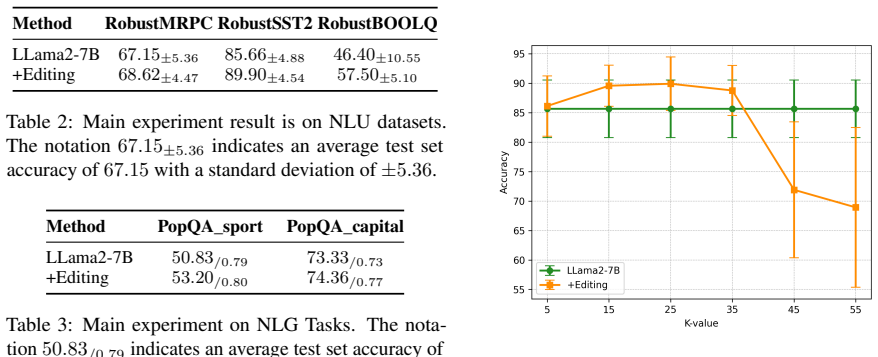
Summary. The paper proposes a locate-then-edit method to improve the semantic consistency of LLMs. It first constructs prompt pairs with equivalent semantics and labels them as consistent or inconsistent based on the target model's own outputs. It then trains linear probes on the hidden states of attention heads and MLPs to predict these consistency labels, selects the top-K components with highest probe accuracy, and adds a bias to those components along the difference between the mean activation of consistent samples and the mean activation of all samples. The method is evaluated on newly constructed NLU benchmarks (RobustSST2, RobustMRPC, RobustBOOLQ) and on NLG datasets (PopQA), reporting improved standard deviation of accuracy (for NLU), mean pairwise cosine similarity (for NLG), and task accuracy compared to the unedited Llama2-7B-Chat model. The paper also includes ablations on the number of edited components, the bias strength, random component/direction controls, out-of-domain generalization, and a comparison with supervised fine-tuning.
Significance. If the proposed method works as claimed, it offers a cheap, inference-time alternative to fine-tuning for improving prompt robustness, and the interpretability framing could provide insight into where inconsistency originates in transformer LMs. The paper contributes three new NLU benchmarks for semantic-consistency evaluation, which could be useful to the community. However, the current evidence has two load-bearing gaps: the NLU consistency metric does not directly measure the paper's own definition of per-instance consistency, and the causal interpretability claim (that probe-selected components are the causes of inconsistency) is not validated. These issues need to be addressed before the central claims can be accepted.
major comments (4)
- [§6.2] The NLU consistency metric, the standard deviation of accuracy across instruction templates, does not measure the paper's own definition of consistency (same answer for the same instance across paraphrases, as stated in Figure 1 and the Introduction). Standard deviation of accuracy is a group-level aggregate; two models can have identical per-instance consistency yet different standard deviations. The reported improvements in 'semantic consistency' for NLU tasks therefore do not directly support the central claim. Please report a per-instance consistency metric, such as the fraction of instances for which all paraphrases yield the same answer, or the average pairwise agreement, and present it alongside the standard deviation.
- [§4.2] The locating step trains linear probes to predict the consistency label c from component hidden states, and then assumes that components with high probe accuracy 'actually cause' the semantic consistency problems. This is a correlational inference: a component whose hidden state is informative about c may simply be carrying information about the model's eventual prediction, not driving the inconsistency. The ablations in Table 5 (random components and random directions) show that the selected components and directions matter, but they do not test whether the selected components are causally responsible. Please add activation-patching or interchange-intervention experiments to validate the causal role of the located components, or substantially soften the interpretability claim that the method 'precisely diagnose[s] the key components'.
- [§5] The NLU test-set construction selects prompts based on the target model's prediction diversity: if the 6 paraphrases yield N distinct outcomes, one prompt from each distinct outcome is included. This selection procedure intentionally oversamples instances where the model is inconsistent and may interact with the editing method differently than with the baseline, potentially exaggerating the measured improvement. Please analyze the distribution of N before and after editing, and report results on a randomly constructed test set (without diversity-based selection) to ensure the reported consistency gains are not an artifact of the selection rule.
- [§4.3 and §6.5.2] The main experiments use alpha=5.0, but the ablation in Table 4 shows that alpha=3.0 yields better results on RobustSST2 (standard deviation 2.98 vs. 4.54). The paper does not specify how alpha and the component count K are chosen for each dataset, nor whether these hyperparameters were selected on the test sets. This is important because the reported improvements may be the result of tuning on the evaluation data. Please clarify the hyperparameter selection procedure and report the sensitivity of the results to K and alpha across all datasets.
minor comments (5)
- [Eq. (4)] Equation (4) contains an extra closing parenthesis in the definition of f(h_{i,j}, p, q); the notation should be f(h_{i,j}, p, q) = [h^p_{i,j,last}; h^q_{i,j,last}].
- [Eq. (7)] The summation notation in Eq. (7) is ambiguous: \sum_{p,c=1} should be specified as a sum over prompts p with label c=1, and the means should be defined clearly over the probe set.
- [§4.3] The phrase 'mass mean' is unusual; consider 'mean' or 'centroid' for clarity.
- [Abstract and Table 10] The abstract claims 'up to 23 times faster', but Table 10 shows speedups of 12X to 23X; please rephrase to 'up to 23 times faster in our experiments' or report the range.
- [§6.5.5] The comparison with SFT uses only 500 training samples for both methods; the conclusion that SFT is more accurate may depend on this budget. A brief discussion of how the comparison would change with more fine-tuning data would be helpful.
Circularity Check
No significant circularity: the method is trained on consistency labels from a probe split and evaluated on held-out instances and instruction templates, with random-component and random-direction ablations as external anchors.
full rationale
The paper's derivation chain is not circular. Consistency labels c are computed from the target LLM's own outputs on training prompt pairs (Section 4.1), linear classifiers are trained on probe-set hidden states and evaluated on a disjoint locate set (Section 4.2), and the editing biases in Eq. (7) are computed from the same probe split but applied to held-out test instances and held-out instruction templates (Section 5). The evaluation metrics for the main claims are measured on test sets with different instances and different instructions from those used to compute biases, so the improvement is an out-of-sample result rather than a reconstruction of the training target. The random-components and random-direction ablations in Table 5 provide an external comparison showing that the specific selected components and directions matter. The causal assumption in Section 4.2 ('we assume that if the model components behave similarly to the target LLM, then these components are actually the causes') is an explicit premise about interpretability, not a definitional reduction of the paper's empirical claims; even if it is scientifically unvalidated, it does not make the reported consistency improvements equivalent to the method's inputs by construction. No self-citation chain is load-bearing: the activation-steering prior work cited (Li et al. 2023, Jorgensen et al. 2023) is external to the authors. The Limitations section honestly notes that locality, portability, and full causal-circuit analysis remain future work, which further confirms that the paper does not present its correlational locating step as a derived mathematical identity. Overall, no equation-level equivalence between inputs and claimed predictions is present.
Assumptions & free parameters
free parameters (2)
- K (number of selected components) =
25
- alpha (bias scaling strength) =
5.0
assumptions (2)
- domain assumption High linear-probe accuracy for the consistency label on a component's hidden states implies that the component causally drives semantic inconsistency.
- domain assumption Adding the mean-difference bias vector to the selected components shifts the model toward a state that improves consistency without substantially harming other capabilities.
Cite this review
Pith. "Pith review of Enhancing Semantic Consistency of Large Language Models through Model Editing: An Interpretability-Oriented Approach." pith.science (2026). https://pith.science/paper/EYYFW24S
@misc{pith2026250111041,
  author       = {Pith},
  title        = {Pith review of: Enhancing Semantic Consistency of Large Language Models through Model Editing: An Interpretability-Oriented Approach},
  year         = {2026},
  howpublished = {\url{https://pith.science/paper/EYYFW24S}},
  note         = {Machine review of arXiv:2501.11041}
}
read the original abstract
A Large Language Model (LLM) tends to generate inconsistent and sometimes contradictory outputs when presented with a prompt that has equivalent semantics but is expressed differently from the original prompt. To achieve semantic consistency of an LLM, one of the key approaches is to finetune the model with prompt-output pairs with semantically equivalent meanings. Despite its effectiveness, a data-driven finetuning method incurs substantial computation costs in data preparation and model optimization. In this regime, an LLM is treated as a ``black box'', restricting our ability to gain deeper insights into its internal mechanism. In this paper, we are motivated to enhance the semantic consistency of LLMs through a more interpretable method (i.e., model editing) to this end. We first identify the model components (i.e., attention heads) that have a key impact on the semantic consistency of an LLM. We subsequently inject biases into the output of these model components along the semantic-consistency activation direction. It is noteworthy that these modifications are cost-effective, without reliance on mass manipulations of the original model parameters. Through comprehensive experiments on the constructed NLU and open-source NLG datasets, our method demonstrates significant improvements in the semantic consistency and task performance of LLMs. Additionally, our method exhibits promising generalization capabilities by performing well on tasks beyond the primary tasks.
Figures


Figures from the paper (1 more)
Forward citations
Cited by 1 Pith paper
-
Certifiable Safe RLHF: Semantic Grounding and Fixed Penalty Constraint Optimization for Safer LLM Alignment
A fixed ReLU penalty and a semantically labeled cost model are proposed to make RLHF safer, but the 'certifiable' guarantee is not fully supported.
Reference graph
Works this paper leans on
-
[1]
URL: " 'urlintro :=
ENTRY address author booktitle chapter edition editor howpublished institution journal key month note number organization pages publisher school series title type volume year eprint doi pubmed url lastchecked label extra.label sort.label short.list INTEGERS output.state before.all mid.sentence after.sentence after.block STRINGS urlintro eprinturl eprintpr...
-
[2]
write newline
" write newline "" before.all 'output.state := FUNCTION n.dashify 't := "" t empty not t #1 #1 substring "-" = t #1 #2 substring "--" = not "--" * t #2 global.max substring 't := t #1 #1 substring "-" = "-" * t #2 global.max substring 't := while if t #1 #1 substring * t #2 global.max substring 't := if while FUNCTION word.in bbl.in capitalize " " * FUNCT...
-
[3]
Guillaume Alain and Yoshua Bengio. 2016. Understanding intermediate layers using linear classifier probes. arXiv preprint arXiv:1610.01644
arXiv 2016
-
[4]
Tom B. Brown, Benjamin Mann, Nick Ryder, Melanie Subbiah, Jared Kaplan, Prafulla Dhariwal, Arvind Neelakantan, Pranav Shyam, Girish Sastry, Amanda Askell, Sandhini Agarwal, Ariel Herbert - Voss, Gretchen Krueger, Tom Henighan, Rewon Child, Aditya Ramesh, Daniel M. Ziegler, Jeffrey Wu, Clemens Winter, Christopher Hesse, Mark Chen, Eric Sigler, Mateusz Litw...
2020
-
[5]
Christopher Clark, Kenton Lee, Ming-Wei Chang, Tom Kwiatkowski, Michael Collins, and Kristina Toutanova. 2019. Boolq: Exploring the surprising difficulty of natural yes/no questions. In Proceedings of the 2019 Conference of the North American Chapter of the Association for Computational Linguistics: Human Language Technologies, Volume 1 (Long and Short Pa...
2019
-
[6]
Bill Dolan and Chris Brockett. 2005. Automatically constructing a corpus of sentential paraphrases. In Third International Workshop on Paraphrasing (IWP2005)
work page 2005
-
[7]
Yanai Elazar, Nora Kassner, Shauli Ravfogel, Abhilasha Ravichander, Eduard Hovy, Hinrich Sch \"u tze, and Yoav Goldberg. 2021. https://doi.org/10.1162/tacl_a_00410 Measuring and improving consistency in pretrained language models . Transactions of the Association for Computational Linguistics, 9:1012--1031
-
[8]
Nelson Elhage, Neel Nanda, Catherine Olsson, Tom Henighan, Nicholas Joseph, Ben Mann, Amanda Askell, Yuntao Bai, Anna Chen, Tom Conerly, et al. 2021. A mathematical framework for transformer circuits. Transformer Circuits Thread, 1
work page 2021
Show all 31 references
-
[9]
Constanza Fierro and Anders S gaard. 2022. https://doi.org/10.18653/v1/2022.findings-acl.240 Factual consistency of multilingual pretrained language models . In Findings of the Association for Computational Linguistics: ACL 2022, pages 3046--3052, Dublin, Ireland. Association ...
2022 doi
-
[10]
Chengguang Gan and Tatsunori Mori. 2023. Sensitivity and robustness of large language models to prompt in japanese. arXiv preprint arXiv:2305.08714
2023 arXiv
-
[11]
Amr Hendy, Mohamed Abdelrehim, Amr Sharaf, Vikas Raunak, Mohamed Gabr, Hitokazu Matsushita, Young Jin Kim, Mohamed Afify, and Hany Hassan Awadalla. 2023. How good are gpt models at machine translation? a comprehensive evaluation. arXiv preprint arXiv:2302.09210
2023 arXiv
-
[12]
Ole Jorgensen, Dylan Cope, Nandi Schoots, and Murray Shanahan. 2023. Improving activation steering in language models with mean-centring. arXiv preprint arXiv:2312.03813
2023 arXiv
-
[13]
Kenneth Li, Oam Patel, Fernanda Vi \'e gas, Hanspeter Pfister, and Martin Wattenberg. 2023. Inference-time intervention: Eliciting truthful answers from a language model. arXiv preprint arXiv:2306.03341
2023 arXiv
-
[14]
Chin-Yew Lin. 2004. Rouge: A package for automatic evaluation of summaries. In Text summarization branches out, pages 74--81
2004
-
[15]
Maas, Raymond E
Andrew L. Maas, Raymond E. Daly, Peter T. Pham, Dan Huang, Andrew Y. Ng, and Christopher Potts. 2011. http://www.aclweb.org/anthology/P11-1015 Learning word vectors for sentiment analysis . In Proceedings of the 49th Annual Meeting of the Association for Computational Linguist...
2011
-
[16]
Kevin Meng, David Bau, Alex Andonian, and Yonatan Belinkov. 2022. Locating and editing factual associations in gpt. Advances in Neural Information Processing Systems, 35:17359--17372
2022
-
[17]
Eric Mitchell, Charles Lin, Antoine Bosselut, Christopher D Manning, and Chelsea Finn. 2022. Memory-based model editing at scale. In International Conference on Machine Learning, pages 15817--15831. PMLR
2022
-
[18]
Cohen, and Mirella Lapata
Shashi Narayan, Shay B. Cohen, and Mirella Lapata. 2018. Don't give me the details, just the summary! topic-aware convolutional neural networks for extreme summarization. ArXiv, abs/1808.08745
2018 arXiv
-
[19]
Long Ouyang, Jeffrey Wu, Xu Jiang, Diogo Almeida, Carroll Wainwright, Pamela Mishkin, Chong Zhang, Sandhini Agarwal, Katarina Slama, Alex Ray, et al. 2022. Training language models to follow instructions with human feedback. Advances in Neural Information Processing Systems, 3...
2022
-
[20]
Xiao Pu, Mingqi Gao, and Xiaojun Wan. 2023. Summarization is (almost) dead. arXiv preprint arXiv:2309.09558
2023 arXiv
-
[21]
Ella Rabinovich, Samuel Ackerman, Orna Raz, Eitan Farchi, and Ateret Anaby-Tavor. 2023. http://arxiv.org/abs/2311.01152 Predicting question-answering performance of large language models through semantic consistency
2023 arXiv
-
[22]
Harsh Raj, Vipul Gupta, Domenic Rosati, and Subhabrata Majumdar. 2023. Semantic consistency for assuring reliability of large language models. arXiv preprint arXiv:2308.09138
2023 arXiv
-
[23]
Harsh Raj, Domenic Rosati, and Subhabrata Majumdar. 2022. Measuring reliability of large language models through semantic consistency. In NeurIPS ML Safety Workshop
2022
-
[24]
Liu, and Christopher D
Abigail See, Peter J. Liu, and Christopher D. Manning. 2017. https://doi.org/10.18653/v1/P17-1099 Get to the point: Summarization with pointer-generator networks . In Proceedings of the 55th Annual Meeting of the Association for Computational Linguistics (Volume 1: Long Papers...
2017 doi
-
[25]
Richard Socher, Alex Perelygin, Jean Wu, Jason Chuang, Christopher D Manning, Andrew Y Ng, and Christopher Potts. 2013. Recursive deep models for semantic compositionality over a sentiment treebank. In Proceedings of the 2013 conference on empirical methods in natural language...
2013
-
[26]
Hugo Touvron, Louis Martin, Kevin Stone, Peter Albert, Amjad Almahairi, Yasmine Babaei, Nikolay Bashlykov, Soumya Batra, Prajjwal Bhargava, Shruti Bhosale, et al. 2023. Llama 2: Open foundation and fine-tuned chat models. arXiv preprint arXiv:2307.09288
2023 arXiv
-
[27]
Zengzhi Wang, Qiming Xie, Zixiang Ding, Yi Feng, and Rui Xia. 2023. Is chatgpt a good sentiment analyzer? a preliminary study. arXiv preprint arXiv:2304.04339
2023 arXiv
-
[28]
Yunzhi Yao, Peng Wang, Bozhong Tian, Siyuan Cheng, Zhoubo Li, Shumin Deng, Huajun Chen, and Ningyu Zhang. 2023. https://doi.org/10.18653/v1/2023.emnlp-main.632 Editing large language models: Problems, methods, and opportunities . In Proceedings of the 2023 Conference on Empiri...
2023 doi
-
[29]
Xiang Zhang, Junbo Jake Zhao, and Yann LeCun. 2015. Character-level convolutional networks for text classification. In NIPS
2015
-
[30]
Chunting Zhou, Junxian He, Xuezhe Ma, Taylor Berg-Kirkpatrick, and Graham Neubig. 2022. https://doi.org/10.18653/v1/2022.findings-emnlp.192 Prompt consistency for zero-shot task generalization . In Findings of the Association for Computational Linguistics: EMNLP 2022, pages 26...
2022 doi
-
[31]
Yu, and Sanjiv Kumar
Chen Zhu, Ankit Singh Rawat, Manzil Zaheer, Srinadh Bhojanapalli, Daliang Li, Felix X. Yu, and Sanjiv Kumar. 2020. http://arxiv.org/abs/2012.00363 Modifying memories in transformer models . CoRR, abs/2012.00363
2020 arXiv
Reviewed August 10, 2026 · model on record in the stance chip above.
Discussion (0). Continue with ORCID to comment.