REVIEW 3 major objections 5 minor 100 references
Phenomenological gravitational waveforms for core-collapse supernovae
T0 review · 3 major / 5 minor · reviewed 2026-08-10 · deepseek-v4-flash
Pith's one-line read This paper presents ccphen v4, a fast parametric waveform generator that claims to reproduce non-rotating core-collapse supernova gravitational-wave morphologies closely enough for machine-learning training.
desk verdict A genuinely useful, well-documented waveform generator whose main limitation is that its 'close similarity' claim is validated only in-sample; worth publishing after an out-of-sample test and some claim tempering. read the letter →
The pith
A machine-rendered reading of the paper's core claim, the machinery that carries it, and where it could break.
The reading
What carries the argument
The machine that carries the argument is a driven damped harmonic oscillator for each independent component of the mass quadrupole moment, $$\ddot{I}'_{lm} + \frac{\omega_0(t)}{Q(t)}\dot{I}'_{lm} + \omega_0(t)^2 I'_{lm} = W_{lm}(t),$$ with $W_{lm}(t)$ the time-integrated random forcing power and $Q\in[1,10]$ the damping quality factor. The generator builds the strain from the second time derivative $\ddot{I}_{lm}$ through the quadrupole formula, and imposes statistical isotropy by enforcing equal rms amplitudes $\langle|I_{20}|^2\rangle=\langle|I_{21}|^2\rangle=\langle|I_{22}|^2\rangle$, which is what makes both polarizations meaningful for a detector network. Around this equation the paper assembles calibrated parameter ranges for the dominant proto-neutron-star mode and the standing accretion shock instability (SASI) component, a random-parameter generator covering three waveform classes, and a spectrogram-residual metric $R$ used to compare against numerical simulations.
What would settle it
Take a recent three-dimensional simulation that was not in the frozen 2022 catalogue, fit the best ccphen v4 waveform to its spectrogram, and check whether the residual $R$ stays near the reported $R\approx0.15$–$0.18$ range; if it jumps far above that, or if a convolutional network trained on v4 waveforms detects held-out simulation waveforms much worse than one trained on simulations, the morphology claim is falsified.
Extended reading notes
Core claim
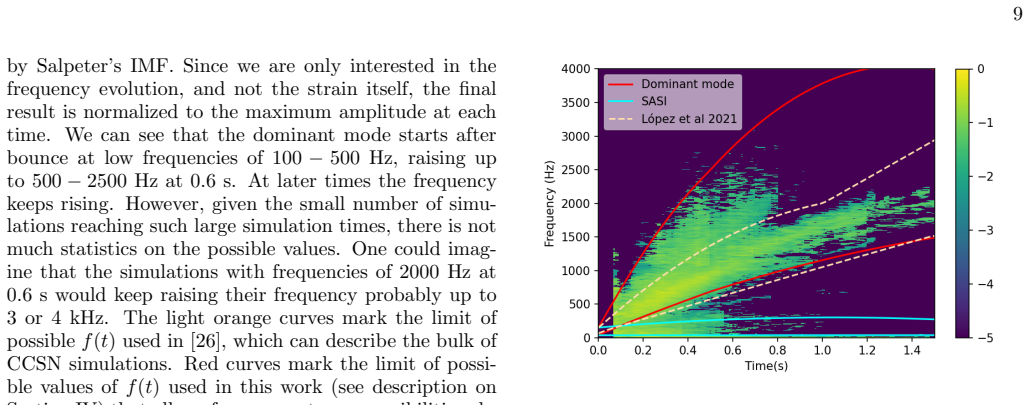
The paper's claim is that the gravitational-wave strain of a non-rotating core-collapse supernova can be reduced to a small set of phenomenological parameters controlling stochastic oscillations of the proto-neutron star. Each spherical-harmonic component of the mass quadrupole obeys a driven damped harmonic oscillator with a time-dependent frequency $\omega_0(t)$, a constant quality factor $Q\in[1,10]$, and a white-noise forcing whose power is scaled by $f(t)^{1-0.45}$ so that the rms strain stays statistically constant. The calibration uses the frozen 2022 catalogue to set ranges for start and end times, frequency tracks, amplitudes, and the $Q$ factor, and the comparison metric $R$ measures squared relative difference between the spectrogram of a numerical waveform and the best-fit ccphen waveform. On that metric the paper reports typical differences of 10–20 points, with the two displayed examples at $R\approx0.16$–$0.18$, and the authors conclude that this is close morphological similarity sufficient for training convolutional neural networks, a use already demonstrated for the older version of the generator.
Load-bearing premise
The load-bearing premise is that the 33 non-rotating three-dimensional simulations frozen in 2022 span the true diversity of core-collapse supernova gravitational-wave signals, so any real signal outside that coverage will not be reproduced by the generator.
Editorial extensions
If this is right
- Thousands of realistic, reproducible waveform realizations can be generated in minutes, giving machine-learning pipelines a training set far larger than the few tens of numerical simulations.
- Because both polarizations are included, the templates can be used for coherent multi-detector searches rather than single-detector strain predictions.
- Adding SASI as a separate component lets templates cover the low-frequency part of the signal alongside the dominant proto-neutron-star mode.
- Uniform coverage of the calibrated parameter space makes the generator usable for pipeline testing, horizon-distance estimates, and improved targeted-search constraints.
Reading between the lines
- A direct stress test is to re-run the calibration on a catalogue updated past 2022: the paper notes that several newer long-duration simulations were excluded, so the current frequency and duration bounds may shift once those are included.
- The morphology metric is computed on spectrograms; a stronger operational test would be to train a convolutional network on v4 waveforms and measure detection efficiency on held-out numerical-simulation waveforms, which the paper identifies as upcoming work.
- The statistical-isotropy assumption implies a network-level prediction: an ensemble of ccphen v4 signals should show no preferred direction in a multi-detector network, so a future event whose reconstructed polarization strongly violates isotropy would challenge the model.
- The paper's finding that only broadband forcing keeps the dominant mode excited suggests that narrow-band turbulent driving alone is unlikely to sustain these oscillations, a claim that could be tested with targeted mode-excitation hydrodynamics.
Editorial analysis
A structured set of objections, weighed in public.
Referee Report
Summary. The manuscript presents ccphen v4, a publicly available phenomenological generator of gravitational waveforms from core-collapse supernovae (CCSNe). The generator models the dominant proto-neutron-star (PNS) oscillation mode (and optionally the SASI mode) as driven damped harmonic oscillators with stochastic forcing, and it is the first phenomenological CCSN waveform model to include polarization and multiple oscillation modes simultaneously. Parameter ranges for the generator (signal duration, frequency evolution, Q-factor, amplitude, SASI parameters) are calibrated against a catalogue of 33 non-rotating 3D simulations plus 17 2D simulations, weighted by a Salpeter initial mass function. The paper claims that ccphen v4 reproduces the morphology of numerical simulation waveforms on the basis of spectrogram comparisons after per-waveform optimization of 7–12 parameters, and emphasizes the low computational cost (~10 ms CPU time, few MB memory) and the suitability of the generator for training machine-learning detection pipelines.
Significance. If the morphological similarity claim is substantiated, ccphen v4 would be a valuable tool for the CCSN gravitational-wave community: it would enable large, homogeneous training sets for ML-based searches, provide waveform-independent horizon-distance estimates, and allow parameter-space coverage that numerical simulations cannot offer. The physics model in Eq. (21) is a reasonable extension of earlier work, the code is public, and the reported computational efficiency is convincingly benchmarked. The isotropy proof in Appendix A is largely internally consistent (modulo a minor typo). However, the central validation of the morphology claim is currently incomplete: the reported residuals are in-sample fits and lack any null baseline or out-of-sample test. As a result, the paper's headline claim that the generator 'reproduces the morphology' of numerical waveforms is not yet established, although the approach is clearly promising.
major comments (3)
- [Section V, Eqs. (32)–(34)] The central claim of morphological similarity is supported only by in-sample fits. In Section V, the parameters (tini, Q, f0–f2, and SASI parameters) are optimized independently for each catalogue waveform using the residual R(Scat,Sccp) defined in Eq. (32), while the allowed parameter ranges were calibrated using the same catalogue in Section III.A. The resulting residuals (R ≈ 0.15–0.18) therefore reflect the flexibility of a 7–12 parameter fit and do not by themselves establish that ccphen v4 reproduces the morphology of numerical waveforms. The authors should provide an out-of-sample test, for example by generating waveforms for the recent simulations [64,65] that are explicitly excluded in Section III.A, or by cross-validating on the catalogue (calibrate on a subset and test on the remainder). Without such a test, the abstract's statement that ccphen v4 'reproduces the morphology of numerical simulation waveforms' is not supported.
- [Section V, Fig. 11] The similarity metric has no null baseline. The paper reports that residuals of 10–20 'points' (or R ≈ 0.15–0.18) indicate close similarity, but it does not compare these values with the intrinsic scatter of the catalogue: for example, the residual between two numerical simulations of the same or similar progenitors, or between independent stochastic realizations of ccphen with identical parameters. Without this baseline, an absolute R value cannot be interpreted as 'close.' The authors should compute R for pairs of numerical simulations (or for repeated ccphen realizations) to calibrate what R corresponds to morphological fidelity. Additionally, the spectrogram definitions used in Eq. (32) (window type, length, overlap, frequency bins) are not specified, which prevents reproducibility and makes the '10–20 points' wording ambiguous.
- [Section VI] The appeal to CNN transfer tests performed with ccphen v3 is not a substitute for validating v4. The paper acknowledges that v4 transfer tests are 'upcoming work,' but the abstract and conclusions nevertheless assert that the waveforms are morphologically similar to numerical simulations. Since v4 introduces polarization and multiple modes, the earlier CNN results for v3 do not directly apply. The morphology claim should be supported by a v4-specific test, such as training a CNN on ccphen v4 waveforms and evaluating on numerical waveforms, or by comparing v4 and v3 residuals on the same catalogue, to demonstrate that the added complexity does not degrade (or improves) the transferability.
minor comments (5)
- [Appendix A, Eq. (A20)] The expression for E[I^2_xy] should be N m^2/15 E[r^4], not 3N m^2/15 E[r^4]. The final relation E[I_xx^2] = 4/3 E[I_xy^2] and the isotropy conclusion remain correct with the corrected value, but as written Eqs. (A19) and (A20) are inconsistent with Eq. (A22).
- [Section V, Eq. (32)] Please specify the spectrogram parameters (window function, window length, overlap, frequency binning) used to compute S_cat and S_ccp so that the reported residuals are reproducible.
- [Abstract and Section VI] The phrase 'reproduces the morphology' is stronger than the evidence presented; consider softening to 'approximates the morphology' or 'is consistent with the morphology within the validation performed,' especially until the out-of-sample tests are completed.
- [Section III.G and Table III] The SASI frequency parameters in Table III list f1 in the range 50–150 Hz and f2 in 50–300 Hz without an explicit restriction that f2 > f1, although the example in Fig. 6 shows a rising SASI track. Clarify whether such a restriction is intended.
- [Table I] The first row (Kuroda et al. 2016) lists 'SFHx SFHx' in the Model and EOS columns; if the model identifier and EOS are distinct, one of them appears to be mislabelled.
Circularity Check
Morphology claim is anchored to an in-sample optimized residual, not to an out-of-sample prediction; v3 CNN evidence is explicitly deferred for v4.
-
fitted input called prediction
[Section V, Eqs. (32)-(34); Section VI conclusion]
"To find phenomenological waveforms that are similar to the ones present in the catalogue, we define an optimization function ... R(Scat, Sccp) = M SE(Scat, Sccp)/hrms,cat ... we optimize the following parameters: R(Scat, Sccp(tini,d, Q0,d, f0,d, f1,d, f2,d)) ... Note that neither in Eq. 33 nor in Eq. 34 the amplitude of the ccphen waveform is an optimization parameter since we scale it by hrms,cat."
The central claim that ccphen v4 'reproduces the morphology' of numerical waveforms is supported by quoting the residual R after minimizing it over 7-12 free parameters (tini, Q, f0-f2, SASI parameters) for each catalogue waveform. The same 33-model catalogue also fixed all parameter ranges in Section III.A, so the comparison is entirely in-sample. Moreover, the amplitude component of the match is imposed by construction through scaling to hrms,cat. The reported '10-20 points' difference is therefore the achieved training residual, not an out-of-sample or null-baseline metric; no held-out simulations (e.g., the explicitly excluded recent simulations [64,65]) or simulation-to-simulation scatter is used to calibrate what 'close' means.
full rationale
The paper contains substantial independent content that is not circular: the damped-oscillator model in Section II, the statistical-isotropy proof in Appendix A, the integrator accuracy and performance tests, and the careful Salpeter-weighted calibration of parameter ranges are all self-contained derivations or implementation checks. The circular concern is confined to the validation of the paper's headline morphology claim. In Section V the similarity metric R in Eq. (32) is minimized over the phenomenological parameters in Eqs. (33)-(34) for every catalogue waveform, with the amplitude forced by scaling to the catalogue rms value. The resulting minimized residuals, 0.157-0.178 in the examples and '10-20 points' in Fig. 11, are then quoted in Section VI as evidence that 'the waveforms are morphologically similar to those in numerical simulations.' That is a goodness-of-fit statement, not a predictive test; the closeness is partly constructed by the optimization and by the shared calibration catalogue. The paper is transparent about the v3 CNN test in Section VI being from the previous version and states that the v4 transfer test is 'upcoming work,' so that self-citation is not counted as load-bearing for v4 here, though it provides no independent support either. Weighing the genuine model-building content against the in-sample validation of the central morphological-fidelity claim, the partial circularity is moderate: score 5.
Assumptions & free parameters
free parameters (5)
- Forcing frequency scaling exponent =
0.55 (from 1 - 0.45)
- Median log10 hrms at 10 kpc =
-23.0 ± 0.4
- Dominant mode Q factor range =
1 to 10
- Dominant mode frequency anchors =
f1=50-150 Hz, f2=700-2500 Hz, f3=1500-4000 Hz
- SASI frequency anchors =
f1=50-150 Hz, f2=50-300 Hz, f3=f2
assumptions (6)
- domain assumption Einstein quadrupole formula approximates GW emission from CCSNe within 10% amplitude error
- domain assumption Non-rotating CCSN sources are statistically isotropic
- domain assumption The PNS can be modeled as a spherically symmetric background with linear oscillation modes
- ad hoc to paper Q-factor is constant in time
- ad hoc to paper White-noise forcing with power-law scaling excites the modes
- domain assumption The frozen 2022 catalogue represents the population of non-rotating CCSN GW signals
Cite this review
Pith. "Pith review of Phenomenological gravitational waveforms for core-collapse supernovae." pith.science (2026). https://pith.science/paper/5XQ7WSX5
@misc{pith2026250111401,
  author       = {Pith},
  title        = {Pith review of: Phenomenological gravitational waveforms for core-collapse supernovae},
  year         = {2026},
  howpublished = {\url{https://pith.science/paper/5XQ7WSX5}},
  note         = {Machine review of arXiv:2501.11401}
}
abstract
Galactic core-collapse supernovae (CCSNe) are a target for current generation gravitational wave detectors with an expected rate of 1-3 per century. The development of data analysis methods used for their detection relies deeply on the availability of waveform templates. However, realistic numerical simulations producing such waveforms are computationally expensive (millions of CPU hours and $10^2-10^3$~GB of memory), and only a few tens of them are available nowadays in the literature. We have developed a novel parametrized phenomenological waveform generator for CCSNe, ccphen v4, that reproduces the morphology of numerical simulation waveforms with low computational cost ($\sim 10$~ms CPU time and a few MB of memory use). For the first time, the phenomenological waveforms include polarization and the effect of several oscillation modes in the proto-neutron star. This is sufficient to describe the case of non-rotating progenitor cores, representing the vast majority of possible events. The waveforms include a stochastic component and are calibrated using numerical simulation data. The code is publicly available. Their main application is the training of neural networks used in detection pipelines, but other applications in this context are also discussed.
Figures


Figures from the paper (9 more)


Reference graph
Works this paper leans on
-
[1]
For the case np = 2 we use linear interpolation
In the interval [ t0, tnp ] we interpolate the function using a piecewise cubic splines interpolation (Stef- fen method, [88]) that guarantees monotonicity of the interpolating function. For the case np = 2 we use linear interpolation
-
[2]
Outside [ t0, tnp ] but inside [ tini, tend] we use linear extrapolation
-
[3]
The waveform is not excited in this region (the strain is essentially zero) but set- ting this value allows for a smooth transition when generating the waveforms
Outside the interval [ tini, tend] we set a constant value of f matched continuously to the previously generated function. The waveform is not excited in this region (the strain is essentially zero) but set- ting this value allows for a smooth transition when generating the waveforms. For all the interpolations we use the implementation in the GNU scienti...
-
[4]
Goldstein et al
A. Goldstein et al. An Ordinary Short Gamma-Ray Burst with Extraordinary Implications: Fermi-GBM Detection of GRB 170817A. Astrophys. J. Lett., 848(2):L14, 2017
2017
-
[5]
B. P. Abbott et al. Observation of Gravitational Waves from a Binary Black Hole Merger. Phys. Rev. Lett., 116(6):061102, 2016
2016
-
[6]
Aasi et al
J. Aasi et al. Advanced LIGO. Class. Quant. Grav., 32:074001, 2015
2015
-
[7]
Acernese et al
F. Acernese et al. Advanced Virgo: a second-generation interferometric gravitational wave detector. Class. Quant. Grav., 32(2):024001, 2015
2015
-
[8]
Abbott et al
R. Abbott et al. GWTC-3: Compact Binary Coales- cences Observed by LIGO and Virgo During the Second Part of the Third Observing Run. arXiv e-prints, 11 2021
2021
Show all 100 references
-
[9]
B. P. Abbott et al. Multi-messenger Observations of a Binary Neutron Star Merger. Astrophys. J. Lett., 848(2):L12, 2017
2017
-
[10]
B. P. Abbott et al. GWTC-1: A Gravitational-Wave Transient Catalog of Compact Binary Mergers Observed by LIGO and Virgo during the First and Second Observ- ing Runs. Phys. Rev. X, 9(3):031040, 2019
2019
-
[11]
Abbott et al
R. Abbott et al. GWTC-2: Compact Binary Co- alescences Observed by LIGO and Virgo During the First Half of the Third Observing Run. Phys. Rev. X, 11:021053, 2021
2021
-
[12]
Neutrino Emission from Supernovae, page 1575
Hans-Thomas J. Neutrino Emission from Supernovae, page 1575. Springer, Cham, 2017
2017
-
[13]
S. E. Gossan, P. Sutton, A. Stuver, M. Zanolin, K. Gill, and C. D. Ott. Observing gravitational waves from core-collapse supernovae in the advanced detector era. Phys. Rev. D, 93(4):042002, February 2016
2016
-
[14]
B. P. Abbott, R. Abbott, T. D. Abbott, S. Abraham, F. Acernese, LIGO Scientific Collaboration, and Virgo Collaboration. Optically targeted search for gravita- tional waves emitted by core-collapse supernovae during the first and second observing runs of advanced LIGO and advan...
2020
-
[15]
H. A. Bethe. Supernova mechanisms. Rev. Mod. Phys., 62:801–866, Oct 1990
1990
-
[16]
B. P. Abbott et al. A First Targeted Search for Gravitational-Wave Bursts from Core-Collapse Super- novae in Data of First-Generation Laser Interferometer Detectors. Phys. Rev. D, 94(10):102001, 2016
2016
-
[17]
Szczepa´ nczyk, Javier M
Marek J. Szczepa´ nczyk, Javier M. Antelis, Michael Ben- jamin, Marco Cavagli` a, Dorota Gondek-Rosi´ nska, Travis Hansen, Sergey Klimenko, Manuel D. Morales, Clau- dia Moreno, Soma Mukherjee, Gaukhar Nurbek, Jade Powell, Neha Singh, Satzhan Sitmukhambetov, Pawe l Szewczyk, Os...
2021
-
[18]
Sato and H
K. Sato and H. Suzuki. Analysis of neutrino burst from 20 FIG. 12: Example of the diversity of the waveforms that can be generated for standard neutrino-driven supernovae without SASI (upper panels), with SASI (middle panels) and for short waveforms (lower panels). For each ca...
1987
-
[19]
Usman et al
Samantha A. Usman et al. The PyCBC search for grav- itational waves from compact binary coalescence. Class. Quant. Grav., 33(21):215004, 2016
2016
-
[20]
= 0, R(I ′ 2−1) = −R(I ′ 2,1), R(I ′ 2−2) = R(I ′ 2,2), I(I ′ 2−1) = I(I ′ 2,1), I(I ′ 2−2) = −I(I ′ 2,2). (20) C. Oscillations of a continuously-excited slowly-evolving proto-neutron star In a realistic model of CCSNe the PNS, oscillation modes are excited continuously by the...
2016
-
[21]
B. P. Abbott et al. Optically targeted search for gravita- tional waves emitted by core-collapse supernovae during the first and second observing runs of advanced LIGO and advanced Virgo. Phys. Rev. D, 101(8):084002, 2020
2020
-
[22]
M. J. Szczepa´ nczyk et al. An Optically Targeted Search for Gravitational Waves emitted by Core-Collapse Su- pernovae during the Third Observing Run of Advanced LIGO and Advanced Virgo. arXiv e-prints, 5 2023
2023
-
[23]
B. P. Abbott et al. All-sky search for short gravitational- wave bursts in the first Advanced LIGO run. Phys. Rev. D, 95(4):042003, 2017
2017
-
[24]
Drago et al
M. Drago et al. coherent WaveBurst, a pipeline for un- modeled gravitational-wave data analysis. SoftwareX, 14:100678, June 2021
2021
-
[25]
N. J. Cornish and T. B. Littenberg. BayesWave: Bayesian Inference for Gravitational Wave Bursts and In- strument Glitches. Class. Quant. Grav., 32(13):135012, 2015
2015
-
[26]
Astone et al
P. Astone et al. New method to observe gravitational waves emitted by core collapse supernovae. Phys. Rev. D, 98(12):122002, 2018
2018
-
[27]
M. L. Chan, I. S. Heng, and C. Messenger. Detection and classification of supernova gravitational wave signals: A deep learning approach. Phys. Rev. D, 102(4):043022, 2020
2020
-
[28]
Cavaglia et al
M. Cavaglia et al. Improving the background of gravitational-wave searches for core collapse supernovae: A machine learning approach. Mach. Learn. Sci. Tech., 1:015005, 2020
2020
-
[29]
Iess et al
A. Iess et al. Core-Collapse Supernova Gravitational- Wave Search and Deep Learning Classification. arXiv e-prints, 1 2020
2020
-
[30]
L´ opez et al
M. L´ opez et al. Deep learning for core-collapse supernova detection. Phys. Rev. D, 103(6):063011, March 2021
2021
-
[31]
L´ opez et al
M. L´ opez et al. Deep learning algorithms for gravitational waves core-collapse supernova detection, 6 2021
2021
-
[32]
Mukherjee, G
S. Mukherjee, G. Nurbek, and O. Valdez. Study of ef- ficient methods of detection and reconstruction of grav- itational waves from nonrotating 3D general relativistic core collapse supernovae explosion using multilayer sig- nal estimation method. Phys. Rev. D, 103(10):103008, 21 2021
2021
-
[33]
Iess et al
A. Iess et al. LSTM and CNN application for core- collapse supernova search in gravitational wave real data. Astron. Astrophys., 669:A42, 2023
2023
-
[34]
Exploring supernova gravitational waves with machine learning
A Mitra et al. Exploring supernova gravitational waves with machine learning. Monthly Notices of the Royal Astronomical Society, 520(2):2473–2483, 01 2023
2023
-
[35]
Matthew C. Edwards. Classifying the Equation of State from Rotating Core Collapse Gravitational Waves with Deep Learning. Phys. Rev. D, 103(2):024025, 2021
2021
-
[36]
Casallas Lagos et al
A. Casallas Lagos et al. Characterizing the gravitational wave temporal evolution of the gmode fundamental res- onant frequency for a core collapse supernova: A neural network approach. arXiv e-prints, 4 2023
2023
-
[37]
Cuoco et al
E. Cuoco et al. Enhancing Gravitational-Wave Sci- ence with Machine Learning. Mach. Learn. Sci. Tech., 2(1):011002, 2021
2021
-
[38]
Ott, Ernazar Abdika- malov, Evan O’Connor, and Chris Sullivan
Sherwood Richers, Christian D. Ott, Ernazar Abdika- malov, Evan O’Connor, and Chris Sullivan. Equation of state effects on gravitational waves from rotating core collapse. Phys. Rev. D, 95(6):063019, March 2017
2017
-
[39]
Inferring as- trophysical parameters of core-collapse supernovae from their gravitational-wave emission
Jade Powell and Bernhard M¨ uller. Inferring as- trophysical parameters of core-collapse supernovae from their gravitational-wave emission. Phys. Rev. D, 105(6):063018, March 2022
2022
-
[40]
Jade Powell, Alberto Iess, Miquel Llorens-Monteagudo, Martin Obergaulinger, Bernhard M¨ uller, Alejandro Torres-Forn´ e, Elena Cuoco, and Jos´ e A. Font. Deter- mining the core-collapse supernova explosion mechanism with current and future gravitational-wave observatories. arX...
2023 arXiv
-
[41]
Torres-Forn´ e et al
A. Torres-Forn´ e et al. Towards asteroseismology of core- collapse supernovae with gravitational-wave observations - I. Cowling approximation. MNRAS, 474(4):5272–5286, March 2018
2018
-
[42]
Morozova et al
V. Morozova et al. The Gravitational Wave Signal from Core-collapse Supernovae. ApJ, 861(1):10, July 2018
2018
-
[43]
Torres-Forn´ e et al
A. Torres-Forn´ e et al. Towards asteroseismology of core- collapse supernovae with gravitational wave observations - II. Inclusion of space-time perturbations. MNRAS, 482(3):3967–3988, January 2019
2019
-
[44]
Sotani et al
H. Sotani et al. Dependence of the outer bound- ary condition on protoneutron star asteroseismology with gravitational-wave signatures. Phys. Rev. D, 99(12):123024, June 2019
2019
-
[45]
J. R. Westernacher-Schneider et al. Multimes- senger asteroseismology of core-collapse supernovae. Phys. Rev. D, 100(12):123009, December 2019
2019
-
[46]
J. R. Westernacher-Schneider. Consistent perturbative modeling of pseudo-Newtonian core-collapse supernova simulations. Phys. Rev. D, 101(8):083021, April 2020
2020
-
[47]
Sotani and T
H. Sotani and T. Takiwaki. Avoided crossing in gravi- tational wave spectra from protoneutron star. MNRAS, 498(3):3503–3512, November 2020
2020
-
[48]
Foglizzo and M
T. Foglizzo and M. Tagger. Entropic-acoustic instability in shocked accretion flows. A&A, 363:174–183, November 2000
2000
-
[49]
J. M. Blondin, A. Mezzacappa, and C. DeMarino. Sta- bility of Standing Accretion Shocks, with an Eye toward Core-Collapse Supernovae. ApJ, 584(2):971–980, Febru- ary 2003
2003
-
[50]
Astone et al
P. Astone et al. New method to observe gravi- tational waves emitted by core collapse supernovae. Phys. Rev. D, 98(12):122002, December 2018
2018
-
[51]
Kip S. Thorne. Multipole expansions of gravitational radiation. Reviews of Modern Physics, 52(2):299–340, April 1980
1980
-
[52]
Reisswig et al
C. Reisswig et al. Gravitational wave extraction in sim- ulations of rotating stellar core collapse. Phys. Rev. D, 83(6):064008, March 2011
2011
-
[53]
Kuroda, K
T. Kuroda, K. Kotake, and T. Takiwaki. A New Gravitational-wave Signature from Standing Accretion Shock Instability in Supernovae. ApJ, 829:L14, Septem- ber 2016
2016
-
[54]
Andresen et al
H. Andresen et al. Gravitational wave signals from 3D neutrino hydrodynamics simulations of core-collapse su- pernovae. MNRAS, 468:2032–2051, June 2017
2017
-
[55]
Kuroda et al
T. Kuroda et al. Correlated Signatures of Gravitational- wave and Neutrino Emission in Three-dimensional General-relativistic Core-collapse Supernova Simula- tions. ApJ, 851(1):62, December 2017
2017
-
[56]
K. N. Yakunin et al. The Gravitational Wave Signal of a Core Collapse Supernova Explosion of a 15M ⊙ Star. arXiv e-prints, page arXiv:1701.07325, January 2017
2017 arXiv
-
[57]
E. P. O’Connor and S. M. Couch. Exploring Fundamen- tally Three-dimensional Phenomena in High-fidelity Sim- ulations of Core-collapse Supernovae. ApJ, 865(2):81, October 2018
2018
-
[58]
Andresen et al
H. Andresen et al. Gravitational waves from 3D core- collapse supernova models: The impact of moderate pro- genitor rotation. MNRAS, 486(2):2238–2253, June 2019
2019
-
[59]
Powell and B
J. Powell and B. M¨ uller. Gravitational wave emis- sion from 3D explosion models of core-collapse super- novae with low and normal explosion energies. MNRAS, 487(1):1178–1190, July 2019
2019
-
[60]
Radice et al
D. Radice et al. Characterizing the Gravitational Wave Signal from Core-collapse Supernovae. ApJ, 876(1):L9, May 2019
2019
-
[61]
Powell and B
J. Powell and B. M¨ uller. Three-dimensional core-collapse supernova simulations of massive and rotating progeni- tors. MNRAS, 494(4):4665–4675, June 2020
2020
-
[62]
K. C. Pan et al. Stellar Mass Black Hole Forma- tion and Multimessenger Signals from Three-dimensional Rotating Core-collapse Supernova Simulations. ApJ, 914(2):140, June 2021
2021
-
[63]
Powell, B
J. Powell, B. M¨ uller, and A. Heger. The final core col- lapse of pulsational pair instability supernovae. MNRAS, 503(2):2108–2122, May 2021
2021
-
[64]
Mezzacappa et al
A. Mezzacappa et al. Gravitational-wave signal of a core-collapse supernova explosion of a 15 M ⊙ star. Phys. Rev. D, 102(2):023027, July 2020
2020
-
[65]
K. N. Yakunin et al. Gravitational wave signatures of ab initio two-dimensional core collapse supernova explosion models for 12 -25 M ⊙ stars. Phys. Rev. D, 92(8):084040, October 2015
2015
-
[66]
K. C. Pan et al. Equation of State Dependent Dynam- ics and Multi-messenger Signals from Stellar-mass Black Hole Formation. ApJ, 857(1):13, April 2018
2018
-
[67]
Eggenberger Andersen O. et al. Equation-of-state De- pendence of Gravitational Waves in Core-collapse Super- novae. ApJ, 923(2):201, December 2021
2021
-
[68]
Mezzacappa et al
A. Mezzacappa et al. Core collapse supernova gravita- tional wave emission for progenitors of 9.6, 15, and 25 M⊙. Phys. Rev. D, 107(4):043008, February 2023
2023
-
[69]
Vartanyan et al
D. Vartanyan et al. Gravitational-wave signature of core- collapse supernovae. Phys. Rev. D, 107(10):103015, May 2023
2023
-
[70]
M¨ uller and H
B. M¨ uller and H. Th. Janka. Non-radial instabilities 22 and progenitor asphericities in core-collapse supernovae. MNRAS, 448(3):2141–2174, April 2015
2015
-
[71]
Liebend¨ orfer, S
M. Liebend¨ orfer, S. C. Whitehouse, and T. Fischer. The Isotropic Diffusion Source Approximation for Supernova Neutrino Transport. ApJ, 698(2):1174–1190, June 2009
2009
-
[72]
C. D. Levermore. Relating Eddington factors to flux limiters. J. Quant. Spec. Radiat. Transf., 31(2):149–160, February 1984
1984
-
[73]
Buras et al
R. Buras et al. Two-dimensional hydrodynamic core- collapse supernova simulations with spectral neutrino transport. I. Numerical method and results for a 15 M ⊙ star. A&A, 447(3):1049–1092, March 2006
2006
-
[74]
S. W. Bruenn et al. The Development of Explosions in Axisymmetric Ab Initio Core-collapse Supernova Simula- tions of 12-25 M Stars. ApJ, 818(2):123, February 2016
2016
-
[75]
Marek et al
A. Marek et al. Exploring the relativistic regime with Newtonian hydrodynamics: an improved effective grav- itational potential for supernova simulations. A&A, 445(1):273–289, January 2006
2006
-
[76]
Cordero-Carri´ on et al
I. Cordero-Carri´ on et al. Improved constrained scheme for the Einstein equations: An approach to the unique- ness issue. Phys. Rev. D, 79(2):024017, January 2009
2009
-
[77]
Shibata and T
M. Shibata and T. Nakamura. Evolution of three- dimensional gravitational waves: Harmonic slicing case. Phys. Rev. D, 52(10):5428–5444, November 1995
1995
-
[78]
T. W. Baumgarte and S. L. Shapiro. Numerical in- tegration of Einstein’s field equations. Phys. Rev. D, 59(2):024007, December 1998
1998
-
[79]
Banik, M
S. Banik, M. Hempel, and D. Bandyopadhyay. New Hy- peron Equations of State for Supernovae and Neutron Stars in Density-dependent Hadron Field Theory. ApJS, 214(2):22, October 2014
2014
-
[80]
Fischer et al
T. Fischer et al. Symmetry energy impact in simulations of core-collapse supernovae. European Physical Journal A, 50:46, February 2014
2014
-
[81]
da Silva Schneider et al
A. da Silva Schneider et al. Equation of State and Pro- genitor Dependence of Stellar-mass Black Hole Forma- tion. ApJ, 894(1):4, May 2020
2020
-
[82]
J. M. Lattimer and D. F. Swesty. A generalized equation of state for hot, dense matter.Nucl. Phys. A, 535(2):331– 376, December 1991
1991
-
[83]
Hempel and J
M. Hempel and J. Schaffner-Bielich. A statistical model for a complete supernova equation of state. Nucl. Phys. A, 837(3-4):210–254, June 2010
2010
-
[84]
A. W. Steiner, M. Hempel, and T. Fischer. Core-collapse Supernova Equations of State Based on Neutron Star Ob- servations. ApJ, 774(1):17, September 2013
2013
-
[85]
E. E. Salpeter. The Luminosity Function and Stellar Evolution. ApJ, 121:161, January 1955
1955
-
[86]
M¨ uller, H.-T
B. M¨ uller, H.-T. Janka, and A. Marek. A New Multi- dimensional General Relativistic Neutrino Hydrodynam- ics Code of Core-collapse Supernovae. III. Gravitational Wave Signals from Supernova Explosion Models. ApJ, 766:43, March 2013
2013
-
[87]
Cerd´ a-Dur´ an et al
P. Cerd´ a-Dur´ an et al. Gravitational Wave Signatures in Black Hole Forming Core Collapse. ApJ, 779(2):L18, December 2013
2013
-
[88]
Universal Relations for Gravitational- Wave Asteroseismology of Protoneutron Stars
Torres-Forn´ e et al. Universal Relations for Gravitational- Wave Asteroseismology of Protoneutron Stars. Phys. Rev. Lett., 123(5):051102, August 2019
2019
-
[89]
Butterworth
S. Butterworth. ”on the theory of filter amplifiers”. Experimental Wireless and the Wireless Engineer, 7:536– 541, 1930
1930
-
[90]
Virtanen et al
P. Virtanen et al. SciPy 1.0: Fundamental Algorithms for Scientific Computing in Python. Nature Methods, 17:261–272, 2020
2020
-
[91]
M¨ uller, H.-T
E. M¨ uller, H.-T. Janka, and A. Wongwathanarat. Parametrized 3D models of neutrino-driven super- nova explosions. Neutrino emission asymmetries and gravitational-wave signals. A&A, 537:A63, January 2012
2012
-
[92]
M. Steffen. A simple method for monotonic interpolation in one dimension. A&A, 239:443–450, November 1990
1990
-
[93]
GNU scientific library reference manual
Brian Gough. GNU scientific library reference manual. Network Theory Ltd., 2009
2009
-
[94]
S. E. Woosley and A. Heger. Nucleosynthesis and rem- nants in massive stars of solar metallicity. Phys. Rep., 442(1-6):269–283, April 2007
2007
-
[95]
J. W. Murphy, C. D. Ott, and A. Burrows. A Model for Gravitational Wave Emission from Neutrino-Driven Core-Collapse Supernovae. ApJ, 707:1173–1190, Decem- ber 2009
2009
-
[96]
mersenne twister: A 623-dimensionally equidistributed uniform pseudorandom number generator
Makoto Matsumoto and Takuji Nishimura. “mersenne twister: A 623-dimensionally equidistributed uniform pseudorandom number generator”. ACM Transactions on Modeling and Computer Simulation, 8:3–30, 1998
1998
-
[97]
Raynaud, P
R. Raynaud, P. Cerd´ a-Dur´ an, and J. Guilet. Gravita- tional wave signature of proto-neutron star convection: I. MHD numerical simulations. MNRAS, 509(3):3410– 3426, January 2022
2022
-
[98]
Methods of integration which pre- serve the contact transformation property of the hamil- tonian equations
Rene De Vogelaere. Methods of integration which pre- serve the contact transformation property of the hamil- tonian equations. Report No. 4, Dept. Math., Univ. of Notre Dame preprint, 1956
1956
-
[99]
Par- tially implicit Runge-Kutta methods for wave-like equa- tions
Isabel Cordero-Carri´ on and Pablo Cerd´ a-Dur´ an. Par- tially implicit Runge-Kutta methods for wave-like equa- tions. arXiv e-prints, page arXiv:1211.5930, November 2012
2012 arXiv
-
[100]
Pareschi and G
L. Pareschi and G. Russo. Implicit-explicit Runge-Kutta schemes and applications to hyperbolic systems with re- laxation. arXiv e-prints, page arXiv:1009.2757, Septem- ber 2010
2010 arXiv
Reviewed August 10, 2026 · model on record in the stance chip above.
Discussion (0). Continue with ORCID to comment.