REVIEW 4 major objections 6 minor 2 cited by
Recurrent Diffusion for Large-Scale Parameter Generation
T0 review · 4 major / 6 minor · reviewed 2026-08-10 · deepseek-v4-flash
Pith's one-line read This paper claims that a recurrent-conditioned diffusion model can synthesize a network's full parameter set—up to about 200 million weights—in a single pass on one commodity GPU, matching fully trained accuracy across vision and language…
desk verdict RPG is a credible scaling breakthrough for weight generation, but the missing inverse of the layer-wise normalization makes the central claim under-specified as written. read the letter →
The pith
A machine-rendered reading of the paper's core claim, the machinery that carries it, and where it could break.
The reading
What carries the argument
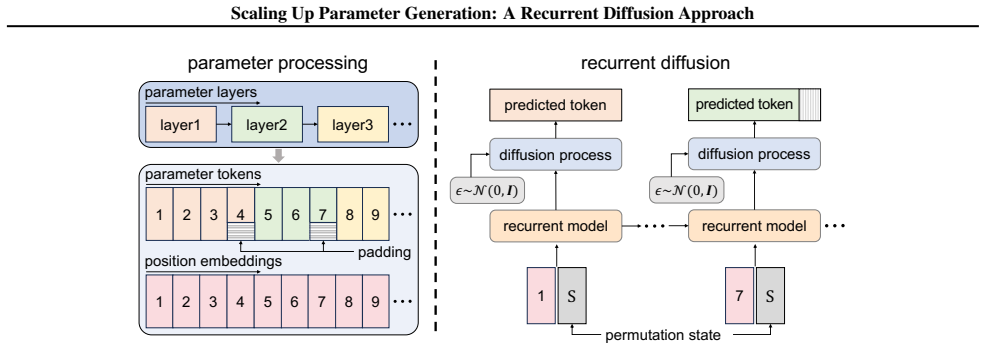
The key machinery is parameter tokenization combined with recurrent-conditioned diffusion: layer-wise normalization and uniform chunking turn a network into a sequence of tokens; a recurrent model (Mamba followed by an MLP) produces per-token prototypes encoding global inter-token dependencies; and a 1D convolutional diffusion model denoises random noise into token values conditioned on those prototypes. The recurrent pass captures cross-token correlation while the diffusion pass refines each token, and this two-step decoupling is what keeps memory usage growing mildly with parameter count rather than quadratically.
What would settle it
Generate a network for an unseen task while withholding all training-checkpoint statistics and using only the model's own denoised outputs to invert normalization; if accuracy collapses or the inverse transform is undefined, the single-pass generation claim is not reproducible. Concretely, compute per-layer mean and standard deviation from one held-out checkpoint and reuse them across different generated samples; if performance depends on which checkpoint's statistics are used, the pipeline is not truly synthesizing complete weights from noise.
Extended reading notes
Core claim
Full-network parameter generation is feasible at practical scale: RPG partitions parameters layer by layer into normalized, uniformly sized tokens, adds a one-hot permutation state to handle weight symmetry, and feeds the token sequence through a recurrent model whose per-token outputs condition a 1D diffusion denoiser. The paper reports that for ConvNeXt-Large (197.8M parameters) and LLaMA-7B DoRA adapters (113.1M parameters) it synthesizes complete parameter sets within minutes on a single H100 with roughly 20GB of memory, matching original accuracy; across seven ImageNet-1K architectures it stays within about 0.5 percent of the trained models; and on 1,022 CIFAR-10 binary tasks it generates valid parameters for unseen tasks without seeing their checkpoints.
Load-bearing premise
The load-bearing assumption is that the per-layer normalization used to create tokens can be inverted at generation time, so denoised normalized tokens can be turned back into real network weights; the paper does not state where the per-layer mean and standard deviation come from when generating for an unseen task.
Editorial extensions
If this is right
- RPG can synthesize full parameter sets of ConvNeXt-Large and ViT-Base in about one minute on a single H100 with roughly 20GB of memory, moving weight generation from academic demonstrations toward practical deployment.
- Generated networks match original accuracy on ImageNet-1K, ADE20K, COCO, and seven commonsense reasoning tasks with DoRA/LoRA on LLaMA-7B, so a single trained generator can replace many trained checkpoints.
- The generator generalizes to unseen CIFAR-10 binary tasks when conditioned on a 10-bit task embedding, meaning a single trained RPG can produce valid models for tasks not in its training set.
- RPG-initialized parameters speed up downstream training: on an unseen task, an RPG-initialized ViT-Tiny reaches 94.4% accuracy at epoch 0 versus 50.0% for training from scratch.
- Because the diffusion model is shared across tokens and tokens can be processed sequentially, generation memory can drop below 8GB, allowing deployment on smaller GPUs.
Reading between the lines
- If the method holds up, the natural next target is cross-architecture generalization: the paper only generates parameters for architectures seen during training, and it explicitly notes that limitation, so conditioning on architecture descriptions rather than fixed token layouts would test whether the learned structure is truly about weights as such.
- The recurrent-conditioned diffusion recipe may transfer to other high-entropy structured tensors—such as pruning masks, quantization schedules, or optimizer states—where global correlation matters but memory is the bottleneck.
- One can test the 'unseen task' claim more sharply by conditioning on randomized embeddings far outside the convex hull of the training distribution and measuring whether accuracy degrades gracefully; the current evaluation uses held-out embeddings from the same 1,022-task set.
- The missing inverse-normalization detail is a reproducibility stake: an independent implementation must decide how per-layer mean and standard deviation are supplied at inference, and if those statistics come from training checkpoints, the claim of generating from pure noise for novel tasks is weakened.
Signed reviews
Editorial analysis
A structured set of objections, weighed in public.
Referee Report
Summary. The paper introduces RPG, a recurrent diffusion framework for generating full neural-network parameter sets. Parameters are layer-wise normalized and tokenized; a recurrent model (Mamba) produces per-token prototypes that condition a 1D diffusion model. The authors report on-par or better accuracy relative to trained models on ImageNet, ADE20K, COCO, and commonsense reasoning with DoRA/LoRA on LLaMA-7B, and demonstrate generalization to unseen binary classification tasks on CIFAR-10. The main scalability claim is generation of up to roughly 200M parameters in a single pass on a single GPU.
Significance. If the claims hold, RPG would be a meaningful step forward in parameter generation, raising the scale by orders of magnitude and offering a practical single-GPU inference pipeline. The combination of recurrent prototypes with token-level diffusion is a sound architectural idea, and the paper includes a broad set of experiments, including held-out task generalization and ablations of the recurrent model, tokenization, and position embeddings. The main limitation is that the paper does not specify the inverse of the layer-wise normalization, without which the synthesized tensors are not demonstrably usable network weights.
major comments (4)
- [Sec. 2.2, Eq. (1); Sec. 2.3 Inference] The layer-wise normalization in Eq. (1) maps weights w to (w-μ)/σ, and the diffusion loss in Eq. (5) is computed on these normalized tokens K. The paper never specifies the inverse transform that maps denoised normalized tokens back to raw weights, nor the per-layer μ and σ to be used at synthesis time. For the unseen-task setting in Sec. 4, no training checkpoint exists from which those statistics could be taken. Without an explicit inverse (e.g., multiplying by σ and adding μ, and stripping padding), the generated output is a set of standardized numbers, not the parameters of a usable network; this directly affects the paper's central claim. Please add the inverse transformation and state for each experiment where the μ/σ values come from.
- [Sec. 3.1 vs. Sec. B.3, Table 13] The main text states 'The length of parameter tokens, permutation states, position embeddings, and prototypes is set to 8192' (Sec. 3.1), but Appendix B.3 states that ViT-Base, ConvNeXt-Large, ADE20K, COCO, and DoRA rank 64 used RPG-Large with token size 16384. These statements are inconsistent, making the configuration of the headline large-model results ambiguous. Please state the exact token size used for each reported model and correct the default description.
- [Sec. 2.2, Eq. (2); Sec. 2.3; Sec. 4] The paper does not explain how padded regions are located and removed after generation, nor how the permutation state S is constructed for unseen tasks. In Sec. 4, binary embeddings are used as conditioning inputs, but the relationship between the binary embedding and S is not defined (e.g., are they concatenated, or does the embedding replace S?). A precise de-tokenization protocol and a definition of S for the unseen-task experiments are needed for the inference procedure to be reproducible.
- [Sec. 3.1, Sec. 3.2, Table 1] It is unclear whether the 'original' accuracies in Table 1 refer to the pretrained timm models or to the fine-tuned checkpoints used to create the training set. If the latter, the on-par result is partly a reconstruction of training data; if the former, that should be stated explicitly. The paper should clarify the baseline and, if possible, add an evaluation on a truly held-out architecture checkpoint to strengthen the generalization claim.
minor comments (6)
- [General] The PDF contains many garbled 'uni' character sequences (e.g., on pages 1, 3, and 17), indicating an encoding problem; please regenerate the source to a clean text version.
- [Eq. (1)] The notation '−µ, /σ' is non-standard; rewrite the normalization as (w[i] − μ_i) / σ_i.
- [Table 8] Table 8 is difficult to read: the columns and subscripts for the four baseline methods are misaligned, and the meaning of the subscript numbers is not explained in the caption.
- [Fig. 5] The caption refers to 'identical seen binary embeddings' and 'unseen binary embeddings' but does not define the color scheme or the number of parameters visualized; please add explicit axes and legends.
- [Appendix C.2, Table 15] Table 15 reports accuracy at epoch 0 for 'RPG initialization + finetune' as 94.4, which seems to correspond to the generated model's zero-shot accuracy; for clarity, distinguish the generated model's zero-shot accuracy from the accuracy after fine-tuning.
- [Table 13] The 'parameter counts' of the recurrent model for RPG-Large (3076M) exceeds the generated model size (up to 200M); this is not a flaw but should be highlighted in the efficiency discussion, since the memory and compute of the generator are not negligible.
Circularity Check
No significant circularity: held-out unseen-task experiments provide genuine prediction; in-distribution main evaluations and an omitted normalization inverse are completeness limitations, not circular reductions.
full rationale
RPG's derivation chain is self-contained: the tokenization/normalization (Eq. 1-2), recurrent prototype conditioning (Eq. 4), and diffusion objective (Eq. 5) define a generative model over parameter tokens, and no predicted quantity is algebraically identical to a fitted input. The generalization claim is supported by an independent held-out experiment in Sec. 4: 1002 seen binary embeddings train RPG, and the remaining unseen embeddings are evaluated without ever accessing their checkpoints during training, so those accuracies are genuine predictions. The ImageNet, ADE20K, COCO, and commonsense-reasoning tables compare generated weights with checkpoints from the same distribution used to collect training data (Sec. 3.1: 'finetune the full parameters ... save 50 checkpoints as the training data'); this is an in-distribution fidelity check rather than an out-of-distribution prediction, and it is not the paper's principal generalization evidence. Self-citations to p-diff (Wang et al., 2024) and COND P-DIFF (Jin et al., 2024) are used as baselines or architectural precedents, not as load-bearing unverified premises. The main genuine gap, that Sec. 2.3 never states the inverse of the layer-wise normalization in Eq. (1) needed to map generated normalized tokens back to raw weights, is an omitted implementation detail and a correctness concern, not a circular reduction. We therefore find no significant circularity.
Assumptions & free parameters
free parameters (3)
- token size k =
8192 default; 16384 for ViT-Base, ConvNeXt-Large and DoRA rank 64 experiments
- layer-wise normalization statistics mu, sigma =
unspecified
- sampling steps for diffusion =
60 for RPG-Large, 1000 for smaller settings
assumptions (4)
- domain assumption The inverse of the layer-wise normalization in Eq. (1) is applied at inference, even though no such step is described.
- domain assumption Fine-tuning a pretrained model for one epoch and saving 50 checkpoints produces a training set representative of high-performing weights for that architecture.
- ad hoc to paper The diffusion training objective in Eq. (5) with random token subsets and a shared 1D CNN is sufficient to learn token-level denoising conditioned on recurrent prototypes.
- standard math Standard diffusion theory and the Mamba state-space model are correct.
invented entities (2)
-
Prototypes P_j^i
-
Permutation state S
Cite this review
Pith. "Pith review of Recurrent Diffusion for Large-Scale Parameter Generation." pith.science (2026). https://pith.science/paper/4TNGNSSO
@misc{pith2026250111587,
  author       = {Pith},
  title        = {Pith review of: Recurrent Diffusion for Large-Scale Parameter Generation},
  year         = {2026},
  howpublished = {\url{https://pith.science/paper/4TNGNSSO}},
  note         = {Machine review of arXiv:2501.11587}
}
read the original abstract
Parameter generation has long struggled to match the scale of today large vision and language models, curbing its broader utility. In this paper, we introduce Recurrent Diffusion for Large Scale Parameter Generation (RPG), a novel framework that generates full neural network parameters up to hundreds of millions on a single GPU. Our approach first partitions a networks parameters into non-overlapping tokens, each corresponding to a distinct portion of the model. A recurrent mechanism then learns the inter token relationships, producing prototypes which serve as conditions for a diffusion process that ultimately synthesizes the full parameters. Across a spectrum of architectures and tasks including ResNets, ConvNeXts and ViTs on ImageNet 1K and COCO, and even LoRA based LLMs RPG achieves performance on par with fully trained networks while avoiding excessive memory overhead. Notably, it generalizes beyond its training set to generate valid parameters for previously unseen tasks, highlighting its flexibility in dynamic and open ended scenarios. By overcoming the longstanding memory and scalability barriers, RPG serves as a critical advance in AI generating AI, potentially enabling efficient weight generation at scales previously deemed infeasible.
Figures


Figures from the paper (5 more)


Forward citations
Cited by 2 Pith papers
-
On the Expressive Power of Permutation-Equivariant Weight-Space Networks
Permutation-equivariant weight-space networks are all equally expressive, and universality holds when hidden-layer biases are pairwise distinct.
-
Drag-and-Drop LLMs: Zero-Shot Prompt-to-Weights
A prompt-conditioned hyper-network generates LoRA fine-tuning weights for unseen tasks in a single forward pass, without training on the target dataset.
Reference graph
Works this paper leans on
-
[1]
write newline
" write newline "" before.all 'output.state := FUNCTION n.dashify 't := "" t empty not t #1 #1 substring "-" = t #1 #2 substring "--" = not "--" * t #2 global.max substring 't := t #1 #1 substring "-" = "-" * t #2 global.max substring 't := while if t #1 #1 substring * t #2 global.max substring 't := if while FUNCTION format.date year duplicate empty "emp...
-
[2]
xlstm: Extended long short-term memory
Beck, M., P \"o ppel, K., Spanring, M., Auer, A., Prudnikova, O., Kopp, M., Klambauer, G., Brandstetter, J., and Hochreiter, S. xlstm: Extended long short-term memory. arXiv preprint arXiv:2405.04517, 2024
arXiv 2024
-
[3]
Piqa: Reasoning about physical commonsense in natural language
Bisk, Y., Zellers, R., Gao, J., Choi, Y., et al. Piqa: Reasoning about physical commonsense in natural language. In AAAI, volume 34, pp.\ 7432--7439, 2020
work page 2020
-
[4]
Bottou, L. et al. Stochastic gradient learning in neural networks. Proceedings of Neuro-N mes , 91 0 (8), 1991
work page 1991
-
[5]
SMASH : One-shot model architecture search through hypernetworks
Brock, A., Lim, T., Ritchie, J., and Weston, N. SMASH : One-shot model architecture search through hypernetworks. In ICLR, 2018. URL https://openreview.net/forum?id=rydeCEhs-
work page 2018
-
[6]
Rethinking attention with performers
Choromanski, K., Likhosherstov, V., Dohan, D., Song, X., Gane, A., Sarlos, T., Hawkins, P., Davis, J., Mohiuddin, A., Kaiser, L., et al. Rethinking attention with performers. arXiv preprint arXiv:2009.14794, 2020
arXiv 2009
-
[7]
Diffusion-sdf: Conditional generative modeling of signed distance functions
Chou, G., Bahat, Y., and Heide, F. Diffusion-sdf: Conditional generative modeling of signed distance functions. In ICCV, pp.\ 2262--2272, 2023
work page 2023
-
[8]
Boolq: Exploring the surprising difficulty of natural yes/no questions
Clark, C., Lee, K., Chang, M.-W., Kwiatkowski, T., Collins, M., and Toutanova, K. Boolq: Exploring the surprising difficulty of natural yes/no questions. arXiv preprint arXiv:1905.10044, 2019
arXiv 1905
Show all 69 references
-
[9]
Think you have solved question answering? try arc, the ai2 reasoning challenge
Clark, P., Cowhey, I., Etzioni, O., Khot, T., Sabharwal, A., Schoenick, C., and Tafjord, O. Think you have solved question answering? try arc, the ai2 reasoning challenge. arXiv preprint arXiv:1803.05457, 2018
2018 arXiv
-
[10]
and Gu, A
Dao, T. and Gu, A. Transformers are ssms: Generalized models and efficient algorithms through structured state space duality. arXiv preprint arXiv:2405.21060, 2024
2024 arXiv
-
[11]
Imagenet: A large-scale hierarchical image database
Deng, J., Dong, W., Socher, R., Li, L.-J., Li, K., and Fei-Fei, L. Imagenet: A large-scale hierarchical image database. In CVPR, pp.\ 248--255. Ieee, 2009
2009
-
[12]
and Nichol, A
Dhariwal, P. and Nichol, A. Diffusion models beat gans on image synthesis. In NeurIPS, volume 34, pp.\ 8780--8794, 2021
2021
-
[13]
An image is worth 16x16 words: Transformers for image recognition at scale
Dosovitskiy, A., Beyer, L., Kolesnikov, A., Weissenborn, D., Zhai, X., Unterthiner, T., Dehghani, M., Minderer, M., Heigold, G., Gelly, S., Uszkoreit, J., and Houlsby, N. An image is worth 16x16 words: Transformers for image recognition at scale. In ICLR, 2021. URL https://ope...
2021
-
[14]
Hyperdiffusion: Generating implicit neural fields with weight-space diffusion
Erko c , Z., Ma, F., Shan, Q., Nie ner, M., and Dai, A. Hyperdiffusion: Generating implicit neural fields with weight-space diffusion. In ICCV, 2023
2023
-
[15]
Structural pruning for diffusion models
Fang, G., Ma, X., and Wang, X. Structural pruning for diffusion models. In NeurIPS, 2023. URL https://openreview.net/forum?id=d4f40zJJIS
2023
-
[16]
and Ghahramani, Z
Gal, Y. and Ghahramani, Z. Dropout as a bayesian approximation: Representing model uncertainty in deep learning. In ICML. PMLR, 2016
2016
-
[17]
Practical variational inference for neural networks
Graves, A. Practical variational inference for neural networks. NeurIPS, 24, 2011
2011
-
[19]
and Dao, T
Gu, A. and Dao, T. Mamba: Linear-time sequence modeling with selective state spaces. arXiv preprint arXiv:2312.00752, 2024
2024 arXiv
-
[20]
M., and Le, Q
Ha, D., Dai, A. M., and Le, Q. V. Hypernetworks. In ICLR, 2017. URL https://openreview.net/forum?id=rkpACe1lx
2017
-
[21]
Deep residual learning for image recognition
He, K., Zhang, X., Ren, S., and Sun, J. Deep residual learning for image recognition. In CVPR, pp.\ 770--778, 2016
2016
-
[22]
Denoising diffusion probabilistic models
Ho, J., Jain, A., and Abbeel, P. Denoising diffusion probabilistic models. In NeurIPS, volume 33, pp.\ 6840--6851, 2020
2020
-
[23]
Untersuchungen zu dynamischen neuronalen netzen
Hochreiter, S. Untersuchungen zu dynamischen neuronalen netzen. Diploma, Technische Universit \"a t M \"u nchen , 91 0 (1): 0 31, 1991
1991
-
[24]
Long short-term memory
Hochreiter, S. Long short-term memory. Neural Computation MIT-Press, 1997
1997
-
[25]
Long short-term memory
Hochreiter, S., Schmidhuber J\" u rgen, Hochreiter, S., and Schmidhuber. Long short-term memory. Neural Comput., 9 0 (8): 0 1735–1780, nov 1997. ISSN 0899-7667. doi:10.1162/neco.1997.9.8.1735. URL https://doi.org/10.1162/neco.1997.9.8.1735
1997 doi
-
[26]
J., yelong shen, Wallis, P., Allen-Zhu, Z., Li, Y., Wang, S., Wang, L., and Chen, W
Hu, E. J., yelong shen, Wallis, P., Allen-Zhu, Z., Li, Y., Wang, S., Wang, L., and Chen, W. Lo RA : Low-rank adaptation of large language models. In ICLR, 2022. URL https://openreview.net/forum?id=nZeVKeeFYf9
2022
-
[27]
Conditional lora parameter generation
Jin, X., Wang, K., Tang, D., Zhao, W., Zhou, Y., Tang, J., and You, Y. Conditional lora parameter generation. arXiv preprint arXiv:2408.01415, 2024
2024 arXiv
-
[28]
Kingma, D. P. and Welling, M. Auto-encoding variational bayes. arXiv preprint arXiv:1312.6114, 2013
2013 arXiv
-
[29]
and Hinton, G
Krizhevsky, A. and Hinton, G. Learning multiple layers of features from tiny images. Technical report, University of Toronto, 2009
2009
-
[30]
Krizhevsky, A., Sutskever, I., and Hinton, G. E. Imagenet classification with deep convolutional neural networks. In NeurIPS, volume 25, 2012
2012
-
[31]
L., and Tanaka, H
Kunin, D., Sagastuy-Brena, J., Ganguli, S., Yamins, D. L., and Tanaka, H. Neural mechanics: Symmetry and broken conservation laws in deep learning dynamics. In ICLR, 2021. URL https://openreview.net/forum?id=q8qLAbQBupm
2021
-
[32]
Autoregressive image generation without vector quantization
Li, T., Tian, Y., Li, H., Deng, M., and He, K. Autoregressive image generation without vector quantization. arXiv preprint arXiv:2406.11838, 2024 a
2024 arXiv
-
[33]
Exploring plain vision transformer backbones for object detection
Li, Y., Mao, H., Girshick, R., and He, K. Exploring plain vision transformer backbones for object detection. In ECCV, pp.\ 280--296. Springer, 2022
2022
-
[34]
Text-to-model: Text-conditioned neural network diffusion for train-once-for-all personalization
Li, Z., Gao, L., and Wu, C. Text-to-model: Text-conditioned neural network diffusion for train-once-for-all personalization. arXiv preprint arXiv:2405.14132, 2024 b
2024 arXiv
-
[35]
Unleash graph neural networks from heavy tuning
Lin, L., Shi, D., Han, A., Wang, Z., and Gao, J. Unleash graph neural networks from heavy tuning. arXiv preprint arXiv:2405.12521, 2024
2024 arXiv
-
[36]
Lin, T.-Y., Maire, M., Belongie, S., Hays, J., Perona, P., Ramanan, D., Doll \'a r, P., and Zitnick, C. L. Microsoft coco: Common objects in context. In Computer Vision--ECCV 2014: 13th European Conference, Zurich, Switzerland, September 6-12, 2014, Proceedings, Part V 13, pp....
2014
-
[37]
F., Cheng, K.-T., and Chen, M.-H
Liu, S.-Y., Wang, C.-Y., Yin, H., Molchanov, P., Wang, Y.-C. F., Cheng, K.-T., and Chen, M.-H. Dora: Weight-decomposed low-rank adaptation. arXiv preprint arXiv:2402.09353, 2024
2024 arXiv
-
[38]
Dpm-solver: A fast ode solver for diffusion probabilistic model sampling in around 10 steps
Lu, C., Zhou, Y., Bao, F., Chen, J., Li, C., and Zhu, J. Dpm-solver: A fast ode solver for diffusion probabilistic model sampling in around 10 steps. In NeurIPS, volume 35, pp.\ 5775--5787, 2022
2022
-
[39]
Deepcache: Accelerating diffusion models for free
Ma, X., Fang, G., and Wang, X. Deepcache: Accelerating diffusion models for free. In CVPR, pp.\ 15762--15772, 2024
2024
-
[40]
Introducing meta llama 3: The most capable openly available llm to date
Meta, A. Introducing meta llama 3: The most capable openly available llm to date. Meta AI, 2024
2024
-
[41]
Can a suit of armor conduct electricity? a new dataset for open book question answering
Mihaylov, T., Clark, P., Khot, T., and Sabharwal, A. Can a suit of armor conduct electricity? a new dataset for open book question answering. In EMNLP, 2018
2018
-
[42]
Neal, R. M. Bayesian learning for neural networks, volume 118. Springer Science & Business Media, 2012
2012
-
[43]
Nichol, A. Q. and Dhariwal, P. Improved denoising diffusion probabilistic models. In ICML, pp.\ 8162--8171. PMLR, 2021
2021
-
[44]
T-stitch: Accelerating sampling in pre-trained diffusion models with trajectory stitching
Pan, Z., Zhuang, B., Huang, D.-A., Nie, W., Yu, Z., Xiao, C., Cai, J., and Anandkumar, A. T-stitch: Accelerating sampling in pre-trained diffusion models with trajectory stitching. arXiv preprint arXiv:2402.14167, 2024
2024 arXiv
-
[45]
and Xie, S
Peebles, W. and Xie, S. Scalable diffusion models with transformers. In ICCV, pp.\ 4195--4205, 2023
2023
-
[46]
A., and Malik, J
Peebles, W., Radosavovic, I., Brooks, T., Efros, A. A., and Malik, J. Learning to learn with generative models of neural network checkpoints. arXiv preprint arXiv:2209.12892, 2022
2022 arXiv
-
[47]
Rwkv: Reinventing rnns for the transformer era
Peng, B., Alcaide, E., Anthony, Q., Albalak, A., Arcadinho, S., Biderman, S., Cao, H., Cheng, X., Chung, M., Grella, M., et al. Rwkv: Reinventing rnns for the transformer era. arXiv preprint arXiv:2305.13048, 2023
2023 arXiv
-
[48]
High-resolution image synthesis with latent diffusion models
Rombach, R., Blattmann, A., Lorenz, D., Esser, P., and Ommer, B. High-resolution image synthesis with latent diffusion models. In CVPR, pp.\ 10684--10695, 2022
2022
-
[49]
Socialiqa: Commonsense reasoning about social interactions
Sap, M., Rashkin, H., Chen, D., LeBras, R., and Choi, Y. Socialiqa: Commonsense reasoning about social interactions. arXiv preprint arXiv:1904.09728, 2019
1904 arXiv
-
[50]
Hyper-representations as generative models: Sampling unseen neural network weights
Sch \"u rholt, K., Knyazev, B., Gir \'o -i Nieto, X., and Borth, D. Hyper-representations as generative models: Sampling unseen neural network weights. In NeurIPS, volume 35, pp.\ 27906--27920, 2022 a
2022
-
[51]
Hyper-representations for pre-training and transfer learning
Sch \"u rholt, K., Knyazev, B., Gir \'o -i Nieto, X., and Borth, D. Hyper-representations for pre-training and transfer learning. arXiv preprint arXiv:2207.10951, 2022 b
2022 arXiv
-
[52]
Model zoos: A dataset of diverse populations of neural network models
Sch\" u rholt, K., Taskiran, D., Knyazev, B., Gir\' o -i Nieto, X., and Borth, D. Model zoos: A dataset of diverse populations of neural network models. In NeurIPS, 2022
2022
-
[53]
W., and Borth, D
Sch \"u rholt, K., Mahoney, M. W., and Borth, D. Towards scalable and versatile weight space learning. arXiv preprint arXiv:2406.09997, 2024
2024 arXiv
-
[54]
Temporal dynamic quantization for diffusion models
So, J., Lee, J., Ahn, D., Kim, H., and Park, E. Temporal dynamic quantization for diffusion models. In NeurIPS, volume 36, 2024
2024
-
[55]
Chaos in random neural networks
Sompolinsky, H., Crisanti, A., and Sommers, H.-J. Chaos in random neural networks. Physical review letters, 61 0 (3), 1988
1988
-
[56]
Denoising diffusion implicit models
Song, J., Meng, C., and Ermon, S. Denoising diffusion implicit models. arXiv preprint arXiv:2010.02502, 2020
2010 arXiv
-
[57]
Consistency models
Song, Y., Dhariwal, P., Chen, M., and Sutskever, I. Consistency models. arXiv preprint arXiv:2303.01469, 2023
2023 arXiv
-
[58]
Soro, B., Andreis, B., Lee, H., Chong, S., Hutter, F., and Hwang, S. J. Diffusion-based neural network weights generation. arXiv preprint arXiv:2402.18153, 2024
2024 arXiv
-
[59]
Llama: Open and efficient foundation language models
Touvron, H., Lavril, T., Izacard, G., Martinet, X., Lachaux, M.-A., Lacroix, T., Rozi \`e re, B., Goyal, N., Hambro, E., Azhar, F., et al. Llama: Open and efficient foundation language models. arXiv preprint arXiv:2302.13971, 2023
2023 arXiv
-
[60]
Attention is all you need
Vaswani, A. Attention is all you need. In NeurIPS, 2017
2017
-
[61]
Neural network diffusion
Wang, K., Xu, Z., Zhou, Y., Zang, Z., Darrell, T., Liu, Z., and You, Y. Neural network diffusion. arXiv preprint arXiv:2402.13144, 2024
2024 arXiv
-
[62]
Z., Khabsa, M., Fang, H., and Ma, H
Wang, S., Li, B. Z., Khabsa, M., Fang, H., and Ma, H. Linformer: Self-attention with linear complexity. arXiv preprint arXiv:2006.04768, 2020
2006 arXiv
-
[63]
GitHub repository: Pytorch image models
Wightman, R. GitHub repository: Pytorch image models. GitHub repository, 2019
2019
-
[64]
Unified perceptual parsing for scene understanding
Xiao, T., Liu, Y., Zhou, B., Jiang, Y., and Sun, J. Unified perceptual parsing for scene understanding. In ECCV, pp.\ 418--434, 2018
2018
-
[65]
Qwen2 technical report
Yang, A., Yang, B., Hui, B., Zheng, B., Yu, B., Zhou, C., Li, C., Li, C., Liu, D., Huang, F., Dong, G., Wei, H., Lin, H., Tang, J., Wang, J., Yang, J., Tu, J., Zhang, J., Ma, J., Xu, J., Zhou, J., Bai, J., He, J., Lin, J., Dang, K., Lu, K., Chen, K., Yang, K., Li, M., Xue, M.,...
2024 arXiv
-
[66]
Diffusion probabilistic model made slim
Yang, X., Zhou, D., Feng, J., and Wang, X. Diffusion probabilistic model made slim. In CVPR, pp.\ 22552--22562, 2023
2023
-
[67]
Hellaswag: Can a machine really finish your sentence? arXiv preprint arXiv:1905.07830, 2019
Zellers, R., Holtzman, A., Bisk, Y., Farhadi, A., and Choi, Y. Hellaswag: Can a machine really finish your sentence? arXiv preprint arXiv:1905.07830, 2019
1905 arXiv
-
[68]
Dynamic tuning towards parameter and inference efficiency for vit adaptation
Zhao, W., Tang, J., Han, Y., Song, Y., Wang, K., Huang, G., Wang, F., and You, Y. Dynamic tuning towards parameter and inference efficiency for vit adaptation. arXiv preprint arXiv:2403.11808, 2024
2024 arXiv
-
[69]
Scene parsing through ade20k dataset
Zhou, B., Zhao, H., Puig, X., Fidler, S., Barriuso, A., and Torralba, A. Scene parsing through ade20k dataset. In CVPR, 2017
2017
-
[70]
write newline
" write newline "" before.all 'output.state := FUNCTION n.dashify 't := "" t empty not t #1 #1 substring "-" = t #1 #2 substring "--" = not "--" * t #2 global.max substring 't := t #1 #1 substring "-" = "-" * t #2 global.max substring 't := while if t #1 #1 substring * t #2 gl...
Reviewed August 10, 2026 · model on record in the stance chip above.
Discussion (0). Continue with ORCID to comment.