REVIEW 4 major objections 4 minor 1 cited by
Imaging signatures of edge currents in a magnetic topological insulator
T0 review · 4 major / 4 minor · reviewed 2026-08-10 · deepseek-v4-flash
Pith's one-line read Edge currents imaged in a quantum anomalous Hall device are explained as magnetization changes, not as topological edge transport, with the chiral edge-state current below 1 nA.
desk verdict Solid imaging experiment: edge currents in QAH breakdown flip with magnetization, and the independently parameterized model tracing them to magnetization changes deserves serious refereeing, with requests for error bars and a test of the local-linear-response assumption. read the letter →
The pith
A machine-rendered reading of the paper's core claim, the machinery that carries it, and where it could break.
The reading
What carries the argument
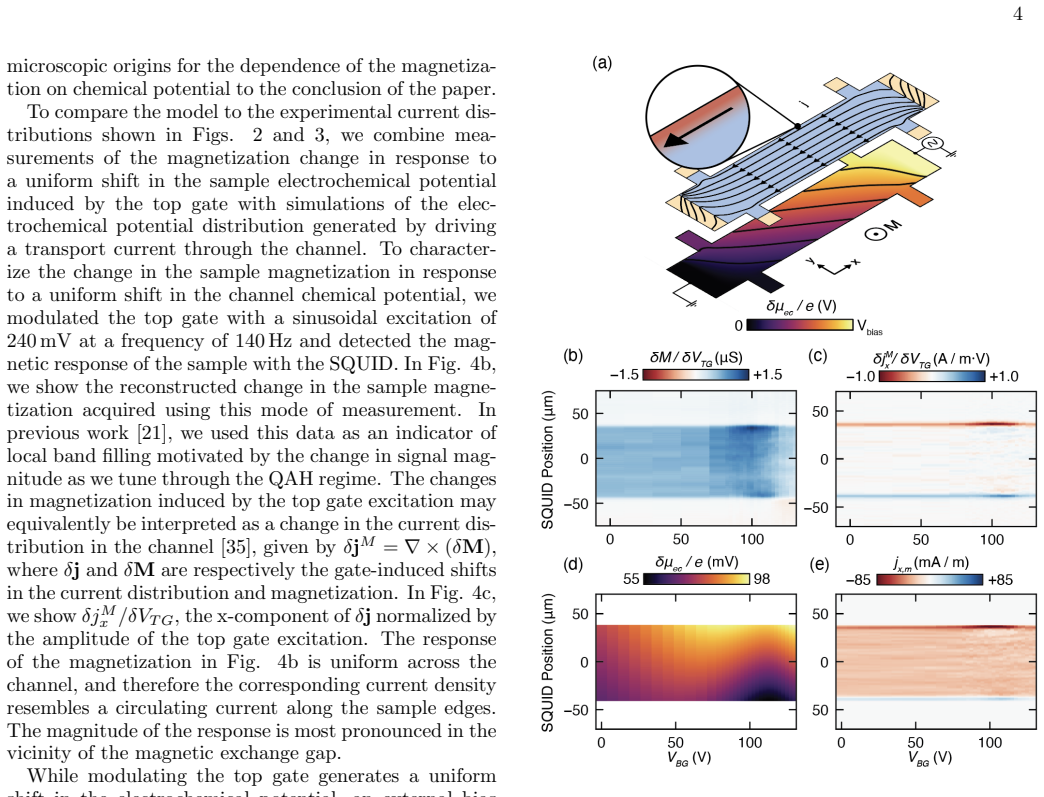
The central object is the current decomposition $j_{\rm tot} = j_\phi + \nabla\times M(\mu_{\rm ec})$, where $M(\mu_{\rm ec})$ is the chemical-potential-dependent out-of-plane magnetization. A shift in electrochemical potential changes $M$, and a spatially varying $M$ is equivalent to a sheet current along the sample edges; this is what the SQUID sees as an edge current. The argument is carried by two calibration inputs: the local response $\delta M/\delta V_{\rm TG}$ measured by top-gate modulation, interpreted as $\delta j^M/\delta V_{\rm TG}$, and the two-dimensional electrochemical potential profile $\delta\mu_{\rm ec}(x,y)$ computed from the measured $\rho_{xx}$ and $\rho_{xy}$ via the Laplace equation. Equation (2), $j_{x,m}=j_{\rm uni}+(\delta j^M_x/\delta V_{\rm TG})\delta\mu_{\rm ec}$, combines them as a parameter-free prediction. A separate capacitance argument, $\delta\mu_{\rm ch} = (C_Q/C_T)\delta\mu_{\rm ec}$ with $C_Q/C_G < 0.01$, bounds the chiral edge-state current, showing that the topological contribution is at most about 1 nA.
What would settle it
Repeat the top-gate calibration while the bias current is on and compare the predicted $j_x$ from Eq. (2) to the imaged current at the same back-gate voltage: if the edge-current amplitude or its sign no longer tracks the product of the zero-bias magnetization response and the calculated electrochemical potential profile, for example an edge current that persists at $V_{\rm BG}=0$ where $\delta M/\delta V_{\rm TG}$ nearly vanishes, the local-equilibrium magnetization explanation fails.
Extended reading notes
Core claim
The discovery is a decomposition of the measured current distribution. In the breakdown regime, $\mathbf{j}_{\rm tot} = \mathbf{j}_\phi + \nabla\times \mathbf{M}(\mu_{\rm ec})$, with $\mathbf{M}(\mu_{\rm ec})$ the chemical-potential-dependent magnetization; the first term is the Ohmic current driven by gradients of the electrochemical potential, and the second is a magnetization current that appears at sample edges wherever the chemical potential varies. The authors calibrate the magnetization response $\delta M/\delta V_{\rm TG}$ by modulating the top gate and imaging the resulting flux, and they compute the bias-induced electrochemical potential profile from the measured resistivity tensor using the Laplace equation. Multiplying the two, as in $j_{x,m} = j_{\rm uni} + (\delta j^M_x/\delta V_{\rm TG})\,\delta\mu_{\rm ec}$, yields edge currents on one edge whose sign flips with magnetization reversal, whose amplitude tracks the back-gate voltage with the strongest signal in the magnetic exchange gap, and whose magnitude does not depend on current direction, matching the images. Because the top-gate response exceeds the estimated chiral edge-state contribution by a factor of 4--5, and because the capacitance ratio $C_Q/C_T < 0.01$ bounds the edge-state current to about 1 nA even in the quantized limit, the paper concludes that the observed edge currents are dominated by magnetization changes of the magnetic dopants rather than by topological edge channels.
Load-bearing premise
The whole calculation depends on assuming that a magnetization change measured for a uniform voltage shift can be applied point by point to the non-uniform potential pattern produced by the bias current, with the magnetization depending only on the local chemical potential and with no extra edge, electrostatic, or nonlinear corrections.
Editorial extensions
If this is right
- Interpreting a magnetic image of a magnetic topological insulator as evidence of chiral edge transport requires a calibration of how the magnetization responds to the local chemical potential; without it, magnetization currents can masquerade as edge currents.
- Edge currents observed in the breakdown regime are expected to appear on the edge selected by the magnetization direction, not by the bias direction, so a one-sided edge current that flips with magnetization reversal is not a signature of helical or trivial edge channels.
- In this sample, the chiral edge-state contribution to transport is bounded at the nanoscale: roughly 1 nA in the quantized regime, rising with breakdown current but still much smaller than the magnetization contribution.
- The vertical current strip at the top-gate boundary is explained by the change in the geometric-to-quantum capacitance ratio there, giving a local handle on where chemical-potential-induced magnetization currents appear.
Reading between the lines
- If the local-equilibrium magnetization model holds generally, magnetic images of edge currents in other Chern insulators and magnetic topological insulators may also need a $\delta M/\delta\mu_{\rm ec}$ calibration before being attributed to topological edge states; the same measurement protocol could be applied to moir\'e Chern insulators and MnBi$_2$Te$_4$ devices.
- A sharper test would be to measure a sample with a larger breakdown current and therefore a larger $C_Q/C_T$, where the model predicts the chiral edge-state current should grow with the capacitance ratio rather than merely with the magnetization response.
- In cleaner samples where electrons propagate ballistically along edges, the assumption of local equilibrium between edge and bulk chemical potentials should fail; then the edge current should decouple from the local $\delta\mu_{\rm ec}$ profile and show contact-dependent, ballistic signatures, which is precisely the regime the paper identifies as beyond its current data.
Editorial analysis
A structured set of objections, weighed in public.
Referee Report
Summary. The paper reports scanning SQUID microscopy of the current distribution in a Cr-doped (Bi,Sb)Te3 quantum anomalous Hall (QAH) device driven into breakdown by source-drain bias currents of 500 nA to 2 µA. The main observations are: (i) current enters through a corner of the Au contact, (ii) an edge-localized current flows along one side of the channel, with the side determined by the magnetization direction but independent of the current direction, (iii) the edge current is strongest when the device is gated into the magnetic exchange gap and is absent in a control Cr:SbTe3 device, and (iv) the edge current is suppressed when the device is tuned out of the gap. To interpret these results, the authors introduce a model j_tot = j_phi + curl(M(µ_ec)) in Eq. (1), where the magnetization current is generated by the bias-induced electrochemical potential profile. The model is parameterized by a separately measured top-gate response δj^M/δV_TG and by transport-derived µ_ec profiles, and is compared with the data in Fig. 4 without fitting. The authors conclude that the observed edge currents are predominantly magnetization currents rather than chiral edge-state currents, estimating the chiral edge-state contribution to be at most about 1 nA.
Significance. If the model attributing the observed edge currents to chemical-potential-dependent magnetization is quantitatively correct, the paper is significant: it would show that edge currents imaged in MTIs in the breakdown regime are not necessarily direct evidence for topological edge transport, and it would demonstrate a method for separating magnetization currents from transport currents in magnetic imaging. The paper has notable strengths: the control sample, the magnetization-reversal dependence, the VBG dependence, the contact-reversal test in the supplementary information, and the attempt to construct a predictive model that is not fitted to the target data. These controls make the qualitative observation of an edge current whose side follows magnetization very convincing. However, the central quantitative attribution to magnetization currents rests on a local-linear-response assumption in Eq. (2) that is tested only by visual comparison, and the capacitive estimate of the chiral contribution contains an internal inconsistency. These issues are load-bearing for the paper's main claim and require additional quantitative support.
major comments (4)
- [Eq. (2) and Fig. 4] The central quantitative attribution rests on Eq. (2), which multiplies the separately measured top-gate calibration δj_x^M/δV_TG by the transport-derived δµ_ec(x,y). This assumes that the magnetization response to a uniform, gate-induced shift of the electrochemical potential is identical to the local response to a non-uniform, bias-induced µ_ec profile, with no nonlocal, electrostatic, or nonlinear corrections at the sample edges. The calibration itself is an edge-localized circulating response (Fig. 4c), so Eq. (2) will generate an edge-like current for any mechanism that produces a nonzero µ_ec gradient at the edges, even if the physical response is not a local function of µ_ec. The paper acknowledges at the end that local equilibration may break down at smaller length scales, and the observed edge current is confined within about 3 µm, exactly the scale where the assumption is least secure. I request a quantitative test of this local-linearity assumption: for example, a check that δM/δV_TG is independent of the modulation amplitude, a comparison of the spatial profile of δj^M/δV_TG with the bias-induced edge-current profile, and residual maps for the lower-bias (Fig. S7) and contact-reversal (Fig. S8) comparisons.
- [Eq. (4), Appendix F, and Appendix E] The capacitive-shunting factor used to bound the chiral edge-state contribution is internally inconsistent. Eq. (4) defines δµ_ch = (CQ/CT) δµ_ec with 1/CT = 1/CG + 1/CQ. For CQ << CG, CQ/CT = (CG+CQ)/CG ≈ 1, not CQ/CG ≈ 0.01. Appendix F Eq. (F4) gives δµ_ch = (CT/CQ) δµ_ec, which in the same limit also tends to 1. Only if CT were the parallel combination CG+CQ would CQ/CT reduce to approximately CQ/CG. The stated upper bound of about 90 nA for δI, and hence the paper's conclusion that the observed δj^M/δV_TG exceeds the chiral-edge-state contribution by a factor of 4–5, follows only if the parallel-capacitance expression is used. Please correct the capacitance model, rederive the bound, and reconcile Eq. (4) with Appendix F. This issue directly affects the central claim that chiral edge-state currents contribute at most about 1 nA.
- [Fig. 4e and Fig. 3a] The comparison between the model prediction in Fig. 4e and the experimental data in Fig. 3a is made only by visual inspection. The reconstructed current densities are shown without error bars, and the model is described as 'capturing the main features' with no residual maps or quantitative amplitude comparison. Because the paper's conclusion is that the observed edge currents are predominantly magnetization currents, the model must be shown to reproduce not only the qualitative edge location but also the magnitude and shape of the edge-current profile as a function of VBG. Please provide quantitative residuals (e.g., difference maps with noise-based error bars) and amplitude-versus-VBG curves for both magnetization directions and for the lower-bias case in Fig. S7(d), where a difference plot is shown but not analyzed.
- [Eq. (2), uniform background] The uniform background current j_uni in Eq. (2) is not defined in the main text or the appendices. If j_uni is determined by total-current conservation, that should be stated explicitly; if it is adjusted to match the data, then the model comparison has a free parameter and its fitted value and uncertainty must be reported. Without this information, the amplitude comparison between Fig. 4e and Fig. 3a is not fully specified, and the 'direct comparison, not a fit' claim is not verifiable.
minor comments (4)
- [Appendix E] The capacitance ratio is labeled inconsistently: Appendix E states 'CG/CQ ≈ 30 mV/5 V = 0.006' while the main text uses 'CQ/CG < 0.01.' These expressions are inverted with respect to each other; please ensure the notation is consistent and the intended ratio is defined unambiguously.
- [Appendix A heading] The heading 'Sample Growth and F abrication' contains a typographical error; it should read 'Fabrication.'
- [Main text, paragraph after Eq. (3)] The sentence 'This leads to an approximate upper bound of 90 nA for δI given the applied top gate modulation of 240 mV' relies on the capacitance factor discussed above; once the capacitance model is corrected, this numerical statement should be updated and the derivation shown explicitly.
- [Appendix J and Fig. S7] Fig. S7(d) shows a difference between model and experiment but the difference is not quantified or discussed. A brief quantitative statement of the residual magnitude relative to the reconstructed noise level would help the reader assess the quality of the model at lower bias.
Circularity Check
No circularity: the Eq. (2) prediction combines an independently measured gate-response calibration with transport-derived potential profiles and is compared, not fitted, to the bias-current images.
full rationale
The derivation chain is self-contained as a prediction. Equation (2) multiplies two independently acquired quantities: the top-gate-modulation current response δj_x^M/δVTG, measured with no source-drain bias (Appendix B and Fig. 4c), and the electrochemical-potential profile δμec(y) computed from ρxx and ρxy measured under the same bias conditions as the current imaging (Fig. 4d and Appendix J). No parameter in the model is adjusted to the bias-current images against which it is compared; the paper states, 'Importantly, the calculation in Fig. 4d is not a fit but a direct comparison between the experimentally determined δM/δVTG, resistivity tensor, and current distribution.' The resulting comparison (Fig. 4e versus Fig. 3a) could in principle have disagreed in amplitude, sign, or back-gate dependence, so the observed agreement is a substantive test rather than a tautology. The cited prior work (Refs. 21 and 25) supplies device characterization, spatial-resolution bounds, and a reconstruction algorithm; these are separately published methods and data and are not used to define the target result. The main weakness flagged by the paper itself—that local equilibration and local-linear-response 'may break down at lower bias currents... and at smaller length scales'—is an untested assumption about the regime of validity of Eq. (2), not a circularity, because the target claim is not assumed in the input. Hence no load-bearing step reduces to its own inputs.
Assumptions & free parameters
free parameters (3)
- deltaM/deltaVTG magnetization response amplitude =
Extracted per VBG; see Fig. S9d (absolute value not quoted)
- j_uni uniform background current density
- CQ/CG capacitance ratio =
0.006
assumptions (4)
- domain assumption M depends locally and linearly on the electrochemical potential, with a spatially uniform response calibrated by the top gate.
- domain assumption The chemical potential of the chiral edge states equilibrates locally with the bulk electrochemical potential.
- domain assumption The electrostatic potential in the channel satisfies the two-dimensional Laplace equation with a spatially uniform conductivity tensor.
- standard math A uniform shift in the channel magnetization is equivalent to a circulating edge current via delta j = curl(delta M).
Cite this review
Pith. "Pith review of Imaging signatures of edge currents in a magnetic topological insulator." pith.science (2026). https://pith.science/paper/RW3UW5BM
@misc{pith2026250111666,
  author       = {Pith},
  title        = {Pith review of: Imaging signatures of edge currents in a magnetic topological insulator},
  year         = {2026},
  howpublished = {\url{https://pith.science/paper/RW3UW5BM}},
  note         = {Machine review of arXiv:2501.11666}
}
read the original abstract
Magnetic topological insulators (MTIs) host topologically protected edge states, but the role that these edge states play in electronic transport remains unclear. Using scanning superconducting quantum interference device (SQUID) microscopy, we performed local measurements of the current distribution in a quantum anomalous Hall (QAH) insulator at large bias currents, where the quantization of the conductivity tensor breaks down. We find that bulk currents in the channel interior coexist with edge currents at the sample boundary. While the position of the edge current changes with the reversal of the magnetic field, it does not depend on the current direction. To understand our observations, we introduce a model which includes contributions from both the sample magnetization and currents driven by chemical potential gradients. To parameterize our model, we use local measurements of the chemical potential induced changes in the sample magnetization. Our model reveals that the observed edge currents can be understood as changes in the magnetization generated by the electrochemical potential distribution in the sample under bias. Our work underscores the complexity of electronic transport in MTIs and highlights both the value and challenges of using magnetic imaging to disentangle various contributions to the electronic transport signatures.
Figures


Forward citations
Cited by 1 Pith paper
-
Direct imaging of magnetotransport at graphene-metal interfaces with a single-spin quantum sensor
Nanoscale current imaging with a scanning NV magnetometer directly visualizes Lorentz deflection of current and maps contact resistance in a graphene-metal hybrid at fields up to 0.53 T.
Reference graph
Works this paper leans on
- [1]
-
[2]
Y. Deng, Y. Yu, M. Z. Shi, Z. Guo, Z. Xu, J. Wang, X. H. Chen, and Y. Zhang, Quantum anomalous Hall effect in intrinsic magnetic topological insulator MnBi 2Te4, Sci- ence 367, 895 (2020)
work page 2020
- [3]
-
[4]
T. Li, S. Jiang, B. Shen, Y. Zhang, L. Li, T. Devakul, K. Watanabe, T. Taniguchi, L. Fu, J. Shan, et al., Quan- tum anomalous Hall effect from intertwined moir´ e bands, arXiv preprint arXiv:2107.01796 (2021)
arXiv 2021
-
[5]
T. Han, Z. Lu, G. Scuri, J. Sung, J. Wang, T. Han, K. Watanabe, T. Taniguchi, H. Park, and L. Ju, Cor- related insulator and Chern insulators in pentalayer rhombohedral-stacked graphene, Nature Nanotechnology 19, 181 (2024)
2024
-
[6]
T. Han, Z. Lu, Y. Yao, J. Yang, J. Seo, C. Yoon, K. Watanabe, T. Taniguchi, L. Fu, F. Zhang,et al., Large quantum anomalous Hall effect in spin-orbit proximitized rhombohedral graphene, Science 384, 647 (2024)
work page 2024
-
[7]
Y. Choi, Y. Choi, M. Valentini, C. L. Patterson, L. F. Holleis, O. I. Sheekey, H. Stoyanov, X. Cheng, T. Taniguchi, K. Watanabe,et al., Electric field control of superconductivity and quantized anomalous Hall effects in rhombohedral tetralayer graphene, arXiv preprint arXiv:2408.12584 (2024)
arXiv 2024
-
[8]
Chang, C.-X
C.-Z. Chang, C.-X. Liu, and A. H. MacDonald, Collo- quium: Quantum anomalous Hall effect, Rev. Mod. Phys. 95, 011002 (2023)
2023
Show all 48 references
-
[9]
Yuan, L.-J
W. Yuan, L.-J. Zhou, K. Yang, Y.-F. Zhao, R. Zhang, Z. Yan, D. Zhuo, R. Mei, Y. Wang, H. Yi, et al., Elec- trical switching of the edge current chirality in quan- tum anomalous Hall insulators, Nature Materials 23, 58 (2024)
2024
-
[10]
Yasuda, T
K. Yasuda, T. Morimoto, R. Yoshimi, M. Mogi, A. Tsukazaki, M. Kawamura, K. S. Takahashi, M. Kawasaki, N. Nagaosa, and Y. Tokura, Large non-reciprocal charge transport mediated by quantum anomalous Hall edge states, Nature Nanotechnology 15, 831 (2020)
2020
-
[11]
Y. Fan, P. Upadhyaya, X. Kou, M. Lang, S. Takei, Z. Wang, J. Tang, L. He, L.-T. Chang, M. Montazeri, et al., Magnetization switching through giant spin–orbit torque in a magnetically doped topological insulator het- erostructure, Nature Materials 13, 699 (2014)
2014
-
[12]
Y. Fan, X. Kou, P. Upadhyaya, Q. Shao, L. Pan, M. Lang, X. Che, J. Tang, M. Montazeri, K. Murata, et al., Electric-field control of spin–orbit torque in a mag- netically doped topological insulator, Nature Nanotech- nology 11, 352 (2016)
2016
-
[13]
Kondou, R
K. Kondou, R. Yoshimi, A. Tsukazaki, Y. Fukuma, J. Matsuno, K. Takahashi, M. Kawasaki, Y. Tokura, and Y. Otani, Fermi-level-dependent charge-to-spin current conversion by Dirac surface states of topological insula- tors, Nature Physics 12, 1027 (2016)
2016
-
[14]
Okazaki, T
Y. Okazaki, T. Oe, M. Kawamura, R. Yoshimi, S. Nakamura, S. Takada, M. Mogi, K. S. Takahashi, A. Tsukazaki, M. Kawasaki, et al., Quantum anomalous Hall effect with a permanent magnet defines a quantum resistance standard, Nature Physics 18, 25 (2022)
2022
-
[15]
L. K. Rodenbach, A. R. Panna, S. U. Payagala, I. T. Rosen, M. P. Andersen, P. Zhang, L. Tai, K. L. Wang, D. G. Jarrett, R. E. Elmquist, et al., Metrological as- sessment of quantum anomalous Hall properties, Physi- cal Review Applied 18, 034008 (2022)
2022
-
[16]
Lian, X.-Q
B. Lian, X.-Q. Sun, A. Vaezi, X.-L. Qi, and S.-C. Zhang, Topological quantum computation based on chiral Majo- rana fermions, Proceedings of the National Academy of Sciences 115, 10938 (2018)
2018
-
[17]
Yasuda, A
K. Yasuda, A. Tsukazaki, R. Yoshimi, K. Kondou, K. Takahashi, Y. Otani, M. Kawasaki, and Y. Tokura, Current-nonlinear Hall effect and spin-orbit torque mag- netization switching in a magnetic topological insulator, Physical Review Letters 119, 137204 (2017)
2017
-
[18]
B¨ uttiker, Absence of backscattering in the quantum Hall effect in multiprobe conductors, Physical Review B 38, 9375 (1988)
M. B¨ uttiker, Absence of backscattering in the quantum Hall effect in multiprobe conductors, Physical Review B 38, 9375 (1988)
1988
-
[19]
Zhu, J.-J
J. Zhu, J.-J. Su, and A. H. MacDonald, Voltage- controlled magnetic reversal in orbital Chern insulators, Physical Review Letters 125, 227702 (2020)
2020
-
[20]
Tschirhart, M
C. Tschirhart, M. Serlin, H. Polshyn, A. Shragai, Z. Xia, J. Zhu, Y. Zhang, K. Watanabe, T. Taniguchi, M. Huber, et al., Imaging orbital ferromagnetism in a moir´ e Chern insulator, Science 372, 1323 (2021)
2021
-
[21]
Ferguson, R
G. Ferguson, R. Xiao, A. R. Richardella, D. Low, N. Samarth, and K. C. Nowack, Direct visualization of electronic transport in a quantum anomalous Hall insu- lator, Nature Materials 22, 1100 (2023)
2023
-
[22]
Weis and K
J. Weis and K. Von Klitzing, Metrology and microscopic picture of the integer quantum hall effect, Philosophi- cal Transactions of the Royal Society A: Mathematical, Physical and Engineering Sciences 369, 3954 (2011)
2011
-
[23]
I. T. Rosen, M. P. Andersen, L. K. Rodenbach, L. Tai, P. Zhang, K. L. Wang, M. Kastner, and D. Goldhaber- Gordon, Measured potential profile in a quantum anoma- lous Hall system suggests bulk-dominated current flow, Physical Review Letters 129, 246602 (2022)
2022
-
[24]
M. E. Huber, N. C. Koshnick, H. Bluhm, L. J. Archuleta, T. Azua, P. G. Bj¨ ornsson, B. W. Gardner, S. T. Hal- loran, E. A. Lucero, and K. A. Moler, Gradiometric micro-SQUID susceptometer for scanning measurements of mesoscopic samples, Review of Scientific Instruments 79, 0537...
2008
-
[25]
C. B. Clement, J. P. Sethna, and K. C. Nowack, Re- construction of current densities from magnetic images by Bayesian inference, arXiv preprint arXiv:1910.12929 (2019)
2019 arXiv
-
[26]
Klass, W
U. Klass, W. Dietsche, K. Von Klitzing, and K. Ploog, Fountain-pressure imaging of the dissipation in quantum- Hall experiments, Physica B: Condensed Matter169, 363 (1991)
1991
-
[27]
Klass, W
U. Klass, W. Dietsche, K. von Klitzing, and K. Ploog, Image of the dissipation in gated quantum Hall effect samples, Surface science 263, 97 (1992)
1992
-
[28]
Komiyama, H
S. Komiyama, H. Sakuma, K. Ikushima, and K. Hi- rakawa, Electron temperature of hot spots in quantum Hall conductors, Physical Review B—Condensed Matter and Materials Physics 73, 045333 (2006)
2006
-
[29]
Kawano, Y
Y. Kawano, Y. Hisanaga, and S. Komiyama, Cyclotron emission from quantized Hall devices: Injection of nonequilibrium electrons from contacts, Physical Review B 59, 12537 (1999)
1999
-
[30]
Kirtley, Z
J. Kirtley, Z. Schlesinger, T. Theis, F. Milliken, S. Wright, and L. Palmateer, Voltage-controlled dissi- pation in the quantum Hall effect in a laterally con- stricted two-dimensional electron gas, Physical Review 10 B 34, 5414 (1986)
1986
-
[31]
Chang, W
C.-Z. Chang, W. Zhao, D. Y. Kim, P. Wei, J. K. Jain, C. Liu, M. H. Chan, and J. S. Moodera, Zero-field dis- sipationless chiral edge transport and the nature of dis- sipation in the quantum anomalous Hall state, Physical Review Letters 115, 057206 (2015)
2015
-
[32]
K. C. Nowack, E. M. Spanton, M. Baenninger, M. K¨ onig, J. R. Kirtley, B. Kalisky, C. Ames, P. Leubner, C. Br¨ une, H. Buhmann, et al., Imaging currents in HgTe quantum wells in the quantum spin Hall regime, Nature materials 12, 787 (2013)
2013
-
[33]
E. M. Spanton, K. C. Nowack, L. Du, G. Sullivan, R.- R. Du, and K. A. Moler, Images of edge current in InAs/GaSb quantum wells, Physical Review Letters113, 026804 (2014)
2014
-
[34]
Nichele, H
F. Nichele, H. J. Suominen, M. Kjaergaard, C. M. Mar- cus, E. Sajadi, J. A. Folk, F. Qu, A. J. Beukman, F. K. De Vries, J. Van Veen,et al., Edge transport in the trivial phase of InAs/GaSb, New Journal of Physics 18, 083005 (2016)
2016
-
[35]
Casola, T
F. Casola, T. van der Sar, and A. Yacoby, Probing condensed matter physics with magnetometry based on nitrogen-vacancy centres in diamond, Nature Reviews Materials 3, 17088 (2018)
2018
-
[36]
Thouless, Field distribution in a quantum Hall device, Journal of Physics C: Solid State Physics18, 6211 (1985)
D. Thouless, Field distribution in a quantum Hall device, Journal of Physics C: Solid State Physics18, 6211 (1985)
1985
-
[37]
Widom, Thermodynamic derivation of the Hall effect current, Physics Letters A 90, 474 (1982)
A. Widom, Thermodynamic derivation of the Hall effect current, Physics Letters A 90, 474 (1982)
1982
-
[38]
Streda and L
P. Streda and L. Smrcka, Thermodynamic derivation of the Hall current and the thermopower in quantising mag- netic field, Journal of Physics C: Solid State Physics 16, L895 (1983)
1983
-
[39]
or scanning probe magnetometry with greater cur- rent sensitivity, will enable the investigation of edge cur- rents in the quantized transport regime. Finally, we note that the abrupt change in the ratio be- tween the geometric and quantum capacitances per unit area at the end...
-
[40]
E. J. Fox, I. T. Rosen, Y. Yang, G. R. Jones, R. E. Elmquist, X. Kou, L. Pan, K. L. Wang, and D. Goldhaber-Gordon, Part-per-million quantization and current-induced breakdown of the quantum anomalous Hall effect, Physical Review B 98, 075145 (2018)
2018
-
[41]
D. Low, G. Ferguson, A. Jarjour, B. T. Schaefer, M. D. Bachmann, P. J. Moll, and K. C. Nowack, Scanning SQUID microscopy in a cryogen-free dilution refrigera- tor, Review of Scientific Instruments 92 (2021)
2021
-
[42]
B. I. Halperin, Quantized Hall conductance, current- carrying edge states, and the existence of extended states in a two-dimensional disordered potential, Physical Re- view B 25, 2185 (1982)
1982
-
[43]
Sample, W
H. Sample, W. Bruno, S. Sample, and E. Sichel, Reverse- field reciprocity for conducting specimens in magnetic fields, Journal of Applied Physics 61, 1079 (1987). 11 SUPPLEMENT AL INFORMA TION Appendix G: Images and simulations of the contact area
1987
-
[44]
Model for current injection To model the magnetic flux coupled into the SQUID, we follow the approach of Sample et al. [42]. In short, we model our device as grid of nodes where the elec- trostatic potential V is defined. The nodes in the grid are linked by a network of resist...
-
[45]
S1(e-h) we show the effects on reversing the sample magnetization on the current injection behavior near the contact
Magnetization reversal In Fig. S1(e-h) we show the effects on reversing the sample magnetization on the current injection behavior near the contact. Reversing the magnetization of the sample modified the current distribution in the vicinity of the contact area. In Fig. S1(e), ...
-
[46]
S6 we repeat the analysis of Fig
Reversed Magnetization In Fig. S6 we repeat the analysis of Fig. 4 with the magnetization of the sample reversed, using the data shown in Fig. 3b
-
[47]
To compare the current distribu- tions in our device to our model for different values of 13 Figure S1
Lower Bias Current Both ρxx and ρxy depend on the bias current Ib driven through the sample. To compare the current distribu- tions in our device to our model for different values of 13 Figure S1. (a) Φ DC coupled into the SQUID by the magnetization of the sample with the devi...
-
[48]
Contact Reversal In our model for the chemical potential dependent edge current, the non-uniform electrochemical potential dis- tribution generated within the channel by a source-drain bias plays a role in determining the contribution to the SQUID signal from changes in the sa...
Reviewed August 10, 2026 · model on record in the stance chip above.
Discussion (0). Continue with ORCID to comment.