REVIEW 5 major objections 5 minor 31 references
MeshONet: A Generalizable and Efficient Operator Learning Method for Structured Mesh Generation
T0 review · 5 major / 5 minor · reviewed 2026-08-10 · deepseek-v4-flash
Pith's one-line read MeshONet learns a mesh-generation operator that maps boundary curves to structured grids, aiming at unseen geometries without retraining.
desk verdict A genuine first application of operator learning to mesh generation, undone by a decoupling assumption that contradicts its own PDE model. read the letter →
The pith
A machine-rendered reading of the paper's core claim, the machinery that carries it, and where it could break.
The reading
What carries the argument
The load-bearing mechanism is the operator decomposition $G(u_1,u_2)(\xi,\eta)=(G_x(u_1)(\xi,\eta),G_y(u_2)(\xi,\eta))$, which turns the two-boundary-function mesh generation task into two coupled single-input sub-operators sharing one trunk network. Branch networks sample the physical boundary at fixed sensors and pass the sampled $x$- or $y$-coordinate values through an adjust layer; the shared trunk receives the computational coordinates $(\xi,\eta)$ after a lift layer expands them into $[\sin\xi,\cos\xi,\sin\eta,\cos\eta,\xi,\eta,\xi^2,\eta^2,\ldots]$; the Output Layer combines branch and trunk features by dot product. This shared trunk is what couples the $x$ and $y$ generations, while the subsampling strategy keeps the input finite-dimensional.
What would settle it
Take a geometry family, fix the $y$-boundary function $u_2$, and vary the $x$-boundary function $u_1$ while generating training meshes with the elliptic solver of Eqs. (1)-(2). If the interior $y$-coordinates of the resulting meshes change measurably with $u_1$, then the mapping $G_y(u_2)$ alone cannot represent the data; a MeshONet trained on this data should fail to reproduce those $y$-variations, and observing such failure would refute the decoupling assumption.
Extended reading notes
Core claim
The paper's central claim is that the multi-input operator $G(u_1,u_2)(\xi,\eta)=(G_x(u_1)(\xi,\eta),G_y(u_2)(\xi,\eta))$ can be approximated by a dual-branch, shared-trunk network trained on input-output pairs of boundary functions and mesh coordinates. The x-coordinate branch consumes sampled x-boundary values; the y-coordinate branch consumes sampled y-boundary values; a shared trunk embeds the computational coordinates $(\xi,\eta)$ through a lift layer that mixes polynomial and trigonometric features. The final coordinates are formed by dot products of branch and trunk features. With an interior plus boundary loss, the trained model outputs the full structured mesh at any chosen resolution in a single forward pass, and the reported experiments show this generalizes across outer-boundary and inner-boundary variations in both interpolation and extrapolation settings.
Load-bearing premise
The load-bearing premise is that the $x$-coordinate of an interior mesh point depends only on the boundary's $x$-function and the $y$-coordinate only on the boundary's $y$-function; the elliptic equations that produce high-quality meshes couple the two through the coefficients $\alpha,\beta,\gamma$, so a PDE-based training set would contain information the network cannot receive.
Editorial extensions
If this is right
- A single trained MeshONet can generate structured meshes for held-out members of a shape family, in both interpolation and extrapolation regimes, without retraining.
- Generation time stays nearly constant as mesh resolution grows, whereas TFI and PDE solve times rise sharply; in the reported runs the PDE solver times out at $1600\times1600$ and $3200\times3200$.
- The operator-learning formulation turns mesh generation into a feedforward evaluation, so real-time or large-scale meshing becomes feasible where PDE iteration would be too slow.
- Mesh refinement can be performed by evaluating the same network on finer $(\xi,\eta)$ grids after training on low-resolution samples, avoiding repeated PDE solves.
- The dual-branch shared-trunk architecture provides a template for other multi-input, multi-output operator problems beyond mesh generation.
Reading between the lines
- Editorial inference: the success of the decoupled form $G_x(u_1),G_y(u_2)$ on the tested families suggests the cross-dependence in the elliptic coefficients is weak there, or the training targets are close to TFI-style interpolation; on families with strong coupling the architecture would need cross-input channels.
- Editorial inference: the four-orders-of-magnitude speedup is generation time, not total time including training; the practical win appears when many query geometries share one trained model.
- Editorial inference: since the trunk is resolution-independent, the same model could be probed at adaptive or selective point sets, which points toward goal-oriented meshing rather than uniform refinement.
- Editorial inference: a direct extension to 3D would add a third branch and a third output block, with boundary-point memory as the main scaling bottleneck.
Editorial analysis
A structured set of objections, weighed in public.
Referee Report
Summary. The paper proposes MeshONet, a dual-branch shared-trunk neural architecture for operator learning, and applies it to structured mesh generation. The stated goal is to learn the operator G(u1, u2)(xi, eta) = (Gx(u1)(xi, eta), Gy(u2)(xi, eta)) that maps boundary coordinate functions u1 and u2 to interior mesh coordinates, so that meshes for previously unseen geometries can be generated without retraining. The paper claims speedups of up to four orders of magnitude over traditional TFI and PDE-based mesh generation, and reports interpolation and extrapolation experiments on six parametric shape families. The experimental section compares MeshONet with modified DeepONet, POD-DeepONet, FNO1D, and FNO2D, and uses visual colormaps of the maximum included angle as the main evidence of mesh quality.
Significance. If the core operator-learning formulation were valid and the experimental claims reproducible, MeshONet would address a real bottleneck: physics-informed mesh generators require retraining for each new geometry, whereas a retraining-free operator model could be practically valuable. The paper also addresses a genuinely useful modeling question, namely how to adapt operator learning to multi-input, multi-output mesh mapping problems. However, the significance is currently not established: the central decomposition in Eq. (5) is inconsistent with the PDE model in Eqs. (1)-(2), the training data generation is never specified, no quantitative mesh-quality metrics or statistical variation are reported, and the promised appendix with hyperparameters and implementation details is absent. The manuscript therefore does not yet provide a sound basis for the claimed generalization and efficiency results.
major comments (5)
- [Section III.A, Eqs. (1)-(5), (10)-(11)] The decomposition G(u1,u2)(xi,eta) = (Gx(u1)(xi,eta), Gy(u2)(xi,eta)) is not valid for the elliptic grid equations in Eqs. (1)-(2). The coefficients alpha, beta, and gamma mix x and y derivatives, so the interior x-coordinate is a functional of both boundary functions u1 and u2, and likewise for y. Equations (10)-(11) implement exactly the decoupled form: x depends only on Branchx(u1) and y only on Branchy(u2), with the shared trunk depending only on (xi,eta). Consequently, if the training targets are generated by solving the PDE system, the model class cannot represent the target operator regardless of training. If the targets are instead generated by TFI, the decoupling holds but the comparison to PDE-based mesh quality in Figures 6-15 is not a comparison of the same operator. The manuscript never states which target generator is used for L_interior and L_boundary, so this ambiguity is load-bearing for the central claim.
- [Section IV.A and Section IV.C] The reproducibility of the experiments is not established. The text repeatedly refers to an appendix for network parameter settings, modified operator-learning baselines, and further experimental details, but no appendix is present in the manuscript. The training data generation procedure, number of training samples, boundary sensor count m, Lift-Layer degree q, loss weights alpha and beta, training iterations, optimizer, learning-rate schedule, and random-seed handling are not reported. Without these details, the reported loss curves and timing comparisons cannot be reproduced or independently verified.
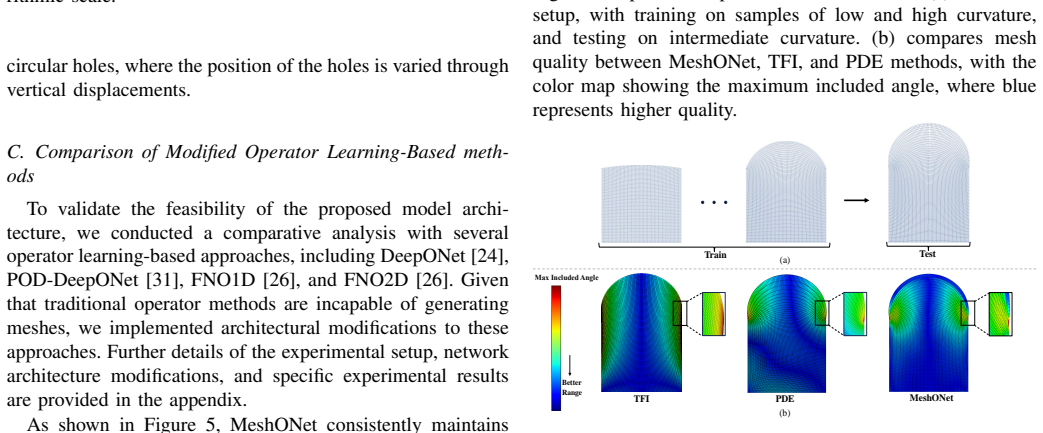
- [Section IV.D-E, Figures 6-15] The central generalization claim rests on visual comparisons of colormaps showing the maximum included angle. No quantitative mesh-quality statistics are reported: there are no aggregate values or distributions of included angles, orthogonality, skewness, or aspect ratio, and no comparison of those statistics between MeshONet, TFI, and PDE methods. Likewise, no standard deviations, confidence intervals, or multiple-seed experiments are reported anywhere in the results. The paper's qualitative statements such as 'our method excels' or 'performs exceptionally well' are therefore not supported by measurable evidence.
- [Section III.B.2, Eqs. (13)-(14)] The loss function notation is inconsistent with the network definition. Equations (13)-(14) write the predictors as Gx(u1, u2) and Gy(u1, u2), whereas Eqs. (10)-(11) define them as Gx(u1) and Gy(u2), and the architecture has no input channel that carries u2 into the x-branch or u1 into the y-branch. This inconsistency needs to be resolved, because it obscures whether the authors intend a truly coupled multi-input operator or two independent single-input operators.
- [Section III.A, Eq. (6) and reference [30]] The universal approximation guarantee from MIONet [30] is invoked for the multi-input operator G(u1,u2), but the proposed architecture is not a MIONet-style multi-input network: it consists of two separate single-input branches, each seeing only one boundary function, that share a trunk. The cited theorem therefore does not justify the approximation in Eq. (6). To use that theorem, the architecture would need to provide each output branch with both boundary inputs, or the authors should explicitly state a different theoretical basis.
minor comments (5)
- [Section I, after Eq. (4)] The sentence 'The operator G takes three inputs: the computational domain coordinates (xi, eta), and two boundary functions u1 and u2' conflicts with the formal definition G(u1,u2)(xi,eta), where (xi,eta) is an evaluation argument rather than a third function input; please clarify the distinction.
- [Section II] There is a grammatical error in 'This methods generate the corresponding mesh...'; it should read 'These methods generate...'.
- [Section IV.F, Table II] The timing results do not state how many repeated runs were performed, whether the timings are wall-clock or solver-only, or what hardware and solver tolerances were used for the PDE baseline; the '-' entries for the PDE method are also undefined in terms of the timeout threshold.
- [Section IV.F, Figure 17] The four datasets shown in Figure 17 are not described in the text; the reader cannot tell which geometry families or boundary-parameter ranges these datasets correspond to.
- [Eq. (2)] The definition beta = x_xi x_eta + y_xi y_eta is written with a comma in the displayed equation; this is a typesetting error and should be corrected to a product.
Circularity Check
No circular derivation: Eq. (5) is an explicit separability ansatz, and the supervised losses (13)-(14) regress against external ground-truth mesh coordinates; cited self-work is not load-bearing.
full rationale
MeshONet's derivation is not circular. The target operator G in Eq. (4) is defined by the mesh-generation problem and, in the supervised losses (13)-(14), the ground-truth coordinates Gx and Gy enter only as external regression labels, not as quantities derived from the network's own fitted parameters. The decoupled decomposition in Eq. (5) and the branch outputs in Eqs. (10)-(11) are an explicit modeling ansatz about the structure of the operator; if that ansatz is inaccurate for the coupled elliptic system (1)-(2), the resulting limitation is a representational or correctness issue, not a circular reduction, because Eq. (5) is an input assumption rather than a consequence of the loss function. The self-citations to MGNet [8], MeshNet [22], and related prior work are contextual related-work references and are not load-bearing for the operator-learning claim, while the cited MIONet theorem [30] is external and used only as motivation for multi-input operator approximation. The limitations paragraph in Section V, noting that parameter size depends on boundary-point count, is an acknowledged limitation of the architecture but does not turn the derivation back into its inputs. Overall, no equation in the paper reduces to its own target by construction, and no fitted parameter is renamed as a prediction. The reported experiments compare against external TFI and PDE baselines, so the central claim remains independently testable even if the decoupling ansatz in Eq. (5) warrants scrutiny.
Assumptions & free parameters
free parameters (3)
- boundary sensor count m =
not stated
- Lift-Layer polynomial degree q =
not stated
- loss weights alpha and beta =
not stated
assumptions (4)
- standard math Universal approximation theorem for continuous multi-input operators (MIONet, ref 30) guarantees a neural network can approximate G to arbitrary precision.
- domain assumption Structured mesh generation is equivalent to solving the elliptic system in Eq. (1)-(2) with boundary data u1 and u2.
- ad hoc to paper The output operator decomposes as G(u1,u2) = (Gx(u1), Gy(u2)) in Eq. (5), so the x-field depends only on the x-boundary and the y-field only on the y-boundary.
- domain assumption Supervised ground-truth meshes Gx and Gy are available for training (Eqs. 13-14).
Cite this review
Pith. "Pith review of MeshONet: A Generalizable and Efficient Operator Learning Method for Structured Mesh Generation." pith.science (2026). https://pith.science/paper/MYQJ2NK7
@misc{pith2026250111937,
  author       = {Pith},
  title        = {Pith review of: MeshONet: A Generalizable and Efficient Operator Learning Method for Structured Mesh Generation},
  year         = {2026},
  howpublished = {\url{https://pith.science/paper/MYQJ2NK7}},
  note         = {Machine review of arXiv:2501.11937}
}
read the original abstract
Mesh generation plays a crucial role in scientific computing. Traditional mesh generation methods, such as TFI and PDE-based methods, often struggle to achieve a balance between efficiency and mesh quality. To address this challenge, physics-informed intelligent learning methods have recently emerged, significantly improving generation efficiency while maintaining high mesh quality. However, physics-informed methods fail to generalize when applied to previously unseen geometries, as even small changes in the boundary shape necessitate burdensome retraining to adapt to new geometric variations. In this paper, we introduce MeshONet, the first generalizable intelligent learning method for structured mesh generation. The method transforms the mesh generation task into an operator learning problem with multiple input and solution functions. To effectively overcome the multivariable mapping restriction of operator learning methods, we propose a dual-branch, shared-trunk architecture to approximate the mapping between function spaces based on input-output pairs. Experimental results show that MeshONet achieves a speedup of up to four orders of magnitude in generation efficiency over traditional methods. It also enables generalization to different geometries without retraining, greatly enhancing the practicality of intelligent methods.
Figures


Figures from the paper (9 more)




Reference graph
Works this paper leans on
-
[30]
MIONet: Learning multiple-input operators via tensor product,
P. Jin, S. Meng, and L. Lu, “MIONet: Learning multiple-input operators via tensor product,” SIAM Journal on Scientific Computing , vol. 44, no. 6, pp. A3490–A3514, 2022
work page 2022
-
[1]
R. Blockley and W. Shyy, Encyclopedia of aerospace engineering . American Institute of Aeronautics and Astronautics, Inc., 2010
work page 2010
- [2]
-
[3]
Petterssen, Introduction to meteorology
S. Petterssen, Introduction to meteorology. Read Books Ltd, 2011
work page 2011
-
[4]
M. E. McCormick, Ocean engineering mechanics: with applications . Cambridge University Press, 2009
work page 2009
-
[5]
W. D. Callister Jr and D. G. Rethwisch, Materials science and engi- neering: an introduction . John wiley & sons, 2020
work page 2020
-
[6]
Transfinite interpolation over implicitly defined sets,
V . L. Rvachev, T. I. Sheiko, V . Shapiro, and I. Tsukanov, “Transfinite interpolation over implicitly defined sets,” Computer aided geometric design, vol. 18, no. 3, pp. 195–220, 2001
work page 2001
-
[7]
I. Babuska, J. E. Flaherty, W. D. Henshaw, J. E. Hopcroft, J. E. Oliger, and T. Tezduyar, Modeling, mesh generation, and adaptive numerical methods for partial differential equations. Springer Science & Business Media, 2012, vol. 75
work page 2012
Show all 31 references
-
[8]
MGNet: a novel differential mesh generation method based on unsupervised neural networks,
X. Chen, T. Li, Q. Wan, X. He, C. Gong, Y . Pang, and J. Liu, “MGNet: a novel differential mesh generation method based on unsupervised neural networks,” Engineering with Computers , vol. 38, no. 5, pp. 4409–4421, 2022
2022
-
[9]
3DMeshNet: A three-dimensional dif- ferential neural network for structured mesh generation,
J. Peng, X. Chen, and J. Liu, “3DMeshNet: A three-dimensional dif- ferential neural network for structured mesh generation,” arXiv preprint arXiv:2407.01560, 2024
2024 arXiv
-
[10]
E. G. Effros and Z.-J. Ruan, Theory of Operator Spaces . American Mathematical Society, 2022, vol. 386
2022
-
[11]
On the applications of algebraic grid generation methods based on transfinite interpolation,
H. L. Nguyen, “On the applications of algebraic grid generation methods based on transfinite interpolation,” Tech. Rep., 1989
1989
-
[12]
Direct numerical simulation: a tool in turbulence research,
P. Moin and K. Mahesh, “Direct numerical simulation: a tool in turbulence research,” Annual review of fluid mechanics , vol. 30, no. 1, pp. 539–578, 1998
1998
-
[13]
J. C. Kaimal and J. J. Finnigan, Atmospheric boundary layer flows: their structure and measurement . Oxford university press, 1994
1994
-
[14]
Automatic mesh generation by the let-it-grow neural network,
S. Alfonzetti, S. Coco, S. Cavalieri, and M. Malgeri, “Automatic mesh generation by the let-it-grow neural network,” IEEE Transactions on Magnetics, vol. 32, no. 3, pp. 1349–1352, 2002
2002
-
[15]
Neural networks based mesh generation method in 2-d,
C ¸ . Ahmet and A. Ahmet, “Neural networks based mesh generation method in 2-d,” in Eurasian Conference on Information and Communi- cation Technology. Springer, 2002, pp. 395–401
2002
-
[16]
A density driven mesh generator guided by a neural network,
D. Lowther and D. Dyck, “A density driven mesh generator guided by a neural network,” IEEE transactions on magnetics , vol. 29, no. 2, pp. 1927–1930, 1993
1927
-
[17]
MeshingNet: A new mesh generation method based on deep learning,
Z. Zhang, Y . Wang, P. K. Jimack, and H. Wang, “MeshingNet: A new mesh generation method based on deep learning,” in International conference on computational science . Springer, 2020, pp. 186–198
2020
-
[18]
How to teach neural networks to mesh: Application on 2-d simplicial contours,
A. Papagiannopoulos, P. Clausen, and F. Avellan, “How to teach neural networks to mesh: Application on 2-d simplicial contours,” Neural Networks, vol. 136, pp. 152–179, 2021
2021
-
[19]
Physics-informed neural networks: A deep learning framework for solving forward and inverse problems involving nonlinear partial differential equations,
M. Raissi, P. Perdikaris, and G. E. Karniadakis, “Physics-informed neural networks: A deep learning framework for solving forward and inverse problems involving nonlinear partial differential equations,” Journal of Computational physics , vol. 378, pp. 686–707, 2019
2019
-
[20]
Physics-informed neural networks for solving forward and inverse problems in complex beam systems,
T. Kapoor, H. Wang, A. N ´u˜nez, and R. Dollevoet, “Physics-informed neural networks for solving forward and inverse problems in complex beam systems,” IEEE Transactions on Neural Networks and Learning Systems, 2023
2023
-
[21]
Physics-informed neural networks with weighted losses by uncertainty evaluation for accurate and stable prediction of manufacturing systems,
J. Hua, Y . Li, C. Liu, P. Wan, and X. Liu, “Physics-informed neural networks with weighted losses by uncertainty evaluation for accurate and stable prediction of manufacturing systems,” IEEE Transactions on Neural Networks and Learning Systems , 2023
2023
-
[22]
Developing a novel structured mesh generation method based on deep neural networks,
X. Chen, J. Liu, Q. Zhang, J. Liu, Q. Wang, L. Deng, and Y . Pang, “Developing a novel structured mesh generation method based on deep neural networks,” Physics of Fluids , vol. 35, no. 9, 2023
2023
-
[23]
An improved structured mesh generation method based on physics-informed neural networks,
X. Chen, J. Liu, J. Yan, Z. Wang, and C. Gong, “An improved structured mesh generation method based on physics-informed neural networks,” arXiv preprint arXiv:2210.09546 , 2022
2022 arXiv
-
[24]
Learning nonlinear operators via deeponet based on the universal approximation theorem of operators,
L. Lu, P. Jin, G. Pang, Z. Zhang, and G. E. Karniadakis, “Learning nonlinear operators via deeponet based on the universal approximation theorem of operators,” Nature machine intelligence , vol. 3, no. 3, pp. 218–229, 2021
2021
-
[25]
Neural operator: Learning maps between function spaces with applications to pdes,
N. Kovachki, Z. Li, B. Liu, K. Azizzadenesheli, K. Bhattacharya, A. Stu- art, and A. Anandkumar, “Neural operator: Learning maps between function spaces with applications to pdes,” Journal of Machine Learning Research, vol. 24, no. 89, pp. 1–97, 2023
2023
-
[26]
Fourier neural operator for parametric partial differential equations,
Z. Li, N. Kovachki, K. Azizzadenesheli, B. Liu, K. Bhattacharya, A. Stuart, and A. Anandkumar, “Fourier neural operator for parametric partial differential equations,” arXiv preprint arXiv:2010.08895 , 2020
2010 arXiv
-
[27]
Wavelet neural operator for solving parametric partial differential equations in computational mechanics problems,
T. Tripura and S. Chakraborty, “Wavelet neural operator for solving parametric partial differential equations in computational mechanics problems,” Computer Methods in Applied Mechanics and Engineering , vol. 404, p. 115783, 2023
2023
-
[28]
Koopman neural operator as a mesh-free solver of non-linear partial differential equations,
W. Xiong, X. Huang, Z. Zhang, R. Deng, P. Sun, and Y . Tian, “Koopman neural operator as a mesh-free solver of non-linear partial differential equations,” Journal of Computational Physics , p. 113194, 2024
2024
-
[29]
LNO: Laplace neural oper- ator for solving differential equations,
Q. Cao, S. Goswami, and G. E. Karniadakis, “LNO: Laplace neural oper- ator for solving differential equations,”arXiv preprint arXiv:2303.10528, 2023
2023 arXiv
-
[31]
A comprehensive and fair comparison of two neural operators (with practical extensions) based on fair data,
L. Lu, X. Meng, S. Cai, Z. Mao, S. Goswami, Z. Zhang, and G. E. Karniadakis, “A comprehensive and fair comparison of two neural operators (with practical extensions) based on fair data,” Computer Methods in Applied Mechanics and Engineering , vol. 393, p. 114778, 2022
2022
Reviewed August 10, 2026 · model on record in the stance chip above.
Discussion (0). Continue with ORCID to comment.