REVIEW 4 major objections 5 minor 43 references
UAV-Assisted Real-Time Disaster Detection Using Optimized Transformer Model
T0 review · 4 major / 5 minor · reviewed 2026-08-10 · deepseek-v4-flash
Pith's one-line read A fine-tuned Swin Transformer quantized with TensorRT post-training quantization detects disasters in aerial images at 3–5x the original speed, with near-original accuracy, on both server GPUs and an NVIDIA Jetson Nano.
desk verdict A useful, plausible deployment benchmark for quantized Swin on UAV images, but the paper oversells its speedups and its new dataset has a real train/test leakage risk. read the letter →
The pith
A machine-rendered reading of the paper's core claim, the machinery that carries it, and where it could break.
The reading
What carries the argument
The central mechanism is post-training quantization with TensorRT, which converts the fine-tuned Swin Transformer's weights, activations, and attention maps from 32-bit floating point to 16-bit or 8-bit precision, then applies layer fusion, kernel auto-tuning, multi-stream execution, and dynamic tensor memory. The Swin Transformer's shifted-window hierarchical attention is the model being compressed, and the quantization must handle non-linear layers like Softmax, GELU, and LayerNorm that earlier CNN-focused methods leave in floating point. TensorRT's precision calibration is what preserves accuracy while cutting latency and memory, and the DisasterEye dataset is what tests the approach on a wider mix of real-world disaster scenes.
What would settle it
Re-split DisasterEye by source video (keeping frames from the same clip in one split) and remove near-duplicate web images using perceptual hashing; if accuracy on that cleaned test set falls by more than a few points from the reported values, the generalization claim is partly an artifact of data leakage.
Extended reading notes
Core claim
Post-training quantization with TensorRT, applied to a fine-tuned Swin Transformer, delivers real-time disaster classification on UAV-class hardware while preserving accuracy close to the original FP32 model. FP16 quantization achieves 336.92 frames per second on an NVIDIA T4 GPU with an F1 score of 0.980 on AIDER and a model size of 58.89 MB (down from 107 MB); INT8 achieves 236.41 FPS, F1 0.977, and 36.76 MB. On a Jetson Nano, the INT8 model reaches 45.22 FPS. The paper argues that this makes a full transformer practical for onboard aerial disaster detection through post-training quantization.
Load-bearing premise
The load-bearing premise is that the DisasterEye test set measures how well the model generalizes to new disaster scenes; because the images come from Google Images and YouTube and are split at the image level without removing near-duplicates or grouping frames from the same video, some of the reported accuracy may come from the model having already seen the same scene during training.
Editorial extensions
If this is right
- A drone can classify disaster scenes onboard at over 200 FPS on a server GPU and over 45 FPS on a Jetson Nano, making round-trip cloud analysis unnecessary for detection.
- INT8 quantization reduces the model from 107 MB to roughly 34 MB, freeing memory for other onboard tasks on small UAV platforms.
- The same TensorRT quantization pipeline is not tied to specific disaster classes, so it can be applied to other transformer backbones for edge classification.
- On datasets with enough samples per class, accuracy stays within about one to two F1 points of the original model, so the speedup does not force a large accuracy tradeoff.
- The DisasterEye dataset provides an eight-class aerial-disaster benchmark that includes conflict and post-earthquake scenes, extending beyond the fire-only focus of earlier benchmarks.
Reading between the lines
- Because DisasterEye is split at the image level without deduplication or grouping by source video, the reported accuracy on that dataset likely overstates generalization to unseen disaster footage.
- The T4 GPU frame rates are not representative of drone hardware; the Jetson Nano numbers are closer to deployment, but the paper does not report power consumption or thermal throttling, which are the next limiting factors.
- The same quantization recipe could be extended from scene classification to object detection or segmentation, which would locate victims or damage rather than only labeling the scene type.
- A fairer comparison with the MobileNet baselines would run all models on the same GPU and input resolution; the current tables mix hardware and frameworks.
Editorial analysis
A structured set of objections, weighed in public.
Referee Report
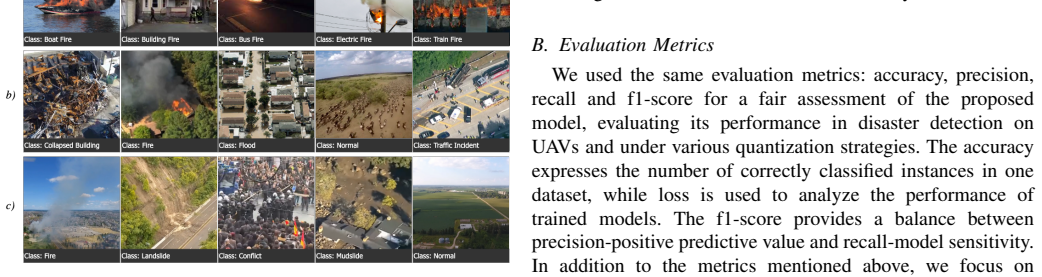
Summary. The paper proposes a UAV-assisted edge framework for real-time disaster image classification. The authors fine-tune a Swin Transformer on three datasets (AIDER, DFAN, and their own DisasterEye), then apply post-training quantization using TensorRT (FP16 and INT8) and compare it with several other quantization methods (MinMax, EMA, OMSE, Percentile, FQ-ViT). They report that TensorRT quantization yields large latency reductions (up to hundreds of FPS on an NVIDIA T4) and smaller model sizes, with only small accuracy drops, and that the INT8 model achieves around 45 FPS on a Jetson Nano. They also introduce a new dataset, DisasterEye, containing 2,751 images in eight classes, and position it as a benchmark for real-world disaster classification.
Significance. If the reported results hold, the paper offers a practical demonstration that transformer-based models can be quantized for real-time onboard UAV inference, and the DisasterEye dataset could be a useful resource for the community. The paper deserves credit for testing on two external benchmarks (AIDER, DFAN) in addition to the new dataset, for comparing several quantization methods, and for releasing the code and dataset. However, the significance is conditional on resolving the data-split leakage risk in DisasterEye and DFAN and on a more rigorous latency-measurement protocol; the current evaluation makes the magnitude and even the direction of some performance comparisons unreliable.
major comments (4)
- [Section IV-A, Figure 3] The DisasterEye dataset is built from Google Images and YouTube and then 'uniformly divided' at the image level into 70/20/10 train/validation/test sets. Since YouTube sources yield correlated frames and near-duplicate web images can appear in both training and testing, this split can leak source content into the test set. The paper itself notes in the same section that DFAN contains duplicate images from video sources, and applies the same splitting strategy to DFAN. This leakage undermines the reported absolute accuracy numbers and, more importantly, the claim of 'almost similar' accuracy after quantization: a quantized model can retain accuracy on memorized near-duplicates while degrading on genuinely novel scenes. The authors should provide a source-grouped or deduplicated split (e.g., grouping frames by video source) and report accuracy, precision, recall, and F1 on such a split for DisasterEye and DFAN.
- [Section IV-D, Table I] The latency and throughput measurements are not adequately specified. The paper does not state the batch size, input resolution after preprocessing, number of repeated runs, warm-up procedure, or whether the reported latencies include I/O and preprocessing. No error bars, standard deviations, or confidence intervals are given, so the numbers in Table I (e.g., 2.97 ms vs. 48.87 ms on AIDER) are presented as exact point estimates from single or unreported runs. The authors should describe the measurement protocol in detail and report mean and standard deviation over multiple trials for both the desktop/T4 and Jetson Nano evaluations.
- [Section IV-G, Table II] The statement that the proposed model 'surpasses all lighter models that contain fewer parameters and smaller model sizes' in terms of FPS is not supported by the table: MobileNet Compressed on Jetson Nano achieves 71 FPS, while the proposed INT8 model on Jetson Nano achieves 45.22 FPS. In addition, the FPS numbers listed in Table II are obtained on different hardware (T4 GPU, Jetson Nano, RTX 3090, etc.), so cross-row comparisons are not valid. The comparison should be restricted to matched hardware or clearly accompanied by a caveat that raw FPS values on different devices are not directly comparable.
- [Section I and Table I] The claimed speedup of '3x to 5x faster than the original' does not match the numbers in Table I. On AIDER, for example, the original latency is 48.87 ms and TensorRT FP16 is 2.97 ms, which is roughly a 16x speedup; similar ratios appear for the other datasets. Either the original latency was measured on different hardware (e.g., RTX 2080 vs. T4), which should be stated explicitly, or the '3x to 5x' claim is inaccurate. Please reconcile the stated speedup with the reported experimental numbers.
minor comments (5)
- [Throughout] There are numerous typographical issues, including 'UA V' and 'UA Vs' spacing in the abstract and introduction, 'TensorTR' instead of 'TensorRT' in Section IV-D, and 'prepossessing' instead of 'preprocessing' in Section IV-C. A careful proofread is needed.
- [Table I] The FQ-ViT row for AIDER reports an accuracy of 0.9839, which is higher than the original model's 0.9825. This is an interesting result that is not discussed; please add a brief explanation of why this particular quantization method can improve accuracy over the full-precision model.
- [Section IV-C] The paper says 'All models are fine-tuned until convergence' but does not report the number of training epochs, batch size, or data augmentation details beyond resizing, cropping, and normalization. Including these training hyperparameters would improve reproducibility.
- [Section III-C] The description of TensorRT states that it uses 'five different optimizations,' including precision calibration, layer fusion, kernel auto-tuning, multi-stream executions, and dynamic tensor memory. The paper does not discuss which of these optimizations is responsible for the observed latency reductions, so it is unclear whether the gains come primarily from reduced precision or from the other TensorRT optimizations. A sentence clarifying this would be helpful.
- [References] Reference [27] (Swin Transformer) is given as an arXiv preprint, but it has been published at ICCV 2021; the published version should be cited for completeness.
Circularity Check
No significant circularity: all central claims are direct empirical measurements on external benchmarks and a self-built dataset; no fitted parameter is renamed as a prediction.
full rationale
The paper's central claims are that a Swin Transformer fine-tuned on disaster images and then quantized with TensorRT runs substantially faster with only a small accuracy drop, and that this holds on both a T4 GPU and a resource-constrained Jetson Nano. These are direct measurements reported in Tables I and II: accuracy, latency, FPS, and model size are measured after post-training quantization, not derived from a fitted parameter. The model is evaluated on two external benchmarks (AIDER and DFAN) as well as the self-built DisasterEye dataset, so the central accuracy claim does not reduce to a fitted value or to a self-citation chain. Evaluating on a self-constructed dataset is standard benchmark practice and is not circular. The main caveat is that DisasterEye was scraped from Google Images and YouTube and split at the image level into 70/20/10 (Section IV-A), which risks train/test leakage from correlated video frames or near-duplicate web images; this is a correctness and generalization concern, not a circularity concern. The paper itself acknowledges a limitation in Section IV-E that class confusion and multi-object scenes remain issues, possibly addressable by more frames or multi-label classification; this is an honest stated weakness, not a circular step. No quantity is equivalent to its input by construction, no prediction is statistically forced, no uniqueness theorem is imported from self-citations, and no ansatz is smuggled in via citation. Therefore the circularity score is 0.
Assumptions & free parameters
assumptions (4)
- domain assumption ImageNet-pretrained Swin Transformer features transfer to UAV disaster imagery.
- domain assumption Web-scraped images from Google Images and YouTube, labeled by the authors, represent real-world disaster scenes without systematic label noise.
- domain assumption TensorRT quantization preserves accuracy sufficiently for operational use.
- domain assumption Image-level random splitting of DisasterEye yields independent training and test sets.
Cite this review
Pith. "Pith review of UAV-Assisted Real-Time Disaster Detection Using Optimized Transformer Model." pith.science (2026). https://pith.science/paper/SAVAN55A
@misc{pith2026250112087,
  author       = {Pith},
  title        = {Pith review of: UAV-Assisted Real-Time Disaster Detection Using Optimized Transformer Model},
  year         = {2026},
  howpublished = {\url{https://pith.science/paper/SAVAN55A}},
  note         = {Machine review of arXiv:2501.12087}
}
read the original abstract
Dangerous surroundings and difficult-to-reach landscapes introduce significant complications for adequate disaster management and recuperation. These problems can be solved by engaging unmanned aerial vehicles (UAVs) provided with embedded platforms and optical sensors. In this work, we focus on enabling onboard aerial image processing to ensure proper and real-time disaster detection. Such a setting usually causes challenges due to the limited hardware resources of UAVs. However, privacy, connectivity, and latency issues can be avoided. We suggest a UAV-assisted edge framework for disaster detection, leveraging our proposed model optimized for onboard real-time aerial image classification. The optimization of the model is achieved using post-training quantization techniques. To address the limited number of disaster cases in existing benchmark datasets and therefore ensure real-world adoption of our model, we construct a novel dataset, DisasterEye, featuring disaster scenes captured by UAVs and individuals on-site. Experimental results reveal the efficacy of our model, reaching high accuracy with lowered inference latency and memory use on both traditional machines and resource-limited devices. This shows that the scalability and adaptability of our method make it a powerful solution for real-time disaster management on resource-constrained UAV platforms.
Figures


Figures from the paper (1 more)

Reference graph
Works this paper leans on
-
[1]
P. Bhadra, A. Balabantaray, and A. K. Pasayat, ”MFEMANet: an effective disaster image classification approach for practical risk assessment,” Ma- chine Vision and Applications, vol. 34, p. 76, 2023. DOI: 10.1007/s00138- 023-01430-1
doi:10.1007/s00138- 2023
-
[2]
O. M. Mogaka, R. Zewail, K. Inoue, and M. S. Sayed, ”TinyEmer- gencyNet: a hardware-friendly ultra-lightweight deep learning model for aerial scene image classification,”Journal of Real-Time Image Processing, vol. 21, p. 51, 2024. DOI: 10.1007/s11554-024-01430-y
-
[3]
H. Yar, X. Xu, J. Zhang, Z. Li, ”An effective attention-based CNN model for fire detection in adverse weather conditions,” ISPRS Journal of Photogrammetry and Remote Sensing , vol. 206, pp. 335–346, 2023. DOI: 10.1016/j.isprsjprs.2023.06.005
-
[4]
H. Yar, Z. A. Khan, I. Rida, W. Ullah, M. J. Kim, and S. W. Baik, ”An efficient deep learning architecture for effective fire detection in smart surveillance,” Image Vision Comput. , vol. 145, no. C, pp. 104989, May 2024, doi: 10.1016/j.imavis.2024.104989
arXiv 2024
-
[5]
T. Khan, Z. A. Khan, and C. Choi, ”Enhancing real-time fire detection: an effective multi-attention network and a fire benchmark,” Neural Computing and Applications , 2023. doi: https://doi.org/10.1007/s00521- 023-09298-y
doi:10.1007/s00521- 2023
-
[6]
Available at: https: //eol.jsc.nasa.gov/ESRS/Disasters/ShowIDCTracking.pl (Accessed: Aug
International Disaster Charter Activations by NASA . Available at: https: //eol.jsc.nasa.gov/ESRS/Disasters/ShowIDCTracking.pl (Accessed: Aug. 26, 2024)
work page 2024
-
[7]
Available at: https://forest-fire.emergency
EFFIS - Statistics Portal . Available at: https://forest-fire.emergency. copernicus.eu/apps/effis.statistics/estimates (Accessed: Aug. 26, 2024)
work page 2024
-
[8]
Ijaz, H., Qureshi, W. S., Khokhar, M. I. and Iqbal, M. (2023) ’A UA V-assisted edge framework for real-time disaster management,’ IEEE Transactions on Geoscience and Remote Sensing , 61, pp. 1–13. doi: 10.1109/TGRS.2023.3306151
arXiv 2023
Show all 43 references
-
[9]
and Theocharides, T
Kyrkou, C. and Theocharides, T. (2020) ’EmergencyNet: Efficient aerial image classification for drone-based emergency monitoring using atrous convolutional feature fusion,’ IEEE Journal of Selected Topics in Ap- plied Earth Observations and Remote Sensing , 13, pp. 1687–1699. ...
2020
-
[10]
(2020) ’AIDER (Aerial Image Dataset for Emergency Response Applications),’ Zenodo
Kyrkou, C. (2020) ’AIDER (Aerial Image Dataset for Emergency Response Applications),’ Zenodo. doi: 10.5281/zenodo.3888300
2020 doi
-
[11]
Y . Li, R. Chen, Y . Zhang, and H. Li, ”A CNN-GCN framework for multi-label aerial image scene classification,” in Proc. IEEE Int. Geosci. Remote Sens. Symp. (IGARSS) , Sep. 2020, pp. 1353–1356
2020
-
[12]
Rahnemoonfar, T
M. Rahnemoonfar, T. Chowdhury, A. Sarkar, D. Varshney, M. Yari, and R. R. Murphy, ”FloodNet: A high-resolution aerial imagery dataset for post-flood scene understanding,” IEEE Access, vol. 9, pp. 89644–89654, 2021
2021
-
[13]
Khose, A
S. Khose, A. Tiwari, and A. Ghosh, ”Semi-supervised classification and segmentation on high-resolution aerial images,” 2021, arXiv:2105.08655
2021 arXiv
-
[14]
Xiang, L
H. Xiang, L. Chen, and W. Xu, ”DRFNet: A lightweight and high accuracy network for resource-limited implementation,” in Proc. IEEE 12th Int. Conf. ASIC (ASICON) , Oct. 2017, pp. 1086–1089
2017
-
[15]
B. C. Ko, K.-H. Cheong, and J.-Y . Nam, ”Fire detection based on vision sensor and support vector machines,” Fire Saf. J. , vol. 44, no. 3, pp. 322–329, Apr. 2009. Available: https://www.sciencedirect.com/science/ article/pii/S0379711208000957
2009
-
[16]
S. Kim, W. Lee, Y .-S. Park, H.-W. Lee, and Y .-T. Lee, ”Forest fire monitoring system based on aerial image,” in Proc. 3rd Int. Conf. Inf. Commun. Technol. Disaster Manage. (ICT-DM) , Dec. 2016, pp. 1–6
2016
-
[17]
Sharma, O.-C
J. Sharma, O.-C. Granmo, M. Goodwin, and J. T. Fidje, ”Deep con- volutional neural networks for fire detection in images,” in Engineering Applications of Neural Networks , G. Boracchi, L. Iliadis, C. Jayne, and A. Likas, Eds. Cham, Switzerland: Springer, 2017, pp. 183–193
2017
-
[18]
Presa-Reyes, Y
M. Presa-Reyes, Y . Tao, S.-C. Chen, and M.-L. Shyu, ”Deep learning with weak supervision for disaster scene description in low-altitude imagery,” IEEE Trans. Geosci. Remote Sens. , vol. 60, 2022, Art. no. 4704510
2022
-
[19]
Y . Zhao, J. Ma, X. Li, and J. Zhang, ”Saliency detection and deep learning-based wildfire identification in UA V imagery,” Sensors, vol. 18, no. 3, p. 712, Feb. 2018
2018
-
[20]
Jadon, M
A. Jadon, M. Omama, A. Varshney, M. S. Ansari, and R. Sharma, ”FireNet: A specialized lightweight fire & smoke detection model for real-time IoT applications,” 2019, arXiv:1905.11922
2019 arXiv
-
[21]
Shoukry, F
N. Shoukry, F. Ehab, and M. A. Salem, ”An improved deep learning model for early fire and smoke detection on edge vision unit,” in Proc. 10th Int. Conf. Intell. Comput. Inf. Syst. (ICICIS) , Dec. 2021, pp. 66–73
2021
-
[22]
Vaswani, N
A. Vaswani, N. Shazeer, N. Parmar, J. Uszkoreit, L. Jones, A. N. Gomez, Ł. Kaiser, and I. Polosukhin, ”Attention is all you need,” in Advances in Neural Information Processing Systems (NeurIPS), 2017, pp. 5998–6008
2017
-
[23]
Dosovitskiy, L
A. Dosovitskiy, L. Beyer, A. Kolesnikov, D. Weissenborn, X. Zhai, T. Unterthiner, M. Dehghani, M. Minderer, G. Heigold, S. Gelly, et al., ”An image is worth 16x16 words: Transformers for image recognition at scale,” in Proc. Int. Conf. Learning Representations (ICLR) , 2020
2020
-
[24]
Touvron, M
H. Touvron, M. Cord, M. Douze, F. Massa, A. Sablayrolles, and H. J´egou, ”Training data-efficient image transformers & distillation through attention,” in Proc. Int. Conf. Machine Learning (ICML) , PMLR, 2021
2021
-
[25]
Carion, F
N. Carion, F. Massa, G. Synnaeve, N. Usunier, A. Kirillov, and S. Zagoruyko, ”End-to-end object detection with transformers,” in Proc. Eur. Conf. Computer Vision (ECCV) , Springer, 2020
2020
-
[26]
Zheng, J
S. Zheng, J. Lu, H. Zhao, X. Zhu, Z. Luo, Y . Wang, Y . Fu, J. Feng, T. Xiang, and P. H. S. Torr, ”Rethinking semantic segmentation from a sequence-to-sequence perspective with transformers,” in Proc. IEEE/CVF Conf. Computer Vision and Pattern Recognition (CVPR) , 2021
2021
-
[27]
Z. Liu, Y . Lin, Y . Cao, H. Hu, Y . Wei, Z. Zhang, S. Lin, and B. Guo, ”Swin transformer: Hierarchical vision transformer using shifted windows,” arXiv preprint arXiv:2103.14030 , 2021
2021 arXiv
-
[28]
Y . Lin, T. Zhang, P. Sun, Z. Li, and S. Zhou, ”FQ-ViT: Post-Training Quantization for Fully Quantized Vision Transformer,” arXiv preprint arXiv:2111.13824, 2023. Available: https://arxiv.org/abs/2111.13824
2023 arXiv
-
[29]
Li and Q
Z. Li and Q. Gu, ”I-ViT: Integer-only Quantization for Efficient Vision Transformer Inference,” arXiv preprint arXiv:2207.01405 , 2023. Avail- able: https://arxiv.org/abs/2207.01405
2023 arXiv
-
[30]
NVIDIA, FasterTransformer, NVIDIA Corporation, 2022
2022
-
[31]
Z. Liu, Y . Wang, K. Han, W. Zhang, S. Ma, and W. Gao, ”Post-training quantization for vision transformer,” in Advances in Neural Information Processing Systems, vol. 34, 2021
2021
-
[32]
Z. Yuan, C. Xue, Y . Chen, Q. Wu, and G. Sun, ”PTQ4ViT: Post- training quantization framework for vision transformers,” arXiv preprint arXiv:2111.12293, 2021. Available: https://arxiv.org/abs/2111.12293
2021 arXiv
-
[33]
Z. Li, M. Chen, J. Xiao, and Q. Gu, ”PSAQ-ViT v2: Towards accurate and general data-free quantization for vision transformers,” arXiv preprint arXiv:2209.05687, 2022. Available: https://arxiv.org/abs/2209.05687
2022 arXiv
-
[34]
Z. Li, L. Ma, M. Chen, J. Xiao, and Q. Gu, ”Patch similarity aware data-free quantization for vision transformers,” in European Conference on Computer Vision (ECCV) , pp. 154–170, 2022
2022
-
[35]
Z. Li, J. Xiao, L. Yang, and Q. Gu, ”RepQ-ViT: Scale reparameterization for post-training quantization of vision transformers,” arXiv preprint arXiv:2212.08254, 2022. Available: https://arxiv.org/abs/2212.08254
2022 arXiv
-
[37]
S. Kim, A. Gholami, Z. Yao, M. W. Mahoney, and K. Keutzer, ”I-BERT: Integer-only BERT quantization,” in Proc. Int. Conf. Machine Learning (ICML), PMLR, 2021, pp. 5506–5518
2021
-
[38]
A., Gupta, S
Yar, H., Hussain, T., Agarwal, M., Khan, Z. A., Gupta, S. K., and Baik, S. W. (2022), ”Optimized Dual Fire Attention Network and Medium- Scale Fire Classification Benchmark,” IEEE Transactions on Image Pro- cessing, 31, pp. 6331–6343
2022
-
[39]
Jacob, B., Kligys, S., Chen, B., Zhu, M., Tang, M., Howard, A., Adam, H., and Kalenichenko, D. (2018) ’Quantization and training of neural networks for efficient integer-arithmetic-only inference,’ Proceedings o the IEEE Conference on Computer Vision and Pattern Recognition , ...
2018
-
[40]
(2019) ’Fully quantized network for object detection,’ Proceedings of the IEEE/CVF Conference on Computer Vision and Pattern Recognition, pp
Li, R., Wang, Y ., Liang, F., Qin, H., Yan, J., and Fan, R. (2019) ’Fully quantized network for object detection,’ Proceedings of the IEEE/CVF Conference on Computer Vision and Pattern Recognition, pp. 4270–4279
2019
-
[41]
(2019) ’Low- bit quantization of neural networks for efficient inference’, IEEE/CVF International Conference on Computer Vision Workshops
Choukroun, Y ., Kravchik, E., Yang, F., and Kisilev, P. (2019) ’Low- bit quantization of neural networks for efficient inference’, IEEE/CVF International Conference on Computer Vision Workshops . IEEE
2019
-
[42]
[Online]
NVIDIA Corporation, ”NVIDIA Developer,” NVIDIA Developer, 2024. [Online]. Available: https://developer.nvidia.com/. [Accessed: Oct. 29, 2024]
2024
-
[43]
V . Sze, Y . H. Chen, T. J. Yang, and J. S. Emer, ”Efficient Pro- cessing of Deep Neural Networks: A Tutorial and Survey,” Pro- ceedings of the IEEE , vol. 105, no. 12, pp. 2295-2329, 2017. doi: 10.1109/JPROC.2017.2761740
2017
-
[2022]
Available: https://arxiv.org/abs/2201.07703
Reviewed August 10, 2026 · model on record in the stance chip above.
Discussion (0). Continue with ORCID to comment.