REVIEW 3 major objections 5 minor 1 cited by
Quantum-Inspired Solver for Simulating Material Deformations
T0 review · 3 major / 5 minor · reviewed 2026-08-10 · deepseek-v4-flash
Pith's one-line read This paper claims that a tensor-network finite-element solver can handle 2D linear elasticity problems with billions of degrees of freedom while memory and runtime grow only logarithmically in the grid size.
desk verdict A clean QTT-FEM application to 2D linear elasticity with honest comparisons, but the exponential-savings claim rests on unverified ranks and the novelty is undercut by a concurrent preprint. read the letter →
The pith
A machine-rendered reading of the paper's core claim, the machinery that carries it, and where it could break.
The reading
What carries the argument
The central object is the quantics tensor train (QTT), a chain of small tensors that encodes a vector of length $2^d$ or a $2^d \times 2^d$ matrix in $O(r^2 d)$ storage, where $r$ is the largest bond dimension (rank). The argument is carried by three tensorized components: mesh-grid TTs $\mathbf{X}$, $\mathbf{Y}$ of rank 2 that make every element Jacobian an affine-linear TT; a TT-cross step that approximates the inverse determinant $(\det \mathbf{J})^{-1}$; and the $\mathrm{AMEn}$ iterative solver, which finds $\mathbf{u}$ from $\mathbf{A}\mathbf{u} = \mathbf{f}$ without forming the full matrix. All costs are therefore linear in $d$ and polynomial in the ranks, not linear in $N$.
What would settle it
Run the cantilever-beam benchmark for increasing $d$ (for example $d=5$ through $d=12$), record the largest TT bond dimension and the wall-clock time and memory for $\mathbf{A}$, $\mathbf{f}$, and $\mathbf{u}$, and compare the slopes against $d$; any rank growing like a power of $d$, or any runtime growing faster than logarithmic in $N=4^d$, would falsify the exponential-savings claim.
Extended reading notes
Core claim
The central claim is that a finite-element solver for 2D linear elasticity can be assembled and solved entirely in tensor-train format, and that the data compression is so strong that storage and time grow only logarithmically with the number of degrees of freedom. On a plane-stress aluminum cantilever beam, the paper reports solutions matching a classical reference FEM solver and the analytic maximum deflection, while $N = 4^d$ degrees of freedom are handled with memory and solve times that scale with $d$ rather than $N$. The conclusion the authors draw is an exponential reduction in both memory usage and computational time compared with classical FEM.
Load-bearing premise
The logarithmic-scaling claim depends entirely on the tensor-train ranks of the stiffness operator, the force vector, and the solution staying small as the grid grows; the paper relies on this assumption without proving it or reporting the rank values.
Editorial extensions
If this is right
- The reported scaling means that a $4^d$-point elasticity mesh, with $2\cdot 4^d$ degrees of freedom, can be stored and solved with memory that stays essentially flat as $d$ grows, where classical FEM would need memory linear in $N$.
- The displacement and energy outputs agree with the classical reference solver and with the analytic maximum-deflection formula, so the compressed representation is not just a compact object but a faithful solution.
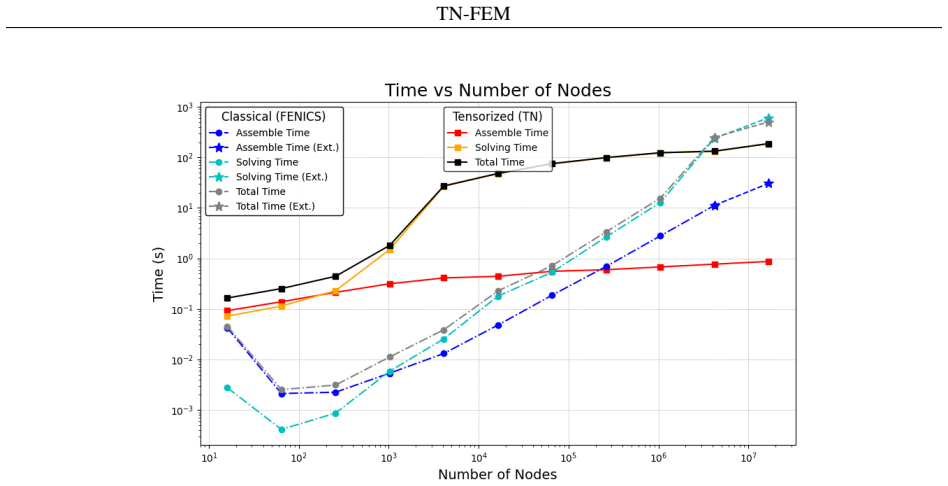
- Total time to solution crosses the classical solver around $10^6$–$10^7$ degrees of freedom, and beyond that point the advantage grows without bound under the stated scaling.
- The same assembly logic extends to 3D, more complex domains, and non-homogeneous or non-isotropic materials, with the clear caveat that the achievable compression then depends on the ranks introduced by the material tensor.
Reading between the lines
- The paper's strongest untested premise is rank stability; a natural extension is to instrument the solver to output the bond dimensions of $\mathbf{A}$, $\mathbf{f}$, and $\mathbf{u}$ at each $d$, since the entire exponential claim reduces to this measurement.
- For engineering practice, the relevant next test is not another 2D isotropic beam but a problem with a material interface or a non-Cartesian mesh, where the affine Jacobian trick no longer holds and rank growth determines whether the advantage survives.
- If rank growth stays benign, the same tensorized assembly could be applied to other elliptic boundary-value problems with tensor-product grids, such as thermoelasticity or structural vibration, giving a general low-rank substitution for sparse matrix assembly.
Signed reviews
Editorial analysis
A structured set of objections, weighed in public.
Referee Report
Summary. The manuscript develops a tensor-network finite-element (TN-FEM) solver for two-dimensional linear elasticity. The stiffness and mass operators and the load vector are assembled directly in quantics tensor-train (QTT) format, the inverse Jacobian determinant is approximated with TT-cross, and the resulting linear system is solved with the AMEn algorithm. The solver is demonstrated on a two-dimensional cantilever beam under gravity, with results compared against FEniCS and against an analytical formula for the maximum deflection. The authors report logarithmic memory and runtime scaling with the number of degrees of freedom and claim that the method solves linear elasticity problems with billions of degrees of freedom and achieves exponential reductions in memory and time.
Significance. If the central claim is correct, this is a practically relevant step toward quantum-inspired solvers for continuum mechanics and would complement the existing QTT-based Poisson and Navier--Stokes solvers. The validation is appropriately non-circular: the solver is checked against an independent analytical beam-deflection formula and against a classical FEM package, and the paper clearly explains the assembly procedure and the algorithm. The main limitation is that the claimed exponential advantage rests on an unverified rank-boundedness assumption. The paper does not report tensor-train ranks, truncation tolerances, AMEn stopping criteria, or the largest problem size actually solved, so the abstract's 'billions of degrees of freedom' and the conclusion's 'exponential advantages' are stronger than the evidence presented. Because the missing measurements are straightforward to supply, the central idea is defensible and the manuscript merits a major revision rather than rejection.
major comments (3)
- [Section 4; Section 6, Figs. 6-7] Section 4 states that the storage cost is O(r^2 d) = O(r^2 log N) 'assuming the ranks r remain small', and Section 6 reports only memory and time scaling without reporting the TT ranks of A, M, f, and u. The exponential-savings claim in the Abstract and Section 7 is therefore conditional on an unmeasured rank-boundedness. If the ranks grow with the grid exponent d, the observed logarithmic scaling in Figures 6 and 7 could be an artifact of the implemented truncation tolerances and of the limited range of d tested. Please report TT ranks of A, M, f, and u as functions of d, the TT-cross and AMEn tolerances, the maximum bond dimensions allowed, and the largest d actually solved; in addition, state explicitly whether any run reached or exceeded 10^9 degrees of freedom.
- [Section 5.1; Section 6] Section 5.1 introduces TT-cross as an efficient approximation of (det J)^{-1} for general quadrilateral meshes, but the only numerical demonstration is a rectangular cantilever beam for which det J is constant and its inverse is exactly representable with low rank. This sidesteps the potentially rank-increasing step that the method would need for genuinely non-rectangular quadrilaterals. To support the 'any quadrilateral' statement in Section 5 and the generality implied by the conclusions, the authors should test a non-rectangular or distorted quadrilateral mesh and report the TT-cross approximation error and the ranks of (det J)^{-1} as d increases.
- [Algorithm 2; Section 6] The accuracy of the AMEn solve is not quantified: no residuals, stopping tolerance, or maximum rank are reported, and the numerical validation in Section 6 rests mainly on one scalar quantity, the maximum displacement, plus visual comparison in Figures 4 and 8. Please report the AMEn stopping criterion and residual, the relative error in the displacement field and in the energy for each d, and the resulting rank of the solution TT; without this, the reader cannot judge whether the observed agreement persists at the largest d or only for the plotted cases.
minor comments (5)
- [Section 5.3; Algorithm 1] The heading 'Force V ector' contains a typo, and Algorithm 1's line 7 writes 'stiffnes' instead of 'stiffness'.
- [Results, figures] Figure 8 is referenced and displayed before Figures 4-7 in the current layout; please reorder the figures and their references so that the presentation is sequential.
- [Section 6] The statement 'For this plot, we used 48 grid points' is unclear because 48 is not a power of 4; please specify the grid exponent d and the implied number of grid points and degrees of freedom.
- [Figures 5 and 7] The captions of Figures 5 and 7 should define the error metric (which norm or which scalar), the legend entries, and how the three timing quantities in Figure 7 are measured, since 'the exact values are less informative' is not a substitute for this information.
- [Section 6] The break-even statement of 10^6 to 10^7 degrees of freedom for total time should be accompanied by the concrete AMEn and TT-cross settings used, because the runtime is sensitive to tolerances and maximum ranks.
Circularity Check
No circularity: the TN-FEM derivation is benchmarked against an external analytic formula and FEniCS, and its algorithmic ingredients come from non-overlapping prior work.
full rationale
I walked the claimed derivation chain and found no step where a prediction reduces by construction to an input. The central mechanism is the QTT complexity formula O(r^2 d) = O(r^2 log N), which is a definitional fact about tensor trains rather than a fitted result; the paper's genuine claim is that this low-rank structure persists for the elasticity stiffness operator, force vector, and solution. That claim is checked against two independent external references: the analytic cantilever deflection formula in Eq. (10) and the classical FEniCS solver. No constant is fitted from these comparisons, and no closely related quantity is predicted from a fitted subset. The only self-citation is Orus [2014], a general tutorial review of tensor networks, which is not load-bearing. The method's prior-art ingredients (Markeeva et al., Bachmayr and Kazeev, Dolgov and Savostyanov, Oseledets, Oseledets and Tyrtyshnikov) have no author overlap with the present paper, and the similar concurrent preprint by Benvenuti et al. is acknowledged. The weakest point is that TT ranks and TT-cross approximation errors are never reported, so the 'billions of degrees of freedom' and exponential-scaling claims rest on an unverified rank-boundedness assumption; however, that is a correctness and evidence concern, not a circularity. The paper does not use any target result as an input, and its validation is external, so the circularity score is 0.
Assumptions & free parameters
free parameters (3)
- TT-cross rank truncation tolerance
- AMEn solver tolerance and maximum rank
- Maximum bond dimension allowed during assembly
assumptions (6)
- domain assumption Linear elasticity constitutive equations (Eq. 2) with homogeneous isotropic material
- domain assumption Affine dependence of Jacobians on element indices (Eq. 8)
- ad hoc to paper TT ranks of A, f, and u remain small as N grows
- ad hoc to paper TT-cross approximation of (det J)^{-1} is sufficiently accurate
- ad hoc to paper AMEn solver converges for the assembled elasticity operator
- standard math Analytical cantilever deflection formula (Eq. 10)
Cite this review
Pith. "Pith review of Quantum-Inspired Solver for Simulating Material Deformations." pith.science (2026). https://pith.science/paper/XUHINLE4
@misc{pith2026250112151,
  author       = {Pith},
  title        = {Pith review of: Quantum-Inspired Solver for Simulating Material Deformations},
  year         = {2026},
  howpublished = {\url{https://pith.science/paper/XUHINLE4}},
  note         = {Machine review of arXiv:2501.12151}
}
read the original abstract
This paper explores the application of tensor networks (TNs) to the simulation of material deformations within the framework of linear elasticity. Material simulations are essential computational tools extensively used in both academic research and industrial applications. TNs, originally developed in quantum mechanics, have recently shown promise in solving partial differential equations (PDEs) due to their potential for exponential speedups over classical algorithms. Our study successfully employs TNs to solve linear elasticity equations with billions of degrees of freedom, achieving exponential reductions in both memory usage and computational time. These results demonstrate the practical viability of TNs as a powerful classical backend for executing quantum-inspired algorithms with significant efficiency gains. This work is based on our research conducted with IKERLAN.
Figures


Figures from the paper (5 more)


Forward citations
Cited by 1 Pith paper
-
Efficient upsampling for tensor-network and quantum-state encoded functions
Tensor-Train Interpolation (TTI) refines a coarse QTT to arbitrary resolution by appending constant-rank polynomial-kernel cores, with error controlled by the coarse grid spacing.
Reference graph
Works this paper leans on
-
[1]
Finite Elements: Theory, Fast Solvers, and Applications in Solid Mechanics
Dietrich Braess. Finite Elements: Theory, Fast Solvers, and Applications in Solid Mechanics. Cambridge University Press, 3 edition, 2007
work page 2007
-
[2]
Low-rank tensor methods for partial differential equations
Markus Bachmayr. Low-rank tensor methods for partial differential equations. Acta Numerica, 32: 0 1–121, 2023. doi:10.1017/S0962492922000125
-
[3]
Román Orús. A practical introduction to tensor networks: Matrix product states and projected entangled pair states. Annals of Physics, 349: 0 117--158, 2014. ISSN 0003-4916. doi:https://doi.org/10.1016/j.aop.2014.06.013. URL https://www.sciencedirect.com/science/article/pii/S0003491614001596
-
[4]
Tensor networks in a nutshell, 2017
Jacob Biamonte and Ville Bergholm. Tensor networks in a nutshell, 2017. URL https://arxiv.org/abs/1708.00006
arXiv 2017
-
[5]
L. Markeeva, I. Tsybulin, and I. Oseledets. Qtt-isogeometric solver in two dimensions. Journal of Computational Physics, 424: 0 109835, 2021. ISSN 0021-9991. doi:https://doi.org/10.1016/j.jcp.2020.109835. URL https://www.sciencedirect.com/science/article/pii/S0021999120306094
arXiv 2021
-
[6]
Markus Bachmayr and Vladimir Kazeev. Stability of low-rank tensor representations and structured multilevel preconditioning for elliptic pdes. Foundations of Computational Mathematics, 20 0 (5): 0 1175--1236, Oct 2020. ISSN 1615-3383. doi:10.1007/s10208-020-09446-z. URL https://doi.org/10.1007/s10208-020-09446-z
-
[7]
Egor Kornev, Sergey Dolgov, Karan Pinto, Markus Pflitsch, Michael Perelshtein, and Artem Melnikov. Numerical solution of the incompressible navier-stokes equations for chemical mixers via quantum-inspired tensor train finite element method, 2023. URL https://arxiv.org/abs/2305.10784
arXiv 2023
-
[8]
Egor Kornev, Sergey Dolgov, Michael Perelshtein, and Artem Melnikov. Tetrafem: Numerical solution of partial differential equations using tensor train finite element method. Mathematics, 12 0 (20), 2024. ISSN 2227-7390. doi:10.3390/math12203277. URL https://www.mdpi.com/2227-7390/12/20/3277
Show all 13 references
-
[9]
A low-rank qtt-based finite element method for elasticity problems, 2025
Elena Benvenuti, Gianmarco Manzini, Marco Nale, and Simone Pizzolato. A low-rank qtt-based finite element method for elasticity problems, 2025. URL https://arxiv.org/abs/2501.07778
2025 arXiv
-
[10]
I. V. Oseledets. Tensor-train decomposition. SIAM Journal on Scientific Computing, 33 0 (5): 0 2295--2317, 2011. doi:10.1137/090752286. URL https://doi.org/10.1137/090752286
2011 doi
-
[11]
I. V. Oseledets. Approximation of 2^d 2^d matrices using tensor decomposition. SIAM Journal on Matrix Analysis and Applications, 31 0 (4): 0 2130--2145, 2010. doi:10.1137/090757861. URL https://doi.org/10.1137/090757861
2010 doi
-
[12]
Tt-cross approximation for multidimensional arrays
Ivan Oseledets and Eugene Tyrtyshnikov. Tt-cross approximation for multidimensional arrays. Linear Algebra and its Applications, 432 0 (1): 0 70--88, 2010. ISSN 0024-3795. doi:https://doi.org/10.1016/j.laa.2009.07.024. URL https://www.sciencedirect.com/science/article/pii/S002...
2010 doi
-
[13]
Dolgov and Dmitry V
Sergey V. Dolgov and Dmitry V. Savostyanov. Alternating minimal energy methods for linear systems in higher dimensions. SIAM Journal on Scientific Computing, 36 0 (5): 0 A2248--A2271, 2014. doi:10.1137/140953289. URL https://doi.org/10.1137/140953289
2014 doi
Reviewed August 10, 2026 · model on record in the stance chip above.
Discussion (0). Continue with ORCID to comment.